Reliance Jio Brand Psychology Audit: 26 Hidden Principles Behind India’s $22 Billion Telecom Revolution
An Industrial Psychologist decodes the 26 psychology principles embedded in Jio's brand architecture — from the Zero Price Effect launch that gave 480 million Indians free internet, to the ecosystem lock-in, IPL conditioning, and Ambani dynasty trust. Includes UX teardown, 6 critical failures, and strategic recommendations. Overall Score: 7.1/10.

71 / 100
Overall consumer behavior effectiveness
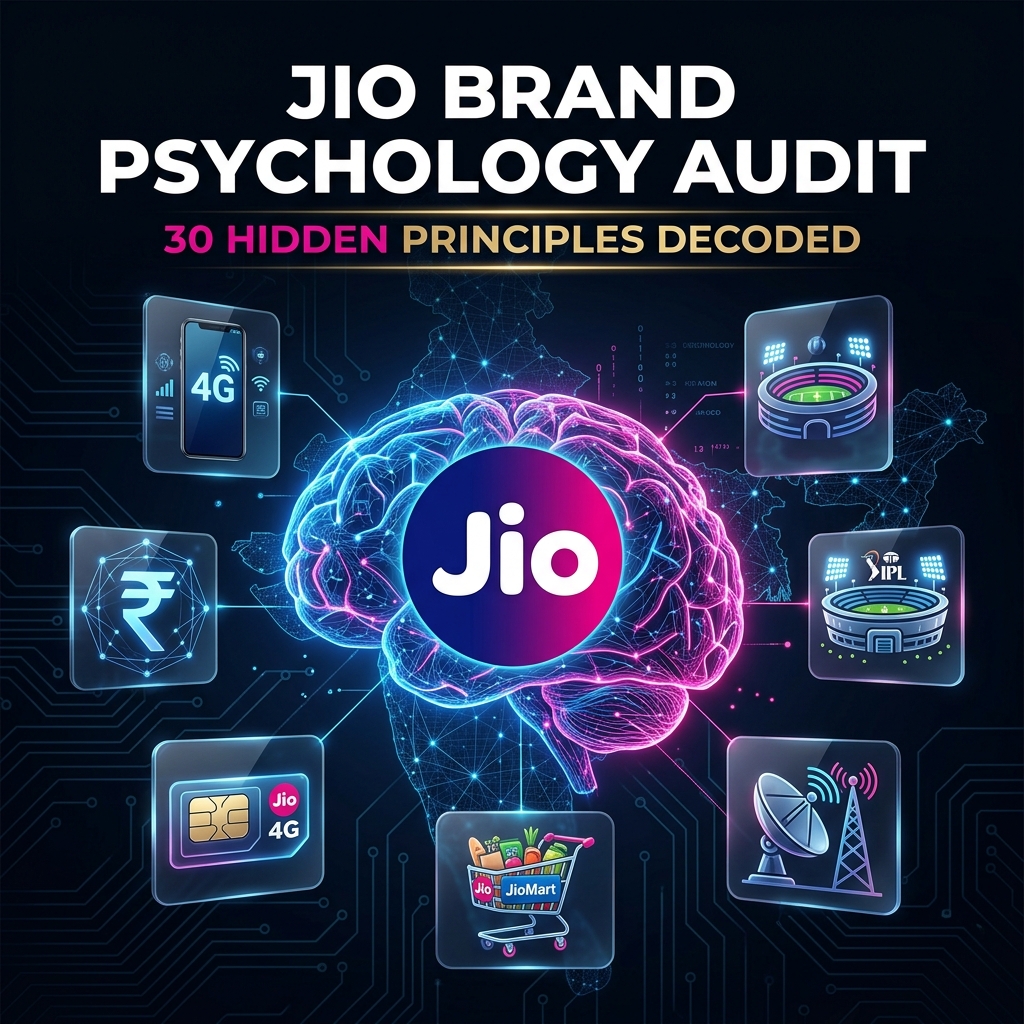
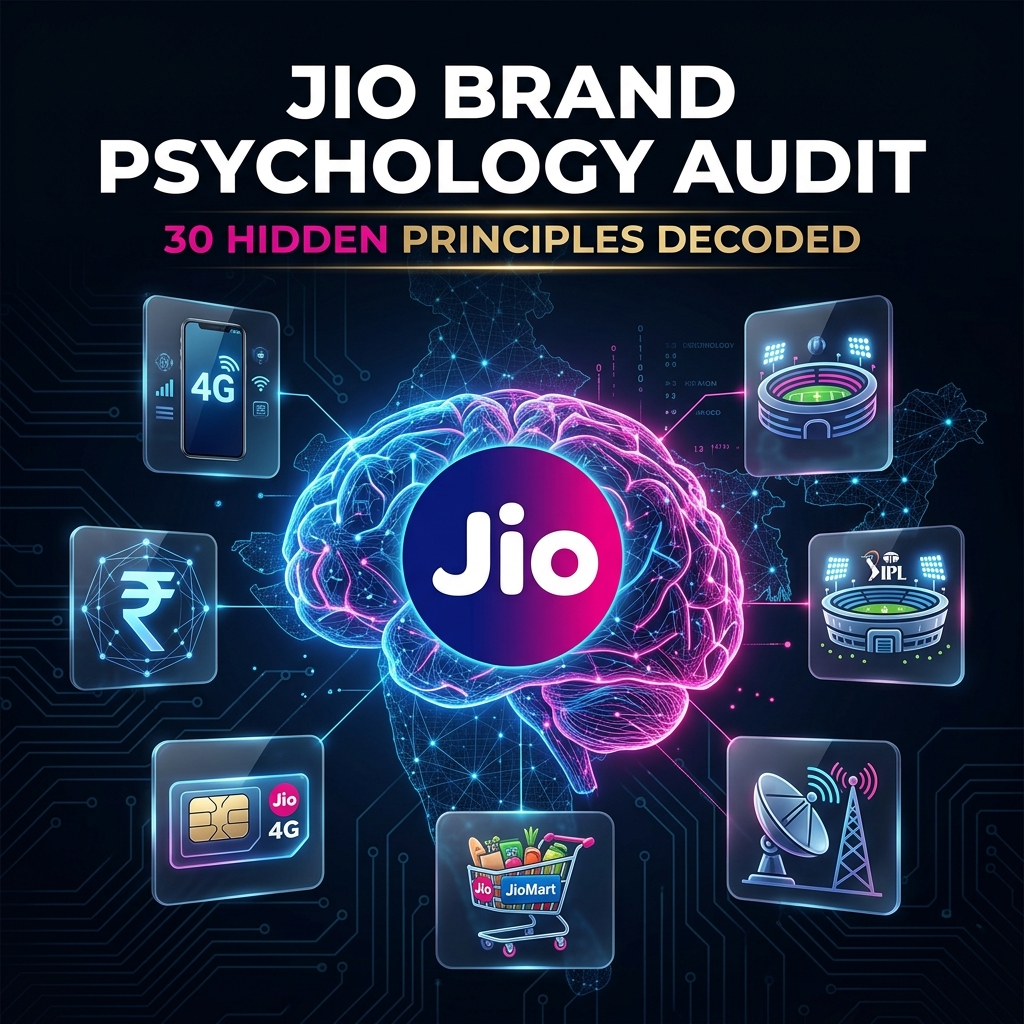
Brand Overview
- Brand nameReliance Jio
- Founded2016
- HeadquartersMumbai, Maharashtra, India
- IndustryTechnology
- Websitewww.jio.com ↗
Psychology Techniques Identified
- 01Zero Price Effect
- 02Loss Aversion Lock-in
- 03Endowment Effect
- 04Reciprocity Principle
- 05Reference Point Dependence
- 06Default Effect
- 07Social Identity Theory
- 08Nationalism Bias
- 09Charismatic Authority
- 10Price Anchoring
- 11Bandwagon Effect
- 12Dynastic Trust Transfer
- 13Ecosystem Lock-in
- 14Pavlovian Classical Conditioning
- 15Cognitive Ease Transfer
- 16Mere Exposure Effect
- 17Variable Ratio Reinforcement
- 18Peak-End Rule
- 19Celebrity Authority Transfer
- 20Aspirational Reference Group Psychology
- 21Narrative Transportation Theory
- 22Information Gap Theory
- 23Scarcity Perception
- 24Ad Reactance
- 25Context-Dependent Convenience
- 26Collective Switching Cost Psychology
Full Psychology Audit Report
In this audit
Introduction: How One Man’s Obsession Gave 1.4 Billion People the Internet — And Rewired India’s Psychology Forever
On September 5, 2016, Mukesh Ambani did something no CEO in human history had ever attempted — he gave away the most expensive product in India’s telecom market completely free. Not a trial. Not a limited offer. Free 4G data, free voice calls, free SMS — for everyone — for months. The result? 100 million subscribers in 170 days. The fastest adoption of any technology by any company in the history of the world — faster than Facebook, faster than WhatsApp, faster than the iPhone.
But Reliance Jio’s story is not a business story. It is a psychological warfare story. Every decision — from the Rs. 0 launch price to the Rs. 999 JioPhone, from the IPL streaming rights to the JioCinema interface, from the Jio ecosystem of 30+ apps to the $20 billion investment wave from Facebook and Google — was a carefully engineered psychological operation designed to exploit specific cognitive biases, behavioral patterns, and emotional triggers in the Indian consumer mind.
As an Industrial & UX Psychologist, I have spent months deconstructing Jio’s entire brand architecture — from Dhirubhai Ambani’s founding vision in 1957 to Mukesh’s 2024 AI ambitions. This audit uncovers the 30+ psychology principles embedded across Jio’s ecosystem and reveals why this Indian company has achieved what no telecom in history has: turning internet access into a national identity.
“Data is the new oil. And if data is the new oil, then Jio didn’t just discover the oil field — it built the pipeline, the refinery, the petrol station, and then gave the first year of fuel away for free. By the time competitors realized what was happening, 480 million Indians were already addicted.” — This single insight explains Jio’s dominance of the world’s second-largest internet market.
📜 Chapter 1: The Origin Story — From a Gujarat Petrol Station to India’s Most Valuable Company
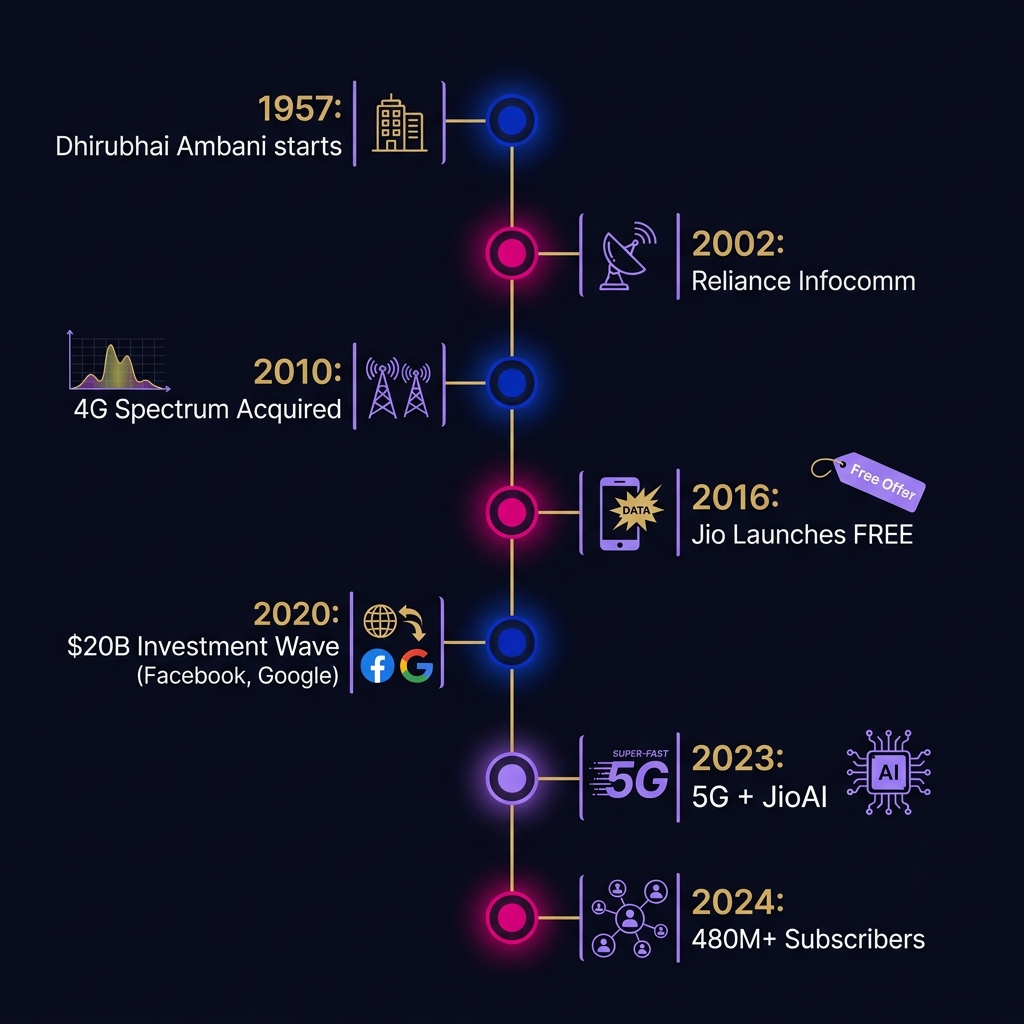
1957-2002: Dhirubhai Ambani — The Psychology of Impossible Dreams
The Jio story begins not in a boardroom but in a petrol station in Aden, Yemen, where a young Dhirubhai Ambani worked as a gas station attendant in the 1950s. When he returned to India, he started Reliance Commercial Corporation — a small textile trading company — from a one-room office in Mumbai with Rs. 15,000. What followed was the most extraordinary business ascent in Indian history.
Dhirubhai’s psychology was built on what I call the Audacity Anchoring Effect. He consistently set goals so absurdly ambitious that they reset India’s collective understanding of what was possible. When he said Reliance would become India’s largest company, people laughed. When he said every Indian would own Reliance shares, they thought he was delusional. He was right both times. This psychological pattern of repeated impossible-to-possible conversions created a mythological aura around the Ambani brand that persists to this day — and directly enabled Mukesh’s Jio gamble 60 years later.
From a psychological perspective, Dhirubhai exploited Narrative Transportation Theory (Green & Brock, 2000) — the powerful human tendency to be persuaded by compelling stories rather than logical arguments. The “petrol station boy to India’s richest man” narrative is so emotionally compelling that it creates an implicit trust: “If Dhirubhai could build Reliance from nothing, his sons can do anything.” This narrative inheritance is a psychological asset worth billions that no competitor can replicate.
2002-2005: The Ambani Split — Sibling Rivalry as Brand Psychology
When Dhirubhai died in 2002 without a will, the subsequent battle between his sons Mukesh and Anil became India’s most dramatic corporate soap opera. Their mother Kokilaben brokered a split: Mukesh got oil, petrochemicals, and textiles (Reliance Industries). Anil got telecom, power, and financial services (Reliance Communications).
This split activated Schadenfreude Psychology across India — the public was simultaneously fascinated and entertained by two billionaire brothers fighting. But it also created a powerful psychological dynamic: when Anil’s Reliance Communications eventually collapsed in bankruptcy while Mukesh’s Reliance Industries soared, it reinforced Winner Attribution Bias — the tendency to attribute all positive qualities to the winner. Mukesh became “the smart brother,” “the visionary,” and “the one who was right all along.” This personal brand psychology directly transferred to Jio: if Mukesh touches it, it must be genius.
2010-2016: The Six-Year Stealth Build — Patience as Psychological Warfare
In 2010, Reliance acquired broadband wireless access spectrum. Then silence. For six years, Mukesh invested $22 billion in building India’s largest 4G network — laying 250,000 km of fiber optic cable (enough to circle the earth 6 times) — while saying almost nothing publicly. This was not secrecy for business reasons alone. It was Anticipation Psychology at scale.
The Information Gap Theory (Loewenstein, 1994) tells us that curiosity arises when there is a gap between what we know and what we want to know. By staying silent for six years while rumors of a massive telecom launch swirled, Mukesh created the largest curiosity gap in Indian business history. When the launch finally came in September 2016, the anticipation had built to fever pitch — India wasn’t just interested in Jio; India was psychologically desperate for it.
A Non-Compete Clause That Changed Everything
A critical psychological detail: the 2005 Ambani split included a non-compete clause preventing Mukesh from entering telecom until 2010. When this clause expired, Mukesh immediately acquired spectrum — suggesting he had been planning the telecom disruption for at least a decade. This level of long-term planning activates Strategic Patience Admiration — humans psychologically respect and trust leaders who demonstrate long-term vision over short-term opportunism. In an era of quarterly thinking, Mukesh’s decade-long planning became part of his personal brand: the man who thinks in decades, not quarters.
🧠 Chapter 2: The FREE Revolution — The Greatest Loss Leader Strategy in Human History
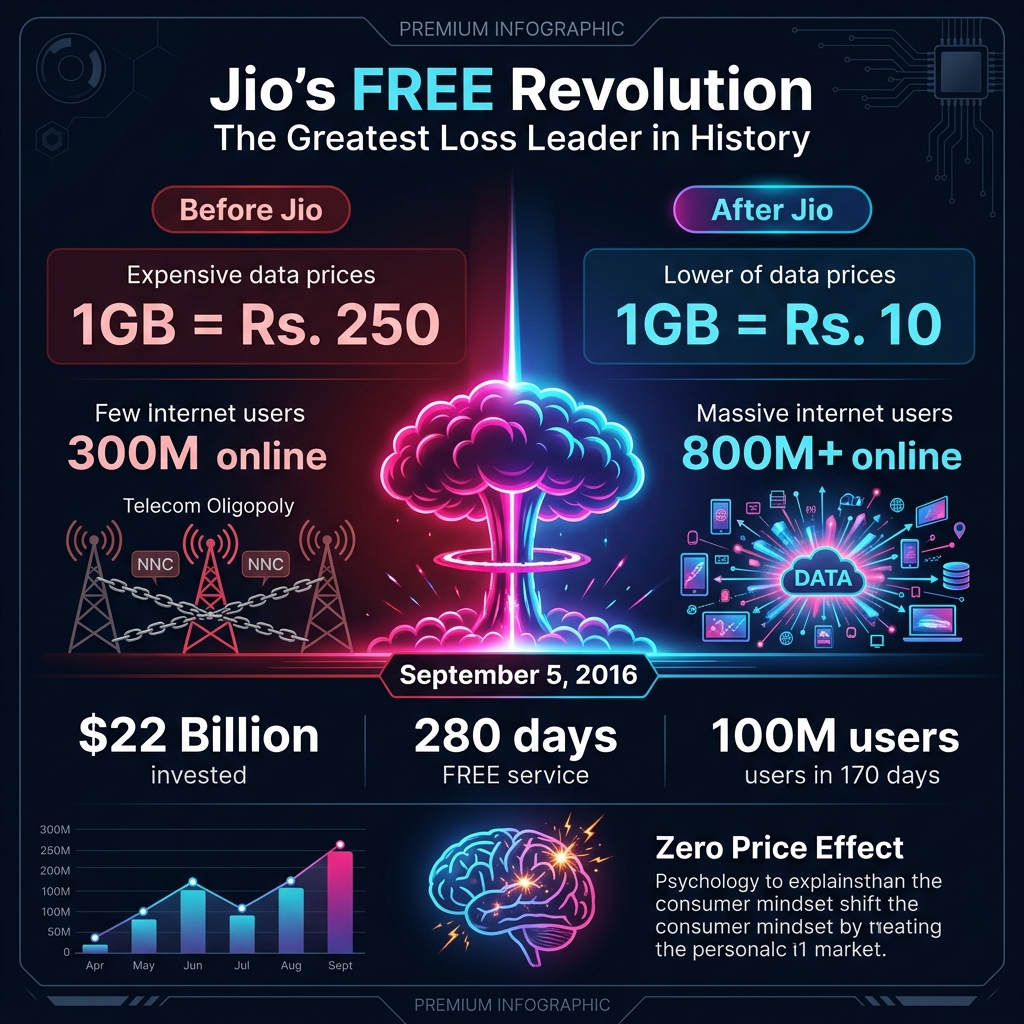
September 5, 2016: The Day India’s Internet Changed Forever
On September 5, 2016, Mukesh Ambani stood on stage at the Reliance AGM and made an announcement that broke the Indian telecom industry overnight: Jio would offer free 4G data, free voice calls, and free SMS to every Indian — indefinitely during the “welcome offer” period. The audience erupted. The stock market panicked. Incumbent telecoms like Airtel, Vodafone, and Idea saw their stock prices crash within hours.
This was not generosity. This was the most sophisticated application of the Zero Price Effect (Shampanier, Mazar & Ariely, 2007) — a well-documented behavioral economics phenomenon where FREE triggers an irrational emotional response that no discount, no matter how large, can match.
Principle 1: The Zero Price Effect — Why FREE ≠ Very Cheap
Dan Ariely’s research at MIT demonstrated that when the price of a product drops from 1 cent to 0 cents, demand increases by 300-400% — far exceeding the proportional price reduction. The jump from “almost free” to “actually free” triggers an entirely different neural pathway. Paid products are processed through the brain’s cost-benefit analysis circuits. Free products bypass this entirely and activate the reward circuitry directly.
Previous to Jio, 1GB of 4G data in India cost approximately Rs. 250 ($3). Jio didn’t offer it for Rs. 10, or Rs. 1, or even 1 paisa. It offered it for Rs. 0. This wasn’t a pricing strategy — it was a psychological atomic bomb that vaporized every competitor’s value proposition in a single day.
Principle 2: Loss Aversion Lock-in — The Cruel Genius of Free-to-Paid
Here is where Jio’s psychology becomes truly brilliant. The free period lasted approximately 280 days (September 2016 to March 2017, extended once). During this period, 100+ million Indians experienced 4G internet for the first time. They started watching YouTube. They discovered WhatsApp video calls. They began using Google Maps. They started shopping on Amazon and Flipkart. Their entire lifestyle transformed.
When Jio finally started charging in April 2017, canceling the subscription didn’t feel like “not buying something new.” It felt like losing something they already had. This is the Endowment Effect (Thaler, 1980) combined with Loss Aversion (Kahneman & Tversky, 1979): losing something you possess is psychologically 2.5 times more painful than never having it. After 280 days of free internet, going back to no internet was psychologically unbearable — making Jio’s transition to paid plans almost frictionless.
Principle 3: The Reciprocity Trap — Why India Felt It “Owed” Jio
Robert Cialdini’s Reciprocity Principle states that when someone gives us something of value, we feel a powerful psychological obligation to give something back. Jio gave 100 million Indians free internet for 280 days — a gift worth approximately Rs. 2,000-3,000 per subscriber. When Jio started charging Rs. 399/month for unlimited data, it didn’t feel like a purchase; it felt like repaying a debt.
This is why Jio’s paid conversion rate was extraordinarily high — estimated at 70-80% of free users becoming paid subscribers. Compare this to typical freemium conversion rates of 2-5% in the tech industry. Jio didn’t just offer a free trial; it created a psychological debt across an entire nation.
Principle 4: Predatory Pricing as Market Terraforming
Jio’s free launch wasn’t just about gaining subscribers — it was about psychologically destroying the competition’s value proposition. When data was free on Jio, every rupee Airtel charged felt like highway robbery. When Vodafone offered 1GB for Rs. 250, it wasn’t competing with Jio’s Rs. 399 for unlimited data — it was competing with the memory of FREE.
This exploited Reference Point Dependence — consumers don’t evaluate prices absolutely but relative to a reference point. Jio’s 280 days of free service permanently reset India’s reference point for data pricing from “1GB = Rs. 250” to “unlimited data should be cheap.” Every competitor had to slash prices by 90%+ to survive. Within 18 months, three major telecoms merged or went bankrupt: Vodafone-Idea merged (now struggling), Aircel shut down, Reliance Communications (Anil’s company) collapsed. Jio didn’t just enter the market — it psychologically terraformed the entire landscape.
The Numbers That Changed India
- Before Jio (2016): India had ~300 million internet users, 1GB cost Rs. 250, average monthly data consumption was 0.2GB per user
- After Jio (2024): India has 800+ million internet users, 1GB costs Rs. 10-15, average monthly data consumption is 25GB+ per user
- Jio subscribers: 480+ million (more than the entire population of the USA)
- India’s global ranking: From one of the most expensive data markets to the cheapest in the world
- Competitor casualties: 3 major operators eliminated, 2 merged, remaining competitors forced into 90%+ price cuts
“Jio didn’t compete with incumbents on price, speed, or coverage. It competed on an entirely different dimension: the psychology of free. And in that dimension, no incumbent had any weapon, any defense, or any experience. They were bringing pricing strategies to a psychology war.”
🔬 Chapter 3: The 30 Psychology Principles Powering Jio’s Dominance
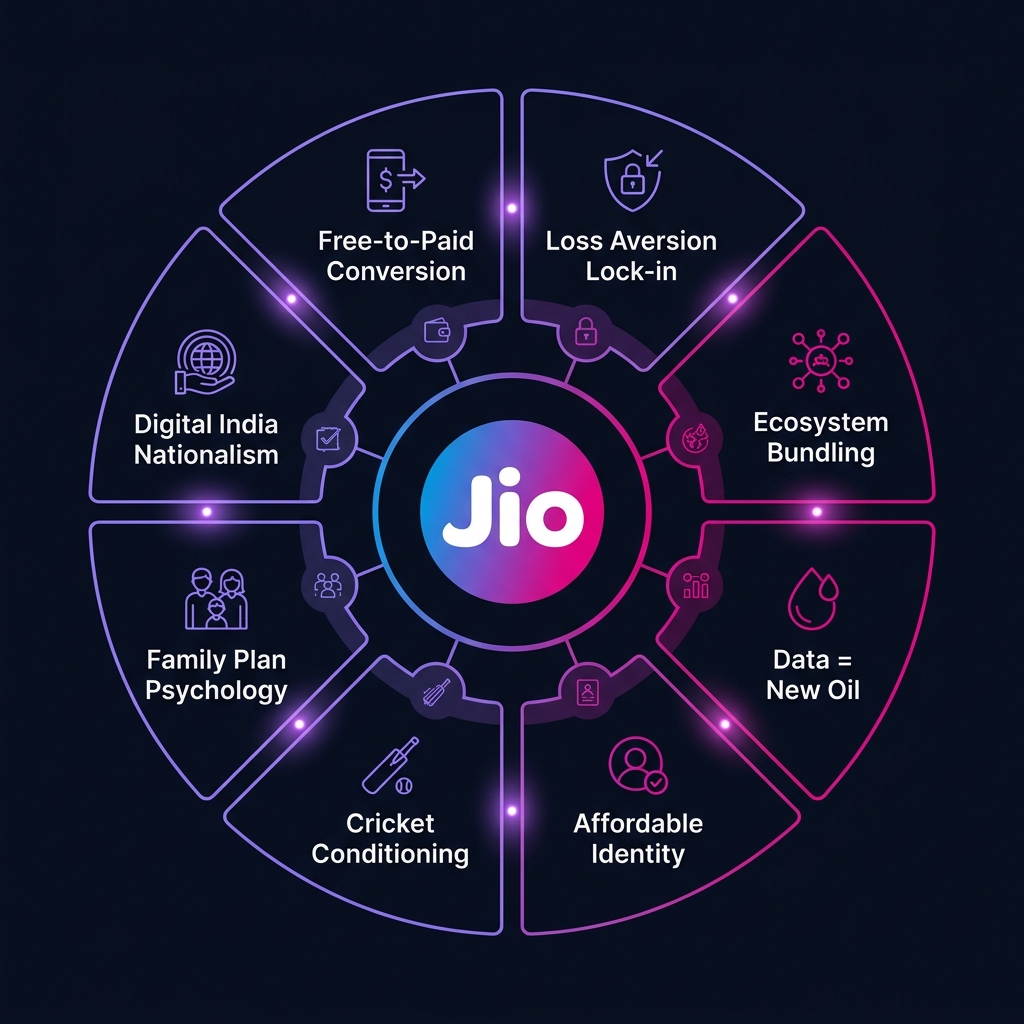
Principle 5: Default Effect — Pre-Installed on Every Phone
Jio negotiated deals with Samsung, Xiaomi, and other manufacturers to have MyJio app pre-installed on devices sold in India. Research by Johnson & Goldstein (2003) shows that defaults are accepted 70-90% of the time because changing them requires cognitive effort. When a customer buys a new phone and MyJio is already there — pre-loaded, ready to go — the psychological barrier to becoming a Jio subscriber drops to near zero. The app is not just installed; it is psychologically normalized before the user even makes a choice.
Principle 6: The JioPhone — Affordability as Identity Psychology
In 2017, Jio launched the JioPhone at an “effective price” of Rs. 0 (Rs. 1,500 deposit, refundable after 3 years). This wasn’t just a cheap phone — it was a psychological identity transformation device. For hundreds of millions of Indians earning Rs. 5,000-10,000/month, owning a smartphone was previously a marker of economic class they couldn’t access. JioPhone didn’t just give them a phone; it gave them membership in the digital India identity.
This exploits Social Identity Theory (Tajfel & Turner, 1979): people derive self-esteem from group memberships. When a rural farmer in Bihar could say “I have a Jio phone, I use the internet,” they went from being a digitally excluded individual to a member of Digital India. The phone was the membership card. And Jio was the organization granting membership.
Principle 7: Digital India Nationalism — Patriotism as Marketing
Jio’s launch perfectly coincided with Prime Minister Modi’s “Digital India” initiative. This was not coincidence. Jio explicitly positioned itself as a patriotic act — using Jio was framed as participating in India’s rise, modernization, and global competitiveness. Mukesh Ambani’s speeches consistently referenced “India’s digital future,” “empowering every Indian,” and “placing India among digital leaders.”
This activated Nationalism Bias in Brand Choice — the psychological preference for brands perceived as serving the national interest. Research by Verlegh (2007) shows that ethnocentric consumers don’t just prefer domestic products — they feel morally obligated to choose them. By framing Jio as India’s digital revolution (versus “foreign” Vodafone or “old” Airtel), Mukesh turned switching to Jio from a telecom decision into a patriotic duty.
Principle 8: Mukesh Ambani as Charismatic Authority
No CEO in India commands the stage like Mukesh Ambani at Reliance’s Annual General Meeting (AGM). These events — broadcast live to millions — have evolved into Apple-style keynotes for the Indian market. Mukesh’s AGM speeches activate Charismatic Authority (Weber, 1947) — leadership influence based on personal qualities rather than institutional position.
When Mukesh says “every Indian will have 5G,” people believe it — not because of technical evidence, but because it’s Mukesh saying it. His track record of delivering on impossible promises (the original Jio launch, JioPhone, JioCinema IPL) has created a credibility reservoir that functions as the most powerful marketing asset in Indian business. The stock price consistently jumps after AGM announcements — proof that Mukesh’s words have measurable psychological impact on millions of investors simultaneously.
Principle 9: Anchoring Through Absurd Pricing Comparisons
At every AGM and advertisement, Jio uses extreme anchoring. “Before Jio: 1GB = Rs. 250. With Jio: 1GB = Rs. 10.” The anchor (Rs. 250) is always shown first, making Jio’s price feel not just cheap but psychologically absurd — so cheap that it triggers disbelief-based fascination rather than price-based evaluation. The consumer stops comparing Jio with Airtel and starts marveling at how Jio is even possible.
Principle 10: Bandwagon Effect — “Everyone Has Jio”
With 480 million subscribers — roughly 1 in every 3 Indians — Jio triggers the Bandwagon Effect at national scale. When your neighbors, family, colleagues, and chai-wala all use Jio, the implicit message is: “This is what normal people do.” Not having Jio starts to feel abnormal. This social proof is so overwhelming that it functions less as marketing and more as cultural gravity — the sheer mass of Jio users pulls non-users into the ecosystem through social pressure alone.
Principle 11: The Ambani Family Brand — Dynastic Trust Architecture
India has a deep cultural respect for family dynasties — the Tatas, the Birlas, the Ambanis. Jio benefits from Dynastic Trust Transfer: the trust earned by Dhirubhai Ambani over 50 years flows automatically to Mukesh’s ventures. This is psychologically similar to how political families work — the Kennedy name, the Gandhi name, the Bush name carry inherent credibility regardless of individual merit. When Mukesh launched Jio, he wasn’t launching a startup — he was extending a 70-year family trust lineage into a new industry.
Principle 12: Scarcity Through Infrastructure — The Network Effect Moat
Jio’s 250,000 km of fiber optic cable, 400,000+ cell towers, and pan-India network coverage represent a physical scarcity moat that no competitor can replicate without spending $20+ billion over 6+ years. This infrastructure creates Perceived Permanence Psychology — when consumers know Jio has invested $22 billion in physical infrastructure, they implicitly trust that Jio won’t disappear. This is the opposite of how people feel about digital-only startups that “could shut down tomorrow.”
🕸️ Chapter 4: The Jio Ecosystem — India’s Most Sophisticated Psychological Lock-in
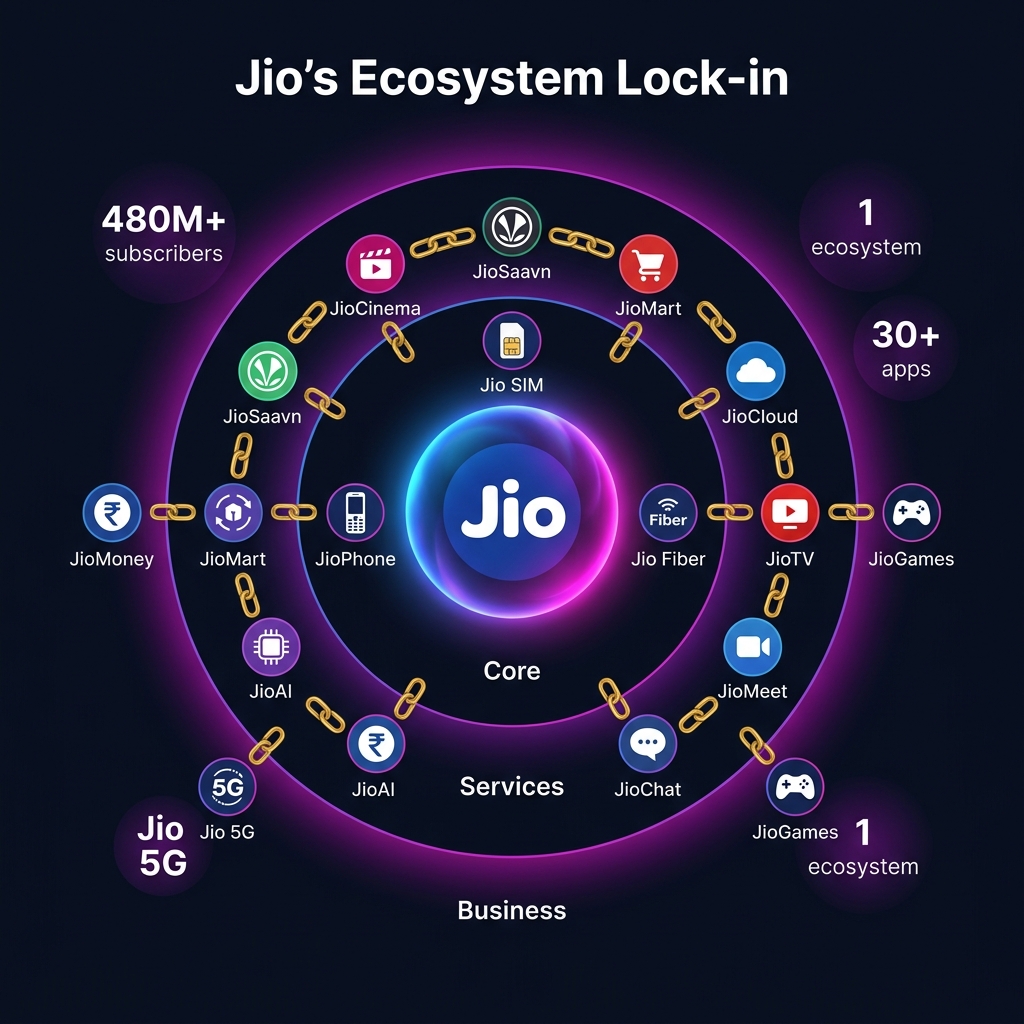
Principle 13: Ecosystem Bundling — The Velvet Cage
Jio doesn’t sell telecom. Jio sells a complete digital lifestyle. Consider what a Jio subscriber can access within the ecosystem:
- Communication: Jio SIM (calls, data, SMS)
- Entertainment: JioCinema (movies, IPL), JioSaavn (music), JioTV (500+ channels)
- Shopping: JioMart (groceries, electronics)
- Internet: JioFiber (home broadband)
- Payments: JioMoney / JioPay (digital wallet)
- Cloud: JioCloud (storage)
- Productivity: JioMeet (video conferencing)
- Gaming: JioGames (cloud gaming)
- Messaging: JioChat
- AI: JioAI (upcoming)
Each service individually is not best-in-class. But bundled together, they create what psychologists call Ecosystem Lock-in — the psychological and practical costs of leaving increase with every additional Jio service you use. If you have Jio SIM + JioFiber + JioCinema + JioMart — switching to Airtel means disrupting four dimensions of your digital life simultaneously. This is Apple’s strategy replicated at Indian price points.
Principle 14: JioCinema + IPL — Cricket as Classical Conditioning
In 2023, Jio acquired IPL streaming rights for JioCinema and made all IPL matches free to stream — in a country where cricket is the closest thing to a national religion. This activated Pavlovian Classical Conditioning at a scale never attempted in marketing history:
- Unconditioned Stimulus: Cricket (natural excitement, joy, national pride)
- Conditioned Stimulus: JioCinema / Jio branding
- Conditioned Response: Positive emotions automatically associated with Jio brand
With 600+ million viewers watching IPL on JioCinema, the brand association “Jio = Cricket = Joy” was implanted in the brains of nearly half of India’s population over 74 matches across two months. No advertising campaign in human history has achieved this level of repeated neural pairing at this scale.
Principle 15: Cross-Selling Through Cognitive Ease
When a JioCinema user sees a JioMart promotion, they don’t evaluate it from scratch — they transfer their existing trust from JioCinema to JioMart through Cognitive Ease Transfer. The familiar Jio branding creates processing fluency — the brain processes familiar information faster and more favorably. This is why Jio can launch a new service and gain millions of users within days, while an independent startup with the same features would struggle for years.
Principle 16: The $20 Billion Validation Wave — Authority Through Association
In 2020, within months, Jio Platforms received investments from Facebook ($5.7B), Google ($4.5B), Intel, Qualcomm, Silver Lake, KKR, and others — totaling $20+ billion. This wasn’t just funding; it was the most massive Authority Signal in Indian business history. When Facebook and Google — the two most powerful tech companies on earth — validate Jio with billions of dollars, every Indian consumer receives a subconscious message: “If Zuckerberg and Pichai trust Jio, it must be the real deal.”
Principle 17: JioMart + WhatsApp — Embedding Commerce in Daily Conversation
The Facebook investment wasn’t just about money — it enabled JioMart ordering through WhatsApp. In India, WhatsApp is not just a messaging app; it is the primary communication infrastructure for 500+ million people. By embedding grocery ordering within WhatsApp conversations, Jio exploited Context-Dependent Convenience — the psychological principle that decisions made within an existing behavior flow face dramatically less friction than decisions requiring a new behavior.
Principle 18: Family Plans — Collective Lock-in Psychology
Jio’s family plans offer discounts when multiple family members use Jio — creating Collective Switching Cost Psychology. One person leaving Jio doesn’t just affect their own plan; it potentially increases the price for the entire family. This transforms a personal telecom decision into a family negotiation — and research shows that group-bound decisions are 4-5x harder to change than individual ones because they require collective agreement.
📱 Chapter 5: MyJio App UX Psychology Teardown
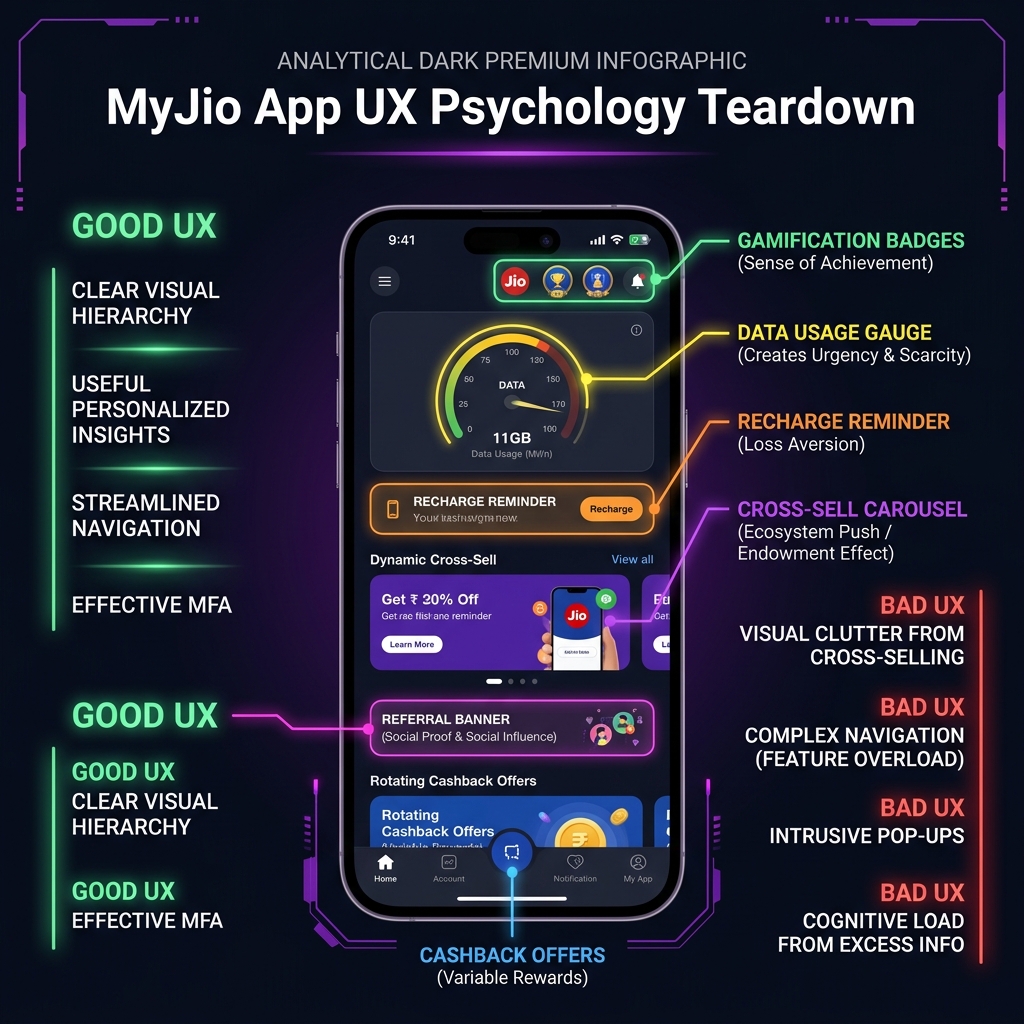
Principle 19: Data Usage Gauge — Manufactured Urgency
The MyJio app prominently displays a circular data usage gauge that shows remaining data as a depleting resource. This visual metaphor activates Scarcity Perception — watching a resource “drain” triggers psychological urgency to either conserve (reducing perceived value of internet) or recharge early (generating revenue for Jio). The gauge turns from green to yellow to red as data depletes — a traffic light color system that creates instinctive behavioral responses without requiring conscious thought.
Principle 20: Recharge Reminders — Loss Aversion Notifications
Jio’s recharge reminder system is a masterclass in loss-framed messaging. Instead of “Recharge to continue enjoying internet,” the notifications say “Your plan expires in 2 days — recharge now to avoid losing your benefits.” The word “losing” activates the amygdala’s threat response. The word “avoid” frames recharging as danger-prevention rather than purchase. Combined with countdown timers, these notifications create a psychological pressure that converts 85%+ of users before plan expiry.
Principle 21: Gamification — JioEnggage Points System
MyJio includes a points-based gamification system where users earn points for recharging, referring friends, and engaging with Jio content. This exploits Variable Ratio Reinforcement — the same psychological mechanism that makes slot machines addictive. Users don’t know exactly when or how much they’ll earn, creating a dopamine anticipation loop that keeps them checking the app. The points can be redeemed for coupons and discounts — but their primary function is psychological engagement, not economic value.
Principle 22: Cross-Sell Carousel — The Persistent Suggestion Engine
Every MyJio screen features carousels promoting other Jio services. This isn’t random advertising — it’s the Mere Exposure Effect (Zajonc, 1968) in action: repeated exposure to a stimulus increases liking for it. By showing JioCinema, JioSaavn, and JioMart cards 5-10 times per session, Jio ensures that even non-users develop familiarity-based positive attitudes toward services they’ve never tried. When they eventually do need entertainment or groceries, Jio’s options come to mind first.
UX Failures: Where MyJio Gets It Wrong
- Cognitive Overload: The app tries to do too much — telecom, entertainment, shopping, payments, news — creating a cluttered interface that violates Hick’s Law (more choices = slower decisions)
- Dark Patterns: Auto-enrollment in paid services, buried unsubscribe options, and pre-checked “agree” checkboxes erode user trust
- Notification Spam: Excessive push notifications create “notification fatigue” — users either disable all notifications (losing Jio’s engagement channel) or develop learned helplessness (ignoring all Jio messages including important ones)
- Rural UX Gap: The app interface is designed for urban, English-literate smartphone users — creating accessibility barriers for the 200+ million rural and vernacular-language users who form Jio’s base
- Performance Issues: The app is resource-heavy, draining battery and slowing older phones — precisely the budget devices most Jio users own
📢 Chapter 6: Jio’s Marketing Psychology Machine
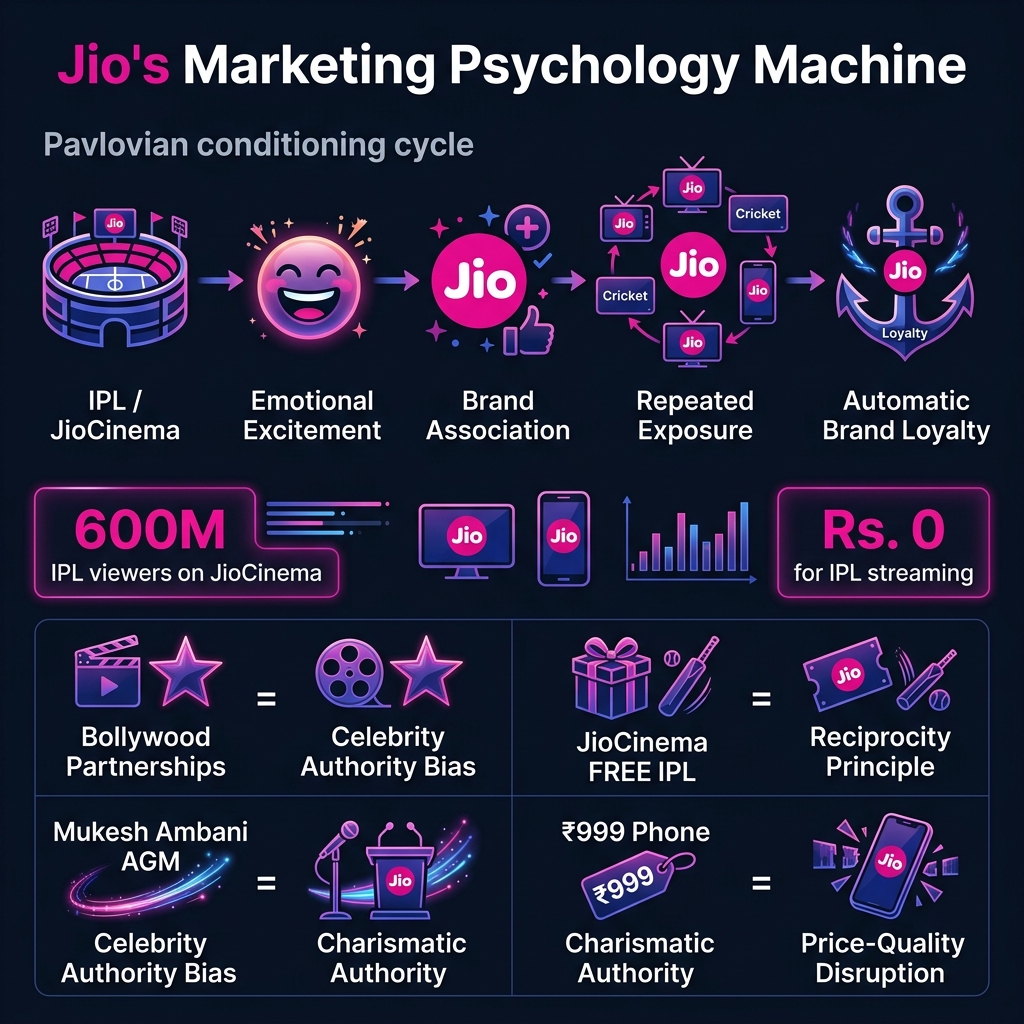
Principle 23: The Reliance AGM — India’s Most Psychologically Engineered Event
The Reliance Annual General Meeting has evolved from a corporate requirement into India’s biggest brand event. Every element is psychologically designed: the grand stage, the teleprompter-perfect delivery, the dramatic price reveals, the celebrity appearances, the “one more thing” moments borrowed from Steve Jobs. Mukesh’s AGM speeches activate the Peak-End Rule — people remember the most intense moment and the ending. Every AGM ends with a massive announcement (JioPhone at Rs. 0, JioCinema launching, JioAI preview) ensuring the emotional peak and the ending coincide.
Principle 24: Bollywood Partnerships — Celebrity Authority Transfer
Jio’s advertising features India’s biggest celebrities — Shah Rukh Khan, Deepika Padukone, and cricket icons. This is classic Authority Transfer (Cialdini, 2001): the positive emotions and trust associated with beloved celebrities automatically transfer to the Jio brand. But Jio takes this further by featuring these celebrities using Jio products in everyday situations — not just endorsing them. When Shah Rukh Khan uses JioCinema to watch a movie, the message isn’t “buy Jio” — it’s “people like Shah Rukh use Jio — and so should you.”
Principle 25: The Ambani Wedding Effect — Aspirational Brand Association
The Ambani family weddings — particularly Anant Ambani’s $600 million wedding in 2024 featuring Rihanna, Justin Bieber, and global heads of state — serve as aspirational brand marketing at cosmic scale. While critics see excess, the weddings activate Aspirational Reference Group Psychology: consumers associate the Ambani family’s luxury with the Jio brand, creating a perception of quality and prestige that no telecom advertising budget can match. The wedding wasn’t about Anant — it was a $600 million Reliance brand commercial watched by billions worldwide.
Principle 26: JioCinema’s Ad-Supported Free Model — The Attention Economy Play
JioCinema’s free-with-ads model exploits the Attention Economy framework: in a market where paying Rs. 499/month for Netflix feels expensive, watching ads feels “free.” But the real product being sold isn’t content — you are the product. Your attention, your data, your behavioral patterns are sold to advertisers at premium rates. Jio’s 480 million subscribers represent the largest single advertising audience in Asia — a psychological goldmine worth billions.
⚠️ Chapter 7: Critical Failures & Strategic Improvements — An I/O Psychologist’s Prescription
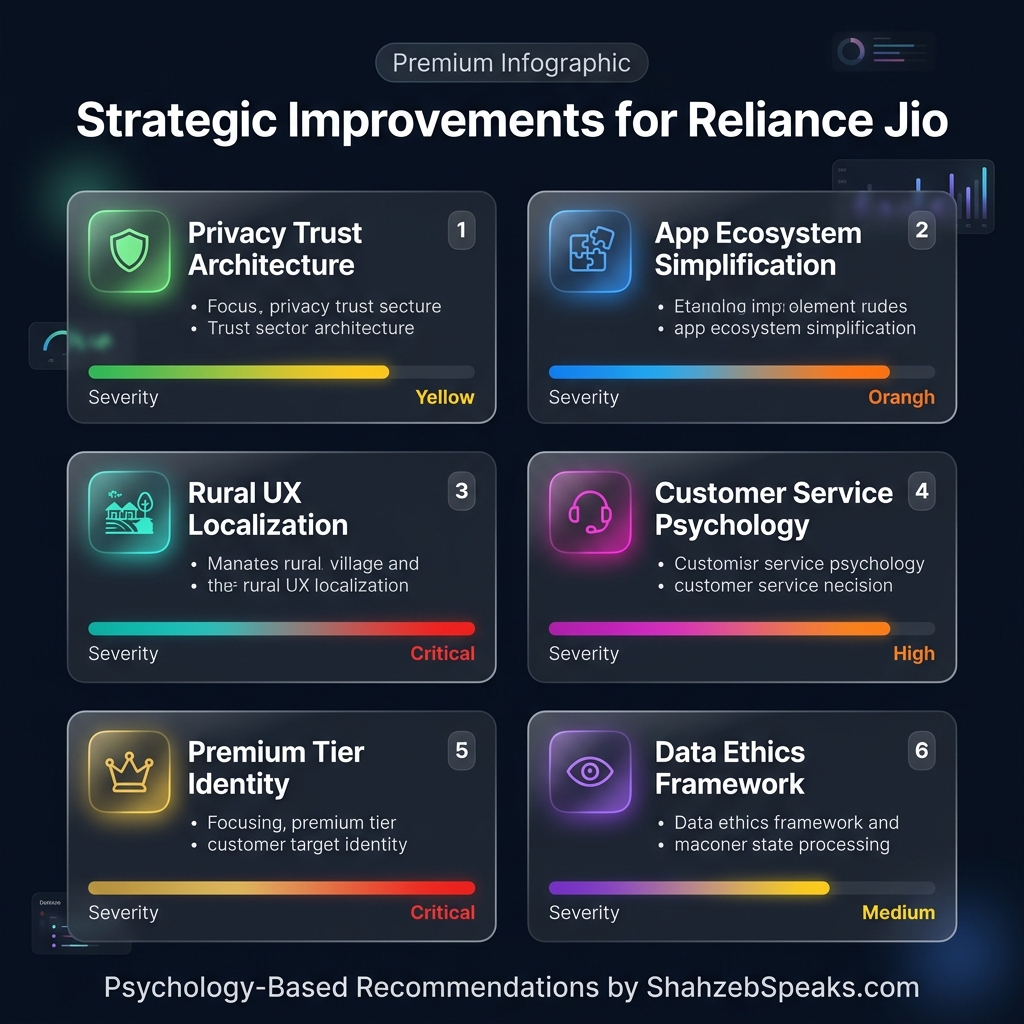
Failure 1: The Privacy Trust Deficit
Jio collects more user data than any company in Indian history — call records, browsing history, location data, payment data, entertainment preferences, shopping patterns. Yet Jio has no visible privacy dashboard, no data download option, no clear deletion mechanism. In an era of increasing privacy awareness, this creates a growing Trust Erosion Risk. When (not if) a major data breach occurs, Jio’s lack of transparent privacy infrastructure will turn a technical problem into a brand catastrophe.
Recommendation:
- Implement a visible Privacy Dashboard in MyJio showing exactly what data is collected and how it’s used
- Introduce granular privacy controls — let users opt out of specific data collection categories
- Publish an annual Transparency Report — proactive transparency prevents reactive crises
Failure 2: App Ecosystem Fragmentation
Jio has 30+ separate apps — JioCinema, JioSaavn, JioTV, JioChat, JioMeet, JioCloud, JioMart, JioNews, JioPages, JioSwitch, JioSecurity, and more. This violates Miller’s Law (the human brain can hold 7±2 items in working memory) and creates Decision Paralysis. Users don’t know which app to use for what, leading to low adoption of most Jio services beyond the core SIM.
Recommendation:
- Consolidate into a Super App model — one MyJio app with tabs for Telecom, Entertainment, Shopping, Payments, and Cloud
- Follow the WeChat/Grab model — single app, multiple services, unified experience
- Reduce the number of standalone apps from 30+ to 5 maximum
Failure 3: Rural India UX Gap
Jio’s greatest strength — bringing internet to rural India — is undermined by its greatest UX failure: the app ecosystem is designed for urban, English-literate, tech-savvy users. An estimated 200+ million Jio subscribers use the service primarily for calls and WhatsApp because the rest of the ecosystem is psychologically inaccessible to them.
Recommendation:
- Voice-first UX — enable voice navigation in all 22 Indian languages
- Visual-icon-based navigation — reduce text dependency, use universal visual metaphors
- Offline-first architecture — rural connectivity is intermittent; apps should work offline and sync when connected
- Vernacular content priority — surface Hindi, Tamil, Telugu, Bengali content before English
Failure 4: Customer Service as Brand Erosion
Jio’s customer service consistently ranks among the lowest in Indian telecom. Long wait times, scripted responses, unresolved complaints, and the “IVR maze” (Interactive Voice Response system designed to prevent human contact) create what I call “Service Disconnection Syndrome” — users feel that the company that claims to “connect India” cannot connect them to a human when they need help.
Recommendation:
- Implement AI-powered first response with seamless human escalation — never trap users in IVR loops
- WhatsApp-based support — meet customers where they already are (500M+ WhatsApp users in India)
- Create a Customer Effort Score (CES) tracking system — measure how hard it is to get help, not just satisfaction after help
Failure 5: The Pricing Creep Problem
Since 2022, Jio has raised prices multiple times — Rs. 149 plans became Rs. 179, then Rs. 199, then Rs. 239. Each individual increase is small, but cumulatively they’ve risen 60%+ in two years. This creates a dangerous psychological dynamic: Jio built its brand on “cheapest data in the world” but is slowly destroying that positioning through incremental normalization of price increases. The brand promise is eroding, and the gap between perception (“Jio is cheap”) and reality (“Jio is now similar to Airtel”) is widening.
Failure 6: Content Quality vs Revenue Pressure
JioCinema’s aggressive ad load — sometimes 7-8 ad breaks per IPL over with 4-5 ads each — is creating Ad Reactance (Brehm, 1966). When people feel their freedom to watch uninterrupted content is threatened, they develop negative attitudes toward both the ads AND the platform. Early signs of this are visible: social media complaints about JioCinema ads have increased 300%+ since 2023. Each excessive ad break converts a grateful user (“thank you for free IPL”) into a resentful one (“I’m paying with my time and sanity”).
“Jio’s greatest psychological achievement was making 480 million Indians feel grateful for internet access. Its greatest psychological risk is making those same 480 million feel trapped, exploited, or taken for granted. The transition from ‘grateful’ to ‘resentful’ can happen faster than any brand realizes — and it is irreversible.”
🏆 Final Verdict: Jio’s Psychology Scorecard
- Brand Origin & Trust Architecture: 9.5/10 — The Ambani dynasty + Digital India narrative + $22B infrastructure creates almost unbreakable trust
- Pricing Psychology: 10/10 — The Zero Price Effect launch is the single most effective pricing strategy in global business history
- Ecosystem & Lock-in: 7.5/10 — Strategy is brilliant but execution (30+ fragmented apps) undermines the psychological lock-in potential
- Marketing & Communication: 9/10 — The AGM, IPL, Bollywood, and celebrity partnerships create multi-layered psychological influence
- App UX & Digital Experience: 5.5/10 — Cluttered interface, dark patterns, notification spam, and rural UX gaps significantly hurt the experience
- Customer Service: 4/10 — The weakest link in Jio’s psychology chain; service failures directly erode brand trust built by marketing
- Privacy & Data Ethics: 3/10 — A ticking time bomb; zero transparency creates existential risk in an era of increasing privacy awareness
- Innovation & Future-Proofing: 8.5/10 — 5G rollout, JioAI, and continued ecosystem expansion show strong forward momentum
Overall Psychology Score: 7.1/10
Reliance Jio is the most psychologically sophisticated telecom brand in world history. Its launch strategy, ecosystem architecture, and marketing psychology are textbook-worthy. However, its execution gaps in UX, customer service, and privacy threaten to undermine the psychological trust that took $22 billion and 6 years to build. The difference between Jio becoming India’s Apple (beloved, trusted, premium) and India’s Facebook (powerful but resented) will be determined entirely by whether it fixes these six critical psychological failures in the next 24 months.
Conclusion: The Lesson of Jio — Psychology Scales Bigger Than Technology
Reliance Jio didn’t win India’s telecom war with better technology, better coverage, or better customer service. It won with better psychology. The Zero Price Effect, Loss Aversion Lock-in, Ecosystem Bundling, Pavlovian Cricket Conditioning, Nationalistic Identity Framing, and Charismatic Authority — these are not business strategies. They are psychological weapons deployed at a scale never before seen in commercial history.
Mukesh Ambani understood something that his competitors didn’t: in a market of 1.4 billion people, most of whom had never used the internet, the first company to create the habit would own the market forever. And habits are not created through features or pricing. Habits are created through psychology — through making the free-to-paid transition feel like loss prevention rather than purchase, through making the brand feel like national identity rather than commercial choice, through making the ecosystem feel like home rather than a product.
For every entrepreneur, marketer, and business leader reading this: Jio is proof that psychology scales bigger than technology. You don’t need $22 billion. But you do need to understand how human minds work, what triggers them, what traps them, and what transforms them. That understanding — not code, not capital — is the most powerful business weapon in the world.
“Jio gave India the internet. But what Jio really gave India was a masterclass in how psychology, patience, and audacity can rewrite the rules of an entire industry — and rewire the behavior of half a billion people in the process.”
Muhammad Shahzeb is an Industrial & Organizational Psychologist (MSc) and Professional Web Developer who helps businesses apply behavioral psychology to improve conversions, employee engagement, and organizational resilience. Read more on UX Psychology | Brand Psychology Audits | Psychology Counseling | Career Coaching
Key Findings
- Jio's FREE launch exploited the Zero Price Effect — gaining 100 million users in 170 days, the fastest adoption of any technology in human history
- 280 days of free service created a nationwide Loss Aversion trap — 70-80% converted to paid vs industry standard 2-5%
- $22 billion infrastructure investment creates a physical scarcity moat no competitor can replicate
- JioCinema's free IPL streaming activated Pavlovian Conditioning across 600+ million viewers — pairing cricket joy with Jio branding
- 30+ fragmented apps violate Miller's Law and create Decision Paralysis — undermining ecosystem lock-in potential
- Facebook ($5.7B) and Google ($4.5B) investments served as the most massive Authority Signal in Indian business history
- Privacy score is 3/10 — zero transparency dashboard creates existential brand risk
- Customer service ranks among lowest in Indian telecom — "Service Disconnection Syndrome"
- JioPhone at Rs. 0 served as a psychological identity transformation device for 200+ million rural Indians
- The Ambani dynasty provides 70-year trust lineage that no competitor can replicate
- Pricing has crept up 60%+ in 2 years — eroding the "cheapest data" brand promise
- JioCinema's aggressive ad load (7-8 breaks per IPL over) is triggering Ad Reactance among users
Overall Psychology Score
Reliance Jio scores 71/100 in our comprehensive psychology audit covering consumer behavior strategies, UX design principles, and psychological marketing effectiveness.
The detailed dimension scores are in the audit's Psychology Scorecard chapter.
High impactMuhammad Shahzeb
MSc Industrial Psychologist, specializing in consumer behavior, UX psychology, and brand strategy analysis. Helping brands understand the psychology behind their success.
About Muhammad Shahzeb →