Free Android app · works offline · no sign-up

The free I/O Psychology app that decides what you study today

Fifty topics on the paper, three weeks left, and you have opened the same chapter four times. Industrial and Organizational Psychology was never hard to learn. The hard part is choosing what to study tonight, and knowing whether you actually know it.

I am an I/O Psychologist, and I built this app to solve exactly those two problems. Works offline. No sign-up. Nothing to pay for.

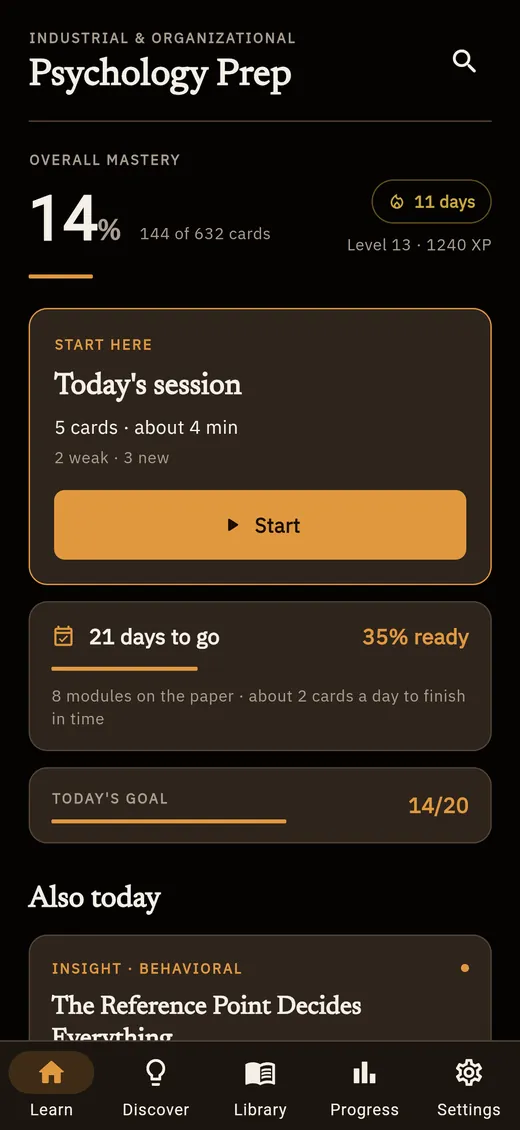
I/O Psychology Prep home screen showing Today's session, an exam countdown and a study streakI/O Psychology Prep
50Study modules
632Flashcards
410Exam questions
87Theorists
100Recommended books
The research

Why most revision fails

Two findings from the learning research shape everything in this app, and both go against what studying feels like it should be.

Finding one

Recognition is not recall

Reading a definition and thinking "yes, I knew that" is a far easier task than producing that definition from an empty page. An exam only ever asks for the second one. Most flashcard apps train the first, which is why a student can revise a term four times and still freeze on it.

Finding two

Mixed practice beats blocked practice

Studying one module until it is finished feels organised and productive. Interleaving several topics in one sitting feels messier and produces better retention. Almost nobody chooses to do it voluntarily, so the app does it for you.

Re-reading your notes feels like studying. It isn't. Recognition is easy, recall is hard, and the exam only asks for the hard one.

01 · Today's session

Today's session: one button, no deciding

Open the app and there is one thing to tap. It tells you how many cards and roughly how many minutes before you commit to anything.

Behind that button the session is already assembled: cards you are about to forget based on when you last got them right, any term you flagged as weak, and new material you have not seen. Those are then shuffled across modules rather than served in blocks.

This removes the single decision that stops most people revising. Not how do I learn this, but what do I open now.

02 · Recall

Write the answer before you see it

The card does not turn over until you have typed the definition in your own words. Your answer then appears beside the real one, and you grade yourself against it.

It is slower than tapping through cards, and that is the point. Producing an answer and seeing exactly where yours was thin is a far better calibration than asking yourself whether something looked familiar.

Everything you type is saved into your notes automatically, so a month of studying quietly builds a full set of definitions in your own words.

Studying somewhere you cannot type? One tap in the toolbar turns it off for that session without changing your settings.

03 · Theorists

The theorists index: who said what

Exam questions are written from names. Adams and equity theory. Vroom and expectancy. Locke and Latham on goals. Hackman and Oldham on job characteristics. Schein on culture, Hofstede on national dimensions, Maslach on burnout, Edmondson on psychological safety.

The app carries 87 of them, each with the years, the area, what they are actually known for, and a single exam-ready sentence you could write straight onto a paper.

Search by name if you have the person, or by idea if you have the theory and have lost the name.

04 · Library and notes

A library, and your own notes

An A–Z glossary of all 632 terms, searchable, with your own weak / important / revise tags. A reading list of 100 books, each with the reason it earns shelf space and the reader it is for.

You can write a note on any term, any theorist, any book, or on nothing at all. They all land in one searchable list, along with the answers you type during study sessions.

Notes are stored on your device and survive a progress reset, because your own writing is not a score to be wiped.

Exam mode

Exam mode: a date, a syllabus and an honest number

Set the exam date and tick which modules are on the paper. You get a countdown, a readiness percentage, and a plain answer to how many cards a day you need to cover everything in time.

The readiness figure is deliberately conservative. A flattering number would be worse than no number, because it would send someone into a hall they were not ready for. From then on your daily session is drawn only from your syllabus, and nothing outside the paper appears.

01

Countdown

Days left, on the home screen, every time you open the app.

02

Readiness score

A straight average across your chosen modules. No flattery.

03

Daily pace

How many cards a day to finish everything before the date.

Contents

What is actually inside

50 study modulesacross four tracks: Core I/O, Consumer & Retail, Marketing & Sales, and Applied & Future
632 flashcardscovering every key term, from the Hawthorne studies to the Job Demands-Resources model
410 exam-style questionseach with an explanation of why the answer is right
87 theoristswith the name, the years, the claim and the exam-ready sentence
100 recommended bookswith the reason each one is worth your money
30 interview questionswith model answers and the mistakes that sink candidates
Spaced repetitionthat brings cards back right before you would forget them
A daily puzzle— one psychology scenario a day, with hints and a streak

The syllabus it covers

Core I/O

Foundations and history, research methods and statistics, job analysis, employee selection, psychological testing, performance appraisal, training and development, motivation, job attitudes, leadership, teams, organisational culture, occupational health and wellbeing, organisational justice, diversity and inclusion, engagement, conflict, remote work, safety, careers, compensation, job design, power and politics, selection law, and counterproductive work behaviour.

Consumer and marketing

Consumer psychology, pricing, brand strategy, service, e-commerce, advertising, neuromarketing, segmentation, digital and social behaviour, sales, positioning, diffusion of innovations, the Elaboration Likelihood Model, habits, and post-purchase behaviour.

Applied and future

UX and engineering psychology, behavioural economics, cross-cultural psychology, emotional intelligence, workplace communication, and the future of work.
Audience

Who it is for

  • BS, MS and PhD psychology students taking Industrial and Organizational Psychology
  • Students preparing for semester papers and comprehensive exams
  • UGC NET, CSS and PPSC psychology candidates
  • SHRM and HRCI candidates who need the psychology under the HR practice
  • HR professionals and managers who want the evidence behind what they already do
  • Marketers and UX designers who want the psychology behind consumer behaviour
FAQ

Frequently asked questions

About the app, the content and who made it.

Is the app really free?

Yes. Every module, flashcard, quiz and the whole library are free. There is no premium tier and no locked content. The app is funded by ads, which is what lets it stay free for students.

Does it work without internet?

Yes. All content is stored on your device, so you can study on a bus, in a basement library, or anywhere with no signal. Only the ads need a connection.

Do I need to sign up or create an account?

No. There is no sign-up, no email and no login. Open the app and start. Your progress and notes are stored on your device only.

Which syllabus does it follow?

The standard Industrial and Organizational Psychology syllabus used in most university programmes, plus the consumer, marketing and applied areas many programmes include. In Exam mode you tick exactly which modules are on your paper, so you only study what you are being examined on.

How is it different from Quizlet or Anki?

With Quizlet and Anki you build the deck yourself, which is where most students give up — a single chapter can take hours to turn into cards. Here the 632 cards are already written by a subject specialist and the app schedules them for you. You never spend a minute making content.

Is there an iPhone version?

Not yet. The app is currently Android only, on Google Play.

Who made it?

Muhammad Shahzeb Anwar, an Industrial and Organizational Psychologist. Every card, question, theorist entry and book recommendation was written by hand, not generated or scraped.

Start with one session

Free, offline, no sign-up. If it helps, an honest review on the Play Store genuinely helps other students find it.

Found a mistake in the content, or something you would like added? Tell me directly — I read every message.