Added to cart
 Tools & Software · Tool
Most onboarding is built around information transfer: policies, systems, org charts, compliance modules. The research on organisational socialisation says the information is the easy part and almost never the reason someone leaves. What decides whether a new hire settles is whether four questions get answered, and a handbook answers none of them. This playbook covers […]
Download link by email · valid 30 days
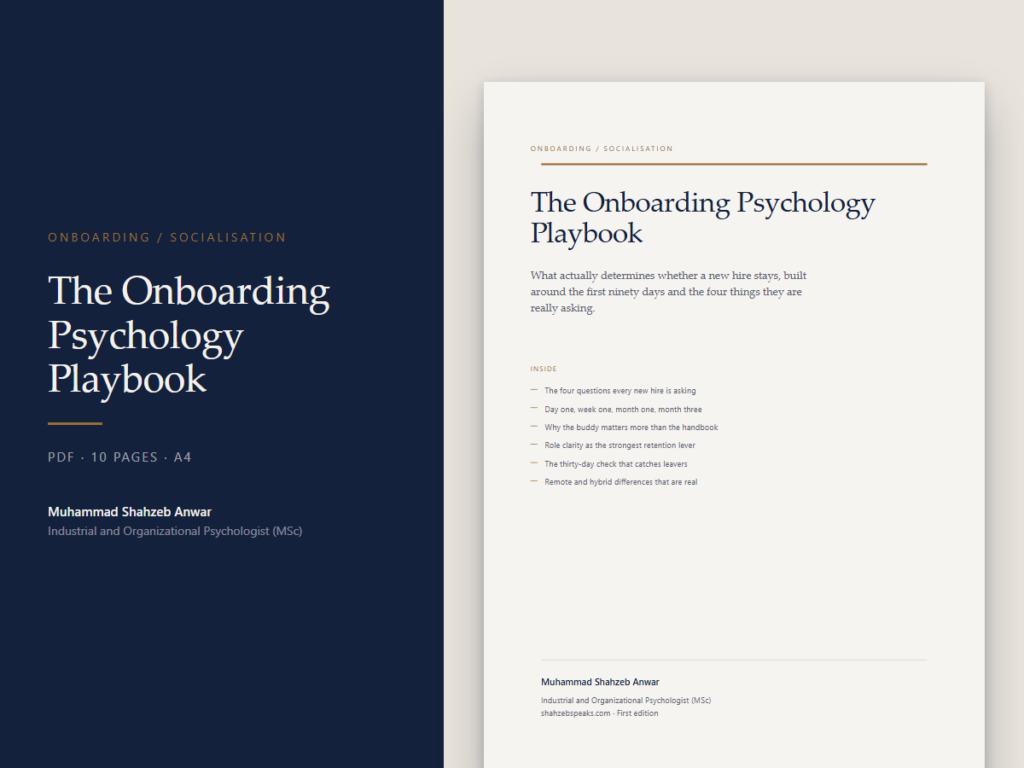
Most onboarding is built around information transfer: policies, systems, org charts, compliance modules. The research on organisational socialisation says the information is the easy part and almost never the reason someone leaves. What decides whether a new hire settles is whether four questions get answered, and a handbook answers none of them.
This playbook covers those four questions and what actually answers each, a day one, week one, month one and month three sequence, why a named buddy outside the reporting line is the cheapest retention intervention available, and the 30-day conversation that catches the person who will otherwise resign in month five. It includes a 30/60/90 plan template and a manager checklist, plus a section on remote and hybrid onboarding that names what is genuinely lost and what replaces it.
For HR teams, hiring managers, team leads and founders.
What it is not: a compliance or induction checklist. It assumes you already have one. This is about the part that decides retention, and it is deliberately opinionated about measurement: it argues that new-hire satisfaction scores are weak evidence and twelve-month retention by manager is strong evidence.
10 pages, A4, formatted for printing. Delivered as a PDF immediately after payment.
Our psychology templates and tools are highly versatile—equally effective for licensed clinical professionals, wellness coaches, and individuals committed to personal mental health growth.
Yes, our therapeutic templates, worksheets, and intervention guides are strictly grounded in established, empirically supported psychological frameworks like CBT, DBT, and ACT.
Yes, all our psychology tools are intentionally engineered in high-resolution, print-ready monochrome and color formats tailored for standard A4 and US Letter sizes.
No. While these are excellent supplementary resources, they are educational diagnostic aids and therapeutic exercises, NOT substitutes for professional medical or psychiatric treatment.
Added to cart
Your cart is empty
Browse Shop Tools & Software · Tool
 Psychology Tools · Psychology