Psynapse — psychology, mapped
Most psychology apps hand you a pile of definitions. The problem was never finding the definition. The problem is that Beck and Ellis look identical at 2am, and the exam is the one place you have to tell them apart.
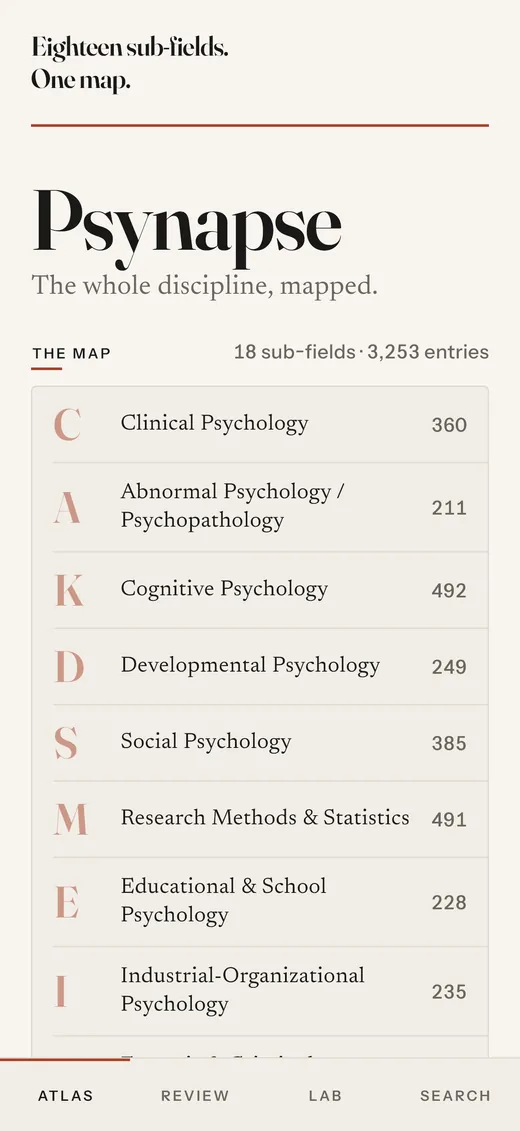
Psynapse is built around that. Two halves: an Atlas that maps the whole discipline, and a Lab where you practise the theory you have just read.
 Psynapse
“Often confused with”
Every entry names its nearest neighbour, and tells you apart from it
Not just what the concept is. Also what it gets mistaken for, why, and the one test that separates them.
Negative reinforcement and punishment. Reliability and validity. Beck's cognitive therapy and Ellis's REBT. Trait EI and ability EI. These are the pairs that cost marks, and no other app addresses them directly.
It maps onto the real failure mode: students rarely forget a definition outright. They confuse it with the one next to it under pressure.
The Atlas
The entire discipline, organised so you can see the shape of it rather than a flat alphabetical list.
The Lab
Evidence-based self-help tools, framed as practice of the theory you are studying. Reading about a thought record teaches you the structure. Filling one in teaches you what it feels like when a client cannot find the evidence against their own thought.
Not a medical device. The questionnaires included (PHQ-9, GAD-7, K10) are screening instruments presented for education. They do not diagnose anything, and the app says so on the screen. If you are in crisis, the Lab carries crisis resources for your country.
What you write never leaves your phone
Mood entries, thought records, questionnaire answers and notes are stored in an encrypted database on your device. The key is generated on your phone and held in the Android Keystore. We do not have it and cannot recover it.
There is no account and no login. Nothing you write is uploaded, shared, or seen by anyone but you. Ads never appear in the Lab, on a questionnaire, or on the crisis resources screen — and that is enforced by an automated test that fails the build if one is ever placed there.
- Encrypted database on your devicestorage
- Key held in the Android Keystorekey
- No account, no login, no uploadaccount
- No ads in the Lab, questionnaires or crisis screenads
Get Psynapse
Free on Google Play. Works offline. No account.