Labubu & Pop Mart Brand Psychology Audit — The $15 Billion “Blind Box” Empire Built on Gambling Psychology and Cuteness
How did a small toy company create a multi-billion dollar empire selling plastic figures to adults? This psychology audit breaks down the genius behind Pop Mart and its flagship character, Labubu. We analyze the dark psychology of the "Blind Box" mechanic (variable ratio reinforcement), artificial scarcity, FOMO, and the "Kidult" phenomenon. Discover how Pop Mart turned vinyl toys into a highly addictive, culturally defining status symbol for Millennials and Gen Z worldwide.

91 / 100
Overall consumer behavior effectiveness
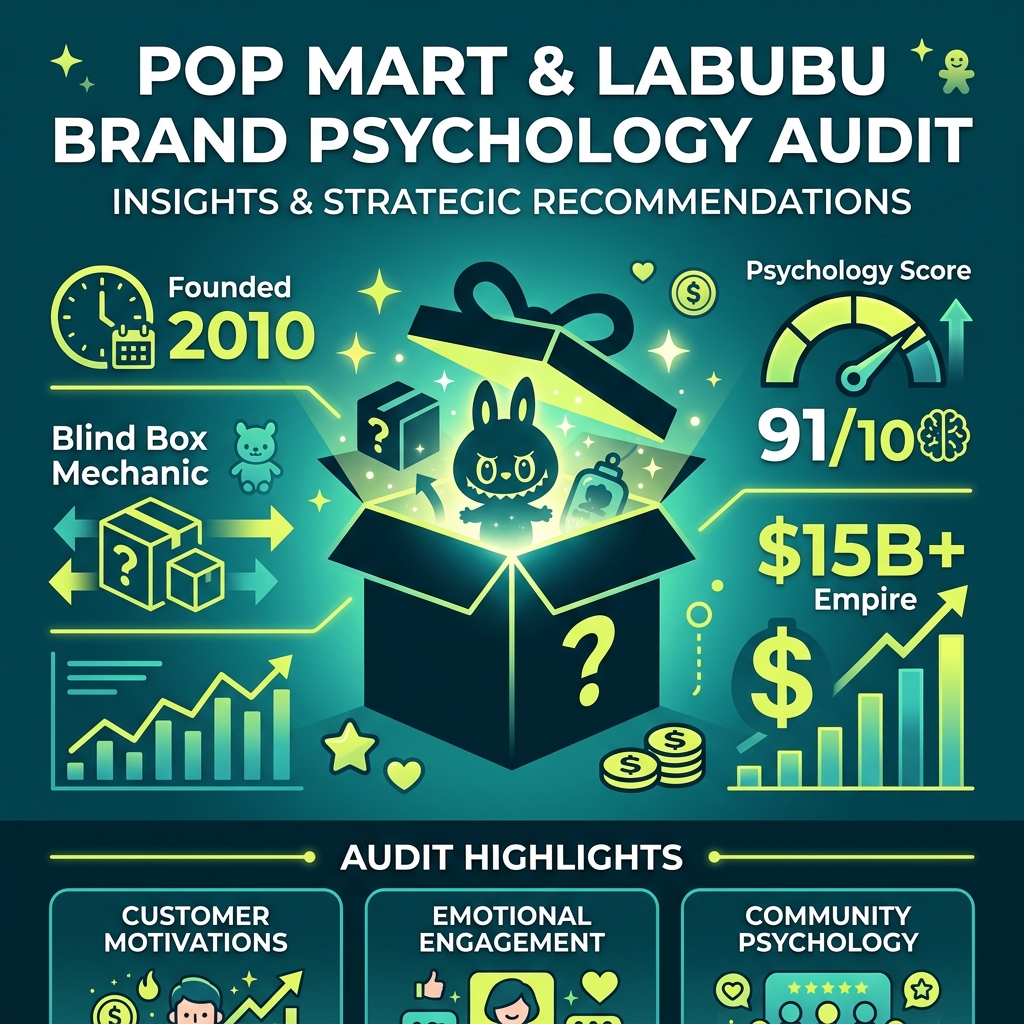
Brand Overview
- Brand namePop Mart (Labubu)
- Founded2010
- HeadquartersBeijing, China
- IndustryEntertainment
- Websitewww.popmart.com ↗
Psychology Techniques Identified
- 01Variable Ratio Reinforcement (Gambling Mechanics)
- 02The "Blind Box" Mystery Effect
- 03Artificial Scarcity & The "Secret" Figure Phenomenon
- 04Cuteness Aggression (Baby Schema / Kindchenschema)
- 05The "Kidult" Emotional Regression Therapy
- 06Status Signaling via Secondary Market Pricing
- 07FOMO Marketing (Fear Of Missing Out)
- 08Endowment Effect & Sunk Cost Fallacy in Collecting
- 09The Ikea Effect of "Discovering" Your Toy
- 10Social Proof via Influencer Unboxings
- 11Tribal Identity (Labubu Collectors)
Full Psychology Audit Report
In this audit
In 2025, the single most desired fashion accessory on planet Earth was not a Hermès bag, not an Apple device, and not a pair of limited-edition sneakers. It was a $27 furry monster with nine serrated teeth, sold in a sealed box so the buyer couldn’t even see which one they were getting. People fought in London stores over it. A human-sized version sold at a Beijing auction for over $150,000. Rihanna clipped one to her Louis Vuitton. And the Chinese company behind it — Pop Mart — briefly became worth more than Mattel, Hasbro, and Sanrio combined.
The toy is called Labubu. And if you think 100+ million people bought a “cute toy,” you have misread the situation entirely. What they bought was a precision-engineered psychological product — one that combines casino mathematics, evolutionary biology, celebrity social proof, and scarcity economics into the most sophisticated impulse-purchase machine physical retail has ever seen.
In this exhaustive brand psychology audit, I will dissect every psychological mechanism behind the Labubu phenomenon — from Pop Mart’s blind box slot machine to the “ugly-cute” facial engineering, from the Lisa BLACKPINK cascade to the March 2026 stock crash — and answer the question every investor, marketer, and collector is now asking: Is Labubu the next Hello Kitty, or the next Beanie Baby?
“Pop Mart doesn’t sell toys. It sells a 15-second dopamine event — the moment between tearing the foil and seeing the face. The plush monster is just the receipt. Labubu is the first brand in history to turn the psychology of a slot machine into something you can hang on a handbag.”
— Brand Psychology Analysis, ShahzebSpeaks
📋 Brand Overview: Labubu & Pop Mart at a Glance
| Character / IP | Labubu — from “The Monsters” universe |
| Creator | Kasing Lung — Hong Kong-born, Netherlands-raised illustrator (created 2015) |
| Parent Company | Pop Mart International Group (HKEX: 9992) |
| Pop Mart Founder | Wang Ning (founded 2010, Beijing) |
| Pop Mart Revenue (2025) | ~37.1 billion yuan (~$5.2 billion) — up ~185% YoY |
| The Monsters IP Revenue (2025) | 14.16 billion yuan — up 365.7% YoY (first Pop Mart IP to cross 10B yuan) |
| Labubu Units Sold (2025) | 100+ million globally |
| Core Sales Mechanic | Blind box — sealed packaging, contents unknown until opened |
| Secret Figure Odds | Typically 1-in-72 (some series 1-in-144) |
| Psychology Score | 88 / 100 — ⚡ Extreme Impact |
📜 Chapter 1: The Complete History — From a Storybook Monster to a $5 Billion Empire (2010–2026)
🏪 2010 — Wang Ning Opens a Small Variety Store in Beijing
Pop Mart did not begin as a psychological empire. It began as a small lifestyle variety shop founded by Wang Ning, a young entrepreneur selling toys, cosmetics, and accessories. The turning point came when Wang noticed something strange in his sales data: one product category — a Japanese collectible figure called Sonny Angel, sold in blind packaging — was massively outselling everything else in the store.
Most retailers would have simply ordered more stock. Wang Ning did something far more consequential: he asked why. Why were adults — not children — returning week after week to buy sealed boxes of tiny figures they couldn’t see? The answer to that question would eventually become a multi-billion-dollar company. This is the first psychological lesson of the Pop Mart story: the founder didn’t discover a product; he discovered a behavior.
🎨 2015 — Kasing Lung Creates “The Monsters”
Meanwhile, in Europe, a Hong Kong-born illustrator named Kasing Lung — who grew up in the Netherlands surrounded by Nordic fairy tales — published a picture-book trilogy called The Monsters. Its star was a small, mischievous forest elf with rabbit-like ears, huge round eyes, and a jagged nine-tooth grin: Labubu. Crucially, Lung wrote Labubu as kind-hearted but chaotic — a creature that wants to help but accidentally causes disaster. That narrative DNA (good intentions, naughty execution) is the exact personality archetype psychologists find most forgivable and most lovable — the same formula behind Dennis the Menace, Stitch, and Bart Simpson.
📦 2016 — Pop Mart Bets Everything on Blind Boxes (The Molly Era)
Back in Beijing, Wang Ning signed artist Kenny Wong’s character Molly and relaunched Pop Mart around a single mechanic: the blind box. Sales exploded. Pop Mart had found its engine — art-toy IP + concealed packaging + collectible series. The company began signing artists the way record labels sign musicians, building a portfolio: Molly, Dimoo, Skullpanda, Hirono, Crybaby.
🤝 2019 — Labubu Joins Pop Mart
Kasing Lung signed an exclusive licensing deal with Pop Mart in 2019, bringing The Monsters universe into the blind box machine. For the first few years, Labubu was a solid mid-tier performer — beloved by art toy collectors, unknown to the general public. The monster was waiting for its trigger event.
🧸 2023 — The Plush Pivot That Changed Everything
In October 2023, Pop Mart made a deceptively simple product decision: it released Labubu as a soft plush keychain pendant (the “Exciting Macaron” series) instead of a hard vinyl figure. Psychologically, this changed the product category entirely. A vinyl figure lives on a shelf at home — private consumption. A plush pendant hangs on a handbag — public display. Pop Mart had accidentally converted a collectible into a wearable status signal. Every owner became a walking billboard.
💥 2024 — The Lisa Moment: One Instagram Story Ignites the World
In April 2024, Lisa of BLACKPINK — one of the most-followed celebrities on Earth — posted Labubu on her Instagram. No paid campaign. No press release. Within weeks, Southeast Asia sold out. Thailand declared Labubu a tourism ambassador. The cascade jumped continents as Rihanna, Dua Lipa, Kim Kardashian, and David Beckham were photographed with Labubu pendants. By mid-2025, a $27 plush monster was hanging from Birkin bags worth $30,000 — the most extreme price-contrast status pairing in modern fashion.
🚀 2025 — The Year of Total Obsession
2025 was Labubu’s imperial year, and the numbers are almost comical: 100+ million units sold; The Monsters IP revenue up 365.7% to 14.16 billion yuan; Pop Mart’s total revenue roughly tripling to ~37 billion yuan; a human-sized Labubu auctioned in Beijing for over $150,000; UK stores suspending in-store sales after physical fights broke out; and a global counterfeit economy (“Lafufu” fakes) so large it became its own meme. Pop Mart’s market value at its peak exceeded the combined worth of Mattel, Hasbro, and Sanrio.
📉 2026 — The Crash Question
Then came the warning shot. In March 2026, despite reporting record annual results, Pop Mart’s stock plunged over 22% as investors panicked about one thing: the company’s dependence on a single IP whose growth curve looked suspiciously like every collectible fad in history. The market was asking the exact question this audit will answer in Chapter 7: is this Hello Kitty (50 years of durability) or Beanie Babies (a spectacular crater)?
🎰 Chapter 2: Blind Box Psychology — The Slot Machine You Can Hug
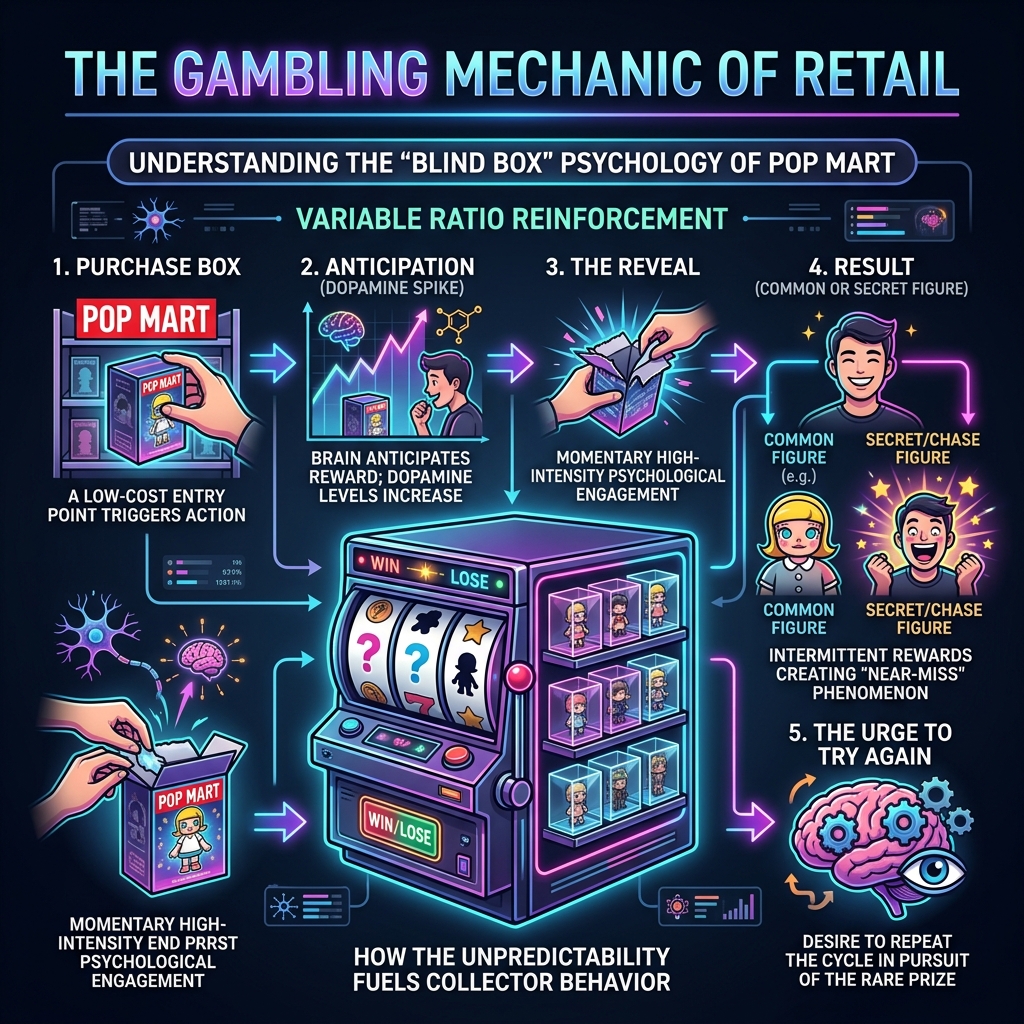
Everything about Pop Mart’s success flows from one mechanic. Not the character. Not the celebrity moments. The box. To understand Labubu, you must understand that Pop Mart’s true product is not a toy — it is uncertainty itself, packaged and sold at $27 per pull.
🧪 Variable Ratio Reinforcement: Skinner’s Pigeons, Reborn in Pastel
In the 1950s, psychologist B.F. Skinner discovered the most powerful behavior-shaping schedule known to science: variable ratio reinforcement. When rewards arrive unpredictably — sometimes after 3 attempts, sometimes after 30 — behavior becomes compulsive and extraordinarily resistant to extinction. It is the mathematical engine of every casino slot machine.
Now map the blind box onto it precisely:
- The lever pull → tearing open the sealed box
- The small win → any regular figure from the series (guaranteed, so no pull ever feels like total loss)
- The jackpot → the secret / chase figure, seeded at ~1-in-72 odds
- The re-bet → “just one more box” — the sentence every collector knows
The genius detail: unlike a slot machine, every blind box “wins” something. This removes the psychological sting of gambling loss while preserving the compulsion loop of gambling reward. Regulators struggle with blind boxes for exactly this reason — it is gambling’s engine wearing a toy’s body.
⚡ Anticipatory Dopamine: The Reward Is Before the Reveal
Neuroscientists Berridge and Robinson demonstrated that dopamine is primarily a chemical of “wanting,” not “liking” — it surges in anticipation of a reward, peaking at maximum uncertainty (around 50% predictability). The blind box weaponizes this perfectly: the dopamine event is the 15 seconds between picking up the box and seeing the face. The toy itself is almost an afterthought. This is why collectors report that the urge returns almost immediately after opening — the product being consumed is the anticipation, and anticipation is instantly renewable.
🎯 The Near-Miss Effect: Engineered Heartbreak
Gambling research (Reid, 1986) shows that near-misses — outcomes close to the jackpot — stimulate the same brain regions as wins and dramatically increase continued play. Pop Mart engineers near-misses through series design: pulling the figure you already own, or the one visually closest to the secret, produces “almost had it” arousal that fuels the next purchase. Even disappointment is monetized.
🧩 Set Completion Bias: The Checklist That Owns You
Each Labubu series ships as a numbered set (typically 6–12 figures). Human beings have a deep, documented compulsion toward completeness — an open set functions like an unfinished task, generating the persistent mental tension of the Zeigarnik Effect. Owning 11 of 12 figures doesn’t feel like 92% success; it feels like one hole. Pop Mart prints the checklist inside the box — a subtle, brilliant act of psychological warfare.
💸 Price Anchoring: The $27 Lie
A single blind box costs roughly $21.99–$27.99 — framed as an affordable, guilt-free “little treat.” But the mechanics above ensure almost nobody buys one. Whole-set buyers, repeat pullers, and secret-hunters routinely spend hundreds per series. The listed price is the psychological anchor; the real customer lifetime value is an order of magnitude higher. This is the same “low entry, deep spend” architecture as free-to-play gaming — GTA Online’s Shark Cards and Labubu blind boxes are cousins.
👹 Chapter 3: The Ugly-Cute Face — Evolutionary Biology as Character Design
Why Labubu and not a thousand other art toys? Because Labubu’s face is one of the most psychologically optimized character designs ever drawn — whether Kasing Lung intended it scientifically or arrived there by artistic instinct.
👶 Kindchenschema: Hacking the Baby Detector
In 1943, ethologist Konrad Lorenz identified the Kindchenschema (baby schema) — a set of infant features (large eyes, oversized head, round cheeks, small nose) that trigger automatic caregiving responses in the human brain. It’s why we melt at puppies and Pixar characters. Labubu is loaded with baby schema: enormous forward-facing eyes, a head disproportionate to its body, soft rounded features. Your nurturing circuitry fires before conscious thought.
😈 The Violation: Nine Teeth That Make It Unforgettable
But if Labubu were only cute, it would be wallpaper — the market is saturated with cute. Lung added the disruption: a wide, mischievous grin with nine serrated teeth and a glint of chaos in the eyes. Psychologists McGraw and Warren call this a benign violation — something that breaks a norm (monsters are threatening) while remaining safe (it’s a soft plush the size of your hand). The simultaneous “aww” and “hmm” produces a level of cognitive engagement that pure cuteness never achieves.
This also triggers the Von Restorff effect: in any lineup of standard-cute characters, the distinctive item — the weird one — is the one memory retains. Labubu wins shelf wars and feed-scroll wars because your brain files it under “unresolved,” and unresolved things get revisited.
🪞 The Ambiguity Projection Screen
Labubu has no fixed canon personality in the mass-market sense — is it sweet? Naughty? Sad? Feral? The ambiguity is functional: like a Rorschach inkblot, owners project their own emotional state onto it. TikTok is full of owners assigning their Labubus names, moods, jobs, and backstories — anthropomorphism in full bloom. A projected personality is far stickier than an assigned one, because the owner co-created it. Co-creation breeds attachment (the IKEA effect applied to meaning rather than furniture).
🧸 The Adult Comfort Object: Kidult Psychology
The core Labubu buyer is not a child — it is a 18–35-year-old adult, majority female, urban, economically stressed. Developmental psychologist Donald Winnicott described “transitional objects” — the childhood teddy bear that provides security. The “kidult” phenomenon is the adult reactivation of that mechanism during chronic uncertainty: economic anxiety, career precarity, post-pandemic loneliness. A soft creature on your bag is a socially sanctioned, fashion-approved comfort object. Pop Mart is effectively selling portable emotional regulation disguised as a fashion accessory — the 2020s version of the “lipstick effect,” where small affordable luxuries spike during hard times.
⏳ Chapter 4: Scarcity Engineering — Manufacturing Famine in a Factory
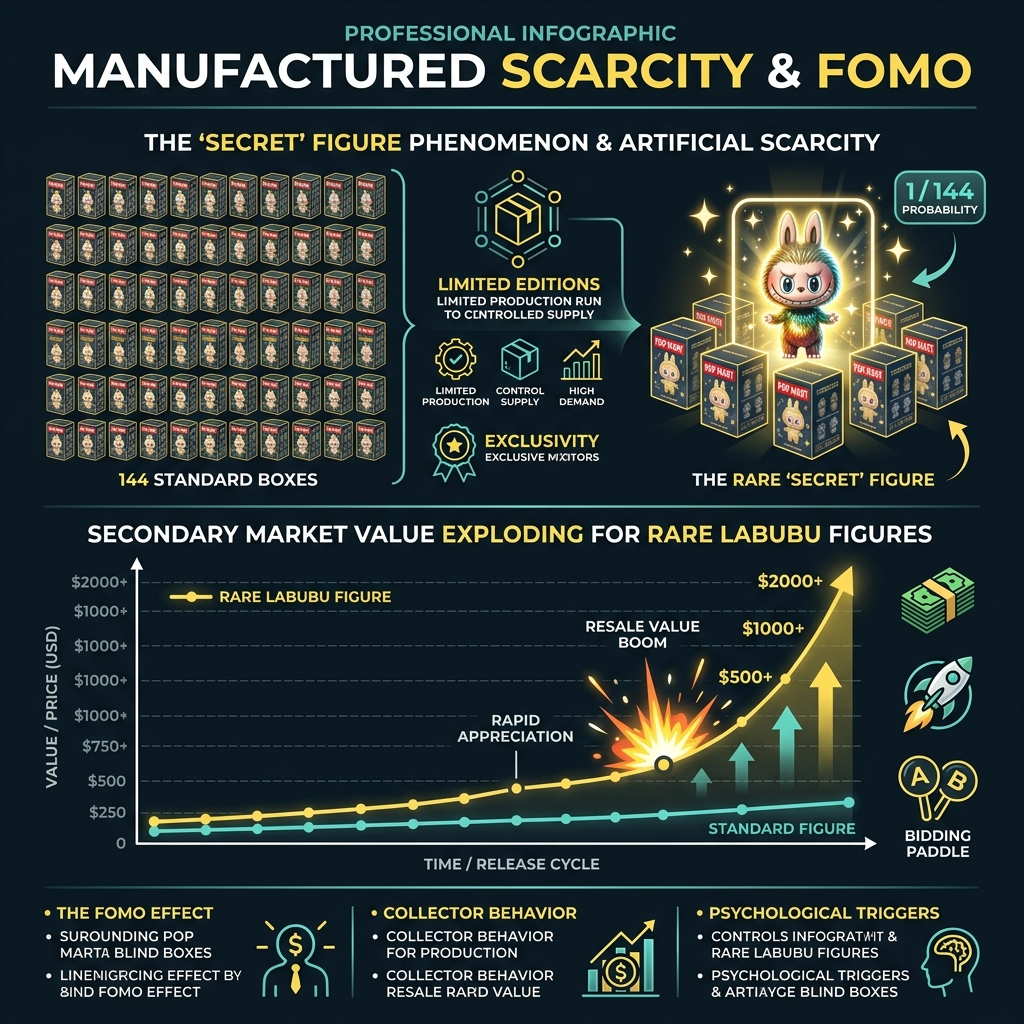
Here is the paradox at the heart of the empire: Pop Mart can manufacture effectively unlimited Labubus. Yet Labubu is one of the hardest products on Earth to buy at retail. That gap is not a supply chain failure. It is the product strategy.
🔥 Hunger Marketing: The Deliberate Stockout
Pop Mart releases series in limited drops, restocks unpredictably, and lets shelves sit empty. Cialdini’s scarcity principle states that perceived scarcity inflates perceived value — but Pop Mart executes the advanced version: scarcity as ritual. Restock announcements trigger queues at 6 AM; app drops sell out in minutes; every stockout event becomes news content, which manufactures the next wave of demand. Empty shelves are advertising.
💎 The Visible Jackpot: Resale as a Feature
Secret figures and limited editions resell for 10x–100x retail on StockX and secondary markets. Most brands fight resellers. Pop Mart’s structure quietly benefits from them, because publicly visible resale prices convert every blind box into a lottery ticket with a posted jackpot. When a $27 box might contain a $500 secret, the purchase reframes from spending to speculating. This recruits an entirely new buyer psychology — the investor mindset — on top of the collector mindset.
⌛ FOMO Drop Culture & Loss Aversion
Kahneman and Tversky’s loss aversion — losses hurt roughly twice as much as equivalent gains please — is the fuel of drop culture. A missed limited series isn’t a neutral non-event; it is experienced as a loss, complete with regret. Pop Mart’s cadence of seasonal series, collabs (Coca-Cola, One Piece, fashion houses), and region-exclusive figures ensures there is always a potential loss on the horizon. The collector is never allowed to feel finished — by design.
🥊 When Scarcity Breaks: The London Brawls
In May 2025, Pop Mart suspended in-store Labubu sales across UK stores after repeated physical altercations in queues. From an audit perspective this is the system working too well: scarcity arousal escalated past excitement into aggression. It also produced the single most valuable press cycle in the brand’s history — “toy causes fights” is an irresistible headline that advertised the scarcity to everyone who hadn’t yet felt it.
📱 Chapter 5: Social Psychology — How Labubu Colonized the Feed and the Handbag
🎬 The Unboxing Economy: Vicarious Dopamine at Scale
The #labubu hashtag has accumulated billions of views, dominated by one format: the unboxing reveal. Mirror neuron research suggests observers partially simulate the experiences they watch — meaning every reveal video delivers a diluted hit of the opener’s anticipation-dopamine to thousands of viewers. Pop Mart thus enjoys a marketing channel that is literally self-replicating: the product’s consumption ritual is the advertisement, produced free by customers, distributed free by algorithms that favor suspense-and-payoff content.
👑 The Celebrity Cascade: Parasocial Social Proof
The Lisa moment demonstrates the modern architecture of social proof. Classic advertising says “this celebrity endorses X” — and audiences discount it as paid. But Lisa posting Labubu unprompted reads as authentic private behavior, which parasocial relationship research shows carries dramatically more influence: fans imitate what idols choose, not what they’re paid to say. The cascade then followed textbook diffusion: idol → superfans → regional sellouts → scarcity headlines → mainstream FOMO → Western celebrities → global normalization. Total paid media spend for this sequence: effectively zero.
👜 Conspicuous Consumption: The $27 Veblen Good
Thorstein Veblen described goods purchased primarily to display status. Labubu executed the strangest Veblen maneuver in memory: it became a status symbol because of its price contrast. A Labubu on a Birkin says “I am wealthy enough to be playful” — status signaling through deliberate whimsy, what fashion sociologists call counter-signaling (only the truly secure can decorate luxury with a $27 monster). Meanwhile, for teenagers, owning a rare secret figure signals insider knowledge and hunt success. One object, multiple status languages — that is IP flexibility money can’t buy.
🫂 Community, Trading & Belonging
Blind boxes produce duplicates; duplicates produce trading; trading produces community. Facebook groups, Discord servers, and physical swap meets form what psychologists call communities of practice — belonging structures with their own vocabulary (pulls, chases, Lafufus), rituals, and hierarchies. Once a brand becomes the medium of a person’s friendships, leaving the brand costs relationships. That is the deepest moat in consumer psychology.
🏬 Chapter 6: Retail & Experience Psychology — The Ritual Architecture
🏪 Stores as Casinos, Vending Machines as Slot Corners
Pop Mart’s retail fleet — flagship stores plus hundreds of “Robo Shops” (automated vending machines) — places the purchase trigger in malls, airports, and transit hubs: exactly where boredom, waiting, and impulse converge. The vending machine format is psychologically significant: it removes the human witness from the transaction, and gambling research consistently shows anonymity increases indulgent play.
🤲 The Box-Shaking Ritual: The Illusion of Control
Watch any Pop Mart store: customers lift boxes, shake them beside their ear, weigh them in their palms, convinced they can detect the secret figure. Ellen Langer’s classic research calls this the illusion of control — irrelevant actions that feel like skill make chance-based activities dramatically more engaging (the same reason dice players throw harder for high numbers). Pop Mart has never discouraged box-shaking. Of course not: ritual deepens investment, and investment precedes purchase.
🎁 Unboxing as Ceremony: The Endowment Accelerator
The packaging is engineered as a multi-stage reveal — outer box, sealed foil bag, the slow emergence of the face. Each stage of physical interaction accelerates the endowment effect (we value what we touch and possess). By the time the figure is fully revealed, it is psychologically already yours — which is why even a disappointing pull rarely gets returned, and why “disappointment” converts to “buy another box” rather than “refund.”
🧬 The Artist-Label Model: A Portfolio of Parasocial IPs
Structurally, Pop Mart operates like a record label for characters: sign artists (Kasing Lung, Kenny Wong, Molly/Skullpanda/Crybaby creators), industrialize their IP through the blind box engine, and rotate releases like album drops. This gives the brand narrative authenticity (“art,” not “merchandise”) — a critical psychological difference, because consumers grant art-objects emotional legitimacy they deny to mass toys. It is also the company’s only real hedge against Labubu dependence — a hedge the March 2026 stock crash suggests is not yet strong enough.
⚠️ Chapter 7: The Dark Side — Gambling, Fakes, and the Beanie Baby Ghost
🎲 Selling Slot Machines to Teenagers
The uncomfortable truth this audit cannot avoid: blind boxes deliver gambling’s core loop to buyers with no age gate that meaningfully works. China’s regulators saw the danger clearly — 2023 blind box rules banned sales to children under 8 and require guardian consent for minors — and other jurisdictions are studying loot-box-style regulation. The psychological risk profile is real: for a subset of vulnerable buyers, “one more box” is not a meme, it is a compulsion with financial consequences. A brand built on variable ratio reinforcement carries a permanent, structural ethical liability — reflected in this audit’s ethics score.
🐉 Lafufu: When Even the Counterfeit Becomes a Brand
The counterfeit flood (“Lafufu” fakes) is enormous — and psychologically fascinating. Rather than purely damaging the brand, the fakes created a two-tier social hierarchy: authenticating a real Labubu (checking teeth count, foot stamps, packaging seals) became a community ritual and status test. The existence of fakes raised the symbolic value of authenticity. Few brands are lucky enough to have their counterfeits function as free proof of desirability — though the revenue leakage and quality-blame risks remain serious.
📉 The Beanie Baby Pattern: An Honest Risk Assessment
Every collectible mania in history — tulips, Beanie Babies, fidget spinners, NFTs — follows the same curve: scarcity-driven speculation inflates, saturation arrives, resale prices crack, speculators exit, and the crash takes casual collectors with it. The warning indicators for Labubu as of 2026:
- Single-IP concentration: The Monsters drives an outsized share of growth — the exact anxiety behind the -22% stock plunge in March 2026
- Speculator contamination: when investor-buyers outnumber emotional collectors, demand becomes reflexive and fragile
- Saturation of the status signal: a status symbol everyone owns is, by definition, no longer one
The counter-case — the Hello Kitty path — requires converting fad energy into emotional infrastructure: story content, generational rituals, and diversified IP. Sanrio survived 50 years because Hello Kitty became a childhood memory machine, not a resale asset. Labubu’s storybook origins give it raw material Beanie Babies never had. Whether Pop Mart uses it is the multi-billion-yuan question.
⚔️ Chapter 8: Competitive Positioning — Why Nothing Else Hits the Same
| Competitor | What They Have | What They Lack vs Labubu |
| Funko Pop | Massive licensed IP catalog | No mystery mechanic at core; borrowed IPs = no ownable emotional identity |
| Sonny Angel | The original blind box cult hit | Pure-cute design (no violation tension); tiny retail machine vs Pop Mart’s global engine |
| Jellycat | Premium plush comfort-object dominance | No gambling loop, no set completion, no secondary market jackpot |
| Miniso / Top Toy | Retail scale and price aggression | Follower positioning; no original IP with genuine parasocial attachment |
Labubu’s moat is the stack, not any single element: original artist IP (emotional legitimacy) + blind box engine (compulsion loop) + plush pendant format (public display) + celebrity cascade (status legitimacy) + resale jackpot (speculative fuel). Competitors each hold one or two layers. Pop Mart holds all five. It is also — and this matters geopolitically — the first Chinese character IP to achieve genuine global pop-culture status, a soft-power milestone previously monopolized by Japan (Hello Kitty, Pokémon) and the US (Disney, Marvel).
📊 Chapter 9: Psychology Scorecard — Detailed Ratings
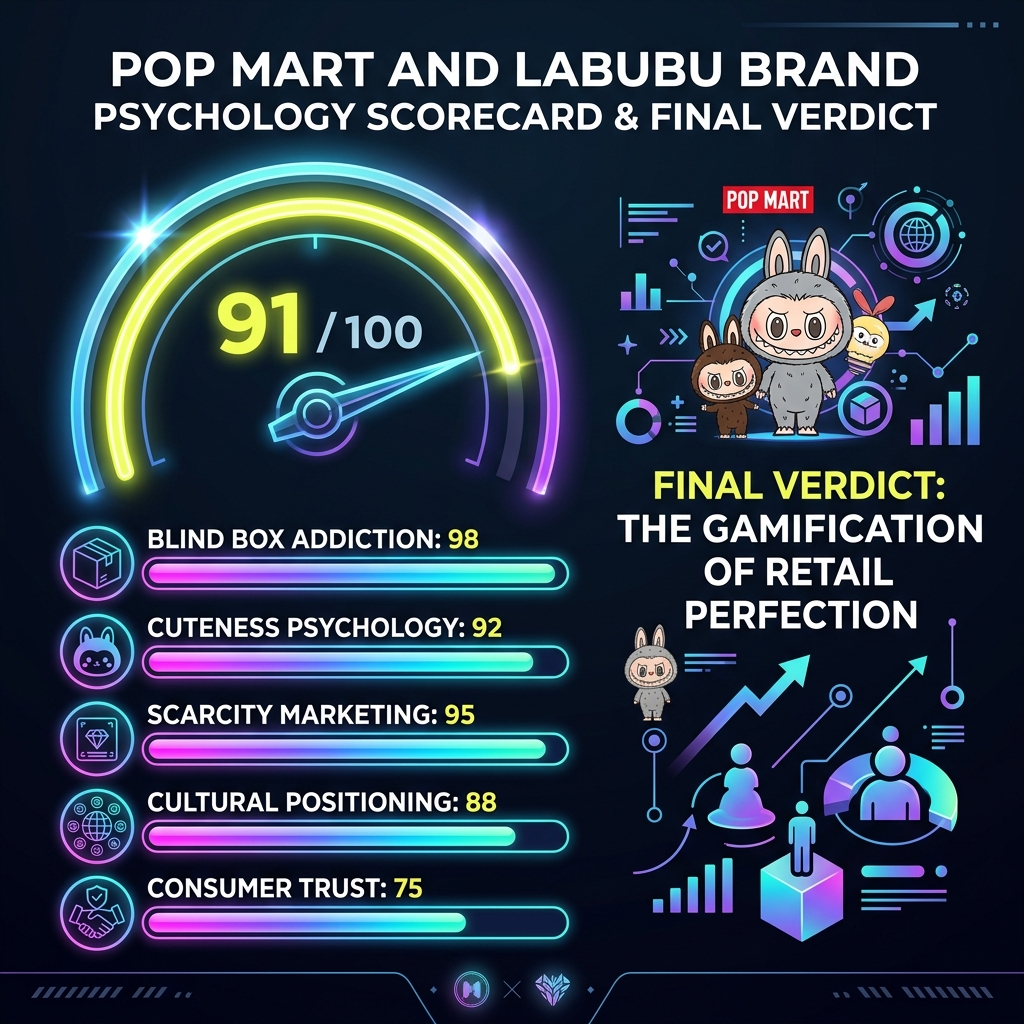
| Psychology Dimension | Score | Verdict |
| Purchase Mechanics (Blind Box Loop) | 98/100 | The most effective compulsion loop in physical retail. Near-perfect Skinnerian design. |
| Character Design Psychology | 95/100 | Baby schema + benign violation = engineered unforgettability. |
| Scarcity & Drop Engineering | 96/100 | Hunger marketing executed at global scale; resale market as visible jackpot. |
| Social Proof & Virality | 97/100 | Celebrity cascade + self-replicating unboxing content. Marketing that funds itself. |
| Retail & Ritual Experience | 90/100 | Box-shaking, robo shops, ceremony packaging — ritual deepens investment. |
| Emotional Attachment Depth | 82/100 | Strong comfort-object bonding, but story universe is underleveraged vs Sanrio/Disney. |
| Brand Durability & Fad Resistance | 62/100 | Classic mania-curve indicators present; single-IP concentration risk confirmed by market. |
| Ethical Psychology | 55/100 | Gambling mechanics without meaningful age safeguards; regulatory exposure growing. |
| OVERALL PSYCHOLOGY SCORE | 88/100 | ⚡ Extreme Impact — a masterclass with two structural cracks. |
✅ Chapter 10: Strengths & Weaknesses — The Psychological Balance Sheet
💪 Psychological Strengths
- The five-layer moat: original IP + blind box loop + wearable format + celebrity legitimacy + resale jackpot — no competitor holds the full stack
- Self-replicating marketing: the consumption ritual (unboxing) is the advertisement; customers produce it free
- Dual-mindset demand: collectors buy for emotion, speculators buy for profit — two independent demand engines on one SKU
- Comfort-object positioning: counter-cyclical demand; economic anxiety increases small-luxury purchases (lipstick effect)
- Soft-power tailwind: first globally beloved Chinese character IP — national pride amplifies domestic loyalty
⚠️ Psychological Weaknesses
- Fad-curve exposure: the growth rate itself (365.7% YoY) is the risk indicator — nothing sustainable grows like that
- Speculator contamination: resale-driven demand evaporates the moment prices flatten, and it takes casual demand with it
- Shallow story infrastructure: no series, no film, no game — Labubu has a face but not yet a world in mass consciousness
- Ethical/regulatory overhang: blind box = loot box in regulators’ eyes; one major Western ruling could break the core mechanic
- Status saturation: ubiquity is the enemy of the signal that created the demand
🔮 Chapter 11: Strategic Recommendations — A Psychologist’s Prescription
- Build the world before the crash, not after. Greenlight animated content around The Monsters immediately. Story converts speculative attachment into narrative attachment — the only known antidote to the Beanie Baby curve. Hello Kitty survived because she became a memory, not a price.
- Engineer a graceful exit for speculators. Gradually increase supply of standard figures while keeping genuine artist editions rare. Deflate the bubble slowly and deliberately rather than letting the market do it violently.
- Pre-empt regulation with self-imposed guardrails. Publish pull odds on every box (as Japan’s gacha industry does), add voluntary age verification, and cap per-transaction purchases. Owning the ethics story is dramatically cheaper than losing the mechanic to law.
- Diversify the compulsion, not just the catalog. Skullpanda, Molly, and Crybaby need their own Lisa moments — invest in organic celebrity seeding per IP rather than letting Labubu carry the entire parasocial load.
- Protect the ritual. As e-commerce share grows, replicate the box-shaking, multi-stage reveal experience digitally (live pulls, app-based reveal ceremonies) — the ritual, not the plush, is the product.
- Convert community into infrastructure. Official trading platforms, authentication services (turning the Lafufu problem into a revenue line), and collector tiers would formalize the belonging structures that make leaving the brand socially expensive.
📝 Final Verdict
Labubu is not a toy phenomenon. It is the most complete demonstration in modern retail of what happens when evolutionary biology (the face), behavioral economics (the box), and network sociology (the feed) are stacked into a single $27 product. Pop Mart found a behavior before it built a brand — and then engineered every layer of the purchase, from the box-shake ritual to the resale jackpot, with a precision that most billion-dollar tech companies would envy.
The numbers are historic: 100+ million units in a single year, an IP growing at 365.7%, and a Chinese character achieving the global cultural penetration that only Japanese and American IPs had ever reached. That achievement is real and it is earned.
But this audit must end with the honest diagnosis: Labubu currently runs on compulsion and status — the two most powerful and least durable forces in consumer psychology. The March 2026 stock plunge was the market pricing in exactly what a psychologist would warn: manias don’t plateau; they either convert into love, or they crater. Pop Mart has perhaps a two-year window to give Labubu what Hello Kitty has and Beanie Babies never did — a story, a childhood, a reason to exist after the queue disappears.
Psychology Score: 88/100 — Labubu earns one of the highest scores ever awarded on ShahzebSpeaks, with near-perfect ratings in purchase mechanics (98), virality (97), and scarcity engineering (96). It is held back by the two cracks in its foundation: an ethics score of 55 for deploying gambling architecture without guardrails, and a durability score of 62 that the stock market has already begun to price in. A masterclass — with an expiry date, unless Pop Mart acts on Chapter 11.
🧠 Want a Psychology Audit for Your Brand?
I’m Muhammad Shahzeb — an MSc Industrial Psychologist & Full-Stack Developer. I apply behavioral science to branding, web design, and conversion optimization. Let’s analyze your brand’s psychological impact.
📚 References & Sources
- Pop Mart International Group. “Annual Results Announcements 2020–2025.” HKEX Filings, popmart.com
- CNBC. “Pop Mart shares plunge over 22% as concerns over sustainability of Labubu sales dwarf stellar results.” March 2026. cnbc.com
- DemandSage. “Labubu Statistics (2026) — Global Popularity & Sales.” demandsage.com
- Visual Capitalist. “Visualized: Pop Mart’s Labubu Revenue Surge.” visualcapitalist.com
- Skinner, B. F. (1953). Science and Human Behavior. Macmillan.
- Ferster, C. B., & Skinner, B. F. (1957). Schedules of Reinforcement. Appleton-Century-Crofts.
- Berridge, K. C., & Robinson, T. E. (1998). “What is the role of dopamine in reward: hedonic impact, reward learning, or incentive salience?” Brain Research Reviews, 28(3), 309-369.
- Reid, R. L. (1986). “The psychology of the near miss.” Journal of Gambling Behavior, 2(1), 32-39.
- Lorenz, K. (1943). “Die angeborenen Formen möglicher Erfahrung” [The innate forms of potential experience]. Zeitschrift für Tierpsychologie, 5(2), 235-409.
- McGraw, A. P., & Warren, C. (2010). “Benign violations: Making immoral behavior funny.” Psychological Science, 21(8), 1141-1149.
- Winnicott, D. W. (1953). “Transitional objects and transitional phenomena.” International Journal of Psychoanalysis, 34, 89-97.
- Cialdini, R. B. (2006). Influence: The Psychology of Persuasion. Harper Business.
- Kahneman, D., & Tversky, A. (1979). “Prospect theory: An analysis of decision under risk.” Econometrica, 47(2), 263-291.
- Langer, E. J. (1975). “The illusion of control.” Journal of Personality and Social Psychology, 32(2), 311-328.
- Veblen, T. (1899). The Theory of the Leisure Class. Macmillan.
- Zeigarnik, B. V. (1927). “On finished and unfinished tasks.” Psychologische Forschung, 9, 1-85.
- Norton, M. I., Mochon, D., & Ariely, D. (2012). “The IKEA effect: When labor leads to love.” Journal of Consumer Psychology, 22(3), 453-460.
- Eyal, N. (2014). Hooked: How to Build Habit-Forming Products. Portfolio/Penguin.
- Robb Report. “Labubu Pushes Pop Mart to a Whopping $2 Billion in Sales the First Half of 2025.” robbreport.com
- Yahoo Finance. “Pop Mart Labubu Sales Hit 100 Million in 2025: 2026 Outlook and New Releases.” finance.yahoo.com
Audit conducted by Muhammad Shahzeb — MSc Industrial & Organizational Psychology | Brand Psychology Specialist | Full-Stack Web Developer
Learn more about my approach →
Key Findings
- The Blind Box mechanic uses the exact same psychological trigger (Variable Ratio Schedule) as slot machines, releasing massive dopamine spikes upon opening.
- By including 1 "Secret" rare figure in every 144 boxes, Pop Mart creates a manufactured lottery that drives extreme repeat purchases.
- Labubu's design perfectly balances cute and creepy (mischievous smile with teeth), triggering deeper emotional engagement than purely "sweet" designs.
- Pop Mart effectively shifted the target audience for toys from children to stressed adults (Kidults), offering nostalgic emotional comfort.
- The secondary resale market for rare Labubu figures acts as financial justification for consumers, allowing them to view toys as "investments" rather than expenses.
- Pop Mart's 2024 revenue exceeded $1 billion, proving that the gamification of retail is one of the most profitable business models of the decade.
Overall Psychology Score
Pop Mart (Labubu) scores 91/100 in our comprehensive psychology audit covering consumer behavior strategies, UX design principles, and psychological marketing effectiveness.
The detailed dimension scores are in the audit's Psychology Scorecard chapter.
RevolutionaryMuhammad Shahzeb
MSc Industrial Psychologist, specializing in consumer behavior, UX psychology, and brand strategy analysis. Helping brands understand the psychology behind their success.
About Muhammad Shahzeb →