Disney Psychology Audit — The $94.4 Billion Dream Machine
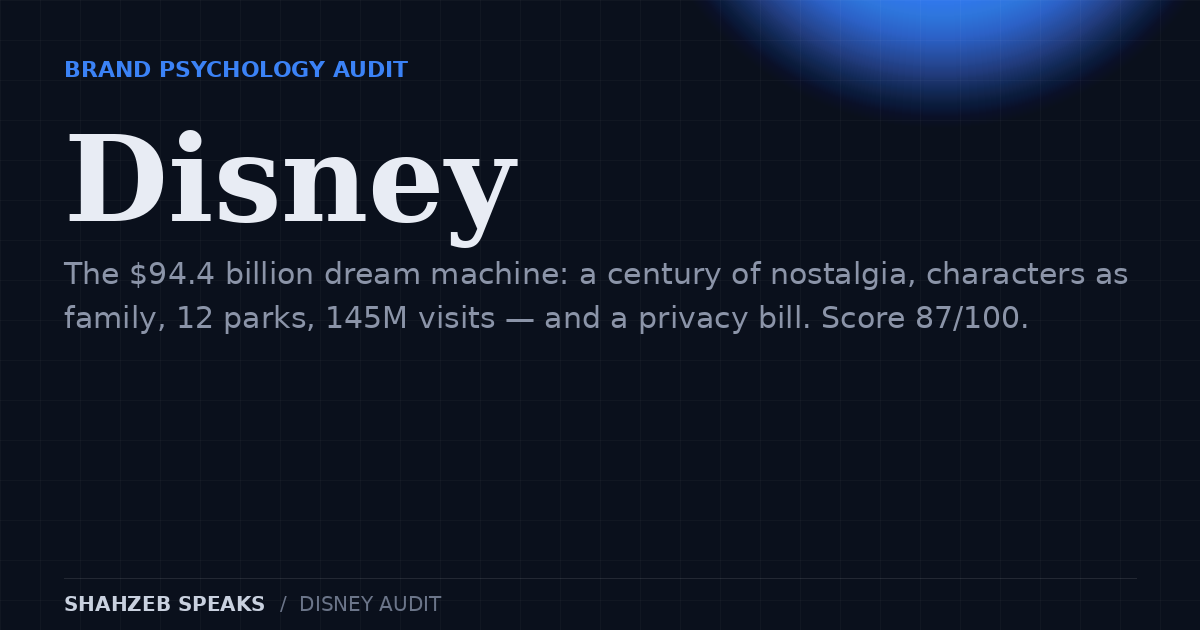
Disney psychology audit: $94.425B FY2025 revenue, record $34.151B Experiences revenue, 12 parks, ~145.2M visits. A psychologist audits nostalgia, the Vault, parasocial bonds and D23 — plus the exact legal record: DeSantis, Johansson, Dream Key, the Slack breach, and $12.75M in privacy settlements.

87 / 100
Overall consumer behavior effectiveness
Brand Overview
- Brand nameDisney
- Founded1923
- HeadquartersBurbank, California
- IndustryEntertainment
- Websitethewaltdisneycompany.com ↗
Psychology Techniques Identified
- 01Nostalgia & Intergenerational Transfer
- 02Parasocial Character Bonding
- 03Narrative Transportation (Immersive Worlds)
- 04Scarcity & the Disney Vault
- 05Endowment Effect (Vacation Club Points)
- 06Ritual & Pilgrimage (Park Visits)
- 07Fandom Community (D23 & Disney Adults)
- 08Premium Pricing as Status Signal
- 09Personalisation (MagicBands & MyMagic+)
- 10Loss Aversion (FOMO on Price Rises)
- 11Co-Creation & UGC (DisneyBounding, Fan Content)
- 12Brand Trust as Family Safety
Full Psychology Audit Report
In this audit
In 2023, the most storied entertainment company on earth had its worst year in living memory: four of its films were among the year’s biggest losers, its streaming business was bleeding money, and its chief executive was calling striking workers’ demands “not realistic” on live television. Eighteen months later, the same company posted $94.4 billion in annual revenue, three billion-dollar films, a profitable streaming business — and handed the keys to a new CEO. Disney did not rebound with better luck. It rebounded on a century of banked psychology: nostalgia engineered to the year, characters people treat as family, scarcity in a vault, and a fandom that treats a theme park like a pilgrimage site.
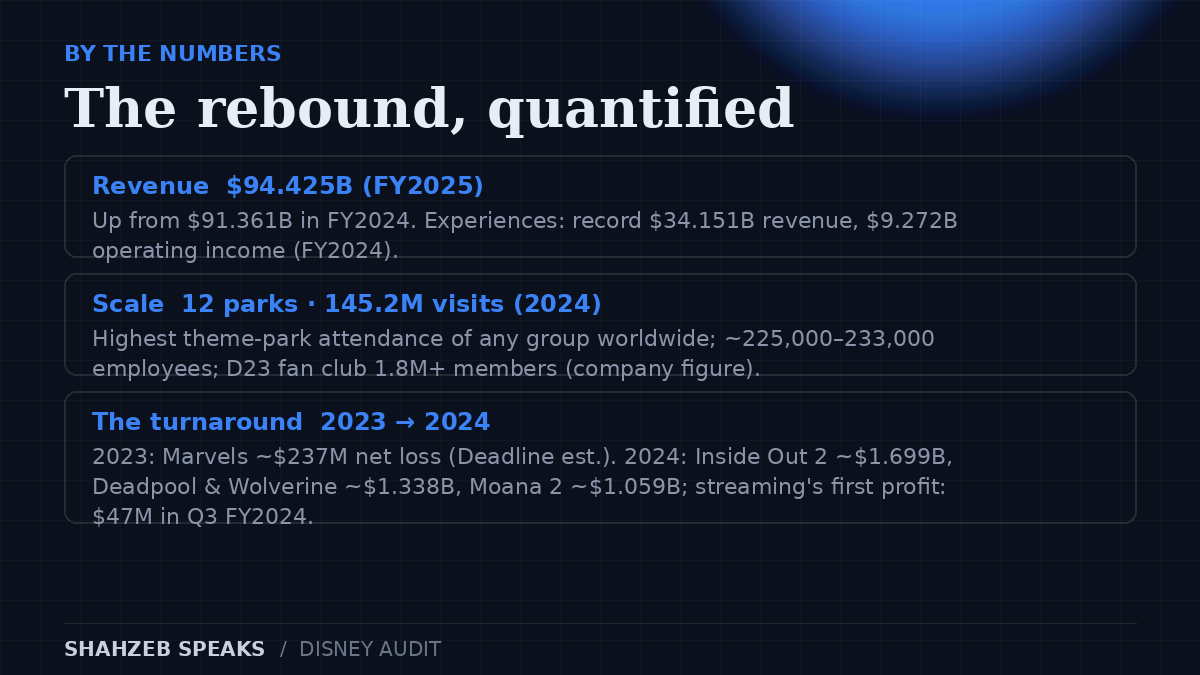
The numbers behind this audit are the scale of a small country. Fiscal 2025 revenue was $94.425 billion; the Experiences segment — parks, cruises, resorts — posted record revenue of $34.151 billion in fiscal 2024 with operating income of $9.272 billion. Twelve theme parks across six resorts drew an estimated 145.2 million visits in 2024, the highest of any park group in the world. The company has made four acquisitions that redefined the industry — Pixar ($7.4 billion), Marvel ($4 billion), Lucasfilm ($4.05 billion) and 21st Century Fox ($71.3 billion) — and on 18 March 2026 it completed its third CEO handover in four years, with parks chief Josh D’Amaro succeeding Bob Iger. It is, by almost any measure, the most psychologically sophisticated company ever built — and the one whose spell broke most publicly in 2023.
I am an Industrial and Organizational Psychologist in Karachi. I audit brands the way I audit workplaces: principles first, evidence always, flattery never. Disney scores 87/100 — but the dark side chapter contains a dismissed federal lawsuit, two privacy settlements totalling $12.75 million, and a data breach, each carried at its exact legal status. The magic is real. So are the fines.
“Disney sells the only product on earth that parents buy for their children and keep for themselves: a memory, a ritual, and a character who feels like family. The parks are the church; the films are the scripture; the Vault is the collection plate.”
— Brand Psychology Analysis, ShahzebSpeaks
📋 Brand Overview: Disney at a Glance
| Field | Detail |
| Founded | 16 October 1923, as the Disney Brothers Cartoon Studio, by Walt and Roy Disney |
| Headquarters | Burbank, California, USA |
| Leadership | Josh D’Amaro, CEO since 18 March 2026 (announced 3 Feb 2026); Bob Iger senior adviser through 31 Dec 2026 |
| Revenue | $94.425 billion (FY2025); $91.361 billion (FY2024) — company earnings releases |
| Parks & Experiences | $34.151 billion revenue, $9.272 billion operating income (FY2024, company-called records); 12 parks, ~145.2M visits in 2024 |
| Streaming | 125M Disney+ subscribers (quarter ended 28 Dec 2024); 178M Disney+ & Hulu combined |
| Employees | ~225,000–233,000 worldwide (FY2024–FY2025 range, press/secondary estimates) |
| Signature acquisitions | Pixar $7.4B (2006) · Marvel $4B (2009) · Lucasfilm $4.05B (2012) · 21st Century Fox $71.3B (2019) |
📜 Chapter 1: The History — A Century of the Dream Machine
On 16 October 1923, two brothers signed a contract to produce the Alice Comedies in a Los Angeles studio the size of a garage. Walt drew; Roy counted. That division of labour — dreamer and disciplinarian — became the company’s permanent operating system. Mickey Mouse arrived in 1928, Snow White in 1937 (the first feature-length cel-animated film, and a bet-the-company gamble that paid), Disneyland in 1955, built by a new in-house R&D arm Walt founded on 16 December 1952 and called WED Enterprises — today Walt Disney Imagineering.
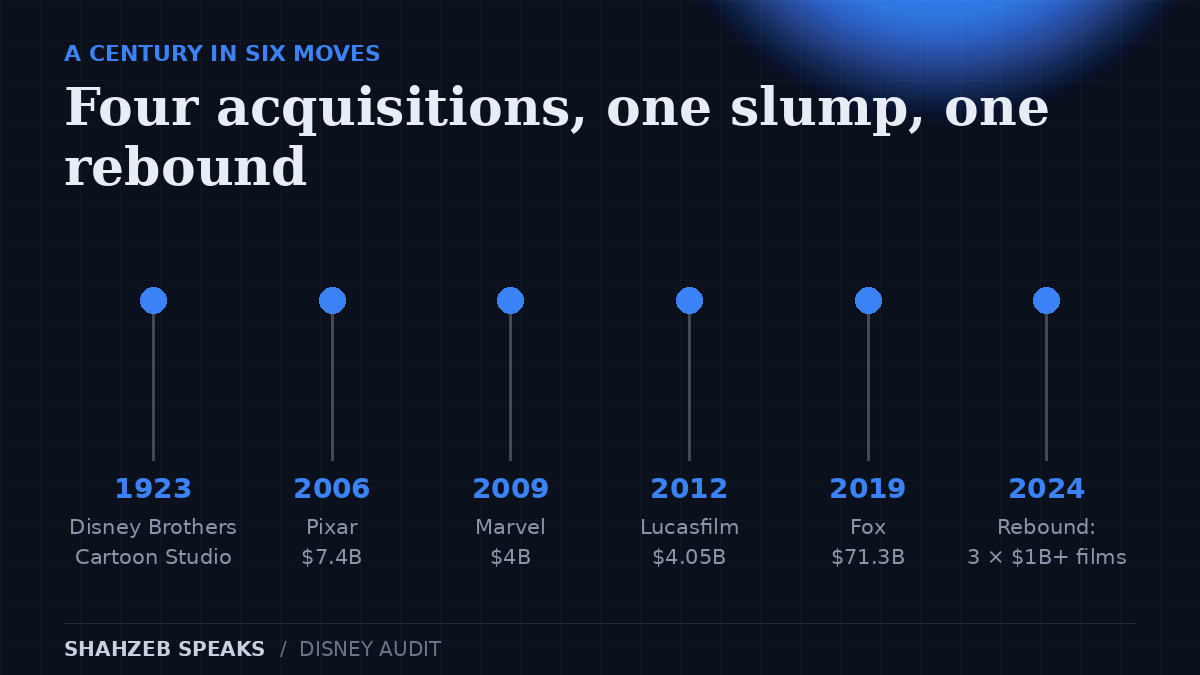
The modern empire was assembled by acquisition, and the price tags tell the strategy: Pixar for $7.4 billion in 2006 (buying the studio that was outperforming Disney Animation at its own craft), Marvel for $4 billion in 2009 (buying 5,000 characters), Lucasfilm for $4.05 billion in 2012 (buying Star Wars), and 21st Century Fox for $71.3 billion in 2019 (buying scale for the streaming war). In 2019 Disney released seven films that each grossed over $1 billion — a year no studio has matched. Then came the fall: 2023 brought an estimated ~$237 million net loss on The Marvels, ~$143 million on Indiana Jones and the Dial of Destiny, ~$131 million on Wish (Deadline estimates), a streaming business still losing money, and the twin WGA/SAG-AFTRA strikes — which Iger, on CNBC’s Squawk Box on 13 July 2023, called “very disturbing” and “not realistic.” The rebound was just as dramatic: Inside Out 2 (~$1.699 billion, the highest-grossing animated film of all time), Deadpool & Wolverine (~$1.338 billion) and Moana 2 (~$1.059 billion) made Disney the only studio past $5 billion at the global box office in 2024, and streaming turned its first combined operating profit — $47 million in Q3 FY2024, rising to $253 million in Q4. The Iger era, which began with his return on 20 November 2022, closed with the handover to Josh D’Amaro on 18 March 2026.
🕰️ Chapter 2: Nostalgia — The 23-Year Time Machine
Nostalgia is not a mood at Disney; it is inventory management. In 1989, Holbrook and Schindler published “Some Exploratory Findings on the Development of Musical Tastes” in the Journal of Consumer Research, finding that our preference for culture peaks for things we encountered at around age 23.5 — a quadratic fit of 23.47 years, later extended to films, movie stars and car models. (Honest note: replications have since shifted the peak younger, to about 17, and weakened the neat inverted-U — the classic claim stands, the exact age is debated.) Disney’s catalogue is the commercial exploitation of this curve. Every adult who wept at a Lion King re-release in their thirties was harvested on schedule.
Watch the machinery. The company celebrated its centennial — Disney100 — in 2023, a year-long nostalgia campaign built entirely on the back catalogue. The Vault (chapter 5) made old films scarce so their return felt like a reunion. The 2024 box-office rebound ran on the same fuel: Inside Out 2 and Moana 2 are sequels to films whose original audiences are now parents, and the mechanism is intergenerational transfer — the parent buys “for the child,” watches through their own childhood, and the ticket is really a time machine. Disney does not sell films. It sells your own past, remastered.
🤝 Chapter 3: Parasocial Bonds — Characters Who Feel Like Family
In 1956, Donald Horton and R. Richard Wohl coined the term “para-social relationship” in Psychiatry — “the seeming face-to-face relationship between spectator and performer.” They were writing about television hosts. They might as well have been writing about Mickey Mouse. Children form genuine one-sided attachments to characters; adults keep them. The meet-and-greet — queuing an hour to hug a person in a Goofy costume — is the industrialisation of the parasocial bond: the character is “real” enough to touch, scripted enough never to disappoint.
This is the engine beneath the documented “Disney adult” subculture. Location-data analyses cited in press coverage suggest only about 37% of Walt Disney World visitors come from households with children under 18 — adults without children are the largest slice of the audience. In the 1990s, Disney’s own advertising promised adults “A World of Magic Without the Kids!” The company understood early what the psychology predicts: parasocial bonds do not expire at eighteen. They compound. A character you loved at six is not a memory; it is a relationship — and relationships are the hardest thing in commerce to price-compete against.
🎭 Chapter 4: Narrative Transportation — Imagineering’s Immersion Engine
In 2000, Melanie Green and Timothy Brock published “The Role of Transportation in the Persuasiveness of Public Narratives” in the Journal of Personality and Social Psychology. Across four experiments they showed that when readers are transported — absorbed into a story world — their beliefs shift toward the story’s, and the effect holds whether the narrative is labelled fiction or non-fiction. Disney’s theme parks are transportation as a business model. You do not watch Star Wars at Galaxy’s Edge; you are inside it, holding a lightsaber, and the cast member refuses to break character. Belief suspension is the product.
The infrastructure behind it is staggering. Walt Disney Imagineering — the R&D arm Walt founded in 1952 — employs illustrators, architects, engineers, lighting designers and show writers whose job is to remove every seam between story and world. Then came the data layer: MagicBands, the RFID wristbands launched in 2013 as part of the MyMagic+ system (estimated at $800 million to $1 billion), which consolidate park entry, hotel access, ride reservations and payments — and let the park greet you by name. Personalisation deepens transportation: the story now knows you. I have mapped how personalisation rewires trust elsewhere in my guide to the psychology of website trust — Disney built the physical version a decade before the web caught up.
🔒 Chapter 5: Scarcity — The Vault and the Price Rise
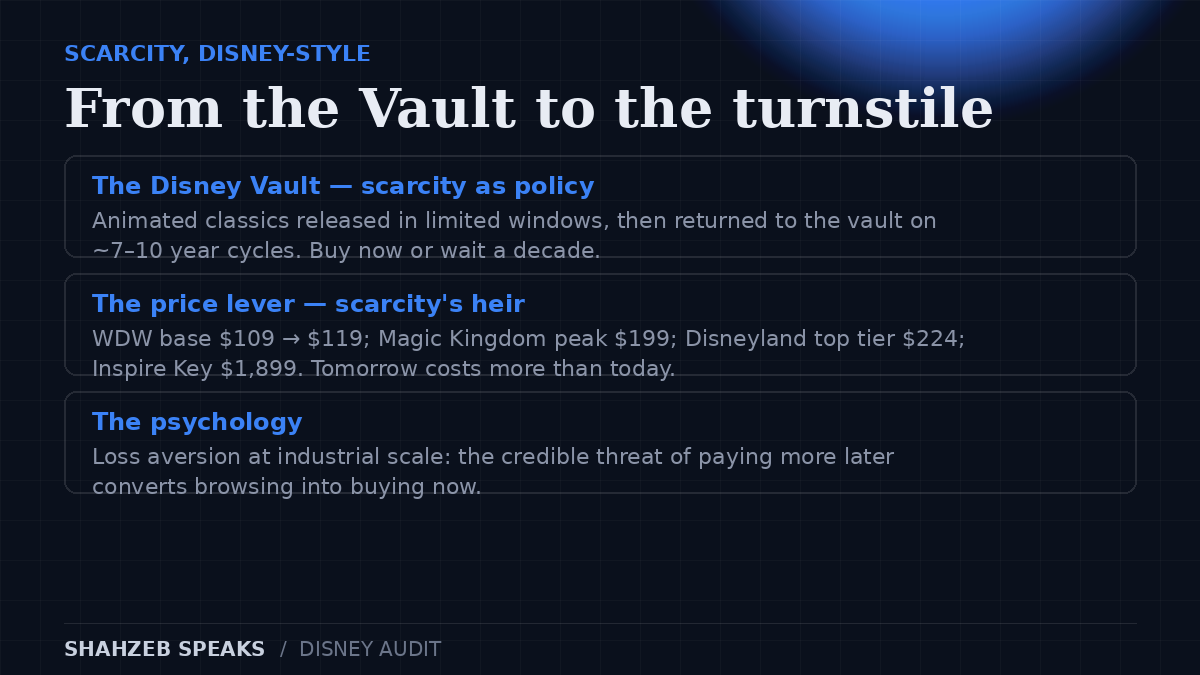
The Disney Vault was the most elegant scarcity machine in entertainment history: animated classics were released for limited windows, then returned “to the vault” — VHS reissues ran on roughly ten-year cycles, later seven to ten — so that every re-release felt like an event and every purchase felt urgent. Buy now or wait a decade. The formal moratorium policy largely ended with the Disney+ launch in 2019, but the instinct survived in new forms: limited-edition merchandise drops, timed park offerings, and the oldest scarcity lever of all — the price rise.
Disney raises park prices the way luxury houses raise handbag prices: routinely, publicly, and without apology. The Walt Disney World one-day base ticket went from $109 to $119 effective 1 January 2025 (the first base increase since December 2022); Magic Kingdom peak pricing hit $199 for the 2025 holiday season; 2026 Disneyland top-tier pricing reached $224, with the Inspire annual pass at $1,899. Each increase does double duty: it extracts more from the willing, and it signals to everyone else that demand is inexhaustible. Scarcity here is not about running out. It is about the credible threat that tomorrow costs more than today — the purest form of loss aversion in the industry. I have charted this urgency machinery across sectors in my guide to scarcity marketing examples; Disney’s version is the original.
🏰 Chapter 6: Ritual and Belonging — Pilgrimage Economics
People do not “visit” Disney parks. They return — annually, in matching shirts, with countdown apps and traditions that look, to an outsider, like religion. The rituals are documented: Disney weddings (dating to at least the 1990s), DisneyBounding (informal character-inspired outfits that began on Tumblr), pin collecting and trading, first-visit badges, the “we go every year” family doctrine. Ritual converts a purchase into an identity, and identity is price-insensitive.
The institution that organises the faithful is D23, the official Disney fan club founded in 2009, which Disney says has more than 1.8 million members worldwide (a company figure, not independently audited), with free and paid tiers up to $329.99 and a biennial convention — D23: The Ultimate Disney Fan Event — that fills Anaheim. This is social proof at cathedral scale: when 1.8 million people pay to belong, belonging becomes the product. The fan content loop completes the machine — Disney influencers receive gifted trips and produce a river of free marketing that no media budget can buy. The community does not just buy the magic. It performs it, films it, and recruits with it.
💎 Chapter 7: Endowment — The Points That Bind
The Disney Vacation Club is Disney’s timeshare programme, and it is a masterclass in the endowment effect (Kahneman, Knetsch & Thaler, 1990): we overvalue what we own. Members buy a real-estate interest expressed as an annual allotment of Vacation Points — usable across Disney resorts from Orlando to Aulani in Hawaii — which can be banked into next year or borrowed from the next. Direct pricing runs into the mid-$200s per point with minimums around 150 points, and contracts stretch to fixed horizons like 2070 for Riviera.
The psychology is the contract. Once you own points, every future holiday is mentally pre-paid; skipping a year feels like losing money you already spent. Banking and borrowing turn the calendar into a game you are already winning. And the multi-decade horizon converts a customer into a stakeholder — someone with a financial and emotional interest in Disney’s survival until 2070. Competitors sell hotel rooms. Disney sells a fifty-year relationship with a deed attached.
💰 Chapter 8: Premium Pricing — The Veblen Castle
In 1899, Thorstein Veblen published The Theory of the Leisure Class and gave economics the phrase “conspicuous consumption.” His verified formulation: “In order to gain and to hold the esteem of men it is not sufficient merely to possess wealth or power. The wealth or power must be put in evidence, for esteem is awarded only on evidence.” A $199 peak-day Magic Kingdom ticket, a $1,899 Inspire Key, a $224 top-tier Disneyland day — these are Veblen goods in mouse ears. The price is the signal: we are the kind of family that does Disney properly.
The pricing architecture is deliberate at every level. The parks extract the premium; Disney+ underprices the living room to keep the characters in daily circulation (mere exposure as a subscription); merchandise converts the memory into a shelf. Premium pricing at Disney is not extraction — it is positioning. The castle is the most expensive thing in the theme-park world the way a good watch is the most expensive thing on the wrist: the price certifies the tribe, and the tribe keeps coming back to be certified.
⚠️ Chapter 9: The Dark Side — The Real Legal and Reputational Record
Disney’s magic has a legal docket, and this chapter carries every item at its exact status, as of 14 October 2026. Two of the six items below are from the last thirteen months — the company’s privacy record, not its films, is where the current exposure sits.
Florida vs Disney — federal suit dismissed; state cases settled. After Florida replaced Disney’s Reedy Creek Improvement District with the state-controlled Central Florida Tourism Oversight District, Disney filed a federal lawsuit in April 2023 alleging First Amendment retaliation. Status: the federal suit was DISMISSED on 31 January 2024 (the court ruled Disney lacked standing to sue the Governor; claims against the district board were dismissed on the merits), and Disney appealed to the 11th Circuit in February 2024. The parallel state-court litigation SETTLED on 27 March 2024: Disney agreed the old board’s development agreements were null and void, both sides dismissed their claims, and no admission of wrongdoing was made by either side. Follow-up: Disney signed a new 15-year development agreement in June 2024 allowing up to $17 billion of investment at Walt Disney World. The feud cost Disney its self-governing district; the settlement bought it fifteen years of building rights.
Scarlett Johansson — filed, then settled. In July 2021, Johansson filed suit in Los Angeles Superior Court alleging Disney’s simultaneous Disney+ Premier Access release of Black Widow breached her exclusive-theatrical-release contract and cut her box-office-linked pay. Status: SETTLED on 30 September 2021 — terms were not disclosed, Disney denied wrongdoing, and the joint statement pledged continued collaboration. (A reported ~$40 million figure circulated in press; it was never confirmed by either party and is not printed here as fact.)
Disneyland “Dream Key” class action — settled, $9.5 million. Passholder Jenale Nielsen filed a class action in 2021 alleging false advertising: the $1,399 Dream Key was sold as having “no blockout dates” while reservation availability was restricted. Status: SETTLED — a $9.5 million fund received FINAL approval on 4 March 2024 (Judge David O. Carter), with about 103,431 Dream Key holders receiving roughly $67.41 each (supplemental $22.85 payments followed in June 2025). Disney did not admit wrongdoing.
The Slack breach — 1.1 terabytes, one guilty plea, no fine against Disney. On 12 July 2024, the hacktivist group NullBulge leaked roughly 1.1TB of Disney’s internal Slack data — nearly 10,000 channels of messages, files, unreleased projects and credentials — to BreachForums. Disney told media it was “investigating this matter,” and by September 2024 had decided to transition away from Slack. The criminal outcome: Ryan Kramer of California, operating as NullBulge, pleaded guilty after malware disguised as an AI image-generation tool harvested an employee’s credentials. Honesty note: no regulator fine against Disney over this breach was found in this research. The company’s data-security posture, not its conduct, is the exposure.
FTC COPPA — fined $10 million, settled. On 2 September 2025, the FTC (3–0 vote) referred a complaint to the Department of Justice: Disney Worldwide Services and Disney Entertainment Operations allegedly violated the COPPA Rule by failing to label some YouTube videos as “Made for Kids,” allowing children’s personal data to be collected for targeted advertising. Status: SETTLED with a $10 million civil penalty; a federal judge approved the order in December 2025. The order also mandates a video-review programme and parental-consent procedures. No admission of liability was stated — do not claim one.
California AG CCPA — settled $2.75 million, February 2026. On 11 February 2026, Attorney General Rob Bonta announced a $2.75 million settlement — the largest CCPA settlement to date — resolving allegations that Disney failed to honour opt-out-of-sale/sharing requests across devices and streaming services: opt-out toggles applied only to the device or service in use. Injunctive relief includes company-wide opt-out honoring and annual reports to the AG. Status: settled; no admission of liability stated.
Two non-legal items for completeness: Disney’s channels went dark on DirecTV on 1 September 2024 in a carriage-fee dispute affecting about 11 million subscribers — resolved 14 September 2024, not a legal action. And the 2023 box-office slump (Deadline estimates: The Marvels ~$237M net loss, Dial of Destiny ~$143M, Wish ~$131M) was a business failure, not a legal one — but it is the reason the 2024 rebound chapter exists.
🇵🇰 Chapter 10: What Pakistani Brands Should — and Shouldn’t — Copy
Copy the ritual design. Disney converts customers into pilgrims with matching shirts, countdown culture and annual traditions. A Pakistani brand with a loyal base — food, fashion, motorcycles — can engineer its own rituals: anniversary drops, member days, traditions customers perform for free. Ritual is the cheapest loyalty programme ever invented.
Copy the intergenerational play. Disney sells to the parent through the child and to the child through the parent’s nostalgia. Any Pakistani brand with a 20-year history is sitting on the same asset: the customer’s childhood. Mine it deliberately — archive campaigns, anniversary editions, “the taste you grew up with” — instead of chasing only the young.
Copy the community infrastructure. D23’s 1.8 million members (company figure) are a volunteer marketing department. A 10,000-member fan club with real perks costs little and buys the one thing advertising cannot: belonging.
Don’t copy the privacy posture. $12.75 million in privacy settlements in thirteen months — the FTC’s $10 million COPPA penalty and California’s record $2.75 million CCPA settlement — is what happens when opt-out toggles do not work across devices. If you collect customer data across an app, a website and a loyalty programme, honour the opt-out everywhere. Regulators now check.
Don’t copy the price-rise-as-strategy without the moat. Disney can raise a ticket to $199 because a century of trust and ritual makes demand inelastic. A brand without that moat that copies the increases only copies the resentment.
📊 Chapter 11: Disney Psychology Audit Scorecard — Detailed Ratings
| Psychology Dimension | Score | Verdict |
| Nostalgia & Intergenerational Pull | 94/100 | A century of catalogue engineered to the nostalgia curve; Disney100 was the proof. |
| Parasocial Character Bonding | 91/100 | Characters as family members; the Disney-adult phenomenon is the receipt. |
| Immersive Storytelling (Transportation) | 90/100 | Imagineering plus MagicBands: the story world now knows your name. |
| Scarcity & Vault Economics | 85/100 | The Vault invented entertainment scarcity; the price rise is its heir. |
| Ritual, Fandom & Community | 92/100 | D23, DisneyBounding, pin trading: pilgrimage economics at global scale. |
| Premium Pricing & Status Signalling | 87/100 | $199 peak days and $1,899 passes: the price certifies the tribe. |
| Trust & Family-Safety Gravity | 84/100 | The deepest moat in entertainment — dented by $12.75M in privacy settlements. |
| Regulatory & Reputation Resilience | 73/100 | Survived DeSantis and the strikes; but privacy enforcement is the new front. |
Score arithmetic: 94 + 91 + 90 + 85 + 92 + 87 + 84 + 73 = 696; 696 ÷ 8 = 87.0 → Overall Psychology Score: 87/100.
✅ Chapter 12: Balance Sheet & A Psychologist’s Prescription
What Disney gets right
- It monetises the full human lifespan: nostalgia for the parent, wonder for the child, ritual for the family, status for the adult fan.
- It turned fandom into infrastructure — D23, pin trading, DisneyBounding — so customers perform the marketing.
- It survived its worst year (2023) without discounting the magic: prices rose while films flopped, and demand held.
- It buys psychology, not just companies: Pixar (storytelling craft), Marvel (characters), Lucasfilm (mythology) were all acquisitions of emotional assets.
- Streaming crossed into profit ($47M in Q3 FY2024, $253M in Q4) — the Dream Machine learned a new medium in under five years.
Where it is exposed
- Privacy is the new legal front: $10M (FTC COPPA) + $2.75M (California CCPA) in thirteen months, both settled without admission — and both about children’s and consumers’ data.
- The 1.1TB Slack breach (July 2024) put internal data in public; the hacker pleaded guilty, but the security posture was the story.
- Creative concentration risk: the 2023 slump proved the machine stalls when the stories do; three of 2024’s four biggest hits were sequels.
- Price elasticity has a limit: $199 peak days and $1,899 passes test even pilgrimage-grade loyalty, and Universal is building next door.
The prescription
- Fix privacy like a product, not a legal department. Company-wide opt-out honoring should have shipped before the $12.75M in settlements. Trust is the moat; data handling is now the drawbridge.
- Rebuild the theatrical original. Sequels carried 2024; the next decade needs a new myth as durable as Frozen — bought or built, but original.
- Turn D23 into a real membership economy. 1.8 million members is a city. Give it currency: points, presales, member pricing — belonging should compound like Vacation Club points.
- Price with a conscience valve. Keep the premium — but protect one genuinely accessible tier per park, or the pilgrimage becomes a gated community and the magic curdles.
📝 Final Verdict
Disney is the most psychologically complete company I have audited: nostalgia tuned to the year you were 23, characters that function as family, stories you can walk inside, scarcity that began with a Vault and continues with a price list, rituals performed in matching shirts, and a fandom of millions doing the marketing for free. The 2023 collapse proved the psychology is load-bearing — when the stories failed, $94 billion of enterprise wobbled; when they returned, it compounded. The privacy fines and the breach are real dents in the trust moat, and the next decade will be judged on whether the company that perfected the childhood memory can also perfect the handling of children’s data. But as a system for turning human needs — belonging, wonder, memory, status — into $94.4 billion of revenue, nothing on earth comes close.
Psychology Score: 87/100 — The Dream Machine: a century of nostalgia, characters as family, and pilgrimage economics — with a privacy bill coming due.
Want your brand audited by a psychologist?
I audit how the world’s biggest brands use psychology — with the receipts. Contact me here.
More audits in this series: my LEGO psychology audit (88/100) on flow and the IKEA effect, and the Apple psychology audit (86/100). For the scarcity principle behind the Vault, read my scarcity marketing examples. I write as an industrial psychology in Pakistan practitioner — the psychology travels; the postcode doesn’t matter.
📚 References & Sources
- The Walt Disney Company. Q4 FY2024 earnings release (FY2024 revenue $91.361B; Experiences revenue $34.151B, operating income $9.272B; 174M Disney+ Core & Hulu subscriptions).
- The Walt Disney Company. Q4 FY2025 earnings release (FY2025 revenue $94.425B).
- The Walt Disney Company. Robert A. Iger appointed CEO, 20 Nov 2022 (company newsroom).
- The Walt Disney Company. D23: The Ultimate Disney Fan Event (Aug 2026, Anaheim; 1.8M+ members — company figure).
- Forbes. The Walt Disney Company profile (225,000 employees, ~$187B market cap, Sep 2026).
- Holbrook, M. B., & Schindler, R. M. (1989). Some exploratory findings on the development of musical tastes. Journal of Consumer Research, 16, 119–124.
- Horton, D., & Wohl, R. R. (1956). Mass communication and para-social interaction. Psychiatry, 19(3), 215–229.
- Green, M. C., & Brock, T. C. (2000). The role of transportation in the persuasiveness of public narratives. Journal of Personality and Social Psychology.
- Veblen, T. (1899). The Theory of the Leisure Class. Macmillan.
- Kahneman, D., Knetsch, J. L., & Thaler, R. H. (1990). Experimental tests of the endowment effect. Journal of Political Economy.
- AP / SHOOT. Scarlett Johansson and Disney settle Black Widow lawsuit (30 Sep 2021).
- Top Class Actions. Walt Disney Parks Dream Key $9.5M settlement — final approval 4 Mar 2024.
- BleepingComputer. Hacker NullBulge pleads guilty to stealing Disney’s Slack data (Jul 2024 breach, ~1.1TB).
- US Federal Trade Commission. COPPA Rule settlement with Disney — $10M civil penalty (announced 2 Sep 2025; court-approved Dec 2025).
- WilmerHale / IAPP. California AG announces $2.75M CCPA settlement with Disney (11 Feb 2026 — largest CCPA settlement to date).
- TheWrap. Disney and Florida settle lawsuit over special district fight (27 Mar 2024).
- WDWMagic. Disney federal suit dismissed 31 Jan 2024; appeal to 11th Circuit (Feb 2024).
- Deadline (via CartoonBrew). 2023 Most Valuable Blockbuster Tournament — Marvels, Dial of Destiny, Wish estimated net losses.
- Collider. 2024 global box office — Inside Out 2 (~$1.699B), Deadpool & Wolverine (~$1.338B), Moana 2 (~$1.059B); Disney only studio past $5B.
- Screen Daily. Disney streaming turns first combined operating profit — $47M, Q3 FY2024.
- WDWNT. Iger calls writer/actor strikes “very disturbing” / “not realistic” — CNBC Squawk Box, 13 Jul 2023.
- BlogMickey. 2024 attendance report — Magic Kingdom ~17.8M; Disney parks ~145.2M visits.
- WDWNT / BlogMickey / AV Club. 2025–2026 Disney park ticket price increases (WDW base $109→$119; Magic Kingdom peak $199; Disneyland top tier $224; Inspire Key $1,899).
Key Findings
- FY2025 revenue $94.425B (FY2024: $91.361B); Experiences record FY2024 revenue $34.151B, operating income $9.272B; 12 parks, ~145.2M visits in 2024 (company earnings releases)
- Acquisitions: Pixar $7.4B (2006), Marvel $4B (2009), Lucasfilm $4.05B (2012), 21st Century Fox $71.3B (2019); CEO Josh D’Amaro since 18 Mar 2026 (Iger senior adviser through 31 Dec 2026)
- 2023 slump (Deadline estimates: The Marvels ~$237M net loss, Wish ~$131M); 2024 rebound (Inside Out 2 ~$1.699B, Deadpool & Wolverine ~$1.338B, Moana 2 ~$1.059B); streaming first profit $47M in Q3 FY2024
- Florida/DeSantis: federal suit DISMISSED 31 Jan 2024 (appealed); state cases SETTLED 27 Mar 2024, no admission; 15-year, $17B development agreement signed June 2024
- Johansson suit FILED Jul 2021, SETTLED 30 Sep 2021 (terms undisclosed, no admission); Dream Key class action SETTLED $9.5M, FINAL approval 4 Mar 2024, no admission (~$67.41 to 103,431 holders)
- FTC COPPA: $10M civil penalty, SETTLED, court-approved Dec 2025, no admission; CA AG CCPA: $2.75M SETTLED 11 Feb 2026 (largest CCPA settlement), no admission; Slack breach Jul 2024 (~1.1TB, NullBulge; Kramer pleaded guilty) — no regulator fine against Disney found
Overall Psychology Score
Disney scores 87/100 in our comprehensive psychology audit covering consumer behavior strategies, UX design principles, and psychological marketing effectiveness.
The detailed dimension scores are in the audit's Psychology Scorecard chapter.
RevolutionaryMuhammad Shahzeb
MSc Industrial Psychologist, specializing in consumer behavior, UX psychology, and brand strategy analysis. Helping brands understand the psychology behind their success.
About Muhammad Shahzeb →