
In May 2025, grown adults threw punches in London shops over a $27 plush monster, and Pop Mart had to suspend in-store Labubu sales across the UK. That same evening, thousands of people on Booking.com stared at a red banner reading “Only 2 rooms left!” and booked hotels faster than they intended to. Somewhere in Paris, a wealthy customer was told, politely, that she could not buy a Hermès Birkin today, at any price, and wanted one more than ever.
Three completely different industries. One identical mechanism. Scarcity is the oldest lever in commerce and, I would argue, still the most powerful one, because it does not persuade you that something is good; it persuades you that the decision cannot wait, and a decision that cannot wait is a decision that skips thinking. I am an Industrial and Organizational Psychologist, and in this article I want to do this topic properly: the strange 1975 experiment that proved the effect with cookies, the three distinct types of scarcity brands run, thirteen real examples from Labubu to the McRib, the fake versions that regulators have already punished, and the two questions that reliably switch the whole trick off.
“Abundance asks your brain a question: do you want this? Scarcity asks a different one: can you live with losing it? Brands discovered long ago that the second question has only one answer people can bear to give.”
— Consumer Psychology Analysis, ShahzebSpeaks
🍪 The cookie jar experiment: the science in one study

In 1975, Stephen Worchel and colleagues ran an experiment so simple it feels like a prank. Participants rated chocolate chip cookies from a jar. Some got a jar holding ten cookies; others got a jar holding two. Identical cookies. The cookies from the nearly empty jar were rated more desirable, more attractive, and worth more money. And the effect got stronger with a twist: when participants first saw a full jar that was then replaced by a near-empty one, desirability jumped even higher. Scarcity is powerful; becoming scarce is more powerful still. Every “selling fast” banner on the internet is that jar swap, performed digitally, a million times a day.
Three mechanisms drive it. Loss aversion, from Kahneman and Tversky’s prospect theory: losses hurt roughly twice as much as equivalent gains please, and a disappearing product converts a neutral non-purchase into a felt loss. Psychological reactance, from Jack Brehm: when freedom to have something is threatened, we want it more, purely to restore the freedom. And commodity theory, from Timothy Brock: unavailability functions as information, because the brain reasons, usually without asking permission, that if something is running out, other people must know something. Notice that last one carefully. Scarcity smuggles social proof inside it. “Almost gone” doesn’t just mean hurry; it means everyone else already decided.
One more distinction before the examples, because brands mix these deliberately. Quantity scarcity: limited units (“only 3 left”). Time scarcity: limited window (“sale ends tonight”). Access scarcity: limited eligibility (“invite only”, “members first”). They feel similar and work differently: quantity triggers competition with other buyers, time triggers deadline stress, and access triggers status hunger. The best operators in the list below run all three at once.
🎁 The 13 real examples
1. Labubu and Pop Mart: scarcity as the entire business
I wrote a full psychology audit of Labubu, so here is the compressed version: Pop Mart can manufacture effectively unlimited plush monsters and deliberately does not. Limited drops, unpredictable restocks, region exclusives, and secret figures seeded at roughly 1-in-72 odds combine quantity scarcity with lottery mechanics. The result was 100+ million units sold in 2025, queues at dawn, and the London store brawls that forced a sales suspension, which then became the most valuable free advertising the brand ever received, because nothing certifies scarcity like the news reporting fights over it. The masterstroke is the visible resale market: when a $27 box might contain a figure reselling for hundreds, scarcity stops being a constraint and becomes a jackpot.
2. Booking.com: the anxiety dashboard

Open any hotel listing and count the pressure signals: “Only 2 rooms left on our site”, “Booked 4 times in the last 24 hours”, “12 people are looking at this property”, “In high demand”. Each is individually defensible as information; stacked together they form what I can only call an anxiety dashboard, quantity scarcity, social proof, and time pressure firing simultaneously while you compare prices. It works, which is why the entire travel industry copied it. It also attracted regulators: the UK’s Competition and Markets Authority secured formal commitments from major booking sites in 2019 to stop misleading pressure tactics, such as counting rooms only on their own platform while implying total availability, and the EU has pushed similar transparency since. Booking.com remains the single best place on the internet to watch scarcity engineering live, now in a slightly better-behaved form.
3. Supreme: the drop model that built a religion
The New York skate brand codified modern scarcity: small weekly drops, Thursday mornings, no restocks, ever. The predictable rhythm plus guaranteed unavailability created queues, bots, a resale economy, and the strange spectacle of a $30 t-shirt with a red box logo reselling for hundreds. Supreme’s insight was that reliability of scarcity beats surprise: because everyone knows nothing returns, every item is a now-or-never decision by design. Half the brands in this list, including Rhode and Pop Mart, are running Supreme’s playbook in other categories.
4. Rhode: the waitlist as advertising
Hailey Bieber’s beauty brand, audited in full here, spent three years deliberately hard to buy: DTC only, limited flavor drops, recurring sellouts, waitlists in the tens of thousands. Every sellout generated headlines, every waitlist number was social proof, and when the dam finally opened at Sephora in September 2025, three years of manufactured famine converted into $10 million of sales in two days. That sequence, scarcity first, scale second, is the textbook execution.
5. Amazon: scarcity at industrial scale
“Only 3 left in stock (more on the way)” is the most honest-dishonest sentence in e-commerce: literally true at warehouse level, psychologically engineered in presentation. Add Lightning Deals with progress bars (“58% claimed”) and countdown clocks, and Amazon runs quantity and time scarcity on millions of SKUs simultaneously. The progress bar is a particularly elegant touch because it is the cookie jar experiment rendered as UI: you are watching the jar empty in real time.
6. Daraz and the 11.11 flash sale economy
South Asia’s biggest shopping event is a scarcity festival: flash sales, “mystery boxes”, countdown timers on every banner, and vouchers that expire in minutes. I covered the mechanics in my Daraz brand audit, and the regional detail worth repeating is that flash-sale culture works even harder in markets where scarcity was recently real: a generation raised on genuine shortages carries a deeper “get it while it exists” reflex, and platforms have learned to pull that thread with manufactured versions.
7. Nike SNKRS: the raffle you lose on purpose
Nike converted sneaker releases into lotteries: enter the draw, mostly lose, occasionally win the right to pay retail price. Losing is the product. Each loss deepens investment (near-miss psychology, the same lever slot machines pull), makes eventual wins feel earned, and keeps demand permanently above supply by design. The resale market then displays the jackpot value of every win. It is Labubu’s architecture for footwear, and it predates Labubu.
8. Hermès Birkin: the scarcity summit
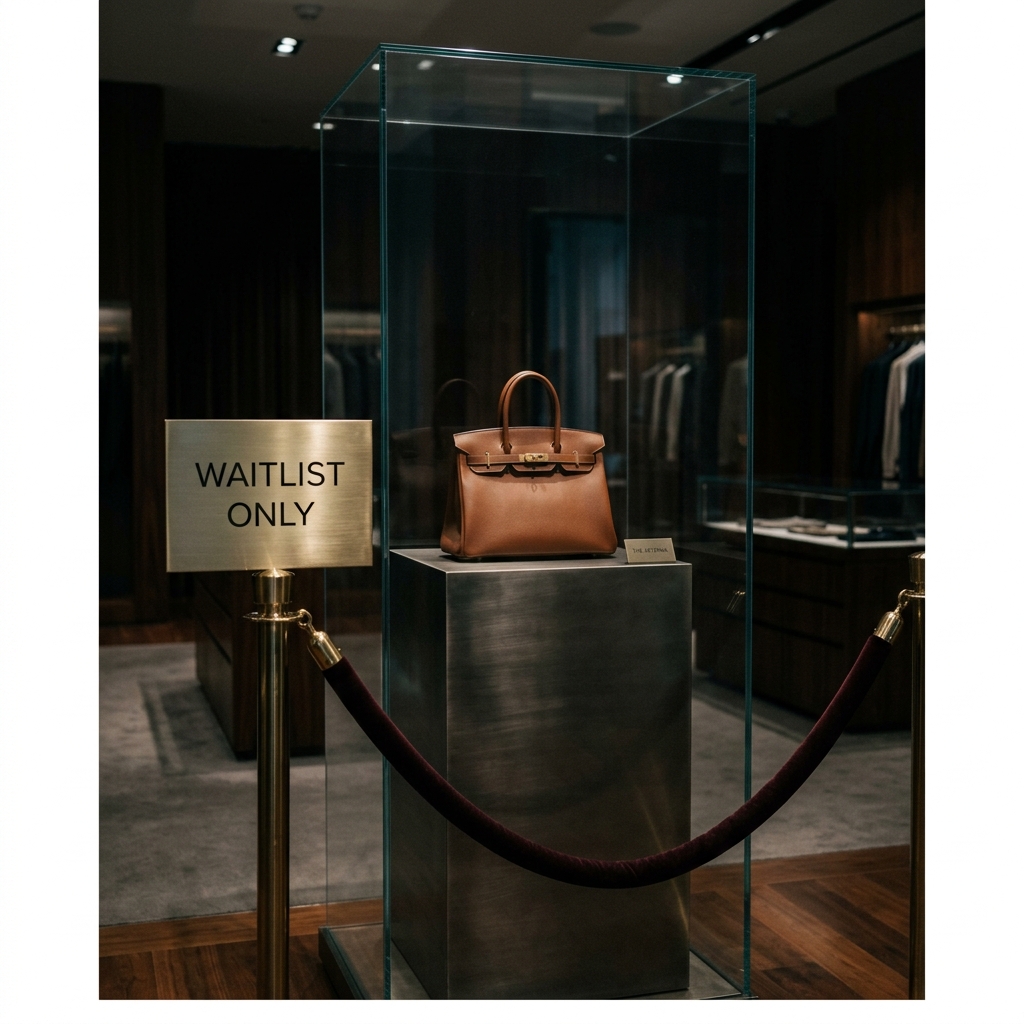
The most extreme example in commerce. You cannot walk into Hermès and buy a Birkin; you build a purchase history, cultivate a relationship with a sales associate, and perhaps, eventually, are offered one. This is access scarcity at its purest: the constraint is not stock but permission. The psychological effect is unmatched, a bag that cannot be bought outranks every bag that can, and resale prices above retail prove it. My honest note: this only works from genuine positional strength. A mid-market brand imitating permission-scarcity just annoys customers. Hermès earned the right to say no over 180 years, which is why nobody else can copy the play.
9. The McDonald’s McRib: rotating scarcity
A sandwich of ordinary quality with an extraordinary marketing engine: it leaves. The McRib’s periodic disappearances and returns generate news coverage, tracker websites, and queues that a permanent menu item could never inspire. Seasonal rotation is scarcity’s gentlest form, and it quietly powers Starbucks’ Pumpkin Spice season, KitKat’s Japan-exclusive flavors, and every “limited edition” biscuit in your supermarket. The product barely matters. The calendar is the marketing.
10. Airlines and “2 seats left at this price”
Fare-class systems mean the message is often technically true: two seats remain in this price bucket, with more available higher up. The presentation, though, is engineered to read as “the plane is filling”, converting a routine pricing tier into a quantity panic. Combined with countdown-timer checkout holds, airline booking flows are among the most pressure-dense interfaces in existence, and knowing the fare-bucket truth is one of the few genuinely useful defenses against them.
11. Ticketmaster and the countdown queue
Concert ticketing stacks every scarcity type at once: fixed inventory (real), a visible queue with your position in it, a countdown on your cart, and dynamic prices that rise as you watch. The queue is the psychologically fascinating part, because it manufactures competition before you have seen a price: thousands of people ahead of you is social proof, threat, and sunk cost in one number, and by the time you reach the front, refusing feels like wasting the wait.
12. Clubhouse, Gmail, and invite-only tech
Tech’s version is access scarcity: Gmail launched invite-only in 2004 and invitations were traded like currency; Clubhouse repeated the trick in 2021 and briefly hit a multi-billion valuation on the strength of exclusion alone. The mechanism is pure reactance plus status: a door that most people cannot open makes the room behind it feel important. The cautionary half of the story: Clubhouse opened the doors, the scarcity evaporated, and so did the desire, which tells you what fraction of the “product” the velvet rope actually was.
13. De Beers: the century-long scarcity myth
The grandfather of them all. Diamonds are not geologically rare in the way their price implies; for most of the twentieth century De Beers controlled supply, warehoused stones, and marketed the scarcity it manufactured, alongside the “a diamond is forever” campaign that made resale unthinkable (keeping supply off the market permanently). It is the largest and longest-running scarcity operation in commercial history, and a standing reminder that scarcity is often a decision, not a fact.
⚖️ An honest caveat: fake scarcity, and when the trick collapses
Because this article will be read by marketers as well as shoppers, the line needs drawing. Scarcity claims sit on a spectrum. Real: Supreme’s no-restock policy, concert seats, a genuine last unit. Framed: airline fare buckets, “only 3 left” counting one warehouse. Fake: countdown timers that reset on refresh, “5 people viewing” counters generated by a plugin, sale deadlines that quietly extend forever. The third category is not clever marketing; in a growing number of jurisdictions it is illegal, and the UK CMA’s action against booking sites plus the EU’s Omnibus Directive on fake urgency show which way enforcement is moving.
The deeper problem with fake scarcity is not legal, it is psychological: it is a trust bomb with a delay fuse. Customers eventually notice the timer that never expires, and scarcity claims from that brand stop working permanently, because scarcity’s entire power comes from believed information. Worse, the belief damage spreads to your honest claims. I have seen e-commerce clients wonder why their genuine year-end sale stopped converting; the answer was the fake “last chance” banner they had run every week since March. Cry wolf with urgency and the one real deadline you ever have will be ignored.
🛡️ How to defend yourself: two questions that break the spell
Scarcity pressure is designed to prevent deliberation, so the defense is anything that forces deliberation back in. Two questions do most of the work.
“Would I want this if there were a warehouse full of them?” This strips the commodity-theory signal out of the decision and leaves only your actual preference. Astonishingly often, the answer is no; the wanting was pointed at the running-out, not the product. The cookie experiment’s participants were not hungrier for the scarce cookies. They were responding to the jar.
“What actually happens if I miss it?” Loss aversion inflates the imagined pain of missing out; naming the real consequence deflates it. Usually the honest answer is: a restock in three weeks, an equivalent product elsewhere, or a resale market. Genuine one-time opportunities exist, but they are rarer than the banners claim by several orders of magnitude. And one practical habit: on any booking site, open a second tab and check availability elsewhere before the countdown bullies you. The “last room in the city” has a suspicious habit of existing on three other websites.
💼 Using scarcity ethically (for the business owners)
I consult on this, so here is the framework I give clients. Scarcity is ethical when it is true and informative: real inventory limits, honest deadlines, genuine editions. It is manipulative when it is manufactured to prevent thinking. The practical rules: never display a number (stock, viewers, timers) that is not literally true; make deadlines real by honoring them, because a deadline that passes is your most credible marketing asset for the next one; prefer rhythm to panic, since Supreme-style predictable drops build anticipation culture while random countdown bombardment builds anxiety and churn; and if your product genuinely is not scarce, use a different lever, because the decoy effect, anchoring, and the Diderot effect are all available without borrowing urgency you do not have. Scarcity is a loan against trust. Real scarcity repays it. Fake scarcity defaults, with interest.
❓ Frequently asked questions
What is scarcity marketing in simple terms?
Making a product feel limited, in quantity, time, or access, so that the decision feels urgent and skipping it feels like a loss. It works because losses weigh roughly twice as much as gains in human decision-making.
What is the most famous scarcity experiment?
Worchel, Lee and Adewole’s 1975 cookie jar study: identical cookies were rated more desirable when the jar was nearly empty, and most desirable of all when a full jar was replaced by a near-empty one.
Is fake scarcity illegal?
Increasingly, yes. The UK CMA forced booking platforms to change misleading pressure tactics, and EU consumer law targets fake countdown timers and false “limited stock” claims. Beyond legality, exposed fake scarcity permanently destroys a brand’s urgency credibility.
What are the three types of scarcity marketing?
Quantity scarcity (limited units), time scarcity (limited window), and access scarcity (limited eligibility, like invite-only products or the Hermès Birkin system). They trigger competition, deadline stress, and status hunger respectively.
Why does scarcity marketing work so well?
Three stacked mechanisms: loss aversion (missing out feels like losing), reactance (threatened freedom increases desire), and commodity theory (unavailability reads as evidence of value, smuggling social proof inside the scarcity signal).
🧠 Want your marketing analyzed by a psychologist?
I’m Muhammad Shahzeb, an MSc Industrial and Organizational Psychologist and Full-Stack Developer. I audit funnels, pricing pages, and campaigns using the research in this article, including telling you which of your urgency tactics are quietly burning customer trust.
📚 References and further reading
- Worchel, S., Lee, J., & Adewole, A. (1975). “Effects of supply and demand on ratings of object value.” Journal of Personality and Social Psychology, 32(5), 906-914. (The cookie jar experiment.)
- Cialdini, R. B. (2006). Influence: The Psychology of Persuasion. Harper Business. (Scarcity principle.)
- Brehm, J. W. (1966). A Theory of Psychological Reactance. Academic Press.
- Brock, T. C. (1968). “Implications of commodity theory for value change.” In Psychological Foundations of Attitudes. Academic Press.
- Kahneman, D., & Tversky, A. (1979). “Prospect theory: An analysis of decision under risk.” Econometrica, 47(2), 263-291.
- UK Competition and Markets Authority. “Hotel booking sites to make major changes after CMA probe.” 2019. gov.uk
- Reid, R. L. (1986). “The psychology of the near miss.” Journal of Gambling Behavior, 2(1), 32-39. (Raffle and near-miss mechanics.)
- Epstein, E. J. (1982). “Have you ever tried to sell a diamond?” The Atlantic. (De Beers supply control.)
- Pop Mart International Group annual results and 2025 reporting on UK in-store sales suspension; see also the full Labubu audit on this site.
- Cosmetics Business reporting on Rhode’s Sephora launch, 2025; see also the full Rhode audit on this site.
Written by Muhammad Shahzeb, MSc Industrial & Organizational Psychology | Consumer Psychology Specialist | Full-Stack Web Developer
Learn more about my approach →