
It is 8 in the morning, and a university student is sitting in a lecture hall with a stomach that will not settle. She has already been to the toilet twice, skipped breakfast because food felt risky, and now she cannot follow the lecture because her attention keeps sliding back to the cramp in her belly. She has ADHD, and she has learned to treat the two problems as separate — one for the study skills tutor, one for the doctor. New research on ADHD gut health suggests they may not be separate at all. People with ADHD are far more likely to live with gut symptoms, and the pattern is too consistent to dismiss — even though nobody yet knows what causes it.

I am an Industrial and Organizational Psychologist in Karachi, and I write about work, study and behaviour for a global reader. This article is built on one primary source read directly: the paper by Sarah Blake, Hugo Cannon and Saran Shantikumar, published in the Journal of Attention Disorders on 10 September 2026, the first systematic review to focus on gut symptoms in ADHD rather than diagnosed gut disease. It pooled 23 studies covering over 1.9 million people, aged 2 to 65, in 11 countries.
“Almost every gut symptom we looked at: constipation, IBS, even indigestion, appeared to be associated with ADHD. These symptoms can have a real impact on daily life, but they could easily be overlooked if the focus is on ADHD itself.”
— Sarah Blake, co-lead author, Warwick Medical School, 2026
This guide covers the short answer, how the review was done, the numbers for each symptom, how common ADHD is, the possible mechanisms, the medication question, what helps and what does not, what it means for students and employees, and the limits you should know before acting on any of it.
🎯 Chapter 1: The short answer — what does ADHD gut health research show?
People with ADHD have 48% higher odds of gut symptoms than people without ADHD, according to a 2026 review of 23 studies covering over 1.9 million people. Constipation, IBS and diarrhoea are all more common, yet no study proves ADHD causes them. Medication, eating habits and stress may each play a part.
That paragraph is the whole article in miniature. The review, by Blake, Cannon and Shantikumar (2026) at Warwick Medical School, found that ADHD was associated with a 48% increase in the odds of gastrointestinal symptoms compared with neurotypical controls — an odds ratio of 1.48, with a 95% confidence interval from 1.35 to 1.62. The authors’ own conclusion is that “ADHD is associated with a substantial increase in functional GI symptoms, distinct from organic gastrointestinal disease”. Functional, here, means symptoms without a diagnosed disease such as inflammatory bowel disease behind them — the review deliberately excluded studies of formally diagnosed organic gut disease.
The second thing to hold on to is that association is not cause. Every study in the review was observational, and the authors state twice that the review “cannot confirm causality”. When I describe a possible mechanism — the microbiome, the vagus nerve, irregular meals — I am describing a hypothesis the authors put forward, not a proven cause. And the review’s clinical message is aimed at doctors: clinicians caring for people with ADHD “should be aware of this increased risk of GI symptom presence and should actively ask about GI symptoms during consultations”. If your own doctor has never asked, that is worth knowing — and worth raising yourself.
📊 Chapter 2: The study — 23 studies, over 1.9 million people
The review, published online on 10 September 2026 in the Journal of Attention Disorders, followed the PRISMA 2020 reporting standard, and its protocol was registered in advance on PROSPERO (CRD42024602363). The authors searched MEDLINE, Embase and APA PsycInfo from their beginnings to 12 May 2026, with two reviewers working independently. The search began with 9,613 records and ended with 23 studies: 6 retrospective cohort studies, 16 cross-sectional studies and 1 case-control study, together representing over 1.9 million participants. The authors received no financial support for the research and declared no potential conflicts of interest.
The inclusion rules decide what the numbers mean. Participants had to have a diagnosis of ADHD defined by the DSM or ICD, the standard diagnostic manuals, and to report gut symptoms. Studies of formally diagnosed organic gut disease were excluded, as were people with both autism and ADHD, case reports, conference abstracts and non-English papers. Excluding people with both autism and ADHD matters: gut symptoms are well documented in autism, so keeping that group out means the ADHD figures are not inflated by autism overlap. The studies came from 11 countries — 10 in the USA, 3 in Sweden, 2 in Israel, and 1 each in Spain, Greece, Germany, China, South Korea, Turkey, Iran and India — with sample sizes from 50 to 742,939 and ages from 2 to 65 years. That spread is a strength, because the pattern held across countries and ages, and a weakness, because the studies measured symptoms in different ways, and that variation shows up as heterogeneity, which I will flag symptom by symptom.
📈 Chapter 3: The numbers — which symptoms, and by how much?
The headline is the 48% figure from Chapter 1. The detail underneath it is more useful, because not every symptom is raised by the same amount.
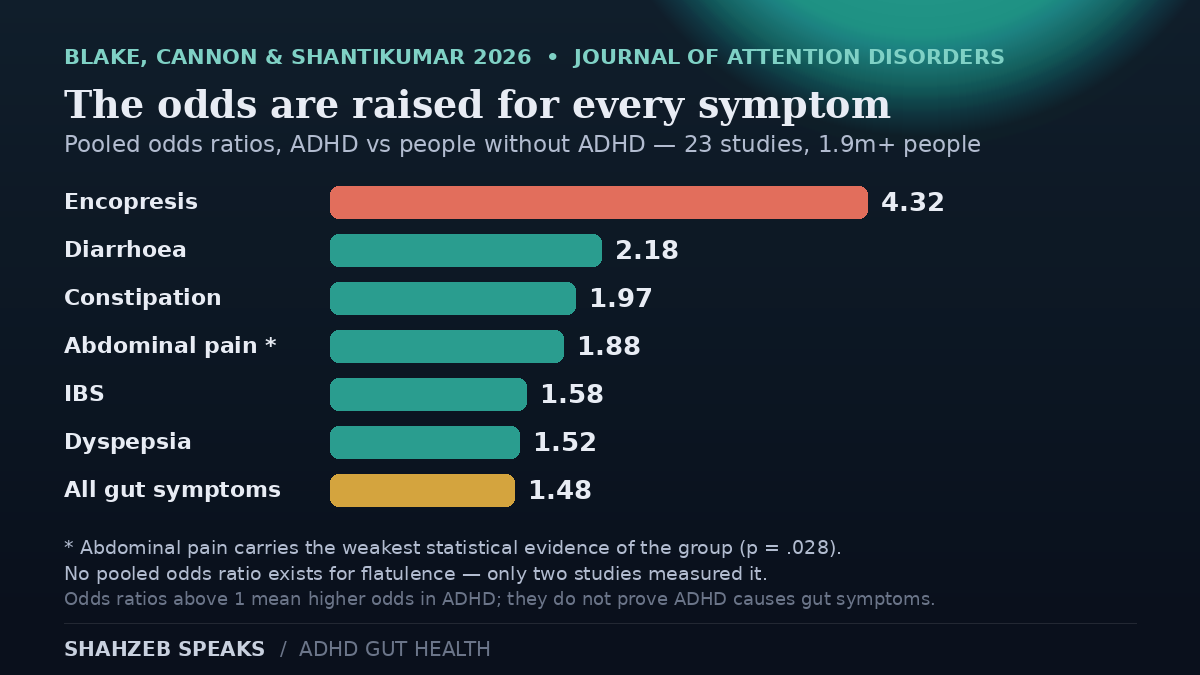
Constipation comes first, because it is both common and striking. People with ADHD had almost double the odds of constipation: an odds ratio of 1.97, with a 95% confidence interval from 1.49 to 2.61, pooled from six of seven studies. But heterogeneity was very high — I² = 95.1% — which means the studies disagreed with each other more than chance alone would explain, most likely because some asked parents and others used medical codes. I would read the direction as solid and the exact size as approximate.
Encopresis is the strongest association in the whole review. Encopresis means repeated involuntary passing of stool, or loss of bowel control, and people with ADHD had over four times the odds of it: an odds ratio of 4.32, with a 95% confidence interval from 2.50 to 7.47, pooled from all five studies that reported it. That does not mean four in ten people with ADHD experience encopresis. It means that, whatever the background rate is, the odds are roughly four times higher in ADHD. Heterogeneity was high here too, at I² = 77.8%, but the direction was consistent across the five studies.
Diarrhoea was more than twice as likely, with an odds ratio of 2.18 and a confidence interval from 1.52 to 3.13. Abdominal pain was 88% more likely, with an odds ratio of 1.88 and a confidence interval from 1.07 to 3.30 — but this is the weakest result in the review, with a p-value of .028, the only one that comes close to the usual threshold for significance, and heterogeneity of I² = 78.5%, driven largely by gender-stratified cohorts in one older study, Holmberg and Hjern (2006). I would treat abdominal pain as probably raised, and as the least certain of the main findings.
Two results stand out for the opposite reason: they are consistent. Irritable bowel syndrome, or IBS, was 58% more likely in ADHD, with an odds ratio of 1.58 and a confidence interval from 1.39 to 1.78 — and heterogeneity was low, at I² = 4.5%, which means the eight studies that reported it largely agreed. Dyspepsia, or indigestion and upper-abdominal discomfort, was 52% more likely, with an odds ratio of 1.52 and a confidence interval from 1.43 to 1.61, and no observed heterogeneity at all (I² = 0.0%). Unspecified stomach and bowel problems were almost twice as likely, with an odds ratio of 1.82 and no heterogeneity either.
| Symptom (Blake et al. 2026) | Odds ratio | What it means |
|---|---|---|
| All gut symptoms combined | 1.48 [1.35, 1.62] | 48% higher odds |
| Constipation | 1.97 [1.49, 2.61] | Almost double the odds |
| Encopresis | 4.32 [2.50, 7.47] | Over four times the odds |
| Diarrhoea | 2.18 [1.52, 3.13] | More than double the odds |
| Abdominal pain | 1.88 [1.07, 3.30] | 88% higher odds; weakest evidence |
| IBS | 1.58 [1.39, 1.78] | 58% higher odds; consistent |
| Dyspepsia (indigestion) | 1.52 [1.43, 1.61] | 52% higher odds; consistent |
| Unspecified stomach/bowel problems | 1.82 [1.61, 2.07] | Almost double the odds |
| Flatulence | No pooled figure | Both studies found more, but no pooled OR exists |
Two symptoms have no pooled number, and the gap is instructive. Flatulence could not be pooled: only two studies reported it, and they measured it in incompatible ways. Both found more flatulence in ADHD. In one, Ming and colleagues (2018), the difference was statistically significant (p = .019). In the other, Martínez-González and colleagues (2025) in Spain reported flatulence in 13.3% of people with ADHD against 3.9% of controls, with no statistical analysis reported. I am giving you those two descriptions because that is all the review can support — anyone who quotes a single pooled figure for flatulence is inventing it. Nausea and vomiting are in the same position: no pooled result is reported for them in the paper, so I will not claim one. Nausea appears later only as a medication side effect.
The IBS finding also has independent support. A second review, by Ng and colleagues (2025) in Scientific Reports, looked at diagnosed intestinal disorders rather than symptoms, pooling 11 studies covering 3,851,163 people. It found no significant increase for intestinal disorders overall — an odds ratio of 1.25, with a confidence interval from 0.75 to 2.07, which crosses 1 — so I will not present that as a confirmed increase. But for IBS specifically it found an odds ratio of 1.63, with a confidence interval from 1.45 to 1.83, very close to Blake and colleagues’ 1.58. Two independent reviews, asking the question in different ways, landing within a few points of each other on IBS: that is the kind of convergence that makes me trust a finding more.
🌍 Chapter 4: How common is ADHD — and why the scale matters
A 48% increase sounds large, and it is. But it only matters at scale if ADHD itself is common, and it is. Thomas and colleagues (2015), pooling 175 studies in Pediatrics, found ADHD in 7.2% of children worldwide, with a 95% confidence interval from 6.7% to 7.8%. Estimates were lower in Europe than in North America, and most studies used single towns or regions rather than population sampling, which limits how far the figure can be generalised. Even with those limits, roughly one child in fourteen is a lot of children.
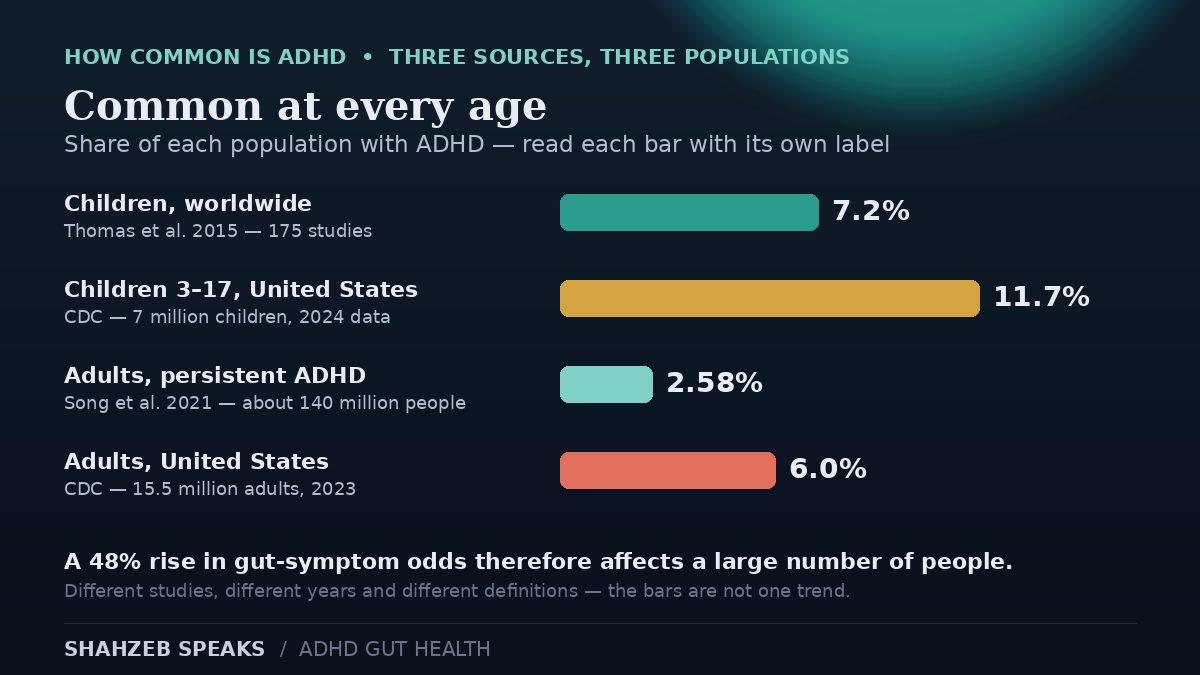
Adults are often left out of this conversation, as if ADHD were a childhood condition that fades. It does not always fade. Song and colleagues (2021), in the Journal of Global Health, reviewed 40 articles from 30 countries and estimated persistent adult ADHD — ADHD that began in childhood and continued — at 2.58% of adults, with a 95% confidence interval from 1.51% to 4.45%, or about 139.84 million adults as a modelled 2020 estimate. Their broader figure for symptomatic adult ADHD, which drops the childhood-onset requirement, was 6.76%. Both figures fall with age.
The United States figures are sharper, because they come from national surveys. The Centers for Disease Control and Prevention, updating its data in July 2026, reports that an estimated 7 million children aged 3 to 17 in the United States — 11.7% — had a current ADHD diagnosis, based on 2024 parent-survey data. Boys were diagnosed more often than girls, at 13% against 7%. About 6 in 10 of those children had moderate or severe ADHD, and nearly 78% had at least one other co-occurring condition. About 30% received neither medication nor behaviour treatment in 2022. For adults, Staley and colleagues (2024), writing in the CDC’s MMWR, estimated 15.5 million US adults — 6.0% — had a current ADHD diagnosis by self-report, based on 7,046 interviews in late 2023. About half, 55.9%, were first diagnosed at age 18 or older, and 36.5% had received no ADHD treatment in the previous 12 months.
🧠 Chapter 5: Why might the gut and the brain be linked?
This is the chapter where I have to disappoint you a little, because the honest answer is that nobody knows yet. Dr Sylvia Baker, a consultant psychiatrist who was not involved in the review, told Medical News Today that the relationship is “likely to be complex rather than having one single explanation”, and added: “At present, it is tempting to look at microbiome differences and assume they are causal, but we simply do not have enough evidence to make that leap.” I agree with her, and everything in this chapter should be read with that sentence attached.
The gut-brain axis
The gut-brain axis is a two-way communication network between the central nervous system and the gut, working through neural, endocrine and immune pathways. Certain gut bacteria can secrete neurotransmitters such as GABA, dopamine and serotonin, which are implicated in ADHD. The vagus nerve is a key route in that network, and children with ADHD have been found to have reduced vagus nerve activity and parasympathetic tone. Gut dysbiosis — an imbalance in the gut microbial community — can increase gut permeability, leading to systemic inflammation, and elevated inflammation markers have been reported in ADHD. Every part of that paragraph is presented in the review as a possible pathway, not as established cause. The wiring exists. Whether it explains the symptoms is unproven.
Microbiome differences
Blake and colleagues propose gut microbiome dysbiosis as their first mechanism. A separate 2026 review, by Rodrigues and colleagues in Microorganisms, searched the literature to 31 December 2025 and found a mixed picture: most studies found no significant difference in alpha-diversity — the variety of microbes within one person’s gut — between ADHD and control groups, while differences in beta-diversity, the composition from one person to another, were more consistent. ADHD was often associated with reduced abundance of Alistipes and of butyrate producers such as Faecalibacterium, and with increased Roseburia and Agathobacter. But the findings remain inconsistent, because of differences in methods and confounding by diet, medication and age — and no meta-analysis was performed because the studies were too different to pool.
Behaviour — the most ordinary explanation
The third mechanism is the least glamorous and, to my mind, the most plausible as a partial explanation. Emotional dysregulation and heightened stress reactivity, recognised features of ADHD, can increase visceral sensitivity and are associated with functional abdominal pain. Impulsive eating and irregular mealtimes may lead to skipped meals or binge episodes, and those behaviours are independently associated with dyspepsia, bloating, constipation and abdominal pain. Sensitivity to food textures and smells may lead to selective eating and avoidance of fibre-rich or varied diets, which can alter bowel habits and cause constipation. Differences in interoceptive awareness — the sense of what is happening inside your own body — may delay recognition of the need to defecate, increasing the risk of constipation or encopresis. None of this is proven as a cause. All of it is a plausible route from ADHD traits to gut symptoms, through ordinary daily behaviour. Sleep belongs here too: sleep disturbance is a core somatic comorbidity of ADHD, and it is known to influence gut motility, immune responses and visceral sensitivity — so disrupted sleep may amplify an underlying gut vulnerability.
💊 Chapter 6: Medication — the confound you cannot ignore
Before anyone concludes that ADHD itself causes gut problems, there is a confound that has to be faced head-on: the medicines used to treat ADHD cause gut symptoms of their own. Stimulant medications such as methylphenidate are known to cause abdominal pain and nausea, and the review’s authors are direct about the problem. They write that “the majority of included studies did not stratify results by medication status” — most studies did not separate people taking medication from people who were not — and that “we cannot rule out that some observed associations are iatrogenic”, meaning caused by treatment rather than by the condition.
The side-effect evidence is not thin. Holmskov and colleagues (2017), in PLOS ONE, pooled 185 methylphenidate randomised controlled trials in children and adolescents with ADHD. In parallel-group trials, methylphenidate decreased appetite, with a risk ratio of 3.66, and weight, with a risk ratio of 3.89. In cross-over trials, it increased abdominal pain, with a risk ratio of 1.61. The authors also note that all the trials were at high risk of bias, so those numbers should be read with care.
That said, medication does not explain everything. The review’s authors write that “the robust associations observed with constipation and encopresis symptoms, which are less typically associated with stimulant use, suggest an intrinsic neurobiological or behavioural component distinct from any potential pharmacological effects”. Stimulants suppress appetite and can cause stomach pain and nausea. They are not typically linked to constipation or to loss of bowel control — yet those are the symptoms with the largest odds ratios in the review, at 1.97 and 4.32. If medication were the whole story, you would expect the stomach-pain figures to dominate. The pattern runs the other way. Future research, the authors say, “should differentiate intrinsic biological pathways from medication-related effects”.
The practical point is the one Dr Baker makes: “if symptoms started or became noticeably worse after beginning or changing ADHD medication, that should be discussed with the prescribing clinician” — and do not assume every gut symptom in someone with ADHD is part of the condition or its medication. Timing matters. A symptom that began the week a dose changed is a different conversation from a symptom present since childhood, before any medication was prescribed. Neither conversation should happen by stopping medication on your own, which the evidence in this article does not support.
🥗 Chapter 7: What helps — and what the evidence does not support
This is the chapter most readers will have come for, and it is the one where I have to be most careful. The short version is that the popular answers — probiotics, restrictive diets, supplements — have the weakest evidence, and the boring answers — regular meals, fibre, fluids, activity, sleep — have the strongest support, which is not the same as proof. No trial in this research pass found that a specific diet, probiotic strain or supplement improves gut symptoms in people with ADHD specifically. If you see that claim online, ask for the trial. It was not found here.
Probiotics: two meta-analyses, no clear benefit
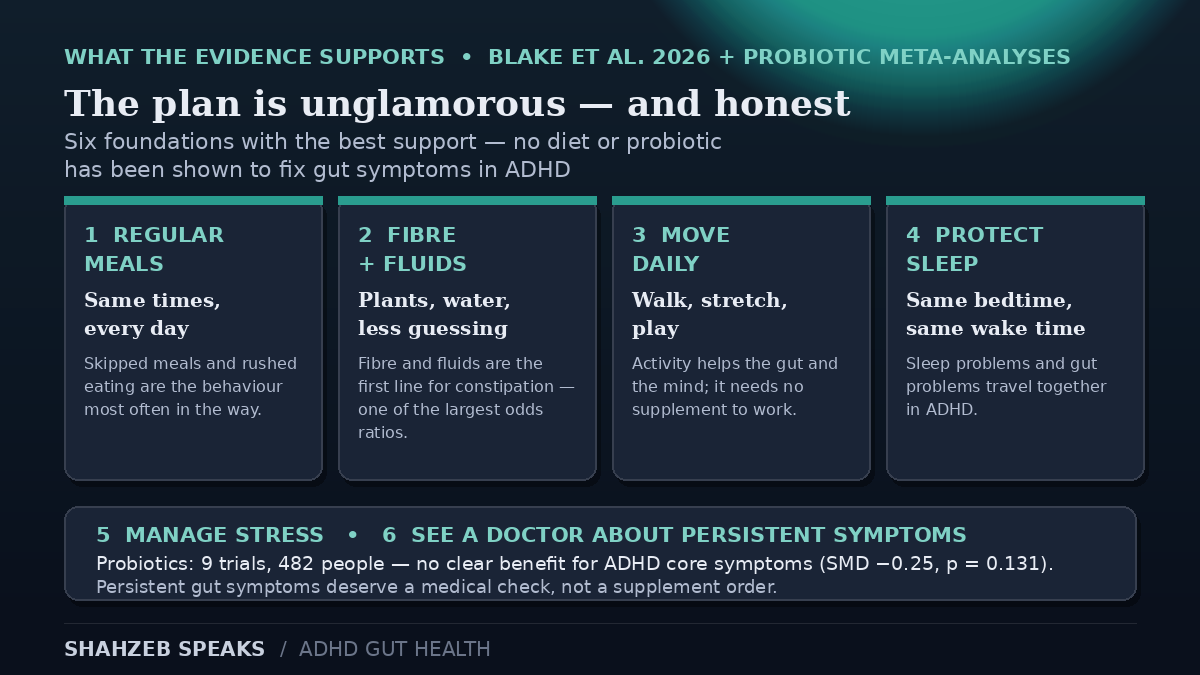
The newest evidence is a 2026 meta-analysis in Nutrients, which pooled 9 randomised controlled trials covering 482 children and adolescents with ADHD, with interventions lasting 8 to 12 weeks. Overall, probiotics did not show a clear benefit for ADHD-related clinical outcomes: the standardised mean difference was −0.25, with a 95% confidence interval from −0.57 to 0.07 and a p-value of 0.131 — the interval crosses zero, which means no clear effect. One exploratory measure, the Conners’ Parent Rating Scale total score, showed a small reduction (SMD −0.33, p = 0.041), but the Child Behavior Checklist total score did not (p = 0.386), and the hyperactivity finding was driven largely by a single study. The authors’ conclusion is plain: “Current 8–12-week RCT evidence does not demonstrate a clear benefit of probiotic supplementation for ADHD core symptom-related measures.”
An earlier meta-analysis points the same way. Liang and colleagues (2024), in BJPsych Open, pooled 7 randomised placebo-controlled trials with 379 participants, mean age 10.37 years and range 4 to 18, and found no significant improvement in total ADHD symptoms (SMD 0.25, p = 0.12), inattention (SMD 0.14, p = 0.30) or hyperactivity and impulsivity (SMD 0.08, p = 0.54) compared with placebo. Note what both reviews measured: ADHD core symptoms, not gut symptoms. Even if probiotics helped attention — and on this evidence they do not clearly do so — that would not prove they help the gut.
Diets: no support for generalised restriction
A 2026 narrative review in the Jornal de Pediatria, covering dietary and nutritional interventions in childhood neuropsychiatric disorders from 2019 to 2025, states that “there is no scientific support for generalized dietary interventions, such as restrictive diets or nutritional supplementation, in the treatment of childhood neuropsychiatric disorders”. Probiotics, it says, “have shown inconsistent results for core ASD/ADHD symptoms, although they may alleviate gastrointestinal complaints in subgroups”. That last clause is the closest supportable statement for gut benefit in this whole research pass, and it is not tied to a specific intervention, a specific strain, or a specific group. Omega-3 fatty acids showed “modest and heterogeneous effects”, with high-dose EPA possibly improving attention when baseline levels are low.
The practical foundations
What is left is less exciting and more useful. Dr Baker’s advice, given as expert guidance rather than trial evidence, is to build consistency: regular meals, adequate fluid intake, sufficient dietary fibre and regular physical activity are sensible foundations for good bowel health. For ADHD specifically, she suggests reminders for meals and hydration, simple nutritious foods readily available, and predictable routines — and addressing sleep and stress, which affect gut function. She also cautioned against adopting restrictive diets or taking multiple supplements on anecdotal evidence without consulting a specialist doctor first. A restrictive diet imposed on a child who already eats selectively because of sensory sensitivities can make nutrition worse, not better.
For a student or an employee, the practical version is small and concrete. Eat at roughly the same times each day, even on deadline days. Keep water and a simple snack where you work. Build movement into the day — a walk between lectures, stairs instead of a lift. Protect sleep, because disrupted sleep may amplify gut vulnerability. And if gut symptoms persist, or change, or come with weight loss, blood, or pain that wakes you at night, see a doctor rather than adding another supplement. Dr Baker puts the threshold plainly: “If someone with ADHD is regularly experiencing constipation, diarrhea, abdominal pain, bloating or changes in bowel habits, it is worth discussing this with [their family doctor] rather than simply putting it down to their ADHD.” On managing attention itself under pressure, see my article on decision fatigue.
🎓 Chapter 8: What this means for students and employees
The research in this article was not done in classrooms or offices, and I will not pretend it was. But its implications land squarely in both places, because gut symptoms and attention problems compound each other in a way that a single diagnosis never captures.
For students, the mechanism is easy to picture. A lecture is ninety minutes long. A student with ADHD is already working harder than their peers to hold attention for that long. Add a cramp, or the worry of needing the toilet, or the fog that follows a skipped breakfast, and the effort doubles. Exams make it worse: stress raises gut sensitivity, and the exam hall offers no graceful exit. The research does not measure exam scores against gut symptoms, and I will not invent that link. But the Blake review’s finding that gut symptoms are a “common comorbidity in ADHD” that “should not be overlooked” is, in practice, a statement about exactly this kind of day. My article on early social media and test scores looks at a different pressure on the same age group, and the lesson is the same: small, repeated disadvantages accumulate across a term.
For employees, the pattern is similar but the stakes are different. Meetings run long, toilets may be a walk away, lunch is the first thing sacrificed when a deadline slips — and irregular meals, as Chapter 5 described, are independently associated with dyspepsia and constipation. An employee with ADHD who skips lunch, feels unwell by three o’clock, and then cannot focus for the rest of the afternoon is not lazy. They are caught in a loop the research describes but does not solve: attention difficulties make regular eating harder, and irregular eating makes gut symptoms worse, which makes attention harder still. Breaking that loop does not require a new diet. It requires the unglamorous things from Chapter 7 — a regular lunch, water at the desk, a walk at midday — and a manager who does not treat a lunch break as optional. On the wider cost of ignoring how work actually feels, see my article on the psychology of workplace burnout, and on protecting the inner resources that carry people through demanding weeks, psychological capital at work.
⚠️ Chapter 9: The honest limits — and when to see a doctor
Every claim in this article has a limit, and this chapter states them. The first is the one I flagged in Chapter 1: all the included studies were observational, so the review “cannot confirm causality”. It is possible that ADHD traits lead to gut symptoms, through behaviour or biology. It is also possible that gut discomfort worsens attention, so that the arrow runs the other way. It is possible that a third factor — stress, sleep, diet, medication — drives both. Longitudinal studies that follow people over time, to establish whether gut symptoms appear before an ADHD diagnosis, alongside it, or after treatment, are what the authors and Dr Baker both call for, and they have not been done yet.
The second limit is medication. Most included studies did not separate people by medication status, and stimulants cause abdominal pain and nausea. Some part of the association is almost certainly iatrogenic, and the review cannot say how large that part is. The constipation and encopresis results argue against medication being the whole story, as Chapter 6 explained, but “not the whole story” is not the same as “no part of the story”. The third limit is measurement. Symptoms were ascertained differently across studies — parental report in some, medical codes in others — and that variation shows up as high heterogeneity for constipation, diarrhoea and abdominal pain. The IBS and dyspepsia results, with low or no heterogeneity, are more trustworthy on that count than the constipation result, even though the constipation number is larger.
Finally, there is the question of what to do. This article is not medical advice, and it does not replace a clinician. See a doctor if gut symptoms are persistent, if they change suddenly, if they come with weight loss, blood in the stool, pain that wakes you at night, or vomiting that does not settle — and see one sooner if symptoms began or worsened after starting or changing ADHD medication, so the prescribing clinician can review it. For children, encopresis and constipation in a child with ADHD deserve a medical conversation, not embarrassment and not waiting. The review’s authors say complex cases “may benefit from input from a dietitian or gastroenterologist”. That is a referral, not a supplement order. Dr Shantikumar, the senior author, puts the overall message in words I would not improve on: “We can’t yet say ADHD causes these gut problems, or exactly what is driving the link, but the pattern is striking enough to warrant attention. Clinicians caring for people with ADHD may want to consider asking about gastrointestinal symptoms, particularly if they may be affecting quality of life.”
❓ Questions I am asked most often
Does ADHD cause stomach problems?
No — not as a proven cause. A 2026 review of 23 studies found people with ADHD have 48% higher odds of gut symptoms, but all the studies were observational, so the review cannot confirm causality. ADHD is associated with gut problems; whether it causes them, and how, is still unknown.
Is IBS more common in people with ADHD?
Yes. Blake and colleagues (2026) found IBS 58% more likely in ADHD, with an odds ratio of 1.58, and the result was consistent across the eight studies that reported it. A second review, Ng and colleagues (2025), found almost the same figure, an odds ratio of 1.63, which strengthens the finding.
Why are children with ADHD more likely to be constipated?
The review does not prove a single reason, but it proposes several: selective eating linked to sensitivity to food textures and smells, which can reduce fibre intake; irregular meals; and delayed recognition of the need to defecate, linked to differences in interoceptive awareness. Medication is a less likely explanation here, since stimulants are not typically linked to constipation.
Can ADHD medication cause stomach pain?
Yes. Stimulant medicines such as methylphenidate are known to cause abdominal pain and nausea. A 2017 review of 185 trials found methylphenidate increased abdominal pain, with a risk ratio of 1.61, and reduced appetite. If pain started or worsened after a dose change, discuss it with the prescribing clinician rather than stopping the medicine yourself.
Can probiotics help ADHD?
On current evidence, no clear benefit has been shown. A 2026 meta-analysis of 9 trials with 482 children found no clear benefit for ADHD outcomes, and a 2024 meta-analysis of 7 trials with 379 participants found no significant improvement in total symptoms, inattention or hyperactivity. Neither review tested whether probiotics help gut symptoms in ADHD specifically.
Does diet affect ADHD and gut health?
Probably through everyday eating patterns, but no specific diet is supported by evidence. A 2026 review found no scientific support for generalised restrictive diets or nutritional supplementation in childhood neuropsychiatric disorders. The defensible advice is regular meals, enough fibre and fluids, physical activity, sleep and stress management, not an elimination diet.
When should someone with ADHD see a doctor about gut symptoms?
See a doctor if gut symptoms are regular or persistent — constipation, diarrhoea, abdominal pain, bloating or changing bowel habits — rather than assuming they are “just ADHD”. Seek care sooner if symptoms began after starting or changing medication, or if they come with weight loss, blood, night-time pain or vomiting that does not settle.
If you live with ADHD and gut symptoms are part of your daily life — or if you are a parent, teacher or manager supporting someone who does — you do not need a new diet or a shelf of supplements. You need the question asked, the basics done consistently, and a doctor involved when symptoms persist. I am an Industrial and Organizational Psychologist, and I work with organisations on work design, wellbeing, study and the measurement of behaviour. Get in touch here.
If you want the wider context, start with my guide to industrial psychology in Pakistan and my article on psychological capital at work. For attention under pressure, see decision fatigue, and for the cost of ignoring how work actually feels, the psychology of workplace burnout.
Sources
- Blake, S., Cannon, H. & Shantikumar, S. (2026). The association between attention-deficit hyperactivity disorder and gastrointestinal symptoms: A systematic review and meta-analysis. Journal of Attention Disorders. Published online 10 September 2026. https://doi.org/10.1177/10870547261469626
- University of Warwick (2026, 10 September). People with ADHD more likely to suffer gut problems. https://warwick.ac.uk/news/pressreleases/people-with-adhd-more-likely-to-suffer-gut-problems/
- Thomas, R., et al. (2015). Prevalence of attention-deficit/hyperactivity disorder: A systematic review and meta-analysis. Pediatrics, 135(4), e994–e1001. https://doi.org/10.1542/peds.2014-3482
- Song, P., et al. (2021). The prevalence of adult attention-deficit hyperactivity disorder: A global systematic review and meta-analysis. Journal of Global Health, 11, 04009. https://doi.org/10.7189/jogh.11.04009
- Centers for Disease Control and Prevention (updated 8 July 2026). Data on ADHD in children. https://www.cdc.gov/adhd/data/index.html/
- Staley, B. S., et al. (2024). Attention-deficit/hyperactivity disorder diagnosis, treatment, and telehealth use in adults — National Center for Health Statistics Rapid Surveys System, United States, October–November 2023. MMWR, 73(40), 890–895. https://doi.org/10.15585/mmwr.mm7340a1
- Ng, Q. X., et al. (2025). Attention-deficit/hyperactivity disorder and intestinal disorders: A systematic review and meta-analysis. Scientific Reports, 15, 19278. https://doi.org/10.1038/s41598-025-04303-x
- Rodrigues, J., Miranda, J. & Costa de Oliveira, R. (2026). Gut microbiota composition and diversity in attention-deficit/hyperactivity disorder: A systematic review. Microorganisms, 14(6), 1301. https://pmc.ncbi.nlm.nih.gov/articles/PMC13302901/
- Holmskov, M., et al. (2017). Gastrointestinal adverse events of methylphenidate in children and adolescents with ADHD: A systematic review and meta-analysis. PLOS ONE, 12(6), e0178187. https://doi.org/10.1371/journal.pone.0178187
- Ming, X., et al. (2018); Martínez-González, A. E., et al. (2025); Holmberg, K. & Hjern, A. (2006). As reported in Blake, Cannon & Shantikumar (2026) above; none of the three papers was read directly.
- Probiotic supplementation in ADHD: A systematic review and meta-analysis (2026). Nutrients, 18(14), 2357. https://www.mdpi.com/2072-6643/18/14/2357
- Liang, C.-S., et al. (2024). The effect of probiotic supplementation on ADHD symptoms: A systematic review and meta-analysis. BJPsych Open, 10(1), e36.
- Dietary and nutritional interventions in the treatment of childhood neuropsychiatric disorders (2026). Jornal de Pediatria, 102 Suppl 1, 101465. https://www.jped.com.br/en-dietary-nutritional-interventions-in-treatment-articulo-S0021755725001548
- Medical News Today (2026). ADHD linked to around 50% higher odds of gut problems, including IBS (independent expert comment from Dr Sylvia Baker, MRCpsych). https://www.medicalnewstoday.com/articles/adhd-linked-higher-odds-every-gastrointestinal-symptom-investigated