
It is a Thursday afternoon and a project manager is staring at a spreadsheet she finished an hour ago. She is not upset. She is not exhausted. She is not even particularly unhappy. She is just flat — languishing at work, as psychologists call it — and the week is passing through her without leaving much of a mark, and when a colleague asks how she is doing, the only honest answer she can find is “fine”. She sleeps well enough, she gets the work done, and nothing is wrong in the way that would send her to a doctor. Yet nothing feels right either. A new report from the University of Illinois, released on 16 November 2026, puts a number on how common that feeling is: in its most recent survey wave, roughly 57% of American workers were languishing at work. Languishing at work is the quiet middle of mental health — neither depressed nor thriving — and in 2026 it is the majority experience, not the exception.

I am an Industrial and Organizational Psychologist in Karachi, and I write about work and behaviour for a global reader. This article is built on primary sources read directly: Corey Keyes’s 2002 paper that defined languishing, Adam Grant’s 2021 New York Times piece that brought the word into everyday language, and the University of Illinois Gies College of Business Workplace Wellbeing Reports from January 2025, February 2026 and November 2026 — three waves of nationally representative survey data covering around 2,000 American workers each. It is written for two people at once: the employee who feels flat and wants to know whether that feeling has a name and what to do about it, and the manager who wants to know why a team that is not burned out is still not performing. Both questions have answers, and both come with honest limits, stated plainly. Languishing is real, it is measurable, and it is not a personal failing — but it is also not a diagnosis, and this article will not pretend that it is.
“It wasn’t burnout — we still had energy. It wasn’t depression — we didn’t feel hopeless. We just felt somewhat joyless and aimless.”
— Adam Grant, The New York Times, 19 April 2021
This guide covers the short answer, what languishing actually is and where it sits on Keyes’s mental health continuum, the 2026 numbers in full, how languishing differs from burnout and depression, what it costs workers and employers, the three habits that separate flourishers from languishers, what managers should change about the work itself, and the limits of the evidence — including when flatness is a sign to seek professional help.
🎯 Chapter 1: The short answer — languishing at work, explained
Languishing at work is the in-between state where you are neither depressed nor thriving: you function, but without energy, purpose or delight. In the Gies Fall 2026 report, about 57% of US workers were languishing. It is not burnout and not depression — and because it is quiet, it is missed until it costs you motivation, focus or your job.
That short paragraph is the whole article in miniature, and it is worth unpacking slowly, because the idea is easy to misunderstand. Languishing is not a synonym for being tired, and it is not a softer word for burnout. It is a specific state defined by the sociologist Corey Keyes in 2002: a person who has low levels of emotional well-being — little positive feeling toward life — and low levels of psychological and social functioning, but who has not been depressed in the past year. In his words, languishers are “neither mentally ill nor mentally healthy”. They go to work, they answer emails, they meet deadlines. They just do it without enthusiasm, without a sense of progress, and without much connection to the people around them.
The reason this matters in 2026 is scale. When the Gies College of Business first measured languishing at work in January 2025, 57% of American workers were languishing and 43% were flourishing. A year later, in February 2026, the figure was 61% languishing against 39% flourishing, in a nationally representative sample of 2,000 workers. In the Fall 2026 release, based on four survey waves run with YouGov across 2025 and 2026, the most recent wave put languishing at roughly 57% again. The number moves a little from wave to wave, and flourishing has edged upward over the year — but the headline has not changed in two years: most workers are not thriving. They are getting by.
One more thing belongs in this chapter, because it shapes everything that follows. Languishing is not a diagnosis. It does not appear in the DSM, and no clinician would write it on a chart. It is a description of a state of well-being — or rather, of the absence of well-being — and it is useful precisely because it names something that the language of illness misses. A worker can be free of depression and still be far from well. That gap, between “not ill” and “well”, is where most of working life actually happens.
🧭 Chapter 2: What languishing actually is — Keyes’s continuum
To understand languishing, you need the model it comes from, because the model is what makes the idea precise instead of vague. Keyes proposed that mental health is not one line from sick to well, but two related dimensions: mental illness on one side, and mental health — the presence of well-being — on the other. A person can be free of mental illness and still have almost no mental health. That is languishing. A person can also have a mental illness and still function well in some areas of life. The two are related, but they are not the same thing, and treating them as the same thing is how workplaces miss most of what is wrong.
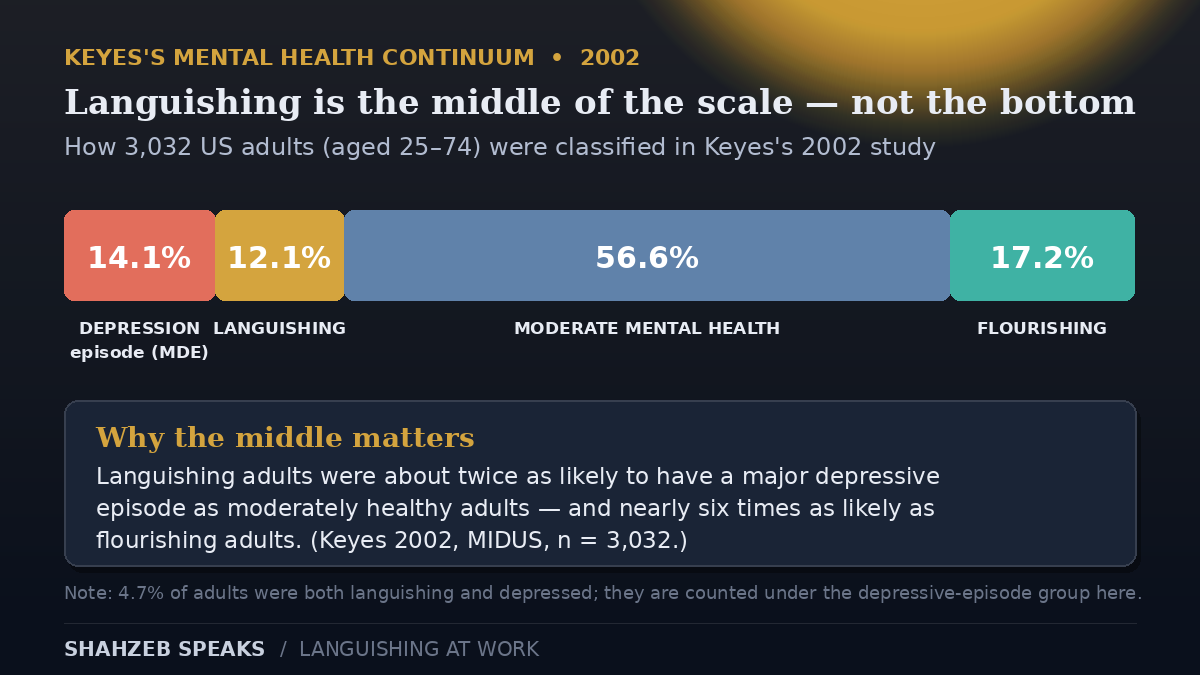
Keyes tested this model on data from the 1995 Midlife in the United States study, a sample of 3,032 American adults aged 25 to 74, and published the results in 2002 in the Journal of Health and Social Behavior (volume 43, issue 2, pages 207–222). The classification was strict: to count as flourishing, a person needed high levels on at least one measure of emotional well-being — feeling cheerful, happy, satisfied with life — and high levels on most measures of positive functioning, such as purpose, mastery, autonomy, positive relationships and social contribution. To count as languishing, a person needed low levels on the same measures. Everyone in between was moderately mentally healthy.
The results are worth reading carefully, because they show how rare flourishing actually is. Only 17.2% of adults fit the criteria for flourishing. More than half — 56.6% — were moderately mentally healthy. And 12.1% were languishing. A further 14.1% met the criteria for a major depressive episode in the previous twelve months. Two details in those numbers matter. First, languishing was nearly as common as depression itself — which is why Keyes later called it a quiet epidemic. Second, the two overlapped: 4.7% of all adults were both languishing and depressed, while 9.4% were depressed without being languishing. The categories describe different things, and a person can sit in more than one of them.
The part of the paper that should worry any employer is what happened next. Languishing adults were about twice as likely to have a major depressive episode as moderately mentally healthy adults, and nearly six times as likely as flourishing adults. Languishing was also associated with significant psychosocial impairment — worse perceived emotional health, more limitations in daily activities, and more workdays lost or cut back. In other words, the middle of the scale is not a safe place to sit. It is a place from which people slide, and the slide is measurable. That finding is the reason the Gies researchers, more than twenty years later, built their workplace reports around the same distinction — and it is the reason this article treats languishing as a problem to solve, not a mood to ignore.
There is a useful way to picture all of this, and it comes from Grant’s 2021 piece. He called languishing “the neglected middle child of mental health” — the void between depression and flourishing, the absence of well-being. Depression is the valley of ill-being: despondent, drained, worthless. Flourishing is the peak: meaning, mastery, mattering to others. Languishing is the flat ground between them, where nothing much happens and nothing much grows. The image is worth keeping in mind, because it explains why languishing is so hard to spot. A valley is obvious. A peak is obvious. Flat ground looks like nothing at all — until you realise you have been walking across it for months.
📊 Chapter 3: The 2026 numbers — more than half of workers are languishing
The Gies Workplace Wellbeing Report is the best current evidence on languishing at work, and it is worth saying how it was done before quoting a single figure from it. The report is an ongoing research programme from the Center for Professional Responsibility in Business and Society at the University of Illinois’ Gies College of Business, led by Professor Oscar Ybarra, with Corey Keyes of Emory University and Ethan Kross of the University of Michigan as co-principal investigators. The Fall 2026 release draws on four nationally representative survey waves conducted in partnership with YouGov in 2025 and 2026, each covering approximately 2,000 full-time workers, including a panel of respondents surveyed in more than one wave — which allowed the researchers to track the same people as their working conditions changed.
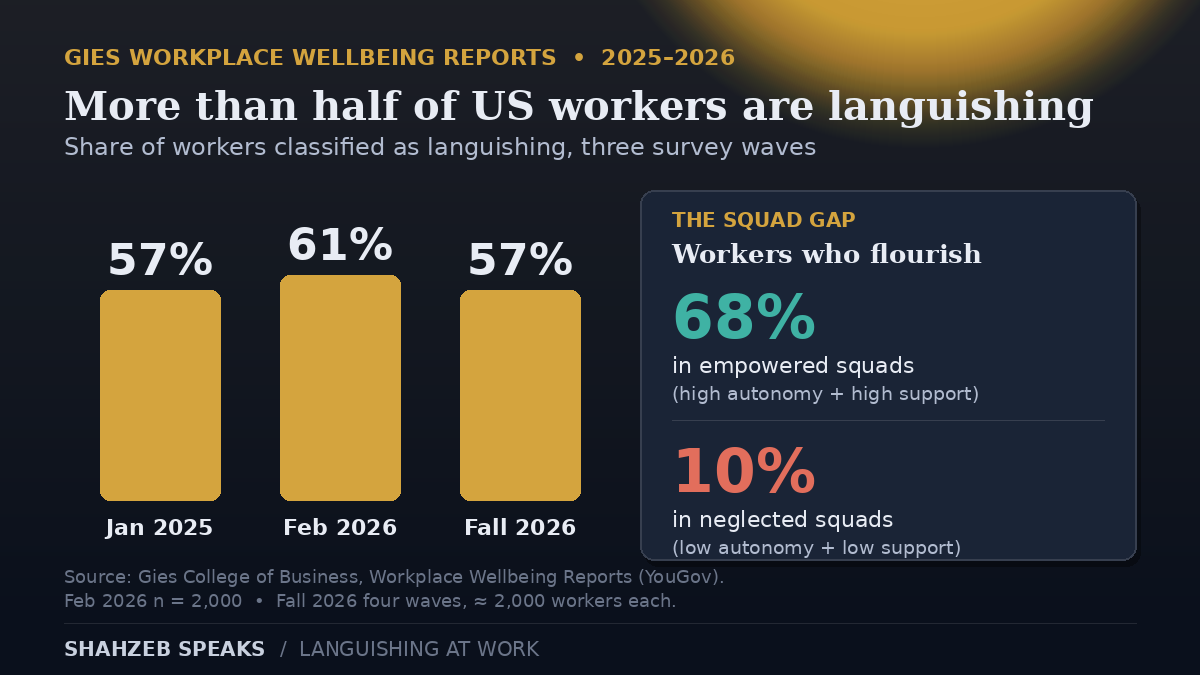
The trend across the three releases tells a consistent story. In January 2025, 57% of workers were languishing and 43% flourishing. In February 2026, in a nationally representative sample of 2,000 workers, the split was 61% languishing and 39% flourishing. In the Fall 2026 release, the most recent wave put languishing at roughly 57% again, with flourishing trending upward over the year. The researchers are careful about what that means: languishing has eased slightly, but it remains the majority experience. This is not a spike caused by one bad quarter. It is the steady state of the American workplace across two years of measurement.
The February 2026 report adds the detail that turns a prevalence figure into a human problem. Compared with flourishers, languishing employees reported higher burnout and distress: 38% of languishers said they feel burned out “very frequently”, against 29% of flourishers, and 34% of languishers said they intend to look for new work in the next twelve months. Those numbers matter because they connect languishing to things employers already measure — burnout and turnover — and show that the flat middle of the scale is expensive even before anyone gets ill. For the wider picture on burnout itself, see my articles on the psychology of workplace burnout and workplace burnout statistics 2026.
The Fall 2026 release adds a second layer of context — the weather workers are doing their jobs in. About 20% of workers reported “considerable or serious concern” that artificial intelligence or automation could make their job obsolete. Another 35% said major life goals, such as home ownership or retirement savings, do not feel achievable — a concern that tracked higher among women and lower-income workers. And 22% said they limit their effort to exactly what their role requires, the behaviour widely called “quiet quitting”, while another 22% said they rarely or never feel they have enough time for what matters. Ybarra’s comment on this is worth quoting directly: “Workers aren’t experiencing their jobs in a vacuum. Worries about AI, about ever affording a home or a retirement, about never having enough time — you might call that the weather people are working in.” For the quiet-quitting question specifically, see my article on what the research actually shows about quiet quitting.
| Gies Workplace Wellbeing Reports | Languishing | Flourishing |
|---|---|---|
| January 2025 (first report) | 57% | 43% |
| February 2026 (n = 2,000) | 61% | 39% |
| Fall 2026 (four YouGov waves, ≈ 2,000 each) | ≈ 57% | ≈ 43% |
One finding from the February 2026 report deserves emphasis, because it corrects a lazy assumption. Languishing appears across age groups, education, income, gender, racial and ethnic groups, and regions of the United States. There is no “at-risk demographic” for it. The strongest signals come not from who workers are, but from the conditions of their work — autonomy, support and ethical climate. That is good news and bad news at once. It is bad news because it means no group is exempt. It is good news because conditions can be changed, and the rest of this article is about how.
🔍 Chapter 4: Languishing is not burnout — and it is not depression
The most common mistake people make with languishing is to treat it as another word for something they already know. It is not. Burnout, depression and languishing are three different states, with different causes, different signs and different remedies — and confusing them is how people get the wrong help. Grant put the distinction in one sentence in 2021: “It wasn’t burnout — we still had energy. It wasn’t depression — we didn’t feel hopeless. We just felt somewhat joyless and aimless.” That sentence is worth holding on to, because it captures the diagnostic shape of the thing.
Burnout, as the World Health Organization defines it, is an occupational phenomenon that comes from chronic workplace stress that has not been successfully managed. It has three parts: exhaustion, cynicism or detachment from the job, and reduced professional efficacy. The key word is exhaustion. A burned-out worker is depleted — she has run out of fuel. A languishing worker has fuel; she just has nowhere she wants to drive. She can still do the work, and often does it competently, but the work gives her nothing back. That is why the two states need different responses: rest and recovery help burnout, but rest does not fix languishing, because languishing is not caused by having too much to do. It is caused by having too little that matters.
Depression is different again, and the difference matters more, because it is a clinical matter. Depression involves persistent low mood or loss of interest, plus symptoms such as disturbed sleep, appetite changes, fatigue, feelings of worthlessness, and difficulty concentrating, lasting at least two weeks and interfering with daily functioning. Languishing, by Keyes’s definition, is the absence of positive well-being in a person who has not been depressed in the past year. The two overlap — remember that 4.7% of adults in Keyes’s study were both languishing and depressed — and languishing raises the risk of a future depressive episode. But they are not the same thing, and calling languishing “mild depression” is wrong in both directions: it understates depression, and it medicalises a state that is often a reasonable response to a flat, purposeless job.
| State | Core feeling | Energy | What helps first |
|---|---|---|---|
| Burnout | Exhausted, cynical, depleted | Run out | Rest, recovery, lighter load |
| Languishing | Flat, aimless, joyless | Present but undirected | Purpose, connection, challenge |
| Depression | Hopeless, worthless, despondent | Low, with other symptoms | Professional assessment and treatment |
There is a practical test that follows from this. If a holiday leaves you rested but the flatness returns within a week of being back at your desk, you are probably not looking at burnout. If you can still enjoy a good meal, a friend’s joke or a weekend walk, but work itself feels empty, you are probably not looking at depression. What you are looking at is a job — or a life at work — that gives you nothing to aim at, nobody to matter to, and no sense that what you do counts. That is a design problem as much as a personal one, and Chapters 6 and 7 take up each side of it.
Students should hear this distinction too, because it applies to study as much as to work. A student who is languishing is not necessarily burned out from too many assignments, and is not necessarily depressed. She may simply be going through the motions of a degree that has stopped feeling like it leads anywhere — attending lectures, submitting work, getting marks, and feeling nothing about any of it. The remedy is not always less work. Sometimes it is work that connects to a purpose, a person, or a skill she can see herself getting better at. The same logic applies at the office, and it is the reason the “just take a break” advice so often fails people who are languishing: they come back rested, and the flatness is still there waiting for them.
💸 Chapter 5: What languishing costs — motivation, focus and the slow slide
Languishing is easy to dismiss precisely because it is quiet. Nobody calls in sick with it. Nobody has a crisis about it. It does not show up in absence figures the way depression does, or in resignation letters the way burnout does. Its cost is slower and harder to see — which is why the research on what it actually does is worth reading carefully. The costs fall into three groups: what it does to the person, what it does to the work, and what it does over time.
For the person, the cost starts with motivation and focus. Grant, writing in the New York Times in 2021, reported that languishing “dulls your motivation, disrupts your ability to focus, and triples the odds that you’ll cut back on work”, citing Keyes’s research. That last figure is the one to sit with: a threefold increase in the odds of cutting back is not a small effect. It means that a languishing worker is not simply doing the same work with less enthusiasm — she is measurably more likely to pull back, to do less, to disengage. And because the disengagement is gradual, neither she nor her manager may notice it happening until the pattern is set. This is the mechanism behind the 22% of workers in the Fall 2026 Gies report who said they limit their effort to exactly what their role requires.
For the work, the cost shows up in the February 2026 figures. Languishers were more likely than flourishers to feel burned out “very frequently” — 38% against 29% — and a third of them, 34%, said they intended to look for new work in the next twelve months. That is a retention cost, not just a wellbeing cost: a workforce in which the majority are languishing is a workforce in which a third of the struggling group is already thinking about leaving. Gallup’s data points the same way — I wrote about engagement falling to a fifteen-year low in my article on employee engagement at a 15-year low, and the two pictures fit together: disengagement and languishing are different measurements of the same flat middle.
Over time, the cost is the slide Keyes documented in 2002. Languishing adults were about twice as likely to have a major depressive episode as moderately mentally healthy adults, and nearly six times as likely as flourishing adults — and languishing was associated with real impairment in daily life, including workdays lost or cut back. That does not mean languishing causes depression in every case; the study was cross-sectional, and the relationship runs both ways. But it does mean that leaving languishing alone is not a neutral choice. The flat middle is not a stable resting place. It is a slope, and the longer a person spends on it without anything changing, the more likely the slide becomes. For the related question of what makes a job worth staying in at all, see my article on the Gallup American Job Quality Study 2026, where only 41% of American workers held a job that cleared the bar for quality.
There is one more cost, and it is the one employers least like to hear about: languishing is contagious in the only sense that matters for a team. A languishing worker does not complain, does not ask for help, and does not make a fuss — which means the manager hears nothing, and the team slowly adjusts to a lower level of energy as normal. New joiners learn the norms from the people around them, and if the norm is flat, they go flat too. This is why the Gies researchers frame the problem as a property of work environments rather than of individuals. A team full of languishing people is not a team full of broken people. It is a team working in conditions that do not produce flourishing — and conditions, unlike personalities, can be redesigned.
🌱 Chapter 6: What actually helps — the 3Rs and job crafting
The most useful part of the Gies research is not the prevalence figure. It is the answer to the question the February 2026 report asked next: when workplace stress strikes, what do flourishing employees actually do differently from languishers? The researchers assessed seventeen emotional regulation strategies and found three clusters that consistently separated the two groups. They called them the 3Rs — reframe, reach out, reset — and the numbers are specific enough to act on.
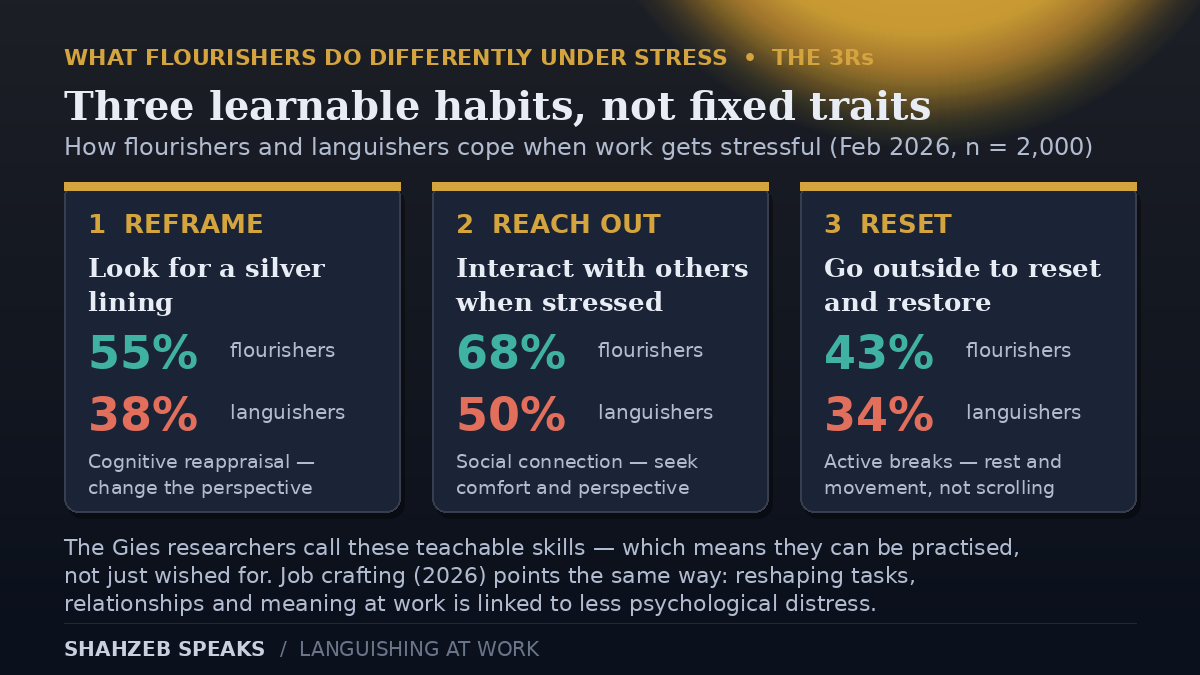
Reframe means cognitive reappraisal: looking for a silver lining in a difficult situation and seeking a change in perspective. In times of stress, 55% of flourishers did this, against 38% of languishers. Reach out means social connection: interacting with others when work is stressful and seeking comfort and perspective from people you trust — 68% of flourishers, against 50% of languishers. Reset means active breaks and movement: going outside to reset (43% of flourishers against 34% of languishers) or using physical activity to manage stress (40% against 29%). The researchers are explicit that these are learnable behaviours, not fixed traits. Ybarra put it plainly: “Flourishing employees aren’t just lucky or naturally resilient; they deploy various strategies in responding to stress. That means other employees can learn these same strategies, especially when their work environment makes it safe and realistic to do so.”
That last clause — “when their work environment makes it safe and realistic” — is doing a lot of work, and it deserves a paragraph of its own. A worker cannot reframe a situation she has no information about. She cannot reach out in a team where asking for help is read as weakness. She cannot reset if her calendar has no gaps and her manager treats a walk as slacking. The 3Rs are individual skills, but they only work inside conditions that allow them — which is why the February 2026 report’s advice to leaders is a two-part agenda: teach the skills and redesign the conditions. The next chapter takes up the conditions. This one stays with what the individual can do.
Job crafting: redesigning the job you already have
The second piece of evidence for what helps comes from a study published in November 2026, and it is the freshest peer-reviewed research in this article. Drawing on self-determination theory, the study used three waves of survey data from 883 employees in Mainland China to ask whether workers can protect their own psychological health by redesigning their day-to-day work — a practice researchers call job crafting. It found that three kinds of crafting were each linked to less psychological distress, through different routes: relational crafting (changing who you work with and how) through a stronger sense of belonging; task crafting (changing what you do and how you do it) through greater job autonomy; and cognitive crafting (changing how you think about the work’s meaning) through stronger self-efficacy. The study was conducted in one country with survey data, so it shows associations rather than proof of cause — but the pattern lines up with the Gies findings in a useful way. Autonomy, connection and meaning are the same three ingredients, arriving from two independent directions.
Job crafting is practical in a way that advice about “finding your passion” is not. It does not require a new job, a new manager or a new life. It means small, deliberate changes: volunteering for the part of a project that uses a skill you enjoy; reshaping a weekly meeting so it includes the colleagues you learn from; reframing a routine task as the thing that makes a customer’s day work. The changes are small, and that is the point — languishing is a flat state, and flat states are moved by small, repeated actions, not by grand gestures. A worker who crafts one task a week is doing something a languishing worker rarely does: exercising choice about her own work. And choice, as the next chapter shows, is one half of the equation that decides who flourishes.
Flow and small wins
Grant’s 2021 piece offers a third suggestion, and it is the oldest idea in this article. The psychologist Mihaly Csikszentmihalyi called it flow: the state of being absorbed in a meaningful challenge, where your sense of time, place and self melts away. Grant suggested starting with small wins — “the tiny triumph of figuring out a whodunit or the rush of playing a seven-letter word” — and then building up to a project that stretches your skills and heightens your resolve. The logic is the opposite of the burnout prescription. Where burnout asks for less, languishing asks for more of the right thing: a challenge that is hard enough to absorb you and meaningful enough to matter. For most workers, that does not mean a new career. It means one task, this week, that is absorbing rather than numbing — and then another one next week.
A final note on the evidence for individual strategies, because honesty requires it. A 2026 systematic review and network meta-analysis in Nature Human Behaviour pooled 183 randomised trials covering 22,811 adults and found that most well-being interventions beat inactive controls, with moderate, similar effects for mindfulness, compassion-based practices, positive psychology, yoga and exercise. That is encouraging, but the effects are moderate, not large, and they come mostly from studies of general well-being rather than languishing at work specifically. Individual habits help. They are not enough on their own. Which brings us to the part of the problem that belongs to managers.
🏢 Chapter 7: What managers should do — build empowered squads
If Chapters 5 and 6 are about the worker, this chapter is about the work — and it contains the most hopeful finding in the whole Gies programme. The Fall 2026 report tracked the same workers across a year of survey waves and found that well-being moves when working conditions move. Workers who moved into a more empowered squad — a team with high autonomy and high support — saw their mental health scores rise by an average of 0.33 points on a 0-to-5 scale. Workers who stayed in the same squad saw an average rise of just 0.02 points. And workers who moved into a less empowered squad saw their scores fall by 0.36 points. The direction of movement predicted the direction of well-being, and the relationship held across survey waves. Ybarra’s summary of the lesson is the most quotable line in the report: “One of the biggest lessons from the studies is that wellbeing is more like a current address than a permanent one. You can move from one wellbeing state to another.”
The squad framework itself is simple, and that is its strength. Autonomy means having a meaningful say in how work gets done. Support means feeling backed up by coworkers, supervisors and the organisation as a whole. Together they define four environments: empowered squads (high autonomy, high support), muted squads (support without autonomy), separated squads (autonomy without support) and neglected squads (low levels of both). The February 2026 numbers show how much the combination matters: in empowered squads, 68% of workers flourish. In neglected environments, only 10% do. Neither autonomy alone nor support alone gets you there — Ybarra’s line is that “it’s not enough to be nice to people or give them freedom independently. Employees need both.”
The movement patterns between waves make the framework practical rather than abstract. Roughly three in four workers in empowered squads stayed empowered between waves. About a third of muted-squad workers moved into empowered situations, gaining autonomy alongside the support they already had. And workers in neglected environments most often moved into separated squads — gaining autonomy while still lacking support. For a manager, that last pattern is a warning: giving people more freedom without more backing does not produce flourishing. It produces people who are on their own. The lever that works is the pair, together.
| What changed for the worker | Mental health score (0–5 scale) |
|---|---|
| Moved into a more empowered squad | +0.33 points |
| Stayed in the same squad | +0.02 points |
| Moved into a less empowered squad | −0.36 points |
Beyond the squad structure, the February 2026 report found that an organisation’s ethical climate also predicts well-being. Flourishing was significantly more likely where employees worked under clear ethical expectations and consistent accountability: 64% of flourishing workers strongly agreed that employees are expected to be ethical in decisions and actions, against 44% of languishers. The mechanism the researchers propose is straightforward — when ethics are clear, people do not waste emotional energy navigating grey areas or worrying about unfair treatment, and they are free to focus on work knowing their integrity is valued. A strong ethical climate is not a poster on the wall. It is a precondition for flourishing, and it is visible in the numbers.
The report’s advice to leaders comes down to three levers, and they are worth stating plainly. First, design for flourishing: empower teams to increase autonomy while strengthening support structures — give people real say over how work gets done, and back them up when they use it. Second, strengthen the ethical climate: clarify expectations and demonstrate values so accountability stays consistent. Third, make healthy coping realistic: protect time for deep focus, normalise restorative breaks, and build the norms that make reaching out acceptable and encouraged. None of these is a wellness programme. All of them are decisions about how work is organised — which is why they work where posters and apps do not. For the related question of how recognition and purpose fit into this picture, see my articles on employee recognition and meaningful work.
One caution belongs here, because the squad finding is easy to over-read. The Fall 2026 analysis tracked the same people over time and found that movement into empowered squads predicted better subsequent mental health — but prediction is not proof of cause. People who move into better teams may also be the people whose lives are improving in other ways, and a better job is often part of a wider improvement. The researchers are careful about this, and so is this article. What the evidence supports is a strong, consistent, repeated association between better conditions and better well-being, in the direction you would hope for, across a year of data. That is enough to act on. It is not enough to promise a result.
⚠️ Chapter 8: The honest limits — and when to get help
Every claim in this article has a limit, and this chapter states them, because an article that hides its limits is not honest — and honesty is the reason this site exists. First, the Gies surveys measure well-being with self-report questionnaires, in the United States, in English, among full-time workers. Self-report is the right tool for measuring how people feel, but it is still people’s own judgement, and it can be coloured by the week they have had. The findings travel best to similar workplaces in the USA, UK and Europe; they should be applied more cautiously elsewhere, including in Pakistan, where the structure of work, the security of employment and the norms around speaking up are different. The pattern — that conditions matter more than demographics — is likely to hold widely. The exact percentages will not.
Second, the evidence is mostly cross-sectional, even in the Fall 2026 report. The panel design is a real improvement — tracking the same people across waves is stronger than a single snapshot — but it still cannot prove that changing a squad causes a change in well-being. It can only show that the two move together, in the expected direction, repeatedly. The Keyes 2002 findings carry the same limit: languishing was associated with a higher risk of a future depressive episode, but the study cannot show that languishing caused it. People who are sliding toward depression may report low well-being first, which would produce the same numbers. The honest reading is that languishing is a warning sign worth taking seriously, not a proven cause of anything.
Third, the Keyes 2002 data are old — the underlying survey was conducted in 1995, and the world of work has changed since then. The Gies reports are the update, and they use a workplace-specific measure rather than Keyes’s general one, which is both a strength and a limit: the numbers are more relevant to work, but they are not directly comparable to Keyes’s original percentages. I have kept the two sets of figures separate in this article for that reason. The 12.1% from 2002 and the 57% from 2026 are measuring different things in different populations with different instruments, and anyone who compares them directly is making a mistake.
Finally, the most important limit of all: this article is not medical advice, and languishing is not a diagnosis. If flatness has lasted for weeks, if you have lost interest in things you used to enjoy, if your sleep or appetite has changed, or if you feel hopeless or worthless, that is no longer the territory of this article — it is the territory of a doctor or a mental health professional, and you should speak to one. The same applies if you are a manager and a member of your team seems to have gone quiet in a way that worries you: the right response is a private, human conversation and a pointer toward proper support, not a resilience workshop. Languishing is common, it is understandable, and it is often fixable by changing the work. But when it is not, the honest thing is to say so — and to get help from someone qualified to give it.
❓ Questions I am asked most often
What is languishing at work?
Languishing at work is the in-between state where you are neither depressed nor thriving: you function, but without energy, purpose or delight. Corey Keyes defined it in 2002 as low emotional well-being combined with low psychological and social functioning, in a person who has not been depressed in the past year — “neither mentally ill nor mentally healthy”.
Is languishing the same as burnout?
No. Burnout is exhaustion from chronic workplace stress — the fuel has run out. Languishing is flatness without exhaustion: you still have energy, but nothing at work gives it direction. Rest and a lighter load help burnout; languishing needs purpose, connection and challenge. The two can overlap, and 38% of languishers in the February 2026 Gies report felt burned out very frequently.
Is languishing depression?
No, and the distinction matters. Depression is a clinical condition with persistent low mood plus symptoms such as disturbed sleep, appetite changes and feelings of worthlessness. Languishing is the absence of well-being in someone who has not been depressed. The two overlap — 4.7% of adults in Keyes’s 2002 study were both — and languishing raises the risk of a future depressive episode, so persistent low mood deserves professional attention.
How common is languishing in 2026?
Very common. The Gies Workplace Wellbeing Reports found 57% of US workers languishing in January 2025, 61% in February 2026 (n = 2,000), and roughly 57% in the most recent Fall 2026 wave, based on four nationally representative YouGov waves. Flourishing has edged upward over the year, but languishing remains the majority experience in every wave measured.
Can languishing turn into depression?
It is associated with a higher risk, not a certainty. In Keyes’s 2002 study of 3,032 adults, languishing people were about twice as likely to have a major depressive episode as moderately healthy adults, and nearly six times as likely as flourishing adults. The study was cross-sectional, so it cannot prove languishing causes depression — but it is a warning sign worth acting on early, not ignoring.
What helps languishing at work?
Two things together. For the individual, the Gies report’s 3Rs: reframe setbacks (55% of flourishers vs 38% of languishers), reach out to others (68% vs 50%), and reset with breaks and movement (43% vs 34%). For the organisation, build empowered squads — high autonomy plus high support — where 68% of workers flourish against 10% in neglected squads. Either half alone is not enough.
If your team looks busy but feels flat — present, competent, and quietly disengaged — the problem may not be effort. It may be the conditions the work is done in. I am an Industrial and Organizational Psychologist, and I work with teams on work design, manager behaviour and the measurement of culture, engagement and retention. Get in touch here.
If you want the wider context, start with my guide to industrial psychology in Pakistan and my article on psychological capital at work, which examines the inner resources that protect mental health. For the question of whether your workplace is safe to speak up in, see psychological safety at work, and for how personal stress spills into the working day, personal stress and work productivity.
Sources
- Keyes, C. L. M. (2002). The mental health continuum: From languishing to flourishing in life. Journal of Health and Social Behavior, 43(2), 207–222. https://pubmed.ncbi.nlm.nih.gov/12096700
- Grant, A. (2021, 19 April). There’s a Name for the Blah You’re Feeling: It’s Called Languishing. The New York Times. https://www.nytimes.com/2021/04/19/well/mind/covid-mental-health-languishing.html
- Gies College of Business, University of Illinois (2026, 16 November). Fall 2026 Workplace Wellbeing Report links better work environments to better mental health. https://giesbusiness.illinois.edu/news/2026/11/16/fall-2026-workplace-wellbeing-report-links-better-work-environments-to-better-mental-health
- Gies College of Business, University of Illinois (2026, 4 February). Annual Workplace Wellbeing Report 2026 finds majority of US workers still languishing. https://giesbusiness.illinois.edu/news/2026/02/04/annual-workplace-wellbeing-report-2026-finds-majority-of-us-workers-still-languishing
- Gies College of Business, University of Illinois (2025, 21 January). New report from Gies College of Business reveals more employees are languishing than flourishing at work. https://giesbusiness.illinois.edu/news/2025/01/21/new-report-from-gies-college-of-business-reveals-more-employees-are-languishing-than-flourishing-at-work
- Job crafting and psychological distress: A self-determination theory perspective (2026). Behavioral Sciences, 16, 2115. https://doi.org/10.3390/bs16112115
- Wilkie, L., Fisher, Z., Geidel, A., Goodall, I., Kamil, S., Davies, E., & Kemp, A. H. (2026). A systematic review and network meta-analysis of randomized controlled trials of well-being-focused interventions. Nature Human Behaviour. https://doi.org/10.1038/s41562-025-02369-1
- Keyes, C. L. M. (2003). Complete mental health: An agenda for the 21st century. In C. L. M. Keyes & J. Haidt (Eds.), Flourishing: Positive Psychology and the Life Well-Lived. American Psychological Association.