

On 28 October 2026, Gallup published a number that should stop every manager mid-scroll: only 29% of American employees are engaged at work. It is the lowest reading since 2011, and the first time in 15 years the figure has fallen below 30%. Employee engagement is not falling because people suddenly care less about work in general. It is falling because two specific things managers control — clear expectations and feeling cared about — fell with it, and fell furthest among the remote and hybrid workers whose managers have the least daily contact with them.
I am an Industrial and Organizational Psychologist in Karachi, and I write about what workplace research actually shows, including when it refuses to give a simple villain. This guide works through Gallup’s Q3 2026 data carefully: what the 29% means, who drove the fall, what the artificial intelligence angle does and does not prove, and what a manager can do this month that the evidence supports. It also names what the data cannot tell us, because a 15-year low is exactly the moment when overclaiming does the most damage.
“Engagement did not fall everywhere at once. It fell where contact is thinnest and change is fastest — and that is a management problem, not a mystery.” — Workplace Psychology Analysis, ShahzebSpeaks
📉 Chapter 1: The short answer — employee engagement at 29%
Employee engagement in the United States fell to 29% in the third quarter of 2026, according to Gallup, its lowest level since 2011 and two percentage points below the previous quarter. In Gallup’s terms, engaged employees are involved in and enthusiastic about their work. The other 71% splits into two groups: 53% who are not engaged, meaning psychologically disconnected but not actively hostile, and 18% who are actively disengaged, up from 17% in the previous quarter. Each percentage point represents about 1.6 million American employees, so the quarterly fall equals about 3.2 million fewer engaged workers, and the total fall since the 2020 peak is about 11 million. Gallup links engagement to productivity, customer service, quality, safety and profitability, which is why a two-point move matters beyond the headline: it is a large number of people, in a large number of workplaces, doing their work with less effort and less care than before.
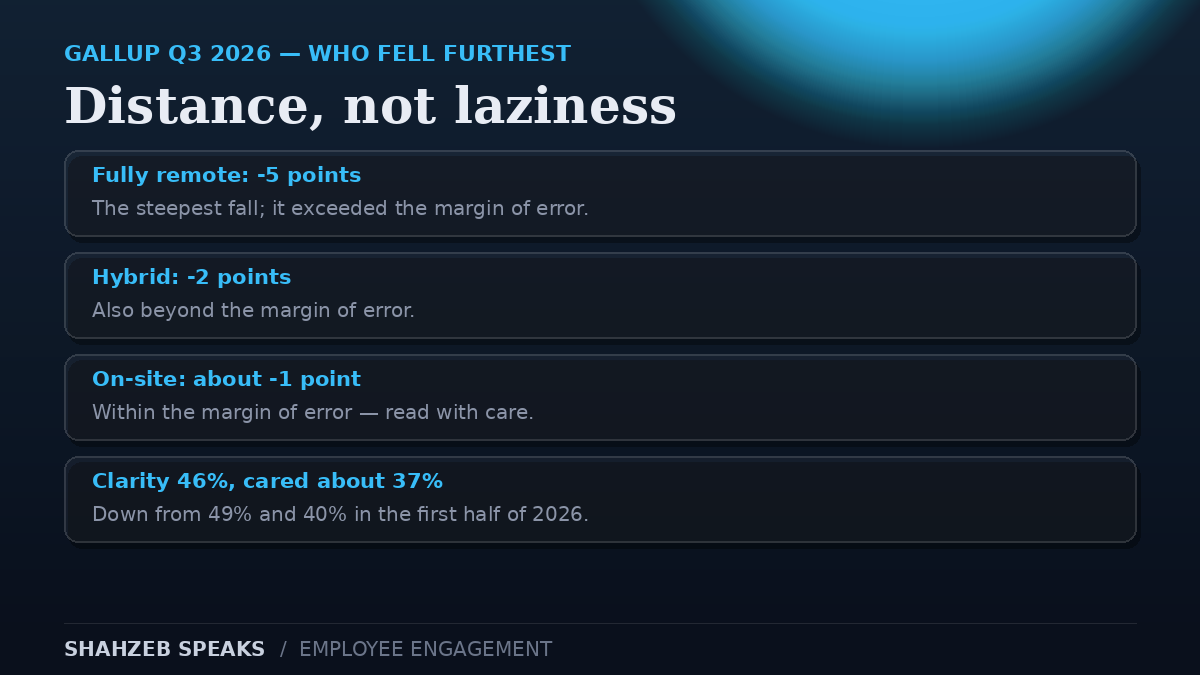
The short answer to “why” has two halves, and both matter. First, the two workplace experiences that moved most were clarity and care: the share of employees who strongly agreed they knew what was expected of them fell from 49% in the first half of 2026 to 46% in the third quarter, and the share who strongly agreed that a supervisor or someone at work cares about them as a person fell from 40% to 37%. Second, the fall was concentrated, not general: fully remote employees fell five points, hybrid employees fell two, and on-site employees and those in jobs that cannot be done remotely fell by about one point. Gallup’s own summary is careful, and this guide follows it: the pattern suggests that AI adoption may be outpacing the communication and managerial support needed to make it effective. “May be” is doing real work in that sentence. It is a hypothesis supported by a pattern, not a proven cause, and the rest of this guide keeps that distinction in view.
📊 Chapter 2: The number in context — from 26% to 36% and back to 29%
Gallup has tracked American employee engagement since 2000, which is what makes the 29% figure more than a bad quarter. In 2000, 26% of employees were engaged. The figure stayed between 26% and 30% through 2013, then climbed, unevenly but persistently, to a peak of 36% in 2020 — the pandemic year, when clarity of purpose and visible leadership briefly pushed engagement up even as work itself was disrupted. Since then it has declined, reaching 31% in 2024 and holding at that level through the first half of 2026, before the third-quarter fall broke below 30% for the first time in 15 years.
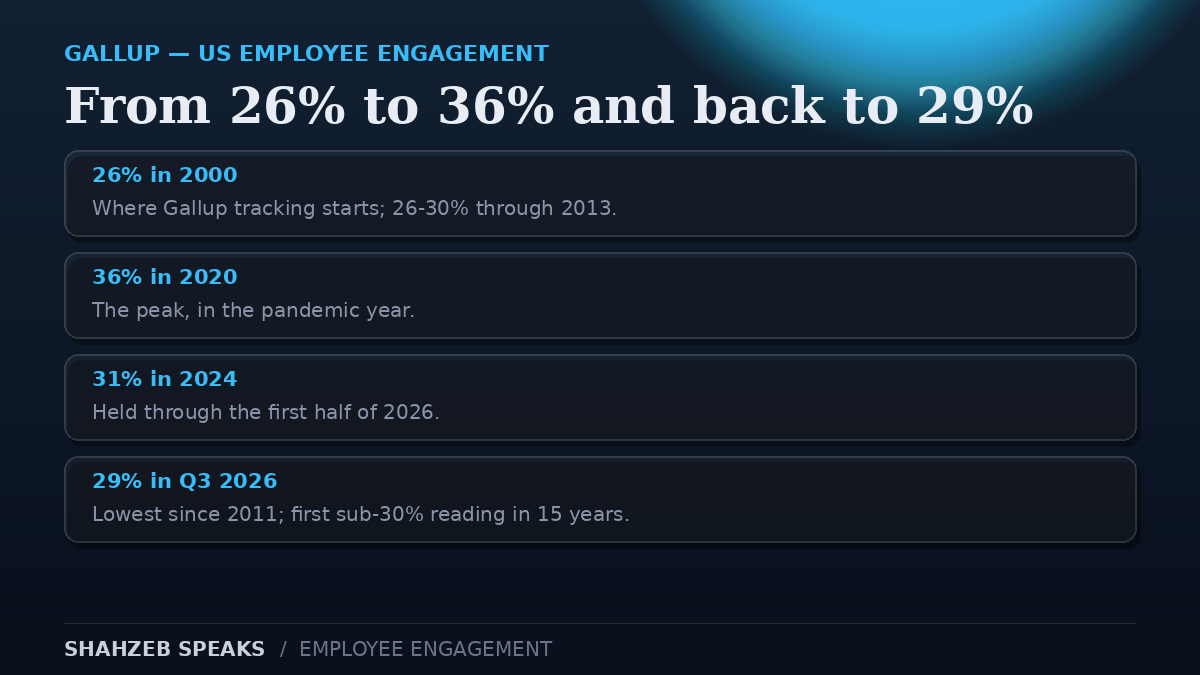
| Period | Engaged | What it means |
|---|---|---|
| 2000 | 26% | Where Gallup’s tracking starts. |
| Through 2013 | 26–30% | A long, flat range before the climb. |
| 2020 peak | 36% | The high point, in the pandemic year. |
| 2024 and H1 2026 | 31% | The level that held until Q3 2026. |
| Q3 2026 | 29% | Lowest since 2011; first sub-30% reading in 15 years. |
| Q3 2026, other groups | 53% not engaged; 18% actively disengaged | Most of the workforce is disconnected, not hostile. |
Two features of this history deserve attention before anyone reaches for a remedy. The first is that the 2020 peak complicates every simple story about remote work. Engagement rose highest in the year when remote work expanded fastest, which means remote work itself cannot be the whole explanation for the fall. The second is that the fall from 36% to 29% is a seven-point slide over six years, not a single-quarter accident. A quarterly survey can move by two points on sampling variation, and Gallup’s margin of error is about one point, but a six-year trend in one direction, confirmed by repeated quarterly readings, is not sampling noise. It is a slow change in how work feels, and slow changes usually have structural causes: in this case, Gallup points to expectations, care and manager support, not to a single event.
A note on method, because method is what separates a headline from evidence. Gallup’s quarterly reading is based, according to secondary reporting of the release, on a random sample of 21,648 American adults aged 18 and older, surveyed from 5 to 19 August 2026, with a margin of sampling error of plus or minus one percentage point at the 95% confidence level. The remote and hybrid declines exceeded that margin; the on-site change of about one point did not. That detail matters for Chapter 3: we can be reasonably confident the remote and hybrid falls are real movements, and we should be more cautious about the on-site figure. It also matters for honesty about scope. This is an American survey. Its lessons travel — clarity, care and manager support are not American inventions — but the 29% figure itself describes the United States, and a reader in Karachi, London or Lagos should treat it as a warning signal for their own workplace, not as a measurement of it.
🏠 Chapter 3: Who fell furthest — remote, hybrid, and the distance problem
The third-quarter fall was not shared evenly. Fully remote employees fell five points. Hybrid employees fell two. On-site employees and workers in jobs that cannot be performed remotely fell by about one point, a change small enough to sit within the margin of error. In other words, the people who lost the most engagement are the people whose managers see them least, and the pattern is not new: Gallup’s earlier research found that from 2020 to 2023, clarity of expectations declined about twice as much among hybrid and fully remote employees as among on-site employees in remote-capable jobs.
Gallup frames this as a possibility, not a proof, and the wording is worth preserving: physical distance can contribute to psychological distance between employees and their organisations. That is a precise claim. It does not say remote work destroys engagement — remember the 2020 peak — and it does not say returning to the office fixes it. It says that distance makes the manager’s ordinary work harder: expectations that would be clarified in a corridor conversation, recognition that would happen in passing, and small signals of care that would be visible in a room all have to be deliberately created when people are apart, and many organisations have not created them. When change arrives on top of distance — a new tool, a new process, a new set of targets — the gap widens, because the employee hears about the change without hearing, clearly, what it means for their own job.
This chapter also corrects a lazy reading that will be common this month. The fall among remote workers is not evidence that remote workers are lazier, less loyal or less capable. Engagement measures the relationship between a person and their work, and a relationship deteriorates when communication deteriorates. The relevant question for a manager is not “where is this person sitting?” but “when did I last make sure this person knows what success looks like this week, and that someone here notices their work?” If the answer is “I assumed they knew”, the Gallup data suggest that assumption is now failing at scale. My guide on psychological safety at work covers the team climate that makes those conversations possible, and my guide on employee onboarding covers the same clarity problem at the start of employment, when it is cheapest to fix.
🎯 Chapter 4: The two measures that moved — clarity and care
If engagement is the headline, clarity and care are the story. Gallup’s engagement measure is built from twelve elements of the work experience, including role clarity, resource availability and recognition for good work. In the third quarter, two of those elements moved enough to explain much of the fall. Knowing what is expected at work: the share strongly agreeing fell from 49% in the first half of 2026 to 46% in the third quarter, matching the 2024 yearly average low for that item. Feeling cared about as a person: the share strongly agreeing that a supervisor or someone at work cares about them fell from 40% in the first half of 2026 to 37% in the third quarter, well below its peak of 47% in March 2020.
These two measures matter because they are the most managerial of all engagement drivers. Pay, promotion and strategy are partly set above the manager’s head. Clarity and care are set in the manager’s week. Clarity means an employee can answer, without guessing, three questions: what am I supposed to achieve this week, what does good look like, and how will I know if I am on track? Care means the employee believes that answer would change if they were struggling — that a supervisor would notice, ask and adjust, rather than simply record the shortfall. When both fall together, the message employees receive is coherent and corrosive: nobody is quite sure what is wanted, and nobody seems to mind very much. That combination produces exactly the largest group in the data, the 53% who are not engaged: not angry, not rebellious, simply disconnected, doing enough to get by and no more.
The care figure deserves a slower look, because it is easy to misread as a demand for friendliness. “Cares about me as a person” does not mean a manager who is warm in a meeting. It means a manager who knows something about the employee’s circumstances, workload and constraints, and acts on that knowledge. A manager who assigns a deadline without asking about the three other deadlines already on the person’s plate is not showing care, however pleasant the tone. A manager who protects a team member from an unreasonable request, or who moves a deadline when a genuine crisis hits, is showing care in a form the employee can verify. The 40% to 37% fall suggests that, across American workplaces, fewer employees are experiencing that verifiable form of care. My guide on employee recognition separates the kinds of recognition that register as care from the kinds that register as noise, and the distinction runs through this chapter: generic praise does not substitute for specific attention.
🤖 Chapter 5: The AI angle — a real pattern, not a proven cause
Almost every report of the Gallup data this week led with artificial intelligence, and the AI pattern is genuinely striking. Gallup’s July 2026 analysis found that engagement was six points higher in organisations that had adopted AI, fifteen points higher in organisations that communicated a clear AI plan, and eighteen points higher in organisations where managers actively supported AI use at work. When all three were present — frequent AI use, a clear plan and active manager support — engagement reached 53%, nearly double the national average. That is a large, coherent pattern, and it points in the same direction as the rest of the data: the tool matters less than the management around the tool.
The third quarter complicates the story in a useful way. In the second quarter, remote employees at AI-integrated organisations had a five-point engagement advantage over their counterparts elsewhere, and hybrid employees had an eight-point advantage. By the third quarter, those advantages had narrowed to just two points, while on-site workers kept an advantage of about four to five points. Something changed between the second and third quarters for remote and hybrid workers at AI organisations, and Gallup’s interpretation is that communication and manager support did not keep pace with adoption. That is plausible, and it fits the clarity and care data. It is not, however, proof that AI caused the fall. Adoption, remote work, restructuring, economic pressure and survey timing all moved together in 2026, and a quarterly survey cannot separate them. Gallup itself does not claim a causal finding; its bottom line says adoption “may be outpacing” the support needed. Any article that tells you AI made workers disengaged, or that AI will fix engagement, is going further than the evidence goes.
What the AI pattern does support is a narrower, more useful claim: rolling out a tool without explaining, by role, how it changes each person’s work is a reliable way to damage clarity, and damaged clarity is a reliable way to damage engagement. Employees need to know how AI applies to their work, when they should use it, and how their performance will be judged as their responsibilities change. Without those answers, a tool that was supposed to save time becomes a source of uncertainty: am I being measured against a machine, will my role shrink, should I admit I do not know how to use this? Those are engagement questions disguised as technology questions, and they are answered by managers, not by software. The organisations that kept their AI advantage into the third quarter were, on Gallup’s reading, the ones whose managers did that answering work. The ones that lost it were the ones that shipped the tool and moved on.
⚠️ Chapter 6: What the data cannot tell us — and what not to do
A 15-year low invites overreaction, and the most expensive overreactions are already predictable. The first is to treat 29% as a verdict on a generation, a work arrangement or a technology. It is none of those. It is a national average of a twelve-element survey, and averages hide as much as they reveal: some organisations in the same survey will have engagement far above 29%, and their practices, not the national mood, are the useful evidence. The second is to respond with a programme that treats the symptom. A new perks package, a town-hall speech about purpose, or a fresh engagement survey with no follow-up will not move clarity or care, and employees can tell the difference between being listened to and being surveyed. My guide on meaningful work makes the related point: purpose language without changed daily experience registers as noise, and noise is itself a small engagement cost.
The third overreaction is the return-to-office reflex: reading a remote fall as proof that presence fixes engagement. The data do not support that reading. On-site engagement also fell, if by less; the 2020 peak happened during mass remote work; and the mechanism Gallup identifies is communication and support, which can be supplied or withheld in any location. Mandating presence without fixing clarity will simply move disconnected employees into the same building, where their disconnection becomes more visible and no less real. The fourth overreaction is to blame managers personally for a structural pattern. Managers are the lever Gallup identifies, but managers are also, in many organisations, carrying larger teams, more change and less training than before. A response that tells managers to “engage their teams” without giving them time, authority and a smaller change load is a slogan, not a strategy. The honest version of this chapter is therefore two-sided: managers are where the fix happens, and organisations are responsible for making the fix possible.
Finally, a limit that belongs in any guide built on a single survey. Gallup’s measure is a respected, long-running instrument, and its trend is consistent across quarters, which gives it weight. It is still one instrument, in one country, at one moment. It does not measure productivity directly, it does not separate industries or occupations in the public summary, and it cannot prove which intervention will work in your team. Treat it as a diagnosis that tells you where to look — clarity, care, remote support, AI communication — and then look, in your own team, with your own conversations and your own follow-up data, before you prescribe.
🧭 Chapter 7: The manager fix — three priorities Gallup actually recommends
Gallup’s recommendations are refreshingly unglamorous, and that is a point in their favour. They are: clarify AI expectations by role; equip managers to support AI use, particularly those leading hybrid and remote employees; and track AI’s impact alongside employee engagement. None of these is a product. All three are management work, and all three can be started this month.
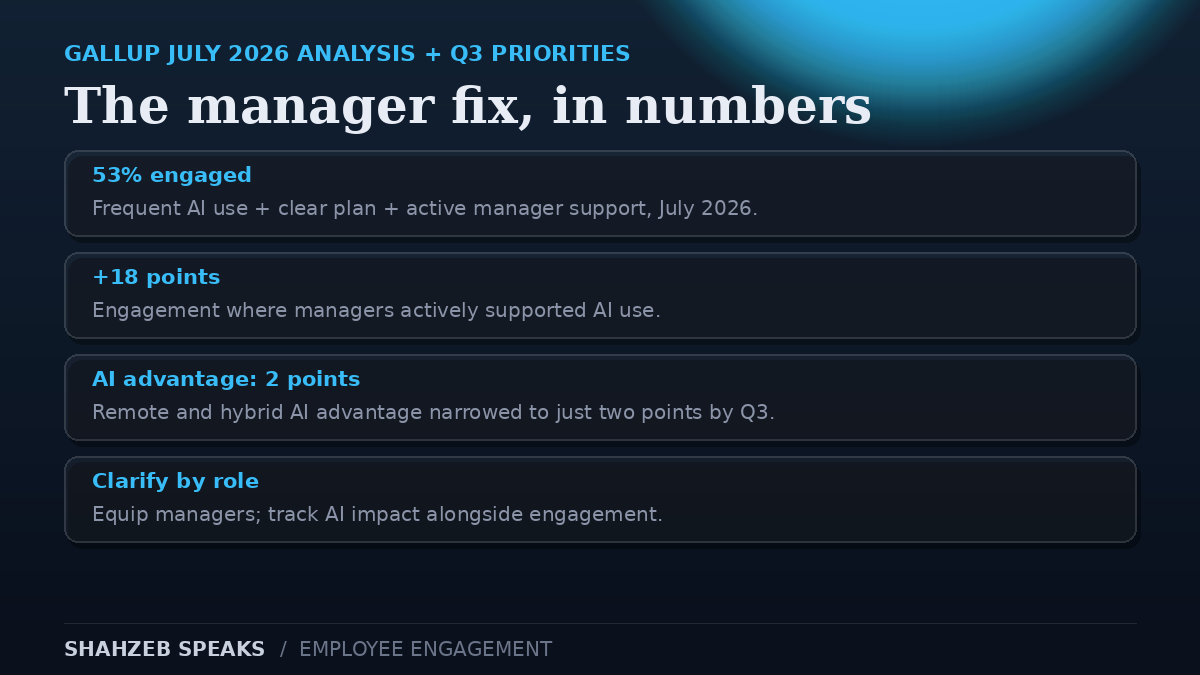
| Priority | What it looks like in practice | What it protects |
|---|---|---|
| Clarify by role | For each role: when to use AI, when not to, and how performance will be judged as tasks change. | Clarity — the measure that fell to 46%. |
| Equip managers | Training and time for managers of hybrid and remote teams to translate plans into weekly expectations. | Care — the measure that fell to 37%. |
| Track both together | Measure AI use and its effects on productivity and problem-solving alongside engagement, and share examples of effective use. | The AI advantage — which narrowed to two points for remote and hybrid staff. |
Clarify by role means writing down, for each job, the answers employees are currently guessing at. Which tasks should AI do, which should a person do, and which need a person to check the machine’s output? What happens to the time saved — is it reinvested in harder work, in learning, or quietly converted into a higher target? How will quality be judged when part of the output is machine-generated? A one-page role note answering those questions, discussed in a team meeting rather than emailed as a policy, does more for clarity than any number of all-staff announcements. Equip managers means recognising that managers translate organisational plans into daily expectations, and that translation is skilled work. A manager of a hybrid team needs time for individual check-ins, authority to adjust workloads when a change lands badly, and examples of good practice to copy — not just a dashboard showing that engagement fell. Track both together means refusing to celebrate AI adoption while engagement falls, or to panic about engagement without asking what changed in the work. Share examples of effective AI use from inside the team, so employees can see what good looks like in their own context, rather than hearing abstract claims about productivity from elsewhere.
Two additions from the wider engagement literature fit Gallup’s priorities without going beyond them. First, make the weekly check-in a clarity check-in, not a status report: one question about what is unclear, one about what is blocking progress, and one about what support is needed. Second, make recognition specific and prompt: name the work, name its effect, and say it close to the event, because recognition that arrives months later in a formal process does not register as care. Neither addition requires a budget. Both require a manager to spend time on people rather than only on tasks, which is precisely the reallocation the Gallup data are asking for. My guide on career change psychology shows what happens when that reallocation never occurs: people do not leave in a single dramatic moment, they disconnect gradually, and by the time they resign, the decision was made months earlier.
✅ Chapter 8: The action plan — this month, for one team
1. This week: run a clarity audit. Ask each team member, individually, to write down what they believe their top three priorities are this month and what good looks like for each. Compare their answers with yours. Every mismatch is a clarity gap, and closing it is the highest-return management act available to you.
2. This week: publish the AI role note. For each role in the team, write the one-page note described in Chapter 7: when to use AI, when not to, and how performance will be judged. Discuss it in person or on video, and invite corrections. A note nobody can challenge is a policy, not clarity.
3. This month: protect one check-in per person. A short, regular, individual conversation that is not cancelled when work gets busy — because work getting busy is exactly when clarity and care are most needed. If the check-in is the first thing sacrificed, the team learns what the organisation actually values.
4. This month: name one thing you will stop. Ask the team which recurring task, report or meeting adds the least value, and stop it or shrink it. Engagement rises when people feel their time is respected, and nothing signals respect like removing work that everyone knows is pointless.
5. This month: track one pair of numbers. Pick one AI-use measure and one engagement signal — even an informal one, like the clarity question from step 1, asked again in four weeks — and review them together. If adoption rises while clarity falls, you have caught the Gallup pattern in your own team while there is still time to act.
If you run only one change from this guide, run the clarity audit. It costs an hour, it needs no approval, and it directly addresses the measure that fell furthest in the national data. A team whose members know what is expected, and believe someone cares whether they succeed, is a team that can absorb new tools, new targets and new ways of working without losing the connection that makes work worth doing.
❓ Questions I am asked most often
What is employee engagement?
It is how involved and enthusiastic employees are about their work, as measured by Gallup through twelve elements of the work experience, including role clarity, resources and recognition. Engaged employees put in additional effort towards organisational goals; those not engaged are psychologically disconnected, and those actively disengaged work against the organisation’s interests.
Why did US employee engagement fall to 29% in Q3 2026?
Gallup reports the fall was sharpest among remote and hybrid employees, and coincided with falls in clarity of expectations (49% to 46%) and feeling cared about (40% to 37%). Gallup suggests AI adoption may be outpacing communication and manager support, but it does not claim AI caused the fall, and no single cause has been proven.
Is 29% the lowest employee engagement has ever been?
No. It is the lowest since 2011 and the first reading below 30% in 15 years. When Gallup began tracking in 2000, engagement was 26%, and it stayed between 26% and 30% through 2013. The recent peak was 36% in 2020, so the current figure is a return below the 2013–2020 range, not an all-time low.
Are remote workers less engaged than office workers?
In Q3 2026, fully remote workers fell furthest (five points) and hybrid workers fell two points, against about one point for on-site workers. That describes a change, not a character trait: Gallup links it to clarity and communication, which are harder to maintain at a distance, not to remote workers caring less.
Does AI adoption raise or lower engagement?
Both patterns appear in Gallup’s data, which is why the management around AI matters more than the tool. In July 2026, engagement was higher where AI was adopted with a clear plan and active manager support (53% when all three combined). By Q3, that advantage had narrowed to about two points for remote and hybrid workers, suggesting adoption without support does not hold its benefit.
What is the single best thing a manager can do about engagement?
Restore clarity, one person at a time: make sure every team member knows what is expected this week, what good looks like, and how their performance will be judged. Gallup’s data point to clarity and care as the measures that moved, and both are set in the manager’s week, not in a company-wide programme.
📬 Clarity, care, or something else in your team?
If engagement has slipped in your team and you are not sure whether the problem is unclear expectations, thin manager support, or a change that was never properly explained, tell me which pattern you recognise. Contact me and describe the week when the connection started to thin.
For the broader field behind this guide, see my homepage on industrial psychology in Pakistan, and for the recognition half of the story, read employee recognition.
Sources
- Gallup (2026). U.S. Employee Engagement Below 30% for First Time in 15 Years. Published 28 October 2026, updated 29 October 2026. https://www.gallup.com/workplace/716117/employee-engagement-below-30-first-time-years.aspx
- Fast Company (2026). Employee Engagement in U.S. Hits Lowest Point in 15 Years. 29 October 2026. (Survey method: 21,648 adults, 5–19 August 2026, margin plus/minus 1 point; twelve-element measure.)
- Digital Today (2026). U.S. Worker Engagement Hits Lowest Level in 15 Years as AI Spreads. 30 October 2026. (Levels for remote and hybrid workers, as reported from Gallup/CNBC.)