
A nurse finishes a twelve-hour shift and goes home tired but steady. A software engineer finishes a well-paid quarter, with a bonus in the bank, and feels hollow. A teacher stays in a school that pays less than the job next door, because the children in her class know her name and wait for her in the morning. The difference is not effort, and it is not gratitude. It is whether the work itself feels meaningful — and in 2026, more people than ever are searching for exactly that word.
This guide explains what meaningful work is in the research literature, what the evidence actually links it to, why the current surge of interest is real but easily misread, and how to build more meaning into a job you already have — without quitting on a slogan, and without waiting for your employer to write a better purpose statement.
I am an Industrial and Organizational Psychologist based in Karachi. I have watched the same pattern repeat: a team is told its work matters, given a poster and a town hall, and nothing changes — because the work itself did not change. Meaning is not a message. It is an experience that comes from the job, the people around it, and the story a person can honestly tell about it. When that experience is missing, people do not always leave at once. They search, they drift, they disengage, and then, when the market allows, they go.
“A purpose statement tells you what the company believes. Meaningful work tells you what the job lets you believe about yourself. Only one of those survives a bad week.”
— Workplace Psychology Analysis, ShahzebSpeaks
⚡ Chapter 1: The short answer
Meaningful work is work a person experiences as personally significant, purposeful and worthwhile — work that matters to them, not only work that matters to the company. Researchers Rosso, Dekas and Wrzesniewski (2010) describe it as arising through four pathways: individuation (autonomy, competence and self-esteem), contribution (perceived impact and significance), self-connection (work that fits who you are) and unification (shared values and belonging). The job characteristics model of Hackman and Oldham (1976) adds the mechanics: skill variety, task identity, task significance, autonomy and feedback feed the experience of meaningfulness.
The evidence for its importance is strong in one direction and weaker in another. A meta-analysis by Allan, Batz-Barbarich, Sterling and Tay (2019), covering 44 articles and 23,144 people, found large correlations — r = 0.70 and above — between meaningful work and work engagement, commitment and job satisfaction, and moderate to large links with life satisfaction, life meaning, general health and lower withdrawal intentions. But the link with performance was smaller and based on self-rated performance, and correlations do not prove that meaning causes performance. The honest conclusion: meaningful work is one of the strongest correlates of engagement and satisfaction we have, and a poor excuse for ignoring pay, workload, management and job security. The rest of this guide separates what the research supports from what the posters promise.
📈 Chapter 2: Why everyone is searching for it now
The search data are striking, and they deserve to be reported with their limits attached. A secondary analysis of Google Trends data by The Vector Impact found searches for “meaningful work” rising from 13 to 93 on Google’s 0–100 index between 2016 and early 2026, with searches for “lack of purpose” also reaching an all-time high. Separately, Inc. reported in October 2026, citing a Searchbloom analysis, that US search interest in “career change” was about three times higher than five years earlier and near a record high. These are search indices, not surveys of what people did. They measure attention and questioning, not resignations.
The workplace data behind that attention are firmer. Gallup reported that the percentage of US employees actively engaged at work averaged 31% in 2025, unchanged from 2024 and down from a high of 36% in 2020 after a decade of growth. Each percentage point represents about 1.6 million employees, so the decline since 2020 equates to about 8 million fewer engaged employees. The falls were sharpest where meaning is made or broken daily: among Generation Z and younger millennials, agreement that “my supervisor, or someone at work, seems to care about me as a person” fell 13 points, from 54% in 2020 to 41% in 2025, and agreement that “this last year, I have had opportunities at work to learn and grow” fell 11 points, from 48% to 37%. Gallup reporting in March 2026 added that 51% of US employees were seeking or watching for new jobs, while only 28% said it was a good time to find a quality job, down from 70% in mid-2022.
Read together, the picture is not “everyone is quitting for purpose”. It is “many people are restless, and many feel stuck”. That is a different problem, and it points to a different solution. A person who cannot leave needs meaning in the job they have, not a lecture about following their passion. For the related evidence on how that restlessness turns into burnout, see my guide to workplace burnout, and for what keeps people speaking up at work, my guide to psychological safety at work.
🧩 Chapter 3: Four pathways, in plain language
Rosso and colleagues (2010) organise a large and messy literature around two dimensions: self versus others, and agency versus communion — roughly, standing apart versus belonging. Crossing them gives four pathways, and most real jobs draw on more than one.
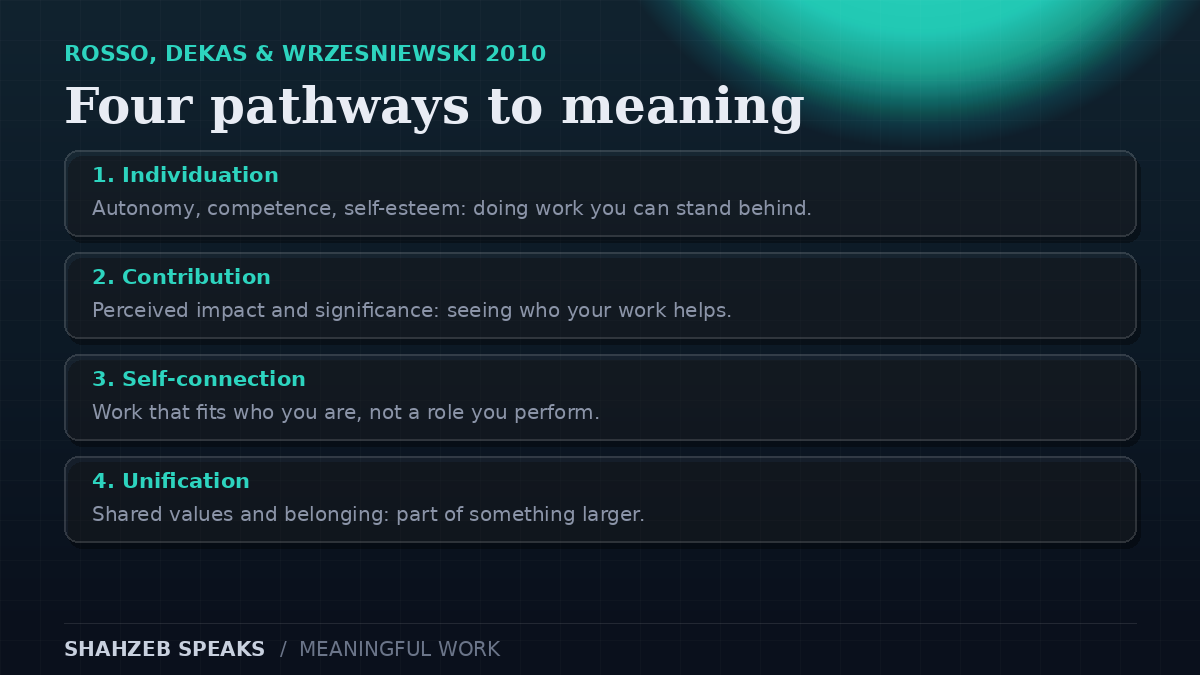
| Pathway | What it feels like | Where it comes from |
|---|---|---|
| Individuation | “I am good at this, and I chose how to do it.” | Autonomy, competence, self-esteem |
| Contribution | “Someone is better off because I did this.” | Perceived impact, significance, interconnection |
| Self-connection | “This work fits who I am.” | Self-concordance, identity affirmation, personal engagement |
| Unification | “We are in this together, for something we share.” | Value systems, social identification, connectedness |
The value of this map is diagnostic. When a person says their work feels meaningless, ask which pathway is blocked. A surgeon who saves lives but has no say in how the ward is run may be high on contribution and low on individuation. A founder who has total autonomy but no team and no visible beneficiary may be high on individuation and low on unification. A teacher who loves her subject but is handed a scripted curriculum may be high on self-connection in principle and low on it in practice. Each blockage suggests a different fix, and a purpose poster fixes none of them. Steger, Dik and Duffy’s Work and Meaning Inventory (2012) captures the same idea in three facets: positive meaning in the work itself, meaning made through work for one’s life as a whole, and motivation to serve a greater good. If a job scores well on only one facet, the other two are where to look.
📊 Chapter 4: What the meta-analysis actually finds — and what it does not
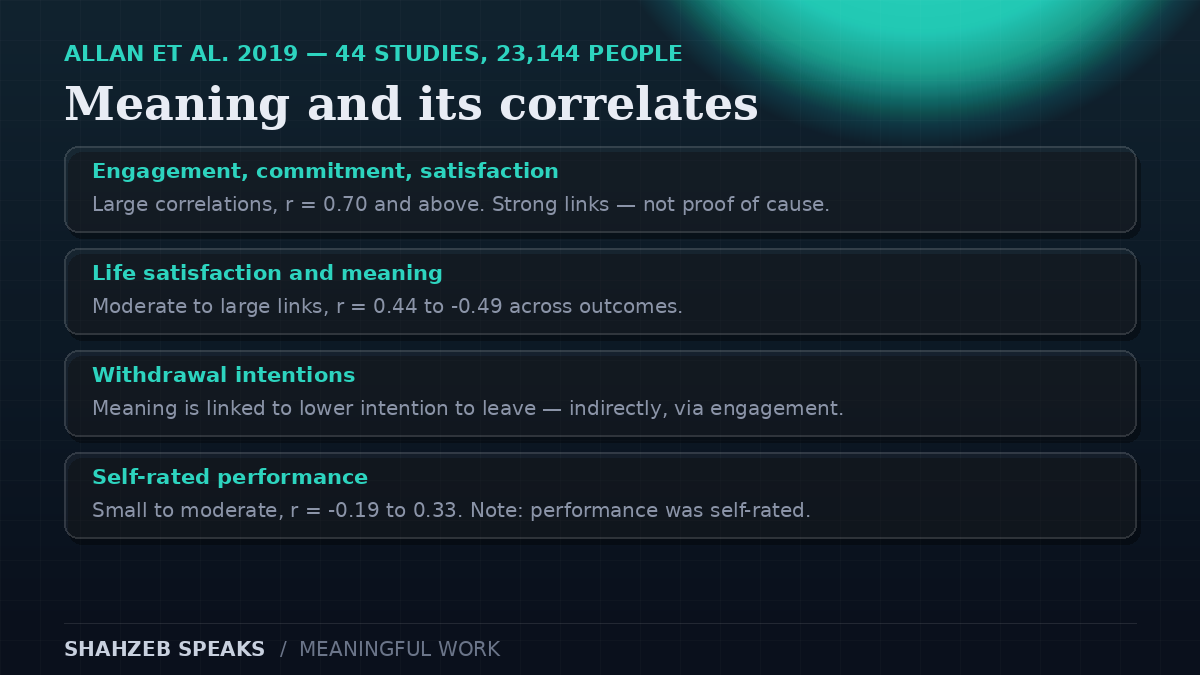
| Outcome (Allan et al. 2019) | Correlation | How to read it |
|---|---|---|
| Work engagement, commitment, job satisfaction | r = 0.70+ | Large. But the measures overlap — people who like their job also call it meaningful. |
| Life satisfaction, life meaning, general health, withdrawal intentions | r = 0.44 to −0.49 | Moderate to large. Meaning travels beyond the office, and is linked to lower intention to leave. |
| Citizenship behaviour, self-rated performance, negative affect | r = −0.19 to 0.33 | Small to moderate. The performance link is real but modest, and self-rated. |
Three cautions follow, and they are the difference between using this research and abusing it. First, the largest correlations are with attitudes measured by similar questionnaires. A person who feels engaged will also say their work is meaningful, and the arrow may run both ways. Allan and colleagues’ best-fitting model has meaningful work predicting engagement, commitment and satisfaction, which then predict performance, citizenship and withdrawal intentions — a plausible chain, but still built mostly from correlational studies. Second, the performance evidence is self-rated. People who find their work meaningful also rate their own performance higher. That is not nothing, but it is not an objective productivity finding, and no honest guide should present it as one. Third, meaning is not a substitute for the basics. Hackman and Oldham’s model itself sits alongside pay, security, supervision and working conditions. A meaningful job that pays badly, overloads its people and is run by a manager who does not care will still lose people — as the Gallup “feeling cared for” figures suggest, care is itself part of how meaning is experienced.
🚫 Chapter 5: Where the meaning industry goes wrong
First, confusing a purpose statement with meaningful work. Lips-Wiersma and Morris (2009) draw the distinction sharply: there is meaningful work, and there is the “management of meaning” — the attempt to get employees to feel meaning without changing the work. A company can have a stirring mission and jobs that offer no autonomy, no visible impact and no learning. Employees notice the gap quickly, and the gap itself becomes a source of cynicism. Second, treating meaning as a property of the person, not the job. “Find your passion” puts the burden on the employee to feel differently about unchanged work. The job characteristics literature puts it the other way: change the work first — its variety, its wholeness, its significance, its autonomy, its feedback — and see whether the experience follows.
Third, using meaning to justify poor conditions. This is the most serious misuse. A hospital, school or charity that tells staff their work is a calling while paying them badly and staffing them thinly is not offering meaning; it is spending it. Meaning can sustain people through hard periods, but it is a finite resource, and organisations that draw on it without replenishing it — through pay, staffing, recognition and rest — will find it runs out. Fourth, assuming one kind of meaning fits everyone. Rosso’s four pathways exist precisely because people differ: some find meaning in mastery, others in service, others in belonging. A programme built only around “impact on customers” will miss the craftsperson who finds meaning in doing a difficult thing well, and the team member who finds it in being part of a group that looks after each other.
🔧 Chapter 6: Job crafting — changing the job without changing jobs
One of the most practical ideas in this literature is job crafting, from Wrzesniewski and Dutton (2001): employees reshape the task, relational and cognitive boundaries of their jobs, within limits, to make the work fit better. A cleaner who reframes her work as protecting patients, a support agent who builds a small library of answers that help new colleagues, a coder who volunteers to mentor interns — each is crafting, not just coping. Crafting is not a licence to ignore the job description. It works best when managers explicitly allow it: a small, agreed change to tasks, to who you work with, or to how you think about the work.
Relational job design offers a second lever, from Grant’s work on task significance: people are more motivated when they can see, or hear from, the people their work benefits. The mechanism is simple and testable in any team: show the end user. A letter from a customer, a visit from a patient, a short video from the community a product serves — these are not rewards. They are information about significance, and significance is one of the five job characteristics that feed meaningfulness. The test for any such intervention is whether the work itself becomes more visible, not whether the presentation about it was more moving. For a related warning about selecting people on vague qualities rather than job evidence, see my guide to personality tests at work and to structured interviews.
✅ Chapter 7: A playbook for building meaning where you are
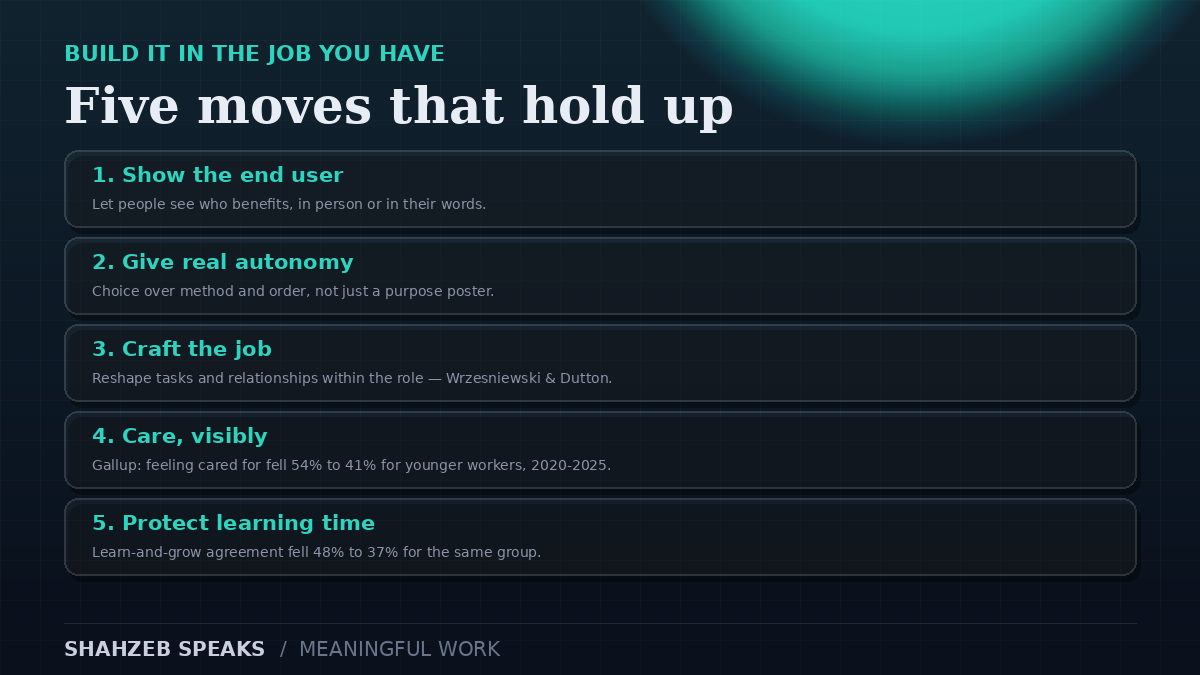
1. Show the end user. Once a month, bring the beneficiary into the room — a customer letter, a patient story, a user interview. Make significance visible, not asserted. 2. Give real autonomy. Let people choose the method, the order, or one project, and defend that choice when it is questioned. Autonomy that disappears under the first deadline was never autonomy. 3. Craft the job, by agreement. Ask each person: which task would you expand, which relationship would you build, which part of the work would you reframe? Agree one small change and review it in a month. 4. Care, visibly and specifically. The Gallup fall in “someone at work seems to care about me” is the cheapest finding in this guide to act on: a manager who knows what a person is working towards, and says so, is not being soft. They are maintaining the relational pathway to meaning. 5. Protect learning time. The parallel fall in learn-and-grow agreement suggests development is being squeezed first. Ring-fence it, even in small amounts, and treat it as work, not as a favour.
For managers, one further rule: audit the basics before launching a purpose initiative. Pay, workload, staffing, clarity of expectations and fairness of process all gate whether meaning can be experienced at all. A team that is overloaded will hear a purpose talk as an instruction to endure more. Fix the load, then talk about meaning — in that order. For how fairness of process itself shapes trust, the next guide in this series will take up organisational justice directly.
🚪 Chapter 8: When leaving is the honest answer
Not every meaning problem can be crafted away. Some jobs are structured so that autonomy is impossible, impact is invisible, and belonging is punished rather than rewarded. Some organisations use meaning language precisely to avoid paying for the work. In those cases, the research supports a different conclusion: withdrawal intentions are a signal, not a character flaw, and the search data show many people are already listening to that signal. The question to ask before leaving is specific: which pathway is blocked, and is it blocked by this job, this manager, or this field? A blocked manager can sometimes be outlasted or transferred around. A blocked field — a whole occupation whose structure denies autonomy or significance — rarely changes because one person tries harder.
If you do leave, leave towards something, not only away from something. The four pathways make a useful checklist for the next role: will I be able to do something well, see who it helps, recognise myself in it, and belong to a group I respect? A job that offers two of the four, honestly, is a better bet than a job that promises all four on a poster and delivers none in the first month. And if you cannot leave yet — because of pay, family, visa or market conditions, as the Gallup job-market figures suggest many cannot — crafting, a better manager, or a change of team inside the same organisation is not settling. It is the evidence-based version of taking meaning seriously while you wait for a real choice.
❓ Questions I am asked most often
What is meaningful work, in simple terms?
Work you experience as personally significant, purposeful and worthwhile. Researchers describe four pathways to it: mastery and autonomy, contribution to others, fit with who you are, and belonging to something shared. It is an experience of the job, not a slogan about the company.
Does meaningful work actually improve performance?
The link is modest and mostly indirect. A meta-analysis of 44 studies found large links with engagement, commitment and satisfaction, but only small to moderate links with self-rated performance. Meaning predicts engagement, which then predicts performance and lower intention to leave — it is not a direct productivity lever.
Is meaningful work more important than pay?
No. Pay, security, workload and fair management gate whether meaning can be experienced at all. Meaning sustains people through hard periods, but organisations that use it to justify poor pay or chronic overload spend a finite resource and will lose people anyway.
Can I find meaning in a job I did not choose?
Often, partly. Job crafting — reshaping tasks, relationships and how you think about the work — can open one or two pathways even in a constrained role. It cannot fix a job that denies autonomy, hides all impact and punishes belonging. In that case, changing team or manager is worth trying before changing field.
Why are searches for meaningful work surging now?
Search data show attention rising sharply since 2016, alongside falling engagement — 31% in the US in 2025, down from 36% in 2020 — and sharp falls in feeling cared for and having chances to learn and grow, especially among younger workers. Searches measure questioning, not quitting; many searchers feel stuck rather than free to leave.
Should managers run a purpose programme?
Only after auditing the basics: workload, pay, clarity and fairness. Show the end user, give real autonomy, protect learning time and care visibly — and judge the programme by whether the work itself changed, not by whether the launch event was well received.
📬 Want help making work meaningful in your organisation?
If your team is engaged on paper and flat in practice, I can review which pathway to meaning is blocked in your roles — and which change to the work itself, not the messaging, would open it.
For context on the field behind this work, my writing on industrial psychology in Pakistan explains what an I/O psychologist actually does — and for how the evidence on emotional skills is often overstated, see my guide to emotional intelligence at work.
Sources
- Allan, B. A., Batz-Barbarich, C., Sterling, H. M., & Tay, L. (2019). Outcomes of meaningful work: A meta-analysis. Journal of Management Studies, 56(3), 500–528.
- Gallup (2026). U.S. employee engagement declines from 2020 peak (31% engaged in 2025, down from 36% in 2020).
- Grant, A. M. (2007). Relational job design and the motivation to make a prosocial difference. Academy of Management Review, 32, 393–417.
- Hackman, J. R., & Oldham, G. R. (1976). Motivation through the design of work: Test of a theory. Organizational Behavior and Human Performance, 16(2), 250–279.
- Lips-Wiersma, M., & Morris, L. (2009). Discriminating between “meaningful work” and the “management of meaning”. Journal of Business Ethics, 88, 491–511.
- Rosso, B. D., Dekas, K. H., & Wrzesniewski, A. (2010). On the meaning of work: A theoretical integration and review. Research in Organizational Behavior, 30, 91–127.
- Steger, M. F., Dik, B. J., & Duffy, R. D. (2012). Measuring meaningful work: The Work and Meaning Inventory (WAMI). Journal of Career Assessment, 20(3), 322–337.
- Wrzesniewski, A., & Dutton, J. E. (2001). Crafting a job: Revisioning employees as active crafters of their work. Academy of Management Review, 26(2), 179–201.
- The Vector Impact (2026). Searches for “meaningful work” have surged 615% as employee engagement hits a decade low (secondary analysis of Google Trends and Gallup data).
- Inc. (2026). Career change search interest reached a record high (reporting a Searchbloom analysis of Google Trends).