

A capable employee sits at her desk at the end of the day, staring at a tool she half understands, wondering whether the skill she spent five years building will still matter next year. She is not afraid of hard work. She is afraid of working hard on the wrong thing. Capability anxiety is the name WTW gave that fear in October 2026: uncertainty about whether your skills will stay relevant, which capabilities will matter most, and where to focus your development when work is changing faster than any training catalogue.
I am an Industrial and Organizational Psychologist in Karachi, and I write about what workplace research actually shows, including when a new phrase is genuinely useful and when it is just a relabelled worry. Capability anxiety is useful, because it names a specific gap rather than a general mood. This guide works through the October 2026 WTW data carefully: what the numbers show, why the gap between changing work and unclear development hurts competence and confidence, what managers get wrong about reassurance, and a practical plan for employees and managers that does not depend on guessing which technology will win.
“Capability anxiety is not fear of change. It is fear of changing in the wrong direction, with nobody willing to say which direction is right.” — Workplace Psychology Analysis, ShahzebSpeaks
🔬 Chapter 1: The short answer — what capability anxiety is
Capability anxiety is uncertainty about whether your skills will remain relevant, what capabilities will matter most, and where you should focus your development. That is WTW’s definition, published in its EX Intelligent report on 7 October 2026, and it is worth keeping exactly, because each clause points at a different failure. “Will my skills remain relevant?” is a question about the future of your job. “What capabilities will matter most?” is a question about priorities. “Where should I focus?” is a question about action. An employee can tolerate one unanswered question. Three at once, sustained over months, is what turns a learning challenge into a daily worry.
The short answer to why it is rising now has two halves that do not match. Work is changing visibly: 45% of employees in the WTW study say artificial intelligence is already important to their daily job, and another 22% say it will fundamentally change their work in the future. Together, that is more than two-thirds of employees who see AI in their present or near future. At the same time, the systems that should translate that change into personal guidance are thin: only about 30% of organisations have established processes for identifying, assessing and tracking workforce skills, and the share of employees who say their manager helps develop their abilities has fallen from 84% to 78% over the past four years. Change is arriving faster than clarity, and the gap between them is where capability anxiety lives.
📊 Chapter 2: The numbers behind the phrase
WTW’s 2026 Employee Experience Global Market Study is a large study, and its size is part of why the findings deserve attention. It includes responses from 549 employer organisations representing 5.6 million employees globally, plus insights from 7,000 employees across the United States, the United Kingdom, Japan, France and Saudi Arabia. That breadth does not make every finding universal — five countries are not the whole world, and employer responses are not the same as employee experience — but it does mean the pattern is not a single company’s survey of its own staff. It is a cross-country, cross-employer picture, and the picture is consistent: employees see the change, employers have not yet built the guidance.
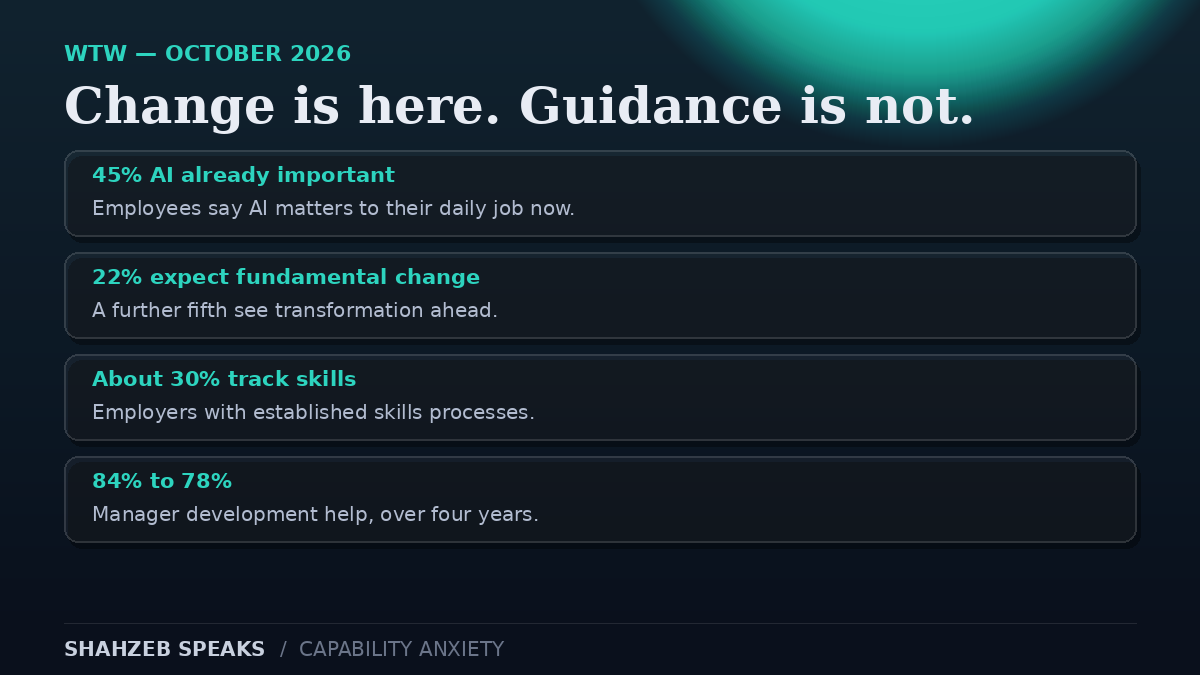
| WTW finding (October 2026) | Figure | What it means |
|---|---|---|
| AI already important to daily job | 45% | Change is present, not distant. |
| AI will fundamentally change their work | 22% | A further fifth expect transformation. |
| Employers with established skills processes | About 30% | Most employers cannot yet map the gap. |
| Manager helps develop abilities | 84% to 78% | Help fell over four years. |
| Employers expecting AI to alter experience in 3 years | 59% | Employers agree change is near. |
| Automation share expected | 14% to 31% | More than doubling in three years, per employers. |
Two cautions belong here, because a new phrase invites overclaiming. First, WTW’s release frames capability anxiety as a risk created by a mismatch, not as a measured clinical condition and not as a proven cause of turnover or productivity loss. The study reports perceptions and employer practices; it does not prove that unclear skills guidance caused any particular business outcome. Second, the 84% to 78% change is reported as a shift over four years in the release summaries; whether it clears a significance threshold is not stated in the summaries I could access, so this guide describes it as a fall, not as a proven collapse. Honesty about those limits is what makes the strong parts of the data usable: the direction is consistent across several measures, and the employer-side figure — only about 30% with established skills processes — is the one organisations can act on regardless of how any single percentage is interpreted.
There is also a useful cross-check from a different survey, published days before WTW’s release. Gallup’s third-quarter 2026 data put United States employee engagement at 29%, its lowest since 2011, with clarity of expectations falling from 49% to 46% and feeling cared about falling from 40% to 37%. Those are different measures in a different survey, and they should not be merged into one story as if they were the same study. But they point in the same direction: the workplace experiences that depend on managers explaining what matters — clarity, care, development — are weakening at the same time as work itself is changing. My guide on employee engagement at a 15-year low works through the Gallup data in full.
🧠 Chapter 3: Why unclear skills hurt more than hard skills
Capability anxiety is not the same as finding a new tool difficult. A difficult tool has a visible learning curve: you practise, you improve, the difficulty fades. Unclear skills have no curve at all, because you cannot tell whether you are climbing the right hill. Psychologists have described this difference for decades. Albert Bandura’s work on self-efficacy showed that belief in your capability to handle a task shapes how much effort you put in and how long you persist when it gets hard. That belief is built from experience, from watching others, from encouragement, and from your own physical and emotional state. When nobody can tell you which capability matters, all four sources weaken at once: your past experience feels outdated, the models around you are also guessing, encouragement becomes generic, and the emotional state is worry rather than focus.
Self-determination theory adds a second lens. Edward Deci and Richard Ryan identified competence — feeling effective in what you do — as a basic psychological need, alongside autonomy and relatedness. Capability anxiety is, in that language, a threatened competence need. The employee is not asking for praise. She is asking for evidence that she can still be effective, and for a path to become effective again where she is not. Organisations that answer with reassurance alone (“don’t worry, your job is safe”) miss the need entirely. Reassurance without a path does not restore competence; it asks the employee to trust a promise about a future nobody has described.
A third lens comes from stress research. Lazarus and Folkman’s appraisal model says stress depends on how a person appraises a demand against their resources. A demanding new tool appraised as learnable is a challenge. The same tool appraised as a threat to your future, with no clear learning resource and no manager guidance, is a threat. That distinction explains why two employees facing the same AI rollout can react so differently: the one whose manager has named the three skills that matter for her role, and the training that builds them, faces a challenge. The one who has only heard that “everyone must upskill” faces a threat, because “upskill” without a target is not an instruction, it is a warning.
👥 Chapter 4: The manager gap — help fell while change rose
The most actionable figure in the WTW release is also the most uncomfortable for managers: the share of employees who say their manager helps develop their abilities fell from 84% to 78% over four years. That is not a story about managers becoming less caring people. It is a story about a job that got harder without getting more time. Managers are carrying larger teams, more change, and more reporting than four years ago, and development conversations are the work most easily postponed when the week fills up. A postponed conversation does not feel like a decision. It feels like next week. Repeated for a year, it becomes a pattern the employee can read clearly: my development is not on anyone’s calendar.
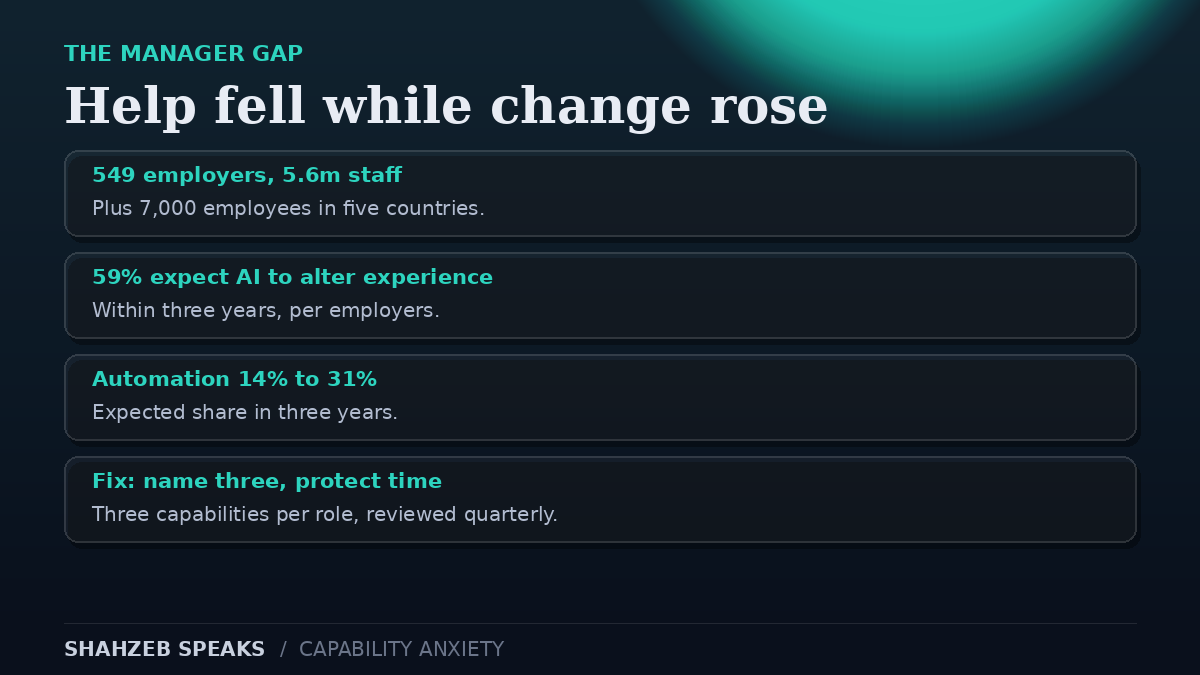
WTW’s recommendation follows directly: give managers more support for development conversations, and give workers clear visibility of the paths their careers could take, including learning opportunities and internal roles. Note the order. The recommendation is not “buy a skills platform first”. It is: make the path visible, then equip the person who explains it. A platform that lists 400 courses without telling an employee which three matter for her next role adds to the anxiety it was bought to reduce. A manager who can say “for your role, these two capabilities matter most this year, here is the training, and here is how we will judge progress” reduces it, even without any platform at all.
This chapter also corrects a common managerial reflex: answering capability anxiety with a training catalogue. A catalogue answers “what could I learn?” Capability anxiety asks “what should I learn, in what order, and how will I know it worked?” The difference is curation and commitment. Curation means someone with authority has chosen. Commitment means the learning time is protected and the new skill is actually used in real work afterwards. My guide on employee onboarding makes the same point at the start of employment: the first 90 days work when expectations are specific, not when information is plentiful.
⚠️ Chapter 5: What managers get wrong about reassurance
Three reassurances fail, predictably, and each fails for a psychological reason worth naming. The first is “AI will not replace your job.” It may be true for a particular role, but it answers a question the anxious employee did not quite ask. She did not ask whether her job title survives. She asked whether her skills survive inside that title, and whether she will be judged against a machine she has not been trained to use. A job that survives with its skills hollowed out is not reassuring; it is a slower version of the same fear.
The second failing reassurance is “everyone needs to upskill.” It fails because it distributes responsibility without distributing direction. When everyone must upskill and nobody knows in what, the employees with the most confidence and the most free time learn fastest, and the gap between confident and anxious employees widens. The organisation then mistakes a self-selected learning elite for a successful programme, while the employees who needed guidance most have spent a year choosing between courses. The third failing reassurance is the generic development plan: a form, completed annually, listing three vague goals (“improve digital skills”) that nobody revisits. It fails because it simulates guidance without providing it, and employees learn quickly to treat the form as paperwork rather than a plan.
There is a related failure on the employee side, and honesty requires naming it too. Capability anxiety can produce avoidance: the employee who fears looking incompetent avoids the very training that would help, because training exposes the gap. Edgar Schein’s idea of learning anxiety captures this: learning something new threatens your sense of competence and identity, so you protect yourself by not learning. A manager who only offers training, without normalising the awkward beginner stage, will watch the most anxious employees decline the offer. The fix is to make early incompetence safe and expected: pair learning with a buddy, judge early attempts on effort and questions rather than output, and let senior people visibly learn in public.
🎯 Chapter 6: Capability anxiety is not the same as job insecurity
It helps to separate capability anxiety from its neighbours, because each needs a different response. Job insecurity is fear of losing the job itself. Capability anxiety can exist in a secure job: the role is safe, the skills inside it are shifting, and nobody has mapped the shift. Imposter syndrome is fear of being exposed as less capable than others believe. Capability anxiety is often more specific: fear that a named, real change has moved the goalposts and you have not been told where they moved to. Burnout is exhaustion from sustained demands. Capability anxiety can contribute to burnout — sustained uncertainty is itself a demand — but rest alone does not fix it, because the uncertainty is still there when you return.
The distinction matters for measurement. If an organisation surveys only engagement or only job security, it will miss capability anxiety entirely. WTW’s own prescription points the right way: use employee listening and workforce data to identify where uncertainty or capability gaps may be affecting confidence and performance. That means asking directly, by role: do you know which capabilities will matter most for your job in the next year? Do you know where to focus your development? Does your manager help you develop? Three questions, asked by role, give a manager more useful information than a hundred-item engagement survey that never names skills at all. My guide on psychological safety at work covers why employees answer such questions honestly only when they believe the answers will change something.
🧭 Chapter 7: The fix — a skills plan you can write this month
WTW’s recommendations, plus the psychology above, compress into a plan with four parts. None of them requires a new platform. All of them require a named person to take responsibility for clarity.
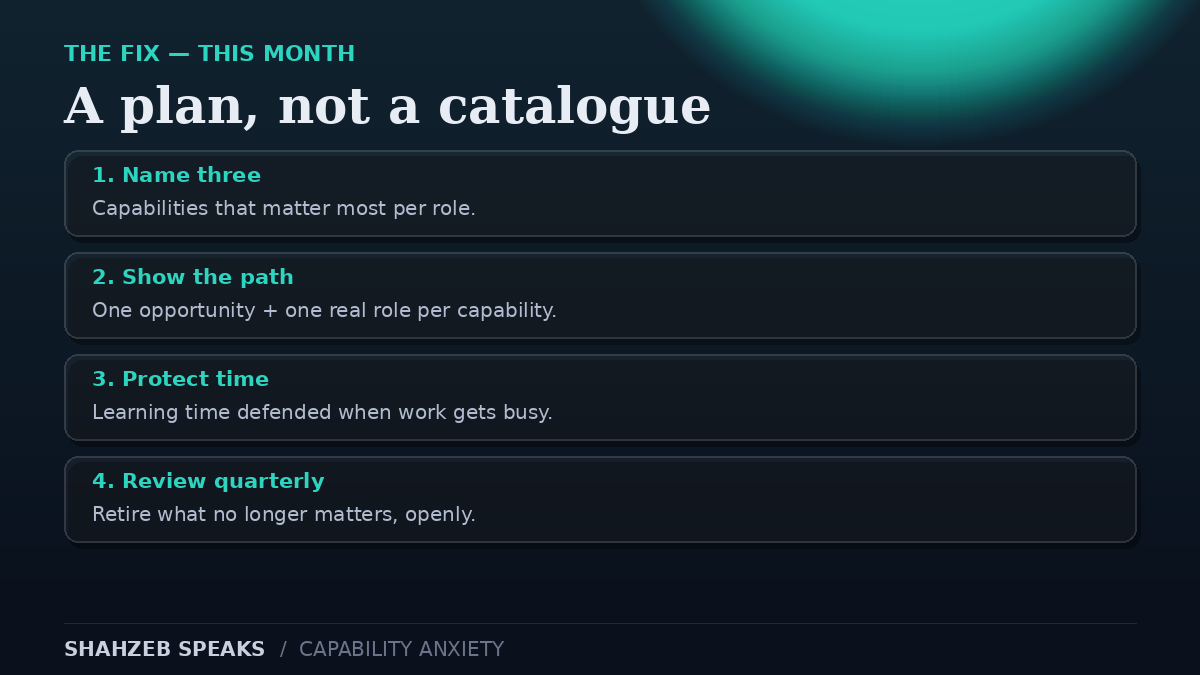
| Step | What to do | What it answers |
|---|---|---|
| 1. Name three | For each role, name the three capabilities that matter most in the next year. | What matters most? |
| 2. Show the path | Link each capability to one learning opportunity and one internal role that uses it. | Where do I focus? |
| 3. Protect time | Put learning time on the calendar and protect it when work gets busy. | Is this real? |
| 4. Review quarterly | Revisit the three capabilities every quarter; retire what no longer matters. | Is this still true? |
For managers: start with one team and one conversation per person. Ask each team member which capability they are most unsure about, and answer with a named priority, not a catalogue. If you cannot name the three capabilities for a role, that is the work: find out from the work itself, from the tools the team actually uses, and from the errors that actually occur. Then protect the learning time. A development plan that is cancelled whenever work gets busy teaches the team that development is decorative. For employees: ask for the same specificity in return. “Which two skills should I build first, and how will we know I have built them?” is a fair question, and a manager who cannot answer it has just learned something useful about their own clarity. If no answer comes, build your own short list from the work: the tasks that take longest, the errors that recur, and the tools your team is actually adopting, in that order.
For organisations: the WTW employer figure is the starting point for an honest audit. If your organisation is among the roughly 70% without established skills processes, the first step is not a vendor selection. It is a map: for each major role family, what capabilities does the work require now, what will it require next year, and where is the evidence? Only about 30% of employers can answer that from a system today. The rest must answer it from managers, and managers can only answer it if they are given time, examples, and permission to say “we do not know yet, and here is how we will find out.” Uncertainty admitted honestly is less anxious than uncertainty papered over with a catalogue. The Talent Canada summary of the same WTW study adds a reason to take this seriously: the 34% of employers who sustained employee experience as a priority over the past three years and continue to do so outperformed their peers on productivity, profitability and workforce outcomes. Sustained attention, not a single initiative, is what separates the two groups.
✅ Chapter 8: The action plan — this week, for one team
1. This week: ask the three questions. Ask every team member: which capabilities will matter most for your job next year, where should you focus, and does your manager help you develop? Record the answers by role. Every “I don’t know” is a clarity gap with a name on it.
2. This week: name three capabilities per role. Write them down, in plain language, with one learning opportunity and one real task that uses each. Share the list. A list nobody sees is not a plan.
3. This month: protect two hours. Put two hours of learning time on each person’s calendar and defend it once, publicly, when work pressures it. One defended hour teaches more than ten promised hours.
4. This month: make beginners safe. Let one senior person learn something new in public, badly at first, and talk about it. The team learns that incompetence is a stage, not a verdict.
5. This quarter: review and retire. Revisit the three capabilities. Keep what still matters, replace what does not, and say openly what changed and why. A plan that never changes is a plan nobody trusts.
If you do only one thing from this guide, ask the three questions. They cost an hour, they need no approval, and they turn a vague anxiety into a named list. And a named list is something a manager, a team, and an employee can actually work on together.
❓ Questions I am asked most often
What is capability anxiety?
It is WTW’s term, from October 2026, for uncertainty about whether your skills will remain relevant, what capabilities will matter most, and where to focus your development. It is not a clinical diagnosis. It is a description of a gap between changing work and unclear guidance, and it is useful because each part of the definition points at a fixable failure.
How is capability anxiety different from job insecurity?
Job insecurity is fear of losing the job itself. Capability anxiety can exist in a secure job: the role survives while the skills inside it shift, and nobody has mapped the shift. The response is also different: job insecurity needs reassurance about employment, while capability anxiety needs a named skills path and protected learning time.
What did WTW actually find in October 2026?
In a study of 549 employer organisations and 7,000 employees, 45% of employees said AI is already important to their daily job and 22% said it will fundamentally change their work. Only about 30% of organisations had established skills tracking processes, and manager development help fell from 84% to 78% over four years.
Does AI cause capability anxiety?
WTW does not claim that. AI is the most visible change, but the anxiety comes from the gap between change and guidance, not from the tool itself. Employees with a clear role plan and manager support face the same tools as a challenge; employees without that guidance face them as a threat. The management around the tool matters more than the tool.
What should a manager say to an anxious employee?
Name the priorities, not the catalogue: which two or three capabilities matter most for this person’s role this year, what learning builds them, and how progress will be judged in real work. Then protect the learning time. Generic reassurance without a path does not restore confidence, because confidence comes from evidence of competence, not from promises.
What can I do if my manager cannot name my priorities?
Build a short list from the work itself: the tasks that take longest, the errors that recur, and the tools your team is actually adopting. Ask your manager to confirm or correct it. If no correction comes, you have still turned a vague worry into a plan you can act on, and you can revisit it quarterly as the work changes.
📬 Which capability are you unsure about?
If you are unsure which skill to build first, or you manage a team that is, tell me the role and the change that worries you most. Contact me and describe the skill you are afraid of getting wrong.
For the broader field behind this guide, see my homepage on industrial psychology in Pakistan, and for the engagement half of the story, read employee engagement at a 15-year low and career change psychology.
Sources
- WTW (2026). Uncertainty about future skills is emerging as the next workforce risk, says WTW. EX Intelligent report / 2026 Employee Experience Global Market Study. Press release, 7 October 2026.
- HR Dive (2026). ‘Capability anxiety’ may be pulling companies down. 13 October 2026.
- HRO Today (2026). Skills Uncertainty Is the Next Workforce Risk. 16 October 2026.
- Talent Canada (2026). Employers must address workers’ ‘fear of becoming obsolete’ as AI reshapes the workplace: survey. Summary of the WTW 2026 Employee Experience Global Market Study.
- Bandura, A. (1977). Self-efficacy: Toward a unifying theory of behavioral change. Psychological Review.
- Deci, E. L., & Ryan, R. M. (2000). The “what” and “why” of goal pursuits: Human needs and the self-determination of behavior. Psychological Inquiry.
- Lazarus, R. S., & Folkman, S. (1984). Stress, Appraisal, and Coping. Springer.
- Gallup (2026). U.S. Employee Engagement Below 30% for First Time in 15 Years. Published 28 October 2026, updated 29 October 2026. (Cross-reference only.)