
On a Monday morning, a new hire arrives to a desk with no login, a manager who is in back-to-back meetings, and a team that has not been told she is starting. By Friday she has learned two things: the job is harder than the interview suggested, and nobody seems to have planned for her. The first 90 days do not test a new hire’s talent. They test whether the organisation had a plan.
This guide covers what the research actually says about employee onboarding, why the first 90 days matter more than the first day, what a workable 30-60-90 plan looks like, and the mistakes that quietly push good hires out. I am careful throughout about what is strong evidence, what is survey data, and what is simply good practice — because onboarding advice is full of confident numbers that fall apart when you check them.
I am an Industrial and Organizational Psychologist based in Karachi. Onboarding is, in plain terms, organisational socialisation: the process by which an outsider becomes an insider. That framing matters, because it stops us treating onboarding as paperwork. Paperwork can be finished in a day. Becoming an insider takes weeks.
“A new hire does not decide to stay on day 90. She decides, in small pieces, from day one — every time she is left waiting, every time her manager shows up, every time the job matches what she was promised.”
— Workplace Psychology Analysis, ShahzebSpeaks
⚡ Chapter 1: The short answer
Employee onboarding is the structured process of helping a new hire become productive, connected and committed — and the evidence says it works through three things: role clarity (knowing exactly what good work looks like), self-efficacy (believing you can do it), and social acceptance (feeling you belong). When those three are in place, satisfaction, commitment, performance and the intention to stay all improve. When they are missing, even a talented hire struggles.
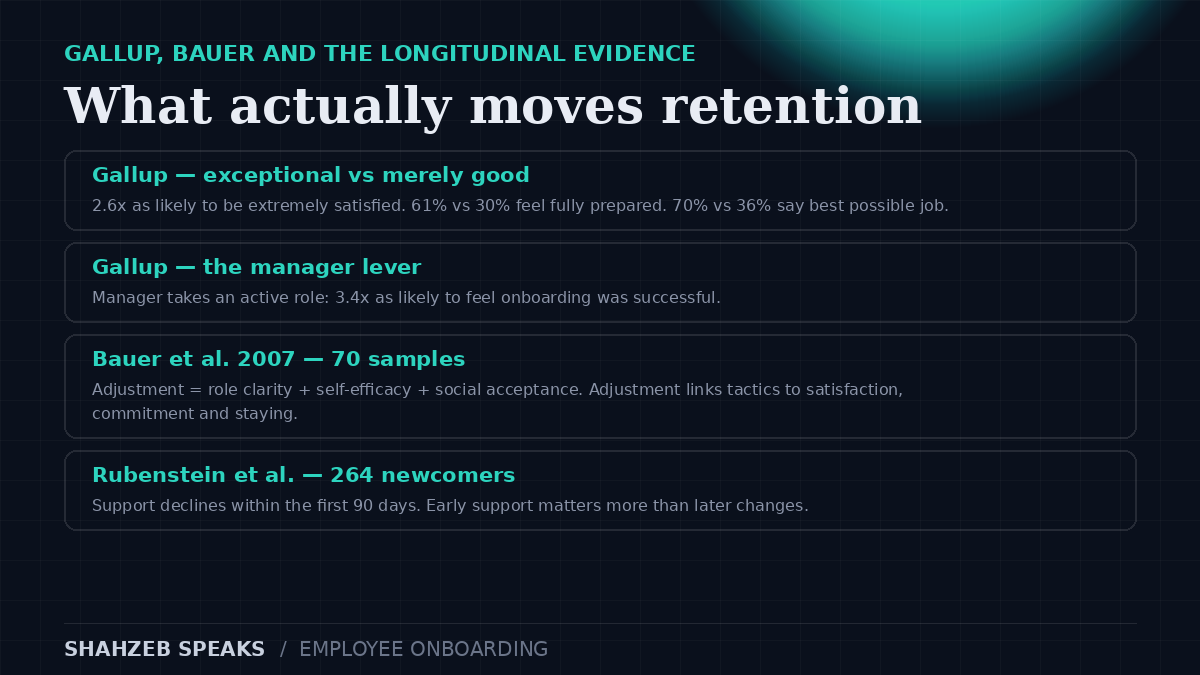
The strongest headline numbers come from Gallup: employees who rated their onboarding as exceptional were 2.6 times as likely to be extremely satisfied with their workplace, and 61% felt fully prepared to excel, compared with 30% of those who merely agreed their onboarding was exceptional. When the manager took an active role, new hires were 3.4 times as likely to feel their onboarding was successful. The practical conclusion is simple: onboarding is not an HR event. It is a manager’s job, supported by HR, spread over at least 90 days.
The rest of this guide explains the mechanism, the timeline, and a plan you can actually run.
🔬 Chapter 2: What onboarding really is
Orientation and onboarding are not the same thing. Orientation is the first-day briefing: policies, passwords, the fire exits. Onboarding, in Talya Bauer’s widely used definition for the SHRM Foundation, is the longer process of integrating a new employee into the organisation — its work, its people and its culture — over weeks or months. A company that confuses the two will proudly finish onboarding by lunchtime on day one and then wonder why the hire is lost by week six.
Bauer and colleagues tested the mechanism properly. In a 2007 meta-analysis in the Journal of Applied Psychology, covering 70 unique samples of newcomers, they found that newcomer adjustment — role clarity, self-efficacy and social acceptance — mediated the effects of socialisation tactics and information-seeking on outcomes including job satisfaction, organisational commitment, job performance, intentions to remain, and turnover. In other words, onboarding activities do not directly produce retention. They produce clarity, confidence and belonging, and those produce retention. If your programme does not move those three, it is theatre.
That is also why the “buddy” matters more than the handbook. A handbook gives information. A buddy, a manager and a team give social acceptance — the sense that you are an accepted member, not a visitor with a laptop. For related evidence on how feedback shapes early performance, see my guide to 360-degree feedback, and for why structured processes beat gut feel in selection, structured interviews.
📊 Chapter 3: The numbers — what is solid, what is survey data
Onboarding statistics travel fast and are often quoted without their source. Here is the honest version.
| Finding | Source and strength |
|---|---|
| Exceptional onboarding → 2.6x as likely to be extremely satisfied | Gallup analysis; strong survey evidence, not a randomised trial |
| 61% vs 30% feel fully prepared (exceptional 5/5 vs agree 4/5) | Gallup; the gap between “exceptional” and merely “good” is the point |
| Manager active → 3.4x as likely to feel onboarding successful | Gallup; manager involvement is the single biggest lever |
| Strong onboarding → retention +82%, productivity +70% | Brandon Hall Group (2015), via secondary reporting; treat as indicative, not precise |
| Support declines within the first 90 days; early support matters most | Rubenstein et al., 14-wave study of 264 newcomers; longitudinal evidence |
Two survey findings are worth knowing even though they are not experiments. BambooHR’s onboarding research found that 70% of new hires decide whether a job is the right fit within the first month, and 39% have second thoughts during onboarding itself. Enboarder’s 2025 survey of HR leaders found that “clear role expectations” received more than double the number-one votes of any other success factor — 408 votes against 137 for the next factor, building relationships. And in the same survey world, 31% of new hires said their onboarding wrapped up within a single day. That last figure is the problem in one number: a one-day process cannot deliver role clarity, confidence and belonging.
The 90-day decline nobody plans for
Here is the finding managers most need to hear. In a 14-wave longitudinal study of 264 newcomers, Rubenstein, Kammeyer-Mueller, Wanberg and Song found that support from co-workers and supervisors declined within the first 90 days of employment — and that early support and early undermining had stronger links to outcomes assessed after 90 days than later changes did. Supervisor undermining was uniquely associated with a higher turnover hazard. The first weeks are not just a warm-up. They lay a foundation that later effort struggles to repair. If support is going to fade, it should fade because the hire no longer needs it, not because the organisation stopped paying attention.
🗓️ Chapter 4: The first 90 days, phase by phase
Michael Watkins’ book The First 90 Days (2003) gave managers a useful discipline: treat a transition as a project with phases, not as a single event. The phases below follow that logic, grounded in Bauer’s three adjustment outcomes.
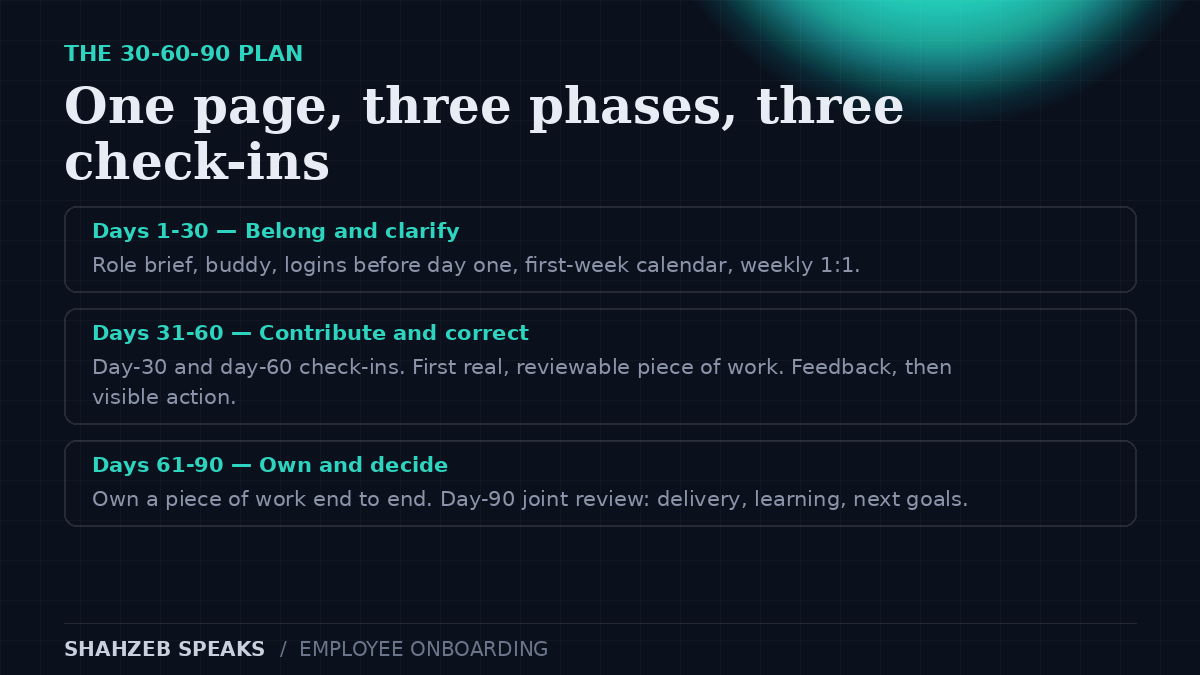
Days 1–30: Belong and clarify
The hire’s questions are basic and urgent: What am I actually judged on? Who do I ask? Am I welcome here? The manager’s job in this phase is to answer them in writing and in person: a one-page role brief (three outcomes for the first 90 days, how each will be judged, what “good” looks like), working logins before day one, a buddy who is not the manager, and a first-week calendar that includes real work, not just briefings. Belonging is built by introductions with a purpose — “meet Sara, she owns the data you will use” — not by a tour of desks.
Days 31–60: Contribute and correct
The novelty fades and the real job appears. This is where role clarity is tested: the hire now knows enough to see where the job description and the job differ. Schedule a structured check-in at day 30 and day 60, and ask three questions: What is clearer now than on day one? What is still confusing? What do you need that you do not have? Then act on the answers visibly. Nothing kills trust faster than a check-in that changes nothing. This is also the phase for the first piece of real, reviewable work — small enough to succeed at, real enough to matter.
Days 61–90: Own and decide
By now the hire should own something end to end, however small, and should be able to explain how their work connects to the team’s goals. The day-90 conversation is not a pass/fail exam. It is a joint review: what was delivered, what was learned, what the next 90 days should target, and whether the role still matches what was promised. If the answer to that last question is no, say so early. A hire who discovers a mismatch at month six feels deceived; a hire who hears it at day 90 can still adjust.
✅ Chapter 5: A 30-60-90 plan you can actually run
A 30-60-90 plan is a planning method, not a magic formula. No randomised trial proves that this exact structure cuts turnover by a specific percentage, and I will not pretend otherwise. Its value is that it forces the manager to decide, in advance, what “progress” means at each stage — which is exactly what role clarity requires.
| Phase | Manager delivers | Hire delivers |
|---|---|---|
| Days 1–30 | Role brief, buddy, logins, first-week calendar, weekly 1:1 | Learns the work, meets key people, asks questions in writing |
| Days 31–60 | Day-30 and day-60 check-ins, first real deliverable, feedback on it | First reviewable piece of work, flags gaps honestly |
| Days 61–90 | Day-90 review, next-90-day goals, recognition of what worked | Owns a piece of work end to end, explains its purpose |
For remote and hybrid hires, add one rule: no “figure it out” onboarding. In an office, a hire overhears how things work. At home, they do not. Write down the unwritten rules — how decisions are made, who must be consulted, what “urgent” means here — and review them at day 30. The same applies to managers: Gallup’s finding that managers account for 70% of the variance in team engagement is a reminder that the manager is the onboarding programme, whatever HR built around them.
⚠️ Chapter 6: What good onboarding is not
Three common substitutes fail Bauer’s test. First, a long induction week of presentations. Information without role clarity is noise; a hire who has sat through eight hours of company history still does not know what they will be judged on. Second, a checklist that only tracks IT tasks. A completed checklist proves logins exist, not that the hire can do the work. Third, “sink or swim” framed as toughness. The Rubenstein finding is the answer to that: early undermining and withdrawn support predict later withdrawal. Toughness that arrives as neglect is not development. It is just neglect.
There is also a fairness point. Onboarding quality varies wildly within the same company — one manager plans, another does not — and that variation becomes an equity problem. New hires in well-managed teams get clarity, confidence and belonging; hires elsewhere get a laptop and good luck. If you care about psychological safety at work, start by standardising the first 90 days: the same role brief, the same check-ins, the same buddy, for every hire.
🚫 Chapter 7: Seven mistakes that push hires out
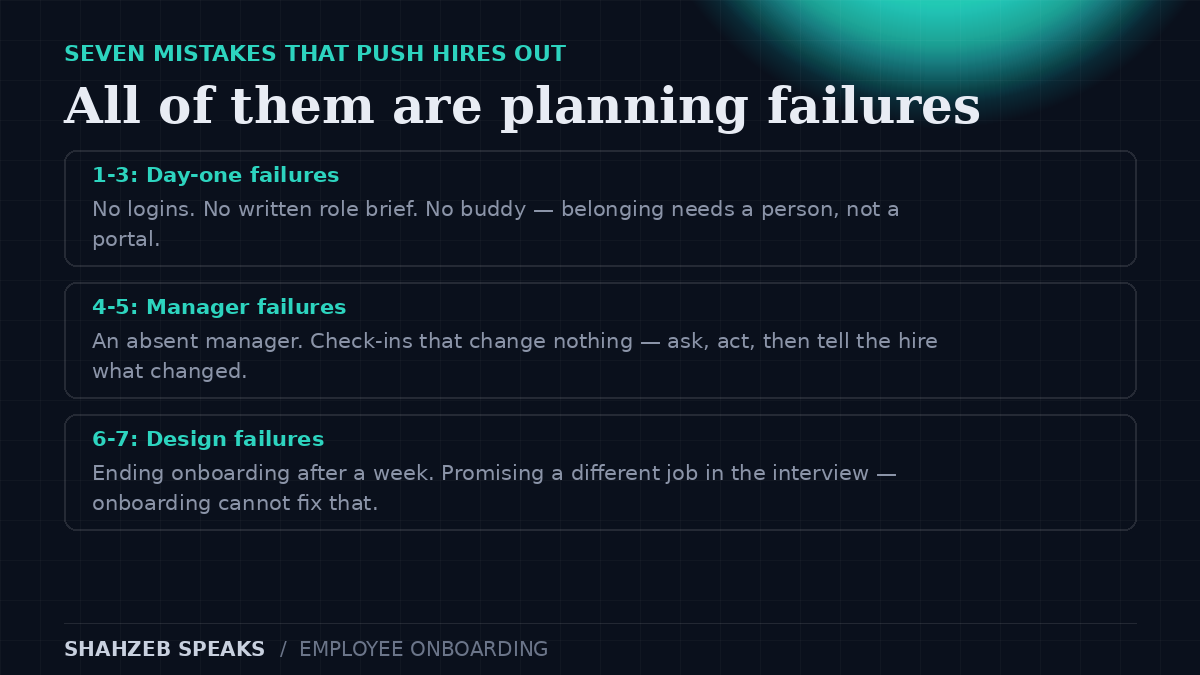
1. No access on day one. The hire’s first memory of your company should not be waiting for IT. 2. No written role brief. Verbal expectations drift; written ones can be checked. 3. No buddy. Belonging needs a person, not a portal. 4. An absent manager. Gallup’s 3.4x finding is, in practice, a warning about this one failure. 5. Check-ins that change nothing. Ask, then act, then tell the hire what changed. 6. Ending onboarding after a week. If 31% of hires report a one-day process, the norm is the problem. 7. Promising a different job. The day-90 mismatch conversation only works if the interview was honest. If it was not, onboarding cannot fix it — and the honest response is to say so.
📋 Chapter 8: A checklist for managers
Before day one: role brief written, logins requested, buddy named, first-week calendar sent, team told. Week one: daily check-in, buddy introduction, first small task assigned. Day 30: clarity check — what is clear, what is not, what is needed. Day 60: feedback on first real work, gaps closed visibly. Day 90: joint review, next goals, recognition. Throughout: protect the 1:1. When a manager cancels the onboarding 1:1 for the third time, the hire hears the message clearly, even if the manager never says it.
Measure three things at day 90, briefly: role clarity (“I know what good work looks like in my role”), self-efficacy (“I am confident I can do it”), and social acceptance (“I feel accepted by my team”). If any one is low, that is your next 90 days’ work — not a new programme, but a specific conversation and a specific fix.
❓ Questions I am asked most often
How long should onboarding last?
At least 90 days, not one day or one week. Bauer’s research treats onboarding as a process over weeks or months, and the longitudinal evidence shows support declining within the first 90 days — which is exactly when hires still need it. A one-day induction is orientation, not onboarding.
What is a 30-60-90 plan?
A one-page plan dividing the first 90 days into learning (days 1–30), contributing (days 31–60) and owning (days 61–90), with a manager check-in at each boundary. It is a planning method, not a proven effect size: its value is forcing clear expectations at each stage, which is what role clarity requires.
What matters most in the first 90 days?
Role clarity first. In Enboarder’s 2025 HR leader survey, clear role expectations received more than double the number-one votes of any other factor. After clarity, the manager’s active involvement matters most — Gallup found it made hires 3.4 times as likely to feel onboarding was successful.
Who owns onboarding — HR or the manager?
HR builds the system; the manager delivers the experience. Gallup’s evidence points the same way: manager involvement is the lever that moves perceived success. A perfect HR programme with an absent manager will fail, and a good manager can rescue a thin programme.
How do I know if onboarding worked?
Ask the hire at day 90 about the three adjustment outcomes: role clarity, self-efficacy and social acceptance. If all three are high, onboarding worked. If one is low, fix that one specifically — with a conversation, a clearer brief, or a real introduction — rather than launching a new programme.
Does onboarding really affect retention?
Yes, through adjustment. Bauer and colleagues’ meta-analysis of 70 samples found adjustment mediated the link between socialisation and satisfaction, commitment, performance and intentions to remain. Survey data points the same way, but the mechanism — clarity, confidence, belonging — is the part to trust and to build.
📬 Want help building a first-90-days plan?
If your new hires are taking too long to become productive, or leaving before they do, the first 90 days are usually where the problem sits. I can review your onboarding against the evidence above and build a plan your managers will actually run.
For context on the field behind this work, my writing on industrial psychology in Pakistan explains what an I/O psychologist actually does — and if early performance conversations are your next problem, the psychology of performance reviews guide covers why they so often fail.
Sources
- Bauer, T. N. (2010). Onboarding new employees: Maximizing success. SHRM Foundation.
- Bauer, T. N., Bodner, T., Erdogan, B., Truxillo, D. M., & Tucker, J. S. (2007). Newcomer adjustment during organizational socialization: A meta-analytic review of antecedents, outcomes, and methods. Journal of Applied Psychology, 92(3), 707–721.
- BambooHR. Onboarding research (survey findings as reported in 2025 summaries).
- Brandon Hall Group (2015). The True Cost of a Bad Hire (as reported in secondary summaries).
- Enboarder (2025). HR Leader Survey: Winning the First 90 Days; (2024) State of Employee Onboarding Report.
- Gallup (2019). Creating an Exceptional Onboarding Journey for New Employees; Essential Ingredients for an Effective Onboarding Program.
- Rubenstein, A. L., Kammeyer-Mueller, J. D., Wanberg, C. R., & Song, Z. The critical role of the hiring manager in new employee onboarding (14-wave longitudinal study, 264 newcomers).
- Watkins, M. (2003). The First 90 Days. Harvard Business School Press.