
Your manager says you are doing fine. Your peers say you interrupt. Your direct reports say you never listen. Which one is the truth? That question is what 360-degree feedback was built to answer — ratings from your boss, your colleagues, and the people who report to you, all pooled into one report. Done well, it is one of the few feedback tools with real evidence behind it. Done badly, it poisons trust, inflates ratings, and changes nothing.
This guide explains what 360-degree feedback actually is, what the strongest studies really found — including the famous result that more than a third of feedback interventions make performance worse — why tying it to pay or promotions quietly destroys it, why so many employees say they would opt out if they could, and the concrete rules that separate the versions that work from the versions that backfire. Every number below is traceable to its published source, and where I only have a survey or a press report rather than a journal paper, I say so plainly.
I am an Industrial and Organizational Psychologist in Karachi. Organisations keep asking me to “install a 360” as if it were software — plug it in, get better managers. The research tells a more interesting and more honest story: the tool itself is neutral. The design decisions around it — who sees the results, what they are used for, whether anyone follows up — decide whether it helps or harms.
“Feedback is only as useful as the system that surrounds it. Collect ratings without anonymity, follow-up, and a developmental purpose, and you have built a very expensive way to make everyone nervous.”
— Workplace Psychology Analysis, ShahzebSpeaks
📋 Chapter 1: The short answer
360-degree feedback collects anonymous ratings about an employee — usually a manager — from their supervisor, their peers, and their direct reports, plus a self-assessment, and feeds the combined picture back to them. Does it work? The best evidence (a 2005 meta-analysis of 24 longitudinal studies) says performance improves afterwards, but the gains are small: the authors warn practitioners “should not expect large, widespread performance improvement.” It works best as a developmental tool — for coaching, not for deciding pay or promotions. Tie the same ratings to compensation and raters inflate them by roughly a third of a standard deviation, which quietly destroys the honesty the whole exercise depends on. If you remember one rule: 360 for development, manager ratings for decisions — never mix the two.
🔍 Chapter 2: What 360-degree feedback actually is
The name describes the geometry. Instead of the traditional one-way appraisal — your boss rates you — a 360 gathers perspectives from all around you:
- Your manager, who sees your output and alignment with strategy.
- Your peers, who see your collaboration, reliability, and politics.
- Your direct reports, who see your leadership — the part your manager never witnesses.
- Yourself, whose self-rating is then compared against everyone else’s.
The comparison between self-ratings and others’ ratings is often the most revealing part. A 1988 meta-analysis by Harris and Schaubroeck found that after correcting for measurement error, self-ratings agreed only moderately with how supervisors (ρ = .35) and peers (ρ = .36) rated the same person — while peers and supervisors agreed with each other considerably more (ρ = .62). In plain terms: other people see you more similarly than you see yourself. The same analysis found that, on average, self-ratings ran over half a standard deviation higher than supervisor ratings and about a quarter of a standard deviation higher than peer ratings. Most of us grade ourselves on a curve.
A few design rules are close to universal in the professional guidance. Most leadership 360s use five to ten raters, plus the leader’s manager and a self-assessment. Peer and direct-report responses are anonymous and aggregated — results are only shown when at least three people have responded in a rater group, so no individual can be identified. The manager’s feedback is usually attributable, because there is only one manager. And the cadence is typically annual: run them too often and you overload raters and leave no time for behaviour to change between rounds. The Center for Creative Leadership’s long-standing guidance puts the purpose rule bluntly: clarify with everyone that the assessment is for development, not part of salary or promotion review.
📊 Chapter 3: The evidence that it works — small, slow, and real
The most cited verdict comes from Smither, London and Reilly (2005), who meta-analysed 24 longitudinal studies of multisource feedback in Personnel Psychology. Their finding: ratings from direct reports, peers, and supervisors do improve over time following feedback — but the improvement is generally small. The corrected effect sizes were d = .15 for direct-report ratings, d = .05 for peer ratings, and d = .15 for supervisor ratings. In everyday language, that is a nudge, not a transformation. The authors explicitly warn that practitioners “should not expect large, widespread performance improvement after employees receive multisource feedback.”
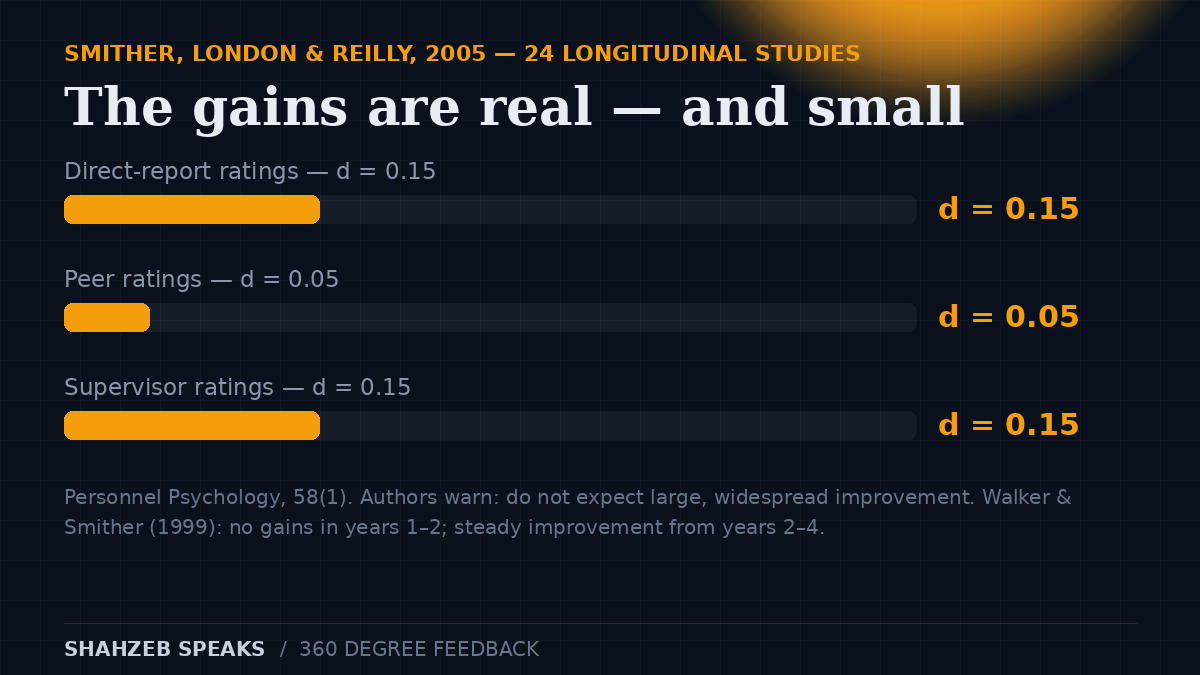
Two details from the same body of research matter more than the headline numbers. First, improvement is slow. Walker and Smither (1999) found no improvement between years one and two of a 360 programme, with steady gains only appearing from years two to four. If your organisation runs one 360 and declares it a failure six months later, it never gave the evidence a chance. Second, improvement is conditional. Smither’s team found gains were most likely when the feedback indicated change was necessary, the recipient had a positive feedback orientation, perceived a genuine need to change, reacted positively to the feedback, believed change was feasible — and then set goals and acted on them. Feedback does not change people; people change themselves after feedback, and only under the right conditions.
There is also encouraging evidence from a very demanding setting. Atwater, Roush and Fischthal (1995) studied 978 student leaders at the US Naval Academy with 1,232 followers rating them: after upward feedback, followers’ ratings of leadership actually improved. Leaders who received negative feedback lowered their self-evaluations; those who received positive feedback raised them. The mirror, held steadily, does adjust the picture — it just takes time and repetition.
What predicts whether someone acts on the feedback
One finding deserves special attention from anyone designing a 360 process. Brutus, London and Martineau (1999) found that in a 360 intervention, it was subordinates’ negative ratings — not the boss’s, not peers’, not the self-rating — that were most strongly related to managers choosing developmental goals. The people below you notice the behaviours you most need to fix, and their criticism is the most motivating kind. That is precisely the rater group most organisations are tempted to exclude, because managers find upward feedback threatening. Excluding it removes the most useful signal in the entire exercise.
⚠️ Chapter 4: The one-third problem — feedback can make things worse
Here is the finding every 360-degree feedback enthusiast should be forced to memorise. In 1996, Kluger and DeNisi published a landmark meta-analysis in Psychological Bulletin covering 607 effect sizes and 23,663 observations of feedback interventions. On average, feedback improved performance (d = 0.41). But over one-third of the feedback interventions decreased performance — and the authors showed this could not be explained away by sampling error, by whether the feedback was positive or negative, or by any existing theory. Feedback is not a vitamin. It is a drug with side effects.
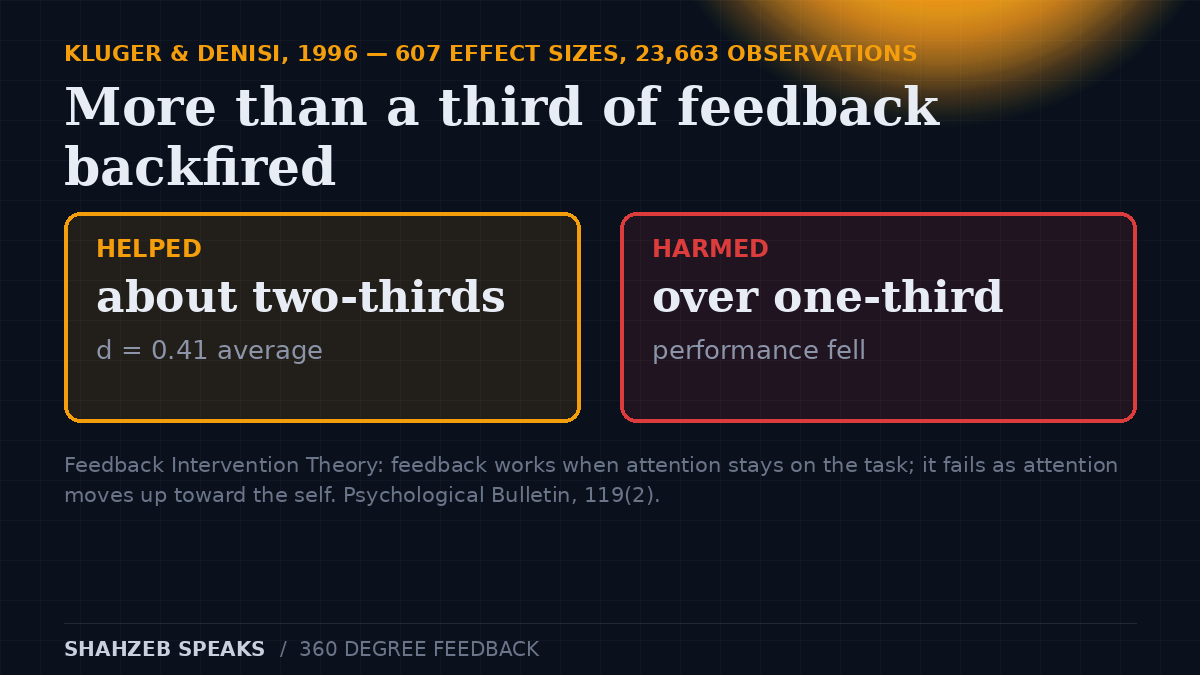
To explain the damage, Kluger and DeNisi proposed Feedback Intervention Theory. Its central claim: feedback shifts where your attention goes, across three levels — task learning (how do I do this better?), task motivation (how hard am I trying?), and meta-task processes (what does this say about me as a person?). And crucially, feedback becomes less effective as attention moves up the hierarchy, closer to the self and away from the task. Tell someone their report needs restructuring and they think about the report. Tell them they are “not leadership material” and they think about themselves — defensively, for weeks.
This is the theoretical reason 360-degree feedback so often misfires in practice. A multisource report is, by design, about the person: their style, their presence, their character as a colleague. It drags attention straight to the top of Kluger’s hierarchy, the level where feedback does the least good. Brett and Atwater (2001) documented the emotional fallout directly: people react with anger and discouragement when feedback is negative — or even just less positive than they expected. Atwater and Brett (2005) added a sobering twist: leaders’ emotional reactions to feedback were not related to how many follow-up development activities they actually did. Feeling bad about your 360 does not make you work on it; it just makes you feel bad. Though there was one constructive pattern in the same study: leaders whose ratings improved over time were the ones whose initial reactions had been more positive — suggesting that how the feedback is delivered and framed genuinely matters.
🔑 The Kluger rule for interpreting any 360 report
If a piece of feedback pulls the recipient’s attention toward themselves (“you are arrogant”), it will likely backfire. If it pulls attention toward the task (“in Tuesday’s client meeting, you interrupted twice — here’s what to do instead”), it can help. The difference between those two sentences is the difference between the one-third that harms and the two-thirds that helps.
💰 Chapter 5: Why tying it to pay quietly poisons it
The single most consequential design decision in any 360 programme is what the results are used for. And the research verdict is unambiguous: the moment raters believe their scores will affect someone’s bonus or promotion, honesty collapses.
Jawahar and Williams (1997) meta-analysed 22 studies with a combined sample of 57,775 people and found that ratings collected for administrative purposes — pay raises, promotions — were on average one-third of a standard deviation more lenient than ratings collected for research or development purposes. The effect was largest in real field settings, with practising managers rating real subordinates. Nobody wants to be the colleague whose anonymous survey cost someone their raise, so everyone rounds up. The ratings still arrive on time and look professional; they have just stopped meaning anything.
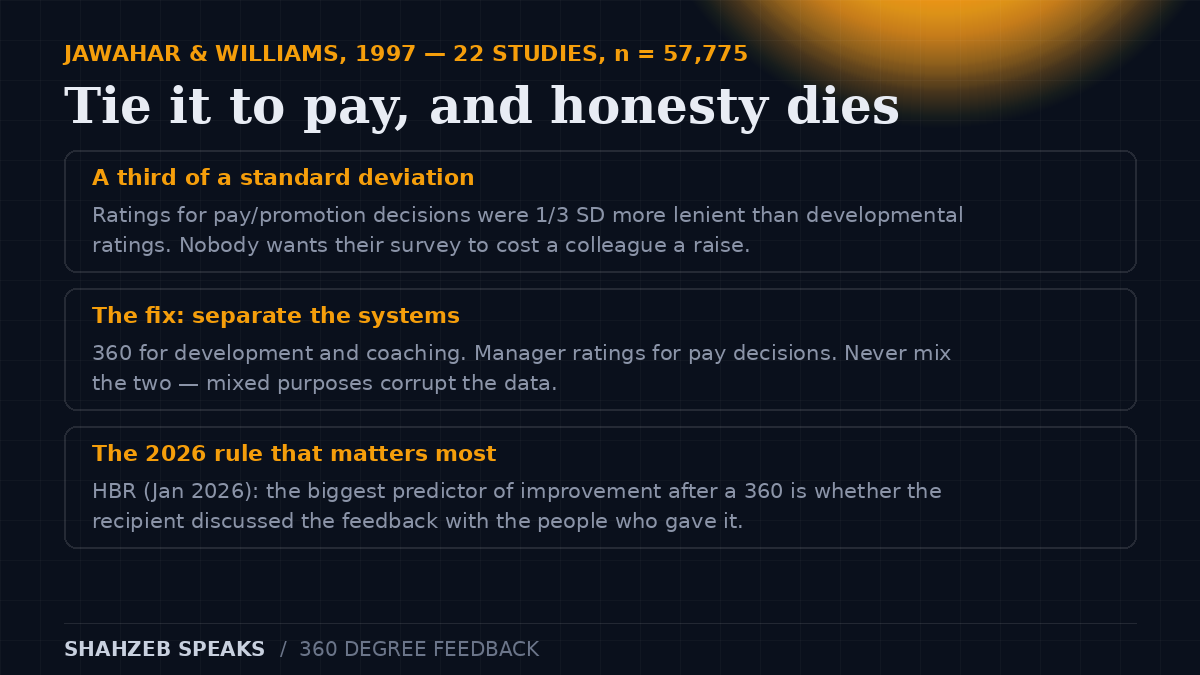
This is why the professional guidance is so consistent, and why I repeat it to every client: keep the two systems separate. Use 360-degree feedback for development — coaching conversations, growth plans, self-awareness. Use manager ratings for administrative decisions. The moment you merge them, raters start “softening their honesty” (as practitioner guidance from QuestionPro puts it), employees start gaming their rater selection, and the organisation ends up paying for an elaborate ritual that measures politeness instead of performance. A 360 that affects compensation is not a development tool with a side effect; it is a corrupted measurement wearing a development tool’s clothes.
😤 Chapter 6: Why so many employees say they would opt out
Ask employees what they think of 360s and the enthusiasm of HR departments evaporates. A commercial survey by LiveCareer (February 2025, 1,000 US workers, reported by WorldatWork) found that 79% of employees would opt out of 360-degree feedback if given the choice — even though 71% of organisations use it regularly. In the same survey, 48% believed 360s amplify office politics, 74% said they had received feedback they felt was unfair, biased or inaccurate, 79% suspected colleagues use feedback to settle personal grudges, and 29% said it creates workplace drama. These are survey responses, not peer-reviewed findings, and they come from a commercial vendor — but the scale of the discontent is hard to dismiss.
Some of that discontent has a rational core. Remember the self-other agreement numbers from Chapter 2: people rate themselves generously, and being told that everyone else sees you less favourably is a genuinely unpleasant experience. Brett and Atwater’s finding on anger and discouragement is not a design flaw to be engineered away; it is the predictable human response to learning your self-image is inflated. Organisations that launch 360s without preparing recipients — without coaching, without framing, without a private first reading of the report — are essentially scheduling hundreds of small emotional injuries and calling it development.
And some of the discontent reflects real process failures. When anonymity is not protected (reports shown with fewer than three raters per group, or managers who interrogate the team about “who wrote this”), fear of retaliation produces dishonest feedback. When nothing happens after the report — no coaching, no follow-up, no second round — employees correctly conclude the exercise was theatre. Gallup and Workhuman’s 2024 research found that only 25% of employees strongly agree they receive valuable feedback from the people they work with — but those who do are five times more likely to be engaged. The problem was never that employees hate feedback. It is that they rarely receive any worth having.
🏢 Chapter 7: What the famous “we killed the annual review” stories actually show
No discussion of workplace feedback is complete without GE and Adobe — and no discussion is honest without the caveats. In August 2015, GE joined Accenture, Adobe and Gap in moving away from traditional annual performance reviews toward more frequent feedback conversations. GE built an app, PD@GE, for exchanging voice and text feedback between employees, managers and teams year-round, following a 2013 “FastWorks” pilot — though ratings for compensation and promotion were still done manually, outside the app. Adobe had made its move earlier, in 2012: it scrapped stacked rankings and annual reviews in favour of ongoing “check-ins” — frequent, unstructured conversations about goals and development — and trained managers in feedback skills through lectures and role-playing.
The numbers Adobe reported are striking. Its old annual review process consumed an estimated 80,000 manager-hours per year, and the company saw a spike in voluntary attrition in the months following each review. Two years after the change, morale among employees and managers had increased significantly — and SHRM, citing Forbes, reported that Adobe’s shares rose 68% in the 18 months following its March 2012 announcement. (Share prices have many parents; treat that as correlation, not proof.) Around the same period, the Institute for Corporate Productivity estimated that about 10% of Fortune 500 companies had dropped annual ratings systems, while CEB put the figure at 6%.
Three honest caveats. First, neither company was running a branded “360-degree feedback programme” — GE used frequent multi-source feedback via its app; Adobe used manager check-ins. Their stories are about feedback culture, not about 360s specifically. Second, as one GovExec column warned at the time, “headlines that say GE has decided to end annual performance reviews are misleading… GE has not eliminated performance reviews.” The revolution was quieter than the headlines. Third, the lesson is not “abolish reviews” — it is that frequency and conversation beat annual ritual. A 360 report delivered once a year into a vacuum changes little; feedback embedded in ongoing conversation, which is what both companies were really building, is a different instrument entirely.
✅ Chapter 8: How to run a 360 that actually works
The research points to a clear, practical playbook. None of these rules is glamorous; together, they are the difference between the small-but-real gains of Smither’s meta-analysis and the backfiring third of Kluger’s.
1. Decide the purpose first — and protect it
Development only. Not pay, not promotion, not succession ranking. Write it down, tell every rater, and mean it. The Jawahar and Williams leniency effect is not a hypothetical; it is 57,775 people showing that mixed purposes corrupt the data.
2. Guarantee real anonymity
Peers and direct reports must be anonymous and aggregated, with a minimum of three responses per rater group before any results are shown. Explain the rules to raters before the survey opens. One breach of anonymity — one manager demanding to know “who said this” — poisons the next three years of surveys.
3. Include the upward raters, especially the uncomfortable ones
Direct reports’ negative ratings were the strongest predictor of managers setting developmental goals (Brutus, London & Martineau, 1999). If your 360 lets managers hand-pick friendly raters, you have built a compliment generator.
4. Make someone discuss the report — out loud
The newest finding in this guide may be the most actionable. Writing in Harvard Business Review in January 2026, Brenda Steinberg reports that “research shows that the biggest predictor of increased leadership effectiveness after a 360 is whether you discussed the feedback with the people who gave it to you.” Not the report’s elegance, not the coaching hours — the conversation. Build a structured debrief with a coach or facilitator into the process, and require the recipient to go back to their raters and talk about what they heard.
5. Give it years, not months
Walker and Smither found no gains between years one and two, with steady improvement from years two to four. Budget for at least two to three annual cycles before judging the programme. Pair the report with goal-setting and follow-up action — Smither’s conditions for improvement (perceived need to change, belief that change is feasible, concrete goals) do not happen by accident.
6. Frame feedback at the task level
Kluger and DeNisi’s theory is a practical editing guide: rewrite every piece of feedback so attention lands on the task, not the self. “Your presentations run over time; here are two techniques” helps. “You lack executive presence” harms. Train raters to write the first kind.
🔑 The one-paragraph 360 policy
Annual, developmental-only 360s. Five to ten raters plus manager and self. Minimum three responses per group, peers and reports anonymous and aggregated. A facilitated debrief for every recipient, a written development plan, and a follow-up conversation with raters. Results never touch compensation. Review the programme’s own effectiveness after three cycles.
❓ Questions I am asked most often
Does 360-degree feedback actually improve performance?
Slightly, and slowly. A 2005 meta-analysis of 24 longitudinal studies found small gains (effect sizes around 0.05–0.15), with the authors warning against expecting large improvements. Gains typically appear from the second year onward, not the first. It is a nudge, not a transformation — but a real one.
Should 360-degree feedback be anonymous?
For peers and direct reports, yes — anonymous and aggregated, with at least three responses per group before results are shown. Without anonymity, fear of retaliation produces dishonest feedback. The manager’s own ratings are usually identifiable, since there is only one manager.
Can you use 360-degree feedback for appraisals or pay decisions?
You can, but the research says you shouldn’t. A meta-analysis of 22 studies (57,775 people) found ratings for pay and promotion decisions were a third of a standard deviation more lenient than developmental ratings. Mixing purposes corrupts the honesty the tool depends on.
How many raters do you need for a 360?
Most leadership 360s use five to ten raters, plus the person’s manager and a self-assessment. Set a minimum of three responses per rater group so individuals cannot be identified. More raters add reliability, but also add survey fatigue — annual cadence is the norm.
Why do employees dislike 360-degree feedback?
A 2025 commercial survey found 79% of US workers would opt out if they could, with many citing office politics and unfair feedback. The research explanations: negative feedback triggers anger and discouragement, self-ratings are systematically inflated so the gap stings, and many programmes lack anonymity protection or any follow-up.
What is the biggest predictor of 360 success?
According to research reported in Harvard Business Review (January 2026), it is whether the recipient discusses the feedback with the people who gave it. The conversation after the report matters more than the report itself. Always build in a facilitated debrief.
Thinking of introducing 360-degree feedback — or fixing a broken one?
I help organisations design feedback systems that survive contact with reality: developmental purpose, honest anonymity, and follow-through. Get in touch here.
If this topic interests you, you may also want my guide to why performance reviews fail — and for the broader field I work in, see industrial psychology in Pakistan and beyond. Related reading: psychological safety at work and assessment centres.
Sources
- Kluger, A. N., & DeNisi, A. (1996). The effects of feedback interventions on performance: A historical review, a meta-analysis, and a preliminary feedback intervention theory. Psychological Bulletin, 119(2), 254–284.
- Smither, J. W., London, M., & Reilly, R. R. (2005). Does performance improve following multisource feedback? A theoretical model, meta-analysis, and review of empirical findings. Personnel Psychology, 58(1), 33–66.
- Harris, M. M., & Schaubroeck, J. (1988). A meta-analysis of self-supervisor, self-peer, and peer-supervisor ratings. Personnel Psychology, 41(1), 43–62.
- Jawahar, I. M., & Williams, C. R. (1997). Where all the children are above average: A meta-analysis of the performance appraisal purpose effect. Personnel Psychology, 50(4), 905–925.
- Brett, J. F., & Atwater, L. E. (2001). 360° feedback: Accuracy, reactions, and perceptions of usefulness. Journal of Applied Psychology, 86(5), 930–942.
- Atwater, L. E., & Brett, J. F. (2005). Antecedents and consequences of reactions to developmental 360° feedback. Journal of Vocational Behavior, 66(3), 532–548.
- Atwater, L. E., Roush, P., & Fischthal, A. (1995). The influence of upward feedback on self- and follower ratings of leadership. Personnel Psychology, 48(1), 35–59.
- Brutus, S., London, M., & Martineau, J. (1999). The impact of 360-degree feedback on planning for career development. Journal of Management Development, 18(8), 676–693.
- Walker, A. G., & Smither, J. W. (1999). A five-year study of upward feedback: What happens with the passage of time? Personnel Psychology, 52(2), 393–423.
- Steinberg, B. (2026, January 28). For your 360-degree feedback to be effective, you need to discuss it. Harvard Business Review.
- Center for Creative Leadership (2002). Best practices in 360-degree feedback.
- WorldatWork / LiveCareer (2025). Survey of 1,000 U.S. workers on 360-degree feedback (commercial survey, reported via WorldatWork).
- Gallup & Workhuman (2024). The human-centered workplace.