
The gym membership you have not used since February. The series you are hate-watching at episode nineteen because “we’ve come this far”. The project at work that everyone privately knows is dead, which the next quarterly review will somehow keep alive. Each one survives on the same logic: we have already paid so much — we can’t walk away now. The sunk cost fallacy is the reason: once money, time, or effort has been spent, quitting feels like wasting it — so we pay more to prove the first payment was right.
This guide explains what the sunk cost fallacy actually is, walks through the two classic experiments that defined it — the 1985 theatre-ticket study and the ski-trip questionnaire — shows how the same mechanism scales up into boardrooms (Staw’s escalation research) and onto basketball courts (the NBA draft study), traces the strange story of the “Concorde fallacy”, and ends with practical rules for quitting smarter. Every number below is traceable to its published source, and where I only have an abstract or a press report, I say so plainly.
I am an Industrial and Organizational Psychologist in Karachi. I study how people make decisions at work and in the marketplace, and I keep meeting the same pattern: rational people, armed with spreadsheets, defending irrational choices. This is the honest version — what the research proves, what it doesn’t, and what to do about it.
“A sunk cost is money you can never get back. The fallacy is the belief that spending more of it will change that.”
— Consumer Psychology Analysis, ShahzebSpeaks
🔬 Chapter 1: The short answer
The sunk cost fallacy is the tendency to continue an investment of money, time, or effort simply because you have already invested — even when the future looks bad. The classic definition comes from Hal Arkes and Catherine Blumer’s 1985 paper “The Psychology of Sunk Cost” (Organizational Behavior and Human Decision Processes): “a greater tendency to continue an endeavor once an investment in money, effort, or time has been made.” Their proposed explanation is almost embarrassingly human: “the psychological justification for this behaviour is predicated on the desire not to appear wasteful” — including to yourself.
Why does it matter? Because it turns one bad decision into two. The first payment is gone; economics says only future costs and benefits should matter. But your mind replays the payment, and the pain of admitting it was wasted outweighs the pain of paying again. The effect shows up in experiments with theatre tickets (Chapter 2), in questionnaire studies with ski trips (Chapter 3), in corporate boardrooms (Chapter 4), and in professional basketball (Chapter 5). It even has a famous aviation nickname (Chapter 6). The chapters ahead take each in turn — with the exact numbers, the authors’ own caveats, and the business disasters that resulted when nobody quit.
Related reading on this site: how loss aversion makes the fear of losing sell harder than the promise of winning and seven real examples of the framing effect.
🎭 Chapter 2: The theatre experiment — the study that started it all
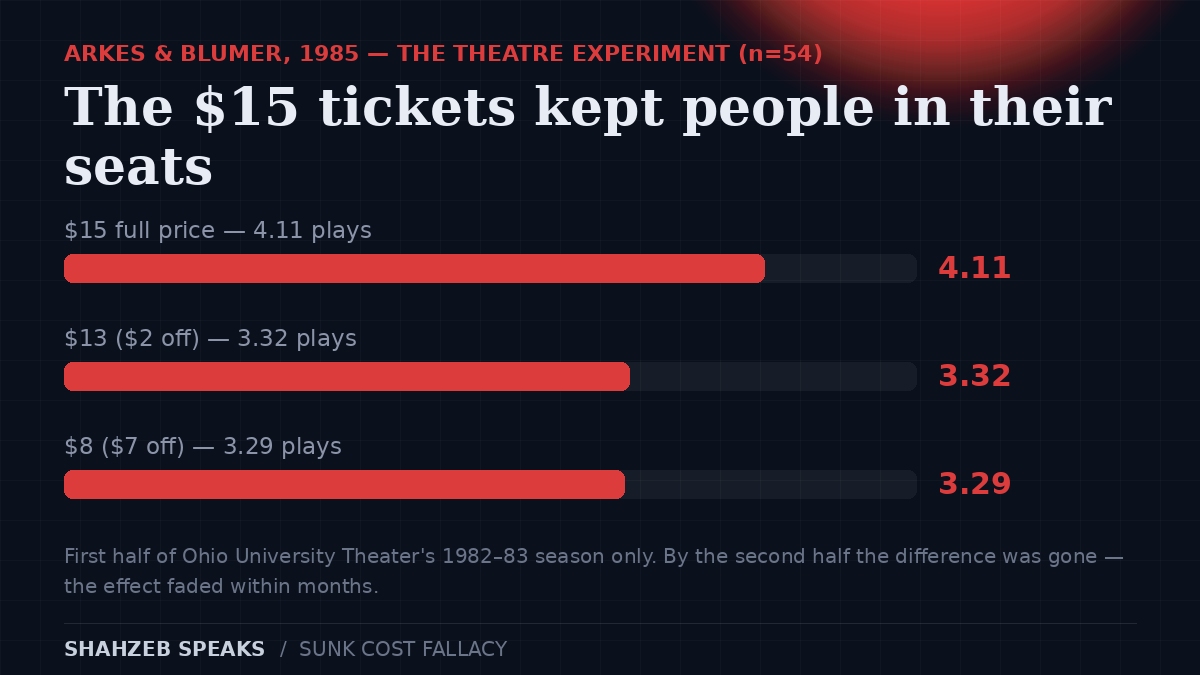
In 1982, Arkes and Blumer ran the experiment that gave the sunk cost effect its first clean field demonstration. The first 60 people approaching the ticket window for Ohio University Theater’s 1982–1983 season were randomly assigned one of three ticket prices: full price ($15), a $2 discount ($13), or a $7 discount ($8). Six buyers were dropped because they had bought as couples (non-independent data), leaving 54 patrons: 18 at full price, 19 at the $2 discount, 17 at the $7 discount. Attendance was then tracked all season by colour-coded ticket stubs — the researchers could see exactly who showed up.
The results, published in the 1985 paper (Experiment 2): in the first half of the season, the full-price group used significantly more tickets — a mean of 4.11 — than the $2-discount group (3.32) and the $7-discount group (3.29), p < .05, one-tailed. Everyone had bought the same season; the only difference was what they had paid. The more they had paid, the more they came. The authors conclude the effect “lasted for 6 months following the purchase of the tickets”.
The theatre experiment — at a glance (Arkes & Blumer, 1985, Experiment 2)
| Group | Price paid | Mean tickets used (first half) |
| No discount (n = 18) | $15 | 4.11 |
| $2 discount (n = 19) | $13 | 3.32 |
| $7 discount (n = 17) | $8 | 3.29 |
Here is the part most retellings of this study skip — and honesty requires it. In the second half of the season, the effect vanished: the authors report no significant difference between the groups, and state plainly that the effect “was not manifested, however, during the second half of the theater series (6 to 9 months following the purchase).” The sunk cost pull weakened as the purchase receded into memory. One field observation does not make this a general law — I will not pretend it does — but it is a useful limit on the story: the fallacy is strongest while the payment is fresh.
⛷️ Chapter 3: The ski trip — 54% chose the trip they would enjoy less
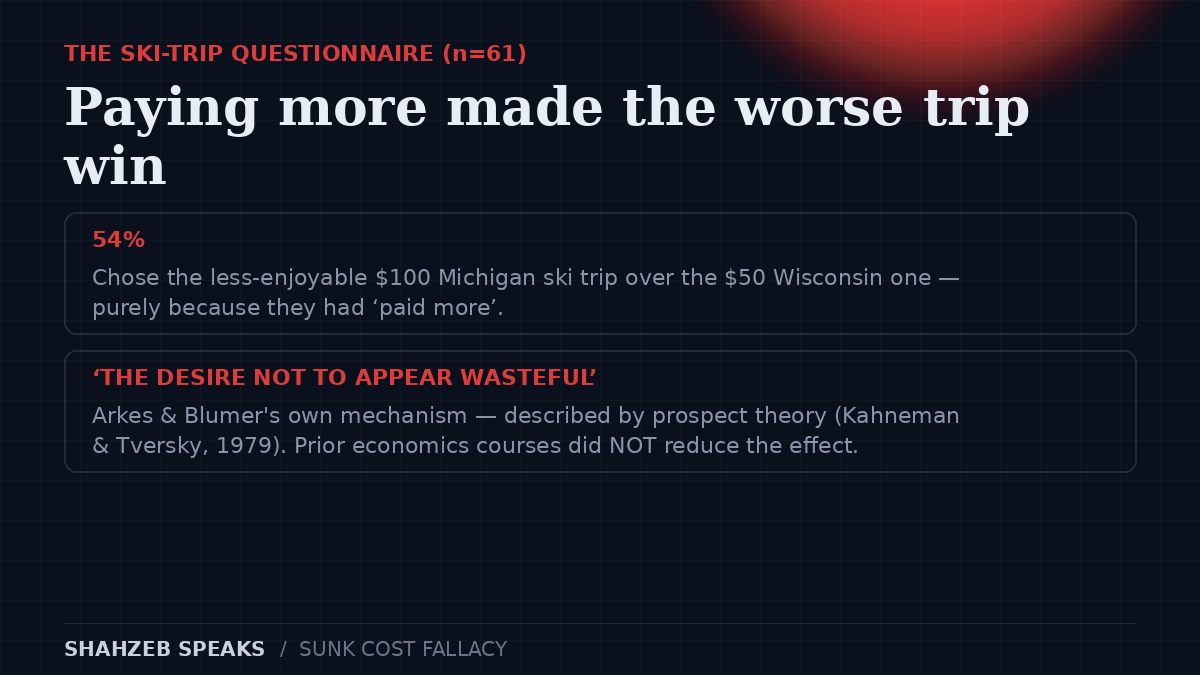
The most famous sunk-cost scenario in psychology is a questionnaire, and it fits on an index card. Sixty-one college students were asked to imagine they had bought two ski trips, both non-refundable, on the same weekend: a $100 trip to Michigan and a $50 trip to Wisconsin. They were then told, and this is the design’s genius, that they would enjoy the Wisconsin trip more. Which trip should they take?
Traditional economics predicts the answer unanimously: the money is gone either way, so everyone should take the trip they will enjoy more — Wisconsin, 100% of the time. In fact, 33 of the 61 students (54%) chose Michigan, and only 28 (46%) chose Wisconsin. More than half the respondents paid the extra price in enjoyment to honour the extra price they had paid in dollars. The authors write: “the prediction of traditional economic theory that 100% of the subjects would choose the Wisconsin trip is disconfirmed.”
This is Experiment 1 of the same 1985 paper, and its result is the cleaner demonstration of the mechanism. In the theatre study you might argue people were getting “their money’s worth.” Here nobody gets their money’s worth: both payments are gone. The 54% are simply refusing to waste the larger payment by letting the smaller one win — which is exactly what Arkes and Blumer meant by “the desire not to appear wasteful.” Nobody likes the feeling of having thrown money away; honouring the bigger payment keeps that feeling at bay, one weekend at a time.
The paper draws two wider connections worth knowing. First, it states the sunk cost finding “appears to be well described by prospect theory (D. Kahneman & A. Tversky, 1979, Econometrica, 47, 263–291)” — the losses loom larger than gains, and admitting the $100 was wasted registers as a loss. (For the broader behavioural-economics lineage, Richard Thaler’s 1980 paper “Toward a positive theory of consumer choice” is the consumer-choice work that first brought sunk-cost-type behaviour into the field.) Second, and this one should humble every trained professional reading this: “the sunk cost effect was not lessened by having taken prior courses in economics.” Knowing the theory does not switch the bias off.
🏢 Chapter 4: The sunk cost fallacy at work — Staw’s escalation research
The sunk cost effect leaves the laboratory and walks into the boardroom in Barry Staw’s 1976 paper, “Knee-deep in the Big Muddy: A study of escalating commitment to a chosen course of action” (Organizational Behavior & Human Performance). Two hundred and forty business school students role-played a corporate investment decision, with two experimental variables: whether they were personally responsible for the original choice, and whether its consequences had been positive or negative. (I verified this paper through its APA PsycNet abstract record — I did not open the original, so I will not quote exact scenario figures from it.)
The headline finding: “Ss committed the greatest amount of resources to a previously chosen course of action when they were personally responsible for negative consequences.” Read that again, because it is the engine of most corporate sunk-cost disasters. It is not failing projects that keep getting funded. It is failing projects chosen by the person now deciding whether to kill them. Killing the project means announcing, in public, that the earlier decision was wrong. Escalation of commitment is the sunk cost fallacy wearing a suit: the “waste” you are avoiding is not just money — it is reputation.
This is the psychological substrate of every doomed product launch, every “just one more funding round,” every failing initiative that survives because its sponsor sits in the room where the kill decision is made. The mechanism Staw documented — personal responsibility for negative consequences predicts escalation — is why the disasters in Chapter 7 look so familiar. They are not failures of analysis. They are failures of self-admission.
🏀 Chapter 5: The NBA study — draft order decides playing time
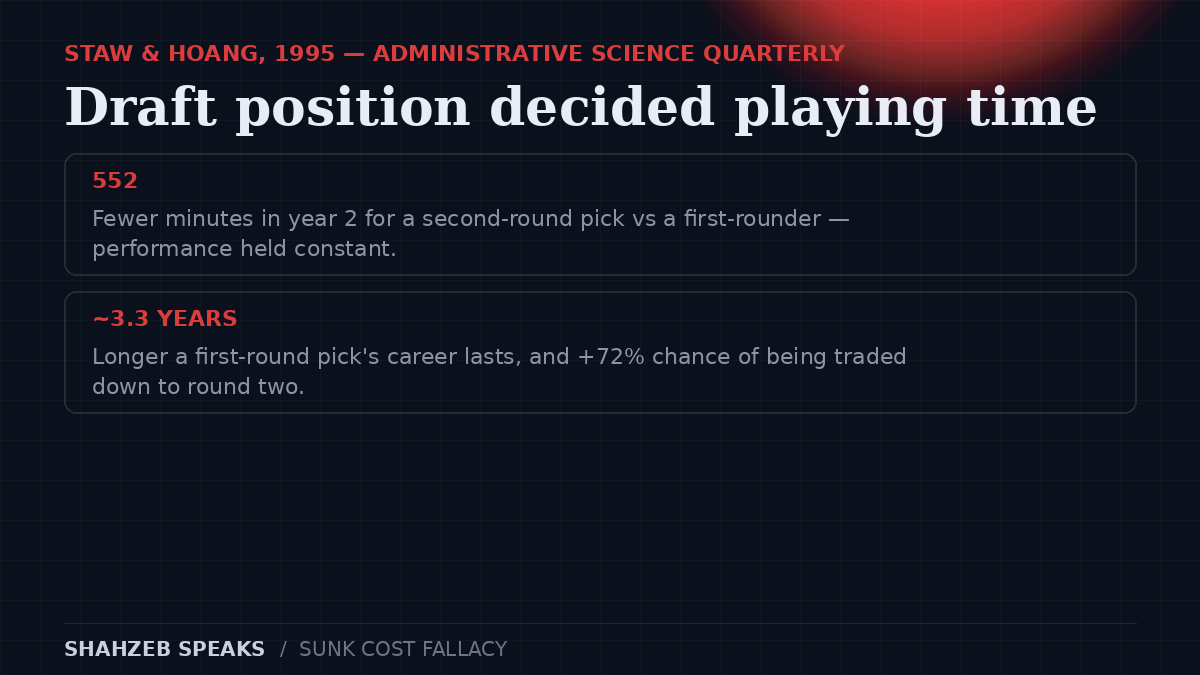
The most striking real-world test of sunk costs comes from professional basketball. Staw and Ha Hoang (1995) studied every player selected in the first two rounds of the 1980–1986 NBA drafts, using draft order as the measure of sunk cost — teams’ salary commitments were “roughly in line with their draft order.” If basketball were rational, playing time would follow performance alone. (Two corrections I verified against the paper itself: it appeared in Administrative Science Quarterly, 40(3), 474–494 — not the Journal of Applied Psychology, as some summaries claim — and its official title uses “Affects”, not “Predicts”: “Sunk Costs in the NBA: Why Draft Order Affects Playing Time and Survival in Professional Basketball.”)
Playing time: draft number significantly predicted minutes played in years 2 through 5, controlling for prior performance, injury, trade status, and position. The coefficients: −22.77 in year 2 (p < .001), −16.21 in year 3, −16.46 in year 4, −13.77 in year 5 — each step down the draft order cut playing time. In concrete terms, being taken in the second round rather than the first meant 552 fewer minutes of playing time in the second year — for players of equal measured performance.
Survival: of 275 players followed through the 1990–91 season, 184 were cut. Each increment in draft number raised the hazard of being cut by 3%, so “a first-round draft pick would therefore stay in the league approximately 3.3 years longer than a player drafted in the second round” — again controlling for performance.
Trades: of 241 players, 157 were traded from their original team — and draft number had a significant positive effect on the hazard of a player’s first trade away from the team that drafted him: each increment raised the trade hazard by 3%, so moving from the first to the second round “increased a player’s chances of being traded by 72 percent.” Note the careful reading the authors invite: early picks were kept and not traded. I will not stretch this finding into a claim about how other teams used traded players — the paper does not test that.
The NBA study matters because it rules out the easy excuses. This is not questionnaire imagination (Chapter 3) or student role-play (Chapter 4). It is real money, real jobs, real coaches, with performance statistically held constant — and the investment history still moved the decisions. When a general manager gives a high draft pick minutes he has not earned, that is the theatre patron attending plays he does not want to see, at a salary of millions.
✈️ Chapter 6: The Concorde fallacy — the nickname and the wasps
The sunk cost effect has a famous alias: the Concorde fallacy. The term was coined by Richard Dawkins and Tamsin Carlisle in “Parental investment, mate desertion and a fallacy,” published in Nature (262, 131–133) in 1976 — the very year Concorde entered commercial service. Their argument: animals should value options by future benefits, not past investment; continuing to pour resources into a failing course because of what was already spent is the fallacy. (I am deliberately not printing the Concorde programme’s cost figures — the commonly repeated numbers were not verified against the UK National Archives or an equivalent authority, so they do not belong here.)
The irony that launched a small literature: Dawkins and H. J. Brockmann’s 1980 study of digger wasps (Sphex ichneumoneus) fighting over nests found that “the wasp with the least prior investment is the one most likely to surrender” — the insects seemingly committing the fallacy themselves (Animal Behaviour, 28(3), 892–896; verified via the APA PsycNet abstract record).
Then came the corrective. Arkes and Ayton (1999), in “The sunk cost and Concorde effects: Are humans less rational than lower animals?” (Psychological Bulletin, 125(5), 591–600), reviewed the animal evidence and concluded that “there are no unambiguous instances of the Concorde fallacy in lower animals.” The wasp behaviour, on closer analysis, could be explained without the fallacy. Their second claim is the more unsettling one: young children behave more normatively than adults in sunk-cost situations. The fallacy is not a primitive instinct — it is something we learn, or rather over-learn, as the authors put it, from the overgeneralisation of the “Don’t waste” rule. Children will abandon a half-built sandcastle without anguish; adults finish the sandcastle, frame it, and pay for its maintenance.
💸 Chapter 7: When companies pay for it — Concord and Iridium
Laboratory effects are interesting; billion-dollar consequences are instructive. Two business cases show what happens when organisations cannot quit — with one important honesty note up front: these are disasters at business scale, not laboratory proof that the psychological mechanism caused them. Keep that distinction; the chapters above are the evidence, these are the illustrations.
Sony’s Concord: fourteen days
Sony launched the hero shooter Concord on PlayStation 5 and PC on 23 August 2024. On 3 September 2024 — eleven days after launch — Sony announced sales would halt immediately and the game would go offline on 6 September, fourteen days after launch, with full refunds to all buyers. The PlayStation Blog’s explanation: the launch “didn’t land the way we’d intended” (via Polygon). Analysts estimated roughly 25,000 copies sold (Fast Company); SteamDB showed a peak of fewer than 700 concurrent players (Pocket-lint). In October 2024 Sony permanently closed the developer, Firewalk Studios, and “permanently sunset” the game.
One figure I refuse to print: an unverified insider claim that Concord cost $400 million to develop, repeated by some outlets. Fast Company explicitly states that Sony has never disclosed how much was spent developing the game. I will not convert a podcast rumour into a fact. But notice what Sony did right at the end: it quit. Fourteen days after launch, full refunds, studio closed. Whatever the sunk investment was — and years of developer time certainly was — Sony stopped throwing good money after bad. The sunk cost fallacy is the reason companies don’t do this. Concord is what it looks like when they do.
Iridium: $5 billion, then bankruptcy
The larger-scale cautionary tale is Motorola’s Iridium satellite phone network: about $5 billion for 66 low-Earth-orbit satellites, with brick-sized handsets costing $3,000 and calls at $6–$30 a minute (Smithsonian Magazine). The network became operational in late 1998. By August 1999 — less than a year later — Iridium was bankrupt, with only about 55,000 customers (People’s Daily Online, 19 March 2000). The network was bought out of bankruptcy for $25 million — described as half a cent on the dollar.
Iridium is the escalation-of-commitment pattern from Chapter 4 written across a balance sheet: enormous investment, a market that never materialised, and continuation until the maths became undeniable. Frame it correctly, though: it demonstrates the consequence of failing to quit, not laboratory evidence of the mechanism. The mechanism is in Chapters 2 through 5. The wreckage is here.
🧭 Chapter 8: How to quit smarter
Knowing about the fallacy does not switch it off — remember, economics students fell for it too (Chapter 3). What works is not willpower but structure: decision rules you set before the investment starts pulling. Four rules, each aimed at a specific part of the mechanism:
1. Ask the forward question
Would you buy this ticket, fund this project, or stay in this arrangement today, at today’s price, knowing what you know now — ignoring everything already spent? If the answer is no, the past payment is doing your thinking for you. The 61 students in the ski-trip study would have chosen Wisconsin; the question just needed asking before the $100 entered the room.
2. Set a kill criterion in advance
Before you start, write down the conditions under which you will stop: a date, a metric, a loss limit. Pre-commitment works because the person who sets the rule is not yet the person who has to admit failure. Staw’s escalation research (Chapter 4) shows why this matters — the hardest person to overrule is the one who made the original call, and that person is usually you.
3. Price the alternative
The fallacy survives by keeping your eyes on the payment. Shift them to the opportunity cost: what could the next hour, the next pound, the next year of effort buy instead? The theatre patrons were not choosing between plays; they were choosing between plays and everything else an evening could hold. Make the alternative concrete and the sunk cost loses its grip.
4. Make quitting cheap in advance
Structure commitments so exit is easy: refundable bookings, trial periods, staged funding with real gates. Concord’s full refunds (Chapter 7) were Sony making exit cheap for its customers after the fact. The smarter move is designing the exit before you need it, while the “desire not to appear wasteful” has not yet taken the wheel.
❓ Questions I am asked most often
What is the sunk cost fallacy?
It is the tendency to keep investing money, time, or effort in something because you have already invested — even when quitting is the better option. Arkes and Blumer (1985) defined it as “a greater tendency to continue an endeavor once an investment in money, effort, or time has been made,” driven by the desire not to appear wasteful.
Who discovered the sunk cost fallacy?
Hal Arkes and Catherine Blumer named and demonstrated it in “The Psychology of Sunk Cost” (Organizational Behavior and Human Decision Processes, 1985), using the theatre-ticket field experiment and the ski-trip questionnaire. Barry Staw’s 1976 “Knee-deep in the Big Muddy” had earlier shown the related pattern of escalating commitment to failing courses of action in organisations.
What is the Concorde fallacy?
Another name for the sunk cost effect, coined by Dawkins and Carlisle in Nature (1976) and applied to animals — the idea that creatures should value options by future benefits, not past investment. Arkes and Ayton (1999) found “no unambiguous instances” of it in lower animals, and noted that young children behave more normatively than adults in sunk-cost situations.
Why do sunk costs affect our decisions?
Two linked reasons. First, the “desire not to appear wasteful” (Arkes & Blumer, 1985): abandoning an investment feels like admitting the money was thrown away, and that admission hurts. Second, prospect theory (Kahneman & Tversky, 1979): losses loom larger than gains, so the certain loss of the sunk payment outweighs the uncertain gain of a better alternative. Training in economics does not remove the effect.
Do businesses fall for the sunk cost fallacy?
Yes — and at enormous scale. Staw (1976) showed that personal responsibility for a failing decision predicts further investment in it. Sony’s Concord (2024) was pulled after 14 days with full refunds and its studio closed; Motorola’s Iridium network cost about $5 billion and was bankrupt by August 1999. These are business-scale illustrations of the failure to quit, not laboratory proof of the mechanism.
How do you overcome the sunk cost fallacy?
With structure, not willpower. Ask whether you would make the same investment today ignoring past spending; set a kill criterion before you begin; make the opportunity cost concrete; and design cheap exits in advance. The goal is to move the quit decision to a moment before pride and the “waste” feeling take over.
Tired of funding decisions that should have been killed months ago?
I help organisations build decision processes that quit early — escalation reviews, kill criteria, and evidence-based strategy. Contact me here.
If this is your first time on the site: I write about the psychology of work and the marketplace as an industrial psychology in Pakistan practitioner. For the close cousins of this bias, see why you overvalue what you own (the endowment effect) and why one purchase always leads to ten more (the Diderot effect).
Sources
- Arkes, H. R., & Blumer, C. (1985). The psychology of sunk cost. Organizational Behavior and Human Decision Processes, 35(1), 124–140. (Full paper PDF read directly.)
- Staw, B. M. (1976). Knee-deep in the big muddy: A study of escalating commitment to a chosen course of action. Organizational Behavior & Human Performance, 16(1), 27–44. (APA PsycNet abstract record.)
- Staw, B. M., & Hoang, H. (1995). Sunk costs in the NBA: Why draft order affects playing time and survival in professional basketball. Administrative Science Quarterly, 40(3), 474–494. (Full paper PDF read directly.)
- Dawkins, R., & Carlisle, T. R. (1976). Parental investment, mate desertion and a fallacy. Nature, 262, 131–133. (Via New Scientist feature.)
- Dawkins, R., & Brockmann, H. J. (1980). Do digger wasps commit the Concorde fallacy? Animal Behaviour, 28(3), 892–896. (APA PsycNet abstract record.)
- Arkes, H. R., & Ayton, P. (1999). The sunk cost and Concorde effects: Are humans less rational than lower animals? Psychological Bulletin, 125(5), 591–600. (APA PsycNet abstract record.)
- Kahneman, D., & Tversky, A. (1979). Prospect theory: An analysis of decision under risk. Econometrica, 47(2), 263–291. (Cited via Arkes & Blumer, 1985.)
- Thaler, R. H. (1980). Toward a positive theory of consumer choice. Journal of Economic Behavior & Organization, 1(1), 39–60. (PsycNet reference-list excerpt.)
- Polygon (2024). Report on Sony pulling Concord: sales halted 3 Sept 2024, offline 6 Sept 2024, full refunds. (Search excerpts.)
- Fast Company (2024). Report on Sony shutting down Concord (~25,000 copies estimated; Sony never disclosed development cost). (Search excerpts.)
- Pocket-lint (2024). Report on Concord’s permanent shutdown and Firewalk Studios closure (SteamDB peak under 700 concurrent players). (Search excerpts.)
- Smithsonian Magazine. “The rise and fall (and rise) of Iridium” (~$5B network, 66 satellites; article opened and read).
- People’s Daily Online (19 March 2000). Iridium bankruptcy filing, August 1999; ~55,000 customers. (Search excerpt.)
- New Scientist. “Call it quits: explaining the sunk cost fallacy” (feature on the fallacy’s history). (Search excerpt.)