
A shopper in Karachi adds a pair of shoes to her cart at 11 pm, sees the delivery fee appear at checkout, and closes the tab. Nothing about the shoes changed. The price did not rise. What changed is that something she had already started to feel was hers was suddenly going to cost more than she expected — and walking away felt easier than watching the deal get worse. That is loss aversion: the same brain that barely notices a gain of a hundred rupees flinches at the loss of it, and marketers have been building around that flinch for decades.
This guide explains what loss aversion is, where the idea comes from, the seven ways brands use it that you can verify with your own eyes, what the evidence actually supports — including the researchers who say the textbooks exaggerate it — and how to use it honestly in your own marketing.
I am an Industrial and Organizational Psychologist based in Karachi. I am not a marketer, which is why I read this literature the way a psychologist would: what was actually measured, who paid for the study, and where the effect stops working. Every number below comes with its source.
“People do not buy so much to gain something as to avoid losing something they have already started to own — the trial, the streak, the cart, the discount. Marketing that understands this does not shout louder. It simply makes the loss visible.”
— Consumer Psychology Analysis, ShahzebSpeaks
⚡ Chapter 1: The short answer
Loss aversion in marketing is the practice of framing an offer around what the customer stands to lose rather than what they stand to gain. “Keep your 20% discount” beats “get 20% off.” “Don’t lose your progress” beats “keep making progress.” The idea comes from prospect theory: psychologists Daniel Kahneman and Amos Tversky showed in 1979 that people judge outcomes as changes from a reference point, and that losses weigh heavier than equal gains.
How much heavier is debated — the famous calibration says losses hit about 2.25 times harder than gains, while newer work finds smaller numbers. The tactics below work whether the true ratio is two or one and a half, because they all rest on the same mechanism: once the brain treats something as already owned, giving it up hurts.
The rest of this article is the evidence, the tactics, and the limits.
🧠 Chapter 2: Where the idea comes from
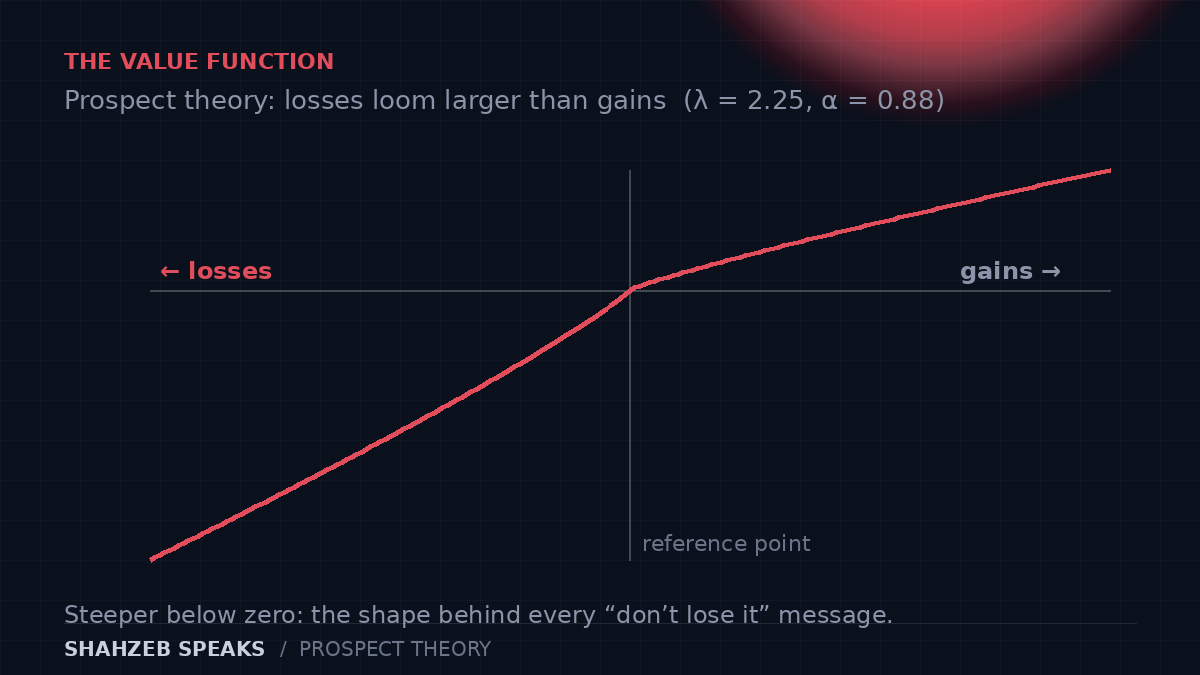
In 1979, Kahneman and Tversky published “Prospect Theory: An Analysis of Decision under Risk” in the journal Econometrica. Their claim was simple and, at the time, radical: people do not evaluate outcomes the way economics textbooks said they should. We evaluate them as gains and losses relative to a reference point — usually the status quo — and the psychological value function is lopsided. It is concave for gains (the second hundred rupees feels smaller than the first) and convex for losses, but above all it is steeper for losses than for gains.
Thirteen years later, Tversky and Kahneman calibrated the model and estimated the loss-aversion coefficient, lambda, at about 2.25 — losses roughly two and a quarter times as painful as equal gains feel pleasant, with a curvature parameter of 0.88. That “2.25” is the number you see quoted in every marketing book. It is worth knowing what it is: one calibration from experimental gambles, not a law of nature.
Here is the part most marketing articles skip. The “losses hurt twice as much” line has serious critics. In 2018, David Gal and Derek Rucker published “The Loss of Loss Aversion” in the Journal of Consumer Psychology, reviewing the evidence and concluding that it does not support losses being, on balance, more impactful than gains as a general principle. And a 2021 study in the Journal of Risk and Uncertainty measured loss aversion at the individual level and found a median of just 1.33 for risky choices — noting the famous 2.25 is probably too high in that setting.
Where does that leave a marketer? With a narrower, more honest claim. Loss aversion is real and well-documented in specific situations — especially when people feel they already own something. It is not a universal multiplier you can paste onto every campaign. I say this as someone whose whole site is built on psychology: the field is more interesting when you admit what it has not proved.
🧪 Chapter 3: The mug experiment — why trials work
In 1990, Kahneman, Jack Knetsch and Richard Thaler ran a series of experiments that marketing has been living off ever since. They gave some participants a coffee mug and asked how much they would sell it for; they asked others, who had no mug, how much they would pay for the same one. Sellers demanded far more than buyers would pay. The mug had not changed. Ownership had.
This is the endowment effect: we value things more once they are ours. And it is the entire business model of the free trial. Consider Amazon Prime: new members get a 30-day free trial with the full benefits, but signing up requires a valid credit card, and at the end of the trial the membership converts to paid automatically unless cancelled. Amazon states all of this plainly on its own help page. The psychology is doing quiet work underneath the plain text: for thirty days, fast delivery feels like the status quo. Cancelling starts to feel like losing something you have.
That is the pattern to recognise. A trial does not persuade you the product is good — though it might be. It moves your reference point. Day one, Prime delivery is a gain. Day twenty-nine, it is the baseline, and the baseline is what loss aversion defends.
| Before the trial | After 30 days of use |
|---|---|
| Fast delivery is a gain you are considering | Fast delivery is the reference point you now expect |
| Not subscribing costs you nothing | Not subscribing takes away what you have |
| The decision feels like buying | The decision feels like losing |
The same mechanism powers software trials, “keep your data” downgrade screens, and the streak I audited in Duolingo: at the end of 2025, about 43 million daily users had a streak of at least seven days, and the company’s own blog says the streak works because breaking it feels like a loss. If you have read my Duolingo psychology audit, you have seen loss aversion running a habit machine with 58.7 million daily users.
🛒 Chapter 4: The seven tactics, with real examples
Below are the seven loss-aversion plays I see most often, each with an example you can check yourself. None of them requires believing the 2.25 number. All of them require the customer to feel, even briefly, that something is already theirs.
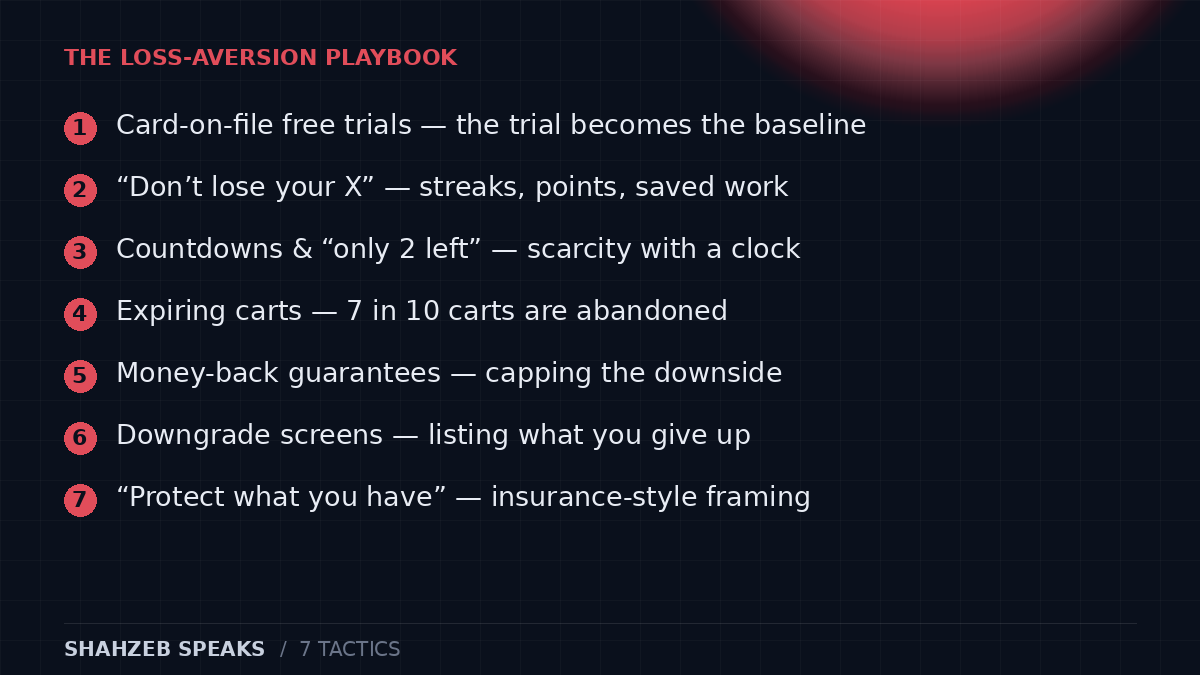
1. The card-on-file free trial
The Amazon Prime pattern from Chapter 3: full benefits for 30 days, card required, auto-conversion at the end. The trial is genuine — you really can cancel — but the default path keeps you. Defaults plus endowment is the combination; I covered the default side of it in my article on choice overload.
2. “Don’t lose your X”
Streaks, saved playlists, accumulated points, draft work. The message is never “gain more” — it is “protect what you have.” Push notifications that say “your streak ends tonight” outperform “come back and learn” because the reference point is the streak, not the lesson.
3. The countdown and the “only 2 left”
Scarcity is loss aversion with a clock. A countdown timer on a sale page reframes the discount as something that will be taken away. My Temu psychology audit walks through how aggressively this can be engineered — and where it tips from urgency into manipulation.
4. The cart that “expires”
Abandoned-cart emails work on the same principle: “your cart is still here” quietly becomes “your cart will not be here much longer.” The scale of the opportunity is enormous — the Baymard Institute’s compilation of 50 checkout studies puts average cart abandonment at 70.22% (see Chapter 5). Every one of those carts is a small endowment effect waiting to be reactivated.
5. The money-back guarantee
This one runs the mechanism in reverse. A guarantee removes the risk of loss from buying, which is exactly what a loss-averse brain is stuck on. “Love it or your money back” does not make the product better; it makes the downside feel capped, so the purchase stops feeling like a gamble.
6. Downgrade screens that list what you lose
Try cancelling a subscription and count how many screens show you what you will give up: your saved projects, your history, your member price. Each item is a small mug from the 1990 experiment. The honest version of this tactic tells you the truth about what ends. The dishonest version hides the cancel button three menus deep — that is not loss aversion, that is a dark pattern.
7. “Protect what you have” framing
Insurance, security software, warranties and backups are almost always sold as loss prevention rather than gain. Nobody buys antivirus for the joy of it; they buy it so nothing gets taken. The framing fits because the product genuinely is about preventing loss — when the frame matches the product, customers do not feel manipulated.
📊 Chapter 5: The 70% cart problem
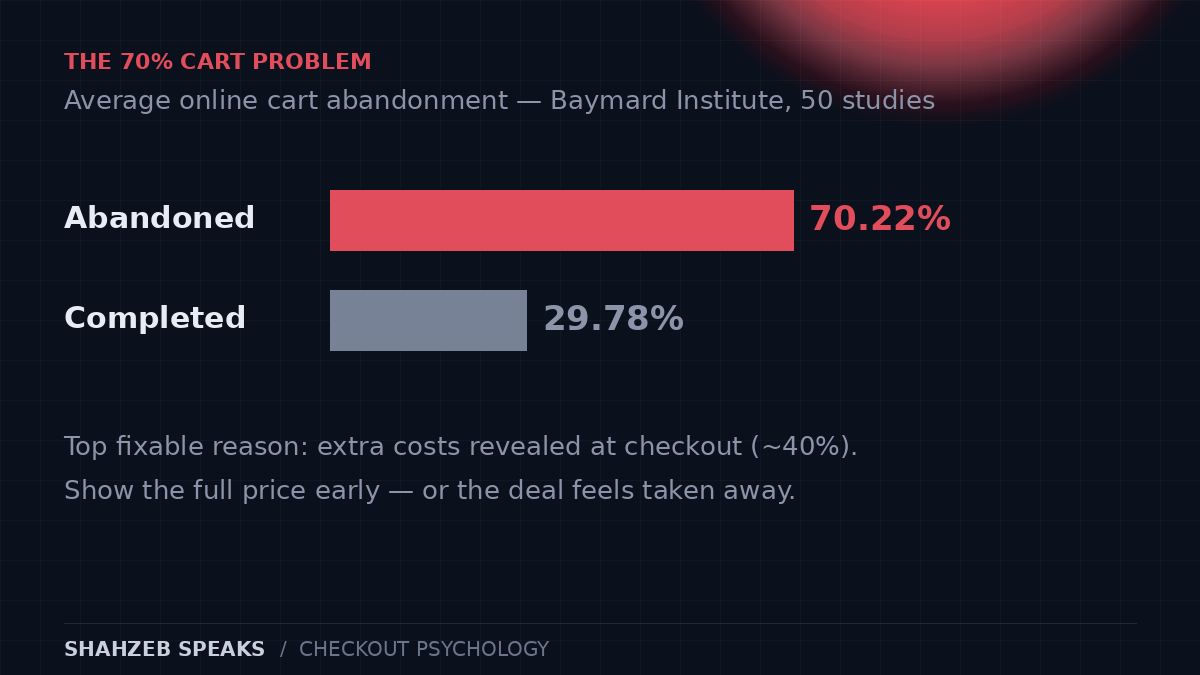
Here is a number that should sober up anyone running an online store. The Baymard Institute — a UX research firm that has tracked this metric for years — averages 50 separate checkout studies and finds that 70.22% of online shopping carts are abandoned. Seven in ten. The figure has barely moved in a decade.
The reasons are revealing. The top fixable cause, at around 40%, is extra costs appearing late: shipping, taxes and fees that were not in the price the shopper agreed to. Then come forced account creation, distrust, slow delivery and long checkouts. Read that list through the loss-aversion lens and it clicks: the shopper had mentally bought the item at one price, and the checkout took something away — the deal they thought they had. Walking away restores the feeling of not being played.
This is why cart-recovery messages lean on loss framing, and why the honest fix is not a cleverer email but a truer price. Show the full cost early and the endowment survives checkout. Hide it, and you manufacture the exact feeling — the deal getting worse — that makes people leave.
🧭 Chapter 6: What the evidence actually supports
After all that, a necessary cold shower. Nathan Novemsky and Daniel Kahneman themselves wrote in 2005, in “The Boundaries of Loss Aversion,” that the effect appears under specific conditions rather than everywhere. Loss aversion is strongest when:
Ownership is felt, not just described. The mug experiment worked because people held the mug. A banner saying “don’t miss out” creates far less endowment than a trial that puts the product in someone’s hands for a month.
The reference point is clear. “Lose your 20% discount” works because 20% off is the stated baseline. Vague urgency — “hurry!” with no stated baseline — has no reference point to defend, so there is nothing to lose.
The loss is credible. Countdown timers that reset when you refresh the page teach customers that the threat is fake. Once the threat is fake, the tactic trains distrust instead of urgency. I have watched Pakistani sale pages do this for years; the customers learn faster than the marketers.
And sometimes gain framing wins outright. “Get an extra month free” can beat “don’t lose your discount” when the audience is in an aspirational mood, shopping for pleasure rather than protecting a budget. The Gal and Rucker critique is a reminder, not a demolition: treat loss aversion as a tool with a manual, not a law of the universe.
🇵🇰 Chapter 7: What it looks like in Pakistan
You do not need Silicon Valley examples. Open any big sale page in Pakistan during a campaign and you will see the playbook running in Urdu and English: timers counting down, “only a few left in stock,” vouchers that expire at midnight. The mechanics are identical to the global ones; the copy is localised.
Fintech does it too. Easypaisa’s app runs “daily rewards — win rewards, every day,” a small daily prize for showing up. Miss a day and the feeling is not “I failed to gain” but “I lost today’s reward.” I have just finished a full brand psychology audit of easypaisa that breaks down exactly how a wallet app turns showing up into something you own — including the 2018 campaign that offered 50% cashback on mobile top-ups, capped and expiring, which is loss aversion wearing a cashback costume.
The pattern to watch for as a consumer is the manufactured reference point: the “original price” nobody ever paid, the discount that was always going to expire, the reward that only exists so you can fear losing it. Real loss aversion needs a real baseline. Everything else is theatre.
⚖️ Chapter 8: Using loss aversion without crossing the line
If you run a business, here is the honest version of the playbook:
Give people something real first. Trials, samples, saved work, genuine discounts with stated baselines. The endowment has to be earned; a fake one is just a lie with better lighting.
Make the loss true. If the offer expires Friday, it expires Friday. A countdown that resets is a short-term conversion gain bought with long-term trust — and trust is the one asset loss aversion cannot rebuild, because every future claim gets discounted.
Let people leave cleanly. Downgrade screens should inform, not imprison. The customers who stay because leaving was easy are worth more than the ones who stay because leaving was hard; the second group tells everyone they know.
Measure, don’t assume. Test loss framing against gain framing for your actual audience. The literature says the winner depends on context — your context is the only one that matters for your revenue.
Loss aversion is one of the most useful ideas psychology has given marketing, and one of the most abused. The difference between the two is whether the thing the customer fears losing was ever really theirs.
❓ Questions I am asked most often
What is loss aversion in simple words?
It is the tendency to feel losses more strongly than equal gains. Losing 1,000 rupees stings more than finding 1,000 rupees pleases. In marketing, it means “don’t lose your discount” usually motivates more than “get a discount.”
What is an example of loss aversion in marketing?
Free trials that ask for your card upfront, like Amazon Prime’s 30-day trial. You use the benefits for a month, they become your normal, and cancelling starts to feel like giving something up rather than simply not buying.
Is loss aversion real or exaggerated?
Both. The effect is well-documented when people feel ownership — the classic mug experiments, trials, streaks. But the famous “losses hurt twice as much” figure is one calibration, and researchers like Gal and Rucker argue it has been overstated as a universal law.
How do brands use loss aversion in Pakistan?
Countdown timers on sale pages, expiring vouchers, “only a few left” stock messages, and daily rewards in apps like Easypaisa where missing a day feels like losing the day’s prize. The mechanics match global practice; the language is local.
What is the difference between loss aversion and FOMO?
FOMO is the anxiety of missing an opportunity others are getting. Loss aversion is the pain of giving up something you feel is already yours. A countdown timer uses both: others are buying (FOMO) and your discount is expiring (loss).
Can loss aversion backfire in marketing?
Yes. Fake urgency — timers that reset, “last chance” emails sent weekly — teaches customers the threat is empty. Each false alarm makes the next real offer less believable, so the tactic burns the trust it needs to work.
Want this thinking applied to your product?
I help businesses apply behavioural psychology to their websites and funnels — honestly, with measurement, and without dark patterns. Contact me here and tell me what you are selling.
If you want the bigger picture of how I think about this field, start with my homepage on industrial psychology in Pakistan, and if the trial-and-streak mechanics interested you, my audits of Duolingo and Temu show the same principles running at full scale.
Sources
- Kahneman, D. & Tversky, A. (1979). Prospect Theory: An Analysis of Decision under Risk. Econometrica, 47(2), 263–291.
- Tversky, A. & Kahneman, D. (1992). Advances in Prospect Theory: Cumulative Representation of Uncertainty. Journal of Risk and Uncertainty, 5, 297–323.
- Kahneman, D., Knetsch, J. L. & Thaler, R. (1990). Experimental Tests of the Endowment Effect and the Coase Theorem. Journal of Political Economy, 98(6), 1325–1348.
- Novemsky, N. & Kahneman, D. (2005). The Boundaries of Loss Aversion. Journal of Marketing Research, 42(2), 119–128.
- Gal, D. & Rucker, D. D. (2018). The Loss of Loss Aversion: Will It Loom Larger Than Its Gain? Journal of Consumer Psychology, 28(3), 497–516.
- Baymard Institute (2025). Cart abandonment statistics, compiled across 50 studies (via secondary compilations, accessed October 2026).
- Amazon Customer Service. “Try Amazon Prime Free Trial” — 30-day trial terms, card requirement and auto-upgrade (amazon.com, accessed October 2026).
- Easypaisa official website (easypaisa.com.pk) — product features, accessed 7 October 2026.