
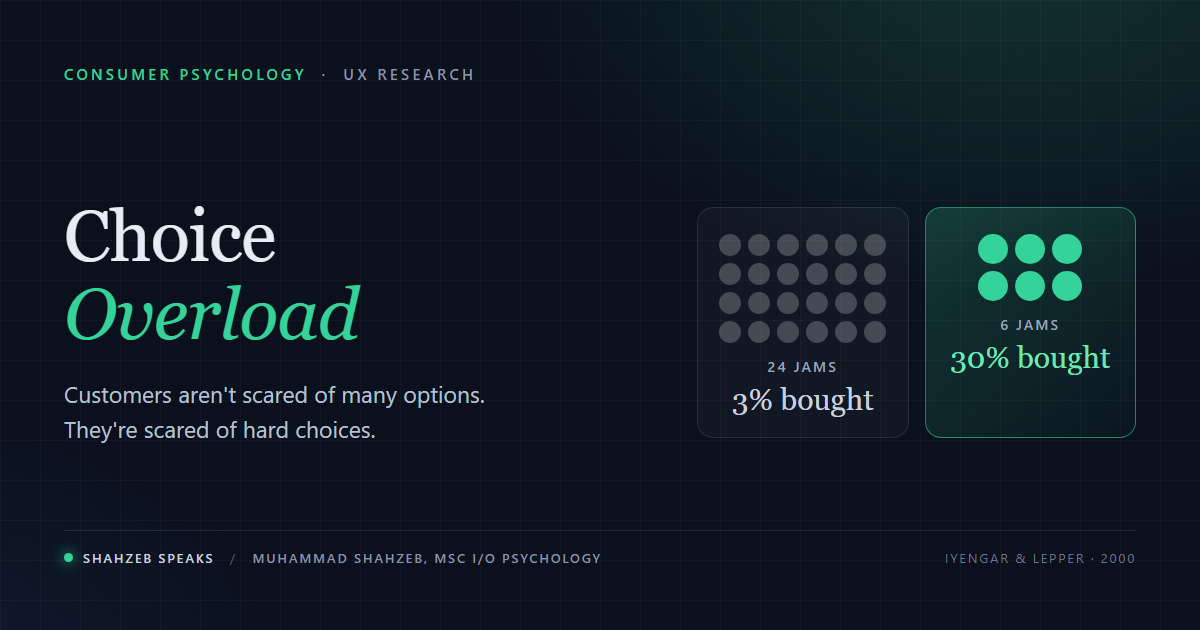
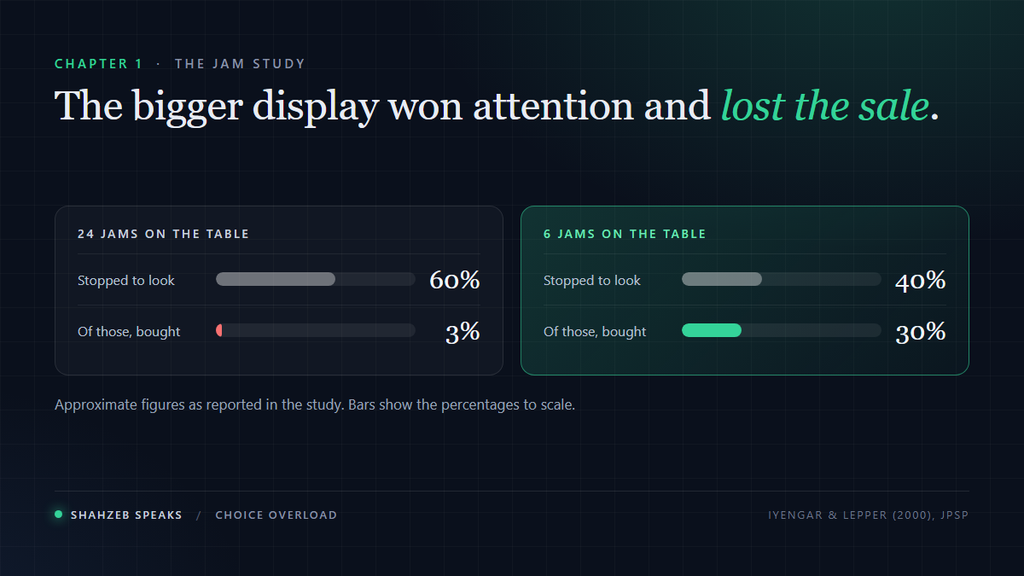
At an upmarket grocery store in California, shoppers walked past a tasting table offering jams. On some days the table showed 24 flavours. On other days, just 6. The big display attracted more people. The small one sold far more jam. Of the shoppers who stopped at the 24-jam table, about 3% bought a jar. At the 6-jam table, about 30% did.
That study, by Sheena Iyengar and Mark Lepper, became one of the most famous findings in consumer psychology. It launched a bestselling book, The Paradox of Choice, and a thousand conference talks telling businesses to cut their options. It is quoted in pricing meetings, product reviews and UX workshops around the world.
Here is what those talks usually leave out. When researchers later combined dozens of attempts to find the same effect, the average effect was close to zero. Choice overload is real, but it is not a law. It appears under specific conditions and disappears under others. I am an Industrial and Organizational Psychologist who also designs websites, and this article covers the original research, what happened when it was tested again, the four conditions that actually trigger overload, and what to do about the options on your own product, menu or pricing page.
“More choice does not reliably scare customers away. Hard choice does. The number of options matters much less than whether the customer can tell them apart and knows what they want.”
— Consumer Psychology Analysis, ShahzebSpeaks
🍓 Chapter 1: The jam study, and why it spread
Iyengar and Lepper published the jam study in 2000 in the Journal of Personality and Social Psychology. The design was simple and clever. On alternating occasions, a tasting booth displayed either 24 or 6 varieties of jam. Shoppers who stopped received a discount coupon, so the researchers could track who later bought.
The large display drew more interest: roughly 60% of passing shoppers stopped at the 24-jam table, compared with about 40% at the 6-jam table. But purchase ran the other way. Around 30% of those who stopped at the small display bought a jar, against only about 3% at the large one.
The same paper reported a second experiment with chocolates. People who chose from a smaller set of chocolates were more satisfied with the one they picked than people who chose from a larger set. More options did not just reduce buying; they seemed to reduce satisfaction with the choice that was made.
The findings spread quickly because they contradicted a deep assumption of economics and marketing: that more choice is always better, because people can simply ignore options they do not want. Iyengar’s work suggested the opposite, and Barry Schwartz’s 2004 book The Paradox of Choice turned it into a cultural idea.
🧠 Chapter 2: Why too many options can backfire
Where choice overload does occur, the psychological mechanisms are well understood.
Decision effort. Every additional option adds comparisons. With 6 options, a shopper can reasonably consider them all. With 24, comparing every pair is impossible, so the decision becomes effortful and uncertain. When effort outweighs the expected benefit, the easiest decision is no decision, and the shopper walks away.
Fear of choosing wrongly. A larger set increases the chance that a better option exists somewhere in it. That raises anticipated regret: the fear of discovering later that you picked the wrong one. People avoid regret partly by avoiding the decision.
Higher expectations. With many options, people expect to find something close to perfect. Any flaw in the chosen option then feels like a personal failure to choose well, which is why satisfaction can drop even when people do buy.
Maximisers suffer most. Schwartz and colleagues distinguished between maximisers, who try to find the best possible option, and satisficers, who look for one that is good enough. In their 2002 research, maximisers reported lower satisfaction and more regret. Large choice sets are hardest on people who feel they must find the best.
These mechanisms connect to other biases I have covered. The fear of choosing wrongly is close to the loss aversion discussed in my article on the endowment effect, and the way a single comparison option can steer a decision is the subject of my article on the decoy effect.
🔬 Chapter 3: The honest part — the effect often fails to appear
This is the part of the story that most business content leaves out, and it changes what you should do.
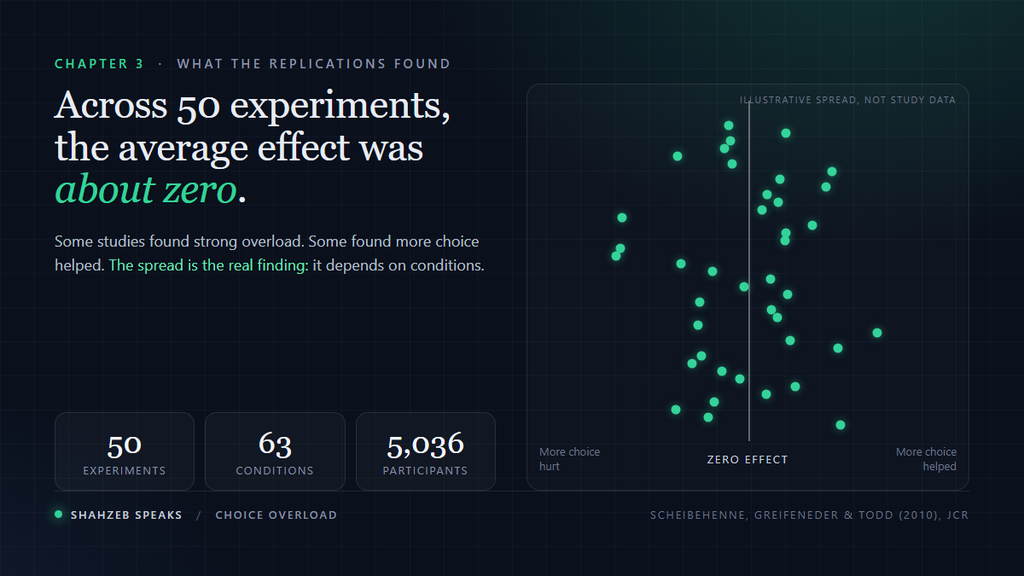
In 2010, Benjamin Scheibehenne, Rainer Greifeneder and Peter Todd published a meta-analysis in the Journal of Consumer Research titled “Can there ever be too many options?” They combined 63 conditions from 50 published and unpublished experiments, covering more than 5,000 participants. The mean effect of offering more options was virtually zero.
That does not mean the jam study was wrong. It means the effect is highly variable. Some studies found strong choice overload. Others found that more choice increased buying or satisfaction. Many found nothing. Averaged together, they cancel out.
Scheibehenne and colleagues had also run their own replication attempts, which often failed to find the effect. Some researchers have since argued that the meta-analysis understates overload in certain conditions, which is exactly the point: the question is not whether choice overload exists, but when.
This has a direct practical consequence. A business that cuts its range because “research proves fewer options sell more” is acting on a claim the research does not support in general. It might increase sales. It might reduce them, by removing the option a particular customer came for. The only way to know for your product is to understand the conditions and test.
That is a theme across much of popular psychology: a single striking study becomes a rule, and the replications arrive later and quietly. I apply the same caution to my own work. When you test your options, be careful about reading too much into one result from many variants; my free multiple comparisons calculator shows how many “winners” appear by chance alone.
🎯 Chapter 4: The four conditions that trigger choice overload
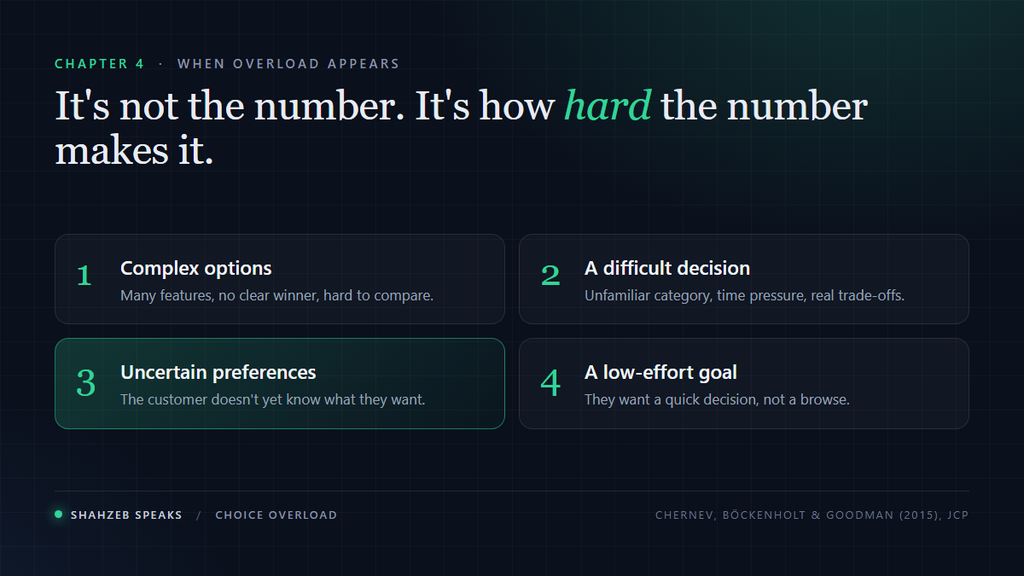
In 2015, Alexander Chernev, Ulf Böckenholt and Joseph Goodman published a second, larger meta-analysis in the Journal of Consumer Psychology. Rather than asking whether choice overload exists, they asked when it appears. They identified four factors that reliably made overload more likely.
- Choice set complexity. Overload is more likely when options are hard to compare: many attributes, no clearly dominant option, or options that differ in ways that are difficult to evaluate. Twelve plans that differ on eight features each are far more overwhelming than twelve colours of the same shirt.
- Decision task difficulty. Time pressure, unfamiliar categories, and complicated trade-offs make overload more likely. The same number of options feels very different to an expert and to a first-time buyer.
- Preference uncertainty. When people know what they want, more options help them find it. When they do not, more options add confusion. A coffee lover with a clear favourite is not overwhelmed by a long menu; a first-time visitor may be.
- Decision goal. If the customer wants to minimise effort, for example making a quick routine purchase, large sets are more likely to cause overload than when they are browsing for enjoyment.
This framework explains why the jam study found such a strong effect. Jams are similar to one another, most shoppers had no strong prior preference among unusual flavours, and a quick grocery trip is a low-effort decision. Almost all four conditions pointed the same way. Change them, and the effect weakens or reverses.
💻 Chapter 5: Where choice overload hurts online
Digital products create exactly the conditions in Chapter 4 more often than physical shops do. Here is where it tends to show up.
Pricing pages. A pricing page with five or six plans, each listing a dozen features, is a textbook complex choice set. Visitors who cannot quickly tell which plan fits them often leave to “think about it” and do not return. The effect is worst for first-time visitors who do not yet know what they need.
Navigation menus. Menus with many similar items slow people down. Hick’s law, from William Hick’s 1952 research, describes how decision time rises as the number of equally likely choices increases. It applies most cleanly to simple, unfamiliar choices; people scanning a well-organised menu for something they already know use search, not comparison, and are much less affected.
Product catalogues without filters. A long list of similar products with no way to narrow it forces exactly the comparison work that overload feeds on. The same catalogue with good filters can feel easy, because the customer never compares all items at once.
Forms and settings. A sign-up flow that asks users to choose between many options before they understand the product asks them to decide under maximum preference uncertainty.
Retirement and financial choices. Outside retail, research by Iyengar, Huberman and Jiang on 401(k) retirement plans found that participation fell as the number of funds offered increased, by roughly 1.5 to 2 percentage points for every ten funds added. When decisions are complex and consequential, and people are unsure what they want, more options can lead them to not choose at all.
🛠️ Chapter 6: What to do instead of just cutting options
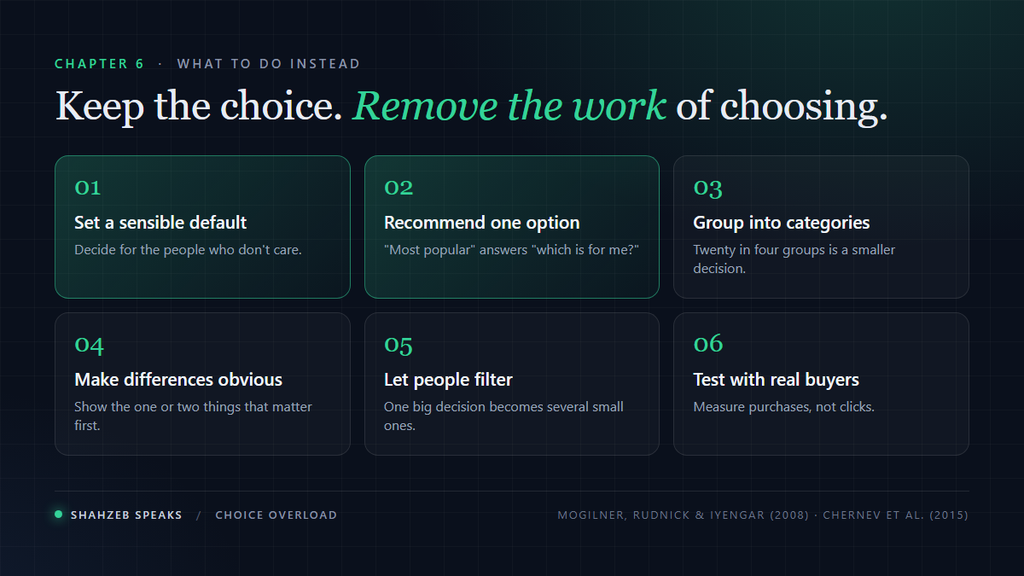
The research points to a better approach than simply reducing the number of options. Keep the choice, but make choosing easier.
- Set a sensible default. A pre-selected option removes the decision for people who do not care, while leaving everyone else free to change it. Defaults are among the most reliable tools in behavioural science, as I described in my article on nudge theory examples.
- Recommend one option clearly. A “most popular” or “recommended for most teams” label gives uncertain customers a reason to choose. It directly addresses preference uncertainty, the third trigger in Chapter 4.
- Group options into categories. Research on categorisation has found that the same number of options feels easier to choose from when grouped under clear headings. Twenty products in four labelled groups is a smaller decision than twenty products in one list.
- Make the differences obvious. If options differ on only one or two things that matter, show those first. Complex comparison tables with every feature listed equally are what drive choice set complexity up.
- Let people filter and narrow. For large catalogues, good filters turn one enormous decision into several small ones, which is far less taxing.
- Test with real customers. Because the effect varies so much, the only reliable answer for your product comes from testing. Change one thing at a time, measure completed purchases rather than clicks, and give the test enough time.
For businesses that sell quotes or proposals rather than products online, the same principles apply to how many options you present to a client. My Quote Presentation Kit is built around offering a small, clearly differentiated set with one recommended option. And for a broader set of these mechanisms, my Cognitive Bias Playbook for Marketers covers how they interact.
🇵🇰 Chapter 7: A note for businesses in Pakistan
Many small and medium businesses in Pakistan, especially online stores on Daraz, Shopify or Instagram, list large numbers of very similar products in a single scroll, often without filters or clear category labels. Restaurants frequently use menus with dozens of dishes across many pages.
These are exactly the conditions where choice overload is most likely: similar options, unclear differences, and customers who often do not know exactly what they want. The fix is rarely to stock fewer products. It is usually to organise them: clear categories, a small “bestsellers” or “recommended” section at the top, visible differences between near-identical items, and a sensible default where one applies. I looked at how Pakistani e-commerce handles this in my Daraz psychology audit.
📝 The takeaway
The jam study was a real and important finding. But the lesson most people took from it, that fewer options always sell better, is not what the wider body of research shows. When dozens of experiments are combined, the average effect is close to zero, because choice overload depends heavily on conditions.
It appears when options are hard to compare, when decisions are difficult, when people are unsure what they want, and when they want to decide quickly. Change those conditions and more choice can help rather than hurt.
So the practical question is not “how many options should we offer?” It is “how hard have we made it to choose?” Defaults, recommendations, grouping and clear differences can let you keep the variety customers value while removing the effort that drives them away.
❓ Frequently asked questions
What is choice overload?
Choice overload is the finding that, in some situations, offering more options makes people less likely to choose at all, or less satisfied with the option they choose. It is also called the paradox of choice.
What was the jam study?
In a study published in 2000, Sheena Iyengar and Mark Lepper set up a jam tasting table in a grocery store with either 24 or 6 flavours. More shoppers stopped at the larger display, but about 30% of those who stopped at the 6-jam table bought a jar compared with about 3% at the 24-jam table.
Is choice overload real?
It is real under certain conditions, but it is not universal. A 2010 meta-analysis of 50 experiments found an average effect close to zero, with large differences between studies. A 2015 meta-analysis identified the conditions that make it more likely.
When does choice overload happen?
It is most likely when options are complex and hard to compare, when the decision is difficult, when people are unsure what they want, and when they want to make the decision with little effort.
How many options should I offer customers?
There is no universal number. Rather than cutting options automatically, make choosing easier with a sensible default, a clear recommendation, grouped categories and visible differences, then test what works for your customers.
What is the difference between choice overload and Hick’s law?
Hick’s law describes how decision time increases as the number of equally likely choices increases, mainly for simple choices. Choice overload is broader, covering whether people choose at all and how satisfied they are, and depends on factors such as complexity and preference uncertainty.
🧠 Are your options helping customers choose, or helping them leave?
I’m Muhammad Shahzeb, an I/O Psychologist and web developer. I review pricing pages, product catalogues and sign-up flows through consumer psychology, and show you where the effort of choosing is costing you sales.
📚 References and further reading
- Iyengar, S. S., & Lepper, M. R. (2000). “When choice is demotivating: Can one desire too much of a good thing?” Journal of Personality and Social Psychology, 79(6), 995-1006.
- Scheibehenne, B., Greifeneder, R., & Todd, P. M. (2010). “Can there ever be too many options? A meta-analytic review of choice overload.” Journal of Consumer Research, 37(3), 409-425.
- Chernev, A., Böckenholt, U., & Goodman, J. (2015). “Choice overload: A conceptual review and meta-analysis.” Journal of Consumer Psychology, 25(2), 333-358.
- Schwartz, B. (2004). The Paradox of Choice: Why More Is Less. Ecco.
- Schwartz, B., Ward, A., Monterosso, J., Lyubomirsky, S., White, K., & Lehman, D. R. (2002). “Maximizing versus satisficing: Happiness is a matter of choice.” Journal of Personality and Social Psychology, 83(5), 1178-1197.
- Iyengar, S. S., Huberman, G., & Jiang, W. (2004). “How much choice is too much? Contributions to 401(k) retirement plans.” In O. S. Mitchell & S. P. Utkus (Eds.), Pension Design and Structure. Oxford University Press.
- Mogilner, C., Rudnick, T., & Iyengar, S. S. (2008). “The mere categorization effect: How the presence of categories increases choosers’ perceptions of assortment variety and outcome satisfaction.” Journal of Consumer Research, 35(2), 202-215.
- Hick, W. E. (1952). “On the rate of gain of information.” Quarterly Journal of Experimental Psychology, 4(1), 11-26.
Written by Muhammad Shahzeb, MSc Industrial & Organizational Psychology | Consumer Psychology Specialist | Full-Stack Web Developer
Learn more about my approach →