
It is half past seven in the evening and a mother is sitting at the kitchen table with her eleven-year-old, who is supposed to be finishing a maths worksheet but keeps glancing at the phone beside his book. She has been wondering for months whether to let him open his first social media account — all his friends have one. A new study in Nature Human Behaviour gives her a real answer about early social media test scores: the earlier children open an account, the lower their standardised test scores tend to be. The age at which a child first joins social media is not a small parenting detail — in the best study we have so far, it is linked to a measurable, lasting gap in learning.
I am an Industrial and Organizational Psychologist in Karachi, and I write about work, learning and behaviour for a global reader. This article is built on one primary source read directly: the paper by Marco Gui, Chiara Respi, Giovanni Abbiati and colleagues, published in Nature Human Behaviour on 3 August 2026, which followed 5,227 Italian students from primary school through to grade 10 and linked the age they first opened a social media account to their standardised test scores. It is the first study I have seen that asks the timing question properly — not how many hours children spend online, but when they start — and it does so with a design that is far stronger than the usual survey snapshot. I will explain what it found, how big the effect really is, why it probably happens, and where the evidence stops. I will also say plainly where the study’s authors have a declared interest, because that matters to how you read it.
“Policies that delay social media access until children are cognitively mature enough to manage its potential distractions could be beneficial.”
— Gui et al., Nature Human Behaviour, 2026
This guide covers the short answer, how the study was done and why its design is unusually strong, when children actually open their first accounts, the size of the test-score gap and whether it grows, the mechanisms that most likely explain it, the one subject where the effect disappears, what parents and schools can actually do, and the honest limits — including why this is not proof in the sense a laboratory experiment would be.
🎯 Chapter 1: The short answer — early social media test scores, explained
Early social media test scores fall the sooner a child opens an account. In a study of 5,227 Italian students, those who opened their first social media profile in grade 6 scored about 0.22 standard deviations lower in Italian and 0.18 lower in maths by grade 8 than similar students who waited until grade 9, when they turned 14. By grade 10 the maths gap had grown to 0.27 standard deviations — roughly six months of schooling, by the authors’ calculation.
That paragraph is the whole article in miniature, and it deserves a slow reading, because the details are what make it believable. The comparison is not between children who use social media and children who never do. Nearly every child in the study ended up on social media eventually. The comparison is between children who started early — in grades 6, 7 or 8 — and children who waited until grade 9, the age of 14, which is the minimum age Italian law sets for opening an account on your own. The researchers then matched the two groups on family background, parents’ education, household structure, earlier technology use and, most importantly, their test scores in grade 5, before anyone had opened an account. The groups started from the same place. By grade 8 they had moved apart, and by grade 10 they had moved further apart still, at least in maths.
The second thing to notice is the pattern. The earlier the account, the bigger the gap. Grade 6 openers lost the most. Grade 7 openers lost less. Grade 8 openers lost least of all — and their maths gap at grade 8 was so small it could have been chance. That dose-response pattern is exactly what you would expect if starting earlier genuinely harmed learning, and it is much harder to explain away than a single difference between two groups. It is also the pattern that makes this study different from the dozens of surveys that came before it, which mostly asked how much time teenagers spend online and found small, messy associations. This study asked a sharper question — when did you start? — and got a clearer answer.
None of this means a phone ruins a child’s education, and this article will not say that it does. The gaps are real but modest in absolute terms, and by the usual benchmarks psychologists use, a difference of 0.2 standard deviations is small. In education research, though, the same size of difference counts as large, because test scores move slowly and a gap of this size is roughly what six months of schooling is worth. Both readings are honest. Which one matters depends on whether you are thinking about one child or about a whole generation of children. For one child, waiting a year or two is a small nudge. For millions of children, it adds up to a great deal of lost learning.
📱 Chapter 2: The study — 5,227 students, four test points, one question
Good research on children and phones is hard to do, and most of what you read about it is weaker than it looks. A typical study asks teenagers how many hours a day they spend on social media, asks them how they are doing at school, and reports a correlation. The problem is that the two things could be linked in either direction — struggling students may spend more time online because school feels hard — and that teenagers are poor judges of their own screen time. The Gui study, published on 3 August 2026 in Nature Human Behaviour (volume 10, pages 1953–1965), avoids both traps, and the way it does so is worth understanding before you believe a single number in it.
The study combines two datasets. The first is the EYES UP survey — short for Early Exposure to Screens and Unequal Performance — a retrospective questionnaire given to 6,609 students in grades 10 and 11 in Lombardy, a region in northern Italy, during the 2023–2024 school year. The survey was run in 28 schools across five provinces — Brescia, Cremona, Mantua, Milan, and Monza e Brianza — out of 552 schools contacted, and the sample was representative by school type at the regional level. Students were asked when they first got each device and account: a games console, a tablet, a computer, a smartphone, messaging apps, and a social media profile. Trained interviewers helped them fill it in during school hours.
The second dataset is what makes the study unusual. The researchers merged the survey answers with the students’ actual test records from INVALSI, the Italian National Institute for the Evaluation of the Education and Training System, which administers standardised tests in Italian and mathematics at grades 2, 5, 8 and 10, and in English at grades 5 and 8. Instead of relying on what students said about their school performance, the researchers had the real scores, measured four times across the child’s school career. Only the birth cohorts of 2007 and 2008 had been tested all four times — the 2020 school closures broke the testing run for other cohorts — so the analytic sample became 5,227 students, and the principal longitudinal analysis used 4,545 of them.
The design is the study’s real strength. The researchers used a difference-in-differences approach combined with statistical matching. In plain terms, they took students who opened an account in grade 6, grade 7 or grade 8, and paired each of them with a student who waited until grade 9 or later and who looked the same on paper: same sex, similar parental education, similar household, similar earlier technology use, similar parental control, and — the part that matters most — similar test scores and school marks in grade 5, before anyone had opened an account. Then they watched how the two groups’ scores changed over time. If the groups were truly alike before the accounts were opened, and their scores moved apart afterwards, the most likely explanation is the accounts themselves.
That is still not an experiment. Nobody was randomly assigned to open an account at eleven or wait until fourteen, and nobody ever will be — parents would not accept it, and ethics committees would not approve it. The authors say this themselves: their estimates should be read as causal only if you accept the assumption that the matched groups would have kept moving together if social media had never entered the picture, and only if nothing unmeasured changed at the same time. I will come back to that assumption in Chapter 8, because it is the hinge the whole study hangs on. But among studies of children and phones, this is about as close to a fair test as the real world allows.
📊 Chapter 3: When children actually join — most start before the law allows
Before the effects, the context. The study’s descriptive results paint a picture that will feel familiar to any parent, whatever country they live in: children are getting phones and accounts far earlier than the rules say they should, and the phone comes first.
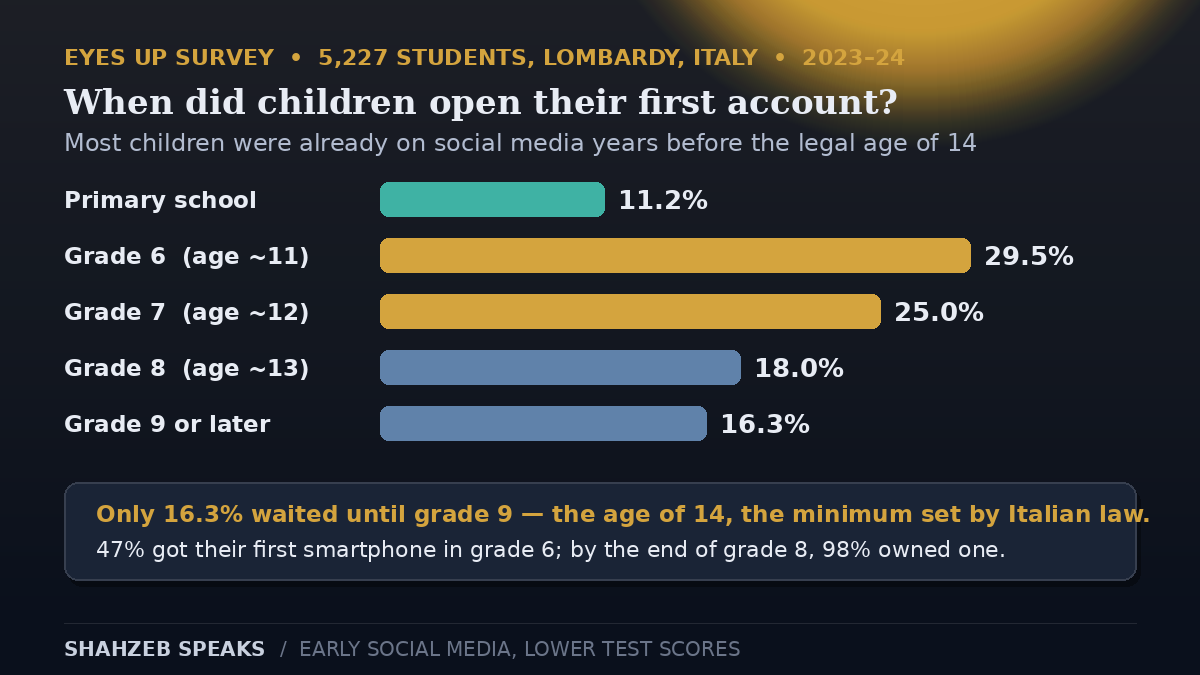
The median child in this sample started using a games console in grade 4 and a tablet on their own in grade 5. Grade 6 — the first year of lower-secondary school in Italy, when children are around eleven — is the turning point. It is the median grade for independent computer access and for owning a personal smartphone connected to the internet. Almost half the students, 47%, received their first smartphone as a present during grade 6. By the end of grade 8, 98% of them owned one. Messaging apps usually arrived with the phone, or the year after, even though most messaging apps require users to be at least 13 or 14.
Social media came last, but not much later. Only 11.2% of students opened their first profile during primary school. The biggest group, 29.5%, opened one in grade 6. Another 25.0% followed in grade 7, and 18.0% in grade 8. That leaves just 16.3% who waited until grade 9 — the age of 14, which is the minimum age Italian law sets for independent access to digital platforms, under Legislative Decree 101/2018. In other words, more than eight in ten children in this sample were on social media before the law said they could be. The platforms’ own rules tell the same story: the minimum age is 13 in the United States and between 14 and 16 in Europe for autonomous use, yet the median child in Lombardy was already there at eleven.
The authors note that the law is “largely disregarded in Italy, as well as in other parts of Europe and other countries overseas”. That is not a surprising finding, but it is an important one, because it frames the whole debate. Campaigns such as Wait Until 8th and Mothers Against Media Addiction in the United States, Smartphone Free Childhood in the United Kingdom, and Patti Digitali in Italy all ask parents to delay — and this study is, in effect, the first serious test of whether delaying actually helps learning. The rest of this article is the answer to that test.
| First social media account opened | Share of students | Typical age |
|---|---|---|
| Primary school | 11.2% | Under 11 |
| Grade 6 | 29.5% | About 11 |
| Grade 7 | 25.0% | About 12 |
| Grade 8 | 18.0% | About 13 |
| Grade 9 or later (legal age) | 16.3% | 14 and over |
One more detail from this chapter belongs in the picture, because it shapes how the results should be read. The children who opened accounts earliest did not start from the same place as the children who waited. On average they came from less educated families, were less likely to live with both parents, had started using every kind of device earlier, and already had lower test scores and lower teacher marks before they opened an account. This is the social gradient of early adoption, and it is exactly why a simple comparison between early and late users would have been misleading. The researchers knew this, which is why they matched the groups first. The gaps reported in the next chapter are the gaps that remain after that matching — after the groups were made as alike as the data allowed.
📉 Chapter 4: The gap — how big it is, and why it grows
Here are the numbers, stated plainly. Compared with students who waited until grade 9, students who opened a social media account in grade 6 scored about 0.22 standard deviations lower in Italian and 0.18 lower in mathematics by grade 8. By grade 10, the Italian gap was still 0.22, and the maths gap had grown to 0.27 standard deviations. For students who opened an account in grade 7, the gaps were smaller but still real: 0.14 lower in Italian and 0.10 lower in maths by grade 8, growing to 0.17 and 0.22 by grade 10. For grade 8 openers, the gaps were smaller still — 0.11 lower in Italian at both grades, and 0.11 lower in maths by grade 10 — while their maths gap at grade 8, at 0.07, was not statistically significant, meaning it could have been chance.
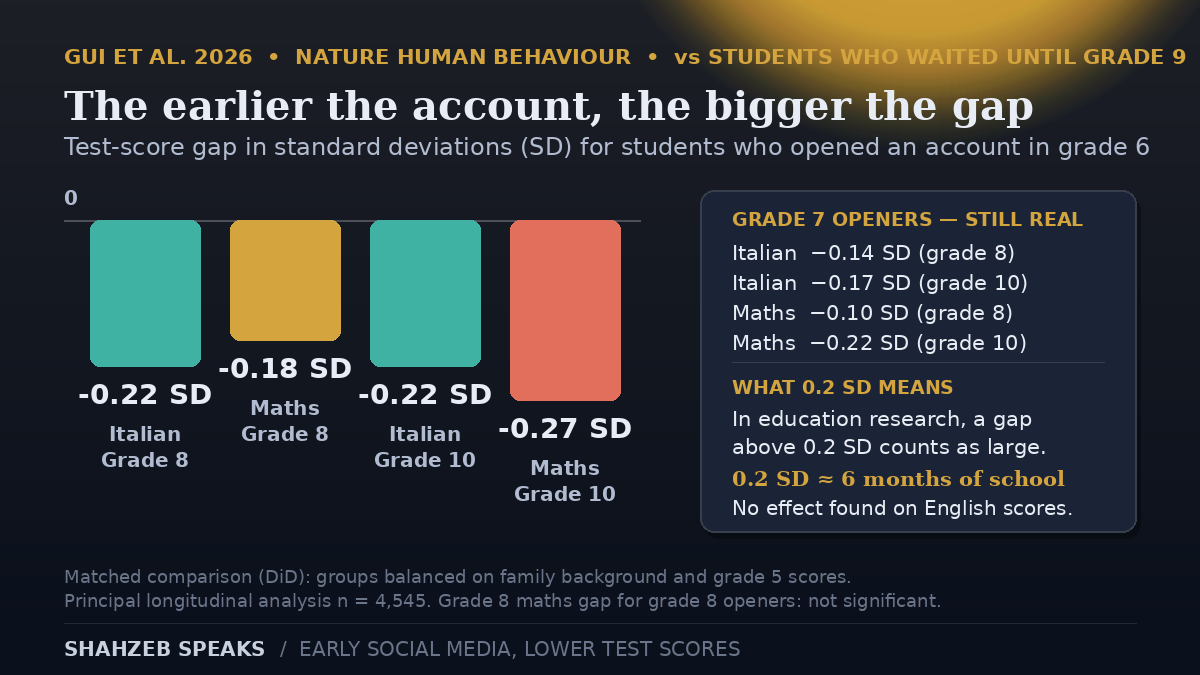
Two features of these results matter more than any single number. The first is that the gap grows with time, or at least does not close. By grade 10, most of the late adopters had opened accounts too — yet the early starters were still behind, and further behind in maths than they had been two years earlier. That is not what you would expect if the harm came only from the shock of joining. It looks more like a cumulative effect: each extra year of exposure adds a little more damage, and the damage compounds. The descriptive figures point the same way. At grade 8, each additional year of social media exposure was associated with scores about 0.05 standard deviations lower in Italian and 0.04 lower in maths. Small per year, but years add up, and the authors found the same cumulative pattern when they compared sixth-grade openers directly against seventh-grade openers, and seventh against eighth.
The second feature is how the authors translate the size of the gap into terms a parent or a policymaker can feel. In education research, effects above 0.2 standard deviations are considered large, because test scores are hard to move. Using a parameter adopted by some educational institutions — 0.4 standard deviations as the equivalent of one year of schooling — a gap of 0.2 standard deviations is worth roughly six months of learning. The grade-6 gap is also about 30% of one of the biggest divides in education: in this sample, the average difference at grade 5 between children with two tertiary-educated parents and children whose parents had no secondary diploma was 0.73 standard deviations in Italian and 0.71 in maths. Losing a third of that divide to the timing of a social media account is not a trivial thing. And in absolute terms, the authors note, the loss is roughly half the average impact of intensive tutoring — one of the most effective, and most expensive, ways of raising achievement that education research knows.
That said, I want to be careful about the translation. The six-months figure is not an official equivalence. INVALSI does not publish a conversion between its scores and months of schooling; the authors borrowed the 0.4 standard deviation parameter from institutions that use it. It is a useful yardstick, not a measurement. And a gap of 0.22 standard deviations, however you translate it, is not the difference between passing and failing for most children. It is the difference between a child doing a little worse than they otherwise would have, across thousands of children, year after year. That is precisely why it matters at the level of policy and barely registers at the level of one family — and why both levels need to hear about it.
The effects did not stop at test scores. Students who opened accounts in grade 6 or 7 were more likely to repeat a grade than late adopters. All three early-user groups were significantly less likely to earn an excellent mark — 8 out of 10 or above — at the end of grade 8, and they reported lower academic self-efficacy, meaning they believed less in their own ability to do well at school. The choice of upper-secondary school track, on the other hand, was largely unaffected. I have not printed exact figures for grade repetition or self-efficacy here, because the paper reports the direction and the significance of those effects rather than numbers I could verify from the text I read — but the pattern is consistent: early starters did worse across nearly every school-related measure the researchers could look at.
🧠 Chapter 5: Why it happens — displacement, distraction and the phone in the room
A gap is not an explanation. The study’s authors propose two routes by which early social media use could harm learning, and they test one of them as far as their data allow. The first route is time and attention: social media displaces the hours a child would otherwise spend on homework, it encourages multitasking — doing homework with one eye on a feed — and it displaces sleep and physical movement, both of which support learning. The second route runs through feelings: the content children meet, and the relationships they form online in early adolescence, could harm their well-being, and poorer well-being could then drag down achievement. The study’s evidence points more strongly toward the first route than the second.
The key piece of evidence is an exploratory analysis of what the authors call smartphone pervasiveness — a validated scale that captures how far the phone intrudes into daily life: using it before sleep, on waking, while doing homework, and at school. Students who scored higher on pervasiveness also scored lower on tests: a one-standard-deviation rise in the pervasiveness index was associated with scores 0.11 standard deviations lower in Italian and 0.14 lower in maths by grade 10. And when the researchers added pervasiveness to their models, it explained a meaningful share of the early-use effect — between 33% and 47% of the gap in maths, and between 15% and 34% in Italian. That is a large share for a single channel, and it fits the displacement story: the phone is not merely present in a child’s life, it is present at the exact moments when learning happens — homework, bedtime, the classroom.
Two cautions belong here, and the authors state both. First, this mediation analysis is exploratory and purely correlational. The researchers had no longitudinal data on pervasiveness itself — they measured it once, in the survey — so they cannot show that pervasiveness came first and lower scores followed. It is a plausible channel, not a proven one. Second, parental control barely moved the numbers. Parents who supervised their children’s online activity, or had access to what they did online, had children who scored a little higher — but parental control explained only a small fraction of the link between early use and lower scores, and the measure itself is ambiguous, because parents often impose controls after they have already seen behaviour they dislike. The honest reading is that supervision helps a little, but it does not cancel out the effect of starting early.
What about the second route, through well-being? Here the evidence is thinner. Subjective well-being showed no significant association with test scores in this sample, and only a weak negative correlation with years of social media exposure, so the authors excluded it as a mediator. That does not mean social media has no effect on children’s well-being — this study was not designed to test that question, and the wider literature on well-being is far more mixed than the literature on learning. What it means is that, in these data, the learning gap does not seem to travel through how happy children say they are. The authors suggest this may be the reason the learning results look clearer than the well-being results that dominate the public debate: displacement and cognitive overload are more direct, mechanical processes than the emotional effects of online life, and they show up more cleanly in test scores. For the wider picture on what heavy phone use does to adults, see my article on the psychology of social media addiction — but note that it is about adults and addiction, not about children and timing, which is a different question.
One thing the study cannot tell us is what exactly children were doing on social media. The researchers collected no screen-time data — they say self-reported screen time is widely recognised as unreliable — and no information about the content children consumed or which platforms they used. So the study measures when accounts were opened, not how many hours children spent on them, and it cannot say whether the harm comes from short video, messaging, scrolling, or something else entirely. That is a real gap, and the authors call for future research to separate passive consumption from active engagement. For now, the practical lesson is about timing and about the phone’s intrusion into homework and sleep — the two things the data can actually speak to.
🔤 Chapter 6: The English exception — the one result that points the other way
Every good study has a result that does not fit, and this one has a striking one: early social media use had no effect at all on English scores. Not a smaller effect, not an effect that failed to reach significance by a whisker — no evidence of any impact, on either reading or listening comprehension at grade 8, across multiple specifications and sample selections. If the study’s story were simply that phones make children worse at school, English should have suffered too. It did not, and the exception is worth a chapter of its own, because it tests the theory rather than just confirming it.
The authors offer a hypothesis, and they label it as one. Much of the content children meet online — especially on social media — is in English. For an Italian child, hours spent on platforms dominated by English-language video, memes, comments and music may amount to incidental exposure to the language, and incidental exposure is a real, if informal, form of practice. If that practice roughly cancels out the harm from distraction and displacement, the net effect on English would be zero — which is what the data show. It is a neat explanation, and it fits the one fact the study can check: English was the only subject tested where the online world itself teaches the subject.
I find the hypothesis plausible, but I would not rest much weight on it. The authors call it “a purely hypothetical explanation” themselves, and the study was not designed to test it — there is no measure of how much English-language content each child consumed. There are other possible explanations. English tests in Italy may be less sensitive to the kind of learning that social media displaces, or the English curriculum may lean more on classroom instruction that a phone cannot easily interrupt. The honest position is that the English result is a genuine puzzle with a plausible answer, not a settled one. What it does usefully show is that the study’s authors were not hunting for a single alarming headline. They reported the null result prominently, and they reported it in the same detail as the positive ones. That is how careful researchers behave, and it is one of the reasons I trust the rest of the paper.
There is a second lesson in the English exception, for parents outside Italy. The study is Italian, and its subjects were learning English as a foreign language. For a child in Britain, the United States or Pakistan, where English is the language of school itself, the incidental-exposure argument would not apply in the same way — the online world is not teaching them a new language, it is the same language they already speak. So the English result should not be read as reassurance that social media is harmless for learning in general. It is a quirk of this sample, in this country, and it tells us more about how the effect works than about whether it exists.
👨👩👧 Chapter 7: What parents and schools can actually do
Research is only useful if it changes a decision, so this chapter is about decisions. The study’s authors draw three implications, and I will add a fourth from my own judgement as a psychologist — clearly marked as mine, because it goes beyond what the data prove.
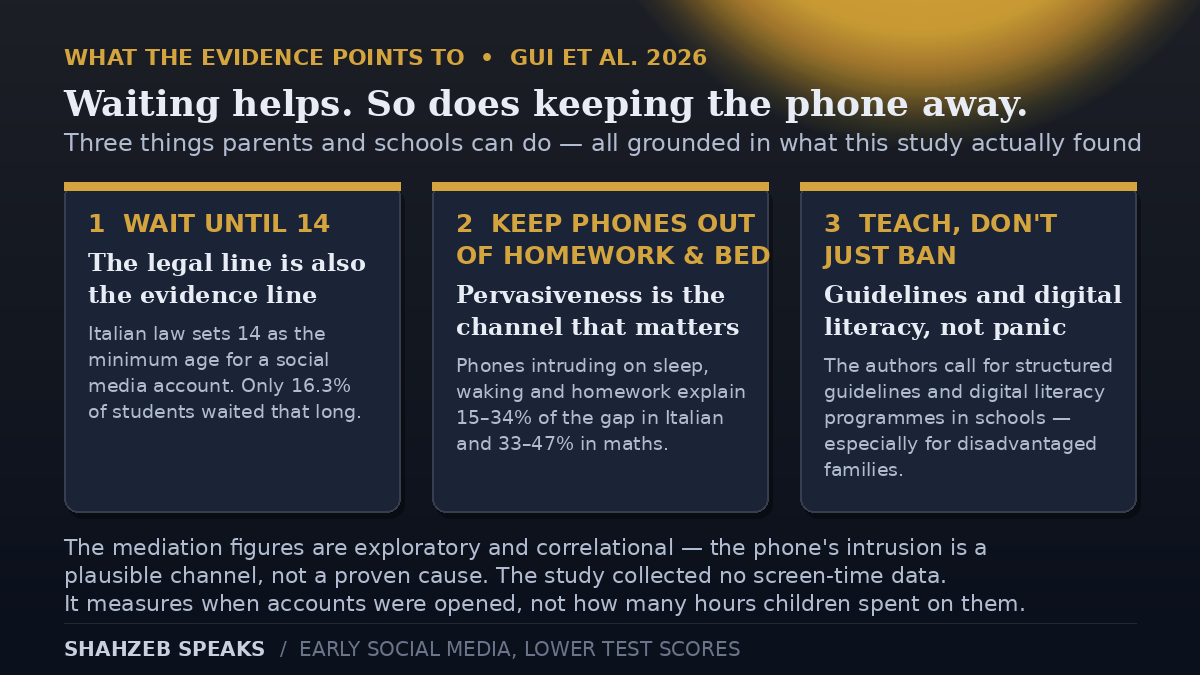
The first implication is the most direct: delay. Policies that hold social media access until children are old enough to manage its distractions could help, and the age the evidence points to is fourteen — the age Italian law already sets, and the age the study used as its comparison point. In practice, delay means a family decision made early, before the pressure arrives, and ideally a decision made together with other families, so that one child is not the only one waiting. Campaigns such as Smartphone Free Childhood in the United Kingdom work on exactly this logic: the hardest part of waiting is not the rule, it is being the only family following it. If your child’s school has no shared approach, that is worth raising with other parents — not as a campaign, but as a conversation.
The second implication is about where the phone is allowed to be, rather than whether it exists. The pervasiveness finding suggests that the damage is concentrated in specific moments: homework, bedtime, and the first minutes after waking. A phone that lives in another room during homework, and charges outside the bedroom overnight, removes the intrusion at exactly the points where the study found it mattered. This is a smaller ask than delaying an account by two years, and it is one a family can start tonight. It also fits what we already know about attention: a phone face-down on the desk still divides attention, even when it is silent. For adults trying the same change, I wrote about what two weeks without a phone actually does in my article on digital detox psychology — the mechanisms are the same, even if the stakes for a child are higher.
The third implication is for schools and policymakers: structured guidelines and digital literacy programmes, aimed particularly at families from disadvantaged backgrounds. The authors are specific about the audience, and they are right to be. Early adoption is not evenly spread — it concentrates in families with less education and fewer resources — so a policy that only reaches confident, well-informed parents will widen the gap it is meant to close. A school that teaches children how platforms are designed to hold their attention, and that gives parents a clear, shared set of expectations, is doing more than a school that simply bans phones at the gate and says nothing else. The authors also call for regulation of the engagement mechanisms built into platforms used by minors — the design features that make an app hard to put down. That is a matter for lawmakers, not for parents, but parents should know it is on the table.
My own addition, as a psychologist rather than as a reporter of this study, is about how the conversation happens at home. A rule imposed without explanation breeds evasion, and children are better at evasion than their parents are at detection. The families I would expect to do best with delay are the ones who treat it as a shared project rather than a prohibition: explain what the study found, in words a twelve-year-old can follow; agree on what will happen instead — the sport, the hobby, the time with friends that fills the space the phone would have taken; and set a date to revisit the decision, so waiting feels like a plan rather than a punishment. None of that is in the paper. It is my judgement, drawn from how behaviour change usually works, and it should be read as such. What is in the paper is the timing, the size of the gap, and the channel — and those three facts are enough to act on.
⚠️ Chapter 8: The honest limits — and when to get help
Every claim in this article has a limit, and this chapter states them, because a study this widely reported deserves to be read carefully rather than quoted carelessly. The first limit is the design. Difference-in-differences with matching is strong, but it is not an experiment, and the authors are explicit about what that means. Their estimates count as causal only if the matched groups would have kept moving together without social media, and only if no unmeasured factor changed at the same time. Family dynamics, personality traits that emerge in early adolescence, a friendship group, a teacher — any of these could, in principle, influence both when a child opens an account and how they do at school, and the study cannot rule them out. The grade 2 test scores give some reassurance: the groups were already alike before exposure, which supports the key assumption. And the sensitivity analysis was reassuring for the grade 6 group in particular — the maths effect at grade 10 survived even when the analysis allowed the assumption to be violated by twice the size of the pre-treatment deviations. But the grade 8 results were not robust to even mild violations, which is why I have described them as smaller and less certain throughout this article.
The second limit is memory. The age at which each child opened an account was reported retrospectively, years after the event, by teenagers filling in a questionnaire. People misremember dates, and they misremember them in patterned ways — rounding to a birthday, or to the start of a school year. The researchers pre-tested the questionnaire carefully, including ten cognitive interviews and a pilot with 123 students, which is more care than most surveys take. Even so, recall error is real, and it most likely blurs the boundaries between adjacent grades — a child who opened an account in the summer might report grade 6 or grade 7. That kind of error would shrink the differences between groups rather than invent them, which makes the findings, if anything, conservative. But it is a limit, and it should be stated.
The third limit is place and time. These are children from Lombardy, in northern Italy, who were adolescents between 2019 and 2023, when TikTok and Instagram dominated and short-form video was rising, and when social media was accessed almost entirely through personal smartphones. A different country, a different school system, or a different era of platforms could produce different results. The pattern — earlier start, lower scores — is likely to travel, because the mechanisms are general. The exact numbers will not. And the sample itself excludes the children the study could not follow: those who dropped out, those in short vocational programmes, and those who repeated multiple years. The authors note that leaving out the most struggling students probably makes their estimates smaller than the true population effect, not larger. That is an honest admission, and it cuts in the direction of taking the findings seriously rather than dismissing them.
Finally, there is a disclosure that belongs in any honest account of this paper. Two of the authors, Marco Gui and Chiara Respi, sit on the governance board of the Patti Digitali Foundation, which advocates a gradual approach to children’s access to digital environments — the same position the paper’s conclusions support. The disclosure is printed in the paper itself, and the coverage in PsyPost on 20 November 2026 flagged it too. Does it invalidate the findings? No. The data come from a national testing institute, the design is transparent, the analysis was peer-reviewed — by Christopher Ferguson, Lukas Gunschera and another anonymous reviewer, with the reports published — and the authors report their null result on English in full. But a reader should know about the connection, and should weigh the paper’s policy recommendations with it in mind. I have done the same in this article: the findings are the findings, and the recommendation to delay is the authors’ — supported by their data, but also aligned with a cause two of them publicly support. You can accept the first and still think carefully about the second.
❓ Questions I am asked most often
At what age should a child get social media?
The evidence points to 14. In the Gui et al. study, students who waited until grade 9 — age 14, the Italian legal minimum — scored higher in Italian and maths than those who started in grades 6, 7 or 8. The gap was largest for grade 6 starters. Waiting is not a guarantee of better grades, but it is the timing the data support.
Does social media lower test scores?
Starting early is linked to lower scores, with an important qualification. This was not an experiment, so the study cannot prove social media caused the gap — only that matched groups who started earlier fell behind, and the earlier they started, the further they fell. The design is the strongest available short of a randomised trial, which no ethics committee would approve for children.
How big is the effect of early social media on test scores?
Grade 6 openers scored 0.22 standard deviations lower in Italian and 0.18 lower in maths by grade 8, against students who waited until grade 9. By grade 10 the maths gap reached 0.27. In education research that counts as large — roughly six months of schooling — though by general psychology benchmarks the same difference is considered small.
Does early social media affect English scores?
No — and that is the study’s most surprising result. Early social media use showed no link to English reading or listening scores at grade 8. The authors suggest that English-language content online may give Italian children incidental practice that offsets the harm. The explanation is a hypothesis, not a finding, and it may not apply where English is the language of school.
Is it the phone or the social media account that matters?
The study cannot fully separate them, because the two arrived together for most children. But its exploratory analysis found that how far the phone intrudes into daily life — homework, bedtime, waking — explained 15–34% of the gap in Italian and 33–47% in maths. The phone’s intrusion, not just the account, looks like a real channel.
Should schools ban phones?
The study does not test bans, so it cannot recommend one. What it supports is delaying accounts until 14, keeping phones out of homework and bedrooms, and teaching digital literacy — especially for disadvantaged families. A ban without teaching changes nothing about how children use phones outside school, which is where most of the exposure happens.
If you are a parent weighing when your child should join social media, or a school thinking about its phone policy, the evidence is now clearer than it was — and the decision is still yours to make. I am an Industrial and Organizational Psychologist, and I work with organisations on learning, attention, work design and the measurement of behaviour. Get in touch here.
If you want the wider context, start with my guide to industrial psychology in Pakistan and my article on the psychology of social media addiction, which looks at what heavy use does to adults. For the question of how to step back from the phone itself, see digital detox psychology, and for what standardised tests can and cannot tell us about ability, intelligence tests and job performance. On the resources that protect wellbeing under pressure, see psychological capital at work.
Sources
- Gui, M., Respi, C., Abbiati, G., Paladini, C., Ercolanoni, S., Milzani, F., Pirola, T., & Vezzoli, G. (2026). Longitudinal effect of early social media use on standardized learning outcomes during school career. Nature Human Behaviour, 10, 1953–1965. https://doi.org/10.1038/s41562-026-02522-4
- PsyPost (2026, 20 November). The earlier kids join social media, the lower their test scores tend to be, study finds. https://www.psypost.org/the-earlier-kids-join-social-media-the-lower-their-test-scores-tend-to-be-study-finds/
- Italian Legislative Decree 101/2018 (minimum age of 14 for autonomous access to digital platforms, under the GDPR), as cited in Gui et al. (2026).
- INVALSI — Italian National Institute for the Evaluation of the Education and Training System (standardised testing at grades 2, 5, 8 and 10), as cited in Gui et al. (2026).