
It is a Friday afternoon in late autumn, and a man of 64 is clearing out his desk for the last time. The farewell cake has been eaten, the card has been signed, and the lift ride down feels longer than usual. He has been asking himself one question for months: does retirement make you lonely? A new study from Australia gives him a better answer than the worry he has been carrying. Retirement itself does not make people lonelier. What changes is everything around it: who leaves first, whether the leaving was chosen, and who is still at home when the working day ends.
I am an Industrial and Organizational Psychologist in Karachi, and I write about work, ageing and behaviour for a global reader. This article is built on one primary source read directly: the paper by Johannes Kunz, Trong-Anh Trinh, Michael Shields and colleagues, published in Scientific Reports on 31 July 2026, which followed 7,434 Australians aged 55 to 75 for nearly twenty years and tested whether retiring changes how lonely people feel. It is the strongest study I have seen on this exact question — the same people tracked year after year, before and after they stopped work — and I will explain what it found, how the researchers made the comparison fair, what other countries found, and where the evidence stops.
“Many people see leaving work as a ‘loneliness cliff’, where you lose colleagues, routine and identity, but our study did not find this to be the case.”
— Dr Johannes Kunz, Monash University, 2026
This guide covers the short answer, how the study was done, the three years either side of retiring, why loneliness matters for health, chosen versus forced retirement, what Europe, England, Finland and Taiwan found, what actually protects against loneliness, the pension-age debate, and the honest limits.
🎯 Chapter 1: The short answer — does retirement make you lonely?
No. In the strongest study we have, retirement itself does not make people lonelier. Researchers followed 7,434 Australians aged 55 to 75 for nearly twenty years and found no measurable change in loneliness when people retired. Loneliness stayed flat in the three years before and the three years after. About one in six were lonely regardless.
That paragraph is the whole article in miniature. The study, published in Scientific Reports in 2026 by Kunz and colleagues at Monash University, did not compare retired people with working people at a single moment and call the difference an effect. It followed the same Australians year after year, through the Household, Income and Labour Dynamics in Australia survey — HILDA — and watched what happened to each person’s loneliness as they crossed into retirement. The headline finding, in the authors’ own words, is that their analysis “reveals no statistically significant effects of retirement on loneliness, a result consistent across various demographic groups and individual circumstances”.
The second thing to notice is how steady the result is. The researchers ran the analysis nine different ways — different measures of loneliness, different definitions of retirement, different age windows — and eight of the nine estimates pointed slightly downwards, as if retirement reduced loneliness a little. But none reached statistical significance, which means none was large enough, given the size of the sample, to rule out chance. The authors put it plainly: “we cannot reject the possibility of no true effect.”
None of this means loneliness in later life is rare. About one in six people in the study — 17.5% — reported high loneliness, scoring 5 or more on a 7-point scale, and the average score across the whole sample was 2.6 out of 7. Loneliness is common among older adults. The point is that retiring does not appear to be what causes it. The loneliness was already there, at roughly the same level, before the farewell cake and the cleared desk.
There is one more reason the short answer matters. Governments in several countries are raising the age at which people can draw a state pension, and loneliness is sometimes raised as a reason to be careful — the argument being that keeping people at work longer keeps them connected. Kunz addressed that directly: “There are many reasons for or against raising the retirement age; however, our results suggest that loneliness is not necessarily a consideration.” It does not settle the pension debate, which turns on money, health and fairness. But it removes one argument from it: if loneliness is the worry, look somewhere other than the retirement date.
📊 Chapter 2: The study — 7,434 Australians, twenty years, one question
Good research on retirement and loneliness is hard to do, and most of what you read about it is weaker than it looks. A typical study asks retired people how lonely they feel, asks working people the same question, and reports the difference. The problem is that the two groups differ in more ways than whether they work. People who retire early often do so because their health has failed, or because they were made redundant, or because they are caring for a partner — and those same things can make a person lonely on their own. A simple comparison mixes up the effect of retiring with the effect of everything that pushed someone into retiring. The Kunz study, published online on 31 July 2026 in Scientific Reports (volume 16, article 35424), avoids that trap.
The study draws on HILDA, the Household, Income and Labour Dynamics in Australia survey, a nationally representative longitudinal study that began in 2001. The first wave interviewed 13,969 respondents from 7,682 households, a top-up sample in 2011 added 2,153 households and 4,009 respondents, and annual re-interview rates ran above 95%. The main analysis uses waves 1 to 19, covering 2001 to 2019, deliberately stopping before the COVID-19 period. Robustness checks using all 23 waves give the same answer. The final analysis sample is 7,434 individuals aged 55 to 75 — 3,553 men and 3,881 women — giving 60,476 person-year observations: on average, about eight yearly observations for each person, which is what lets the researchers watch loneliness move within the same life rather than guessing from a snapshot.
Loneliness itself was measured with a single statement, asked every wave: “I often feel very lonely”, answered on a 7-point scale from 1 (strongly disagree) to 7 (strongly agree). A score of 5, 6 or 7 counted as high loneliness. The researchers also used a multi-item factor score, adding “I often need help from other people but can’t get it” and “People don’t come to visit me as often as I would like”, and the results were the same either way. A single question is a limitation, and the authors say so, but it correlates about 0.88 with the three-item UCLA loneliness measure, the standard short scale in this field. Retirement was measured as being “not in the labour force” from age 55 onwards. In this sample, 54.8% were classified as retired, the average retirement lasted 5.5 years, the mean age was 64, 52.7% were women, and 74.3% were married.
The design is the study’s real strength, and it turns on a piece of Australian law. Simply comparing retirees with workers would be unfair, for the reasons above. Instead, the researchers used the Australian Age Pension eligibility age as a natural experiment. Whether someone has reached their birth cohort’s pension age strongly predicts whether they retire, but the threshold itself is set by birth date and by law, not by personal choice — so it acts like a random push into retirement. In plain terms, the researchers compared otherwise similar people on different sides of a pension-age line drawn by their date of birth, and asked whether the ones pushed into retirement felt lonelier.
That method has one consequence you need to understand, because it shapes everything else in this article. The estimate it produces captures the effect for “compliers”: people who retire because they reach pension age. It should not be generalised to all retirees — in particular, not to people forced out of work by illness or redundancy at 55. For now, the point is that within the group the method can speak about — ordinary people retiring around pension age — the answer is a clear null. The statistics behind it are strong: first-stage F-statistics above 70, well past the usual thresholds for a weak instrument, and 119.9 for men against 70.9 for women, because pension eligibility for women in earlier cohorts was lower and rose more gradually.
📉 Chapter 3: The three-year window — flat before, flat after
The most convincing part of the study is not a single number. It is a picture of loneliness over time, and the picture is flat. The researchers tracked each person’s loneliness from three years before they retired to three years after, and found nothing that looks like a cliff, a dip or a slow slide. Loneliness did not rise as the last day at work approached, and it did not rise — or fall — in the years that followed. As Kunz put it: “We followed the same Australians for nearly two decades, and we found that their loneliness didn’t change in the three years before retiring or in the three years after.”
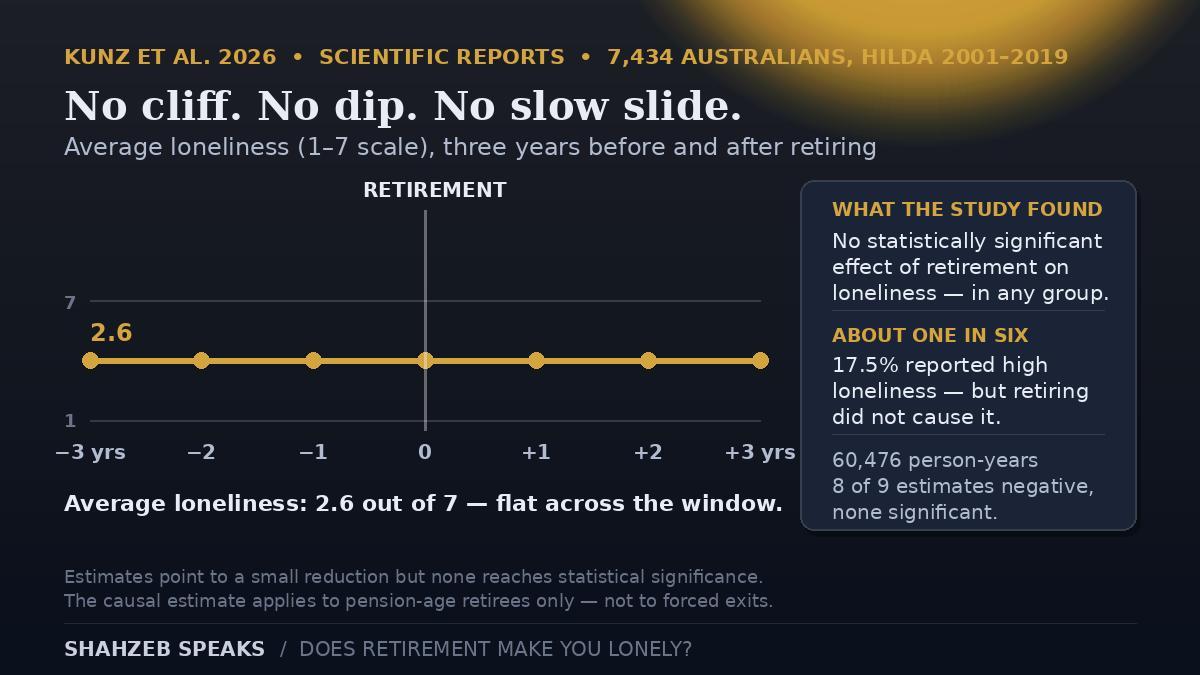
That flat line rules out two stories people tell about retirement at once. The first is the cliff: the day you stop work, you lose your colleagues, your routine and your reason to leave the house, and loneliness follows. If that were true, the line would jump at the moment of retirement. It does not. The second is the slow fade: you keep in touch for a while, then the work friendships thin out, and loneliness creeps up a year or two later. If that were true, the line would tilt upwards after retirement. It does not do that either. The estimates after retiring were consistently negative — pointing, if anything, to a small reduction — but none was statistically significant, so the honest reading is no change at all.
Think about what that means for the man clearing his desk in the opening of this article. The fear he carries into his last week — that silence will arrive with retirement itself — is not what the data show. His loneliness, if he feels it, is more likely to be the loneliness he already had, carried across the boundary unchanged. The work of staying connected cannot wait until the farewell party; it has to happen on ordinary Tuesdays, not ceremonial Fridays.
| What the study measured | What it found |
|---|---|
| Loneliness 3 years before retirement | No change; no rising trend |
| Loneliness at the moment of retiring | No jump up or down |
| Loneliness 3 years after retirement | No change; estimates slightly negative, none significant |
| Average loneliness score | 2.6 out of 7 |
| Share reporting high loneliness | About one in six (17.5%) |
| Main results (9 estimates) | 8 of 9 negative, none statistically significant |
🧠 Chapter 4: Why loneliness matters — the health case for taking it seriously
Why does this question deserve a twenty-year study? Because loneliness is not a soft complaint or a matter of temperament. It is a health risk on the same scale as the risks doctors warn about most, and the numbers are stark enough to change how you think about a quiet house.
The first, published in 2015 in Perspectives on Psychological Science, pooled 70 independent prospective studies covering 3,407,134 participants followed on average for seven years. After controlling for other factors, loneliness was associated with a 26% increased likelihood of mortality — an odds ratio of 1.26. Social isolation carried a 29% increase (1.29), and living alone a 32% increase (1.32). The second meta-analysis, published in 2010 in PLoS Medicine, covered 148 studies and 308,849 participants and found that stronger social relationships were associated with a 50% increased likelihood of survival — an odds ratio of 1.50, with a 95% confidence interval from 1.42 to 1.59. The authors concluded that the influence of social relationships on mortality risk is comparable with well-established risk factors such as smoking. That is not a metaphor. It is a measured comparison.
That is why the Australian null result is good news and bad news at once. Good news, because the retirement transition itself is not adding to this risk. Bad news, because the risk is already there, at about one in six, and it does not go away when the retirement date passes. Loneliness is a public health issue in its own right: the World Health Organization launched a Commission on Social Connection in 2023. In the Health Survey for England 2021, based on 5,880 responses, 22% of adults in England reported being lonely at least some of the time — 33% in the most deprived areas against 10% in the least deprived. Older people are not the loneliest group in England — but they are the group for whom loneliness most often arrives alongside bereavement, illness and the loss of a partner.
There is a point of psychology here that I want to make as a practitioner, not just as a reporter of studies. Loneliness and being alone are different things, and confusing them is one of the commonest mistakes in this debate. A person can live alone and spend long stretches of the day by themselves without feeling lonely, if the relationships they do have feel close and reliable. Another person can be surrounded by colleagues, family and neighbours and still feel lonely, because none of those contacts feels like it counts. The HILDA question — “I often feel very lonely” — measures the feeling, not the headcount. That is why the findings here point towards the quality of relationships rather than the quantity of company, and why the advice in Chapter 7 is about depth, not diary-filling. For the wider picture, see my article on psychological capital at work — the same inner resources that steady people through a career change steady them through retirement.
⚖️ Chapter 5: Voluntary vs involuntary — the kind of retirement that hurts
If the Australian study is the strongest evidence that retirement itself does not cause loneliness, then the most important qualification to it comes from a second study, which asked a sharper question: does it matter whether you chose to stop? The answer is yes — and the difference is large enough to change the whole story.
The study is by Hagani and colleagues, published in 2024 in the Journal of Epidemiology and Community Health (volume 78, pages 602–608). It compared Australia, China and the United States using long-running national surveys. Retirement was associated with higher loneliness in Australia and the United States, and with lower loneliness in China. But the finding that matters most sits underneath: in both Australia and the United States, voluntary retirement was associated with lower loneliness, while involuntary retirement was associated with greater loneliness. I should be clear about the status of these figures: they come through a secondary summary of the Hagani paper, not from the paper itself, so treat them as reported findings — and as associations, not proof of cause, because involuntary retirement often follows ill health, caring duties or job loss, each of which can bring loneliness of its own.
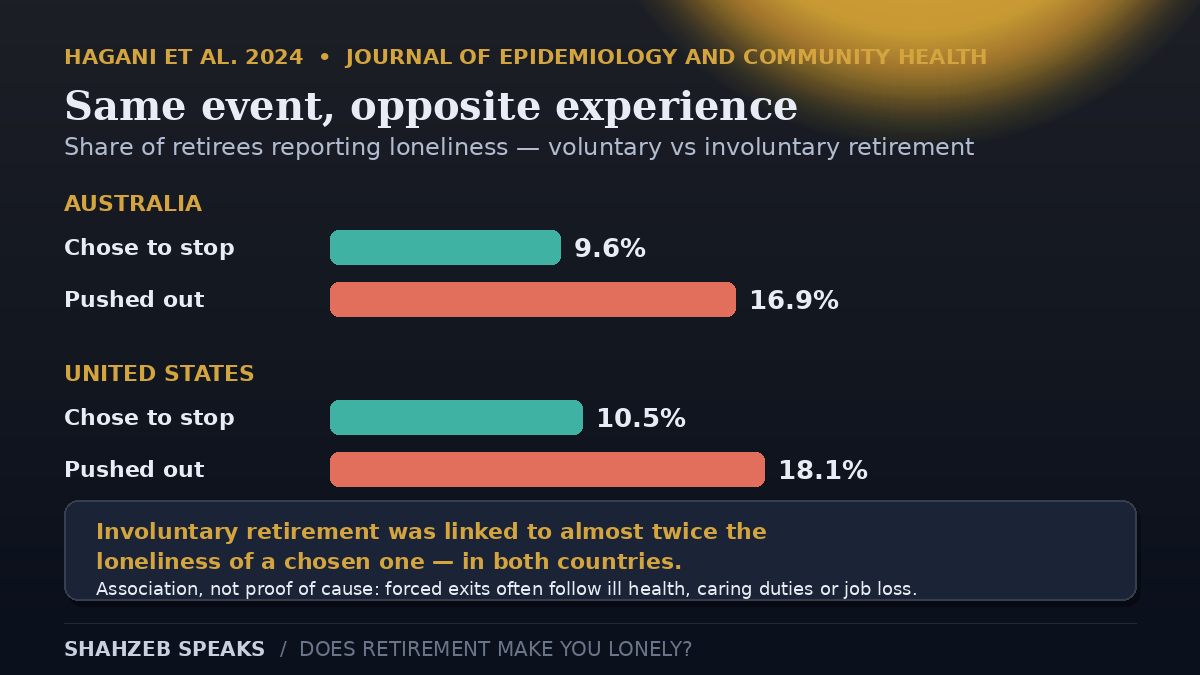
Here are the numbers behind that contrast. In Australia, the model-based predicted share of lonely people was 9.6% among those who retired voluntarily, against 16.9% among those who retired involuntarily — a gap of more than seven percentage points. In the United States the pattern was the same: 10.5% for voluntary retirement against 18.1% for involuntary. Overall, retired people in the United States were lonelier than those still working — 19.3% against 15.7% — and that overall difference was statistically significant only in the United States. In China the pattern reversed entirely: 10.0% of retired people were lonely against 17.1% of those not retired — a reminder that the meaning of retirement depends on culture, family structure and what work meant in the first place.
| Group (Hagani et al. 2024) | Share lonely |
|---|---|
| Australia — voluntary retirement | 9.6% |
| Australia — involuntary retirement | 16.9% |
| USA — voluntary retirement | 10.5% |
| USA — involuntary retirement | 18.1% |
| USA — retired overall | 19.3% |
| USA — not retired | 15.7% |
| China — retired overall | 10.0% |
| China — not retired | 17.1% |
This is where the two studies fit together. Kunz and colleagues used pension age as their lever, so their estimate describes people who retire because they reach pension age — a planned, expected, largely voluntary transition. Hagani and colleagues found that the voluntary kind of retirement is linked to less loneliness, while the involuntary kind is linked to more. The two results do not contradict each other. They describe different people. The Australian null result is, in effect, a result about the ordinary, chosen retirement. The Hagani result is a warning about the other kind — the retirement that arrives as a redundancy notice, a diagnosis, or a caring duty that leaves no room for a job. Kunz and colleagues flag the Hagani method explicitly: it assumes no unmeasured factor is left over that could explain the difference, and that assumption is a strong one. Even so, the pattern fits what work psychology has long shown: loss of control is one of the most reliable predictors of distress after a job change. Being pushed out of work is not the same experience as walking out of it.
That distinction has a practical consequence for employers and for governments. If the risky retirement is the forced one, then the help that matters is not a farewell party. It is what happens before the exit: phased retirement, part-time options, honest conversations about timing, and support for people whose health or caring duties are forcing the decision. My article on employee engagement at a 15-year low looks at the same problem from the other side — what happens when people feel they have no say in their own working lives — and the lesson is the same: control is not a luxury. It decides whether a change feels like a choice or a blow.
🌍 Chapter 6: What Europe and England found — the same question, different answers
The European evidence comes from Guthmuller and colleagues, published in 2024 in Scientific Reports (volume 14, article 26971). They used SHARE, the Survey of Health, Ageing and Retirement in Europe, covering 13 European countries plus Israel across waves 5, 6 and 8, with a pooled balanced sample of 19,600 individuals and 59,097 observations, and the same kind of design as the Australian study — using national retirement rules as a lever. Their finding matches Australia in the short run: no clear short-run effect of retirement on loneliness. But in the long run the picture changes. People who had been retired since the previous wave — roughly two to five years, or four to six years after retirement in the abstract’s wording — reported significantly less loneliness, driven by feeling less isolated and less lacking in companionship. The long-run fall was about a quarter of a standard deviation on the three-item UCLA loneliness scale, and it was more pronounced for highly educated people. In Europe, then, retirement does not make people lonelier in the short run — and a few years on, it may make them slightly less lonely.
There is one exception inside that European result. Women showed a short-run increase in loneliness, apparently driven by lacking companionship when their partner had not yet retired. One partner is suddenly at home all day while the other still leaves every morning, and the retired partner’s days feel emptier rather than fuller. Kunz and colleagues tested exactly this in Australia — using the partner’s pension eligibility as a lever — and found no significant effect. That is a genuine difference between Australia and Europe, possibly institutional or cultural, and I would not over-explain it. But the practical point travels across both studies: retirement is rarely a solo event. It happens inside a household, and the timing of two retirements relative to each other matters. Couples who plan their exits together, or at least talk about the gap between them, are planning for the thing the data actually flag.
England tells a similar story, with a twist of its own. A study in BMC Public Health in 2025, using the English Longitudinal Study of Ageing — ELSA — followed 3,758 participants across waves 4 to 8, from 2008 to 2017, of whom 766 retired between waves 4 and 5. Retirement had no effect on short-term loneliness (adjusted odds ratio 0.96, 95% confidence interval 0.77–1.21) or on long-term loneliness (aOR 0.95, 95% CI 0.75–1.20). Both intervals cross 1, which is the statistical way of saying no detectable effect. But retirement did reduce the odds of social isolation in the short term (aOR 0.76, 95% CI 0.58–0.98) — a real, if modest, reduction that disappeared in the long term (aOR 0.84, 95% CI 0.62–1.14). Almost a fifth of the English sample were classified as lonely at the start — 19.5% at baseline, scoring 6 or more on the three-item UCLA scale — close to the Australian figure of about one in six. The two countries, measured differently, land in the same place.
Two smaller studies add texture, and both come through secondary summaries, so I will mark them as such. In Finland, the Retirement and Aging study followed 2,319 people — 84% women, average age 63.2 — surveyed every year before and after retirement. The average person had a network of 21.6 people: an inner circle of 5.6, a middle circle of 6.9, and an outer circle of 9.1. During the transition, the outer circle shrank by an average of 0.67 people and then stopped shrinking, while the inner and middle circles did not fall at all, for women and men and across occupations and marital status. In Taiwan, the Health and Retirement Study followed 2,370 retirees aged 50 to 74, surveyed in 2015–16 and again in 2018–19. About two-thirds remained not lonely at both surveys, and fewer than 10% were lonely at both. Work–family conflict before retiring and stressful life events afterwards were linked to higher odds of remaining lonely, while increased social contact after retirement was linked to lower odds of becoming or staying lonely. None of this proves cause — these are associations, and the primary papers were not read directly — but the direction is consistent: what happens around retirement matters more than retirement itself.
🛡️ Chapter 7: What actually protects against loneliness
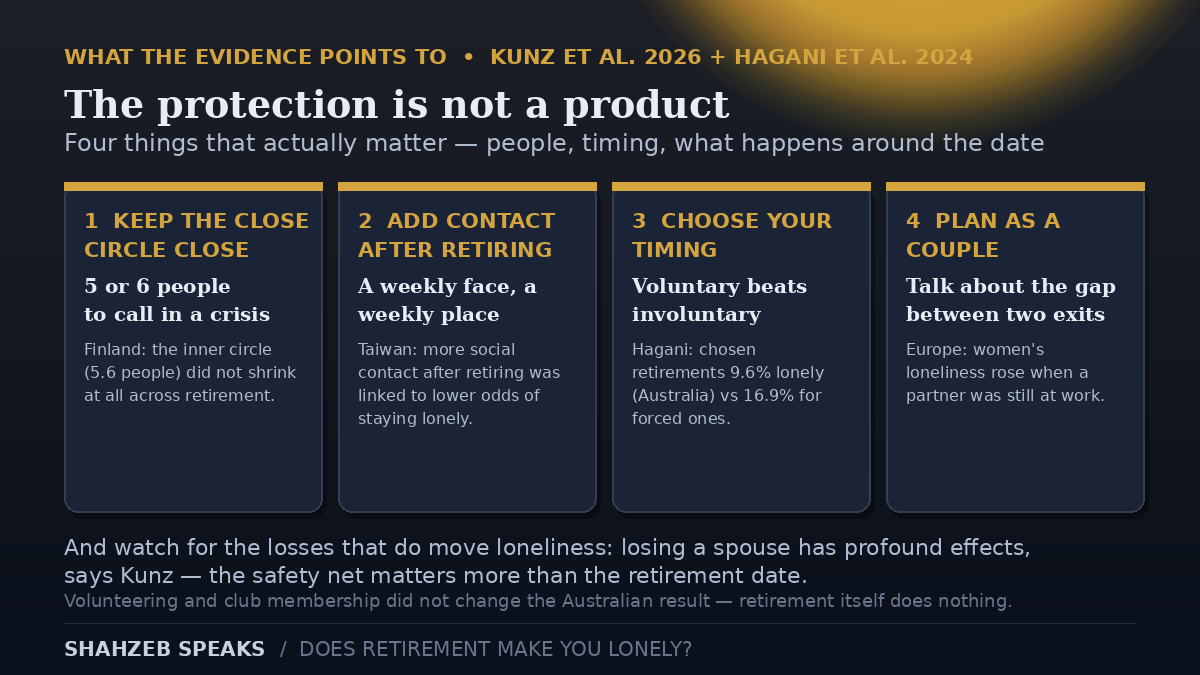
First, keep the close circle close. The Finnish study is the clearest evidence for this: across the retirement transition, the inner circle of about 5.6 people and the middle circle of about 6.9 people did not shrink at all. Only the outer circle — the acquaintances, the people you nod to in a corridor — thinned, by less than one person on average. That tells you where to put the effort. A plan built around five or six people you would call in a crisis beats one built around dozens of new acquaintances. The practical version is unglamorous: a standing weekly call with a sibling, a regular walk with a friend, a meal on the same day every week whether anyone feels like it or not.
Second, add social contact after retiring — not before the farewell, but in the months that follow. In Taiwan, increased social contact after retirement was linked to lower odds of becoming or staying lonely, and in Europe, the long-run fall in loneliness was linked to taking up more activities. Both are associations, not proof. But the mechanism is easy to see: work supplies a ready-made structure of contact, and when that structure goes, something has to replace it. The replacement does not need to be grand. A class, a volunteer shift, a walking group, a regular game — anything that puts the same faces in the same place at the same time each week. Volunteering and club membership did not change the Australian result, which is important to state honestly: in the Kunz study, people who volunteered or belonged to clubs showed no different retirement effect from anyone else. That does not mean those activities are useless — only that they do not change what retirement itself does.
Third, protect the timing. The Hagani figures make this the most actionable point in the whole article: voluntary retirement was linked to far less loneliness than involuntary retirement, in both Australia and the United States. Wherever you have a say in when you stop, use it. Wherever an employer has a say, the kindest thing it can do is offer a real choice — phased hours, a later date, a part-time bridge — rather than a fixed exit. And where the exit is forced by health or redundancy, that is the moment to watch closely, because it is the one the data flag as risky. A person who loses their job at 58 through no choice of their own needs more attention, not less, in the months that follow. For the search for purpose after work ends, see my article on meaningful work.
Fourth, plan as a couple, not as an individual. The European finding that women’s loneliness rose in the short run when their partner had not yet retired is a small result, but it points at a large truth: two people rarely retire on the same day, and the gap between their exits deserves a conversation. The Australian data found no partner-timing effect, so I will not overstate this. But the cost of the conversation is zero, and the cost of skipping it is a year of quiet resentment.
Fifth, and most sobering, watch for the losses that do move loneliness. Kunz is explicit that losing a spouse has profound effects on the perception of loneliness, drawing on other work rather than on this paper’s own estimates. That is the event the data point to, and it is the one no retirement plan can schedule. The honest implication is that the safety net matters more than the retirement date: family nearby, friends who notice absence, a community that checks in, and services that reach people who have lost a partner rather than waiting for them to ask. On the balance between work and the rest of life, see my article on work-life balance overtakes salary: what workers now value most is not pay but time.
🌐 Chapter 8: The pension-age debate — Denmark, Britain and the United States
Denmark has gone furthest. On 22 May 2025, the Danish parliament passed legislation raising the state pension age to 70 by 2040 — the highest in Europe — applying to people born after 31 December 1970. The vote was 81 in favour and 21 against. The current age is 67, rising to 68 in 2030 and 69 in 2035. Since a welfare reform in 2006, Denmark has tied the pension age to life expectancy and revises it every five years, so the age keeps moving as people live longer. Loneliness was not the centre of that debate, and on the Australian evidence it should not be: working longer does not make people lonelier, though age, bereavement and failing health still might.
Britain is moving more slowly, and the timetable is worth knowing if you live there. The State Pension age is currently 66 for men and women. It rises to 67 between 2026 and 2028, and it is legislated to rise to 68 between 2044 and 2046. The government launched a third review of State Pension age in July 2025, with a review expected in late 2026. The same logic applies: if the question is whether working to 67 rather than 66 will make people lonelier, the Australian evidence says no. The questions to ask instead are about health — whether people in manual jobs can physically work that long — and about fairness, because life expectancy differs sharply by income and by place. A person in a deprived area of England, where 33% of adults report being lonely at least some of the time against 10% in the least deprived areas, faces a different retirement from a person in a wealthy one, and a single pension age treats them as if they did not.
| Country | Pension age now | Where it is heading |
|---|---|---|
| Denmark | 67 | 68 in 2030, 69 in 2035, 70 by 2040 |
| United Kingdom | 66 | 67 in 2026–2028, 68 in 2044–2046 |
| United States | 67 (born 1960 or later) | Early eligibility 62 with reduced benefits |
| Australia | 67 (youngest cohorts) | Age Pension age used in the Kunz study |
In the United States, the Social Security full retirement age is 67 for people born in 1960 or later, phased up from 65 under the 1983 amendments, with early eligibility remaining at 62 on reduced benefits. Australia, the setting of the anchor study, has an Age Pension age of 67 for the youngest cohorts in the study. The pattern across all four countries is the same: the age is drifting upwards, roughly in step with longer lives, and the political debate is about affordability. What this article adds is narrow but useful. Loneliness is sometimes invoked as a reason to slow down, on the grounds that work keeps people connected. The best evidence says work is not what keeps them connected — or at least, that losing work does not disconnect them. If a government wants to reduce loneliness, raising or lowering the pension age is the wrong lever. The right levers are the ones the research keeps pointing to: support after bereavement, help for people forced out of work, and the everyday infrastructure of community life.
⚠️ Chapter 9: The honest limits — and when to get help
Every claim in this article has a limit, and this chapter states them. The first is the one I flagged in Chapter 2, and it is the most important: the Australian estimate describes “compliers” — people who retire because they reach pension age. It does not describe people forced out of work by illness or redundancy at 55, and it should not be quoted as if it did. If you were pushed out of work, this study has less to say about you than the headline suggests, and the Hagani figures in Chapter 5 are the more relevant evidence.
The second limit is the measure of retirement itself. The researchers counted people as retired if they were “not in the labour force” from age 55 onwards. That net catches some people who are not retired in the ordinary sense — people on long-term disability, people with heavy caring responsibilities, people with only a weak attachment to the labour force. The authors tested an alternative definition, based on people saying they were “completely retired”, and the results were broadly consistent, which is reassuring. But the definition is still a proxy, and a proxy can blur the edges. The same caution applies to the loneliness measure. A single question — “I often feel very lonely” — is a limitation the authors state themselves, even though it correlates about 0.88 with the three-item UCLA scale and the multi-item version gave the same answer.
The third limit is that the design, strong as it is, is still not an experiment. Nobody was randomly assigned to retire at 65 or keep working, and nobody ever will be. The pension-age lever is a clever substitute, but it rests on an assumption: that reaching pension age affects loneliness only through retirement, and not through some other channel. The researchers ran a battery of robustness checks, and the null finding survived all of them, except for one marginally significant negative result for the multi-item measure when all 23 waves were used. That is a strong record — still not proof in the sense a laboratory experiment would be.
The fourth limit is about what the study cannot see. It cannot see the quality of a person’s relationships, only whether they report feeling lonely. It cannot see the grief that follows a partner’s death, except through the lead author’s statement that losing a spouse has profound effects on perceived loneliness — a statement drawn from other work, not from this paper’s own estimates. And it cannot see the people who were already lonely before they retired and stayed lonely afterwards. A US Health and Retirement Study analysis found that lonely older workers were at increased risk of maladjustment and depressive symptoms after retiring, which suggests that pre-existing loneliness is itself a risk factor for a bad transition — and that the people who most need help are identifiable before they ever hand in their notice. If the flat, empty feeling after stopping work does not lift within a few months, take it seriously rather than waiting it out. My article on languishing at work describes the same muted, “meh” feeling in a working context, and the advice is the same: name it, talk about it with someone you trust, and seek professional support if it persists.
Finally, there is the matter of expectations. In the run-up to retirement, 56% of workers close to retiring look forward to it, but 32% are worried about missing social connections and 17% are worried about being lonely. Those worries are understandable, and this article should not be read as telling worried people they are foolish. The worry is real; the evidence simply says the feared event — retirement itself making you lonely — is not what happens, on average, to people who retire around pension age. The things worth worrying about are narrower: a forced exit, a partner’s death, a gap between two retirements, a network that was already thinning.
❓ Questions I am asked most often
Does retirement make you lonely?
No. In the strongest study available, 7,434 Australians followed for nearly twenty years showed no measurable change in loneliness when they retired. Loneliness stayed flat in the three years before and after. About one in six were lonely anyway, but leaving work did not cause it.
Why do so many people fear retirement will be lonely?
Because work supplies what loneliness researchers call ready-made structure: colleagues, routine, a reason to leave the house and a place where you are known. Losing all four at once sounds like a cliff. The evidence says the cliff is mostly imagined — the relationships that matter survive the transition.
Does retiring early make loneliness worse?
Not if you choose it. The Hagani study found voluntary retirement was linked to less loneliness — 9.6% lonely in Australia against 16.9% for involuntary retirement — and the same pattern in the United States. The risk sits with forced exits through redundancy, ill health or caring duties.
Does loneliness get worse as you get older?
Yes, but not because of retirement. In the Australian data, loneliness dipped slightly from the late 50s into the late 60s, then began rising again around age 68. Kunz puts it plainly: it is the general effect of ageing that raises loneliness as people age, not the transition out of work.
What should I do before I retire to avoid loneliness?
Keep your close circle warm before you need it: a standing weekly call, a regular walk, a meal on the same day each week. Agree the plan with your partner, including the gap if one of you retires first. Choose your timing where you can, and line up one regular activity for the months after work ends.
Should governments worry about loneliness when raising the pension age?
On this evidence, no. Kunz states that loneliness is not necessarily a consideration when deciding the retirement age, and the Australian data support him: working longer does not protect against loneliness, because stopping work does not cause it. The honest debate is about money, health and fairness
If you are approaching retirement and wondering what it will do to your social life — or if you are supporting a parent or a partner through the transition — the evidence is now clearer than it was, and the decision is still yours to make. I am an Industrial and Organizational Psychologist, and I work with organisations on work design, wellbeing, transitions and the measurement of behaviour. Get in touch here.
If you want the wider context, start with my guide to industrial psychology in Pakistan and my article on psychological capital at work. For purpose after work ends, see meaningful work, and for the flat, empty feeling that sometimes follows a big change, languishing at work. On the balance between work and the rest of life, see work-life balance overtakes salary.
Sources
- Kunz, J. S., Trinh, T. A., Berk, M., Earnest, A., Engel, L., Filia, K., Le, L. K.-D., Lim, M., Skouteris, H., Shields, M. A. & Mihalopoulos, C. (2026). The impact of retirement on loneliness: Evidence from Australia. Scientific Reports, 16, article 35424. https://doi.org/10.1038/s41598-026-64288-z
- Monash University (2026, 2 November). Retirement does not make older Australians more lonely. https://www.monash.edu/newsroom/news/2026/retirement-does-not-make-older-australians-more-lonely
- Monash Business School, Centre for Health Economics (2026, 15 September). Retirement and loneliness: Cause for concern? https://www.monash.edu/business/che/impact-and-engagement/research-bites/retirement-and-loneliness-cause-for-concern
- Holt-Lunstad, J., Smith, T. B., Baker, M., Harris, T., & Stephenson, D. (2015). Loneliness and social isolation as risk factors for mortality: A meta-analytic review. Perspectives on Psychological Science, 10(2), 227–237. https://doi.org/10.1177/1745691614568352
- Holt-Lunstad, J., Smith, T. B., & Layton, J. B. (2010). Social relationships and mortality risk: A meta-analytic review. PLoS Medicine, 7(7), e1000316. https://doi.org/10.1371/journal.pmed.1000316
- Guthmuller, S., et al. (2024). Retirement and loneliness. Scientific Reports, 14, 26971. https://doi.org/10.1038/s41598-024-74692-y
- Hagani, N., et al. (2024). Retirement and loneliness: A longitudinal comparison of Australia, China and the United States. Journal of Epidemiology and Community Health, 78, 602–608. (Figures as reported in the Understanding Aging summary; the Hagani paper itself was not read directly.)
- English Longitudinal Study of Ageing (2025). Retirement, loneliness and social isolation in England. BMC Public Health. https://doi.org/10.1186/s12889-025-24472-8
- Understanding Aging (summary of Guthmuller et al. 2024, Hagani et al. 2024, the Finnish Retirement and Aging study and the Taiwan Health and Retirement Study). https://understandingaging.org/research/retirement-loneliness
- Health Survey for England 2021 (loneliness prevalence by age and deprivation), as cited in the ELSA paper above.
- House of Commons Library (2025). State Pension age review. https://commonslibrary.parliament.uk/research-briefings/sn06546
- US Social Security Administration. Full retirement age for people born in 1960 or later. https://www.ssa.gov/benefits/retirement/planner/1960.html