
It is 9:40 on a Monday morning and the team meeting has barely started when the boss leans back and tells the room a story. A client was overcharged last week, he says, and he personally caught it and sent the money back. He had not needed to. Nobody would have known. But that is the kind of person he is, and the kind of team this is. Half the room nods. The other half looks at their notebooks. Boss bragging about good deeds can leave a team feeling inspired — or quietly put off — and a new study in the Journal of Applied Psychology shows the difference is not the deed itself, but whether the boss ever praises anyone else’s.

I am an Industrial and Organizational Psychologist in Karachi, and I write about work and behaviour for a global reader. This article is built on primary sources read directly: the abstract of the study itself, published in the Journal of Applied Psychology in 2026, the full PsyPost report that interviewed the lead author, and a related 2026 study on what happens when bosses share good news of any kind. It is written for the manager who wants their team to take ethics seriously, and for the employee who has sat through that Monday story and wondered why it left a bad taste.
“Calling attention to one’s own good deeds can also come across as morally superior or disingenuous.”
— Grace Ching Chi Ho, assistant professor of management, Southern Methodist University, speaking to PsyPost
This guide covers the short answer, the study behind the headline, the two emotions one story can trigger, the single habit that tips the balance, why stories about morals sting more than stories about results, the finding the authors flagged but could not explain, and a short playbook for bosses and for employees.
🎯 Chapter 1: The short answer — boss bragging about good deeds, explained
When a boss tells employees about their own ethical actions at work — researchers call it supervisor moral capitalization — the team can feel morally elevated, warmed and more willing to help. Or the team can feel disgust, and help less. A 2026 study of 254 boss–employee pairs and a preregistered experiment with 233 US workers found both reactions are real, and the deciding factor is whether the boss also highlights the good deeds of other people. Share the spotlight, and the story inspires. Keep it on yourself, and the same story reads as self-righteous.
That is the whole finding in one paragraph, but the details matter, because the study is careful where most commentary on this subject is not. It does not say bosses should stop talking about ethics. It does not say employees who feel put off are right about the boss’s motives. And it does not say the disgust is strong: on a scale of 1 to 7, the average disgust rating was 2.74 in the real-workplace survey and 1.44 in the experiment. This is a faint sour note, not open contempt. The point of the study is that even a faint sour note, repeated week after week, changes how much help a boss gets.
📊 Chapter 2: The study in numbers — 254 pairs, then 233 strangers
The study, by Grace Ching Chi Ho of Southern Methodist University’s Cox School of Business and Hudson Sessions of Arizona State University’s W. P. Carey School of Business, was published in the Journal of Applied Psychology in 2026 under the title “Uplifting or off-putting? The effects of supervisors capitalizing on their involvement in positive moral events on employee outcomes”. It has two parts, and the two parts do different jobs.
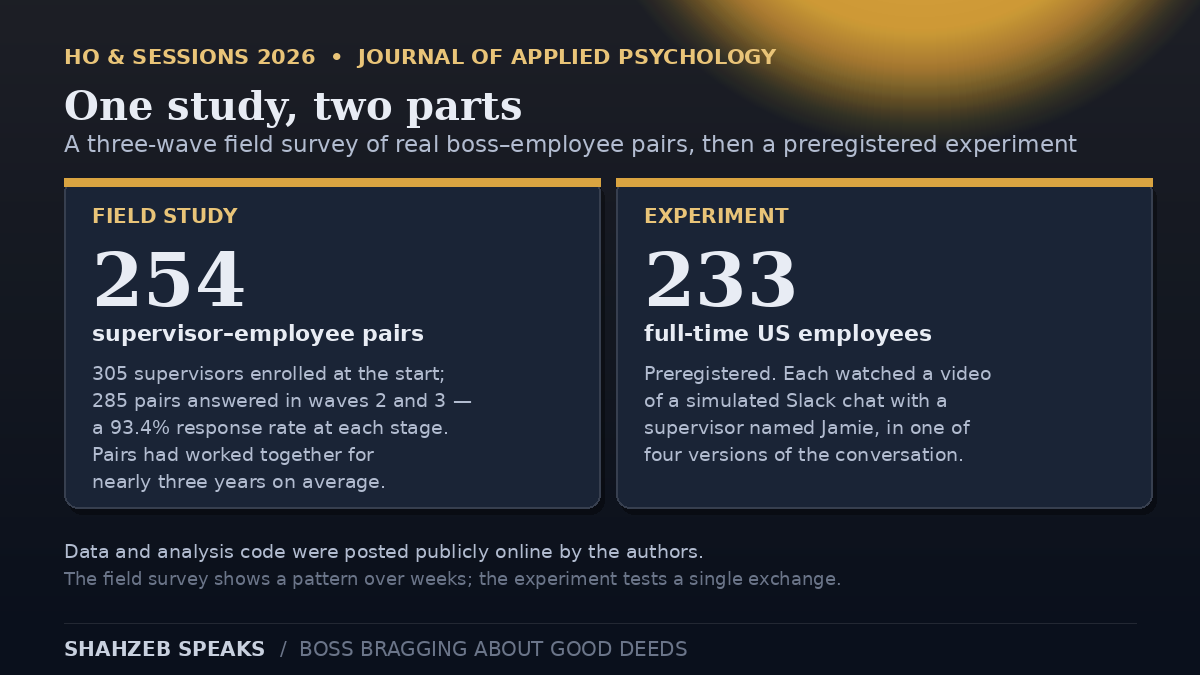
The first part is a three-wave field survey of real working pairs. A total of 305 full-time supervisors enrolled, and each nominated an employee they worked with frequently. In the second and third waves, 285 employees and 285 supervisors responded — a 93.4 percent response rate at each stage. After accounting for missing data and checks for attentive responding, the final sample was 254 supervisor–employee pairs who had worked together for an average of nearly three years. In the first survey, supervisors rated how often over the past several weeks they had told employees about their own ethical actions at work, and how often they had talked about the ethical actions of other people. Several weeks later, the paired employees rated how much their recent interactions with their supervisor had left them feeling morally elevated — inspired and admiring — or disgusted and repulsed. In the third wave, the supervisors evaluated how much voluntary help they had recently received from that employee. The authors posted their data and analysis code publicly online, and they statistically accounted for supervisors’ broader moral humility, running extra checks to make sure the results did not simply reflect generally modest or upbeat managers, or habits like sharing ordinary work wins or displaying pride.
The second part is a preregistered experiment with 233 full-time US employees. Each participant watched a video of a simulated chat on the workplace messaging app Slack, playing the role of an employee wrapping up a typical weekly meeting with a supervisor named Jamie. In the high self-focused condition, Jamie described personal ethical choices: declining an employee’s referral of a close friend as a project vendor to stay fair and avoid a conflict of interest, showing compassion to a stressed shipping manager, and honestly returning an overpayment after a customer mistakenly sent $1,100 for a $1,010 invoice. In the low self-focused condition, Jamie shared routine updates like reviewing standard operating procedures. Then Jamie turned to updates about other coworkers — either praising colleagues’ ethical behaviour, such as an employee generously staying late to help a burned-out accounting team and another throwing a welcome-back party for a new parent, or mentioning mundane tasks like completing basic onboarding training. After watching the exchange, participants rated their feelings of moral elevation and disgust, and how willing they would be to go out of their way to assist Jamie.
The two parts matter together. The survey shows the pattern in real relationships over weeks. The experiment shows that a single exchange can produce the same emotional reactions, which makes it harder to dismiss the survey pattern as a quirk of particular bosses or particular teams. Neither part is perfect — Chapter 8 comes back to the limits — but the combination is considerably stronger than either on its own.
⚖️ Chapter 3: Two emotions, one story
The study’s framework starts from a simple observation: the same sentence can land in two opposite places. Hearing about a leader’s principled choices can spark moral elevation, a warm, uplifting sense of admiration that motivates people to copy the goodness they have just seen. The idea is not new. Jonathan Haidt, who coined the term elevation, described it in 2003 as a positive moral emotion triggered by the good or admirable deeds of others, one that motivates people to do good or admirable deeds themselves. It is the feeling behind the lump in the throat when you watch someone do the right thing at a cost to themselves.
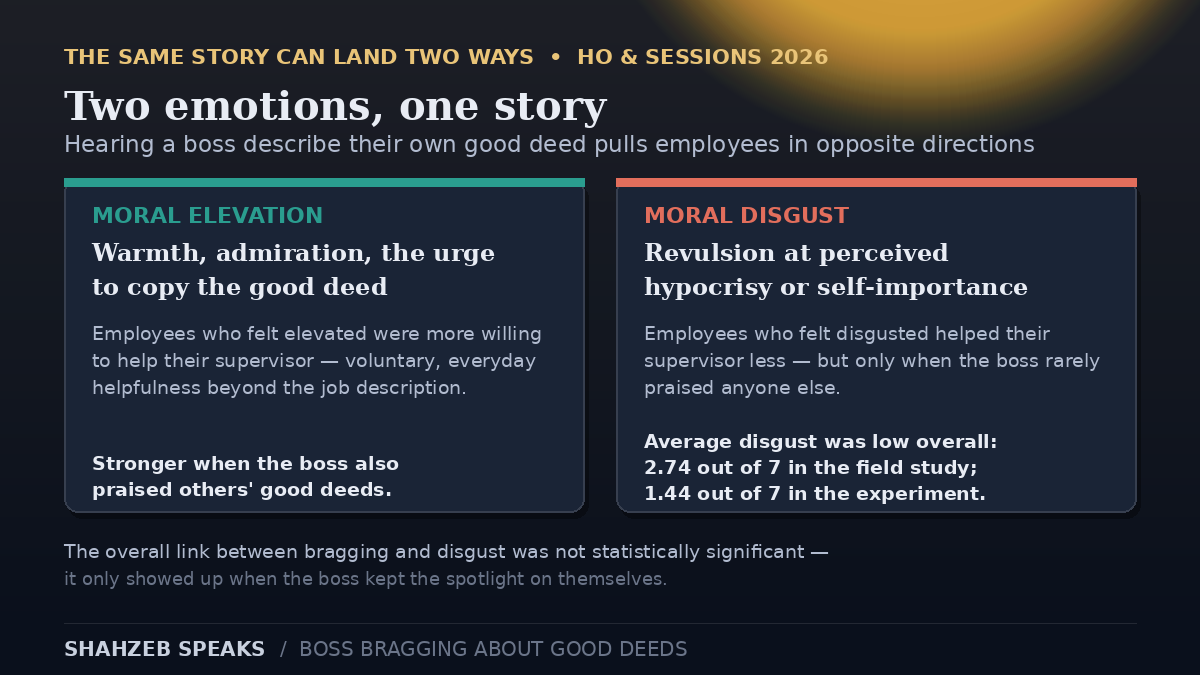
The opposite reaction is moral disgust: an emotional feeling of revulsion toward perceived hypocrisy or moral impurity. The authors’ point is that calling attention to one’s own morality carries a specific risk that calling attention to one’s own results does not. A boss who talks about hitting a target is claiming competence. A boss who talks about their own fairness is claiming goodness, and goodness claimed by the person themselves is easy to read as a holier-than-thou image, marred by self-superiority, virtue signalling and disingenuousness. Those are the authors’ words in the abstract, and they capture the mechanism precisely: the listener is not judging the deed, they are judging the telling.
What the study found is that both reactions are real and both have consequences. Across the field sample, supervisors who more frequently talked about their own ethical behaviour tended to have employees who reported greater moral elevation, and higher elevation was in turn associated with more helpful behaviour toward the supervisor — voluntary, everyday acts of helpfulness that go beyond formal job duties, which researchers call supervisor-directed organisational citizenship behaviour. But the disgust side of the story only appeared under a condition, which is the subject of the next chapter. One number worth holding on to: the overall direct link between a boss talking about their own morality and employee disgust was not statistically significant in either study. On its own, the story does not reliably disgust people. What disgusts them is the story told a particular way.
| What the study found, at a glance | Result |
|---|---|
| Boss talks about own good deeds → employee feels elevated → helps more | Found in the field study |
| Boss talks about own good deeds → employee feels disgust (overall) | Not statistically significant |
| Same story, but boss rarely praises others → disgust rises, help falls | Found in both studies |
| Same story, boss also praises others → elevation stronger, disgust link gone | Found in the field study |
| Average disgust, 1–7 scale | 2.74 (field) / 1.44 (experiment) |
A practical point follows from the low disgust scores. Nobody in this study was storming out of meetings. The employees were reporting a mild, background feeling — the kind that shows up as a slightly slower reply to a request, a little less volunteering for the extra task, a little less warmth in the next one-to-one. That is exactly how a boss loses help without ever knowing why. The damage is not dramatic. It is cumulative.
🔦 Chapter 4: The spotlight rule
The finding that matters most for managers is the one the authors built the study around: the boss can tip the balance by sharing the spotlight. When supervisors regularly praised the ethical conduct of others at work, sharing their own moral actions was tied to stronger employee moral elevation, and the link to disgust was not statistically significant. When supervisors rarely highlighted the ethical actions of others, the picture flipped: talking frequently about their own morality was positively associated with employee disgust, and higher disgust was linked to less helpfulness toward the supervisor. For those bosses, the story also lost its tie to moral elevation — that relationship was not statistically significant either. In other words, the self-focused boss got the worst of both worlds: no uplift, and a sour note instead.
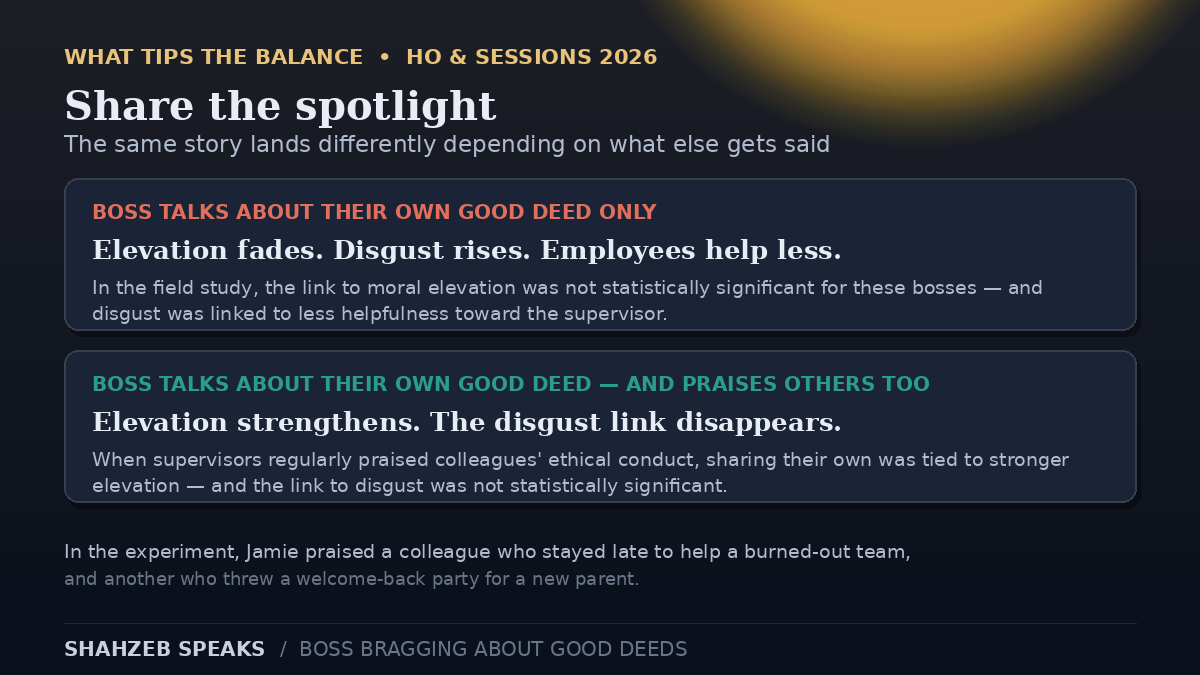
The experiment echoed the pattern, with one honest difference. When Jamie talked about personal good deeds while mentioning only routine tasks for coworkers, employee disgust rose, and that pattern was linked to a lower willingness to help Jamie. When Jamie paired personal moral stories with praise for coworkers’ kindness and generosity, the direct effect on disgust was not statistically significant on its own, though in the full pathway model that combination had a positive indirect association with willingness to help, because disgust ran lower in that condition. Unlike in the field study, the added boost to moral elevation from also praising coworkers was not statistically significant in the experiment. The authors’ reading of that gap is worth repeating, because it is a good example of how to interpret mixed results: failing to mention others’ good deeds during a single brief chat may seem neutral, whereas a real-world boss who rarely acknowledges coworkers over an extended period may appear intentionally stingy with credit. A habit reads differently from a single omission. That is also why the field study, which watched real pairs over weeks, is the stronger evidence for the spotlight rule, and the experiment is the stronger evidence that a single exchange can start the reaction.
Ho’s advice to leaders follows directly from this: “The key takeaway for leaders navigating this challenge is to share the spotlight by recognizing others’ ethical actions alongside their own.” It is a small change in wording with a large change in meaning. “I caught the overcharge” is a story about me. “I caught the overcharge, and Sarah stayed late to fix the invoices for the client” is a story about us. The deed has not changed. The audience’s reading of the speaker has.
🧪 Chapter 5: Why morals sting more than results
A fair question at this point is whether the problem is really about morals, or just about bosses talking about themselves. After all, a boss who talks about their own achievements can also grate. The study answers that question with an additional parallel experiment, which compared moral sharing directly against sharing ordinary performance wins. The evidence was that sparking disgust was distinctive to sharing moral involvement, not to sharing performance-related accomplishments. That distinction matters, because it tells us the reaction is not generic self-promotion fatigue. It is specific to the claim of goodness.
The reason is not hard to see once you name it. A performance claim can be checked. A moral claim cannot be checked in the same way, so the listener has to decide whether to trust the speaker’s account of their own character — and the speaker has an obvious interest in the answer. That is why the same employee who happily applauds a boss’s sales record can feel uneasy when the boss applauds their own integrity. The first claim invites admiration of a result. The second invites judgement of a person, by the person themselves.
There is a second, related line of research that belongs in this chapter, because it shows the same pattern from a different angle. A 2026 study by Emily Poulton, Emma Frank and Joanna Lin, published in Organizational Behavior and Human Decision Processes, looked at what happens when supervisors share good news of any kind with subordinates — the behaviour researchers call workplace capitalization. Across four preregistered experiments and a ten-day field study of supervisor–subordinate pairs, the team found a split: for supervisors, sharing good news was energising. Talking through a positive experience let them relive it and receive affirmation, a boost the authors call relational energy, which in turn encouraged supervisors to help the subordinate who had listened. For subordinates, the same conversation could be an energy drain. When your boss tells you about something that went well, it may not seem acceptable to respond with indifference. You are expected to appear interested, impressed and enthusiastic, even when that is not how you really feel. The authors call this an emotional display obligation, and in their experiments it was associated with greater counterproductive behaviour toward the supervisor — though the field study did not fully replicate the subordinate pathway, which the authors report honestly. For more on how small pressures like this accumulate at work, see my articles on psychological safety at work and micromanagement psychology.
Put the two studies together and the picture is consistent. Good news from a boss is not received the way good news from a peer is received, because hierarchy changes the listener’s job. A peer’s story asks for a reaction. A boss’s story asks for a performance of a reaction — and when the story is about the boss’s own virtue, the performance is harder, because the listener is being asked to certify the boss’s character, in public, to the boss’s face. The Ho and Sessions study adds the twist that makes the story useful rather than merely discouraging: the performance stops feeling like a performance when the boss is also certifying other people.
⚠️ Chapter 6: The finding the authors flagged, not explained
One result in the field study deserves its own chapter, because it is the kind of finding that is easy to overstate and wrong to ignore. In supplemental analyses, self-focused moral sharing was associated with stronger employee disgust when the supervisor identified as a woman than when the supervisor did not. The authors report the pattern and flag it rather than explaining it, and that restraint is the right response: the analysis was supplemental, no numbers were published for the size of the gap, and the study was not designed to test why it appears. What can be said is that it fits a familiar pattern in research on women in leadership, where the same behaviour is judged more harshly when a woman does it — a double standard the leadership literature has documented for decades. But fitting a pattern is not proving a cause, and this article will not turn a flagged supplemental finding into a settled claim.
What the authors do suggest, practically, is worth noting. They propose that organisations might help offset this penalty by formally recognising leaders’ ethical contributions — through public awards, for example — so managers do not have to promote their own good deeds at all. The logic is sound whichever way you read the gender finding: if the organisation tells the story, nobody has to tell it about themselves, and the disgust trigger disappears with the telling. That is a structural fix, not a coaching tip, and it is the kind of fix a company can actually make. For the wider evidence on how recognition works when it is done well, see my article on employee recognition.
🛠️ Chapter 7: What to do with this — a short playbook
The study’s lesson is not “never talk about ethics”. Leaders are, as Ho says, often encouraged to use their own behaviour as an example of ethical conduct at work, and sharing how they showed compassion or corrected an overcharge can make ethical values tangible. The lesson is about how the story is told, and who else is in it.
If you are the boss
Tell two stories, not one. Every time you mention your own part in a good outcome, name someone else’s part in the same breath. “I caught the overcharge, and Sarah stayed late to fix the invoices” is not false modesty. It is an accurate account of how work actually happens, and it is the version the research says lands well.
Let the work speak first. If the deed is real, the people affected already know, or will find out. A story told by the person who benefited from it carries no disgust risk at all. If you want the team to know you corrected the overcharge, ask the client-facing colleague to mention it in the debrief.
Keep a private record instead of a public one. If you need to track your own ethical calls — for a review, for your own reflection — write them down privately. The meeting is not the place to build your case. For how reviews actually go wrong, and what to do instead, see my article on why performance reviews fail.
Ask the organisation to do the telling. If your company has awards or a way of recognising ethical contributions formally, use it. The study’s authors suggest exactly this, and it solves the problem for everyone, including the women leaders the supplemental finding suggests are judged more harshly.
If you are the employee
Separate the deed from the telling. A boss who tells you about their own good deed may still have done a good deed. Ho makes this point explicitly: “An employee’s negative reaction does not establish that a supervisor’s good deed was insincere.” The study measured responses to the sharing, not the motive behind the act. Hold both thoughts at once.
Notice the pattern, not the episode. One story in one meeting is not evidence of anything. The research says the reaction builds over weeks, when a boss rarely acknowledges anyone else. If the spotlight never moves, that is the pattern worth paying attention to — and worth raising, calmly, with the boss or with HR, as a question about recognition rather than as an accusation about character.
Do not perform enthusiasm you do not feel. The Poulton study in Chapter 5 shows that the pressure to seem impressed is itself a cost. A brief, honest “thanks for flagging that” is enough. You are not obliged to applaud, and the applause is part of what makes the exchange draining.
🔍 Chapter 8: What the study cannot tell us
An honest article ends with the limits, and this study has several that the authors state plainly. First, the field survey is correlational. It shows that bosses who talk about their own good deeds without praising others tend to have employees who feel more disgust and help less, but it cannot prove the talking caused the feeling. It is possible, for example, that bosses who already have strained relationships talk about themselves more. The experiment helps here, because it manipulated the story directly, but it measured a hypothetical willingness to help a fictional manager, not actual workplace behaviour.
Second, the field survey’s sample was chosen by the supervisors themselves: each supervisor nominated the employee who took part. That may have tilted the sample toward relatively cooperative working pairs, which would mean the study underestimates the effect in more difficult relationships, not overestimates it — but it is a guess either way, and the direction is not proven.
Third, the disgust scores were low. An average of 2.74 out of 7 in the field and 1.44 in the experiment means most employees were not disgusted at all. The authors note that reluctance to report socially undesirable negative emotions may have made a broad direct effect harder to detect, which is plausible. It is also possible that the effect is genuinely small in most workplaces and large only in a few. The study cannot settle that.
Fourth, the study is silent on culture. The authors themselves suggest that workers in mission-driven organisations such as hospitals, nonprofits or religious institutions, where ethical values are discussed openly, might welcome a supervisor’s moral stories more readily than employees in industries often viewed skeptically by the public, such as tobacco or gambling, where similar remarks might strike listeners as hypocritical. They also note that future studies could examine how employees’ differing personal moral values shape reactions, what happens when managers talk about charity work outside the office, and how workers respond when leaders use inclusive “we” language to emphasise shared ethical efforts. None of that is tested yet. For a related question — how decisions get worse as the day goes on — see my article on decision fatigue.
None of these limits makes the study weak. A three-wave field survey plus a preregistered experiment, with data posted publicly, is a solid design. But the limits decide what the study can be used for. It can tell a manager to share the spotlight. It cannot tell a company that its bosses are insincere, and it cannot tell an employee that their boss’s story was a lie. The study is about how stories land. Use it that way.
❓ Questions I am asked most often
What is supervisor moral capitalization?
It is when a boss talks to employees about their own part in a good or ethical event at work — for example, how they helped a struggling colleague, treated someone fairly, or corrected a billing error. Ho and Sessions (2026) distinguish it from other-focused moral capitalization, which is talking about other people’s good deeds. The term comes from workplace capitalization, the wider habit of telling colleagues about positive events at work.
Does bragging about good deeds always backfire?
No. In a 2026 study of 254 boss–employee pairs, bosses who talked about their own ethical actions tended to have employees who felt more morally elevated, and elevation was linked to more voluntary help. The backfire appeared only when the boss rarely praised other people’s good deeds. When bosses regularly praised others too, the story inspired more and the disgust link disappeared.
Why do employees feel disgust when a boss brags about being good?
Because a moral claim is a claim about character, and a character claim made by the person themselves reads as self-superiority or virtue signalling. The study found the reaction was specific to moral stories: a parallel experiment showed disgust was triggered by sharing moral involvement, not by sharing ordinary performance wins like hitting a target.
How strong is the disgust, really?
Mild. Average disgust was 2.74 out of 7 in the field study and 1.44 out of 7 in the experiment, and the overall link between bragging and disgust was not statistically significant. The effect is a faint sour note, not open contempt — but repeated weekly, it was linked to measurably less help for the boss.
What should a boss do instead of telling their own story?
Share the spotlight. Name someone else’s good deed alongside your own, let the people who benefited tell the story, or ask the organisation to recognise ethical contributions formally. The study’s lead author put it simply: recognise others’ ethical actions alongside your own.
Does this mean my boss’s good deed was fake?
No, and the researchers say so directly. Ho told PsyPost that an employee’s negative reaction “does not establish that a supervisor’s good deed was insincere”, because the study measured responses to the sharing, not the motive behind the act. Judge the telling and the deed separately.
If the way your team talks about ethics — or the way your boss talks about themselves — is the part of your work you want to understand better, that is what I do. I am an Industrial and Organizational Psychologist, and I work with people and teams on leadership, work design and the measurement of behaviour. Get in touch here.
If you want the wider context, start with my guide to industrial psychology in Pakistan and my article on psychological capital at work. For the pressures around recognition and safety in more depth, see employee recognition, psychological safety at work and why performance reviews fail.
Sources
- Ho, G. C. C., & Sessions, H. (2026). Uplifting or off-putting? The effects of supervisors capitalizing on their involvement in positive moral events on employee outcomes. Journal of Applied Psychology (advance online publication). DOI: 10.1037/apl0001416. https://psycnet.apa.org/doi/10.1037/apl0001416
- PsyPost (21 November 2026). New study finds bosses who share stories about their own good deeds risk disgusting employees. https://www.psypost.org/new-study-finds-bosses-who-brag-about-their-own-good-deeds-risk-disgusting-their-employees/
- Poulton, E. C., Frank, E. L., & Lin, S.-H. (2026). “That’s SO interesting!”: The divergent implications of supervisors’ workplace capitalization for supervisors and subordinates. Organizational Behavior and Human Decision Processes, 196. DOI: 10.1016/j.obhdp.2026.104512.
- Haidt, J. (2003). Elevation and the positive psychology of morality. In C. L. M. Keyes & J. Haidt (Eds.), Flourishing: Positive psychology and the life well-lived (pp. 275–289). American Psychological Association.