

It is 9 p.m. You have made good decisions all day — at work, with money, with people — and now you are staring at a food delivery app unable to choose a meal, or agreeing to something you would have refused at 9 a.m. You are not suddenly a weaker person. Decision fatigue is the name psychologists gave to the way decision quality slips after a long run of choices — and the honest story is more interesting than the slogan: the feeling is real, the famous battery theory behind it mostly failed, and the fix is not more willpower but fewer decisions.
I am an Industrial and Organizational Psychologist in Karachi, and I write about what research actually shows about working life, including when it contradicts a popular idea. This guide separates the two halves of decision fatigue: the everyday experience, which most of us recognise, and the laboratory theory, which has not survived testing in its strong form. It then gives you a system that works whether or not the battery exists, because it is built on defaults and routines rather than on heroic self-control.
“You do not need a stronger battery. You need fewer decisions competing for the same tired brain.” — Workplace Psychology Analysis, ShahzebSpeaks
⚡ Chapter 1: The short answer — decision fatigue in one paragraph
Decision fatigue describes how the quality of our choices tends to worsen after we have made many of them, so we start defaulting to the easiest option, avoiding the decision, or choosing impulsively. The classic evidence came from two famous studies: Israeli parole boards whose favourable rulings fell from about 65% to nearly zero across a session before a break (Danziger and colleagues, 2011), and a laboratory experiment in which people who resisted chocolate gave up on unsolvable puzzles after about 8 minutes, against about 19 to 21 minutes for everyone else (Baumeister and colleagues, 1998). Both findings launched a powerful idea — that willpower is a limited resource, like a muscle or a battery, that drains with use. That strong version has since been badly damaged: large pre-registered replications found effects close to zero, and the parole pattern turned out to be partly explained by the order cases were heard, not only by tired judges. What survives is a humbler claim, and a useful one: after sustained mental effort, attention narrows, motivation shifts, and the safe or easy option becomes more attractive. The practical answer is therefore not to “recharge your willpower” with a snack, but to design your day so the important decisions are made early, the routine ones are pre-decided, and the evening is protected from choices that do not deserve your remaining attention.
⚖️ Chapter 2: The hungry judges — the study that started it all, and its problem
In 2011, Shai Danziger, Jonathan Levav and Liora Avnaim-Pesso published an analysis of 1,112 parole decisions made by eight Israeli parole boards over ten months. Their headline pattern was dramatic: the percentage of favourable rulings dropped gradually from about 65% at the start of a decision session to nearly zero just before a food break, then jumped back to about 65% after the break. The authors suggested that as judges made more decisions and their mental resources dwindled, they defaulted to the status quo — denying parole, which keeps the prisoner where he is and requires no change. The study became the “hungry judge” story, retold in newspapers, books and management talks as proof that a snack could change a life sentence.
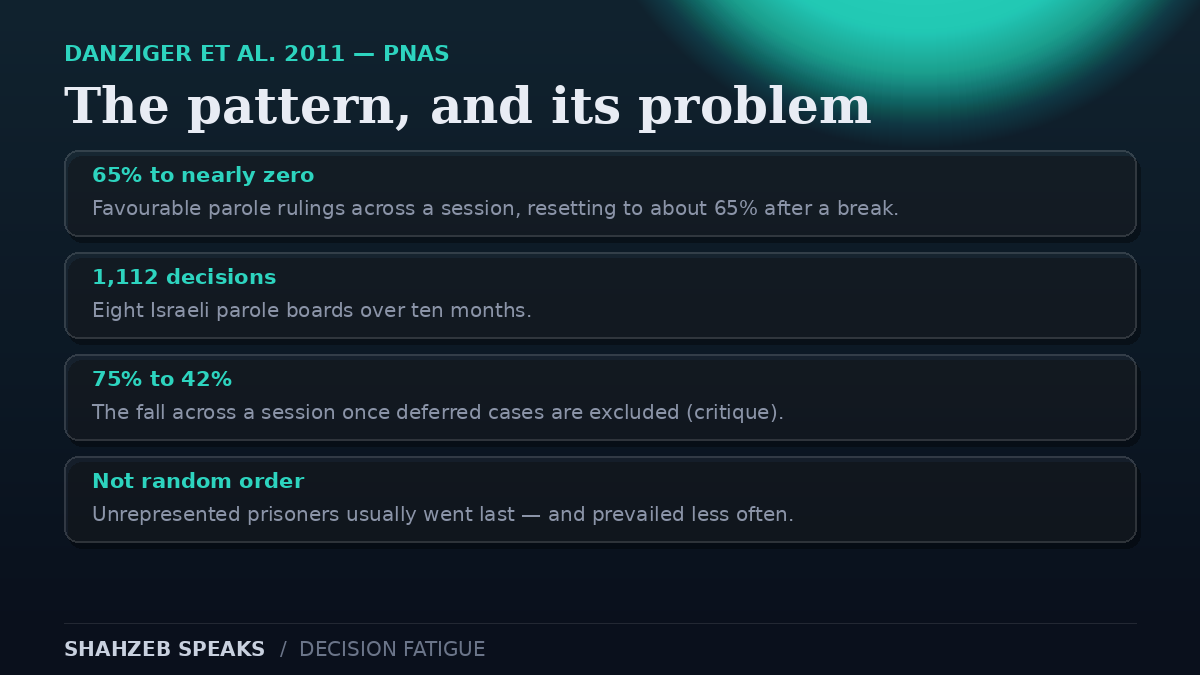
The problem arrived the same year, in the same journal. Keren Weinshall-Margel and Kobi Shapard examined the authors’ data and interviewed court staff, and found that case ordering was not random. The board tried to finish all cases from one prison before a break, and unrepresented prisoners usually went last — and unrepresented prisoners prevailed far less often than prisoners with lawyers. When deferred cases were excluded, the success rate still fell across a session, from about 75% to about 42% in the authors’ own data, but the critique showed that a large part of the headline pattern could be scheduling, not hunger. The lesson is not that the parole study was worthless. It is that a single striking pattern, however clean it looks in a graph, is not proof of a mechanism. Decision fatigue entered public conversation on the back of this study, and the study itself is now the best reason to be careful about the term.
That care matters for a second reason. The parole boards were panels of three — a judge, a criminologist and a social worker — not a single hungry judge, and the researchers had no data on prisoners’ behaviour in prison, which is a central legal factor in parole. A story that simplifies all of that into “eat before you decide” is a story that has stopped being science and started being a slogan. Keep the study in mind, but hold it the way researchers now hold it: suggestive, contested, and not a licence to blame every bad evening decision on low blood sugar.
🍪 Chapter 3: The radish experiment — and why the battery ran out of charge
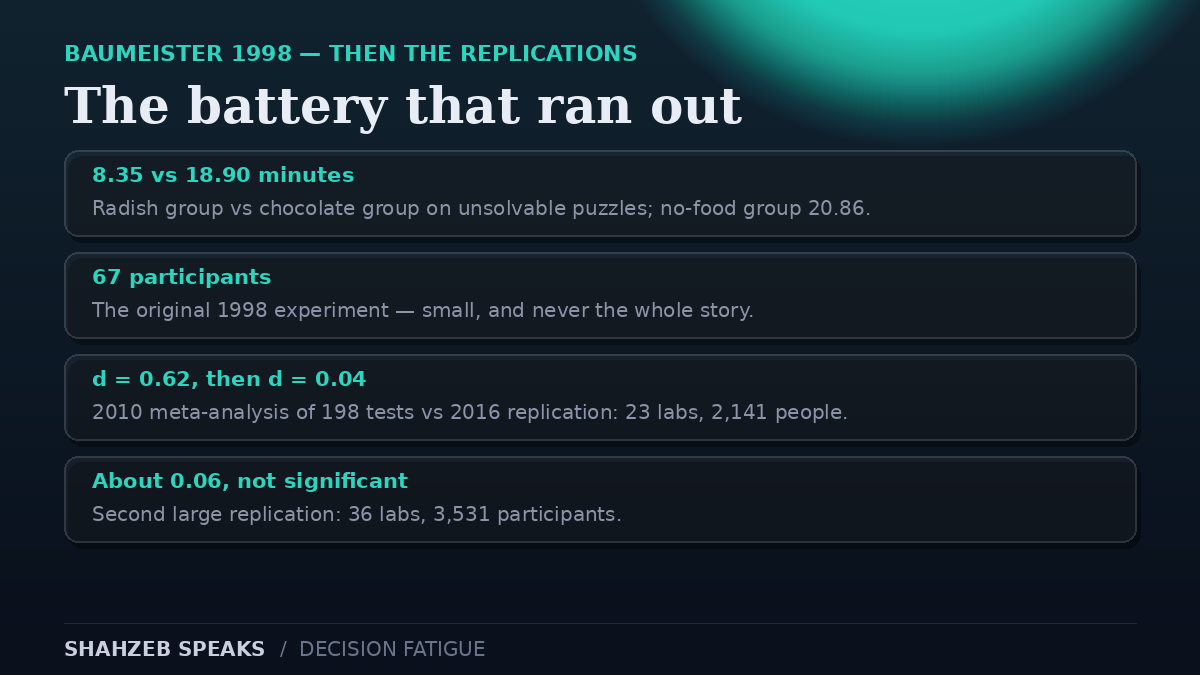
The laboratory half of the story is older and, at first, cleaner. In 1998, Roy Baumeister and colleagues ran an experiment with 67 hungry participants in a room scented with freshly baked chocolate. Some were told to eat the chocolate; others had to resist it and eat radishes instead. Afterwards, everyone tried puzzles that were, unknown to them, unsolvable. The radish group gave up after 8.35 minutes on average, against 18.90 minutes for the chocolate group and 20.86 minutes for a group given no food. A second experiment found that making an effortful choice against one’s own attitudes also reduced later persistence. Baumeister called the pattern ego depletion: self-control draws on one limited resource, and using it on one task leaves less for the next.
For a decade, the theory flourished. A 2010 meta-analysis by Martin Hagger and colleagues gathered 198 tests and found a medium effect size of d = 0.62 — a result that looked robust enough to build books, training programmes and productivity advice on. Then came the replications that changed the field. In 2016, Hagger himself coordinated a pre-registered multi-lab replication across 23 laboratories with 2,141 participants. The effect was d = 0.04, with a 95% confidence interval from -0.07 to 0.15 — indistinguishable from zero. A second, even larger replication led by Kathleen Vohs, one of Baumeister’s long-time collaborators, tested 3,531 participants across 36 labs and found a confirmatory result of about 0.06, again not significant. The authors of that replication concluded that depletion was not as reliable or robust as previously assumed.
Baumeister and his defenders replied that the replications used tasks that differed from the original protocol, and that they never properly tested the hypothesis. That dispute is still live, and a small effect after very demanding tasks has not been ruled out. But the strong claim — that every act of self-control measurably drains a general battery, so that a day of decisions leaves you reliably depleted — has not survived. The glucose version has fared worse: the idea that willpower burns blood sugar, and that a sweet drink restores it, has not held up, and merely tasting something sweet has been reported to restore performance in some studies, which points to motivation and expectation rather than fuel. If you take one sentence from this chapter, take this: do not buy a product, a snack or a system that promises to recharge your willpower. The battery was the metaphor, not the finding.
😴 Chapter 4: What is real, then? Fatigue, attention and the October 2026 evidence
If the battery is gone, why does the evening still feel like a worse time to decide? Because several smaller, better-supported mechanisms produce the same experience without needing a single depletable resource. Attention tires. Motivation shifts: after sustained effort, the brain weighs immediate comfort more heavily and future benefit less heavily. Beliefs matter: people who believe willpower is limited tend to perform worse after effort than people who believe it is not, which suggests that part of “depletion” is a story we tell ourselves about being tired. And real tiredness matters on its own: sleep loss, illness and chronic stress degrade the same executive functions — planning, inhibition, working memory — that good decisions need. None of this requires a battery. All of it predicts that a long day of choices will leave you more likely to take the default, postpone the decision, or grab the immediate reward.
Fresh evidence points in the same direction, carefully. A study published in Communications Psychology and reported on 5 October 2026, by Raymond Hernandez and colleagues, analysed six studies and found that feeling more tired than usual, and performing faster than usual on a mental task, each predicted a stronger link between fatigue and slower processing speed at the next assessment — what the authors called lower “fatigue override”. The authors’ own caution matters: this is about how fatigue and speed at one moment predict performance at the next, not proof that a specific intervention restores performance, and whether people can use that signal to time important work still needs testing. It is a hint, not a hack, and it fits the humbler picture: pace matters, and pushing faster when tired can cost you later.
The search data tell a parallel story about demand, not mechanism. An October 2026 analysis of Australian Google Trends data found that searches for “burnout” averaged a relative interest score of 66 over five years, against 4 for “workplace stress”, with peaks in February and May 2026 — May the highest since 2021 — and rising interest in “how to recover from burnout”. Google Trends scores are relative, on a scale of 0 to 100, not counts of searches, so they show what people are turning to search engines about, not how many people are burnt out. Still, the direction is clear: people are not looking for a theory of willpower. They are looking for a way out of exhaustion, and decision fatigue is one of the names they give to it.
🛒 Chapter 5: Why evenings go wrong — defaults, deferral and impulse
When decision quality slips, it rarely slips into random error. It slips into three predictable directions, and recognising them is half the defence.
First, the default wins. The status quo — keep the subscription, accept the recommended option, stay with the current supplier — requires no action, so it wins when action feels costly. The power of defaults is one of the best-documented findings in decision research, and it is not a laboratory curiosity. In a 2003 Science paper, Eric Johnson and Daniel Goldstein compared organ donor registration across European countries: Germany, with an opt-in system, had an effective consent rate of 12%, while Austria, with an opt-out system, had 99.98%. Those figures describe registration under different default rules, not actual transplant rates — later commentary stressed that families are still asked, and the effect on actual donations is smaller and contested — but the direction is unmistakable: when the default does the deciding, most people go along with it. The same machinery operates at 9 p.m., when the app’s recommended meal, the pre-ticked box and the “keep current plan” button all become your decision by default.
Second, decisions get deferred. Postponement feels free, but it is itself a decision with a cost: the unresolved choice keeps occupying attention, the deadline gets closer, and the eventual choice is made under more pressure with less time. This is why a long day ends with a pile of “I’ll decide tomorrow” items that are harder tomorrow, not easier. Third, impulse wins. When attention is narrow and motivation has shifted towards immediate comfort, the quick reward — the extra purchase, the harsh reply, the snack, the “yes” to something you will regret — becomes harder to resist, not because a battery is empty but because the brakes are tired and the accelerator is loud. My guide on workplace burnout covers the longer version of this state, and my guide on choice overload covers its close cousin: too many options at once, rather than too many decisions across a day.
One more distinction keeps this honest. Decision fatigue is not the same as choice overload, and neither is the same as burnout. Choice overload is about the number of options in a single choice; decision fatigue is about the number of choices across time; burnout, as the World Health Organization defines it, is an occupational phenomenon resulting from chronic workplace stress that has not been successfully managed, marked by exhaustion, detachment and reduced efficacy. They overlap, they feed each other, and they are often confused. Naming which one you are dealing with matters, because the fixes differ: fewer options helps overload, fewer decisions helps fatigue, and neither fixes burnout on its own.
🧭 Chapter 6: The system — fewer decisions, better defaults, protected evenings
The system below does not depend on the battery theory. It works if the mechanism is attention, motivation, habit or all three, because it reduces the number of decisions your tired brain has to make at all.
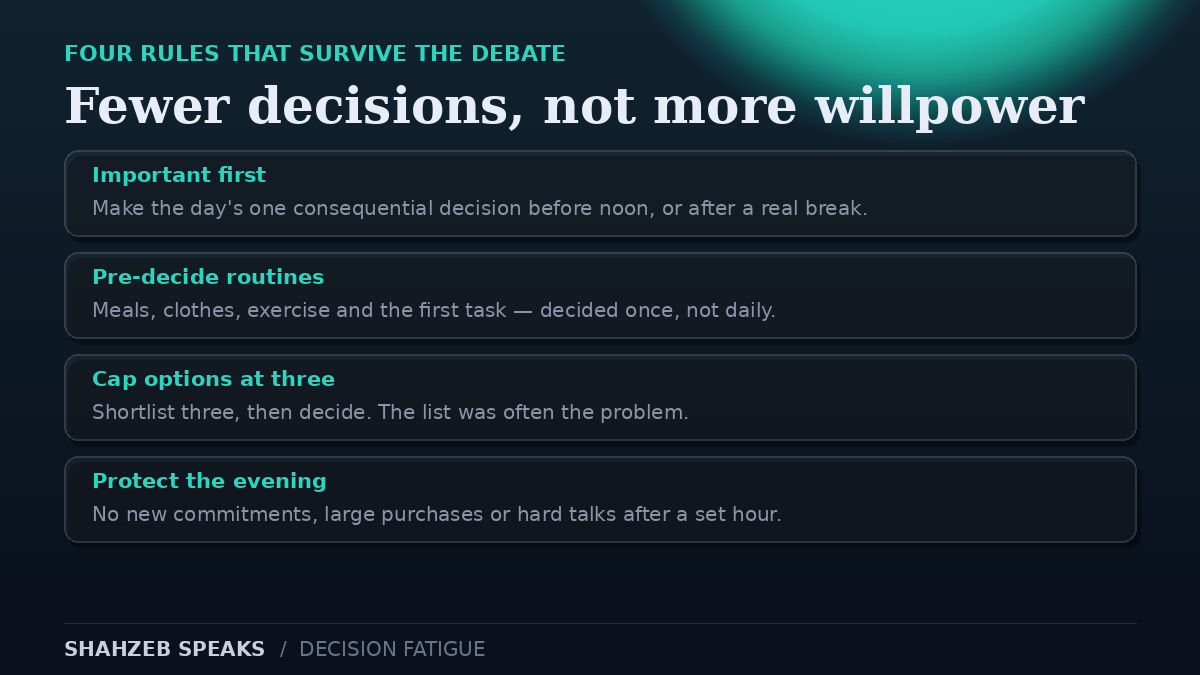
| Rule | What to do | Why it helps |
|---|---|---|
| Important first | Make the day’s one consequential decision before noon, or after a real break. | Attention and motivation are freshest before the day’s choices accumulate. |
| Pre-decide routines | Fix meals, clothes, exercise and the first work task in advance for the week. | Routine choices stop consuming the attention that important ones need. |
| Cap options at three | Shortlist three candidates for any non-trivial choice, then decide among them. | Three is enough to choose well and small enough to avoid overload. |
| Protect the evening | No new commitments, large purchases or difficult conversations after a set hour. | Defaults and impulse win in the evening; the rule removes the contest. |
Start with a decision budget. Each morning, name the one decision that matters most today, and make it first. Everything else that day is either routine (pre-decided), delegated (someone else’s call), or deferred to a named time — not “later”, which is not a time, but “Thursday at 10 a.m.”, which is. Turn recurring choices into rules. A rotating weekly menu, a standard meeting agenda, a fixed savings transfer, a rule that you do not answer non-urgent messages after 8 p.m. — each rule is a decision you make once and never remake. This is the default effect working for you instead of against you: you are choosing your own defaults in advance, while you are fresh, rather than accepting someone else’s defaults while you are tired.
Design the environment, not just the intention. If evening spending is the problem, remove the saved card from the app, not just the resolve to resist it. If evening arguments are the problem, agree the rule with the other person in daylight: “We do not settle big things after 9 p.m.; we write them down and talk tomorrow.” If work decisions pile up, batch them: two decision windows a day, with everything else queued, beats a day of constant choosing. And separate rest from recovery theatre: scrolling through more choices — more feeds, more menus, more tabs — is not rest, because it is more deciding. Rest is a walk, a shower, a conversation, sleep. The Hernandez finding supports the same instinct from the other side: pushing faster when tired predicts worse performance later, so pacing is not laziness. It is the strategy.
⚠️ Chapter 7: When it is not decision fatigue — the honest limits
Not every bad evening decision is decision fatigue, and labelling it so can hide a problem that needs a different answer. Persistent exhaustion, low mood, poor sleep, or an inability to concentrate for weeks is not a decision problem; it is a health matter, and a clinician, not a blog article, is the right next step. A workplace that demands constant, high-stakes decisions with no breaks, no staffing and no recovery time is not a willpower problem either; it is a job-design problem, and no personal system fully compensates for it. My guide on psychological safety at work and my guide on toxic workplace signs cover the organisational side of that story.
Two further limits deserve plain statement. First, the advice in this guide is general information, not medical or financial advice, and no single study cited here proves that any individual will decide better by following it. Second, the replication debate cuts both ways: just as the strong battery theory is not proven, the claim that “decision fatigue does not exist at all” is also not proven. What the evidence supports is a middle position — sustained mental effort changes how we decide, through attention, motivation and fatigue, even if it does not drain a single measurable resource. Build your system for that middle position, and it will serve you under either version of the theory.
✅ Chapter 8: The action plan — this week, not someday
1. Today: set your evening rule. Pick an hour after which you make no new commitments, large purchases or difficult decisions. Write it down. Tell one other person. The rule only works if it is decided in advance, not negotiated while tired.
2. Tomorrow morning: name the one decision. Before email, before messages, write down the single consequential decision of the day and make it first. If it needs information, gather that first; do not let ten small choices eat the morning first.
3. This week: pre-decide five routines. Breakfasts, work clothes, exercise slot, the first task of the day, and the wind-down routine. Five rules, decided once, remove dozens of small decisions from the week.
4. This week: cap one choice at three. Take a decision you are currently dithering over, shortlist three options, and decide among them by Friday. Notice how much of the difficulty was the size of the list, not the options themselves.
5. This week: audit your defaults. Check the pre-ticked boxes, subscriptions and recommended options you have accepted in the last month. Keep the ones you would choose fresh; cancel or change the ones you only accepted tired. Defaults you choose are a system. Defaults you inherit are someone else’s system.
If you run only one change from this guide, run the evening rule. It costs nothing, it needs no willpower in the moment — because it was decided in the morning — and it protects exactly the decisions most likely to go wrong: the ones made when you are too tired to notice you are deciding at all.
❓ Questions I am asked most often
What is decision fatigue?
It is the tendency for decision quality to worsen after many choices, so people default to the easiest option, defer the decision, or choose impulsively. The experience is widely recognised; the original battery theory behind it has largely failed replication, so treat it as a description of a pattern, not a proven mechanism.
Is decision fatigue real, or was it debunked?
Both halves are true. The strong claim — a single willpower battery drained by every choice — was not supported by large pre-registered replications in 2016 and later, which found effects near zero. The weaker claim — that sustained effort, attention loss and tiredness change how we decide — remains well supported, and is the basis for the system in this guide.
Why do I make worse decisions at night?
Because a day of choices narrows attention and shifts motivation towards immediate comfort, so defaults and impulses win more often. Sleep loss and chronic stress add to the effect. Protecting evenings with a pre-decided rule — no new commitments after a set hour — removes the contest rather than relying on willpower.
Does eating or sugar restore willpower?
No reliable evidence supports that. The glucose theory of willpower has not held up, and studies in which merely tasting something sweet restored performance point to motivation and expectation, not fuel. Eat because you are hungry and rest because you are tired — not because a snack recharges a battery.
How is decision fatigue different from choice overload?
Choice overload is about too many options in one choice; decision fatigue is about too many choices across a day. Both push people towards defaults and deferral, but the fixes differ: fewer options for overload, fewer decisions — through rules and routines — for fatigue.
What is the single best fix for decision fatigue?
Pre-decide. Turn routine choices into rules decided once, make the day’s important decision first, cap other choices at three options, and protect evenings with a no-new-decisions rule. A system beats willpower because it removes decisions instead of asking a tired brain to make them better.
📬 Too many decisions, or too many options?
If you are not sure which problem you have — fatigue across the day, or overload inside one choice — tell me which one shows up most in your week. Contact me and describe the decision that keeps going wrong.
For the broader field behind this guide, see my homepage on industrial psychology in Pakistan, and for the related problem of too many options at once, read choice overload.
Sources
- Danziger, S., Levav, J. & Avnaim-Pesso, L. (2011). Extraneous factors in judicial decisions. Proceedings of the National Academy of Sciences, 108(17).
- Weinshall-Margel, K. & Shapard, K. (2011). Overlooked factors in the analysis of parole decisions. Proceedings of the National Academy of Sciences, 108(42).
- Baumeister, R. F., Bratslavsky, E., Muraven, M. & Tice, D. M. (1998). Ego depletion: Is the active self a limited resource? Journal of Personality and Social Psychology, 74(5).
- Hagger, M. S. et al. (2010). Ego depletion and the strength model of self-control: A meta-analysis. Psychological Bulletin.
- Hagger, M. S. et al. (2016). A multilab preregistered replication of the ego-depletion effect. Perspectives on Psychological Science.
- Vohs, K. D. et al. Multi-site preregistered paradigmatic test of the ego-depletion effect. (Confirmatory result about 0.06, not significant; as summarised in secondary sources.)
- Hernandez, R. et al. (2026). Fatigue and processing speed predict subsequent fatigue override. Communications Psychology. Reported 5 October 2026.
- Johnson, E. J. & Goldstein, D. (2003). Do defaults save lives? Science, 302(5649).
- World Health Organization (2019). Burnout: An occupational phenomenon. ICD-11.
- Pro Bono Australia (2026). Beyond Burnout Symptoms: Why Workplace Conditions Matter. Google Trends analysis, October 2026.