

Every evening, the same quiet negotiation. You close the laptop, tell yourself the job is fine, and then type “career change” into a search bar anyway. You are not alone in that contradiction: in 2026, searches for career change reached near a record high, while most of the people searching stayed exactly where they were. Career change psychology explains that gap — four mental traps keep you in a job you have already outgrown, and the way out is not a sudden leap but a series of small, testable experiments.
I am an Industrial and Organizational Psychologist in Karachi, and I write about what actually happens inside working lives, not what motivational posters promise. This guide uses the 2026 search and survey data, classic research on identity and decision-making, and Herminia Ibarra’s work on career reinvention to answer a plain question: why is leaving so hard even when staying feels wrong, and what actually helps people move?
“You do not need certainty before you act. In career change, the clarity usually comes after the experiment, not before it.” — Workplace Psychology Analysis, ShahzebSpeaks
⚡ Chapter 1: The short answer — career change psychology in one paragraph
Career change psychology is the study of why people stay in jobs they want to leave, and what actually helps them move. Four forces do most of the holding: sunk cost (you have invested years, so leaving feels like wasting them), status quo bias (the current job feels safer than any alternative simply because it is current), loss aversion (the certain losses of leaving — pay, title, routine — weigh more heavily than the uncertain gains), and identity (your job has become part of who you are, so changing it feels like losing yourself). None of these forces means the job is right for you. They mean your brain is doing its normal job: protecting what exists. The research on successful career changers points to a different method than the one most advice gives: instead of deciding first and acting second, try small experiments — a project, a course, a new network — and let what you learn from doing them shape the decision. This guide explains each trap, shows when staying is genuinely the right call, and ends with a plan you can start this month.
One warning before we start. Nothing here tells you to quit your job. A career change is a high-stakes decision with financial, family and health consequences, and a blog article cannot weigh those for you. What this guide can do is separate the psychological traps from the real constraints, so that whichever choice you make is a choice, not a reflex.
📈 Chapter 2: The 2026 surge — everyone is searching, almost nobody is moving
Start with the search bar, because it is where career change now begins. A Searchbloom analysis reported by Inc. on 7 October 2026 found that US Google search interest in “career change” was approximately three times higher through June 2026 than five years earlier, and near a record high. The Inc. piece is careful about what that does and does not mean: searches reflect consideration, not completed career changes. People are thinking about leaving at a historic rate. That is not the same as leaving.
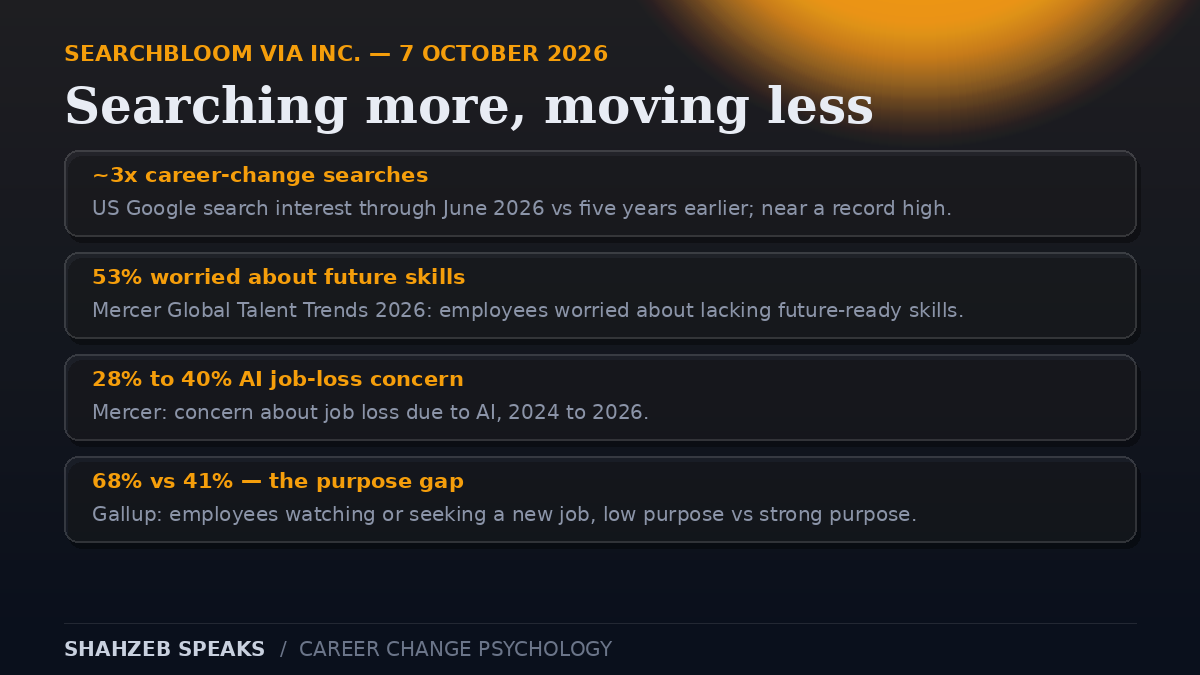
Two pressures sit behind the surge. The first is skill anxiety. Mercer’s Global Talent Trends 2026 report, as reported by Inc., found that 53% of employees worried about lacking future-ready skills, and concern about job loss due to AI rose from 28% in 2024 to 40% in 2026. The second is purpose. Gallup figures reported by Inc. show that 68% of employees with low work purpose were watching for or actively seeking another job, compared with 41% of employees with strong work purpose. Gallup’s March 2026 analysis added that pay or benefits was the leading reason for seeking another job, among both dissatisfied employees and those seeking better opportunities. Read together, the pattern is not a single cause. Some people are pushed by fear that their skills will not carry them; some are pulled by the absence of purpose; most are negotiating both at once.
That negotiation is visible in the staying data too. Monster’s Job Hugging Series, Volume 2, updated on 13 October 2026, found that 48% of workers are currently “job hugging” — staying mainly for security, comfort or stability rather than because the work engages them — while 87% have job hugged at least once. And SHL’s October 2026 survey of more than 2,000 employed adults in the US and UK, reported by HR Dive, found that two-thirds of workers feel they will have to leave their current employer to advance their career, despite wanting to stay. SHL sells talent assessment, so its figures should be read with that commercial interest in mind. Even allowing for that, the two surveys agree: a large share of the workforce wants a next step it cannot see inside its own organisation, and stays anyway. The next chapter explains why.
🪤 Chapter 3: The four traps — why a bad fit feels like a safe choice
These four traps are not character flaws. They are normal decision-making machinery, and they operate whether or not you notice them. Naming them is the first defence, because an unnamed trap feels like a fact about the world (“there is nothing better out there”) while a named trap feels like what it is: a bias to check.
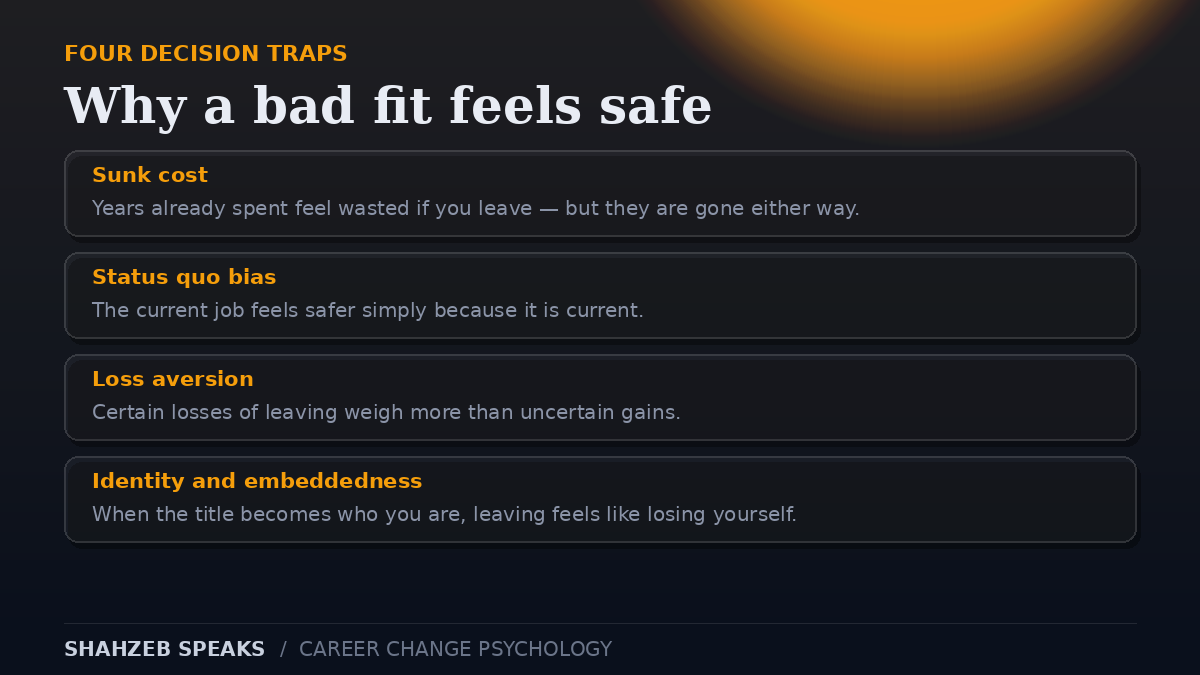
| Trap | What it sounds like | The test question |
|---|---|---|
| Sunk cost | “I have spent eight years here; leaving wastes all of it.” | Would you choose this job today, from scratch, knowing what you know now? |
| Status quo bias | “Better the devil you know.” | Is the current job actually safer, or just more familiar? |
| Loss aversion | “I would lose the title, the team, the routine.” | What would you gain that you are not pricing in? |
| Identity and embeddedness | “I am a banker / teacher / engineer. What else would I be?” | Which parts of that identity are skills, and which are just the label? |
Sunk cost is the most expensive trap because it feels like loyalty. The years you spent are gone either way; they are not refunded by staying, and they are not lost by leaving, because the skills, contacts and judgement you built travel with you. I have written separately about the sunk cost fallacy and why it keeps people paying for things they should quit. The test is simple and brutal: if you would not choose this job today from a blank slate, the past is not a reason to stay. It is a reason you already paid, and paying more does not change that.
Status quo bias, described by Samuelson and Zeckhauser in 1988, is the tendency to stick with the current state of affairs simply because it is current. The current job gets a free advantage in every comparison: its flaws are known and therefore discounted, while any alternative’s flaws are unknown and therefore exaggerated. The test is to compare like with like. Write down the real risks of staying for three more years — stalled skills, the same frustration, the next reorganisation — next to the risks of moving. Familiarity is not safety; it is only familiarity.
Loss aversion, from Kahneman and Tversky’s prospect theory (1979), is the finding that losses weigh more heavily than equivalent gains. Leaving means certain, immediate losses: a known salary, a known team, a known commute, a title people recognise. The gains — better work, growth, energy — are uncertain and future. So the scales tip towards staying even when the expected value of moving is higher. The correction is to price the gains properly: what is a year of your working life worth if the work itself drains you? That is not a sentimental question. It is the other side of the ledger, and loss aversion hides it.
Identity and embeddedness is the deepest trap, and the one most advice ignores. Mitchell and colleagues’ job embeddedness framework (2001) describes how links to colleagues, fit with the role, and the sacrifices leaving would require bind people to a job beyond satisfaction. When the job title has become part of how you introduce yourself, changing careers feels like changing who you are. That is why the next chapter matters so much: identity is not discovered by thinking harder. It is discovered by trying things on.
🎭 Chapter 4: Possible selves — Ibarra’s answer to “but I don’t know what I want”
The most common reason people give for not changing careers is that they do not know what they want instead. Herminia Ibarra’s research suggests that is the wrong starting point. In her Harvard Business Review article “How to Stay Stuck in the Wrong Career” (December 2002) and her book Working Identity (2003), Ibarra studied professionals in transition through in-depth interviews and found that the people who reinvented their careers did not first work out exactly what they wanted and then act. They learned what they wanted by experimenting: trying out new activities, building new relationships, and making sense of what they discovered. The clarity came after the action, not before it.
The idea behind this comes from Hazel Markus and Paula Nurius, who introduced “possible selves” in American Psychologist in 1986: the versions of ourselves we imagine we might become, hope to become, or fear becoming. Possible selves motivate what we do in the present. Ibarra’s contribution was to show that in career change, possible selves are not chosen by introspection alone. They are tried on. A person does not decide to become a writer and then write; they write something small, notice whether it gives them energy, and adjust. The experiment teaches what the daydream cannot.
Two cautions keep this honest. First, Ibarra’s work is qualitative interview research. It describes how successful career changers made their shifts; it does not prove that any single method will work for everyone, and I have not attached any success rate or participant count to it here because none was verified for this guide. Second, experiments need to be real but small. A weekend project, a freelance assignment, a volunteer role, a short course with actual coursework — these are experiments. Reading about a field for six months is not. The difference is contact with reality: other people, real feedback, and the feeling of doing the work rather than imagining it.
⚖️ Chapter 5: When staying is the right call — the honest counterweight
Not every urge to leave should be obeyed, and a guide that only argues for change would be dishonest. Sometimes the job is not the problem. Sometimes the market is bad, the timing is wrong, or the dissatisfaction comes from something a move will not fix — a difficult manager who exists in every organisation, a workload problem that follows the profession, or a personal season that makes everything feel grey. Gallup’s May 2025 study of 717 voluntary leavers found that 42% said their manager or organisation could have done something to prevent them from leaving. That cuts both ways: it means many departures are preventable, and it means a conversation inside your current organisation is sometimes the right move before any external one. My guide on exit interviews and stay interviews covers how to have that conversation while it can still change something.
There is also a distinction worth making: changing employer is not the same as changing career. SHL’s finding that two-thirds of workers feel they must leave to advance does not mean two-thirds need a new profession. Many need a new employer, a new team, or a new role in the same field. And Monster’s job-hugging data — 48% currently staying mainly for security — includes people for whom staying is rational: a mortgage, a visa, a sick parent, a child in school. Security is a legitimate reason to stay, as long as it is chosen rather than drifted into. The question is not “are you staying?” It is “would you still stay if you had a real alternative, and have you tested whether one exists?”
Finally, there is the fairness test. My guide on organisational justice covers why fair process matters as much as fair outcomes: when decisions feel unfair, voice dries up and exit starts to look like the only option. If your urge to leave is really an urge to be treated fairly, a move may help — or it may carry the same wound into a new building. Sorting out which problem you actually have is the work of Chapter 6.
🔬 Chapter 6: The experiment method — three strategies that replace the leap
Ibarra’s work points to three strategies, and they work best together. First, experiment with new professional activities: take on a project outside your current role, do a short freelance piece, shadow someone in the field you are curious about, teach a topic you want to learn. Second, build new networks: talk to people doing the work you imagine doing, not just people doing your current work. New contacts do more than open doors; they give you a reference group that makes the possible self feel normal instead of reckless. Third, make sense of what happens: after each experiment, write down what gave you energy, what drained you, and what surprised you. Reflection without experiments is daydreaming; experiments without reflection are just busyness.
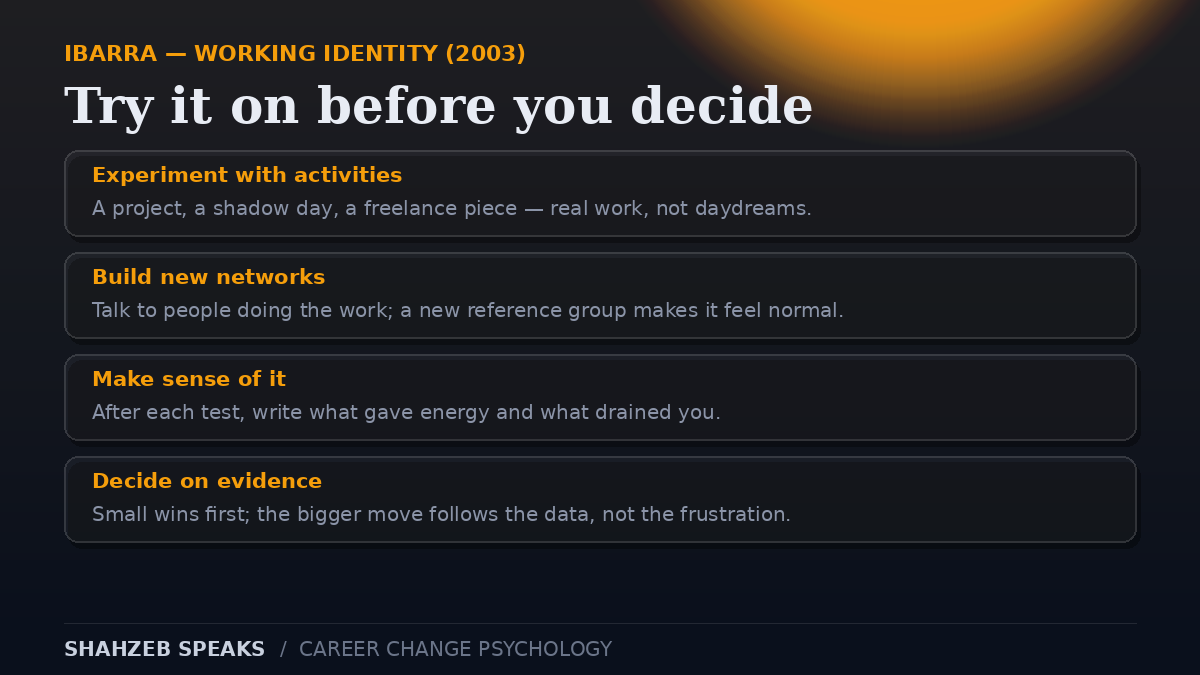
Two design rules make experiments work. The first is small wins: each experiment should be completable in weeks, not months, so that momentum survives contact with a busy life. A person who finishes a small project learns something; a person who starts a two-year qualification and stalls learns only guilt. The second is separation from the current identity: experiments work best when they are not announced as “my new career” to everyone you know. Trying something on quietly protects it from other people’s opinions while it is still fragile, and protects you from having to defend a decision you have not yet made. When an experiment repeatedly produces energy and a second one confirms it, you have evidence. When experiments repeatedly drain you, that is evidence too — and it is cheaper than a resignation.
What about money? Experiments do not remove the financial question; they make it answerable. After three or four small experiments you can estimate what the new field actually pays at entry level, how long the transition takes, and what you would need saved before moving. That turns “I cannot afford to change” from a fog into a number. Sometimes the number confirms you cannot move yet, and then the plan becomes saving and sequencing rather than leaping. That is still progress. A dated, costed plan beats a permanent daydream.
⚠️ Chapter 7: Honest limits — what this guide cannot do
First, the survey data here describe populations, not you. That 53% worried about future-ready skills, or the 68% with low purpose who are looking, tells you about the climate you are deciding in. It tells you nothing about whether your specific move will succeed. Second, Ibarra’s research describes people who changed careers successfully; it says less about those who tried and returned, or those for whom experiments confirmed that staying was right. Survivorship is built into any story of reinvention, and this guide does not correct for it. Third, experiments have their own costs: time, energy, and sometimes money, all spent while holding down the job you already have. If you are exhausted, the first step may be rest and recovery, not another project. My guide on workplace burnout is the honest starting point there, and burnout is a health matter, not a career-planning puzzle.
Fourth, nothing here is financial or legal advice, and nothing here advises any individual to stay in or leave a specific job. Where a move touches visas, pensions, contracts, or regulated professions, a qualified adviser in your jurisdiction is the right next step. What psychology can do is narrower and still valuable: it can show you which of your reasons are traps, which are real constraints, and how to gather evidence before you decide.
✅ Chapter 8: The action plan — a 90-day experiment, not a leap
1. This week: run the four trap tests. Answer the Chapter 3 test questions in writing. Cross out every reason for staying that fails its test. What remains is your real constraint list — money, timing, family — and that list is your actual plan.
2. This week: name two possible selves. Not ten. Two versions of your working life that you are curious about, specific enough to test: a role, a field, a way of working. Vague selves (“something creative”) cannot be experimented with.
3. This month: run one small experiment per possible self. A project, a shadow day, a freelance piece, a short course with real coursework. Finish both within a month, and write down what gave you energy and what drained you.
4. This month: talk to three people doing the work. Not influencers, not gurus — practitioners. Ask what their week actually looks like, what they dislike, and what they wish they had known before entering. Their answers are your cheapest data.
5. At 60 days: decide what the evidence says. If both experiments drained you, the problem may be the season, not the career — rest, then re-test. If one produced energy, design a bigger experiment around it. If the constraint list blocks you, cost it: how much, by when, and what would have to change.
6. At 90 days: choose deliberately. Stay with a plan, move employer within the same field, or begin a staged career change with a dated, costed sequence. Any of the three counts as success if it was chosen on evidence rather than drifted into by fear.
If you run only one change from this guide, run the trap tests. They cost an evening and they change the question from “should I leave?” — which fear answers — to “what exactly is keeping me here?” — which evidence can answer. And if you are the manager reading this rather than the employee, remember the other side of the same data: when two-thirds of your people believe advancement requires leaving, the retention problem is not their ambition. It is your internal ladder.
❓ Questions I am asked most often
What is career change psychology?
It is the study of why people stay in jobs they want to leave and what helps them move. It draws on decision research — sunk cost, status quo bias, loss aversion — and on identity research about how our work becomes part of who we are.
Why do I stay in a job I do not enjoy?
Usually a mix of four traps: sunk cost (years already invested), status quo bias (the familiar feels safer), loss aversion (certain losses outweigh uncertain gains), and identity (the job title feels like who you are). Monster’s 2026 data found 48% of workers currently job hugging, staying mainly for security.
How do I know what career to change to?
You probably cannot know in advance, and that is normal. Ibarra’s research found that successful career changers learned what they wanted by experimenting — small projects, new networks, real feedback — rather than deciding first. Name two possible selves and test both before choosing.
Is it too late to change careers?
No evidence in this guide supports an age deadline, and Ibarra’s interviewees were mid-career professionals, not new graduates. What changes with age is the constraint list — money, family, health — not the method. Cost the constraints honestly instead of treating them as a verdict.
Should I quit my job to figure out what I want?
Usually no. Quitting first removes the income that funds experiments and replaces a decision problem with a financial emergency. Test possible selves alongside your current job, and move when the evidence — not the frustration — supports it. Keep the income, run the experiments, and let the evidence set the date.
What if my experiments show I should stay?
Then staying is a result, not a failure. Experiments that drain you are evidence too, and a deliberate decision to stay — with a plan for what changes inside the current job — is very different from drifting. Revisit the question when your constraints change.
📬 Staying, leaving, or still deciding?
If the trap tests left you with a real constraint list rather than a clear answer, that list is the work. Contact me and tell me which trap is doing the most holding in your case — sunk cost, status quo, loss, or identity.
For the broader field behind this guide, see my homepage on industrial psychology in Pakistan, and for why fair process matters when you raise the conversation at work, read organisational justice at work.
Sources
- Searchbloom analysis, as reported by Inc. (2026). Career Change Search Interest Reached a Record High. 7 October 2026.
- Mercer (2026). Global Talent Trends 2026 (figures as reported by Inc., 7 October 2026).
- Gallup (2026). Work purpose and job search figures; March 2026 analysis of reasons for seeking another job (as reported by Inc., 7 October 2026).
- Monster (2026). Job Hugging Series, Volume 2 — Job Hugging Statistics 2026. Updated 13 October 2026.
- SHL (2026). Internal mobility survey of 2,000+ US and UK employed adults, as reported by HR Dive, 20 October 2026.
- Gallup (2025). 42% of Employee Turnover Is Preventable but Often Ignored. Based on a nationally representative study of 717 voluntary leavers, May 2025.
- Ibarra, H. (2002). How to Stay Stuck in the Wrong Career. Harvard Business Review, December 2002.
- Ibarra, H. (2003). Working Identity: Unconventional Strategies for Reinventing Your Career. Harvard Business School Press.
- Markus, H. & Nurius, P. (1986). Possible Selves. American Psychologist.
- Samuelson, W. & Zeckhauser, R. (1988). Status Quo Bias in Decision Making. Journal of Risk and Uncertainty.
- Kahneman, D. & Tversky, A. (1979). Prospect Theory: An Analysis of Decision under Risk. Econometrica.
- Mitchell, T. R., Holtom, B. C., Lee, T. W., Sablynski, C. J. & Erez, M. (2001). Why People Stay: Using Job Embeddedness to Predict Voluntary Turnover. Academy of Management Journal.