

Most organisations ask their best question about retention on the worst possible day: the day someone has already decided to leave. The exit interview arrives when the decision is made, the new job is signed, and politeness is the safest answer. The stay interview asks the same question months earlier, while something can still change. Exit interviews and stay interviews are not two versions of the same meeting. One collects a verdict. The other creates a chance to act — and only the second one can keep anyone.
I am an Industrial and Organizational Psychologist in Karachi, and I write about what actually happens inside workplaces, not what the policy document promises. This guide uses four October 2026 surveys, Gallup’s work on preventable turnover, and a 1970 framework that still explains the whole problem, to answer a plain question: what should you ask, when should you ask it, and what must happen afterwards for either conversation to be worth having?
“An exit interview records a decision. A stay interview can still change one — but only if something changes after it.” — Workplace Psychology Analysis, ShahzebSpeaks
⚡ Chapter 1: The short answer — exit interviews and stay interviews in one paragraph
Exit interviews and stay interviews serve opposite purposes, and confusing them is the most common mistake in retention. An exit interview is a structured conversation with a departing employee, held near the end of employment, to learn why they are leaving and what the organisation should change for those who remain. A stay interview is a structured, one-to-one conversation with a current employee, held while they are still employed and not actively leaving, to learn what keeps them, what frustrates them, and what would make them stay longer. The exit interview is retrospective and, by definition, too late for the person in the room. The stay interview is prospective: it only earns its name if the manager follows up with visible action. Run both, but never expect the first to do the second’s job.
That distinction runs through everything that follows. The October 2026 surveys show a workforce staying without engaging, leaving for growth it cannot find inside, and telling researchers afterwards that something could have prevented the departure. Exit data alone misleads: people answer differently once they no longer need a reference, and differently again when asked months later. So the honest design is a pair of conversations: stay interviews that surface problems early, exit interviews checked against other evidence, and a follow-up that tests whether either conversation changed anything.
📊 Chapter 2: The October 2026 picture — staying is not the same as engaging
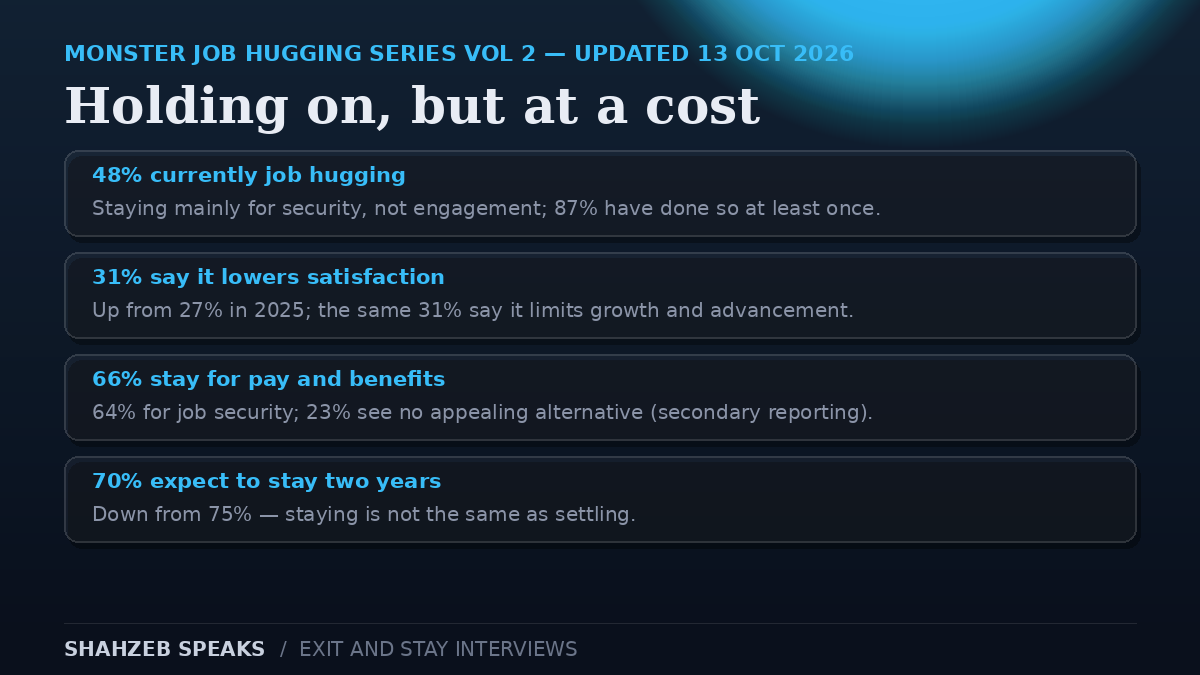
Start with the number that should unsettle any retention dashboard. Monster’s Job Hugging Series, Volume 2, updated on 13 October 2026, found that 48% of workers are currently “job hugging” — staying mainly for security, comfort or stability rather than because the work engages them — while 87% have job hugged at least once. Job hugging itself has barely moved since 2025. What has moved is how it feels: 31% now say it decreases their job satisfaction, up from 27% in 2025, and the same 31% say it limits growth and advancement, also up from 27%. Secondary reporting puts the survey at 1,005 employed US adults in mid-September 2026, and gives the reasons people stay as 66% for pay and benefits, 64% for job security, and 23% because they see no appealing alternative. Those are self-reports, not a census, but the pattern is consistent: people are holding on, and holding on is starting to cost them.
The Employee Benefit Research Institute’s 2026 Workplace Wellness Survey, released on 12 October 2026, tells the same story from a different angle. Among 1,238 US workers aged 21 to 64, surveyed online between 24 June and 17 July 2026, 60% were extremely or very satisfied with their current job and 90% planned to stay with their current employer for the next two years. Yet 59% said they often or always do not care about their job, 55% fantasised about quitting, 52% said they perform below what they are capable of, and 50% said they do just enough to get by. Read those two sentences together and the lesson is plain: satisfaction scores and staying intentions do not measure engagement. A team can score well on satisfaction, show low turnover, and still be full of people who have quietly stopped caring. That is exactly the team a stay interview is designed to find — and exactly the team a turnover dashboard will call healthy until the day several people leave at once.
SHL’s October 2026 survey adds the missing reason. Across more than 2,000 employed adults in the US and UK, two-thirds said they feel they will have to leave their current employer to advance their career, despite wanting to stay. Only 42% said their managers fully understood their skills beyond their current role, and 59% of US workers said their employer favours outside candidates over internal development. SHL sells talent assessment, so its figures should be read with that commercial interest in mind. Even allowing for that, the finding lines up with Monster’s: many believe the next step in their career does not exist inside their own organisation. A stay interview that never asks about growth and skills will miss the largest reason people eventually walk out.
🔍 Chapter 3: Why exit interviews mislead — and why that does not make them useless
An exit interview has three built-in biases, and any design that ignores them will produce confident, wrong conclusions. First, reference-seeking: a departing employee who may need a reference, a future return, or a clean handover has every reason to soften criticism, especially of the manager who will be asked about them later. Second, politeness and fatigue: by the final week, most people want a graceful exit, not a confrontation, so the harshest truths are the ones least likely to be spoken. Third, timing: the person is describing a decision shaped over months, but they are asked to summarise it in a single meeting, under time pressure, while their attention is already on the next job.
An Inc.com piece published on 22 October 2026 makes the practical consequence vivid. Its headline claim is that exit interviews often blame the wrong person, and its case shows how a single exit conversation pointed at one manager while the fuller picture, gathered afterwards, pointed elsewhere. The piece cites research by Feinberg and Jeppesen in retail environments, which found that what people mentioned in their exit interviews often did not match what they mentioned in follow-up surveys later. I have not opened the Feinberg and Jeppesen primary paper, so I report that finding as Inc. reports it, without a year, sample size or effect size. But the direction of the finding matches the three biases above, and it is the reason this guide insists on a 90-day follow-up survey in Chapter 6: the first answer is a draft, not a verdict.
None of this means exit interviews should be abandoned. It means they should be treated as one source among several. A single exit interview that blames a manager is a hypothesis. Five exit interviews from the same team naming the same pattern, plus colleague interviews that confirm it, plus a follow-up survey that repeats it after the reference pressure has passed — that is evidence. The failure is acting on one untested answer as if it were a finding, and filing the rest away unread.
💬 Chapter 4: The two conversations Gallup says matter — and the 52% versus 42% confusion
Gallup’s work on preventable turnover is quoted so often that two different figures are routinely merged into one, so let me separate them now. In Gallup’s earlier perspective on exit programmes, 52% of exiting employees said their manager or organisation could have done something to prevent them from leaving. In a newer Gallup study, a nationally representative sample of 717 people who voluntarily left an employer in the previous 12 months, measured in May 2025, the figure was 42%. Those are different samples, years and survey contexts. The honest reading is not that “the rate fell from 52% to 42%”. It is that in both pieces of work, roughly two in five to one in two voluntary leavers said something could have prevented their departure — and the remedy is the same in both: conversations before the resignation, not after it.
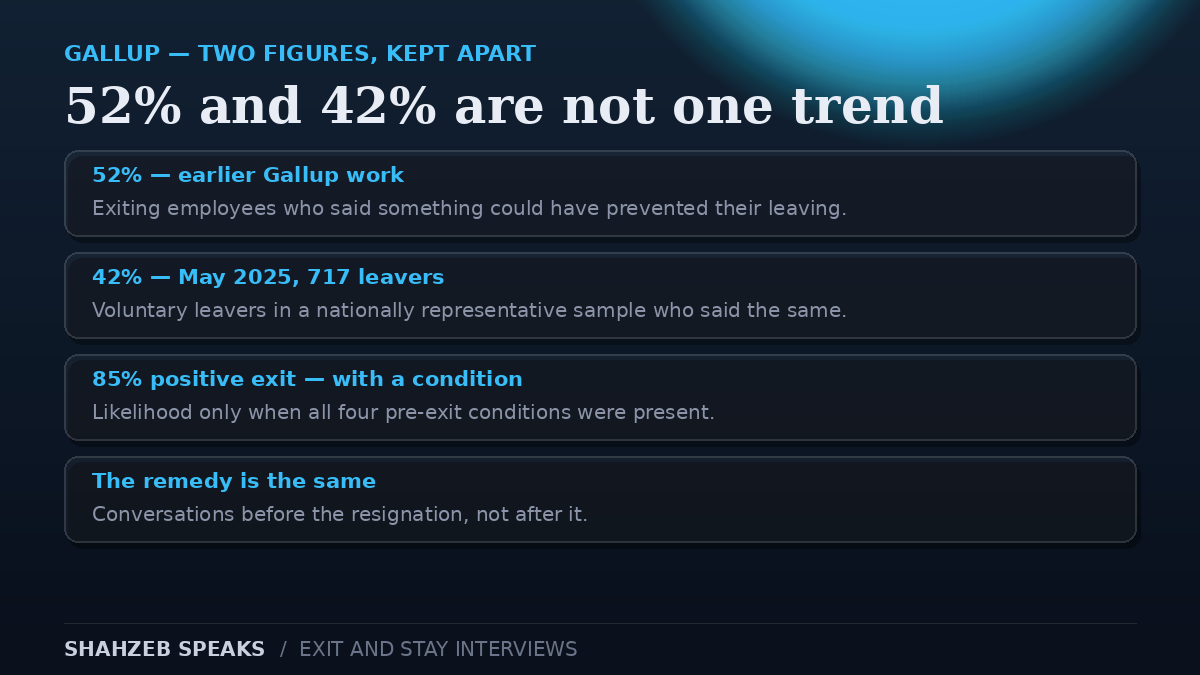
Gallup’s positive-exit finding is just as easy to misquote, so here it is in full, with its condition attached. Gallup reports an 85% likelihood of a positive exit experience when employees said they had all four of the following experiences with their previous organisation: a supervisor or leader talked with them in the three months before leaving about their job satisfaction, the future of their career with the organisation, and what it takes to be effective; they talked with someone about leaving before resigning; they felt there was nothing their manager could have done to prevent them from leaving; and they felt proud of their contributions. Notice what that list actually describes. Three of the four items are about conversations that happened before the exit, and the fourth is about pride in the work itself. A good exit, in Gallup’s data, is mostly made before the exit begins. That is the strongest argument in this whole guide for stay interviews: the conditions for a good ending are created during employment, not during the leaving process.
That is the standard a stay interview should be held to. It is not a therapy session, and it is not a performance review in disguise. It is a short, regular, structured conversation about the person’s work, future and needs, held often enough that problems surface while they are still small.
🌱 Chapter 5: The stay interview question set — what to ask, and what not to ask
A stay interview works when it is structured, private, and led by someone who can act on the answers. Ideally that is the direct manager, trained for the conversation and held accountable for follow-up. Where the manager is part of the problem, or where trust is low, a skip-level manager or a trained HR partner should lead instead — and the choice should be explained honestly, not hidden. The interview should take 30 to 45 minutes, happen at least twice a year for valued staff, and never be combined with a performance review, a pay discussion, or a disciplinary process. Mixing those purposes guarantees guarded answers.
| Ask this | What it reveals |
|---|---|
| What part of your work here do you look forward to most, and what part drains you? | Energy and fit — what to protect and what to redesign |
| What would make you consider leaving, if anything has crossed your mind? | Early warning, asked directly while action is still possible |
| Do you feel your skills are fully used here? What can you do that we have not yet used? | Hidden skills — the SHL gap, in the person’s own words |
| What does your next step look like, and do you believe it exists inside this organisation? | Growth expectations — the reason two-thirds say they must leave to advance |
| When did you last feel recognised for good work, and did it feel genuine? | Recognition quality, not just frequency |
| What one thing, if changed, would make the biggest difference to you staying? | A single, actionable priority — not a wish list |
| What do you need from me, specifically, that you are not currently getting? | Manager behaviour — the one lever the manager controls directly |
| Is there anything you have not raised because you doubted it would change? | Silence itself — the most valuable answer in the whole set |
Three rules protect the answers. First, never ask a question you are unwilling to act on or explain honestly if you cannot act. Asking about growth and then ignoring the answer is worse than never asking, because it teaches employees that speaking up changes nothing. Second, write down what was agreed, share the note with the employee, and set a date to revisit it. A stay interview without a written follow-up is a pleasant chat, not a retention tool. Third, never punish honesty. If an employee says they are considering leaving and the manager responds with coldness or reduced opportunities, every future stay interview in that team is finished. Aggregate themes — not named quotes — go to senior leadership.
What not to ask matters too. Do not ask employees to rank colleagues, report on each other’s performance, or disclose health details, personal finances or job-search activity. Do not ask leading questions that fish for praise (“You are happy here, aren’t you?”). And do not use the stay interview as a retention ambush — a surprise counter-offer, a guilt trip about loyalty, or a promise about promotion or pay the manager has no authority to keep. A panic counter-offer teaches employees that threatening to leave is the way to get a raise.
🔄 Chapter 6: Redesigning the exit interview — who asks, when, and what happens next
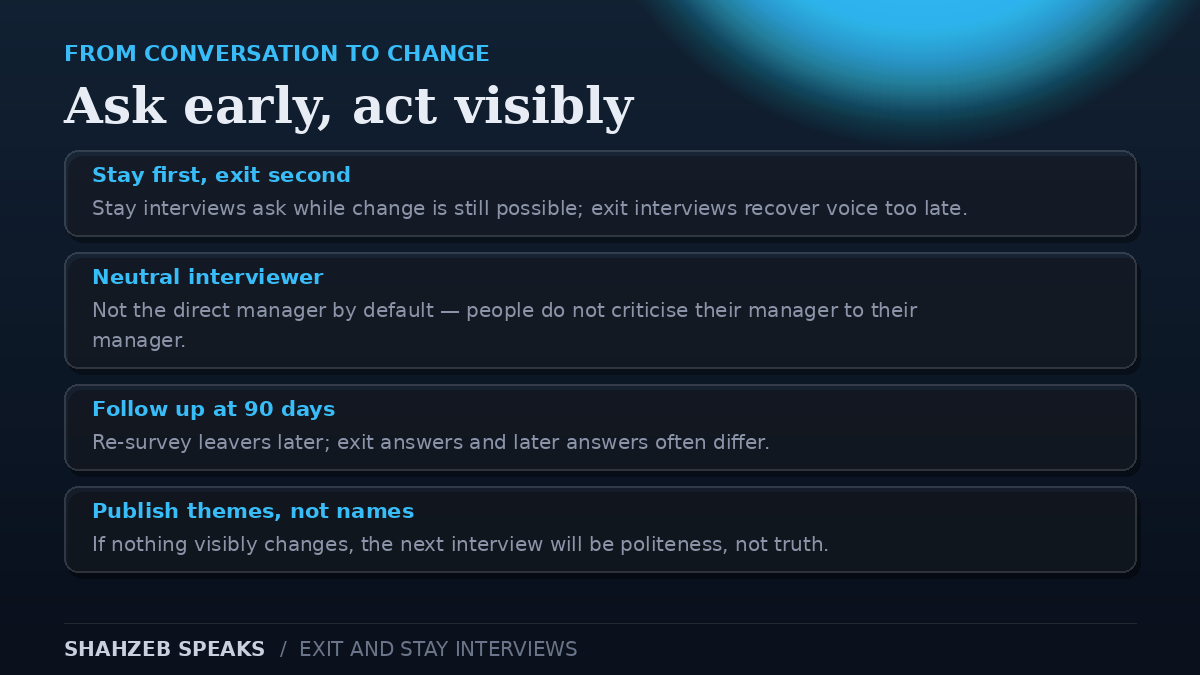
Here is the redesign, built from the Inc. piece’s method and Gallup’s findings rather than from habit. First, who asks: not the departing employee’s direct manager, except where the relationship is genuinely strong and the employee chooses that. The default interviewer should be a trained HR partner, a skip-level manager, or an external interviewer where affordable. The reason is plain: people do not criticise their manager to their manager. A neutral interviewer gets cleaner data, and the manager still receives the themes.
Second, when: two conversations, not one. The first happens in the final week, covers the handover, the employee’s own summary of reasons, and thanks for their contribution — and it is explicitly labelled as preliminary. The second is a short follow-up survey sent 90 days after departure, when the reference is secured, the new job has settled, and the person can say what they actually thought. The Feinberg and Jeppesen finding reported by Inc. is the justification: answers change over time, so a design that only captures the first answer will systematically mislead. The follow-up should repeat the core questions in the same wording, so changes can be compared, and it should be short enough that former employees actually complete it.
Third, anonymity and reporting: individual exit interviews should never be reported as named quotes to the manager concerned. Themes should be aggregated — by team, by quarter, by reason — and only reported when the group is large enough that no individual can be identified. In a small team, that may mean reporting quarterly rather than per departure. Fourth, splitting feedback by owner, exactly as the Inc. piece recommends: pay and benefits themes go to HR and reward; workload themes go to operations; manager-behaviour themes go to leadership development. Feedback filed under “manager” when it belongs to “pay policy” produces a coaching plan for a manager who cannot fix the problem, and a pay problem that never gets fixed.
| Stage | Who | What happens |
|---|---|---|
| Final-week interview | Neutral interviewer, not the direct manager | Handover, reasons in the employee’s own words, thanks — labelled preliminary |
| 90-day follow-up survey | Same core questions, sent after departure | Tests whether the first answers still hold once reference pressure has passed |
| Colleague triangulation | Interviewer speaks to team members | Checks whether the pattern is shared or specific to one person |
| Split by owner | HR sorts themes by who can fix them | Pay to reward, workload to operations, manager behaviour to development |
| Published action | Leadership reports back in aggregate | What changed, what could not change, and why — visible to current staff |
The final stage is the one most organisations skip, and it determines whether current employees will ever speak honestly. When exit themes lead to a change, current staff should hear about it in aggregate, without names. When themes lead to no change, that should be said too, with the reason. Silence teaches the remaining team that the exercise is theatre. Published action teaches them that speaking up had a point.
🧭 Chapter 7: A 1970 framework that still explains all of this
Albert O. Hirschman published Exit, Voice, and Loyalty in 1970, and its argument maps onto this whole guide with uncomfortable precision. When members of an organisation face decline in quality or benefit, Hirschman argued, they have essentially two responses: exit, withdrawing from the relationship, or voice, attempting to repair or improve it through communication. Loyalty is what delays exit and gives voice time to work. Voice, he noted, is often more difficult, stressful and costly than exit — and exit sends a crude, sometimes uninterpretable signal about why someone left. That last point is the theoretical version of the Inc. finding: a resignation tells you someone left, not why, and certainly not what to fix.
Read through Hirschman, a stay interview is an organised form of voice, and an exit interview is an attempt to recover voice after exit has already been chosen. That is why the stay interview must come first: voice only works while the person is still present to use it, and loyalty only buys time if the organisation uses that time. Later expansions add a fourth response, neglect — reducing effort, attention to quality and attendance — which is the EBRI picture in a single word: 59% not caring, 55% fantasising about quitting, 50% doing just enough to get by. Neglect is what happens when both exit and voice feel closed. A workforce full of neglect is the most expensive outcome of all, because it looks like retention on every dashboard while producing less and less.
The framework also explains why stay interviews fail when nothing changes afterwards, the subject of the next chapter. Voice that is invited and then ignored is not neutral: it teaches employees that voice is pointless, pushing them towards exit or neglect. An organisation that runs stay interviews without acting on them is actively training its people not to speak again.
⚠️ Chapter 8: Honest limits — what these conversations cannot do
First, exit data are biased, and no redesign removes the bias entirely. Reference-seeking, politeness and timing distort the final-week interview, and even the 90-day follow-up has its own distortions: memory fades, the new job colours the old one, and former employees who had the worst experiences are the least likely to reply at all. The redesign in Chapter 6 reduces the bias. It does not eliminate it, and any report that presents exit themes as precise measurements is overstating what the method can deliver.
Second, stay interviews fail when nothing changes afterwards, in a specific, predictable way. The first usually produces honest answers, because employees hope this time will be different. If the agreed actions do not happen, and no explanation is given, the second produces polite generalities. By the third, employees have learned the lesson, and the manager concludes — wrongly — that there are no problems left. The failure looks like success: a quiet team, no complaints, low turnover. It is actually silence. The test of a stay-interview programme is not how many interviews were held, but how many agreed actions were completed.
Third, neither conversation fixes structural problems on its own. If pay is below market, if promotion genuinely requires leaving, if a manager is abusive, or if workloads are unmanageable, no interview technique will compensate. Interviews diagnose and prioritise; they do not replace fair pay, internal career paths, competent management, or reasonable workloads. My guide on organisational justice covers the fairness side of the same problem: when decisions feel unfair, voice dries up regardless of how well the interview is run. Nothing here advises any individual to stay in, or leave, a specific job, and nothing here is legal advice. Where health, discrimination or retaliation is involved, a qualified professional — not a blog article — is the right next step.
✅ Chapter 9: The action plan — a 12-month rhythm that actually closes the loop
1. This month: separate the two conversations. Give stay interviews and exit interviews different owners, different question sets, and different reporting lines. Stop using the exit form as a retention tool.
2. This quarter: train interviewers and run the first stay-interview round. Train managers in the Chapter 5 question set, the confidentiality rule, and the written follow-up. Run stay interviews for valued staff first, not for everyone at once, so follow-up stays manageable.
3. Every quarter: publish aggregate exit themes and the actions taken. Report themes by owner — pay, workload, manager behaviour — with the action attached to each. Delay small-team reporting until the group is large enough to protect anonymity.
4. At 90 days after every departure: send the follow-up survey. Repeat the core questions in the same wording. Compare the two answers, and treat a mismatch as information, not as proof that either answer was dishonest.
5. Twice a year: review what stay interviews actually changed. Count agreed actions completed, not interviews held. Ask employees directly whether the last interview changed something real, and report that answer to senior leadership.
6. Annually: test the whole system against the numbers that matter. Voluntary turnover of valued staff, internal mobility rates, and the gap between satisfaction and engagement in your own survey — not just the headline retention rate. If retention is high and engagement is low, you have a job-hugging problem, not a retention success.
If you run only one change from this guide, run the stay interview — and then complete the first action it produces, visibly, within a month. That single completed action will do more for your next round of interviews than any training course, because it proves the conversation was real. And if you are the employee rather than the manager, you now know exactly which questions to ask for yourself.
❓ Questions I am asked most often
What is the difference between an exit interview and a stay interview?
An exit interview is held with a departing employee near the end of employment to learn why they are leaving. A stay interview is held with a current employee, while they are still employed, to learn what keeps them and what would make them stay longer. The first records a decision; the second can still change one.
Why do so many people stay in jobs they do not enjoy?
Monster’s 2026 Job Hugging Series found 48% of workers currently job hugging, staying mainly for security rather than engagement. Secondary reporting gives the reasons as pay and benefits, job security, and a lack of appealing alternatives. Staying often reflects caution about the job market, not satisfaction with the work.
Can exit interviews really be trusted?
Only partly. Departing employees may soften criticism to protect references, and research reported by Inc. found exit answers differed from later follow-up surveys. Treat one exit interview as a hypothesis, combine it with colleague evidence and a follow-up survey after departure, and report themes in aggregate rather than as named quotes.
Why do Gallup’s 52% and 42% figures differ?
They come from different Gallup work in different years. The 52% figure comes from Gallup’s earlier exit-programme perspective, while 42% comes from a May 2025 study of 717 voluntary leavers. Both point the same way — a large share of voluntary leaving was seen as preventable — but they must never be merged into a single trend.
What makes a good exit experience, according to Gallup?
Gallup reports an 85% likelihood of a positive exit experience when employees had all four experiences: a supervisor talked with them about satisfaction, career future and effectiveness in the three months before leaving, they discussed leaving before resigning, they felt nothing could have prevented it, and they felt proud of their contributions.
What questions should a stay interview ask?
Ask what energises and drains the person, what would make them consider leaving, whether their skills are fully used, what their next step looks like inside the organisation, and what one change would matter most. Always agree a written follow-up action with a date, and never use the interview as a performance review or pay negotiation.
What if stay interviews change nothing?
Then they will stop working, predictably. Employees who speak up and see no action learn that voice is pointless, and later interviews produce polite generalities instead of honest answers. The test of a stay-interview programme is completed actions, not interviews held — and silence after an interview is worse than never asking.
📬 Are your best people staying — or just staying put?
If your retention rate looks healthy but engagement does not, the gap is the story. Contact me and tell me which conversation your organisation is missing: the one before people leave, or the one after.
For the broader field behind this guide, see my homepage on industrial psychology in Pakistan, and for why fair process matters when decisions go wrong, read organisational justice at work.
Sources
- Monster (2026). Job Hugging Series, Volume 2 — Job Hugging Statistics 2026. Updated 13 October 2026.
- Employee Benefit Research Institute & Greenwald Research (2026). 2026 Workplace Wellness Survey. Press release, 12 October 2026.
- Gallup (2025). 42% of Employee Turnover Is Preventable but Often Ignored. Based on a nationally representative study of 717 voluntary leavers, May 2025.
- Gallup. Gallup’s Perspective on Exit Programs That Retain Stars and Build Brand Ambassadors (earlier perspective; 52% figure and 85% positive-exit finding).
- Gallup. 3 Ways to Create a Positive Exit Experience for Your Employees (85% likelihood finding).
- Eckfeldt, B. / Inc.com (2026). Exit Interviews Often Blame the Wrong Person. This 5-Step Process Finds the Real Problem. 22 October 2026.
- SHL (2026). Internal mobility survey of 2,000+ US and UK employed adults, as reported by HR Dive, 20 October 2026.
- Hirschman, A. O. (1970). Exit, Voice, and Loyalty: Responses to Decline in Firms, Organizations, and States. Harvard University Press.