

A manager tells me her team is “a bit toxic”. When I ask what she means, she lists five different things: a rude email, a shouting supervisor, a colleague frozen out of meetings, a workload nobody can finish, and a complaint that went nowhere. Those are five different problems, with different evidence and different fixes — and calling all of them “toxic” hides every one of them. Toxic workplace signs are real, but they are only useful when you name the exact behaviour, because researchers measure incivility, abusive supervision and bullying as three different things.
I am an Industrial and Organizational Psychologist in Karachi, and I write about what actually happens inside workplaces, not what the poster on the wall promises. This guide separates the three constructs researchers actually measure, sets out what a major 2026 study of 8,478 workers found — and where its limits are — and finishes with what has actually been shown to help.
“‘Toxic’ is a verdict. Incivility, abusive supervision and bullying are measurements — and measurements can be fixed.” — Workplace Psychology Analysis, ShahzebSpeaks
⚡ Chapter 1: The short answer — toxic workplace signs in one paragraph
Toxic workplace signs fall into three measurable patterns. Workplace incivility is low-intensity rudeness with ambiguous intent: being ignored, interrupted, spoken to dismissively. Abusive supervision is a supervisor’s sustained hostile behaviour as perceived by subordinates: ridicule, public put-downs, broken promises, blame-shifting. Workplace bullying is repeated, systematic negative acts over months, combined with a power imbalance that leaves the target unable to defend themselves. “Toxic workplace” itself is not a single validated construct in this literature. It is an umbrella label that surveys use with their own definitions. So the first step in any real case is not to ask “is this toxic?” but to ask which of the three patterns is happening, how often, and who holds the power.
That distinction matters because the numbers change completely depending on which pattern you count. One study finds 71% of employees experiencing some incivility over five years. Another estimates about 10% experiencing abusive supervision. A Norwegian study finds 8.6% bullied in six months. None of those numbers is wrong. They are counting different things, over different periods, in different samples. Anyone who quotes a single “toxic workplace rate” without saying which definition they used is selling certainty the research does not offer.
📊 Chapter 2: The October 2026 headline — “leaders didn’t know” does not survive the data
The Toxic Workplace Report 2026, released on 8 October 2026 by Corporate Criminologist Jennifer Brick of Capdeca Solutions, surveyed 8,478 workers through online assessments, including 543 voluntary first-person accounts. Its headline finding is blunt: only 4% of workers in toxic workplaces said leadership was unaware of what was happening. A further 67% said leaders knew and either did nothing (27.4%) or participated directly (39.2%). Brick’s own summary line, quoted in the release, is that “toxic work culture is created and enabled at the top” — her framing as the study’s author, not an independent finding.
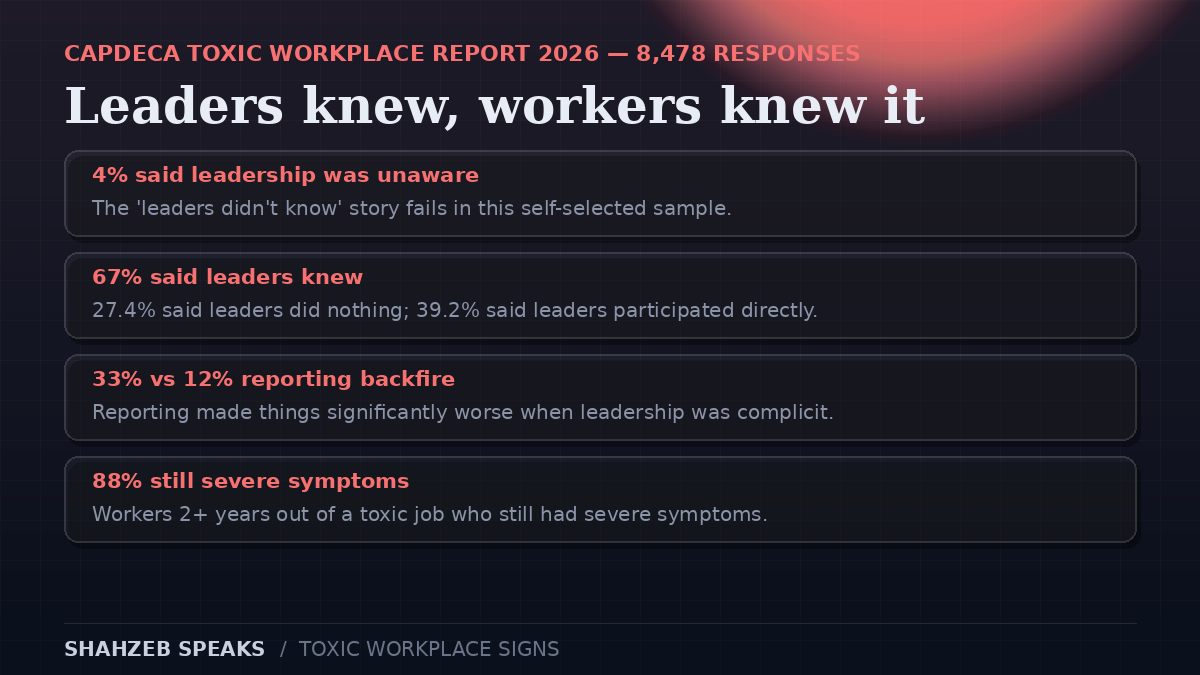
Before you repeat those numbers, note the caveat that belongs with them. The sample was self-selected participants in online assessments, not a nationally representative probability sample. Capdeca is Brick’s own company, so this is a company-issued study, not independent peer-reviewed research. Its percentages describe the people who chose to take part — people with experiences they wanted to report — and they cannot be generalised to “all workers”. That does not make the findings worthless. It makes them a loud signal from a particular group, and a signal worth investigating, not a census.
Two further findings deserve attention precisely because they challenge comfortable stories. First, reporting did not reliably help: when workers said leadership was complicit, reporting was nearly three times as likely to make things significantly worse (33%) as when leadership was not complicit (12%). A summary of the report published by Fair Play Talks adds that only 1 in 10 workers who formally reported toxic behaviour said the issue was handled appropriately, that 32.5% considered reporting but did not feel safe enough, and that 44% never formally reported at all. Second, the two strongest predictors of readiness to leave were not day-to-day treatment. They were how workers felt imagining themselves in the job a year from now, and how they felt about their career trajectory. People leave a future, not just a bad week.
The same report’s after-effects finding is the one I would put in front of any board. Among workers two or more years out of a toxic job, 88% still had severe symptoms. Anxiety and distrust eased over time, but hypervigilance and fear of future toxic work experiences increased. The report calls this pattern “Post-Toxic Job Syndrome” — and it explicitly describes it as a descriptive framework, not a recognised clinical diagnosis. Do not let anyone quote it as a diagnosis. What it describes, in plain terms, is that leaving ends the exposure, not necessarily the damage.
🧩 Chapter 3: The three constructs researchers actually measure
Here are the definitions, in the researchers’ own terms, because loose language is how real cases get dismissed. Andersson and Pearson (1999) defined workplace incivility as “low-intensity deviant behavior with ambiguous intent to harm the target, in violation of workplace norms for mutual respect” — characteristically rude and discourteous behaviour showing a lack of regard for others. Their model treats incivility as an interactive spiral: people react to each other’s perceived incivility, and the exchange can escalate. Tepper (2000) defined abusive supervision as “subordinates’ perceptions of the extent to which supervisors engage in the sustained display of hostile verbal and nonverbal behaviors, excluding physical contact”. Note the three conditions: it is measured from the subordinate’s perception, it must be sustained rather than one-off, and it excludes physical contact. Einarsen and colleagues (2011) defined bullying at work as harassing, offending, socially excluding someone, or negatively affecting their work tasks, as a gradual process of repeated, systematic negative acts — typically weekly or daily — over a prolonged period such as six months, where the target perceives little recourse to defend themselves.
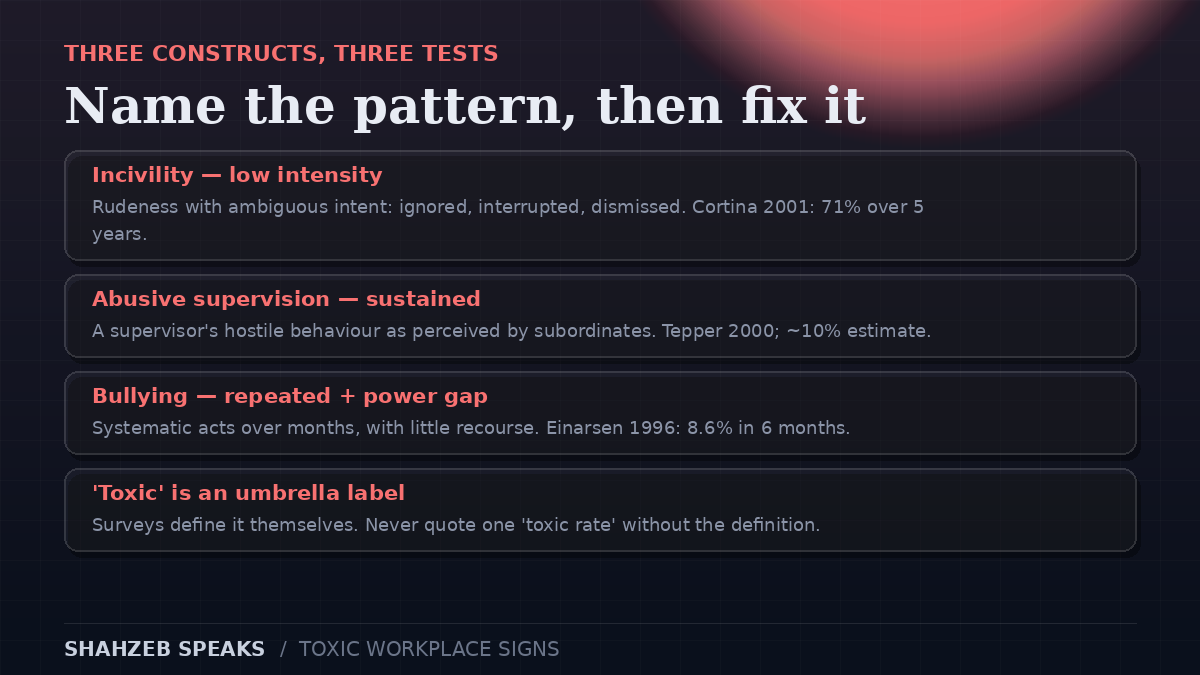
| Construct | Test | Example |
|---|---|---|
| Workplace incivility | Low intensity, ambiguous intent, breaks norms of mutual respect | Being ignored in a meeting, a dismissive tone, a greeting withheld |
| Abusive supervision | Sustained hostile behaviour by a supervisor, as perceived by the subordinate | Ridicule, public put-downs, blame-shifting, broken promises |
| Workplace bullying | Repeated, systematic acts over months + power imbalance + little recourse | Weekly exclusion, impossible deadlines set deliberately, sustained gossip |
Bullying itself splits into two kinds that need different responses. Work-related bullying includes unreasonable deadlines and unmanageable workloads imposed as a pattern. Person-related bullying includes insulting remarks, teasing, gossip and social isolation. A manager who sets one impossible deadline during a genuine crisis is not necessarily a bully. A manager who sets impossible deadlines for one person, week after week, while excluding them from the information they need, is describing a different pattern — and the six-month, repeated-acts test is what separates the two.
📈 Chapter 4: How common is it? Why the numbers disagree — and why that is honest
Cortina, Magley, Williams and Langhout (2001) surveyed 1,180 public-sector employees and found 71% reported some experience of workplace incivility in the previous five years. As many as one third of the most powerful individuals in the organisation had instigated uncivil acts. Women endured greater frequencies than men, but both genders experienced similarly negative effects on job satisfaction, job withdrawal and career salience. The same study found uncivil experiences associated with greater psychological distress, while indices of psychological and physical health were “relatively unaffected” — so do not cite Cortina 2001 as proof that rudeness damages physical health. It does not claim that.
Abusive supervision is rarer by definition, because it requires a sustained pattern from a supervisor. An estimate attributed to Tepper and colleagues (2017) puts it at approximately 10% of employees, via secondary summaries. Bullying, which requires repetition over months plus a power imbalance, is rarer still in strict studies: Einarsen and Skogstad (1996), across 14 Norwegian surveys of 7,986 employees, found 8.6% had been bullied at work during the previous six months, with superiors named as bullies as often as colleagues. Reviews note prevalence typically reported between 0.3% and 20% across continents depending on definition and setting. Never quote a single “global bullying rate”. The range is the finding.
Surveys that use the umbrella label “toxic” naturally produce bigger numbers, because they let respondents apply their own definition. The iHire Toxic Workplace Trends Report 2026, released 25 June 2026 and based on 1,220 US workers, found 68.9% had worked for an employer they considered toxic, down from 75.9% in 2025. Of those who experienced toxicity, 79.1% blamed unethical, unaccountable or unsupportive leadership, and 72.1% cited poor communication by leaders or managers. And 47.6% said they had quit a job because of a toxic environment. Those are self-reported, self-defined figures — useful for showing how many people carry the label, not for comparing with Cortina’s 71% or Einarsen’s 8.6%. Different questions, different answers.
Two meta-analytic points help managers take the supervisor pattern seriously. Hershcovis and Barling (2010) found mistreatment by a supervisor corresponded to a systematically stronger relationship with job dissatisfaction, psychological distress, job performance and turnover intentions than mistreatment by a co-worker or outsider. Mackey and colleagues (2017) found abusive supervision negatively associated with affective organisational commitment and job satisfaction, and positively linked to turnover intentions. In plain terms: who mistreats you matters, and a supervisor’s behaviour carries more weight than a colleague’s. That is why leadership behaviour is the first lever, not the last.
🚨 Chapter 5: Why speaking up can backfire — and what that means for reporting systems
The Capdeca finding that reporting made things significantly worse in 33% of complicit-leadership cases, against 12% otherwise, should change how organisations design reporting. A reporting channel that routes a complaint back to the person complained about, or to their ally, is not a safety mechanism. It is a risk. The Fair Play Talks summary adds that 57% of workers in toxic jobs said they had no safe network at work, nearly 1 in 5 described themselves as completely isolated, and only 17% had a genuinely trusted circle. Workers with someone to turn to for a reality check reported around 20% less self-doubt — an association in self-reported data, not proof that finding a confidant causes the reduction, but a reminder that isolation is part of the harm, not just a side effect.
The same logic shows up in a very different workforce. A Kahoot! survey of 2,000 US retail workers, reported in October 2026, found 45% had experienced verbal abuse or threatening behaviour from customers or members of the public at work, 47% had experienced burnout in their current role, and 53% felt reporting workplace issues was pointless because nothing would change. More than 4 in 10 were considering leaving within the next 12 months. When a majority believes reporting changes nothing, the reporting system has already failed, whatever its policy document says. The measure that matters is not whether a channel exists. It is what happens after someone uses it: whether complaints are investigated, how long investigations take, whether reporters experience retaliation, and whether the same leaders or teams generate repeated complaints. If an organisation does not track those four things, it does not have a reporting system. It has a form.
💔 Chapter 6: What it costs people — stated carefully
The health evidence is real and it is limited, and both halves matter. Kivimäki and colleagues (2003) followed 5,432 Finnish hospital employees and found prolonged bullying — reported in both surveys, about 2% of the sample — associated with incident depression with an odds ratio of 4.2 after adjustments, a significant result. For cardiovascular disease, the odds ratio was 2.3 after adjusting for sex, age and income, but it fell to 1.6 and was no longer statistically significant after further adjustment for overweight at baseline. A later multicohort European study found bullying and violence associated with higher cardiovascular risk in a dose-response pattern, while its authors explicitly said that from that study a causal relation could not be concluded. So the honest sentence is: bullying is strongly associated with depression and psychological distress, and associated with cardiovascular risk through pathways that are not yet established as causal. Anyone who writes “bullying causes heart disease” has gone beyond the evidence.
A meta-analysis by Verkuil and colleagues (2015) found workplace bullying associated with psychological distress, anxiety, depressive symptoms, emotional exhaustion, sleep disturbances, PTSD-related symptoms, and increased sickness absence, work disability and turnover, with longitudinal evidence that effects may persist. Secondary summaries of other studies report mistreated workers showing a 42% increase in expected days of absence, and bullied workers reporting more health problems and more frequent absence. These are associations in observational data, not controlled experiments — nobody can ethically randomise bullying — but the pattern across studies, countries and outcomes is consistent: the costs are health costs and absence costs, not just morale costs.
The organisational cost shows up in leaving and in reputation. The iHire survey found 47.6% had quit a job because of a toxic environment, 61.9% had told others about negative experiences, and 26.2% had advised candidates not to pursue a job at a toxic company. The Capdeca summary adds that 76% of workers said they cared less about their careers after a toxic job, 57% had previously experienced at least one other toxic job, and more than 1 in 4 were in their third or subsequent toxic workplace, with no evidence that repeated exposure made people more resilient. That last point kills the “what doesn’t kill you makes you stronger” version of this story. Repeated exposure, in this self-reported data, did not toughen people. It accumulated.
🌍 Chapter 7: October 2026 in context — this is not one company’s story
Three further October 2026 surveys describe strain beyond any single workplace, and they are worth reading together because they use different samples. Harvard Kennedy School’s The People Lab Public Servant Pulse, reported on 21 October 2026, surveyed nearly 5,000 US state and local government employees: 40% experienced at least one symptom of burnout, 35% reported being bullied, threatened, attacked or harassed during the previous year, and 27% intended to leave within the next 12 months — alongside 82% who were at least somewhat satisfied with their jobs. Satisfaction and strain coexist. That combination is normal, and it is why a single engagement score never tells the whole story.
The Aflac WorkForces Report 2026–2027, conducted by Kantar among 2,001 US employees online between 20 April and 29 May 2026 and released on 13 October 2026, found an all-time high of 75% of employees experiencing workplace stress, up from 72% in 2025, and 39% experiencing burnout in their current roles, of whom 83% reported at least moderate burnout. Aflac sells supplemental health insurance and has a commercial interest in benefits findings, so its figures should be read with that interest in mind — but the direction matches the other surveys. If you want the companion guide on fairness under strain, read my article on organisational justice, and for the recognition side of the same problem, my guide on employee recognition.
None of these surveys proves that workplaces suddenly became toxic in October 2026. Surveys cluster in October because reports are released in October. What they do show is a workforce in which burnout, harassment and leaving intentions are being measured at scale, in public, at the same time — and in which the old reassurance that “leaders just don’t know” is now contradicted by the largest recent dataset on the question. That is the news. Not that toxicity is new, but that ignorance is a weaker excuse than it was.
🛠️ Chapter 8: What has actually been shown to help
Start with the distinction the rest of this chapter depends on: tested interventions versus report recommendations. Only the first group has evidence that it changed anything. The second group may be wise, but it has not been tested as an intervention, and this article will not upgrade it.
The best-tested civility intervention in the literature is CREW — Civility, Respect, and Engagement at Work. Leiter, Laschinger, Day and Oore (2011) ran a six-month employee-based civility intervention with health-care workers across 41 units. Most measures improved significantly for the 8 intervention units compared with the 33 contrast units, including coworker civility, supervisor incivility, respect, cynicism, job satisfaction, management trust and absences — and improvements in civility mediated improvements in attitudes. A colleague-based civility programme studied by Gilin Oore and colleagues (2010) mitigated the negative relationship between work overload and mental health six months later in intervention compared with comparison hospital units. Both studies are in health care, so generalising to every industry needs care. But they are real interventions with comparison groups, which is more than most workplace advice can claim.
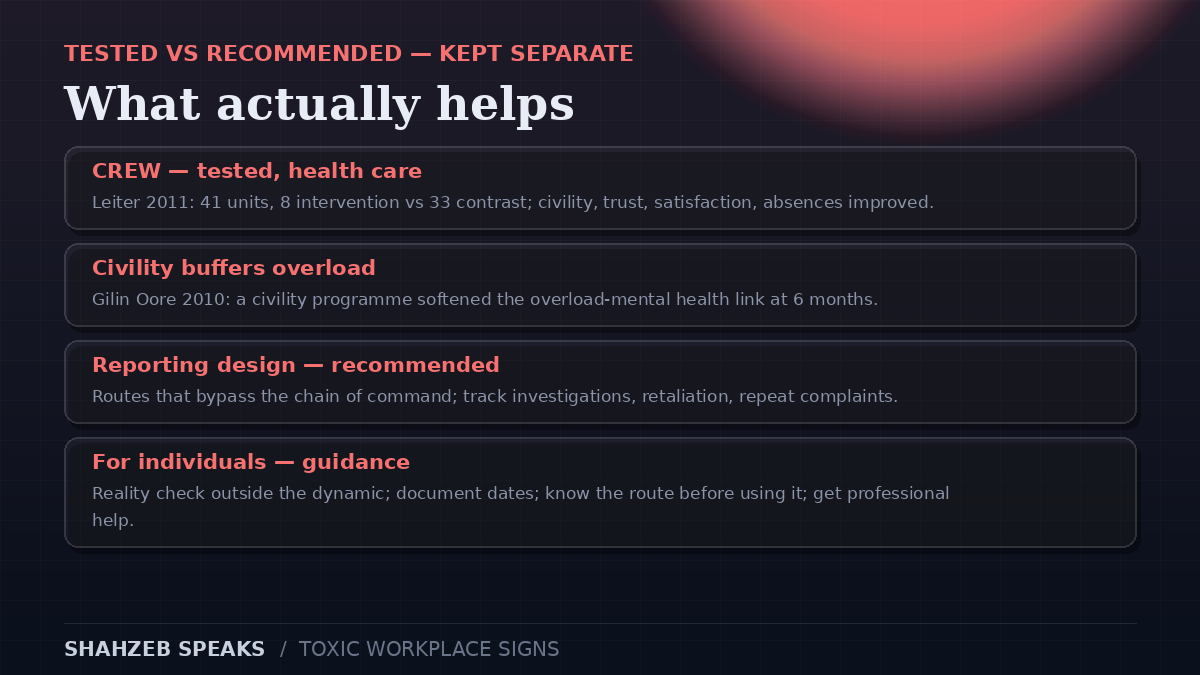
For reporting systems, the recommendations that follow from the Capdeca findings are design principles, not proven cures: create reporting routes that bypass the line of command where the immediate manager or leadership may be implicated, such as independent whistleblowing routes, an ombuds, or board-level escalation; track what happens after a report, including investigation time, retaliation checks, and repeat complaints about the same leaders; and publish, in aggregate, what the system did. A system that cannot say how many reports led to action, and how many reporters experienced retaliation, is asking for trust it has not earned.
For individuals, the guidance synthesised from the report is practical and limited: seek a trusted reality check outside the immediate dynamic; document incidents and patterns with dates, rather than relying on memory; understand the grievance and whistleblowing routes before using them, including whether the channel is independent of the people involved; and seek medical or mental-health support where health is affected, and independent professional advice where serious misconduct, discrimination or retaliation may be involved. This article gives no jurisdiction-specific legal advice, and nothing here establishes any individual’s legal rights. If health, discrimination or retaliation is involved, a qualified professional — not a blog article — is the right next step.
✅ Chapter 9: A reader’s checklist — before you call it toxic, check these
1. Name the pattern. Is it incivility (low intensity, ambiguous intent), abusive supervision (sustained, from a supervisor), or bullying (repeated over months, with a power imbalance)? The name decides the response.
2. Count frequency and duration. One rude email is not a pattern. Six months of exclusion is. Write dates down; memory softens patterns and sharpens single incidents.
3. Ask who holds the power. Can the target defend themselves or retaliate without risk? If not, the power-imbalance condition for bullying is met, and the case needs a route outside the normal chain.
4. Ask what happened last time someone spoke up. If reports went nowhere, or made things worse, that is data about the system, not about the reporter. Do not use a broken channel and call the silence consent.
5. Separate the outcome from the process. A disappointing decision delivered fairly is a different problem from a fair-looking outcome produced by a rigged process. My guide on organisational justice gives a six-point test for the process itself.
6. Check the after-effects, not just the incident. Sleep, confidence, dread on Sunday evenings, career plans quietly shrinking — the Capdeca data says these can persist for years after leaving. If they are present, support matters more than a new policy document.
If the problem is the broader climate rather than one pattern — low psychological safety, silence in meetings, fear of honest feedback — read my article on psychological safety at work. And if you are deciding whether to stay or go, notice what the Capdeca data actually predicted leaving: not the worst week, but the imagined future. Ask yourself, honestly, what you expect this job to look like in a year — and whether anyone in power has given you a reason to believe it.
❓ Questions I am asked most often
What is the difference between incivility, abusive supervision and bullying?
Incivility is low-intensity rudeness with ambiguous intent. Abusive supervision is sustained hostile behaviour by a supervisor, as perceived by the subordinate. Bullying is repeated, systematic negative acts over months, combined with a power imbalance that leaves the target unable to defend themselves.
Is a toxic workplace a medical or legal term?
No. It is an umbrella label surveys use with their own definitions, not a single validated construct and not a clinical diagnosis. The Capdeca report’s “Post-Toxic Job Syndrome” is explicitly a descriptive framework, not a recognised diagnosis. Legal rights depend on jurisdiction and on specific conduct, not on the label.
Do leaders really not know about toxic workplaces?
In the Capdeca 2026 study of 8,478 responses, only 4% of workers in toxic workplaces said leadership was unaware, while 67% said leaders knew and either did nothing or participated. The sample was self-selected, so this describes those respondents, not all workers — but it weakens ignorance as a default excuse.
Does reporting a toxic workplace make things worse?
Sometimes. In the Capdeca data, reporting made things significantly worse in 33% of cases where workers said leadership was complicit, against 12% where it was not. A summary of the report adds that only 1 in 10 formal reports were handled appropriately. The risk depends heavily on whether the channel is independent.
Does leaving a toxic job fix the damage?
Not automatically. In the Capdeca data, 88% of workers two or more years out of a toxic job still had severe symptoms, and 76% said they cared less about their careers afterwards. Leaving ends the exposure; support, time and sometimes professional help address what remains.
How common is workplace incivility?
In Cortina and colleagues’ 2001 study of 1,180 public-sector employees, 71% reported some experience of incivility in the previous five years. That counts any experience, including minor ones, over five years — which is why it is far higher than bullying rates measured over six months.
What has actually been shown to improve civility at work?
The CREW programme (Civility, Respect, and Engagement at Work), tested by Leiter and colleagues in 2011 across 41 health-care units, improved coworker civility, supervisor incivility, respect, satisfaction, trust and absences in intervention units compared with contrast units. It is health-care evidence, not a universal guarantee.
📬 Is your team’s culture costing you good people?
If complaints keep going nowhere, or the same names keep appearing in them, the system — not just one manager — needs a check. Contact me and tell me which pattern you are seeing.
For the broader field behind this guide, see my homepage on industrial psychology in Pakistan, and for why fair process matters when decisions go wrong, read organisational justice at work.
Sources
- Brick, J. / Capdeca Solutions (2026). Toxic Workplace Report 2026. PR Newswire release, 8 October 2026.
- Fair Play Talks (2026). Summary of the Toxic Workplace Report 2026, 20 October 2026.
- iHire (2026). Toxic Workplace Trends Report 2026, 25 June 2026.
- The People Lab, Harvard Kennedy School (2026). Public Servant Pulse, as reported 21 October 2026.
- Kahoot! (2026). US retail worker survey, as reported by Retail Customer Experience, October 2026.
- Aflac / Kantar (2026). 2026–2027 WorkForces Report. PR Newswire release, 13 October 2026.
- Tepper, B. J. (2000). Consequences of abusive supervision in the workplace. Academy of Management Journal, 43(2), 178–190.
- Andersson, L. M., & Pearson, C. M. (1999). Tit for tat? The spiraling effect of incivility in the workplace. Academy of Management Review, 24(3), 452–471.
- Cortina, L. M., Magley, V. J., Williams, J. H., & Langhout, R. D. (2001). Incivility in the workplace: Incidence and impact. Journal of Occupational Health Psychology, 6(1), 64–80.
- Einarsen, S., Hoel, H., Zapf, D., & Cooper, C. L. (2011). The concept of bullying and harassment at work. In S. Einarsen et al. (Eds.), Bullying and harassment in the workplace (2nd ed.). CRC Press.
- Einarsen, S., & Skogstad, A. (1996). Bullying at work: Epidemiological findings in public and private organizations. European Journal of Work and Organizational Psychology, 5(2), 185–201.
- Hershcovis, M. S., & Barling, J. (2010). Towards a multi-foci approach to workplace aggression. Journal of Organizational Behavior, 31(1), 24–44.
- Mackey, J. D., Frieder, R. E., Brees, J. R., & Martinko, M. J. (2017). Abusive supervision: A meta-analysis and quest for a new research agenda. Journal of Management, 43(6), 1940–1965.
- Kivimäki, M., Virtanen, M., Vartia, M., Elovainio, M., Vahtera, J., & Keltikangas-Järvinen, L. (2003). Workplace bullying and the risk of cardiovascular disease and depression. Occupational and Environmental Medicine, 60(10), 779–783.
- Verkuil, B., Atasoy, S., & Molendijk, M. L. (2015). Workplace bullying and mental health: A meta-analysis on cross-sectional and longitudinal data. PLOS ONE, 10(8), e0135225.
- Leiter, M. P., Laschinger, H. K. S., Day, A., & Oore, D. G. (2011). The impact of civility interventions on employee social behavior, distress, and attitudes. Journal of Applied Psychology, 96(6), 1258–1274.
- Gilin Oore, D., et al. (2010). A civility intervention and its effect on work overload and mental health. Journal of Nursing Management, 18(8), 989–999.