

Two people get the same promotion decision. One accepts it, even though she did not get the role. The other leaves within months, even though he did. The difference is rarely the outcome alone. It is how the decision was made, how it was explained, and whether the person felt heard before it was taken. That difference is organisational justice — and the evidence says it shapes trust, commitment and leaving far more than most managers realise.
I am an Industrial and Organizational Psychologist in Karachi, and I write about what actually happens inside workplaces, not what the poster on the wall promises. This guide explains organisational justice in plain language: the four kinds of fairness people judge, what the research links them to, and a practical test you can run on any decision before you announce it.
“People can live with a no. What they struggle to live with is a no that feels rigged, rushed, or unexplained.” — Workplace Psychology Analysis, ShahzebSpeaks
⚡ Chapter 1: The short answer — organisational justice in one paragraph
Organisational justice is employees’ perception of fairness at work. It is not one thing. Research distinguishes four judgements: distributive justice (was the outcome fair?), procedural justice (was the process fair?), interpersonal justice (was I treated with respect?) and informational justice (was the decision explained honestly and clearly?). A decision can be fair on one count and unfair on another — and people notice. That is why a generous pay rise announced without explanation can still damage trust, while a disappointing decision delivered through a fair, transparent process is much easier to accept.
The classic evidence base is large. Colquitt and colleagues’ 2001 meta-analysis reviewed 183 justice studies and examined how the justice dimensions relate to job satisfaction, organisational commitment, evaluation of authority, citizenship behaviour, withdrawal and performance. The dimensions were moderately to highly related to each other, yet each still added something distinct to fairness perceptions. In other words, fairness is not a single feeling with one lever. It is a set of judgements, and each one needs attention.
📈 Chapter 2: Why fairness is in the news in October 2026
October 2026 has produced a run of workplace-strain figures that make fairness hard to ignore. The Aflac 2026-2027 WorkForces Report, conducted by Kantar and released on 13 October 2026, surveyed 2,001 employees in the United States online between 20 April and 29 May 2026, alongside 1,000 employers. It found an all-time high of 75% of employees experiencing workplace stress, up from 72% in 2025, and 39% experiencing burnout in their current roles, of whom 83% reported at least moderate burnout. Secondary coverage of the same report put heavy workload at 34%, long hours at 26% and insufficient salary at 23% among top stressors.
Days later, reporting on Harvard Kennedy School’s The People Lab Public Servant Pulse described nearly 5,000 state and local government employees across all 50 US states, with 40% experiencing at least one burnout symptom, 35% reporting workplace harassment in the previous year and 27% intending to leave within 12 months. Both samples are American, so neither figure describes the whole world. But together they describe a workforce under strain — and strain is exactly when fairness judgements sharpen. When people are tired, overloaded or uncertain, they watch process more closely, not less. A vague promotion round, an unexplained rota change or a bonus formula nobody can reproduce becomes evidence, fairly or not, about how the organisation treats people.
That is the practical reason to take organisational justice seriously now. It is not a soft extra for calm times. It is the lens through which stressed employees interpret every decision you make.
🧩 Chapter 3: The four kinds of fairness people actually judge
Colquitt’s 2001 validation study tested whether justice really breaks into four parts, in two settings — a university setting and a field setting in an automobile-parts manufacturing company — and found that a four-factor structure fitted significantly better than two- or three-factor alternatives. The same study found predictive validity for leader evaluation, rule compliance, commitment and helping behaviour. Here is what each factor means in practice.
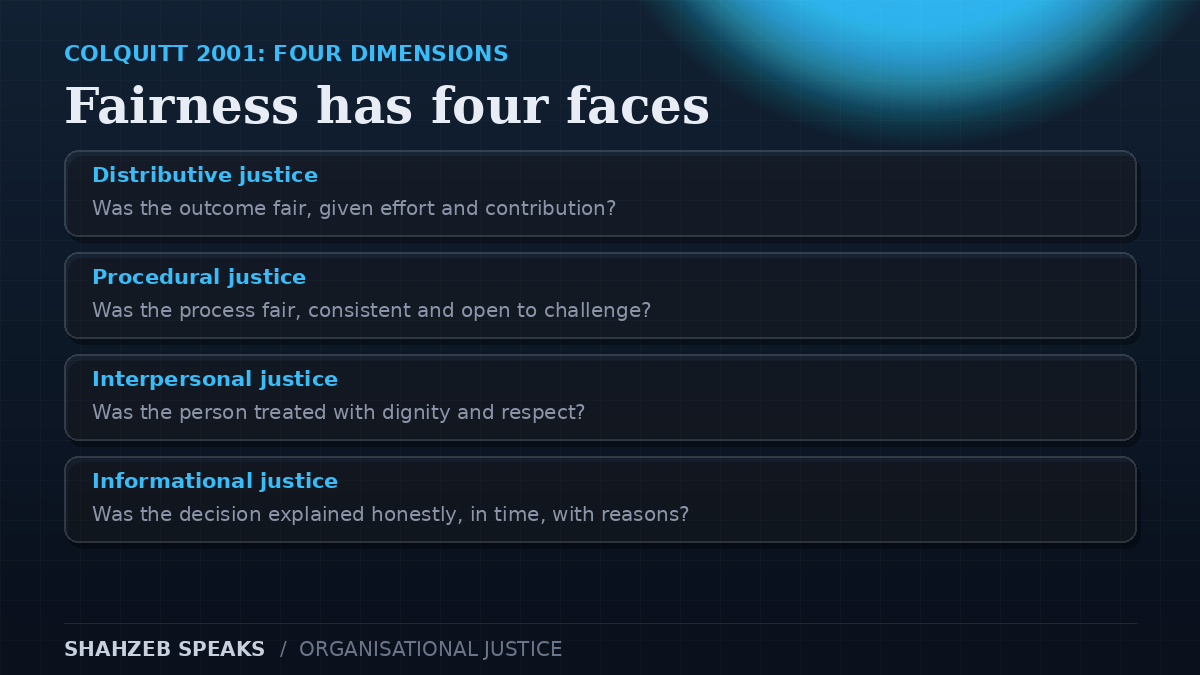
| Dimension | The question employees ask | Where it breaks |
|---|---|---|
| Distributive justice | Was the outcome fair, given effort, contribution and need? | Two people do the same work; one is paid far more, with no reason given. |
| Procedural justice | Was the process fair, consistent and open to challenge? | The criteria change after applications close, or the same rule is applied differently to two teams. |
| Interpersonal justice | Was I treated with dignity and respect? | A restructure is announced by email on a Friday, with no conversation and no thanks. |
| Informational justice | Was the decision explained honestly, in time, with reasons? | “Budget reasons” is offered as the whole explanation for a decision that was really about performance. |
Notice what this table does to the usual management instinct. Most leaders, when a decision goes badly, reach for a better outcome: more money, a bigger title, a softer landing. Sometimes that helps. But if the break was procedural — the process was inconsistent — or informational — the explanation was thin — then a better outcome alone will not repair it. People will still believe the next decision will be made the same way.
🔬 Chapter 4: What the evidence links fairness to
The Colquitt meta-analysis is the anchor, but it does not give us a single number to quote for every outcome — its abstract confirms the outcome list and the incremental value of each dimension, not a set of correlation coefficients I can safely reproduce here. The newer, single-country studies are more specific, and they point in the same direction: fairness, especially procedural and distributive fairness, tracks with whether people intend to stay.
In Korea, a 2024 study using the 2022 Korean Public Employee Perception Survey found that distributive justice (β = -1.19), procedural justice (β = -0.68) and interactional justice (β = -0.22) were all significantly and negatively associated with turnover intention — in plain terms, higher perceived fairness went with lower intention to leave. The procedural-justice effect was significantly stronger for MZ-generation employees, born between 1981 and 2005, than for older generations (interaction β = -0.34). That last point matters for managers who assume younger staff only care about pay: in this sample, how decisions were made mattered more to them, not less.
In China, a 2024 study of 1,200 primary healthcare workers surveyed in July 2023 found overall organisational justice significantly reduced turnover intention (β = -0.435). Distributive justice (β = -0.203) and procedural justice (β = -0.177) were significant, while interactional justice was not, and work motivation mediated the effect. In Spain, a 2024 study of 302 retail workers found authentic leadership positively associated with affective commitment, with distributive justice mediating that link. Three countries, three sectors, one pattern: fairness is not decoration. It is part of the mechanism by which leadership becomes commitment, and by which commitment becomes staying.
None of this proves that a single fairness intervention will cut turnover by a fixed percentage. The studies are observational, the samples are specific, and turnover has many causes. What the pattern does justify is a discipline: treat every consequential decision as a fairness event, and check all four dimensions before you announce it.
✅ Chapter 5: Leventhal’s six-point test for any process
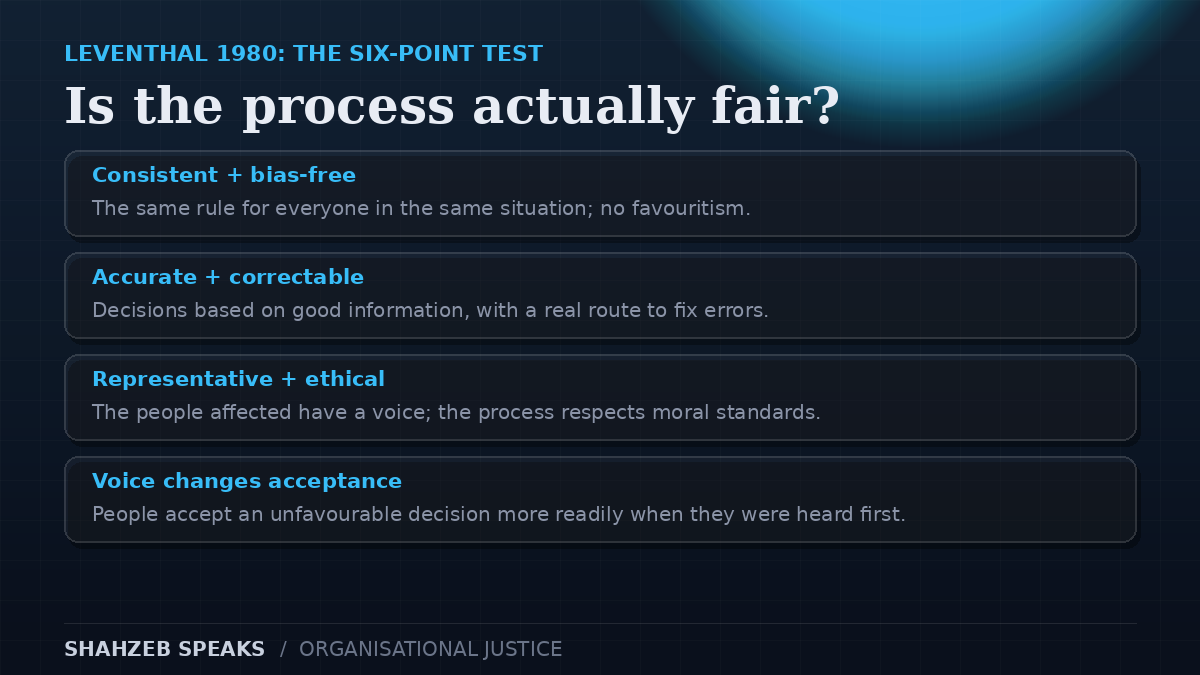
Procedural justice has a classic checklist. Leventhal’s 1980 criteria ask whether a process is consistent, bias-free, accurate, correctable, representative and ethical. In workplace language: the same rule for everyone in the same situation; no favouritism in who decides or who benefits; decisions based on good information; a real way to appeal or correct a mistake; a voice for the people affected; and a process that respects basic moral standards. Research reviewed under Tyler’s work adds a related point: people who perceive voice or control in a process are more willing to accept an unfavourable decision. Voice does not mean veto. It means being heard before the decision, not merely informed after it.
Run a real example through the test. A manager shortlists two internal candidates for a role, interviews both, and picks the one with more experience. That sounds fair — until you learn the criteria were written after the interviews, one candidate’s manager was on the panel and the other’s was not, and the unsuccessful candidate was told only that “the other candidate was a stronger fit”. The outcome may be defensible. The process fails consistency, bias suppression, accuracy and informational justice at once. The unsuccessful candidate does not need to believe the winner was unqualified to feel treated unfairly. She only needs to see that the process could not have protected her if she had been the better candidate.
The fix is rarely expensive. Publish the criteria before applications open. Keep the panel composition consistent. Record the evidence against each criterion. Give the unsuccessful candidate a short, specific account of where the gap was, and a real route to challenge a factual error. None of that guarantees agreement. All of it changes the judgement from “the process was rigged” to “I lost a fair contest” — and that is a very different belief to carry back to a team.
🚫 Chapter 6: Where fairness work goes wrong
First, fairness theatre. A consultation that has already decided its outcome is worse than no consultation, because it teaches staff that voice is a performance. If a decision is genuinely already taken, say so, explain why, and be honest about what is still open. Second, outcome-only fairness. Raising pay while keeping an opaque bonus formula will not buy trust; it buys a better-paid suspicion. Third, respectful delivery as a substitute for a fair process. A kind manager delivering an unfair process is still delivering an unfair process — interpersonal justice helps, but it cannot carry the other three dimensions alone.
Fourth, and most common, is the appeal that is not an appeal. “You can raise it with HR” is not correctability if HR cannot change the decision, if the deadline has already passed, or if the record of the original decision no longer exists. A correctable process keeps notes, keeps a window open, and can say, in a real case, “we got a fact wrong and we have changed the outcome”. Organisations that never reverse a decision are not demonstrating consistency. They are demonstrating that the process cannot learn.
If you want a related guide on the conditions that make people speak up in the first place, read my article on psychological safety at work. If the problem is recognition rather than process, my guide on employee recognition covers what praise does and does not fix.
🛠️ Chapter 7: A playbook for fairer decisions
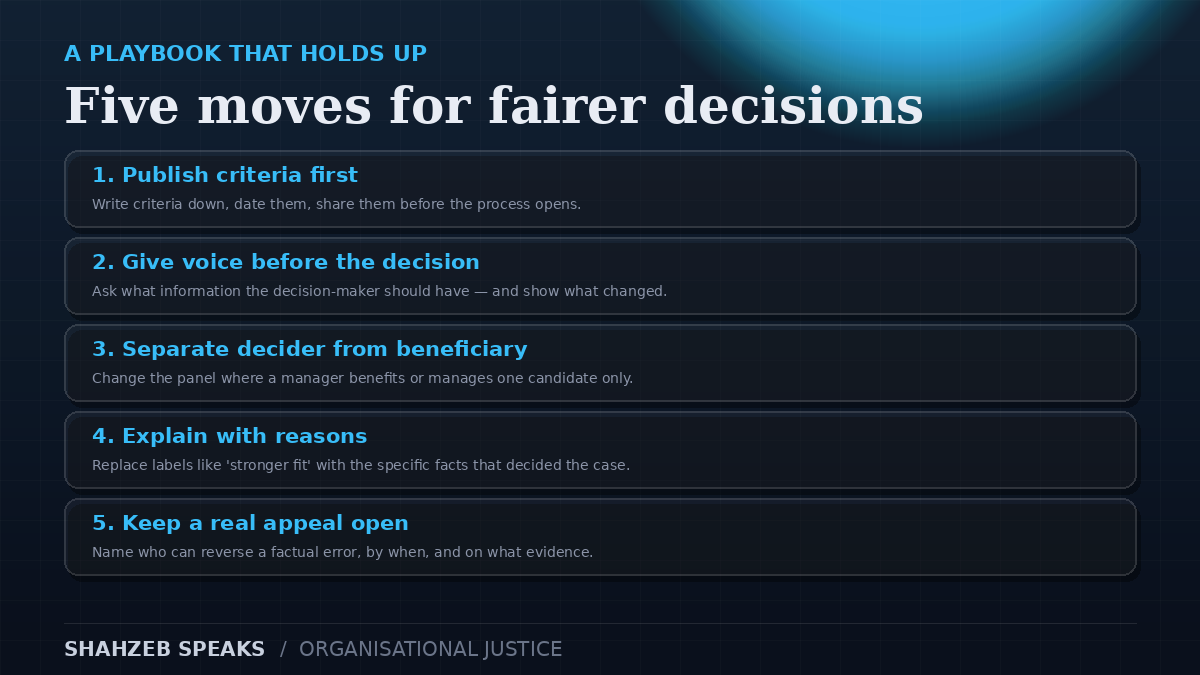
1. Publish criteria before you open the process. For promotions, bonuses, shift patterns and redundancies alike, write the criteria down, date them, and share them with everyone in scope. If the criteria change, restart the clock and say why.
2. Give voice before the decision, not after it. Ask the people affected what information the decision-maker should have, and what a fair outcome would look like from their side. Record what you heard, and show where it changed — or did not change — the decision.
3. Separate the decision-maker from the beneficiary. Where a manager benefits from an outcome, or manages one candidate and not another, change the panel or add an independent check. Bias suppression is a design choice, not a character trait.
4. Explain with reasons, not labels. Replace “stronger fit”, “business need” and “budget reasons” with the specific facts that decided the case, in time for the person to respond. Informational justice is the cheapest fairness intervention there is, and the most often skipped.
5. Keep a real appeal route open. Name who can reverse a factual error, by when, and on what evidence. Then use it at least once in public memory — a reversed decision, honestly explained, teaches more about fairness than ten policies.
For the first 90 days of a new role, when fairness impressions form fastest, my guide on employee onboarding is a useful companion. And if your performance reviews are where fairness most often breaks, read why performance reviews fail before the next cycle.
🚪 Chapter 8: What to do this week
Pick one decision your team will make in the next month — a promotion, a rota, a bonus split, a hybrid-working exception. Before it is taken, write down the four fairness questions from Chapter 3 and Leventhal’s six criteria from Chapter 5, and score the planned process honestly. Where it fails, fix the process, not the announcement. Then, when the decision lands, explain it with reasons, offer a real route to correct a factual error, and note what you will do differently next time. Fairness is not a value statement. It is a habit of making decisions that can survive being examined by the people they affect.
That habit is also why this matters beyond any single decision. Organisations do not lose trust in one dramatic betrayal. They lose it in a series of small processes that nobody checked, each one teaching staff that outcomes are decided elsewhere, by rules they cannot see. The reverse is also true. A series of small, checkable, well-explained decisions teaches staff that the organisation can be trusted with the next hard call — even when the answer is no.
❓ Questions I am asked most often
What is organisational justice in simple terms?
It is how fair employees perceive workplace decisions to be. It covers four judgements: whether outcomes are fair, whether processes are fair, whether treatment is respectful, and whether explanations are honest and clear.
Is procedural justice more important than distributive justice?
Neither dominates in every study, and both matter. Procedural fairness often matters most when outcomes are disappointing, because a fair process makes an unfavourable result easier to accept. Outcome fairness matters most when the gap is large or unexplained.
Can a fair process make an unpopular decision acceptable?
It can make it more acceptable, not automatically popular. Research on voice and procedural justice finds people accept unfavourable decisions more readily when they were heard and the process was consistent, accurate and correctable.
How do I measure organisational justice in my team?
Use Colquitt’s four-dimension structure as your survey frame, and ask separately about outcomes, process, treatment and explanations. Do not collapse them into one “fairness” score — the separate scores tell you which lever to fix.
Does fairness really affect whether people leave?
The newer studies reviewed here link higher perceived fairness with lower turnover intention, in Korea, China and Spain, with different samples and sectors. That is an association, not a guarantee that one intervention will cut leaving by a fixed amount.
What is the fastest fairness fix for a manager?
Explain decisions with specific reasons, in time, and offer a real route to correct factual errors. Informational justice and correctability cost little, and they change how every other decision is interpreted.
📬 Want help building fairer processes in your organisation?
If promotion, pay or rota decisions keep creating resentment in your team, the process — not just the outcome — probably needs a check. Contact me and tell me which decision is causing the trouble.
For the broader field behind this guide, see my homepage on industrial psychology in Pakistan, and for the related question of purpose at work, read meaningful work psychology.
Sources
- Colquitt, J. A., Conlon, D. E., Wesson, M. J., Porter, C. O. L. H., & Ng, K. Y. (2001). Justice at the millennium: A meta-analytic review of 25 years of organizational justice research. Journal of Applied Psychology, 86(3), 425–445.
- Colquitt, J. A. (2001). On the dimensionality of organizational justice: A construct validation of a measure. Journal of Applied Psychology, 86(3), 386–400.
- Greenberg, J. (1987). A taxonomy of organizational justice theories. Academy of Management Review, 12(1), 9–22.
- Leventhal, G. S. (1980). What should be done with equity theory? In K. J. Gergen, M. S. Greenberg, & R. H. Willis (Eds.), Social exchange: Advances in theory and research. Plenum Press.
- Kim, et al. (2024). Organisational justice and turnover intention among Korean public employees. Sustainability, 16(6), 2454.
- Zhao, et al. (2024). Organisational justice, work motivation and turnover intention among primary healthcare workers in China. Risk Management and Healthcare Policy.
- González-Cánovas, et al. (2024). Authentic leadership, distributive justice and affective commitment among Spanish retail workers. Frontiers in Psychology, 15, 1359581.
- Aflac (2026). 2026–2027 WorkForces Report (conducted by Kantar). PR Newswire release, 13 October 2026.
- The People Lab, Harvard Kennedy School (2026). Public Servant Pulse, as reported 21 October 2026.