
Once a year, a manager sits down with a form, tries to remember twelve months of someone’s work, gives it a number from one to five, and then spends an uncomfortable hour defending that number to a person who disagrees with it. Both of them leave the room less motivated than they entered it. And the company calls this performance management.
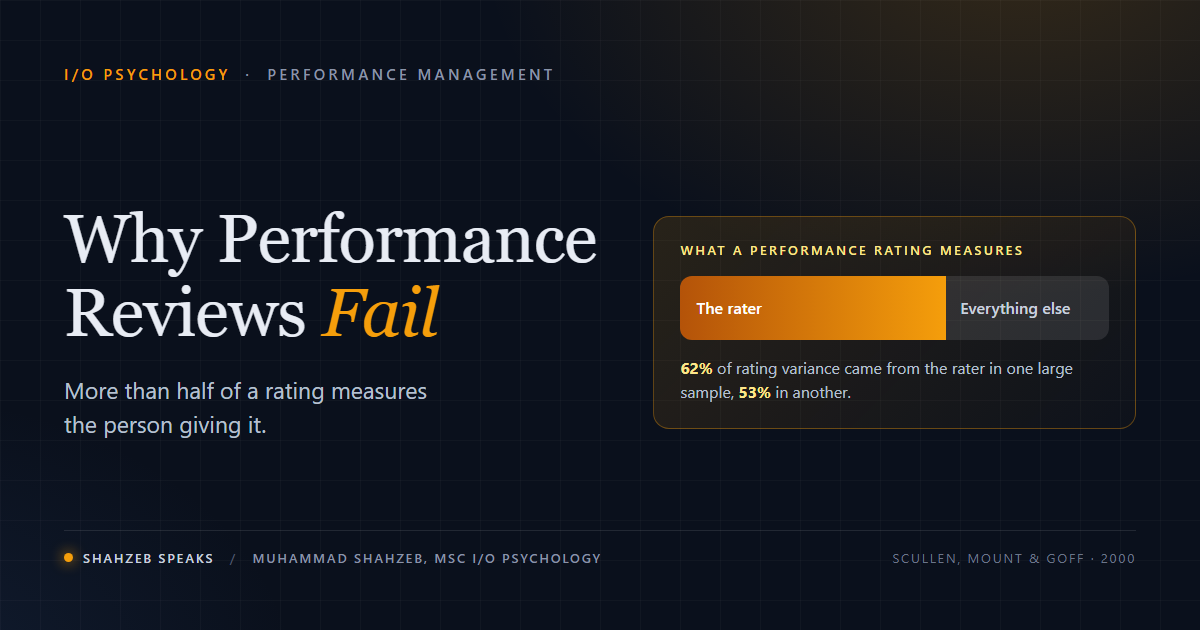
If that sounds cynical, the data is harsher. Gallup found that only 14% of employees strongly agree that their performance reviews inspire them to improve. Only 29% strongly agree their reviews are fair, and only 26% that they are accurate. One of the largest studies of rating data ever conducted found that more than half of what a performance rating measures is the person giving it, not the person being rated.
I am an Industrial and Organizational Psychologist, and performance appraisal is one of the oldest research topics in my field. This article covers what the evidence says about why reviews fail, the biases that distort almost every rating, the uncomfortable finding that feedback can make performance worse, and what organisations that have fixed the problem actually changed.
“A performance rating tells you as much about the rater as about the person being rated. Until an organisation accepts that, it will keep making pay, promotion and exit decisions on a number that is more than half noise.”
— Workplace Psychology Analysis, ShahzebSpeaks
🔍 Chapter 1: What a performance review is trying to do (all at once)
The first reason reviews fail is that most organisations ask one conversation to do four jobs that pull in opposite directions.
- Evaluation: judge how well someone performed, usually as a number.
- Reward: decide pay rises, bonuses and promotions.
- Development: help the person get better.
- Documentation: create a record the organisation can rely on if the relationship ends badly.
Evaluation and reward require the employee to defend themselves. Development requires them to admit weaknesses. You cannot ask someone to be openly vulnerable about their shortcomings in the same meeting that decides their salary. Every experienced employee knows this, so they spend the development part of the conversation managing impressions rather than learning. The meeting is formally about growth and psychologically about money.
Angelo DeNisi and Kevin Murphy, two of the leading researchers in this area, reviewed a century of performance appraisal research in the Journal of Applied Psychology in 2017. One of their central conclusions was that decades of effort went into perfecting rating formats and scales, while the bigger problems sat in the purpose of the system and the context around it. Better forms did not fix a meeting that was trying to do incompatible things.
🎯 Chapter 2: The rating mostly measures the rater
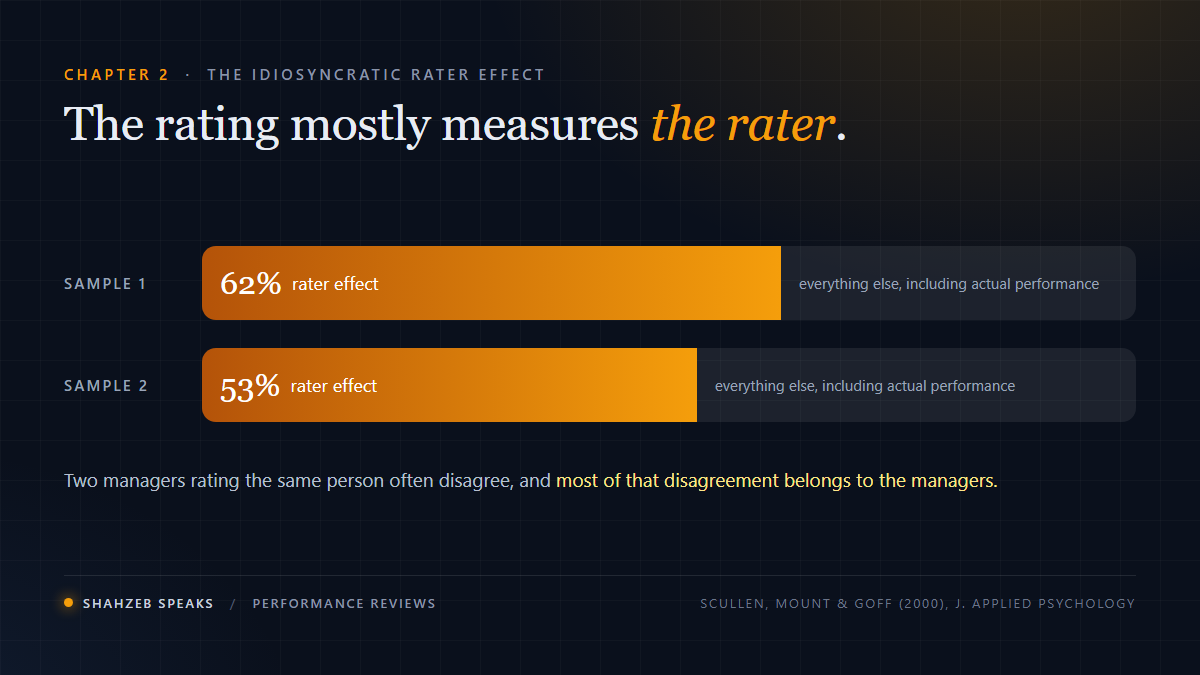
In 2000, Steven Scullen, Michael Mount and Maynard Goff published a study in the Journal of Applied Psychology that should have changed how every company uses ratings. They analysed two large samples of managers, each rated by several people, including bosses, peers and subordinates, and separated out where the variation in ratings actually came from.
The largest single source was not the performance of the person being rated. It was what researchers call the idiosyncratic rater effect: each rater’s personal tendencies, standards and quirks. In the two samples, it accounted for 62% and 53% of the variance in ratings. Actual performance was a much smaller share.
In plain language: if two managers rate the same employee, much of the difference between their scores says something about the managers. One is generous. One is harsh. One values speed, another values polish. One remembers March, the other remembers November. The rating combines all of that with the employee’s real performance and presents the result as a single, official-looking number.
This matters enormously because organisations then treat that number as data. They rank people by it, link pay to it, identify “low performers” with it and sometimes dismiss people partly on the basis of it. A number that is more than half rater noise is being used as if it were a measurement of the employee.
I built the Performance Rating Calibration tool for exactly this problem: it shows when one manager’s scores run consistently higher or lower than their colleagues’, so the difference can be discussed before it is turned into pay.
⚠️ Chapter 3: Feedback can make performance worse
Almost every management guide assumes that more feedback leads to better performance. The research is less comfortable.
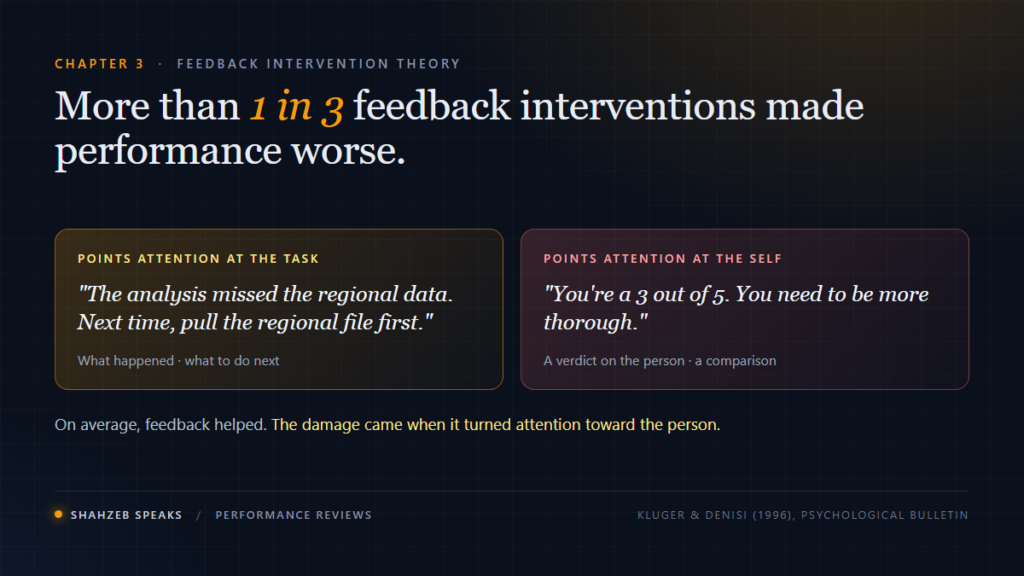
In 1996, Avraham Kluger and Angelo DeNisi published a major meta-analysis of feedback interventions in Psychological Bulletin. On average, feedback did improve performance, which is reassuring. But the average hid a striking finding: in more than a third of cases, feedback made performance worse.
Their explanation, Feedback Intervention Theory, is one of the most useful ideas in this whole topic. Feedback helps when it directs attention to the task: what was done, what the result was, and what to do differently. It backfires when it directs attention to the self: how good or bad the person is, how they compare to others, what the feedback says about their worth.
Now think about the typical annual review. It ends with a single rating that is effectively a verdict on the person. It is often compared with colleagues’. It is tied to money. Almost every feature pulls attention toward the self and away from the task, which is precisely the condition in which Kluger and DeNisi found feedback does harm.
This is why a “3 out of 5” can demotivate someone who is doing solid work. They hear a judgement about who they are, not information about what to do next. And the psychological threat of that judgement, as I described in my article on psychological safety at work, makes people defensive exactly when they need to be open.
🧠 Chapter 4: The biases inside almost every rating
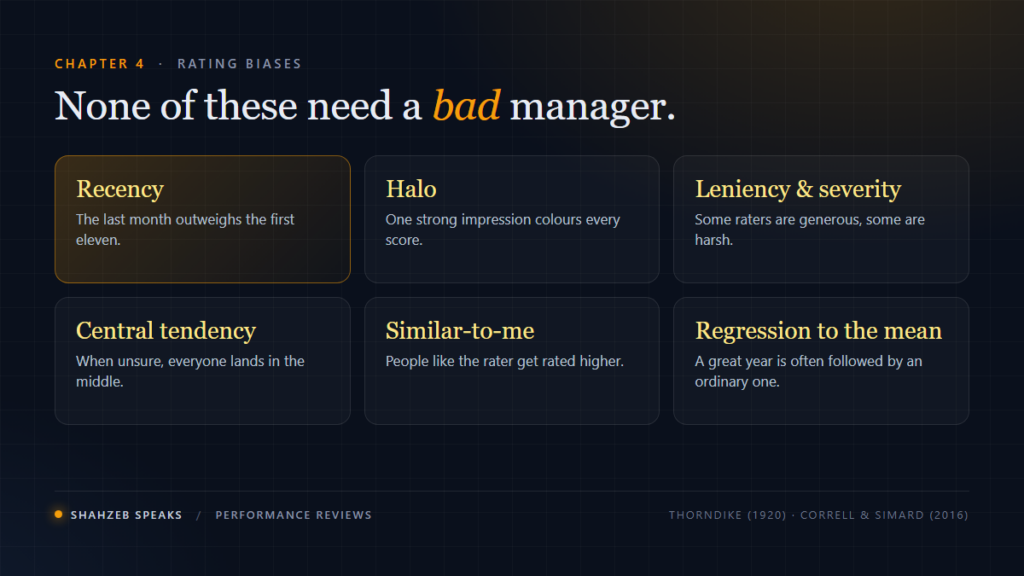
The rater effect in Chapter 2 is made up of predictable, well-documented biases. None of them require a careless or unfair manager. They are how human judgement works when it is asked to summarise a year into a number.
Recency bias. Memory is not a fair record. The last few weeks before the review are vivid; March is a blur. An employee who had an excellent year and a difficult final month often receives a lower rating than one who coasted for ten months and finished strongly.
The halo effect. One strong impression spreads to every dimension. A manager impressed by someone’s confident presentations tends to rate their teamwork, reliability and technical quality higher too, whether or not the evidence supports it. I covered this mechanism in detail in my article on the halo effect, and it operates inside organisations exactly as it does in marketing.
Leniency and severity. Some managers rate almost everyone highly to avoid conflict or protect their team. Others reserve high ratings for almost nobody. Neither pattern reflects the team; it reflects the manager, which is the rater effect in its simplest form.
Central tendency. When unsure, or when a high or low rating would require an uncomfortable justification, raters cluster everyone in the middle. The result is a system that cannot distinguish strong from weak performance at all.
Similar-to-me bias. People tend to rate more favourably those who resemble them in background, style or personality. This is one of the routes through which bias against women and minorities enters appraisals. Research reported by Shelley Correll and Caroline Simard in Harvard Business Review in 2016 found that women were more likely to receive vague feedback, and less likely to receive specific feedback tied to business outcomes, which makes it harder to know how to advance.
Regression to the mean. An exceptional year is often followed by a more ordinary one, simply because extraordinary results involve some luck. Managers who do not account for this conclude that a star has “coasted.” I built a free regression to the mean calculator to show how much of an extreme score is expected to fall back on its own.
🔁 Chapter 5: What went wrong with forced ranking
For years, many large companies tried to solve rating inflation with forced distribution, sometimes called “rank and yank”: a fixed percentage of employees had to be rated top, most in the middle, and a fixed percentage at the bottom, often with consequences for those at the bottom.
The logic was appealing. If managers rate everyone highly, force them to differentiate. But the approach assumes that every team, of every size, contains the same distribution of performance, which is statistically unlikely for small teams. It also turns colleagues into competitors. When your rating depends on someone else’s being lower, helping them becomes irrational. Collaboration, knowledge sharing and mentoring all suffer.
Several prominent organisations moved away from annual ratings and forced ranking during the 2010s. Adobe replaced its annual review with regular “check-ins” in 2012. Deloitte, as Marcus Buckingham and Ashley Goodall described in Harvard Business Review in 2015, calculated that it was spending close to two million hours a year on its performance management process and redesigned it around frequent, forward-looking conversations.
⚖️ Chapter 6: The honest part — ratings are not going away, and should not
It is fashionable to declare that performance reviews should be abolished. That is not what the evidence supports, and it is worth being precise.
Organisations still have to make decisions
Someone must decide who gets promoted, how pay rises are distributed and, occasionally, who should leave. Removing formal ratings does not remove those decisions. It often moves them into private, undocumented judgements that are less transparent and more open to bias, not less. Several companies that dropped ratings later reintroduced some form of them for exactly this reason.
The problem is the design, not the idea of evaluation
The research does not show that evaluating performance is harmful. It shows that evaluating it once a year, from memory, as a single number, tied directly to pay, in the same meeting as development produces poor data and poor motivation. Each of those features can be changed separately.
Continuous feedback is not automatically better
Replacing an annual review with weekly check-ins only helps if the check-ins are good. A manager who gives vague, self-focused feedback once a year will give vague, self-focused feedback fifty times a year if nothing else changes. Kluger and DeNisi’s finding applies to frequent feedback as much as to annual feedback.
Some roles are hard to measure
In many knowledge jobs, output is collaborative, delayed and difficult to attribute to one person. No appraisal system can fully solve that, and one that pretends to measure individual contribution precisely in such roles is producing false confidence.
🛠️ Chapter 7: What actually works
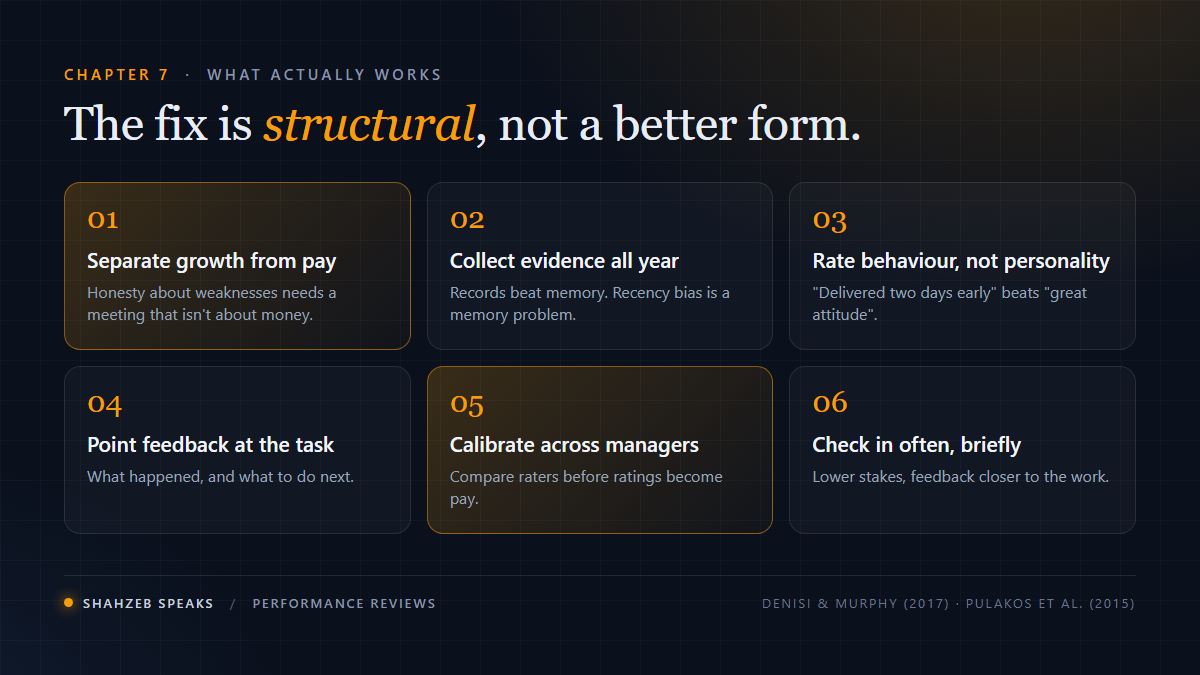
These changes follow directly from the research above. Most of them are structural rather than a new template.
- Separate development from pay. Hold the conversation about growth at a different time from the decision about money. People can only be honest about weaknesses when the honesty will not be used against them in the same meeting.
- Collect evidence throughout the year. Recency bias is a memory problem, so solve it with records. Brief notes on specific achievements and problems, made when they happen, give the review something more reliable than recollection.
- Rate observable behaviour, not personality. “Delivered the client report two days early and it needed no revisions” is evidence. “Has a great attitude” is an impression that halo effect and similar-to-me bias thrive on.
- Point feedback at the task. Following Kluger and DeNisi, describe what happened and what to do next, not what it says about the person. “The analysis missed the regional data, so next time pull the regional file first” beats “you need to be more thorough.”
- Calibrate across managers. Given the size of the rater effect, ratings should be compared across managers before they drive decisions. When one manager’s average is far above another’s, that is a discussion to have before pay is set, not after.
- Check in often, and briefly. Short, frequent conversations about current work reduce the stakes of any single meeting and keep feedback close to the events it describes. My Performance Review Rewrite Kit turns vague review language into specific, behaviour-based feedback for exactly this.
If you are the one being reviewed
- Keep your own record of achievements through the year, with dates and outcomes. You are the best protection against your manager’s recency bias.
- Ask what a higher rating would require, specifically. “What would I need to have done to be rated a 4?” converts a verdict into a target.
- Separate the number from the information. If the rating stings, ask for the two or three specific behaviours behind it. That is the part you can use.
🇵🇰 Chapter 8: Performance reviews in Pakistani organisations
Many organisations in Pakistan run performance appraisal through forms inherited from multinational templates, applied in a context those templates were not designed for.
Relationships weigh heavily. In high power-distance and relationship-oriented workplaces, closeness to the manager can influence ratings strongly, which magnifies the similar-to-me and halo biases described above.
Leniency is common, then compressed by budget. Managers often rate generously to protect team morale, and then pay rises are squeezed into a fixed budget anyway. Employees see high ratings with small increments and conclude, reasonably, that the rating means little.
Feedback often arrives only once a year. In workplaces where day-to-day feedback is rare, the annual review becomes the single moment of judgement, raising the stakes and the defensiveness.
The same fixes apply: separate development from pay, keep evidence through the year, and calibrate across managers. For many organisations here, the biggest single improvement is simply more frequent, specific feedback. I work with organisations on these systems through my organisational psychology work.
📝 The takeaway
Performance reviews fail for reasons that have been understood for decades. A single conversation is asked to judge, reward, develop and document at once. The rating it produces reflects the rater more than the person rated. And feedback delivered as a verdict on the self, which is exactly what an annual rating is, can make performance worse rather than better.
The answer is not abolishing evaluation. It is redesigning it: separating growth from pay, gathering evidence instead of relying on memory, focusing on behaviour and on the task, and calibrating across managers before decisions are made.
If you remember one finding from this article, make it the one from Chapter 2. Before you act on a performance rating, ask how much of it belongs to the person who gave it. The research says the answer is usually “more than half.”
❓ Frequently asked questions
Why do performance reviews fail?
Mainly because one meeting is asked to evaluate, decide pay, develop the employee and create a record at the same time, which makes honest development conversations difficult. Ratings are also heavily influenced by the rater’s own tendencies and by biases such as recency and halo effects.
What is the idiosyncratic rater effect?
It is the part of a performance rating that reflects the person giving the rating rather than the person being rated. A 2000 study by Scullen, Mount and Goff found it accounted for 62% and 53% of the variance in ratings in two large samples.
What is recency bias in performance reviews?
Recency bias is the tendency to give more weight to recent events when summarising a whole review period. Performance in the last few weeks often shapes the rating more than performance earlier in the year.
Can feedback make performance worse?
Yes. A 1996 meta-analysis by Kluger and DeNisi found that feedback improved performance on average, but in more than a third of cases it made performance worse, especially when it focused attention on the person rather than the task.
Should companies get rid of performance reviews?
The evidence supports redesigning them rather than removing evaluation entirely. Organisations still need to make pay and promotion decisions, and removing formal reviews can move those decisions into less transparent judgements.
How do you give a good performance review?
Base it on evidence collected throughout the year, describe specific behaviours and outcomes rather than personality, focus feedback on what to do next, and hold the development conversation separately from decisions about pay.
🧠 Are your ratings measuring your people, or your managers?
I’m Muhammad Shahzeb, an MSc Industrial and Organizational Psychologist. I review performance management systems using the research on rating bias and feedback, and I tell you honestly which parts of your process are producing noise, including the ones that feel most official.
📚 References and further reading
- Scullen, S. E., Mount, M. K., & Goff, M. (2000). “Understanding the latent structure of job performance ratings.” Journal of Applied Psychology, 85(6), 956-970.
- Kluger, A. N., & DeNisi, A. (1996). “The effects of feedback interventions on performance: A historical review, a meta-analysis, and a preliminary feedback intervention theory.” Psychological Bulletin, 119(2), 254-284.
- DeNisi, A. S., & Murphy, K. R. (2017). “Performance appraisal and performance management: 100 years of progress?” Journal of Applied Psychology, 102(3), 421-433.
- Wigert, B., & Harter, J. (2017). Re-Engineering Performance Management. Gallup.
- Buckingham, M., & Goodall, A. (2015). “Reinventing performance management.” Harvard Business Review, 93(4), 40-50.
- Correll, S., & Simard, C. (2016). “Research: Vague feedback is holding women back.” Harvard Business Review.
- Pulakos, E. D., Mueller-Hanson, R., Arad, S., & Moye, N. (2015). “Performance management can be fixed: An on-the-job experiential learning approach for complex behavior change.” Industrial and Organizational Psychology, 8(1), 51-76.
- Thorndike, E. L. (1920). “A constant error in psychological ratings.” Journal of Applied Psychology, 4(1), 25-29. (The halo effect.)
Written by Muhammad Shahzeb, MSc Industrial & Organizational Psychology | Workplace Psychology Specialist | Full-Stack Web Developer
Learn more about my approach →