
Personnel psychology is the “industrial” side of I/O psychology. It studies how organisations analyse jobs, recruit and select people, appraise their performance and train them. Its core tools include job analysis (such as the PAQ, 1972), validated selection tests and structured interviews, behaviour-based appraisal scales and Kirkpatrick’s four levels of training evaluation (1959).
These notes are for BS, MSc and MBA students taking industrial psychology, personnel psychology or HRM, for candidates preparing for PPSC, CSS, UGC NET or the Philippine psychometrician board, and for thesis students who need the big picture before they choose a topic. They follow the order most syllabi use: job analysis, recruitment, selection, performance appraisal and training. Each section gives the key ideas, the names and dates examiners expect, and a link to a full page with tables, an exam answer plan and practice MCQs.
If you are new to the field, start with what is I/O psychology, and if you want the difference between the two halves of the field, read industrial vs organizational psychology.
What is personnel psychology?
I/O psychology has two halves. The organisational half studies motivation, job attitudes, leadership, teams and culture. The industrial half, usually called personnel psychology, studies the decisions an organisation makes about people: which jobs exist and what they need, whom to hire, how to judge their work, and how to develop them. Personnel psychology is where psychological measurement does most of its work, so reliability, validity and fairness run through every topic below.
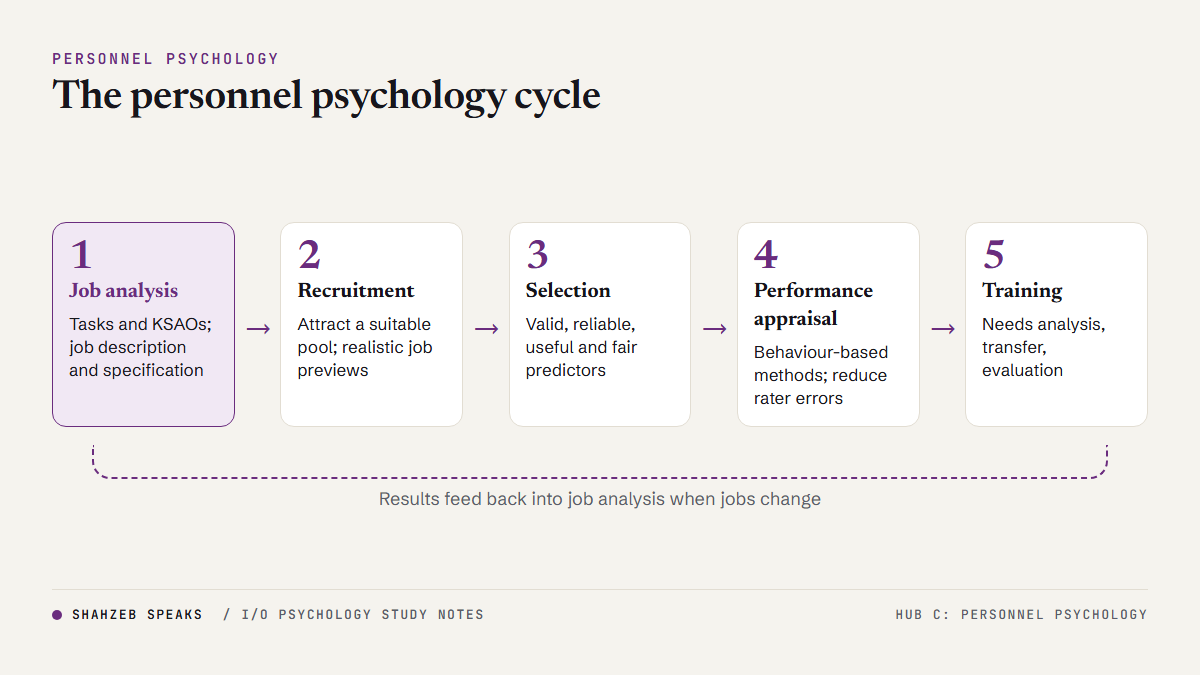
A simple way to remember the field is as a cycle. Job analysis describes the job. Recruitment brings in applicants. Selection chooses among them. Performance appraisal measures how well people do the job. Training closes the gaps that appraisal and change reveal, and the results feed back into job analysis when jobs change.
Personnel psychology matters beyond the classroom. In Pakistan, India and the Philippines, many organisations still hire through unstructured interviews and references, appraise with one-page trait forms, and train whoever is free on the day. The methods in these notes are the evidence-based alternative, and knowing them is a real advantage if you want to work in HR or consulting. For the local career picture, see industrial psychology in Pakistan, and for how the field differs from HR practice, I/O psychology vs HRM.
Job analysis: the foundation
Job analysis is the systematic collection of information about what a job involves (tasks, duties, responsibilities) and what a person needs to do it (knowledge, skills, abilities and other characteristics, or KSAOs). It produces two documents: the job description (what the job is) and the job specification (what the person needs). The difference is explained with examples in job description vs job specification.
Methods fall into two families. Job-oriented methods describe the work itself; worker-oriented methods describe general human behaviours that apply across jobs. The methods to know:
- Observation, interviews, questionnaires and work diaries: the general-purpose tools.
- Position Analysis Questionnaire (PAQ): McCormick, Jeanneret and Mecham (1972); worker-oriented; most textbooks give 194 items in six divisions (information input, mental processes, work output, relationships with other persons, job context, other job characteristics).
- Critical incident technique: Flanagan (1954); collects examples of behaviour that made a clear difference, each with situation, behaviour and result.
- Functional job analysis: Sidney Fine; rates tasks on data, people and things.
- O*NET® data: the US occupational database that replaced the Dictionary of Occupational Titles (Peterson et al., 2001); a starting point, not a substitute for local analysis.
Job analysis is not perfect. Morgeson and Campion (1997) described 16 social and cognitive sources of inaccuracy, such as job holders inflating their job’s importance. That is why most projects combine methods. Full notes, an advantages and disadvantages table and MCQs: job analysis methods.
Recruitment: attracting the right applicants
Recruitment is the process of attracting a pool of suitable applicants; selection is choosing among them. Students often mix the two up, so the site has a separate page on recruitment vs selection.
Recruitment sources are usually grouped as internal (promotions, transfers, employee referrals) and external (job portals, campus drives, agencies, social media). Internal recruits know the organisation; external recruits bring new skills and ideas.
One research-backed recruitment tool every student should know is the realistic job preview (RJP): giving applicants an honest picture of the job, including its downsides, before or soon after they join. Premack and Wanous (1985) meta-analysed 21 RJP experiments, and Earnest, Allen and Landis (2011), with 52 studies and about 17,000 people, found that RJPs reduce voluntary turnover mainly because they make the organisation look honest. A call centre that shows applicants a recording of a difficult night-shift call before they accept the offer is using an RJP.
Selection: predictors, validity, utility and fairness
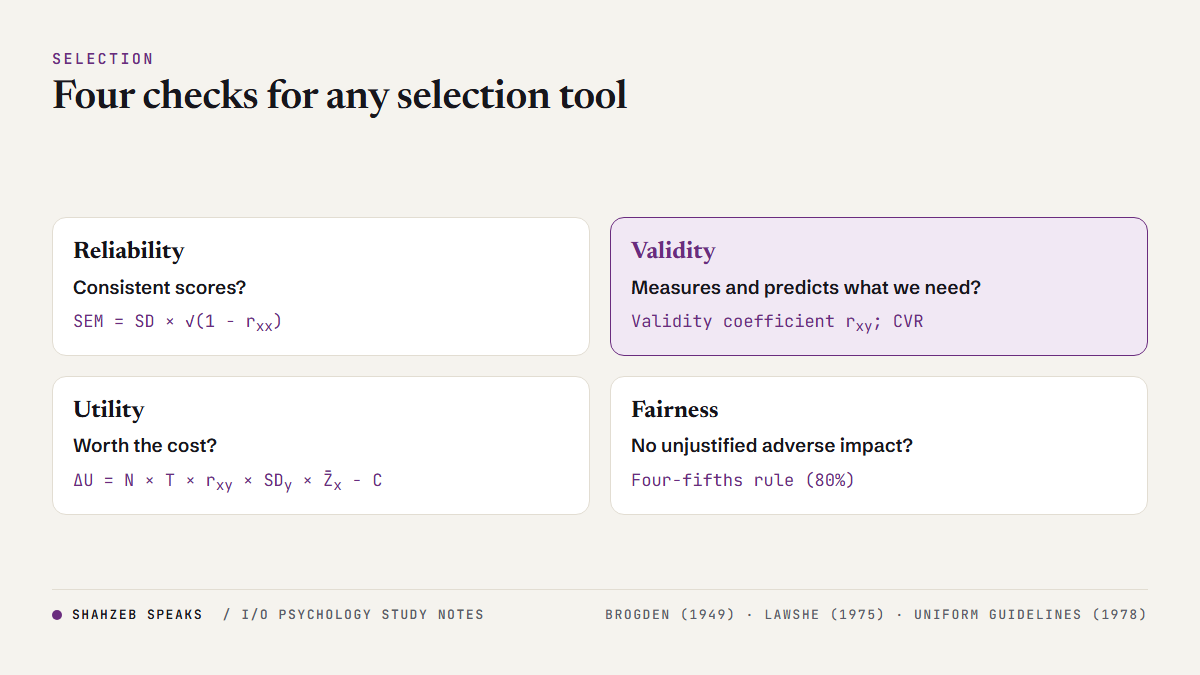
Selection is choosing the applicants most likely to perform well, using predictors (tests, interviews, exercises) whose scores are related to a criterion (a measure of job success). Four questions decide whether a predictor is any good: is it reliable, is it valid, is it worth the cost, and is it fair?
The main predictors
- Cognitive ability tests: measure general mental ability; strong predictors, especially for complex jobs, but with larger group differences than most tools.
- Personality tests: the Big Five model is standard; conscientiousness predicts performance across most jobs. See personality tests at work.
- Integrity tests: predict counterproductive behaviour such as theft and rule-breaking.
- Structured interviews: the same job-related questions for every candidate, scored against set anchors. See structured vs unstructured interviews.
- Work samples and job knowledge tests: candidates do part of the job or show job knowledge.
- Assessment centres: several exercises rated by trained assessors; see assessment centres.
- Situational judgement tests and biodata: realistic dilemmas and structured life-history questions.
If you are on the other side of the table, the site’s guide on psychometric tests for jobs in Pakistan explains what candidates face.
Reliability
A predictor must give consistent scores. The four types are test-retest, parallel forms, internal consistency (split-half with Spearman-Brown, KR-20, Cronbach’s alpha) and inter-rater reliability. The standard error of measurement, SEM = SD × √(1 − rxx), turns reliability into a band around an individual’s score, which is why candidates a couple of points apart may not really differ; try the SEM and banding calculator. Full notes: reliability in psychological testing.
Validity
Validity is the evidence that scores mean what we claim and predict what we need. The classic types are:
- Content validity: experts judge that the test samples the job; Lawshe’s (1975) content validity ratio puts a number on it. Try the content validity ratio calculator and the Aiken’s V calculator.
- Criterion-related validity: the correlation (validity coefficient) between test scores and performance, in a predictive design (test applicants, measure performance later) or a concurrent design (test current employees, measure performance now).
- Construct validity: evidence that the test measures the intended trait, including convergent and discriminant evidence (Cronbach and Meehl, 1955; Campbell and Fiske, 1959).
- Face validity: whether the test looks relevant to candidates; not technical evidence, but it affects how fair they think the process is.
How valid are the main predictors? For years the standard answer came from Schmidt and Hunter (1998). Sackett, Zhang, Berry and Lievens (2022) re-analysed the evidence, argued that earlier corrections for range restriction were too large, and lowered most estimates by .10 to .20. In their revised table, structured interviews came first (.42), followed by job knowledge tests (.40) and empirically keyed biodata (.38), with cognitive ability tests at .31 (down from .51) and unstructured interviews at .19. The full comparison is in validity in employee selection.
Utility: is the tool worth it?
A valid test is only worth using if its benefits outweigh its costs. Three ideas answer this:
- Taylor-Russell tables (Taylor and Russell, 1939): the proportion of hires who will succeed depends on the validity coefficient, the selection ratio (hires ÷ applicants) and the base rate (the proportion who would succeed anyway). A modest test helps a lot when you can be choosy (low selection ratio). Try the Taylor-Russell calculator and the selection accuracy calculator.
- Utility analysis (Brogden, 1949; Cronbach and Gleser, 1965) estimates the money value of better selection. The Brogden-Cronbach-Gleser formula is ΔU = N × T × rxy × SDy × Z̄x − C, where N is the number hired, T their average tenure, rxy the validity, SDy the money value of one standard deviation of performance, Z̄x the average standardised test score of those hired, and C the total cost of testing. Try the utility analysis calculator.
- Range restriction: validity studies only see the people who were hired, which shrinks correlations. The range restriction calculator shows the correction, and the 2022 debate shows why the size of the correction matters.
Fairness and adverse impact
A selection process should not exclude groups for reasons unrelated to the job. In the United States, the Uniform Guidelines (1978) use the four-fifths rule: if one group’s selection rate is below 80% of the highest group’s rate, that is generally regarded as evidence of adverse impact, and the employer needs validity evidence for the tool. Check your own numbers with the adverse impact calculator. Remember the technical distinction: group differences in average scores are not by themselves proof of test bias; bias means the test predicts performance differently for different groups. Tools differ a lot on this trade-off. In Sackett et al. (2022), structured interviews combined the highest validity with a relatively small Black-White difference, while cognitive ability tests showed a much larger one.
Performance appraisal: measuring performance fairly
Performance appraisal is the formal evaluation of how well an employee does the job. It feeds pay, promotion, training and dismissal decisions, so its accuracy matters.
The criterion problem
Any measure of performance (the criterion) captures only part of real performance. A criterion is deficient when it misses important parts of the job (judging nurses only on the number of patients seen, ignoring patient safety) and contaminated when it includes things that are not performance (a sales figure inflated by a rich territory). Good appraisal systems try to reduce both.
Methods
Traditional methods include ranking, paired comparison, graphic rating scales, checklists, critical incidents, essays and forced distribution. Modern methods include BARS (behaviourally anchored rating scales; Smith and Kendall, 1963), BOS (behavioural observation scales; Latham and Wexley, 1977), management by objectives (Drucker, 1954) and 360-degree feedback. Format alone gives limited gains; Landy and Farr (1980) concluded that changing formats had improved ratings only a little. A comparison table, a worked BARS example and MCQs are in methods of performance appraisal; the site’s full article on 360-degree feedback covers multi-source ratings, and talent reviews often use the nine-box grid generator.
Rater errors and rater training
Ratings are only as good as the raters. Viswesvaran, Ones and Schmidt (1996) found that two supervisors rating the same people’s overall performance agreed only moderately (mean inter-rater reliability .52). The classic rater errors are:
- Halo: one impression colours all dimensions (Thorndike, 1920).
- Leniency, severity and central tendency: everyone rated too high, too low or in the middle.
- Recency: the last few weeks dominate.
- Contrast: rated against the previous person instead of the standard.
- Similar-to-me: people like the rater are rated higher (Rand and Wexley, 1975).
The best-supported fix is frame-of-reference training, which gives raters a shared standard through examples, practice and feedback (Bernardin and Buckley, 1981; Roch et al., 2012). Simply telling raters to avoid errors changes the shape of ratings without making them more accurate. Full notes: performance appraisal errors. For how employees experience reviews, and why many firms changed their systems, read the psychology of performance reviews.
Training and development: needs, design and evaluation
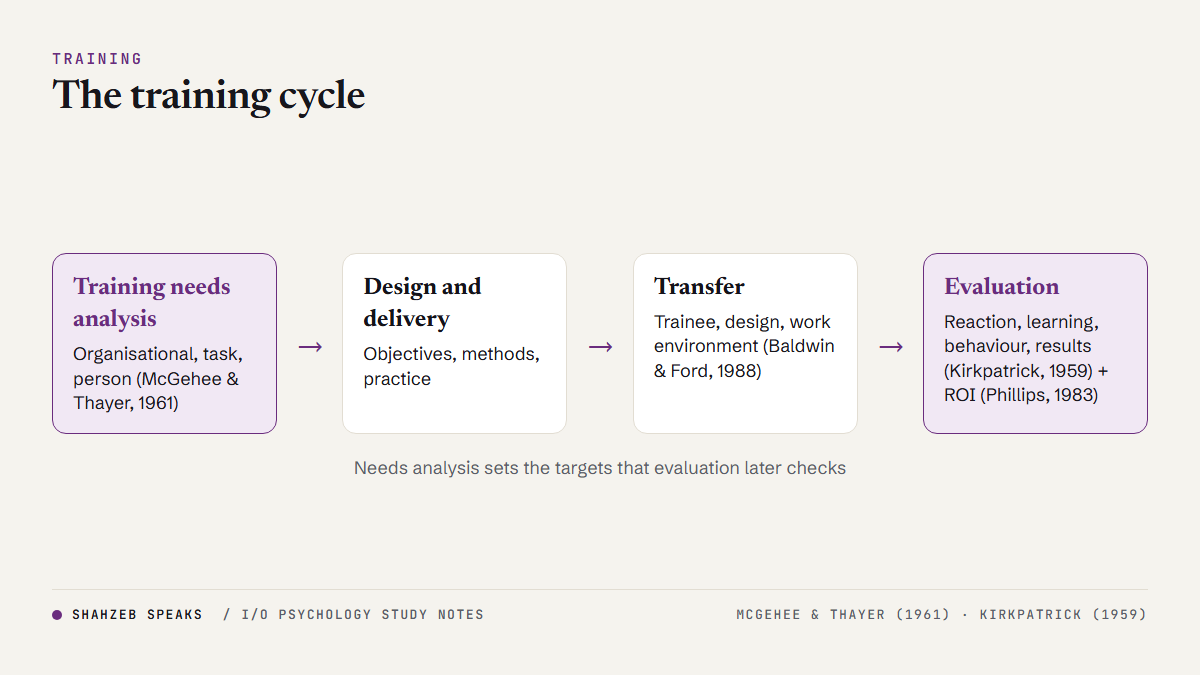
Training follows a cycle: analyse needs, design and deliver, then evaluate.
Training needs analysis
McGehee and Thayer (1961) set out three levels of training needs analysis: organisational analysis (where training is needed and whether the organisation will support it), task analysis (what the job requires) and person analysis (who lacks those skills). The key person-level question is whether someone cannot do the task (train them) or can but does not (fix tools, targets or motivation instead). Steps, methods and a worked textile-mill example: training needs analysis.
Design and transfer
Design and delivery means turning the needs into objectives, choosing methods and giving trainees enough practice. Training only pays off if people use it on the job, which is called transfer of training. Baldwin and Ford (1988) grouped the influences on transfer into trainee characteristics, training design and the work environment. A supervisor who blocks new methods can undo a good course. The research also shows that training works on average: Arthur, Bennett, Edens and Bell (2003) found medium to large effects (d around .60) on reaction, learning, behaviour and results criteria.
Evaluation: Kirkpatrick’s four levels
Kirkpatrick (1959) proposed four levels of evaluation: reaction, learning, behaviour and results. Phillips (1983) added return on investment as a fifth level: ROI (%) = (benefits − costs) ÷ costs × 100. Alliger and Janak (1989) criticised three assumptions people make about the levels (that higher levels give more information, are causally linked and are positively correlated), and Holton (1996) called the framework a taxonomy of outcomes rather than a full model. Full notes: Kirkpatrick’s four levels of training evaluation.
Personnel psychology at a glance: names, dates and pages
Use this table for last-minute revision. Every row links to a full page.
| Topic | Key idea | Names and dates to quote | Full notes |
|---|---|---|---|
| Job analysis | Describe tasks and KSAOs; produce job description and specification | Flanagan (1954); McCormick, Jeanneret and Mecham (1972); Fine and Wiley (1971) | Job analysis methods |
| Job description vs specification | What the job is vs what the person needs | Output of job analysis | JD vs JS |
| Recruitment | Attract a suitable pool; realistic job previews | Premack and Wanous (1985); Earnest, Allen and Landis (2011) | Recruitment vs selection |
| Validity | Content, criterion-related, construct, face | Lawshe (1975); Cronbach and Meehl (1955); Schmidt and Hunter (1998); Sackett et al. (2022) | Validity in selection |
| Reliability | Test-retest, parallel forms, internal consistency, inter-rater; SEM | Kuder and Richardson (1937); Cronbach (1951); Cohen (1960) | Reliability |
| Utility and fairness | Selection ratio, base rate, money value; four-fifths rule | Taylor and Russell (1939); Brogden (1949); Uniform Guidelines (1978) | Utility calculator |
| Appraisal methods | Traditional vs modern; BARS, BOS, MBO, 360 | Drucker (1954); Smith and Kendall (1963); Latham and Wexley (1977) | Appraisal methods |
| Rater errors | Halo, leniency, severity, central tendency, recency, contrast, similar-to-me | Thorndike (1920); Bernardin and Buckley (1981); Roch et al. (2012) | Appraisal errors |
| Training needs | Organisational, task, person analysis | McGehee and Thayer (1961) | TNA |
| Training evaluation | Reaction, learning, behaviour, results; ROI | Kirkpatrick (1959); Phillips (1983); Alliger and Janak (1989) | Four levels |
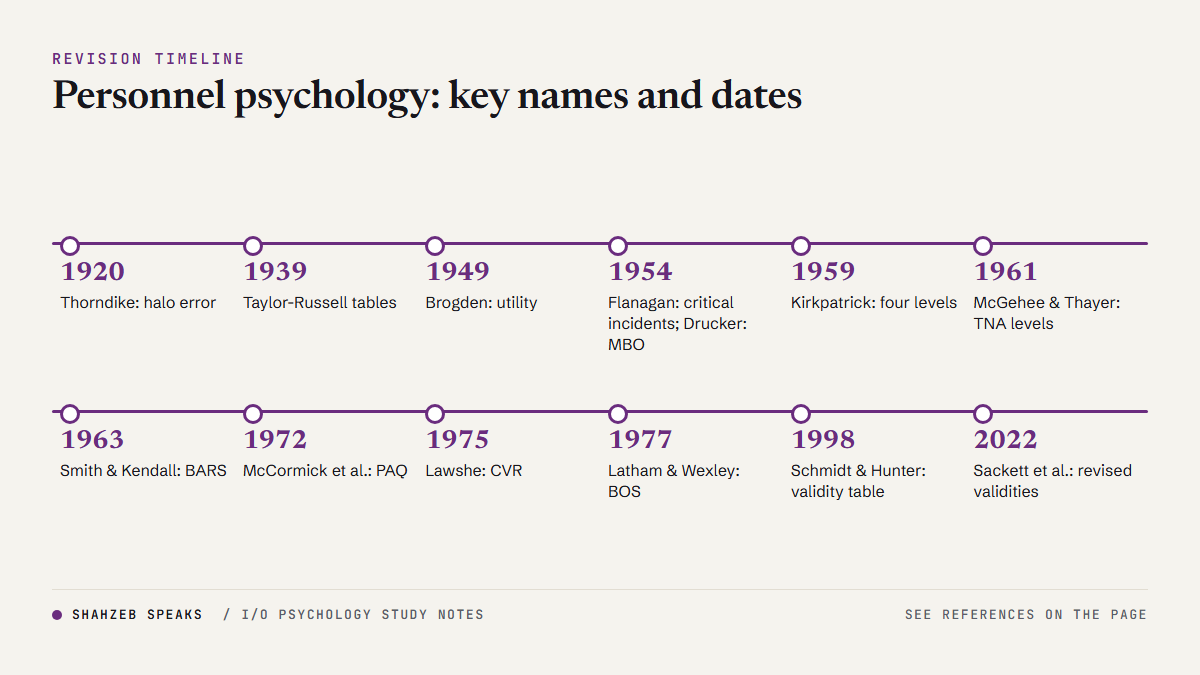
10-mark answer structure: “Discuss the scope of personnel psychology”
- Definition: personnel psychology is the branch of I/O psychology concerned with job analysis, recruitment, selection, performance appraisal and training.
- Job analysis: definition, two outputs, two methods with dates (PAQ, 1972; critical incident technique, 1954).
- Recruitment and selection: predictors; validity and reliability in one line each; the 2022 finding that structured interviews have the highest validity.
- Utility and fairness: Taylor-Russell (1939), the four-fifths rule.
- Performance appraisal: one modern method (BARS, 1963), two rater errors (halo, leniency), frame-of-reference training.
- Training: McGehee and Thayer’s three levels (1961) and Kirkpatrick’s four levels (1959).
- Local example: how a bank or call centre could apply one of these steps.
- Conclusion: the steps form one cycle, and each depends on good job analysis and sound measurement.
Model opening line: “Personnel psychology, the industrial side of I/O psychology, applies psychological measurement to the whole employment cycle, from analysing jobs and selecting employees to appraising and training them, so that decisions about people are accurate, fair and useful to the organisation.”
Practice MCQs: personnel psychology across topics
Practice questions written to the published syllabus, not past-paper items. Each topic page has its own 10 questions; these mix topics.
-
Which step comes first in the personnel psychology cycle and supports all the others?
- Selection
- Training needs analysis
- Job analysis
- Performance appraisal
Show answer
C. Job analysis defines tasks and KSAOs, which selection tests, appraisal forms and training plans all depend on.
-
A bank shows applicants a short video of the hardest parts of a teller’s day before they accept the offer. This is:
- a work sample test
- a realistic job preview
- an assessment centre
- a concurrent validity study
Show answer
B. Giving an honest picture of the job, downsides included, is a realistic job preview. It is a recruitment tool, not a test or a validation design.
-
A company can choose 5 hires from 100 applicants. Its selection ratio is:
- 0.05
- 0.20
- 5
- 20
Show answer
A. Selection ratio = hires ÷ applicants = 5 ÷ 100 = 0.05. A low ratio means the organisation can be choosy, which increases a valid test’s usefulness.
-
Judging nurses only on the number of patients seen, ignoring patient safety, is an example of a criterion that is:
- contaminated
- deficient
- reliable
- face valid
Show answer
B. It misses an important part of the job, so it is deficient. Contamination would mean including things that are not performance.
-
In the Brogden-Cronbach-Gleser utility formula, SDy stands for:
- the standard deviation of test scores
- the money value of one standard deviation of job performance
- the selection ratio
- the standard error of measurement
Show answer
B. SDy converts performance differences into money. Test-score spread, the selection ratio and SEM are different quantities.
-
Which pairing of name and contribution is WRONG?
- Flanagan: critical incident technique
- Lawshe: content validity ratio
- Kirkpatrick: three levels of training needs analysis
- Smith and Kendall: BARS
Show answer
C. The three levels of training needs analysis are McGehee and Thayer’s (1961). Kirkpatrick gave the four levels of training evaluation.
-
Group A is hired at 40% and Group B at 36%. Under the four-fifths rule:
- there is evidence of adverse impact
- there is no evidence of adverse impact, because 36 ÷ 40 = 0.90
- the rule cannot be used for hiring rates
- adverse impact exists whenever rates differ
Show answer
B. The impact ratio is 0.90, above 0.80, so the rule does not flag adverse impact. Any difference is not enough by itself.
-
A team leader rates every agent 3 out of 5 because she does not want to justify extreme ratings. This is:
- halo
- central tendency error
- contrast error
- severity
Show answer
B. Clustering everyone at the midpoint is central tendency. Halo is about one person’s dimensions; severity pushes ratings down.
-
According to Sackett et al. (2022), cognitive ability tests have an estimated operational validity of about:
- .51
- .42
- .31
- .19
Show answer
C. .31 in the 2022 revision. .51 was Schmidt and Hunter’s (1998) value; .42 is structured interviews; .19 is unstructured interviews.
-
Trained staff do not use a new procedure because their supervisor discourages it. This is a problem of:
- reliability
- transfer of training linked to the work environment
- content validity
- job evaluation
Show answer
B. Baldwin and Ford (1988) list the work environment as one of three influences on transfer. It is not a measurement or job evaluation issue.
Practise on your phone
The free I/O Psychology Prep app has 410 explained
questions, flashcards and an exam countdown, and works offline. Get it on Google Play
· About the app
For more practice by topic, use the I/O psychology MCQs hub, including the sets on job analysis, selection and validity, performance appraisal and training.
Questions students ask
What is personnel psychology?
It is the branch of industrial and organisational psychology that deals with people decisions at work: analysing jobs, recruiting and selecting employees, appraising performance and training. It relies heavily on psychological measurement, so reliability, validity and fairness are central.
What is the difference between personnel psychology and organisational psychology?
Personnel (industrial) psychology focuses on fitting people to jobs through selection, appraisal and training. Organisational psychology focuses on how people experience work: motivation, attitudes, leadership, teams and culture. Most I/O courses cover both.
What topics are included in personnel psychology?
Job analysis, job descriptions and specifications, recruitment, selection methods and testing, reliability and validity, utility and adverse impact, performance appraisal methods and rater errors, training needs analysis, training design and transfer, and training evaluation.
Which is the best predictor of job performance?
In the 2022 revision by Sackett and colleagues, structured interviews had the highest average validity (.42), followed by job knowledge tests (.40) and empirically keyed biodata (.38). Combining several valid tools usually predicts better than any single one.
Is personnel psychology the same as HRM?
They overlap but are not the same. HRM covers the full management of people, including pay administration, employment law and employee relations. Personnel psychology supplies the research and measurement methods behind hiring, appraisal and training decisions.
How do I revise personnel psychology quickly?
Learn the cycle in order, then for each step learn one definition, two named methods with dates and one criticism. Use the summary table above, then test yourself with the topic MCQ sets and the app’s flashcards.
Revise the whole cycle offline
The free I/O Psychology Prep app has 410 explained
questions, flashcards and an exam countdown, and works offline. Get it on Google Play
· About the app
References
- Alliger, G. M., & Janak, E. A. (1989). Kirkpatrick’s levels of training criteria: Thirty years later. Personnel Psychology, 42(2), 331-342. https://doi.org/10.1111/j.1744-6570.1989.tb00661.x
- Arthur, W., Jr., Bennett, W., Jr., Edens, P. S., & Bell, S. T. (2003). Effectiveness of training in organizations: A meta-analysis of design and evaluation features. Journal of Applied Psychology, 88(2), 234-245. https://doi.org/10.1037/0021-9010.88.2.234
- Baldwin, T. T., & Ford, J. K. (1988). Transfer of training: A review and directions for future research. Personnel Psychology, 41(1), 63-105. https://doi.org/10.1111/j.1744-6570.1988.tb00632.x
- Bernardin, H. J., & Buckley, M. R. (1981). Strategies in rater training. Academy of Management Review, 6(2), 205-212. https://doi.org/10.5465/amr.1981.4287782
- Brogden, H. E. (1949). When testing pays off. Personnel Psychology, 2(2), 171-183. https://doi.org/10.1111/j.1744-6570.1949.tb01397.x
- Cronbach, L. J., & Gleser, G. C. (1965). Psychological tests and personnel decisions (2nd ed.). University of Illinois Press.
- Earnest, D. R., Allen, D. G., & Landis, R. S. (2011). Mechanisms linking realistic job previews with turnover: A meta-analytic path analysis. Personnel Psychology, 64(4), 865-897. https://doi.org/10.1111/j.1744-6570.2011.01230.x
- Flanagan, J. C. (1954). The critical incident technique. Psychological Bulletin, 51(4), 327-358. https://doi.org/10.1037/h0061470
- Kirkpatrick, D. L. (1959). Techniques for evaluating training programs. Journal of the American Society of Training Directors (four-part series, November 1959 to February 1960).
- Lawshe, C. H. (1975). A quantitative approach to content validity. Personnel Psychology, 28(4), 563-575. https://doi.org/10.1111/j.1744-6570.1975.tb01393.x
- McCormick, E. J., Jeanneret, P. R., & Mecham, R. C. (1972). A study of job characteristics and job dimensions as based on the Position Analysis Questionnaire (PAQ). Journal of Applied Psychology, 56(4), 347-368. https://doi.org/10.1037/h0033099
- McGehee, W., & Thayer, P. W. (1961). Training in business and industry. Wiley.
- Premack, S. L., & Wanous, J. P. (1985). A meta-analysis of realistic job preview experiments. Journal of Applied Psychology, 70(4), 706-719. https://doi.org/10.1037/0021-9010.70.4.706
- Sackett, P. R., Zhang, C., Berry, C. M., & Lievens, F. (2022). Revisiting meta-analytic estimates of validity in personnel selection: Addressing systematic overcorrection for restriction of range. Journal of Applied Psychology, 107(11), 2040-2068. https://doi.org/10.1037/apl0000994
- Schmidt, F. L., & Hunter, J. E. (1998). The validity and utility of selection methods in personnel psychology: Practical and theoretical implications of 85 years of research findings. Psychological Bulletin, 124(2), 262-274. https://doi.org/10.1037/0033-2909.124.2.262
- Smith, P. C., & Kendall, L. M. (1963). Retranslation of expectations: An approach to the construction of unambiguous anchors for rating scales. Journal of Applied Psychology, 47(2), 149-155. https://doi.org/10.1037/h0047060
- Taylor, H. C., & Russell, J. T. (1939). The relationship of validity coefficients to the practical effectiveness of tests in selection: Discussion and tables. Journal of Applied Psychology, 23(5), 565-578. https://doi.org/10.1037/h0057079
- Thorndike, E. L. (1920). A constant error in psychological ratings. Journal of Applied Psychology, 4(1), 25-29. https://doi.org/10.1037/h0071663
- Uniform guidelines on employee selection procedures, 29 C.F.R. pt. 1607 (1978). https://www.ecfr.gov/current/title-29/subtitle-B/chapter-XIV/part-1607
- Viswesvaran, C., Ones, D. S., & Schmidt, F. L. (1996). Comparative analysis of the reliability of job performance ratings. Journal of Applied Psychology, 81(5), 557-574. https://doi.org/10.1037/0021-9010.81.5.557
Up to the main guide: What is I/O psychology? A student’s complete guide. The full Hub C series: job analysis methods, job description vs job specification, recruitment vs selection, validity in employee selection, reliability in psychological testing, performance appraisal errors, methods of performance appraisal, training needs analysis and Kirkpatrick’s four levels.