
Methods of performance appraisal are the formats used to judge an employee’s work. Traditional methods include ranking, paired comparison, graphic rating scales, checklists, critical incidents, essays and forced distribution. Modern methods include BARS (Smith and Kendall, 1963), behavioural observation scales (Latham and Wexley, 1977), management by objectives (Drucker, 1954) and 360-degree feedback.
This guide is for BS, MBA and MSc students who need “traditional and modern methods of performance appraisal” for an exam, and for HR officers choosing a format. Each method gets a plain explanation, a workplace example and its main strength and weakness. Then you get a comparison table, a worked BARS example, a 10-mark answer plan and practice MCQs with explanations.
Appraisal is part of the performance management unit of personnel psychology; the personnel psychology notes pillar shows the whole unit.
What is a performance appraisal method?
A performance appraisal is a formal judgement of how well an employee has done their job over a period, usually by their manager. The method (or format) is the tool the rater uses to record that judgement: a rank order, a numbered scale, a checklist, a set of goals, or ratings from several people.
Methods are often divided into two groups:
- Comparative methods judge employees against each other (ranking, paired comparison, forced distribution).
- Absolute methods judge each employee against a standard (graphic rating scales, checklists, BARS, BOS, MBO).
Textbooks in India and Pakistan also divide them into traditional methods (older, simpler, often trait-based) and modern methods (behaviour- or results-based, often with more than one rater). The split is a teaching device, not a strict rule, but it is how exam questions are usually asked.
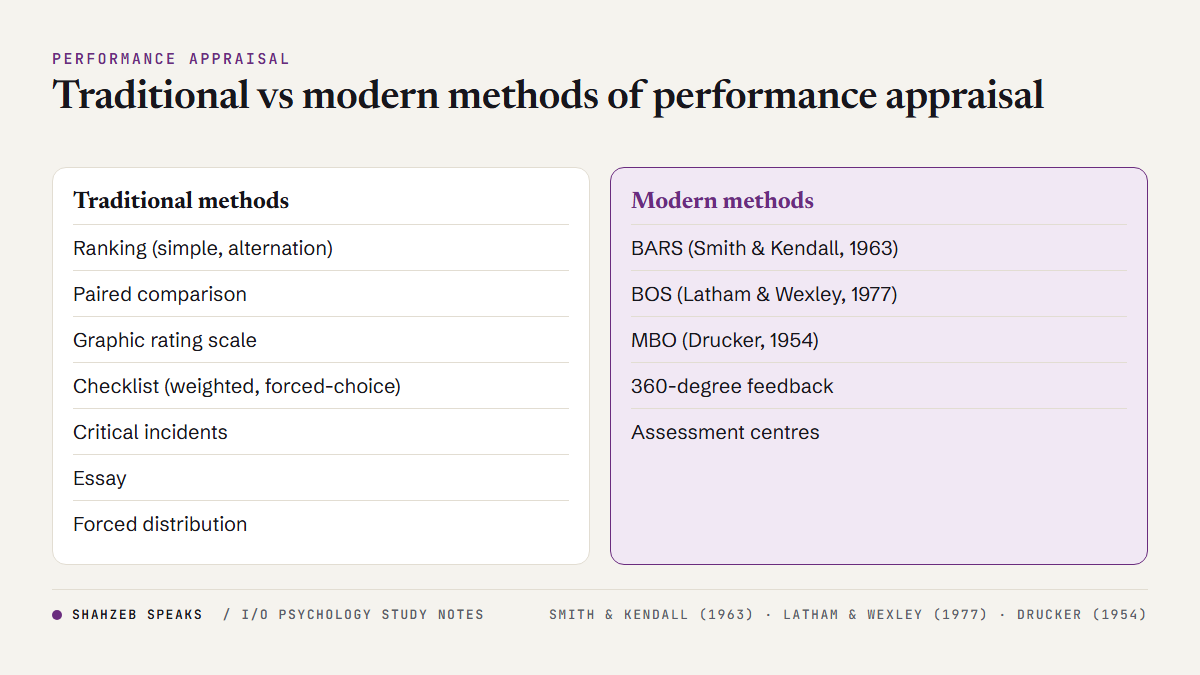
Traditional methods of performance appraisal
1. Ranking method
The rater puts employees in order from best to worst. In simple ranking the manager just lists them. In alternation ranking the manager picks the best, then the worst, then the next best, and so on, which is easier for long lists. Ranking is quick and forces the manager to separate people, but it does not say how much better the first person is than the second, and it is hard to compare ranks across different teams.
2. Paired comparison method
Each employee is compared with every other employee, one pair at a time, and the rater picks the better one in each pair. The person chosen most often ranks highest. The number of comparisons is n(n − 1) ÷ 2, so a team of 10 needs 45 comparisons and a team of 30 needs 435. It gives a more careful order than simple ranking, but becomes unworkable for large teams.
3. Graphic rating scale
The most common format. The rater scores each employee on a list of dimensions (quality of work, dependability, cooperation) on a numbered scale, such as 1 (poor) to 5 (excellent). It is simple and cheap, and the numbers can be compared across people. Its weakness is that the labels are vague: one manager’s “4 for dependability” is another manager’s “3”. When the dimensions are personality traits rather than behaviours, halo, leniency and central tendency errors creep in easily (see performance appraisal errors).
4. Checklist method
The rater ticks statements that describe the employee (“Completes reports on time”, “Helps new staff”). In a weighted checklist, HR gives each statement a hidden weight and the score is the sum of weights for the ticked items. In a forced-choice checklist, the rater must choose between statements that look equally favourable but differ in how well they separate good from poor performers, which makes it harder to inflate the rating. Checklists are easy for raters, but building and weighting good statements takes work, and forced-choice formats can frustrate managers who cannot see how the score is produced.
5. Critical incident method
The manager keeps a record of specific examples of very good and very poor behaviour through the year, each with the situation, the behaviour and the result. The method comes from Flanagan’s (1954) critical incident technique, covered in job analysis methods. Incidents give concrete examples for feedback and protect against recency error, but they take discipline to record and do not by themselves give a score that can be compared across people.
6. Essay (narrative) method
The manager writes a description of the employee’s strengths, weaknesses and potential. Essays can capture detail that scales miss, but their quality depends heavily on the manager’s writing skill and effort, and they are hard to compare.
7. Forced distribution
Managers must place set percentages of their staff into categories, for example top 20%, middle 70% and bottom 10%. General Electric under Jack Welch popularised a 20-70-10 version, which Welch described in his 2001 book. Forced distribution prevents leniency and central tendency by design. Its problems are just as clear: it assumes every team has the same spread of performance, it can turn colleagues into competitors, and it can feel unfair in a small team of strong performers. Scullen, Bergey and Aiman-Smith (2005) simulated forced distribution systems that dismiss the lowest-rated employees each year. They found the system could improve average workforce potential, but most of the gain came in the first few years, and it depended heavily on how many people were dismissed and how much voluntary turnover there was.
Modern methods of performance appraisal
8. Behaviourally anchored rating scales (BARS)
BARS were introduced by Smith and Kendall (1963) in the Journal of Applied Psychology. Each scale point is anchored with a description of a specific behaviour, so raters judge what the employee actually did rather than a vague trait. BARS are built in steps:
- Experts collect critical incidents of effective and ineffective behaviour.
- The incidents are grouped into performance dimensions.
- A second group of experts sorts the incidents back into the dimensions (this “retranslation” step, from Smith and Kendall’s title, keeps only incidents that experts agree on).
- Experts rate how effective each incident is, and incidents with consistent ratings become anchors at each scale point.
BARS are job-specific and give clear feedback, and the experts who help build them tend to accept them. They are costly to develop, need a separate scale for each job, and a rater may see behaviour that matches none of the anchors.
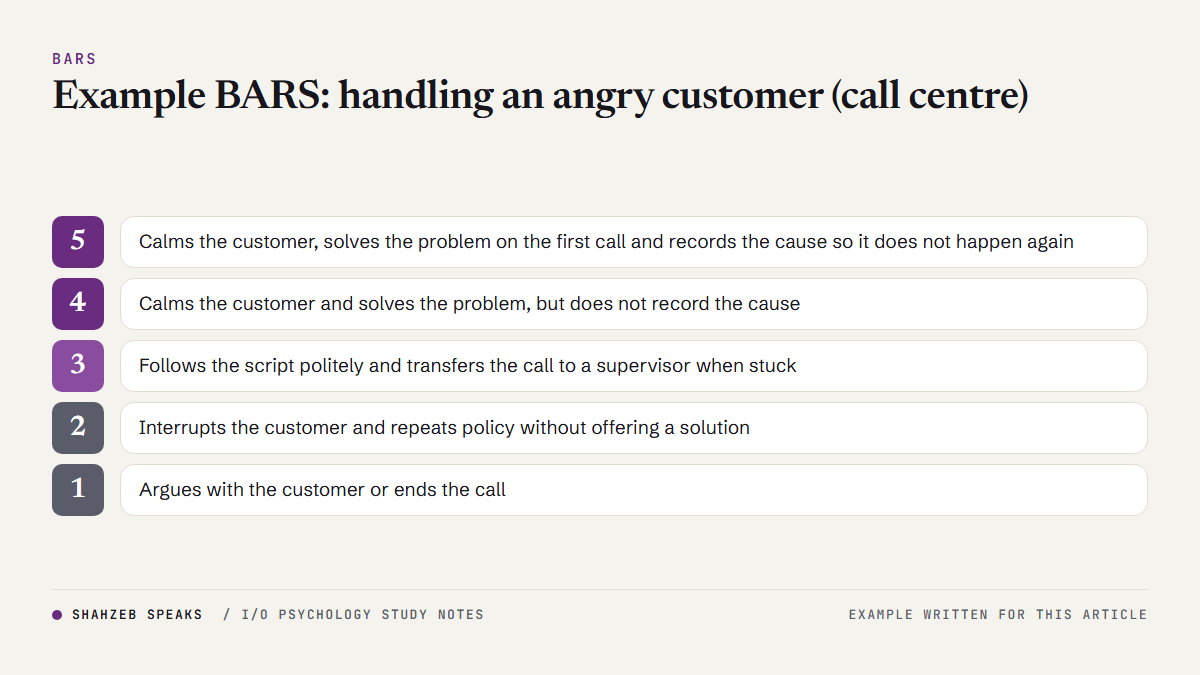
Here is how the example above reads, from the top of the scale down:
- 5: Calms the customer, solves the problem on the first call and records the cause so it does not happen again.
- 4: Calms the customer and solves the problem, but does not record the cause.
- 3: Follows the script politely and transfers the call to a supervisor when stuck.
- 2: Interrupts the customer and repeats policy without offering a solution.
- 1: Argues with the customer or ends the call.
9. Behavioural observation scales (BOS)
BOS were developed by Latham and Wexley (1977). Like BARS they start from critical incidents (Latham and Wexley used 1,204 incidents for logging supervisors), but instead of picking one anchor, the rater says how often the employee shows each listed behaviour, usually on a 5-point scale from “almost never” to “almost always”. The scores are added up for each dimension. BOS give detailed feedback on many behaviours, but they need the rater to have observed the employee often enough to judge frequency, and long lists can be tiring to complete.
10. Management by objectives (MBO)
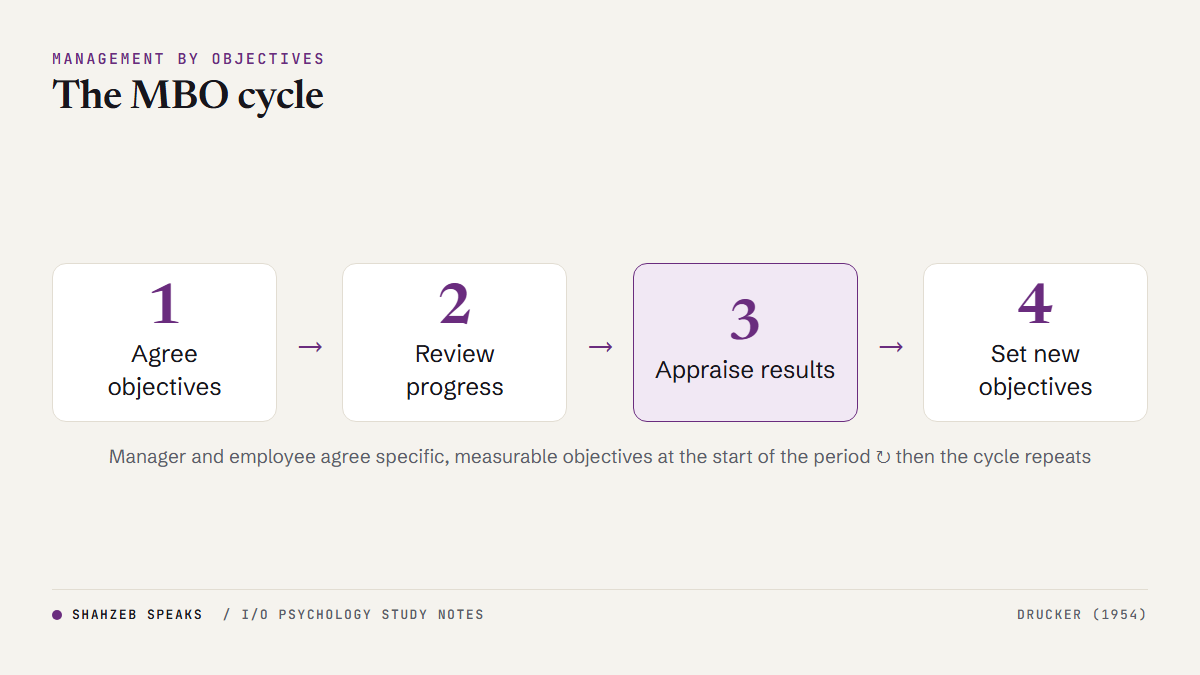
Management by objectives was set out by Peter Drucker in The Practice of Management (1954). The manager and employee agree specific, measurable objectives at the start of the period, review progress during it, and appraise the employee on how far the objectives were met, before setting new objectives for the next period. It links appraisal to the organisation’s goals and to goal-setting theory, explained in goal-setting theory. Its weaknesses: results can be affected by factors outside the employee’s control, objectives can be set too easy, and it can ignore how results were achieved (a salesperson who hits target by misleading customers).
11. 360-degree feedback
360-degree feedback collects ratings from several sources: the manager, peers, subordinates, sometimes customers, and the employee’s own self-rating. It gives a fuller picture and reduces dependence on one rater’s biases. It is widely recommended for development rather than pay decisions, and it needs anonymity and careful handling to work. The site’s full article on 360-degree feedback covers it in depth.
12. Assessment centres and other modern approaches
Assessment centres use several exercises (in-basket tasks, group discussions, role plays) and several trained assessors, and are used to judge potential for promotion more than past performance; see assessment centres. Many organisations now also use frequent check-ins and continuous feedback alongside, or instead of, a single annual review, which is discussed in the psychology of performance reviews.
Methods of performance appraisal compared (table)
| Method | Group | How it works | Main strength | Main weakness |
|---|---|---|---|---|
| Ranking | Traditional, comparative | Order staff from best to worst | Quick; forces separation | No size of differences; hard across teams |
| Paired comparison | Traditional, comparative | Compare every pair; n(n − 1) ÷ 2 comparisons | Careful ordering | Unworkable for large teams |
| Graphic rating scale | Traditional, absolute | Score dimensions on a 1-5 scale | Simple, cheap, comparable numbers | Vague labels; halo and leniency |
| Checklist (weighted / forced-choice) | Traditional, absolute | Tick statements that describe the employee | Easy for raters; forced-choice resists inflation | Hard to build; raters cannot see scoring |
| Critical incidents | Traditional, absolute | Record specific good and poor behaviour | Concrete feedback; fights recency | Time-consuming; no comparable score |
| Essay | Traditional, absolute | Written description | Rich detail | Depends on writing skill; not comparable |
| Forced distribution | Traditional, comparative | Fixed percentages in each category | Stops leniency and central tendency | Assumes equal spread; harms teamwork |
| BARS | Modern, absolute | Scale points anchored with behaviours | Job-specific, clear feedback | Costly; one scale per job |
| BOS | Modern, absolute | Rate how often each behaviour occurs | Detailed behavioural feedback | Needs frequent observation; long forms |
| MBO | Modern, results-based | Agree objectives, appraise results | Links to goals; motivating | Ignores how results were achieved |
| 360-degree feedback | Modern, multi-source | Ratings from manager, peers, subordinates, self | Fuller picture, less single-rater bias | Best for development, not pay |
Which method is best?
No format removes rater error on its own. In a major review, Landy and Farr (1980) concluded that changing the rating format had produced only small improvements in rating quality, and suggested that researchers study how raters think and process information instead. DeNisi and Murphy (2017), reviewing 100 years of appraisal research, still list scale formats as only one of eight areas, alongside rater training, rating purpose, rating sources and reactions to appraisal.
In practice, choose by purpose:
- For development and feedback: BARS, BOS, critical incidents or 360-degree feedback, because they describe behaviour the employee can change.
- For pay and promotion decisions: a behaviour-based scale combined with results (MBO), with calibration across units. Treat small score differences with care, because ratings are not perfectly reliable.
- For small firms with little HR support: a short graphic rating scale with behavioural descriptions for each point, plus a few critical incidents, is often realistic.
- Whatever the format: train raters (frame-of-reference training is the best-supported approach) and keep records through the year.
For talent reviews that combine performance with potential, the nine-box grid generator turns two ratings into a simple grid.
10-mark answer structure
- Definition: performance appraisal is the formal evaluation of an employee’s job performance over a period; methods are the formats used to record it.
- Classification: traditional vs modern; comparative vs absolute.
- Traditional methods: ranking, paired comparison (with the n(n − 1) ÷ 2 formula), graphic rating scale, checklist, critical incidents, essay, forced distribution, one line each.
- Modern methods: BARS (Smith and Kendall, 1963) with the steps, BOS (Latham and Wexley, 1977), MBO (Drucker, 1954), 360-degree feedback.
- Table of strengths and weaknesses.
- Example: a BARS anchor for a call-centre or bank job.
- Evaluation: format alone gives small gains (Landy and Farr, 1980); rater training and purpose matter.
- Conclusion: combine behaviour-based and results-based methods to suit the purpose.
Model opening line: “Performance appraisal methods range from traditional comparative techniques such as ranking and forced distribution to modern behaviour-based and results-based approaches such as BARS, BOS and management by objectives; each balances cost, accuracy and usefulness for feedback differently.”
Practice MCQs: methods of performance appraisal
Practice questions written to the published syllabus, not past-paper items.
-
Behaviourally anchored rating scales were introduced by:
- Latham and Wexley
- Smith and Kendall
- Drucker
- Flanagan
Show answer
B. Smith and Kendall (1963). Latham and Wexley developed BOS, Drucker MBO, and Flanagan the critical incident technique that BARS draw on.
-
A manager compares each of her 8 staff with every other staff member. How many comparisons does she make?
- 16
- 28
- 56
- 64
Show answer
B. n(n − 1) ÷ 2 = 8 × 7 ÷ 2 = 28. 56 forgets to divide by two; 64 is 8 squared.
-
Which method rates how often an employee shows each listed behaviour?
- BARS
- Behavioural observation scales
- Forced distribution
- Essay method
Show answer
B. BOS use frequency ratings (“almost never” to “almost always”). BARS pick one anchored level; forced distribution sets quotas; essays are narrative.
-
A company requires every manager to place 10% of staff in the lowest category. This is:
- MBO
- forced distribution
- paired comparison
- weighted checklist
Show answer
B. Fixed percentages per category define forced distribution. The others do not impose quotas.
-
In building BARS, the “retranslation” step means:
- translating the form into another language
- a second group of experts re-sorts incidents into dimensions, and only agreed incidents are kept
- converting ratings into percentiles
- rewriting objectives each quarter
Show answer
B. Retranslation checks that experts agree which dimension each incident belongs to. It has nothing to do with language, percentiles or objectives.
-
Which is the main criticism of MBO?
- It needs critical incidents for every job
- It can ignore how results were achieved
- It forces fixed percentages of staff into each category
- It cannot be linked to organisational goals
Show answer
B. MBO judges results, so behaviour on the way can be ignored. It links well to goals (D is wrong) and does not use incidents or quotas.
-
Which is NOT usually classed as a modern method?
- BARS
- 360-degree feedback
- Management by objectives
- Simple ranking
Show answer
D. Simple ranking is a traditional comparative method. The other three are modern behaviour-based, multi-source or results-based methods.
-
A rater must choose between two equally favourable-looking statements about an employee. This is a:
- forced-choice checklist
- graphic rating scale
- essay appraisal
- paired comparison
Show answer
A. Forced-choice formats hide which statement scores higher, to reduce inflation. Paired comparison compares people, not statements.
-
360-degree feedback is generally recommended mainly for:
- setting salaries
- employee development
- legal defence of dismissals
- replacing job analysis
Show answer
B. Multi-source feedback works best for development; using it for pay can make raters less honest. It does not replace job analysis.
-
Landy and Farr (1980) concluded that changing the rating format:
- removed all rater errors
- produced only small improvements in rating quality
- made appraisal unnecessary
- doubled rating reliability
Show answer
B. They found small gains from format changes and pointed research towards raters’ cognitive processes. No format removes all errors.
Practise on your phone
The free I/O Psychology Prep app has 410 explained
questions, flashcards and an exam countdown, and works offline. Get it on Google Play
· About the app
More practice: the performance appraisal MCQs set.
Questions students ask
What are the traditional and modern methods of performance appraisal?
Traditional methods are ranking, paired comparison, graphic rating scales, checklists, critical incidents, essays and forced distribution. Modern methods are BARS, behavioural observation scales, management by objectives, 360-degree feedback and assessment centres.
What is the difference between BARS and BOS?
Both are built from critical incidents. BARS ask the rater to pick the anchored behaviour that best matches the employee on each dimension. BOS ask the rater how often the employee shows each of many listed behaviours, and add up the frequencies.
Which performance appraisal method is the best?
None is best for every purpose. Behaviour-based methods (BARS, BOS) suit feedback and development; MBO suits results-focused jobs; 360-degree feedback suits leadership development. Rater training and good records matter as much as the format.
What is the graphic rating scale method?
The rater scores the employee on several dimensions, such as quality of work or dependability, using a numbered scale such as 1 to 5. It is the most common and simplest format, but vague labels make it prone to halo and leniency errors.
Who introduced management by objectives?
Peter Drucker set out management by objectives in his 1954 book The Practice of Management. It became widely used as an appraisal method in which manager and employee agree objectives and appraise results against them.
Why is forced distribution criticised?
It assumes every team has the same spread of good and poor performers, which is often untrue for small or carefully selected teams. It can also make colleagues compete instead of cooperate, and people in a strong team can be rated low simply to fill the quota.
Revise appraisal methods with flashcards
The free I/O Psychology Prep app has 410 explained
questions, flashcards and an exam countdown, and works offline. Get it on Google Play
· About the app
References
- DeNisi, A. S., & Murphy, K. R. (2017). Performance appraisal and performance management: 100 years of progress? Journal of Applied Psychology, 102(3), 421-433. https://doi.org/10.1037/apl0000085
- Drucker, P. F. (1954). The practice of management. Harper & Row.
- Flanagan, J. C. (1954). The critical incident technique. Psychological Bulletin, 51(4), 327-358. https://doi.org/10.1037/h0061470
- Landy, F. J., & Farr, J. L. (1980). Performance rating. Psychological Bulletin, 87(1), 72-107. https://doi.org/10.1037/0033-2909.87.1.72
- Latham, G. P., & Wexley, K. N. (1977). Behavioral observation scales for performance appraisal purposes. Personnel Psychology, 30(2), 255-268. https://doi.org/10.1111/j.1744-6570.1977.tb02092.x
- Scullen, S. E., Bergey, P. K., & Aiman-Smith, L. (2005). Forced distribution rating systems and the improvement of workforce potential: A baseline simulation. Personnel Psychology, 58(1), 1-32. https://doi.org/10.1111/j.1744-6570.2005.00361.x
- Smith, P. C., & Kendall, L. M. (1963). Retranslation of expectations: An approach to the construction of unambiguous anchors for rating scales. Journal of Applied Psychology, 47(2), 149-155. https://doi.org/10.1037/h0047060
- Welch, J., & Byrne, J. A. (2001). Jack: Straight from the gut. Warner Books.
Back to the hub: Personnel psychology notes. Related: performance appraisal errors, job analysis methods and training needs analysis.