
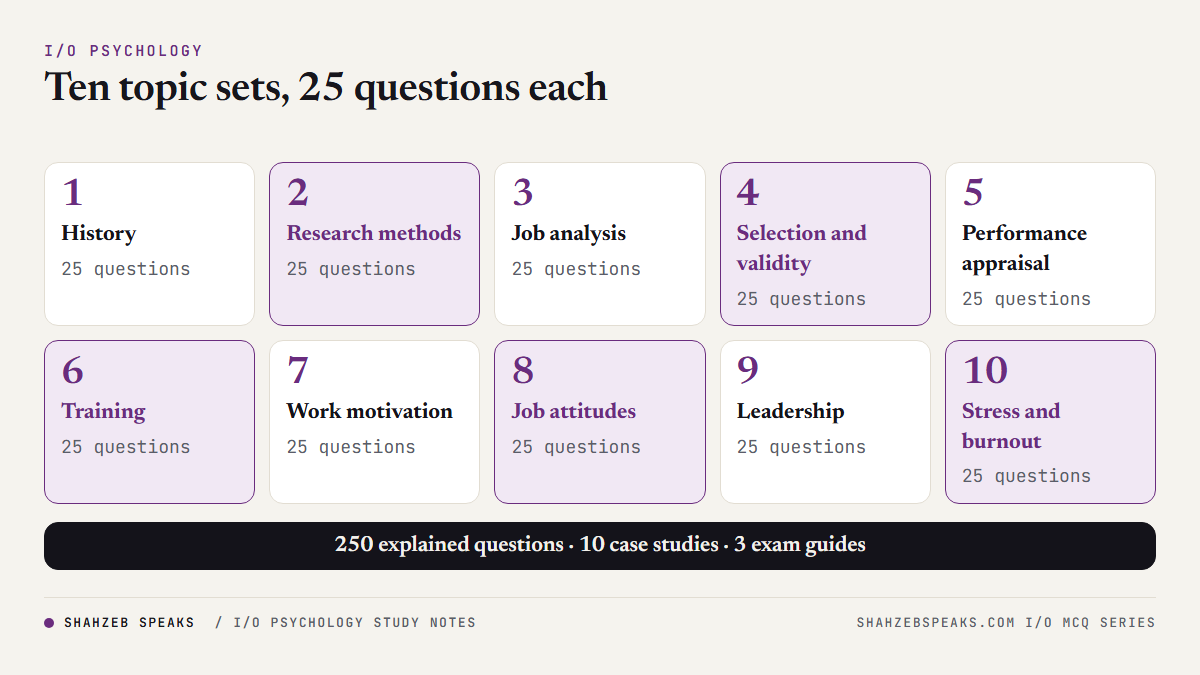
I/O psychology MCQs come from about ten topics: history, research methods, job analysis, selection and validity, performance appraisal, training, motivation, job attitudes, leadership, and stress. This page gives 30 mixed questions with answers and explanations, then links to ten topic sets of 25 questions each, case studies and three exam guides.
I made this page for students who type “industrial psychology MCQs with answers” the night before a paper and find either question lists with no answers or paid PDFs. Everything here is free, every answer is explained, and the explanations say why the wrong options are wrong, which is what actually helps you on the day. It suits BS and MSc psychology students in Pakistan and India, psychometrician board reviewers in the Philippines, and first I/O courses in the UK, US and South Africa.
The questions are practice questions written to the published syllabus of typical I/O courses. They are not past-paper, board or leaked questions, and no page on this site will ever claim to have those. If you want the exam-specific angle, use the guides for the psychometrician board exam, PPSC, FPSC and CSS and UGC NET and IGNOU.
What is on I/O psychology exams?
Course outlines are the best evidence of what gets examined, because papers are set from them. The University of the Punjab’s outline for BSTE 322 Industrial Psychology (BS Technology Education, 2024) is a typical example. Its sixteen weeks run in this order: introduction and history; research methods; job analysis and selection; training and development; performance appraisal; motivation and job satisfaction; work stress and well-being; organisational culture and climate; leadership; teams; organisational development and change; diversity and inclusion; employee and labour relations; HR policies; technology and work; and review. Its main textbook is Landy and Conte’s Work in the 21st Century, with Aamodt’s Industrial/Organizational Psychology: An Applied Approach as suggested reading.
Most I/O courses in other countries follow the same textbooks, so the same core topics come up: the industrial (personnel) side with job analysis, selection, appraisal and training, and the organisational side with motivation, attitudes, leadership, teams and stress. Board and public service exams cover these inside a wider psychology syllabus. Their weightage and format change, so always check the latest official syllabus from the exam body itself; the exam guides linked above point to those official pages.
Three kinds of question appear again and again in every topic:
- Recall: who proposed it, which year, what the parts are called (for example, the five core job dimensions).
- “Which is NOT”: three true parts of a theory and one item from a neighbouring theory. These test whether you can keep similar theories apart.
- Scenario: a short workplace story (a bank branch, a call centre, a hospital ward) where you must name the theory, error or method it shows. These are the ones students miss most, because they need understanding rather than memory.
The ten topic sets, case studies and exam guides
Each set below has 25 questions with explanations, a one-page summary of the topic and a plan for the long question. Together they give 250 questions. Each set has its own questions rather than the same items reshuffled, so working through all of them is real practice.
| Topic set | What it covers | Questions |
|---|---|---|
| History of I/O psychology | Scott, Taylor, Münsterberg, Army Alpha and Beta, Hawthorne, Division 14 and SIOP | 25 |
| Research methods and statistics | Designs, sampling, measurement, reliability coefficients, mediation and moderation | 25 |
| Job analysis | KSAOs, PAQ, critical incidents, O*NET, job evaluation | 25 |
| Selection, reliability and validity | Types of reliability and validity, SEM, utility, the four-fifths rule | 25 |
| Performance appraisal | Criteria, BARS, BOS, MBO, 360-degree feedback, rater errors | 25 |
| Training and development | Needs analysis, Kirkpatrick’s four levels, transfer of training, evaluation designs | 25 |
| Work motivation | Maslow, ERG, Herzberg, McClelland, Vroom, Adams, goal setting, SDT, JCM | 25 |
| Job attitudes, OCB and CWB | Job satisfaction, commitment, engagement, citizenship and counterproductive behaviour | 25 |
| Leadership theories | Traits, Ohio State, Fiedler, path-goal, LMX, transformational leadership | 25 |
| Occupational stress and burnout | Appraisal and coping, demand-control, effort-reward, JD-R, burnout | 25 |
| I/O psychology case studies | Ten workplace cases with questions, for application practice | 10 cases |
How to use these MCQs so they actually stick
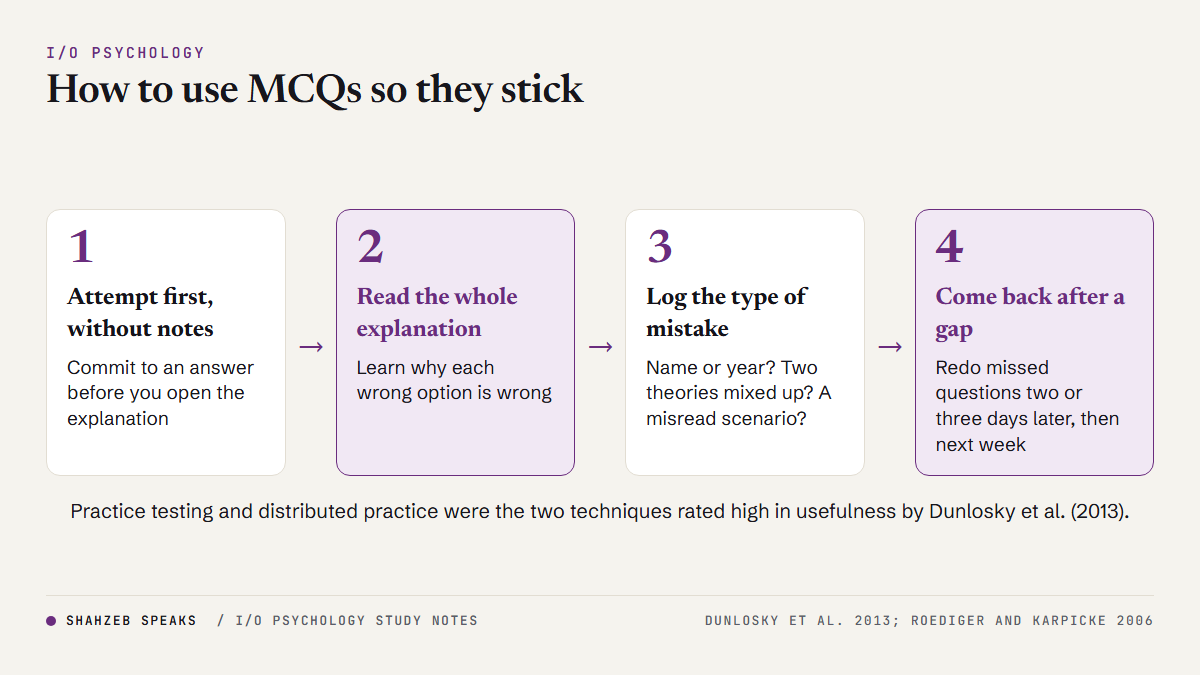
Reading notes again feels productive but does little for recall on the day. Two techniques have strong evidence behind them. In Dunlosky and colleagues’ (2013) review of ten common study techniques, practice testing and distributed practice (spreading study over time) were the only two rated high in usefulness. Roediger and Karpicke (2006) found that students who were tested on a passage remembered more a week later than students who spent the same time re-reading it. MCQs with explanations are one easy way to do both.
- Attempt first, without notes. Commit to an answer before opening the explanation. Guessing and then checking still counts as retrieval practice.
- Read the whole explanation. The lines about why the distractors are wrong teach you to separate neighbouring theories, which is what “which is NOT” items test.
- Log the type of mistake. Was it a name or year you did not know, two theories you mixed up, or a scenario you misread? Each needs a different fix.
- Come back after a gap. Redo the questions you missed two or three days later, then again the next week, instead of repeating the whole set the same evening.
30 mixed I/O psychology MCQs with answers
These 30 questions mix all ten topics, three from each, so they feel like a real paper. None of them appears in the topic sets. Each explanation ends with the set to go to if you want more on that topic.
-
Which event is usually treated as the starting point of the human relations movement in management and I/O psychology?
- The Army Alpha and Beta testing programme of 1917
- Taylor’s Principles of Scientific Management (1911)
- The Hawthorne studies at Western Electric
- The incorporation of SIOP in 1982
Show answer
C. The Hawthorne findings about attention, supervision and informal groups shifted thinking toward the social side of work. Army testing advanced selection, Taylor’s book is the scientific management view the movement reacted against, and SIOP came much later. More: history set.
-
Which of these is NOT one of Bandura’s (1977) four sources of self-efficacy?
- Mastery experiences (succeeding at the task yourself)
- Vicarious experience (seeing similar others succeed)
- Verbal persuasion
- Length of service in the organisation
Show answer
D. Bandura named mastery experiences, vicarious experience, verbal persuasion and physiological and emotional states. Years of service may bring mastery, but tenure itself is not a source in the theory. More: motivation set.
-
A bank’s hiring process has a numerical test, then an interview, then a medical check. Candidates who fail any stage leave the process and do not go on to the next. This is a:
- Compensatory approach
- Multiple hurdle approach
- Banding approach
- Top-down selection on one test
Show answer
B. In a multiple hurdle design, each stage must be passed in turn. In a compensatory approach, a high score on one predictor can make up for a low score on another. Banding treats close scores as equal, and top-down selection ranks on a single score. More: selection set.
-
A new lecturer has been told she must “contribute to the department” to be promoted, but nobody can say whether that means research papers, teaching scores or committee work. Which stressor is this?
- Role conflict
- Role overload
- Role ambiguity
- Effort-reward imbalance
Show answer
C. Role ambiguity is a lack of clear information about what is expected (Rizzo, House and Lirtzman, 1970). Role conflict is incompatible demands, role overload is too much to do, and effort-reward imbalance is about high effort with low rewards. More: stress set.
-
To understand a call-centre agent’s job, an analyst works a few shifts as an agent herself, taking real calls under supervision. Which job analysis method is this?
- Observation
- Job participation (doing the job)
- The Position Analysis Questionnaire
- Job evaluation
Show answer
B. Doing the job gives first-hand knowledge of its demands, though it suits jobs that are safe and quick to learn. Observation means watching others work, the PAQ is a structured questionnaire, and job evaluation sets the relative worth of jobs for pay. More: job analysis set.
-
Longenecker, Sims and Gioia (1987) interviewed executives about how they rated their subordinates. What did they find?
- Executives rated with near-perfect accuracy
- Executives often adjusted ratings on purpose for political reasons, such as avoiding conflict or protecting a pay rise
- Rating errors happened only when forms were badly designed
- Executives refused to give any ratings
Show answer
B. Their “behind the mask” interviews showed that many inaccurate ratings were deliberate choices, not just perceptual errors. That is why better forms and error training cannot fix appraisal on their own. More: appraisal set.
-
A supervisor at a garment factory repeatedly mocks workers in front of others, blames them for his own mistakes and gives them the silent treatment, without ever touching anyone. Tepper (2000) would call this:
- Laissez-faire leadership
- Management by exception
- Initiating structure
- Abusive supervision
Show answer
D. Tepper defined abusive supervision as subordinates’ perception of sustained hostile verbal and non-verbal behaviour, excluding physical contact. Laissez-faire is the absence of leadership, management by exception is stepping in when things go wrong, and initiating structure is organising the work. More: leadership set.
-
Eisenberger and colleagues (1986) described employees’ general belief about how much the organisation values their contributions and cares about their well-being. They called it:
- Perceived organisational support
- Continuance commitment
- Job involvement
- Psychological safety
Show answer
A. Perceived organisational support is the employee’s sense that the organisation, as a whole, values and cares about them. Continuance commitment is staying because leaving costs too much, job involvement is how central the job is to a person’s identity, and psychological safety is feeling safe to take interpersonal risks. More: job attitudes set.
-
Staff learning a new hospital records system are told to explore it, make mistakes and work out what went wrong, rather than follow a step-by-step guide that avoids errors. Keith and Frese’s (2008) meta-analysis found this error management training led to:
- Better transfer than error-avoidant training, especially to new tasks not covered in training
- Worse performance in every case
- No difference at all
- Better results only for very simple tasks
Show answer
A. Encouraging errors and learning from them improved transfer overall, and the gain was clearest for adaptive transfer to new problems. It did not harm learning in every case, and the benefit was not limited to simple tasks. More: training set.
-
A bank randomly assigns 20 of its 40 real branches to a new incentive scheme and compares sales with the other 20 over six months. Compared with a laboratory study, this field experiment mainly gains:
- Complete control over every outside influence
- No need for random assignment
- Realism, so the results are more likely to apply to real workplaces
- Guaranteed statistical significance
Show answer
C. Field experiments keep random assignment but run in real settings, which helps generalisation; the price is less control over outside events. They do not remove the need for randomisation, and nothing guarantees significance. More: research methods set.
-
A supervisor stops sending reminder messages to an agent as soon as she submits her daily report on time, and from then on she submits it on time. Which reinforcement process is this?
- Positive reinforcement
- Punishment
- Extinction
- Negative reinforcement
Show answer
D. Removing something unpleasant (the reminders) to strengthen a behaviour is negative reinforcement. Positive reinforcement adds something pleasant, punishment weakens a behaviour, and extinction weakens it by withdrawing the reinforcer. Students often confuse negative reinforcement with punishment. More: motivation set.
-
Which statement correctly separates the “industrial” and “organizational” sides of I/O psychology?
- Industrial covers factories; organizational covers offices
- Industrial covers personnel work such as job analysis, selection, training and appraisal; organizational covers motivation, attitudes, leadership, teams and culture
- Industrial is research; organizational is practice
- Industrial is American; organizational is European
Show answer
B. The split is by topic, not by setting, method or country. A hospital, bank or software house has both sides. More: industrial vs organizational psychology.
-
A company decides that candidates scoring between 78 and 84 on its test will be treated as equal, because the test’s standard error of measurement makes differences that small unreliable. This practice is called:
- Multiple hurdles
- Forced distribution
- Range restriction
- Banding
Show answer
D. Banding groups scores whose differences are within measurement error, then uses other factors to choose within the band. Multiple hurdles is a sequence of stages, forced distribution is an appraisal method, and range restriction is a statistical problem in validation. Try the SEM and banding calculator.
-
A bank teller’s speed and accuracy at transactions are her task performance. Her habit of helping new colleagues and volunteering for extra duties is what Borman and Motowidlo (1993) called:
- Contextual performance
- Criterion contamination
- Counterproductive work behaviour
- Halo
Show answer
A. Contextual performance supports the social and psychological setting in which the core work gets done. Contamination is a measurement flaw, counterproductive behaviour harms the organisation, and halo is a rating error. More: appraisal set.
-
The Yerkes-Dodson law, first reported in 1908, is now usually drawn as an inverted U. What does it say about arousal and performance?
- More arousal always improves performance
- Arousal has no link with performance
- Performance rises with arousal up to a point, then falls, and the best level is lower for difficult tasks
- Only low arousal produces good performance
Show answer
C. Moderate arousal suits most tasks, while very high arousal hurts complex ones. The original study used mice learning a discrimination task, and the neat inverted-U curve is a later simplification, so use it as a rough guide. More: stress set.
-
Which of these is the best-written task statement for a ward nurse’s job analysis?
- “Responsible for patients”
- “Records patients’ vital signs every four hours on the ward chart so that changes are noticed early”
- “Good with people and calm under pressure”
- “Works hard on every shift”
Show answer
B. A good task statement says what is done (action verb and object), how or when, and why. “Responsible for patients” is too vague, “good with people” describes a worker characteristic (a KSAO), not a task, and “works hard” is a judgement, not an observable task. More: job analysis methods.
-
A student writes: “Extraverts make better leaders.” Judge, Bono, Ilies and Gerhardt (2002) suggest which refinement?
- Extraversion has no link with leadership at all
- Only introverts become effective leaders
- Extraversion is related more strongly to emerging as a leader than to being an effective one
- Extraversion matters only in military settings
Show answer
C. Extraverted people tend to be noticed and chosen as leaders, but the link with how well they lead was weaker. Extraversion was still the most consistent Big Five correlate overall, so options A, B and D are wrong. More: leadership set.
-
Griffeth, Hom and Gaertner’s (2000) meta-analysis of employee turnover found that the link between job satisfaction and actually leaving was:
- Negative but modest in size, so many dissatisfied people stay and some satisfied people leave
- Zero
- Positive: satisfied people leave more
- So strong that satisfaction alone predicts who will leave
Show answer
A. Lower satisfaction goes with more turnover, but the relationship is modest because leaving also depends on job alternatives, commitment and personal circumstances. It is not zero, not positive and not strong enough to predict individuals on its own. More: job attitudes set.
-
A training designer for experienced engineers explains why each module matters, builds on their work experience and uses real problems from their sites. This follows which ideas about how adults learn?
- Taylor’s scientific management
- Knowles’s andragogy
- Skinner’s fixed-interval schedule
- Fiedler’s LPC
Show answer
B. Knowles (1980) argued that adults want to know why they are learning, bring experience that should be used, and learn best around real problems. The other options are about job design, reinforcement timing and leadership. More: training set.
-
Schmidt and Hunter (1977) argued that test validities vary much less from job to job than single small studies suggest. Which method did they use to show this?
- A single large laboratory experiment
- Qualitative interviews with HR managers
- Meta-analysis that corrects results for sampling error and other statistical artefacts (validity generalisation)
- Case studies of one company
Show answer
C. By combining many validity studies and correcting for small samples, range restriction and unreliability, they showed much of the apparent variation was artefact. This is validity generalisation. Single experiments, interviews and case studies cannot show this. More: research methods set.
-
Call-centre agents get a bonus after an unpredictable number of completed sales, on average one bonus for every ten sales. Which reinforcement schedule is this?
- Fixed interval
- Fixed ratio
- Variable interval
- Variable ratio
Show answer
D. Ratio schedules depend on the number of responses; “unpredictable number” makes it variable. Variable-ratio schedules produce high, steady response rates that are slow to fade (Ferster and Skinner, 1957). Interval schedules depend on time, and a fixed ratio would pay after exactly ten sales every time. More: motivation set.
-
Candidates for a branch manager post receive a pile of memos, emails and customer complaints and must decide what to do with each within an hour. This assessment centre exercise is called:
- An in-basket (in-tray) exercise
- A leaderless group discussion
- A structured interview
- A personality inventory
Show answer
A. The in-basket tests planning, prioritising and decision-making on realistic paperwork. A leaderless group discussion puts candidates together without an appointed chair, a structured interview asks set questions, and a personality inventory is a questionnaire. See assessment centres.
-
Which of these is NOT one of the four recovery experiences measured by Sonnentag and Fritz (2007)?
- Psychological detachment from work
- Relaxation
- Rumination about work problems
- Mastery experiences
Show answer
C. The four are psychological detachment, relaxation, mastery and control over leisure time. Rumination, going over work problems in your head, is the opposite of detachment and works against recovery. More: stress set.
-
A bank is planning a “digital branch adviser” role that does not exist yet. Analysts ask senior managers and technology experts to forecast the future tasks and KSAOs. Schneider and Konz (1989) called this:
- Strategic job analysis
- The Position Analysis Questionnaire
- Job evaluation by ranking
- Criterion contamination
Show answer
A. Strategic (future-oriented) job analysis studies what a job will need, not only what it needs now. The PAQ analyses existing jobs, ranking is a pay method, and contamination is a measurement flaw. More: job analysis set.
-
In performance measurement, “criterion relevance” refers to:
- How many raters are used
- The overlap between the actual measure and the ultimate criterion
- The cost of the rating form
- How quickly ratings are completed
Show answer
B. Relevance is the part of the actual measure that truly captures the ultimate criterion. The parts it misses are deficiency, and the irrelevant parts it picks up are contamination. Rater numbers, cost and speed are practical issues, not relevance. More: appraisal set.
-
Which of these is NOT one of the four components of authentic leadership measured by Walumbwa and colleagues (2008)?
- Self-awareness
- Relational transparency
- Management by exception
- Balanced processing
Show answer
C. The four components are self-awareness, relational transparency, balanced processing and an internalised moral perspective. Management by exception belongs to transactional leadership. More: leadership set.
-
An unhappy officer at an insurance company goes to her manager with a written proposal to fix the shift system that is causing problems. In Farrell’s (1983) framework of responses to dissatisfaction, this is:
- Exit
- Neglect
- Loyalty
- Voice
Show answer
D. Voice is an active, constructive attempt to improve conditions. Exit is leaving, neglect is letting things slide (lateness, low effort), and loyalty is waiting patiently for things to improve. More: job attitudes set.
-
Why do airlines train pilots for engine failures in full flight simulators rather than only in real aircraft?
- Simulators let trainees practise rare and dangerous events safely in conditions very close to the real task, which supports transfer
- Simulators are always cheaper than any other training
- Real aircraft cannot be used for any training
- Simulator training needs no evaluation
Show answer
A. High-fidelity simulation allows safe, repeated practice of situations that cannot be created on purpose in real flights, and the close match to the real cockpit helps skills carry over. Cost varies, aircraft are also used, and simulator training still needs evaluation. More: training set.
-
A job satisfaction survey asks people to rate statements from “strongly disagree” to “strongly agree”. This response format is named after:
- Louis Thurstone
- Rensis Likert
- Charles Spearman
- Lee Cronbach
Show answer
B. Likert (1932) described summated ratings on agree-disagree statements. Thurstone developed a different, judge-based scaling method, Spearman worked on correlation and intelligence, and Cronbach on alpha and validity. More: research methods set.
-
Elton Mayo’s 1933 book, which drew on the Hawthorne research and helped launch the human relations movement, was titled:
- The Principles of Scientific Management
- Management and the Worker
- The Human Side of Enterprise
- The Human Problems of an Industrial Civilization
Show answer
D. Mayo’s 1933 book is The Human Problems of an Industrial Civilization. Taylor wrote the 1911 scientific management book, Roethlisberger and Dickson wrote Management and the Worker (1939), and McGregor wrote The Human Side of Enterprise (1960). More: history set.
Practise on your phone
The free I/O Psychology Prep app has 410 explained
questions, flashcards and an exam countdown, and works offline. Get it on Google Play
· About the app
How to answer the “define I/O psychology” question
Almost every I/O paper opens with a definition-and-scope question, and it is the easiest 10 marks to lose by writing one line. Use this structure, then pull examples from the topic sets above.
10-mark answer structure
- Definition: I/O psychology as the scientific study of human behaviour at work and the application of psychology to improve the well-being and performance of people and organisations.
- Two sides: industrial (personnel) psychology, covering job analysis, selection, training and appraisal; organizational psychology, covering motivation, attitudes, leadership, teams and culture.
- Short history: Münsterberg (1913) and Scott (1903), World War I testing (1917), the Hawthorne studies (from 1924), APA Division 14 (1945) and SIOP (1982).
- Scientist-practitioner model: research and practice inform each other (SIOP guidelines).
- Scope with examples: a structured interview for bank officers, a training needs analysis in a hospital, a stress audit in a call centre.
- Relevance where you study: local workplaces, laws and the growing HR profession.
- Conclusion: the field’s aim is to fit people and work to each other using evidence.
Model opening line: “Industrial and organizational psychology is the scientific study of human behaviour in the workplace and the application of psychological principles to improve the performance and well-being of employees and organisations.”
Questions students ask
Is there a PDF of these I/O psychology MCQs?
Not as a separate download. You can print any page from your browser (Print, then Save as PDF). The free app holds 410 explained questions and flashcards offline, so you can revise on your phone without a connection.
Which I/O topics come up most in exams?
Course outlines give the best clue. Motivation theories, selection and validity, performance appraisal and leadership appear in almost every outline, along with the definition and history of the field. Check your own course outline and past assessment pattern, since weightage varies by university.
How many I/O questions are in the psychometrician board exam or PPSC test?
It changes, and only the exam body’s latest official document is reliable. The psychometrician reviewer and PPSC and FPSC guide link to the official sources and explain what they say.
Are these past papers?
No. They are original practice questions written to the topics in published syllabi. Past papers belong to the exam bodies, and pages that claim to have leaked or “actual” board questions should not be trusted.
Which book should I study for I/O psychology MCQs?
Many university outlines use Landy and Conte’s Work in the 21st Century or Aamodt’s Industrial/Organizational Psychology: An Applied Approach. My list of the best books for I/O psychology compares them.
How long does it take to finish all ten sets?
At about a minute per question plus reading the explanations, one set takes 40 to 60 minutes. Doing one set a day with a quick redo of yesterday’s mistakes covers all ten in under two weeks.
Practise on your phone
The free I/O Psychology Prep app has 410 explained
questions, flashcards and an exam countdown, and works offline. Get it on Google Play
· About the app
References
- Bandura, A. (1977). Self-efficacy: Toward a unifying theory of behavioral change. Psychological Review, 84(2), 191-215. https://doi.org/10.1037/0033-295X.84.2.191
- Borman, W. C., & Motowidlo, S. J. (1993). Expanding the criterion domain to include elements of contextual performance. In N. Schmitt & W. C. Borman (Eds.), Personnel selection in organizations (pp. 71-98). Jossey-Bass.
- Dunlosky, J., Rawson, K. A., Marsh, E. J., Nathan, M. J., & Willingham, D. T. (2013). Improving students’ learning with effective learning techniques. Psychological Science in the Public Interest, 14(1), 4-58. https://doi.org/10.1177/1529100612453266
- Eisenberger, R., Huntington, R., Hutchison, S., & Sowa, D. (1986). Perceived organizational support. Journal of Applied Psychology, 71(3), 500-507. https://doi.org/10.1037/0021-9010.71.3.500
- Farrell, D. (1983). Exit, voice, loyalty, and neglect as responses to job dissatisfaction: A multidimensional scaling study. Academy of Management Journal, 26(4), 596-607. https://doi.org/10.2307/255909
- Ferster, C. B., & Skinner, B. F. (1957). Schedules of reinforcement. Appleton-Century-Crofts.
- Griffeth, R. W., Hom, P. W., & Gaertner, S. (2000). A meta-analysis of antecedents and correlates of employee turnover: Update, moderator tests, and research implications for the next millennium. Journal of Management, 26(3), 463-488. https://doi.org/10.1177/014920630002600305
- Judge, T. A., Bono, J. E., Ilies, R., & Gerhardt, M. W. (2002). Personality and leadership: A qualitative and quantitative review. Journal of Applied Psychology, 87(4), 765-780. https://doi.org/10.1037/0021-9010.87.4.765
- Keith, N., & Frese, M. (2008). Effectiveness of error management training: A meta-analysis. Journal of Applied Psychology, 93(1), 59-69. https://doi.org/10.1037/0021-9010.93.1.59
- Knowles, M. S. (1980). The modern practice of adult education: From pedagogy to andragogy (Rev. ed.). Cambridge Books.
- Likert, R. (1932). A technique for the measurement of attitudes. Archives of Psychology, 22(140), 1-55.
- Longenecker, C. O., Sims, H. P., & Gioia, D. A. (1987). Behind the mask: The politics of employee appraisal. Academy of Management Executive, 1(3), 183-193. https://doi.org/10.5465/ame.1987.4275731
- Mayo, E. (1933). The human problems of an industrial civilization. Macmillan.
- Rizzo, J. R., House, R. J., & Lirtzman, S. I. (1970). Role conflict and ambiguity in complex organizations. Administrative Science Quarterly, 15(2), 150-163. https://doi.org/10.2307/2391486
- Roediger, H. L., & Karpicke, J. D. (2006). Test-enhanced learning: Taking memory tests improves long-term retention. Psychological Science, 17(3), 249-255. https://doi.org/10.1111/j.1467-9280.2006.01693.x
- Schmidt, F. L., & Hunter, J. E. (1977). Development of a general solution to the problem of validity generalization. Journal of Applied Psychology, 62(5), 529-540. https://doi.org/10.1037/0021-9010.62.5.529
- Schneider, B., & Konz, A. M. (1989). Strategic job analysis. Human Resource Management, 28(1), 51-63. https://doi.org/10.1002/hrm.3930280104
- Society for Industrial and Organizational Psychology. (2016). Guidelines for education and training in industrial-organizational psychology. https://www.siop.org/Portals/84/docs/SIOP_ET_Guidelines_2017.pdf
- Sonnentag, S., & Fritz, C. (2007). The Recovery Experience Questionnaire: Development and validation of a measure for assessing recuperation and unwinding from work. Journal of Occupational Health Psychology, 12(3), 204-221. https://doi.org/10.1037/1076-8998.12.3.204
- Tepper, B. J. (2000). Consequences of abusive supervision. Academy of Management Journal, 43(2), 178-190. https://doi.org/10.2307/1556375
- University of the Punjab, Department of Technology Education, IER. (2024). Course outline: BSTE 322 Industrial Psychology. https://pu.edu.pk/document/merit/exam/1724123169Industrial%20Psychology.pdf
- Walumbwa, F. O., Avolio, B. J., Gardner, W. L., Wernsing, T. S., & Peterson, S. J. (2008). Authentic leadership: Development and validation of a theory-based measure. Journal of Management, 34(1), 89-126. https://doi.org/10.1177/0149206307308913
- Yerkes, R. M., & Dodson, J. D. (1908). The relation of strength of stimulus to rapidity of habit-formation. Journal of Comparative Neurology and Psychology, 18(5), 459-482. https://doi.org/10.1002/cne.920180503
Start with the set you feel weakest in, or begin at the top with the history set. For the bigger picture, read what I/O psychology is, and if you are studying in Pakistan, my page on industrial psychology in Pakistan explains where the subject leads. Students writing a thesis can also use the free I/O calculators.