
Job analysis is the systematic study of a job: the tasks it involves and the knowledge, skills, abilities and other characteristics (KSAOs) a person needs to do it. Its two main products are the job description and the job specification. Classic methods include observation, interviews, the critical incident technique (Flanagan, 1954) and the Position Analysis Questionnaire (McCormick, Jeanneret and Mecham, 1972).
This page is for BS, MSc and MBA students revising job analysis for a mid-term, a final paper or a competitive exam. It gives you a short topic summary, a methods table, a 10-mark answer structure, and 25 practice questions with answers and explanations. The questions are practice questions written to the published syllabus (for example the job analysis week of Punjab University’s Industrial Psychology outline). They are not past-paper or board questions.
Try each question before you open the answer. If you get one wrong, read the explanation: it also tells you why the other options are wrong, which is where most exam marks are lost.
Job analysis in 400 words: what you need before the MCQs
What it is. Job analysis collects information about what is done in a job and what a person needs in order to do it. The information comes from subject matter experts (SMEs), usually experienced job holders (incumbents) and their supervisors.
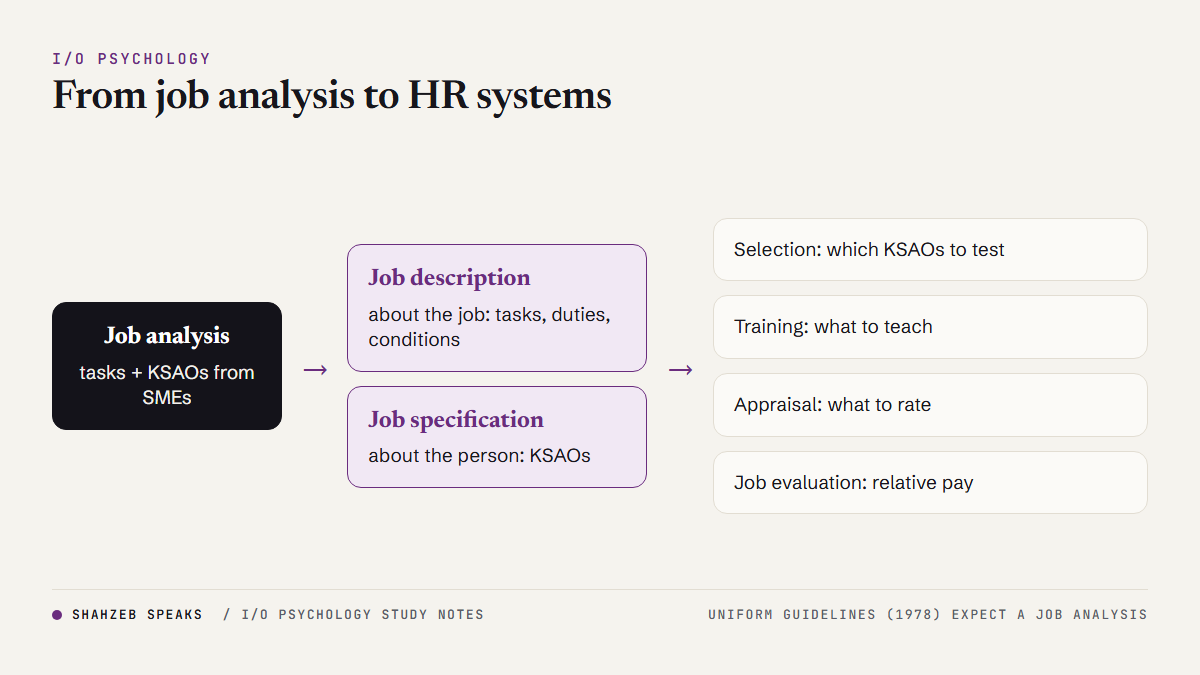
What it produces. A job description lists the job’s title, purpose, tasks, duties and working conditions. A job specification lists the KSAOs: knowledge, skills, abilities and other characteristics such as a licence or a personality requirement. In short, the description is about the job and the specification is about the person.
Two orientations. Task-oriented methods describe the work itself (for example, “reconciles the cash drawer with the system balance at the end of each shift”). Worker-oriented methods describe the human attributes the work demands (for example, “numerical accuracy” or “dealing with upset customers”). Functional Job Analysis, which rates what a worker does with data, people and things, is usually taught as task-oriented (Fine and Cronshaw, 1999). The Position Analysis Questionnaire (PAQ) is the classic worker-oriented instrument.
Where it is used. Almost every HR system starts here: selection (which KSAOs to test), training (what to teach), performance appraisal (what to rate), job evaluation (how much each job is worth relative to others) and job design. In the United States, the Uniform Guidelines on Employee Selection Procedures (1978) say a content validity study should rest on a job analysis of the important work behaviours.
Data sources and accuracy. Job analysts use more than one method because each has blind spots. Observation misses mental work. Interviews depend on what people remember. Questionnaires are fast but can be filled carelessly. Morgeson and Campion (1997) described social and cognitive sources of inaccuracy, such as incumbents presenting their job as more important than it is.
Newer ideas. O*NET, the US Department of Labor’s online occupational database, replaced the printed Dictionary of Occupational Titles (Peterson et al., 2001). Competency modelling describes broader, strategy-linked capabilities that apply across many jobs (Campion et al., 2011). Sanchez and Levine (2012) argue that because jobs now change fast, the field should speak of “work analysis” rather than the analysis of fixed jobs.
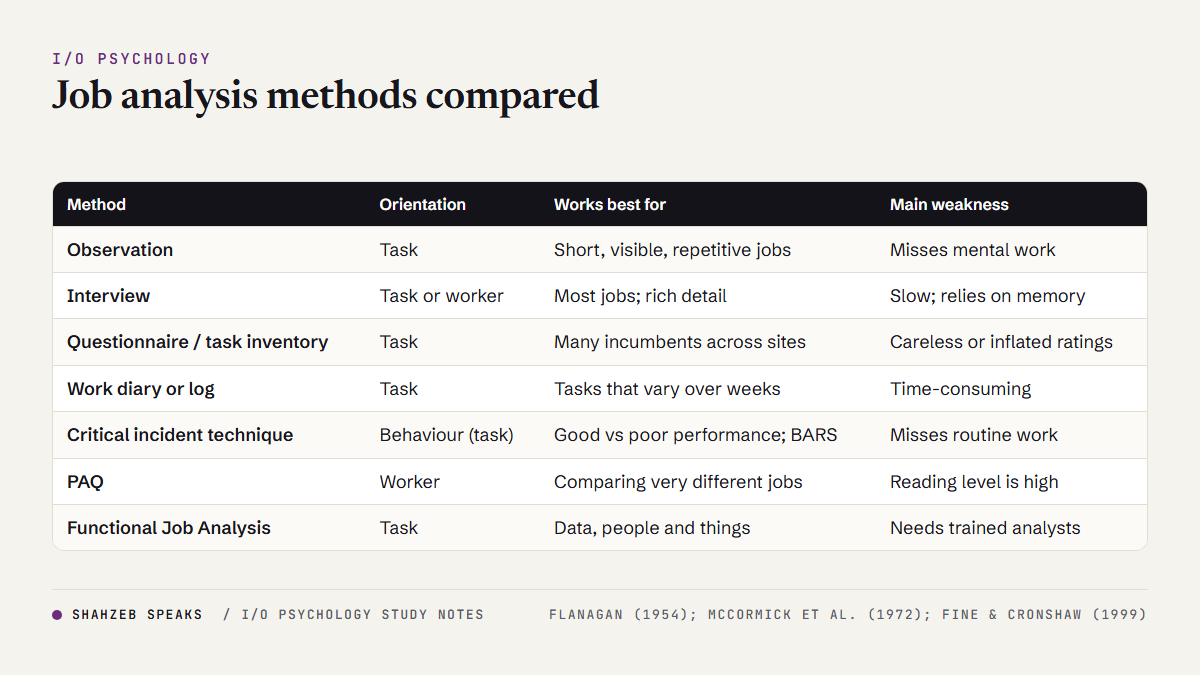
Job analysis methods compared in one table
| Method | Orientation | Works best for | Main weakness |
|---|---|---|---|
| Observation | Task | Short, visible, repetitive jobs (packing line, cashier) | Misses mental work; people act differently when watched |
| Interview (single or group) | Task or worker | Most jobs; rich detail and examples | Slow; relies on memory and honesty |
| Questionnaire or task inventory | Task | Many incumbents across sites | Careless or inflated ratings |
| Work diary or log | Task | Jobs whose tasks vary over weeks | Time-consuming; people forget to record |
| Critical incident technique | Behaviour (task) | Separating good from poor performance; rating scales | Focuses on extremes, misses routine work |
| Position Analysis Questionnaire (PAQ) | Worker | Comparing very different jobs on one scale | Reading level is high (Ash and Edgell, 1975) |
| Functional Job Analysis (FJA) | Task | Rating work with data, people and things | Needs trained analysts |
Practice MCQs: job analysis (25 questions)
-
Which statement best defines job analysis?
- Rating how well each employee performed against last year’s goals
- Systematically collecting information about a job’s tasks and the human attributes needed to perform them
- Deciding the salary band of each employee
- Writing and posting a job advertisement
Show answer
B. Job analysis studies the job (tasks) and the person requirements (KSAOs). A describes performance appraisal, C is pay setting (which job evaluation feeds), and D is recruitment.
-
A document that lists “B.Com degree, two years of banking experience, accuracy with numbers and calm handling of complaints” is a:
- Job description
- Job evaluation
- Job specification
- Organisation chart
Show answer
C. A job specification lists the qualifications and KSAOs a person needs. A job description lists tasks and duties, job evaluation sets relative pay, and an organisation chart shows reporting lines.
-
In the abbreviation KSAO, the letter “O” stands for:
- Objectives
- Outputs
- Organisational fit
- Other characteristics
Show answer
D. Other characteristics cover things such as personality traits, licences or willingness to work night shifts. The other three are not part of the standard term.
-
A job analyst at a Karachi bank branch writes: “Counts the cash drawer at the start of each shift and reconciles it with the system balance.” This statement is best described as:
- A task statement from a task-oriented analysis
- A worker attribute (KSAO)
- A competency from a competency model
- A compensable factor
Show answer
A. It describes an action the worker performs (verb, object, purpose), which is the form of a task statement. A KSAO would be “numerical accuracy”; a competency would be broader (“attention to detail”); a compensable factor is used in job evaluation.
-
Which of these is a worker-oriented job analysis instrument?
- A task inventory of 120 cashier duties
- The Position Analysis Questionnaire
- A time-and-motion study
- The list of duties in a job description
Show answer
B. The PAQ rates jobs on general human behaviours (information input, mental processes and so on), so it is worker-oriented. A task inventory, a time-and-motion study and a duty list all describe the work itself.
-
The Position Analysis Questionnaire was developed by:
- John Flanagan
- Sidney Fine
- Ernest McCormick, P. Richard Jeanneret and Robert Mecham
- J. Richard Hackman and Greg Oldham
Show answer
C. McCormick and colleagues developed the PAQ at Purdue University; their 1972 Journal of Applied Psychology study used Form B. Flanagan gave us the critical incident technique, Fine gave us Functional Job Analysis, and Hackman and Oldham gave us the Job Characteristics Model.
-
Which of the following is NOT one of the six divisions of the PAQ?
- Information input
- Mental processes
- Career aspirations of the worker
- Relationships with other persons
Show answer
C. The six divisions are information input, mental processes, work output, relationships with other persons, job context and other job characteristics. The PAQ describes the job, not the worker’s career plans.
-
In the critical incident technique, subject matter experts are asked to:
- Describe specific examples of especially effective or ineffective behaviour, what led to it and what happened as a result
- Rate the job on 194 standard items
- Time each movement a worker makes with a stopwatch
- Rank all jobs in the organisation from most to least valuable
Show answer
A. Flanagan (1954) built the technique around concrete incidents: the situation, the behaviour and its outcome. B describes the PAQ, C is time-and-motion study, and D is the ranking method of job evaluation.
-
Critical incidents collected during a job analysis are most often used to build which tool?
- An organisation chart
- Behaviourally anchored rating scales (BARS)
- A job evaluation point plan
- An O*NET occupation code
Show answer
B. BARS use real behavioural examples as anchors on each rating point, and those examples come from critical incidents (Smith and Kendall, 1963). The other options do not need behavioural examples.
-
Functional Job Analysis describes what a worker does in relation to:
- Skill, effort, responsibility and working conditions
- Input, process and output
- Knowledge, skills and abilities
- Data, people and things
Show answer
D. FJA, associated with Sidney Fine, rates the level of a worker’s involvement with data, people and things. A lists the usual compensable factors in job evaluation, and C is part of KSAOs.
-
O*NET was created to replace which older resource?
- The Dictionary of Occupational Titles
- The Position Analysis Questionnaire
- The Uniform Guidelines on Employee Selection Procedures
- The Hawthorne reports
Show answer
A. The US Department of Labor replaced the printed Dictionary of Occupational Titles with the online O*NET database (Peterson et al., 2001). The PAQ is an instrument, the Uniform Guidelines are a legal guidance document, and the Hawthorne reports are history.
-
Which of these is NOT one of the six domains of the O*NET Content Model?
- Worker characteristics
- Experience requirements
- Personality test norms
- Occupational requirements
Show answer
C. The six domains are worker characteristics, worker requirements, experience requirements, occupational requirements, workforce characteristics and occupation-specific information. O*NET does not publish norms for personality tests.
-
Observation would be the LEAST suitable main method for analysing which job?
- A packer on a biscuit factory line
- A supermarket cashier
- A research scientist planning a year-long study
- A data entry operator
Show answer
C. Much of a scientist’s work is mental and happens over long cycles, so watching them shows little. The other three jobs are visible and repetitive, which suits observation.
-
A field sales officer in Lahore does different tasks every week. The analyst asks her to note what she is doing every 30 minutes for two weeks. This is the:
- Critical incident technique
- Work diary (log) method
- Position Analysis Questionnaire
- Job evaluation method
Show answer
B. A diary or log records activities as they happen over a period, which suits jobs with varied, long-cycle tasks. CIT collects only notable incidents, the PAQ is a standard questionnaire, and job evaluation sets pay.
-
A company has 4,000 call-centre agents in three cities and needs job data from many of them within a month. Which method is most efficient?
- One-to-one interviews with every agent
- Observing each agent for a full shift
- A structured questionnaire or task inventory sent to a large sample
- A single interview with the head of HR
Show answer
C. Questionnaires reach many incumbents quickly and the answers can be added up, for example ratings of each task’s frequency and importance. Interviewing or observing 4,000 people is too slow, and one HR interview gives a narrow, second-hand view.
-
Who is LEAST likely to act as a subject matter expert for a ward nurse’s job analysis?
- An experienced ward nurse
- The head nurse who supervises the ward
- A nurse educator who trains new staff
- The hospital’s software vendor who has never worked on a ward
Show answer
D. SMEs need direct knowledge of the job, which incumbents, supervisors and trainers have. A vendor may know the software but not the job.
-
Incumbents rate their own job as more complex and important than it really is, so that it looks valuable to management. Morgeson and Campion (1997) would call this:
- A social source of inaccuracy such as self-presentation
- Range restriction
- Central tendency error in appraisal
- Test-retest unreliability
Show answer
A. Morgeson and Campion listed social sources (such as impression management and conformity in groups) and cognitive sources (such as limited information and carelessness). Range restriction is a statistics problem, central tendency is a rating error, and test-retest unreliability is about scores changing over time.
-
An HR team at a Faisalabad textile mill compares the machine operator, quality inspector and line supervisor jobs on skill, effort, responsibility and working conditions to set pay grades. This activity is:
- Training needs analysis
- Job evaluation
- Job enlargement
- Competency modelling
Show answer
B. Job evaluation decides the relative worth of jobs, often by rating compensable factors such as skill, effort, responsibility and working conditions. TNA finds training gaps, job enlargement adds tasks to a job, and competency modelling describes broad capabilities.
-
In which job evaluation method does each job receive points on each compensable factor, with the points added to give a total?
- Ranking method
- Job classification (grading) method
- Point method
- Forced distribution
Show answer
C. The point method scores each factor and sums the scores. Ranking orders whole jobs, classification places jobs into pre-written grades, and forced distribution is a performance appraisal method for people, not jobs.
-
The principle that jobs of equal value to the organisation should receive equal pay, even if their content differs, is called:
- Comparable worth
- Equity sensitivity
- Job enrichment
- Merit pay
Show answer
A. Comparable worth compares the value of different jobs (often to examine gender pay gaps) and uses job evaluation data. Equity sensitivity is an individual difference, job enrichment adds responsibility, and merit pay rewards individual performance.
-
Compared with traditional job analysis, competency modelling is usually:
- More detailed about the tasks of one job
- Broader, linked to the organisation’s strategy and applied across many jobs
- Used only for factory jobs
- Free of any need for evidence
Show answer
B. Campion and colleagues (2011) describe competency models as broader, strategy-linked and often organisation-wide. Job analysis is the more task-specific of the two. Competency models still need evidence if they are used for hiring decisions.
-
Under the US Uniform Guidelines on Employee Selection Procedures (1978), a content validity study should be based on:
- The opinions of the applicants
- A job analysis of the important work behaviours
- The test publisher’s advertising
- The pass rate of the previous year
Show answer
B. Section 14C(2) of the Guidelines asks for a job analysis that covers the important work behaviours. Applicant opinions, publisher claims and old pass rates are not validity evidence.
-
Ten SMEs review a test item and 8 of them rate it “essential” to the job. Using Lawshe’s (1975) formula CVR = (ne − N/2) ÷ (N/2), what is the content validity ratio?
- 0.80
- 0.30
- 1.60
- 0.60
Show answer
D. (8 − 5) ÷ 5 = 0.60. 0.80 is just the proportion saying essential, 1.60 forgets to subtract N/2, and 0.30 divides by N instead of N/2. You can check it with the free content validity ratio calculator.
-
Put these steps in the right order when building a hiring process: (1) choose or build predictors, (2) job analysis, (3) validate predictors against job performance, (4) identify the KSAOs.
- 1, 2, 3, 4
- 4, 2, 1, 3
- 2, 4, 1, 3
- 2, 1, 4, 3
Show answer
C. You study the job first, then derive the KSAOs, then pick tests that measure those KSAOs, then check that the tests predict performance. Choosing a test before knowing the KSAOs (options A, D) is the common mistake.
-
Which of these is NOT a common use of job analysis results?
- Writing job descriptions
- Designing training content
- Setting performance appraisal criteria
- Diagnosing an employee’s clinical depression
Show answer
D. Job analysis describes jobs; clinical diagnosis is a health matter for qualified clinicians. The other three are standard uses.
Practise on your phone
The free I/O Psychology Prep app has 410 explained
questions, flashcards and an exam countdown, and works offline. Get it on Google Play
· About the app
How to answer a long question on job analysis methods
10-mark answer structure: “Explain the methods of job analysis with their merits and limitations”
- Definition: job analysis is the systematic collection of information about a job’s tasks and the KSAOs needed to perform it. Name the two products: job description and job specification.
- Classify the methods: task-oriented versus worker-oriented. One line each with an example.
- Explain four or five methods, each with one merit and one limitation: observation, interview, questionnaire or task inventory, critical incident technique (Flanagan, 1954), PAQ (McCormick, Jeanneret and Mecham, 1972). Draw or copy the methods table if time allows.
- Give a worked example: analysing a bank cashier’s job by observing two shifts, interviewing three cashiers and the branch manager, then writing task statements and KSAOs.
- Uses: selection, training, appraisal, job evaluation and legal defence (Uniform Guidelines, 1978).
- Critical point: accuracy problems (Morgeson and Campion, 1997) and the shift from fixed jobs to “work analysis” (Sanchez and Levine, 2012).
- Conclusion: no single method is enough; combine methods and SMEs, and update the analysis when the job changes.
Model opening line: “Job analysis is the systematic process of collecting information about the tasks a job involves and the knowledge, skills, abilities and other characteristics a person needs to perform it; it is the base on which selection, training, appraisal and pay decisions are built.”
Common mistakes students make on job analysis questions
- Mixing up the description and the specification. Ask yourself: is this sentence about the job (description) or about the person (specification)?
- Calling the PAQ task-oriented. It is the standard example of a worker-oriented instrument. Form B, used in the 1972 study, has 194 items: 187 job elements in six divisions plus 7 items about pay, so an MCQ that offers “194 items” is pointing at the PAQ.
- Confusing job analysis with job evaluation. Job analysis describes the job; job evaluation uses that description to decide its relative pay.
- Forgetting the legal angle. Examiners in HRM and I/O papers like the point that a selection test without a job analysis is hard to defend.
Questions students ask
What is job analysis in simple words?
It is finding out exactly what a job involves and what kind of person can do it well. You watch the work, talk to the people who do it and to their supervisors, and write down the tasks and the skills needed.
What are the main methods of job analysis?
Observation, interviews, questionnaires and task inventories, work diaries, the critical incident technique, and standard instruments such as the PAQ and Functional Job Analysis. Analysts usually combine two or three. A full explanation with examples is in the job analysis methods guide.
What is the difference between task-oriented and worker-oriented job analysis?
Task-oriented methods describe what gets done (duties and tasks). Worker-oriented methods describe what the person needs in order to do it (human behaviours and KSAOs). The PAQ is worker-oriented; a task inventory is task-oriented.
How is job analysis different from job evaluation?
Job analysis describes a job. Job evaluation compares jobs to decide their relative worth for pay, using methods such as ranking, classification and the point method. Job evaluation needs job analysis data first.
How many items does the PAQ have?
The 1972 study by McCormick, Jeanneret and Mecham used Form B, which has 194 items: 187 job elements in six divisions plus 7 items about pay. That is why some books say 194 and others say 187. If your textbook gives one figure, use that figure in the exam.
Is job analysis still used now that jobs change so fast?
Yes, but the focus has widened. Sanchez and Levine (2012) suggest “work analysis”, which studies work roles and how they change rather than a fixed list of duties. Competency models and O*NET are part of that wider picture.
Practise on your phone
The free I/O Psychology Prep app has 410 explained
questions, flashcards and an exam countdown, and works offline. Get it on Google Play
· About the app
References
- Ash, R. A., & Edgell, S. L. (1975). A note on the readability of the Position Analysis Questionnaire (PAQ). Journal of Applied Psychology, 60(6), 765–766. https://doi.org/10.1037/0021-9010.60.6.765
- Campion, M. A., Fink, A. A., Ruggeberg, B. J., Carr, L., Phillips, G. M., & Odman, R. B. (2011). Doing competencies well: Best practices in competency modeling. Personnel Psychology, 64(1), 225–262. https://doi.org/10.1111/j.1744-6570.2010.01207.x
- Equal Employment Opportunity Commission, Civil Service Commission, Department of Labor, & Department of Justice. (1978). Uniform guidelines on employee selection procedures. 29 C.F.R. § 1607. https://www.law.cornell.edu/cfr/text/29/1607.14
- Fine, S. A., & Cronshaw, S. F. (1999). Functional job analysis: A foundation for human resources management. Lawrence Erlbaum. https://doi.org/10.4324/9781410602497
- Flanagan, J. C. (1954). The critical incident technique. Psychological Bulletin, 51(4), 327–358. https://doi.org/10.1037/h0061470
- Lawshe, C. H. (1975). A quantitative approach to content validity. Personnel Psychology, 28(4), 563–575. https://doi.org/10.1111/j.1744-6570.1975.tb01393.x
- McCormick, E. J., Jeanneret, P. R., & Mecham, R. C. (1972). A study of job characteristics and job dimensions as based on the Position Analysis Questionnaire (PAQ). Journal of Applied Psychology, 56(4), 347–368. https://doi.org/10.1037/h0033099
- Morgeson, F. P., & Campion, M. A. (1997). Social and cognitive sources of potential inaccuracy in job analysis. Journal of Applied Psychology, 82(5), 627–655. https://doi.org/10.1037/0021-9010.82.5.627
- O*NET Resource Center. (n.d.). The O*NET content model. US Department of Labor, Employment and Training Administration. https://www.onetcenter.org/content.html
- Peterson, N. G., Mumford, M. D., Borman, W. C., Jeanneret, P. R., Fleishman, E. A., Levin, K. Y., et al. (2001). Understanding work using the Occupational Information Network (O*NET): Implications for practice and research. Personnel Psychology, 54(2), 451–492. https://doi.org/10.1111/j.1744-6570.2001.tb00100.x
- Sanchez, J. I., & Levine, E. L. (2012). The rise and fall of job analysis and the future of work analysis. Annual Review of Psychology, 63, 397–425. https://doi.org/10.1146/annurev-psych-120710-100401
- Smith, P. C., & Kendall, L. M. (1963). Retranslation of expectations: An approach to the construction of unambiguous anchors for rating scales. Journal of Applied Psychology, 47(2), 149–155. https://doi.org/10.1037/h0047060
More practice: go back to the I/O psychology MCQs hub, or try the training and development MCQs and the selection, reliability and validity MCQs. For the theory behind these questions, read job description vs job specification and the personnel psychology notes.