
The Hawthorne studies were a series of experiments and interviews at Western Electric’s Hawthorne Works near Chicago, run from 1924 to 1932. They began as lighting tests with the National Research Council and grew, with Elton Mayo’s Harvard group, into a study of how social relations, supervision and group norms shape output.
This page is for students who have to explain the Hawthorne studies in an exam, an assignment or the literature review of a thesis. You get the four phases with their real dates, what each phase found, who actually ran them, what the “Hawthorne effect” means, and what later researchers found when they went back to the original data. At the end there is a 10-mark answer plan and 10 practice MCQs with explanations.
The dates and numbers below come from the original report, Roethlisberger and Dickson’s Management and the Worker (1939), and from Harvard Business School’s Baker Library, which holds the study records. Many notes online copy each other and get the dates wrong, so where textbooks disagree I say so.
What were the Hawthorne studies?
The Hawthorne Works was a large Western Electric factory just outside Chicago. Western Electric was the manufacturing arm of AT&T and made telephone equipment. Between 1924 and 1932 the company, first with the National Research Council of the National Academy of Sciences and later with researchers from Harvard Business School, studied what made its workers more or less productive.
The first question was simple and physical: does better lighting raise output? The answer turned out to be messy, and the researchers kept changing their questions. By the end they were studying friendship groups, attitudes to supervisors and unwritten group rules. That shift, from treating the worker as a machine that responds to conditions to treating the worker as a member of a social group, is why the studies matter. They are the starting point of the human relations movement in management and a key event in the “organizational” side of I/O psychology.
| Question students ask | Answer you can write |
|---|---|
| Where? | Hawthorne Works of the Western Electric Company, near Chicago, USA |
| When? | Illumination tests from November 1924; the main inquiry 1927 to 1932 (Baker Library dates the whole programme 1924 to 1933) |
| Who? | Western Electric engineers and managers (George Pennock, William Dickson, Harold Wright); the National Research Council for the lighting tests (C. E. Snow); Elton Mayo and Fritz Roethlisberger of Harvard Business School from 1928 |
| Main report | Roethlisberger & Dickson (1939), Management and the Worker, Harvard University Press |
| Mayo’s own book | Mayo (1933), The Human Problems of an Industrial Civilization, Macmillan |
| Big idea | Output depends on attitudes, social relations and group norms, not only on physical conditions and pay |
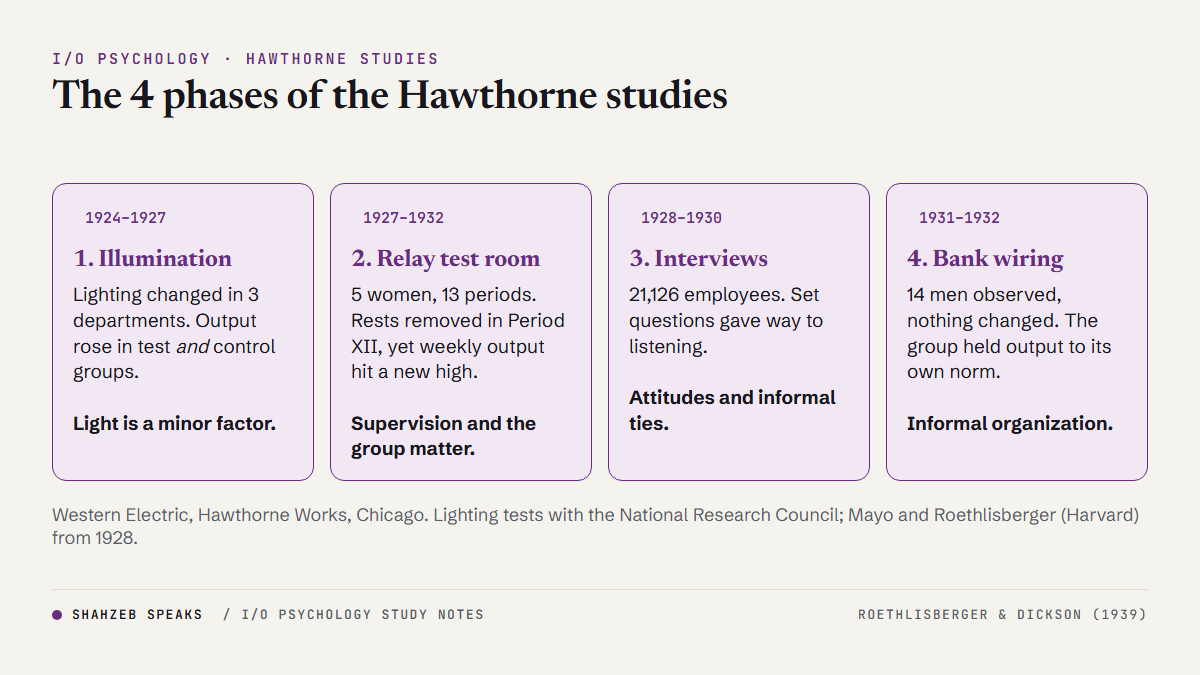
The 4 phases of the Hawthorne studies, with dates
Most syllabi teach four phases. Some books list five because they count the smaller follow-up test rooms (the Second Relay Assembly Group and the Mica Splitting Test Room) as a separate phase. If your teacher uses five, add those as phase 3 and move the others down.
Phase 1: Illumination experiments (November 1924 to April 1927)
Western Electric, working with the National Research Council, set out to study the relation of lighting to efficiency. The tests lasted about two and a half years and were run in three departments: one inspected small parts, one assembled relays and one wound coils. Output went up and down, but not in step with the lighting. In a later test there was a test group whose light was changed and a control group whose light was kept steady. Output rose in both groups. When the test group’s light was cut step by step down to 3 foot-candles, output held up until the workers complained that they could hardly see.
In a final informal test, two operators kept their efficiency under light as low as 0.06 of a foot-candle, about the light of a moonlit night. In another, an electrician swapped bulbs for bulbs of the same strength while the women believed the light was changing. They said they liked the “brighter” light, but their production did not materially change. The company drew two conclusions: light is only one, and a minor, factor in output; and in a big shop department there are too many uncontrolled factors to measure any single one.
Phase 2: Relay Assembly Test Room (April 1927 to 1932)
To control those factors, five women who assembled telephone relays were moved into a separate room, with a sixth woman (the layout operator) preparing their parts. Each finished relay dropped down a chute and was recorded automatically, so output was measured exactly. An observer sat with them. Over 13 test periods up to 1929, the researchers changed one condition at a time: a small-group pay plan, rest pauses of different lengths, a mid-morning snack, a shorter day and a shorter week.
Output generally rose across the periods. The surprise came in Period XII (September to November 1928), when the old conditions came back: a 48-hour week with no rest pauses. The hourly rate fell for most operators, yet total weekly output reached a new high for every operator. Something other than rest pauses was keeping output up. The researchers pointed to the changed relations in the room: a friendly observer instead of a strict foreman, being consulted about changes, and a close-knit group. One honest detail many notes leave out: two of the original five, whose output and attitude had fallen, were sent back to the department and replaced early in 1928.
Phase 3: The interviewing programme (1928 to 1930)
If attitudes mattered so much, the company needed to know what workers thought. Starting in the Inspection Branch in 1928, interviewers spoke to 1,600 employees that year, 10,300 in 1929 and 9,226 in 1930: 21,126 in total. At first they asked set questions. They soon found that people spoke more openly when they were simply allowed to talk, so the interviews became non-directive and grew from about 30 minutes to 90 minutes or more. The interviews showed that complaints often carried feelings about a person’s whole situation, at work and at home, and that informal ties between co-workers mattered a great deal. The material was used to train 2,487 supervisors by 1930 and led to an employee counselling programme.
Phase 4: Bank Wiring Observation Room (November 1931 to spring 1932)
The last study observed 14 men who wired “banks” of terminals for telephone exchanges: nine wiremen, three soldermen and two inspectors. Nothing was changed; an observer simply watched and recorded. The men were paid under a group incentive plan, so in theory each man should have wanted the group to produce as much as possible. Instead, the group held output to its own idea of a fair day’s work, about two equipments a day, and reported figures that looked steady.
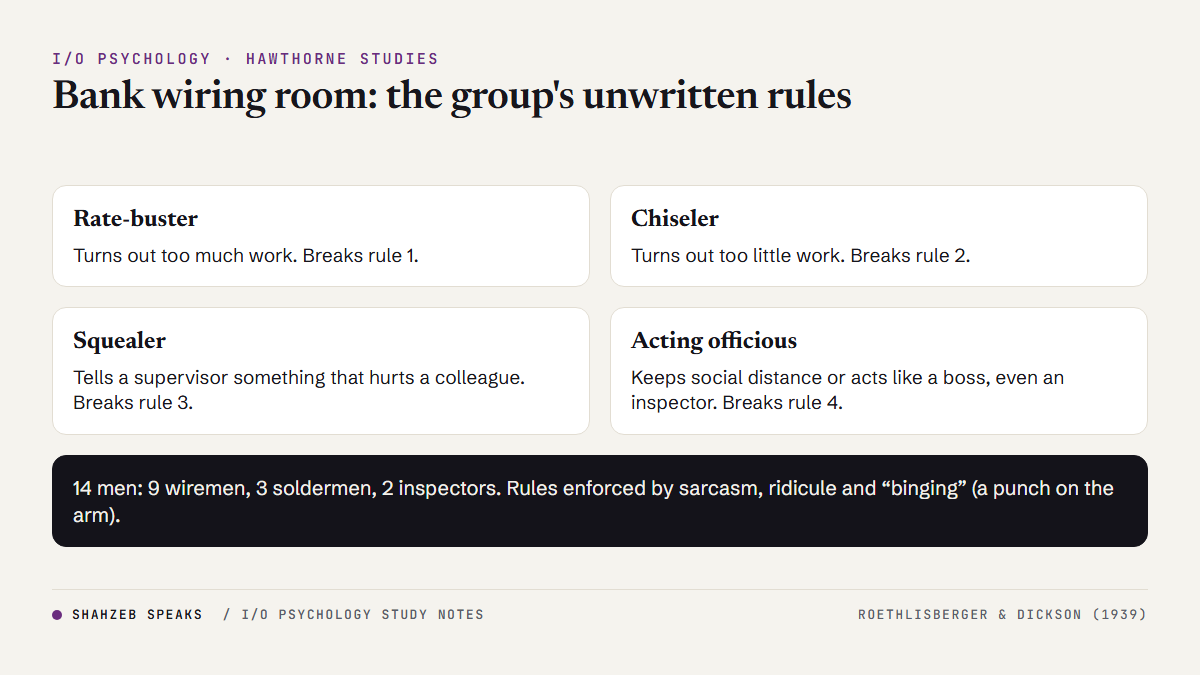
Roethlisberger and Dickson summed up the group’s unwritten rules like this: do not turn out too much work (or you are a “rate-buster”), do not turn out too little (or you are a “chiseler”), do not tell a supervisor anything that could hurt a colleague (or you are a “squealer”), and do not act officious or keep social distance, even if you are an inspector. The men enforced the rules with sarcasm, ridicule and “binging”, a hard punch on the upper arm. The room also split into two cliques. This is the classic evidence for the informal organization: the unofficial structure of friendships, cliques and norms that exists beside the formal organization chart.
What did the Hawthorne studies find?
For a 10-mark answer, these are the conclusions examiners expect. Write them in your own words and tie each to a phase.
- Physical conditions are not the whole story. Lighting, rest pauses and hours did not explain output on their own (phases 1 and 2).
- Attitudes and feelings affect output. How workers felt about their supervision, their group and their life outside work showed up in what they produced (phases 2 and 3).
- Supervision style matters. A friendly, consultative observer in the test room went with higher output than strict foreman-style control (phase 2).
- The work group sets its own norms. Groups decide what a “fair day’s work” is and pressure members to keep to it, even against their financial interest (phase 4).
- Organizations have an informal side. Cliques and unwritten rules run alongside the formal structure, and managers who ignore them misread the workplace (phase 4).
- Listening has value. Non-directive interviews gave workers a release and gave managers information they could not get any other way (phase 3).
A Pakistani example helps an examiner see you understand. Picture a Karachi call centre that installs brighter lights and new chairs, and handled calls stay flat. Then a new team leader starts asking agents how the shift roster should work, and the team’s numbers rise. Or picture a textile mill where an experienced weaver tells a fast new worker to “slow down, you are making us look bad”. That is the bank wiring room’s rate-buster rule, eighty years later.
Who conducted the Hawthorne studies? (A common exam trap)
Many MCQs say “the Hawthorne studies were conducted by Elton Mayo”. That is the expected answer in most papers, but the fuller truth earns you marks in a long answer. The illumination tests (1924 to 1927) were run by Western Electric with the National Research Council, before Mayo was involved. In 1928, George Pennock, a Western Electric superintendent, turned to Mayo at Harvard Business School for help with the puzzling test room results. Mayo, an Australian-born Harvard Business School professor, then guided the work with his colleague Fritz Roethlisberger, while Western Electric staff such as William Dickson and Harold Wright did much of the day-to-day research. Mayo wrote about the studies in his 1933 book; Roethlisberger and Dickson wrote the full report in 1939.
So the safe exam line is: “conducted at Western Electric’s Hawthorne Works from 1924 to 1932, and interpreted and made famous by Elton Mayo and his Harvard colleagues”. You can read more about Mayo’s place among the founders on the I/O psychology theorists page.
What is the Hawthorne effect?
The Hawthorne effect is the idea that people change their behaviour because they know they are being studied or watched, rather than because of the change the researcher made. The label came after the studies: it is usually traced to John R. P. French in 1953 and to Henry Landsberger’s book Hawthorne Revisited (1958), which spread it widely. Roethlisberger and Dickson themselves explained the test room results through social relations and attitudes, not through a simple “being watched” effect.
In I/O research the term is used as a warning. If you introduce a new training programme and measure the trained group only, part of any improvement may come from the attention, not the training. A comparison group that also gets attention, or measurement that people do not notice, helps separate the two.
Hawthorne effect vs halo effect. Students mix these up because both start with “h”. The halo effect is a rater’s error: one good (or bad) trait colours the rater’s judgement of everything else, as when a supervisor rates a punctual employee high on every dimension. The Hawthorne effect is about the people being studied changing because they are observed. See performance appraisal errors for the halo effect in ratings.
Were the Hawthorne studies right? Later critiques
The Hawthorne studies are famous, but the evidence is weaker than the story. A good answer shows the examiner you know this.
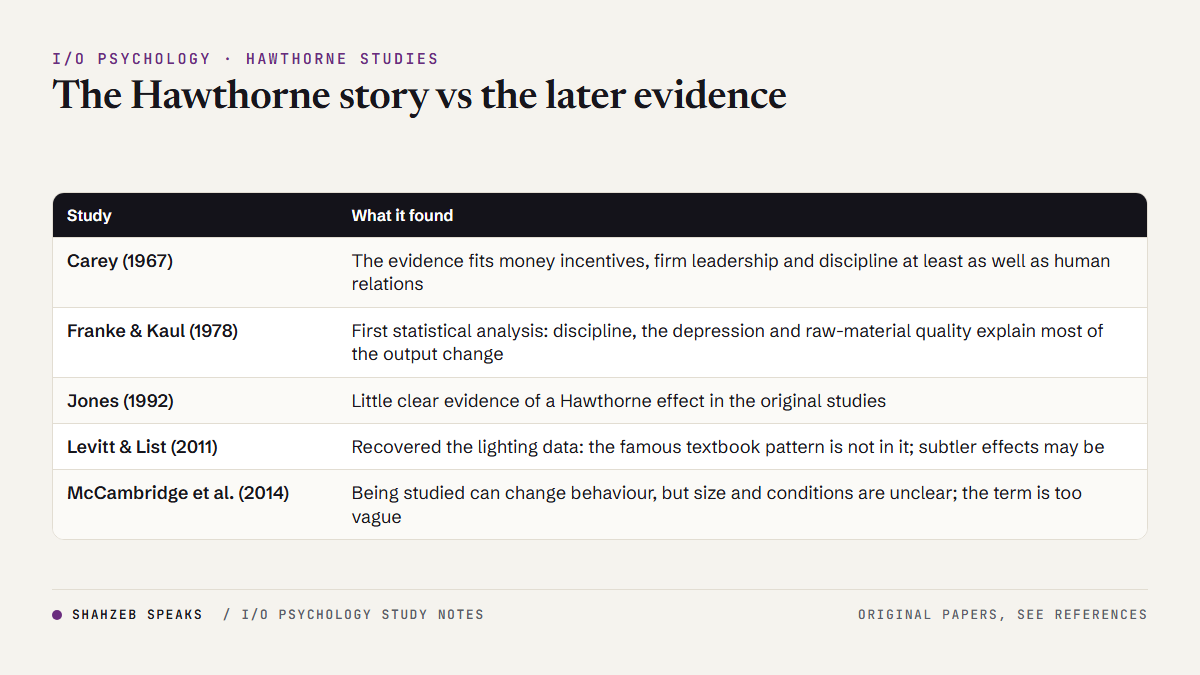
- Carey (1967) argued that the published evidence did not support the human relations conclusions. Read closely, it fitted older explanations, money incentives, firm leadership and discipline, at least as well.
- Franke and Kaul (1978) ran the first statistical analysis of the Relay Assembly Test Room data. They found that most of the variation in output could be explained by managerial discipline (such as the replacement of two operators), economic adversity during the depression and the quality of raw materials, rather than by better human relations.
- Jones (1992) re-analysed the relay data and asked directly whether there was a Hawthorne effect. He concluded that, however you define the term, the original studies contain little clear evidence of a Hawthorne effect.
- Levitt and List (2011) found the original illumination data, long believed lost. They concluded that the dramatic patterns described in textbooks (output rising whatever the light did) do not appear in the actual data, although they found subtler signs that output reacted to the experimenters’ changes.
- McCambridge, Witton and Elbourne (2014) reviewed studies of research participation effects across fields. They found that being studied can change behaviour, but the size and conditions of the effect are unclear, and they argued that the term “Hawthorne effect” is too vague to be useful on its own.
Two fair conclusions follow. First, the Hawthorne studies are better as a turning point in ideas than as proof of any single effect. Second, they still changed management thinking for good: attention to attitudes, supervision, groups and listening became a normal part of the field. Baker Library calls the experiments a case study of how researchers read data through the lens of their own time.
Hawthorne studies vs scientific management
Examiners often ask you to compare the Hawthorne findings with Frederick Taylor’s scientific management (1911). Taylor treated output as an engineering problem: find the one best way, select and train the worker, pay by output. The Hawthorne researchers found that the same worker under the same physical conditions produces more or less depending on group norms and how he or she is treated. The full comparison is on the Taylor vs Mayo: scientific management vs human relations page, and the wider story is in the history of I/O psychology timeline.
10-mark answer structure
- Definition (who, where, when): studies at Western Electric’s Hawthorne Works, Chicago, 1924 to 1932; lighting tests with the National Research Council, later interpreted by Elton Mayo and Fritz Roethlisberger of Harvard; reported in Management and the Worker (1939).
- Phase 1, illumination (1924 to 1927): output rose in test and control groups; light a minor factor.
- Phase 2, relay assembly test room (1927 to 1932): five women, 13 periods; weekly output reached a new high even when rest pauses were removed in Period XII; supervision and group feeling mattered.
- Phase 3, interviews (1928 to 1930): 21,126 employees; directed to non-directive interviewing; attitudes and informal ties.
- Phase 4, bank wiring room (1931 to 1932): 14 men; group norms restricted output (rate-buster, chiseler, squealer); informal organization.
- Conclusions: social and psychological factors affect output; birth of the human relations movement; the Hawthorne effect named later (French 1953, Landsberger 1958).
- Criticism: the evidence also fits money and discipline (Carey 1967); output explained by discipline, the depression and raw materials (Franke & Kaul 1978); little clear evidence of the effect (Jones 1992); illumination data do not show the famous pattern (Levitt & List 2011).
- Example: a local call centre or textile mill where group norms or a new supervisor’s style changed output more than new equipment did.
- Conclusion: weak as proof, strong as a turning point; it moved the field from the worker as a machine to the worker as a member of a group.
Model opening line: “The Hawthorne studies (1924 to 1932) at Western Electric’s Hawthorne Works began as tests of lighting and ended as the first large study of how social relations, supervision and group norms shape output at work.”
Practice MCQs: Hawthorne studies
These are practice questions written to the published syllabus, not past-paper questions. Try each one before opening the answer.
-
The Hawthorne studies were carried out at a plant belonging to which company?
- General Motors
- Bethlehem Steel
- Western Electric
- Ford Motor Company
Show answer
C. The Hawthorne Works near Chicago belonged to Western Electric, AT&T’s manufacturing arm. Bethlehem Steel is where Taylor did his pig-iron work; the other two are distractors.
-
The illumination experiments were first planned with which body?
- The American Psychological Association
- The National Research Council of the National Academy of Sciences
- The US Army
- The Society for Industrial and Organizational Psychology
Show answer
B. Western Electric ran the lighting tests “in connection with” the National Research Council from November 1924. SIOP did not exist until 1982, and the APA and Army were not involved.
-
In the illumination tests, output rose in both the test group and the control group. What is the best interpretation?
- Brighter light raises output
- Light was only a minor factor and other, uncontrolled factors were affecting output
- The control group secretly had more light
- Workers were paid more during the test
Show answer
B. If both groups improve, the change in light cannot be the cause. The company concluded that light was a minor factor among many. A and C contradict the data; D was not part of the lighting tests.
-
In Period XII of the Relay Assembly Test Room, the original 48-hour week with no rest pauses was brought back. What happened to total weekly output?
- It fell to the starting level
- It reached a new high for every operator
- It was not measured
- It fell for every operator
Show answer
B. The hourly rate fell for most operators, but total weekly output reached a new high for every operator. This is why researchers looked beyond rest pauses to the social situation of the room.
-
Roughly how many employees were interviewed in the Hawthorne interviewing programme (1928 to 1930)?
- About 200
- About 2,000
- About 21,000
- About 210,000
Show answer
C. Roethlisberger and Dickson’s table gives 21,126 interviews over three years. 2,487 is the number of supervisors later trained with the material, a common source of confusion.
-
Why did the interviewers change from set questions to letting employees talk freely?
- The set questions took too long to print
- Employees spoke more openly and gave more useful information when allowed to talk
- Management ordered shorter interviews
- The union banned questionnaires
Show answer
B. Non-directive interviewing brought out real concerns. Interviews actually became longer, not shorter, so C is wrong; A and D are invented.
-
A fast new worker in a bank wiring group is teased and punched on the arm by colleagues. According to the group’s norms, what is he being called?
- A chiseler
- A squealer
- A rate-buster
- An inspector
Show answer
C. Turning out too much work broke the first rule and earned the label “rate-buster”. A chiseler produced too little; a squealer told the supervisor things that hurt colleagues.
-
Which of these was NOT a finding of the Hawthorne studies?
- Work groups set their own output norms
- Workers’ attitudes affect productivity
- Output is determined mainly by lighting levels
- An informal organization exists alongside the formal one
Show answer
C. The lighting tests showed the opposite: light was a minor factor. A, B and D are central conclusions of the later phases.
-
A researcher finds that a new training programme improved scores, but only the trained group was measured and they knew they were in a study. Which threat should she mention?
- The halo effect
- The Hawthorne effect
- Central tendency error
- Range restriction
Show answer
B. People may improve because they are being studied and given attention. The halo effect and central tendency are rater errors; range restriction affects correlations in selection research.
-
Levitt and List (2011) are known in the Hawthorne literature for what?
- Running the bank wiring room
- Coining the term “Hawthorne effect”
- Recovering and analysing the original illumination data, finding the famous patterns were not in it
- Writing Management and the Worker
Show answer
C. They found the lighting data thought to be lost and showed the textbook pattern does not appear, though subtler effects might. The term came from French and Landsberger in the 1950s; the 1939 report was by Roethlisberger and Dickson.
Practise on your phone
The free I/O Psychology Prep app has 410 explained
questions, flashcards and an exam countdown, and works offline. Get it on Google Play
· About the app
Want more questions on the founders and the early years? Try the history of I/O psychology MCQs or the full I/O psychology MCQ hub.
Questions students ask
Who conducted the Hawthorne studies?
They were conducted at Western Electric’s Hawthorne Works. The lighting tests (1924 to 1927) were run by the company with the National Research Council. From 1928, Elton Mayo and Fritz Roethlisberger of Harvard Business School guided the work, with Western Electric researchers such as William Dickson. Mayo is the name most exams expect.
Between which years were the Hawthorne studies conducted?
From November 1924, when the illumination tests began, to 1932, when the research was suspended. Roethlisberger and Dickson date the main inquiry 1927 to 1932. Baker Library at Harvard dates the whole programme 1924 to 1933. Writing “1924 to 1932” is safe in an exam.
What is the main conclusion of the Hawthorne studies?
That productivity depends on social and psychological factors such as attitudes, supervision and group norms, not only on physical conditions and pay. The studies are treated as the start of the human relations movement.
How many phases were there, four or five?
Four in most textbooks: illumination, relay assembly test room, interviewing and bank wiring room. Books that list five count the smaller follow-up test rooms (second relay assembly group and mica splitting) separately. Use the number your syllabus uses and name the phases.
What is the difference between the Hawthorne effect and the halo effect?
The Hawthorne effect is a change in behaviour because people know they are being studied. The halo effect is a rater’s error, where one strong impression of a person colours ratings of all their other qualities.
Why are the Hawthorne studies important in organizational behaviour?
They shifted attention from the individual worker and physical conditions to groups, informal structure, communication and leadership. Those topics became the core of organizational behaviour and of the organizational side of I/O psychology.
Is the Hawthorne effect real?
Being studied can change behaviour, but the size of the effect varies and is often small. Re-analyses of the original data (Franke & Kaul, 1978; Jones, 1992; Levitt & List, 2011) found much weaker support than the textbook story suggests.
Practise on your phone
The free I/O Psychology Prep app has 410 explained
questions, flashcards and an exam countdown, and works offline. Get it on Google Play
· About the app
References
- Baker Library, Harvard Business School. (n.d.). The human relations movement: Harvard Business School and the Hawthorne experiments, 1924–1933 [Online exhibit]. https://www.library.hbs.edu/hc/hawthorne/
- Carey, A. (1967). The Hawthorne studies: A radical criticism. American Sociological Review, 32(3), 403–416. https://doi.org/10.2307/2091087
- Franke, R. H., & Kaul, J. D. (1978). The Hawthorne experiments: First statistical interpretation. American Sociological Review, 43(5), 623–643. https://doi.org/10.2307/2094540
- Jones, S. R. G. (1992). Was there a Hawthorne effect? American Journal of Sociology, 98(3), 451–468. https://doi.org/10.1086/230046
- Landsberger, H. A. (1958). Hawthorne revisited: Management and the worker, its critics, and developments in human relations in industry. Cornell University.
- Levitt, S. D., & List, J. A. (2011). Was there really a Hawthorne effect at the Hawthorne plant? An analysis of the original illumination experiments. American Economic Journal: Applied Economics, 3(1), 224–238. https://doi.org/10.1257/app.3.1.224
- Mayo, E. (1933). The human problems of an industrial civilization. Macmillan.
- McCambridge, J., Witton, J., & Elbourne, D. R. (2014). Systematic review of the Hawthorne effect: New concepts are needed to study research participation effects. Journal of Clinical Epidemiology, 67(3), 267–277. https://doi.org/10.1016/j.jclinepi.2013.08.015
- Roethlisberger, F. J., & Dickson, W. J. (1939). Management and the worker: An account of a research program conducted by the Western Electric Company, Hawthorne Works, Chicago. Harvard University Press.
- Sonnenfeld, J. A. (1985). Shedding light on the Hawthorne studies. Journal of Occupational Behaviour, 6(2), 111–130. https://doi.org/10.1002/job.4030060203
This post is part of the I/O psychology study guide. Read next: Taylor vs Mayo, the history of I/O psychology and Hugo Münsterberg. If you study in Pakistan, see how these ideas are used in industrial psychology in Pakistan.