
Hugo Münsterberg (1863 to 1916) was a German-born Harvard psychologist often called the founder of industrial psychology. His book Psychology and Industrial Efficiency (1913) set out three goals: the best possible man for the job, the best possible work, and the best possible effect. He tested streetcar drivers, ship officers and telephone operators against job demands.
If your syllabus asks for “Münsterberg’s contribution to I/O psychology”, this page gives you the answer in a form you can use: who he was, what is actually in his 1913 book, the three experiments examiners mention, how he differs from Frederick Taylor, why his reputation fell, and a 10-mark answer plan with practice MCQs.
I read his book itself for this page (it is out of copyright and the full text is on the Internet Archive), so the details below come from Münsterberg’s own words, not from the copied notes that circulate online.
Who was Hugo Münsterberg?
Münsterberg was born in Danzig (now Gdańsk, Poland) in 1863. He earned a PhD at Leipzig in 1885 under Wilhelm Wundt, who had founded the first experimental psychology laboratory, and then a medical degree at Heidelberg in 1887. In 1892 William James invited him to Harvard to run its psychology laboratory. After a short return to Germany he came back to Harvard in 1897 and stayed there for the rest of his life. He was elected president of the American Psychological Association in 1898.
He was a very public scientist. He wrote on psychology and the law (On the Witness Stand, 1908), on teaching, on therapy and on film (The Photoplay, 1916). For I/O students, the important book is Psychology and Industrial Efficiency. He first published it in German in 1912 as Psychologie und Wirtschaftsleben. The English book appeared in February 1913; in its preface he says it is not a straight translation, but its substance is the same.
| Fact | Detail |
|---|---|
| Born | 1 June 1863, Danzig |
| Training | PhD, Leipzig, 1885 (with Wundt); MD, Heidelberg, 1887 |
| Harvard | Invited by William James in 1892; returned for good in 1897 |
| APA president | 1898 |
| Key I/O book | Psychology and Industrial Efficiency (Houghton Mifflin, 1913); German version 1912 |
| Name he used for applied psychology | “Psychotechnics” |
| Died | 16 December 1916, Cambridge, Massachusetts, while lecturing at Radcliffe College |
Psychology and Industrial Efficiency (1913): the three parts
The book has an introduction on applied psychology and then three parts. This structure is the heart of most exam answers, so learn the three titles exactly.
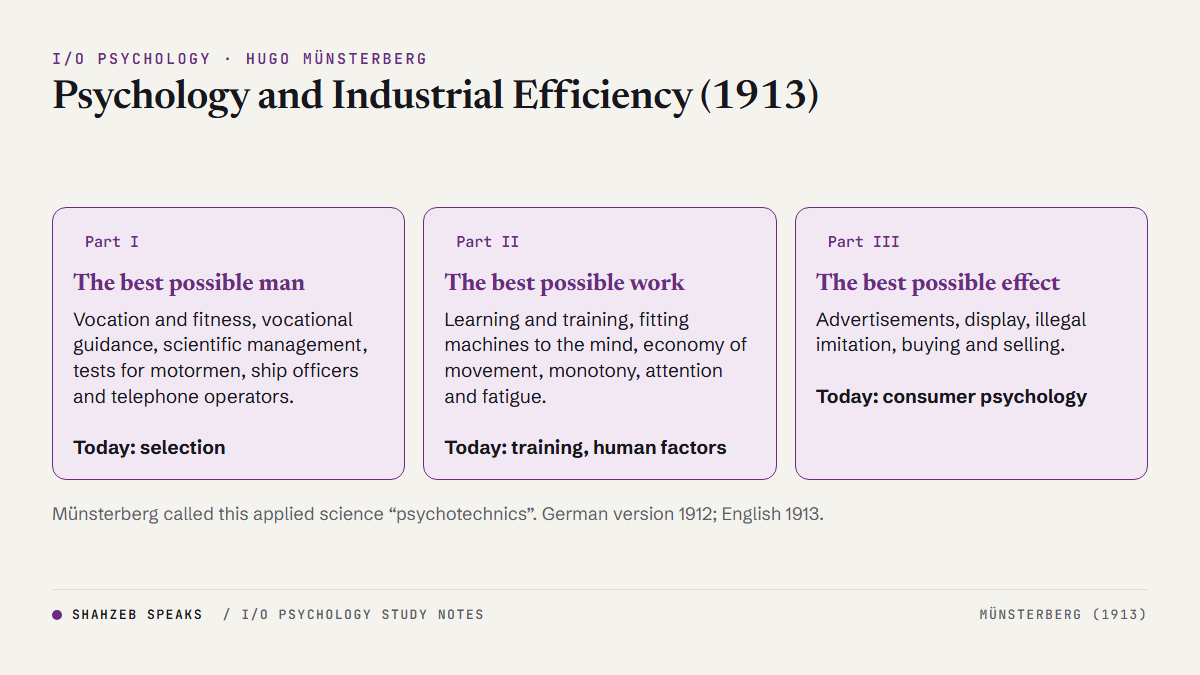
- The Best Possible Man. How to find the people whose mental qualities fit a job. Chapters cover vocation and fitness, vocational guidance, scientific management, the methods of experimental psychology, and his experiments on electric railway, ship and telephone work. Today we call this personnel selection.
- The Best Possible Work. How to get the best output from a person in a job: learning and training, fitting machines to the mind, economy of movement, monotony, attention and fatigue, and physical and social influences on working power. Today this sits under training, human factors and work design.
- The Best Possible Effect. How business can influence buyers: advertisements, shop display, illegal imitation of brand names, buying and selling. Today this is consumer psychology, which mostly left I/O psychology and moved to marketing.
He called this whole applied science “psychotechnics”. In his view it was a technical science like engineering: it tells you which means will reach a given end, but it cannot tell you which ends a business ought to choose. That was his answer to people who worried psychologists would simply serve employers.
Münsterberg’s three experiments: motormen, ship officers, telephone operators
Electric railway motormen
Street railway accidents caused public anger and heavy compensation payments for the companies. Münsterberg looked for the mental function behind a safe driver: the ability to keep attention on many moving things at once and judge which ones might cross the track. He built a laboratory version of the street. Each card showed a track down the middle with numbers on both sides: 1 for a pedestrian, 2 for a horse, 3 for a car, each moving that many squares. Red numbers moved towards the track, black ones ran beside it. The motorman worked through a pack of twelve cards and had to find, as fast as possible, the points on the track that the red figures would reach, while ignoring the black ones. His test, in his own words, had to show good results with reliable motormen and bad results with unreliable ones, and it had to feel like the real job to the people taking it.
Ship officers
For ship officers, the key quality was quick, sound decisions under pressure. He gave candidates cards covered in 48 letters and asked them to sort the cards into piles by which letter appeared most. Some candidates became confused and slow, some were fast but careless, and a third group was fast and accurate and found the task stimulating. He argued that the same three types showed up in real ship service.
Telephone operators
Operators at busy exchanges sometimes handled more than 225 calls an hour. Münsterberg tested about thirty young women who had just joined the telephone company’s training school (entrants were aged 17 to 23) on eight mental functions. The group tests covered memory, attention, intelligence, exactness and speed; for attention, for example, each woman had to cross out a given letter in a printed text. He combined the results into one average rank list, and three months later compared his ranking with the company’s own judgement of who had turned out best, average and unfit.
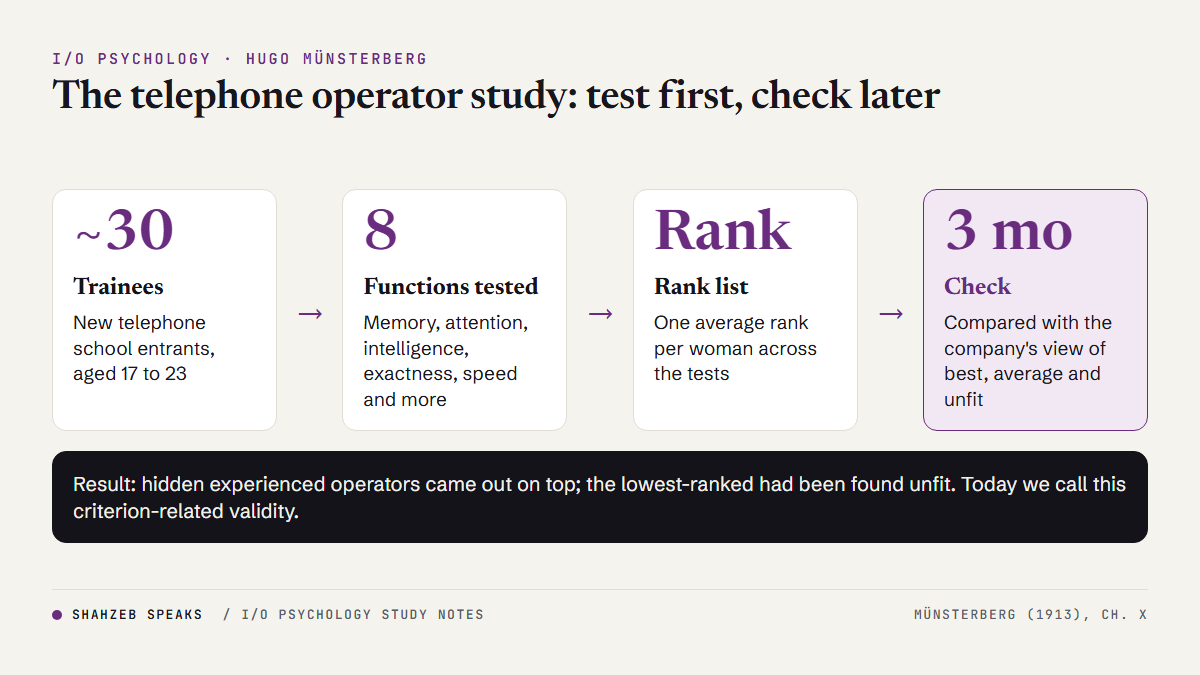
The company had quietly mixed some experienced operators, who had even been chosen as teachers, into the group. Münsterberg did not know who they were. They came out at the top of his list, and the women at the bottom had in the meantime been found unfit for the work. This is why textbooks call the study an early example of testing against job demands: test first, then check the test against later job performance. In modern terms, that is criterion-related validity.
What did Münsterberg give I/O psychology?
For a contribution question, give five or six points and tie each one to something he did.
- Selection by testing. He argued that people should be matched to jobs by measuring the mental qualities the job needs, not by guesswork or appearance (the motormen and telephone studies).
- Job analysis before testing. He first worked out what the job demanded of the mind, then built the test. That order is still the rule in selection.
- Checking the test against performance. The telephone study compared test ranks with later job success, the logic of validation.
- Simulation and work-sample tests. His railway card test tried to feel like the real job, an early form of the job simulation.
- Training, fatigue and monotony. Part II brought learning, attention, fatigue and monotony into the study of work, the roots of training research and human factors.
- A scientific, value-neutral stance. His “psychotechnics” said psychology supplies means, not ends, an early statement of the scientist-practitioner role.
You can see where he sits among the other founders on the I/O psychology theorists page and in the history of I/O psychology timeline.
Münsterberg vs Taylor vs Scott
Students often confuse the three people who shaped the field before 1920. Here is the difference in one table.
| Point | Hugo Münsterberg | Frederick W. Taylor | Walter Dill Scott |
|---|---|---|---|
| Background | Experimental psychologist (Wundt’s student), Harvard | Engineer, steel industry | Psychologist, Northwestern University |
| Key work | Psychology and Industrial Efficiency (1913) | The Principles of Scientific Management (1911) | The Theory of Advertising (1903) |
| Main focus | Fitting the right person to the job by measuring mental abilities | Finding the one best way to do a task, timing it, paying by output | Advertising and persuasion, later selection of salespeople and soldiers |
| Tool | Laboratory tests and simulations | Time and motion study, stopwatch | Rating scales and tests |
| View of the worker | A mind with measurable abilities that differ between people | A unit of output to be trained and paid efficiently | A person to be persuaded or rated |
Münsterberg actually wrote a chapter called “Scientific Management” in his book. He thought Taylor’s movement had “most valuable suggestions” but that some of Taylor’s followers had made “almost a religion” of it. His point was that scientific management needed psychology to choose the right people in the first place. For the full Taylor story see scientific management vs human relations.
Why was Münsterberg forgotten, and what are the criticisms?
Three reasons come up in the history books.
- The First World War. Münsterberg openly defended Germany’s side, which made him deeply unpopular in the United States as the war went on. He died suddenly in December 1916, and his death drew little public attention.
- Thin evidence by later standards. His studies used small groups (about thirty trainees in the telephone study) and simple rank comparisons, with no statistics of the kind the field later required. They show the idea of validation more than they prove any particular test works.
- Ideas taken over by others. The large-scale testing of US Army recruits in 1917 (Army Alpha and Beta) was led by others, and it was this work, not his, that made testing big business after the war.
Frank Landy’s 1992 article in the Journal of Applied Psychology asked in its title whether Münsterberg was a “victim or visionary”. For exam purposes, the fair answer is both: his methods were rough, but the questions he asked (who fits this job, how do we know, how do we train them) are still the questions of personnel psychology.
A local example makes the point. When a Pakistani bank or a Manila call centre gives applicants a typing or call-handling simulation and then checks, months later, whether high scorers became good performers, it is doing what Münsterberg did with telephone operators in 1912.
10-mark answer structure
- Introduction (who, when): Hugo Münsterberg (1863 to 1916), German-born psychologist trained by Wundt, at Harvard from 1892; often called the founder or father of industrial psychology.
- Key book: Psychology and Industrial Efficiency (1913; German version 1912), which founded “psychotechnics”.
- The three parts: the best possible man (selection), the best possible work (training, fatigue, monotony), the best possible effect (advertising and sales).
- Experiments: streetcar motormen (attention test on cards), ship officers (quick decisions with letter cards), telephone operators (about 30 trainees, eight functions, compared with company ratings after three months).
- Contributions: job demands first, then test; validate tests against performance; simulations; training and fatigue research; value-neutral applied science.
- Comparison: Taylor studied the task and the one best way; Münsterberg studied the person and individual differences.
- Criticism: small samples, no statistics, reputation damaged by his pro-German stance in the First World War.
- Example: a modern bank or call centre simulation used in hiring and checked against later performance.
- Conclusion: his methods were early and rough, but his three questions still define personnel psychology.
Model opening line: “Hugo Münsterberg’s Psychology and Industrial Efficiency (1913) was the first systematic attempt to use experimental psychology to choose workers, improve their work and influence buyers, which is why he is called the founder of industrial psychology.”
Practice MCQs: Hugo Münsterberg
Practice questions written to the published syllabus, not past-paper questions.
-
Under whom did Münsterberg earn his PhD at Leipzig?
- William James
- Wilhelm Wundt
- Sigmund Freud
- Edward Titchener
Show answer
B. He completed his PhD with Wundt at Leipzig in 1885. William James later brought him to Harvard; Freud and Titchener were not his supervisors.
-
Which is the correct order of the three parts of Psychology and Industrial Efficiency?
- Best possible work, best possible man, best possible effect
- Best possible man, best possible work, best possible effect
- Best possible effect, best possible man, best possible work
- Best possible man, best possible effect, best possible work
Show answer
B. The book moves from choosing the person, to the work itself, to the effect on buyers. The other orders mix up the parts.
-
A modern company uses a typing simulation to choose data-entry clerks. Which part of Münsterberg’s book does this fit best?
- The best possible effect
- The best possible work
- The best possible man
- None; he did not study selection
Show answer
C. Choosing the person who fits the job is “the best possible man”. The best possible work is about training and conditions once someone is hired; the best possible effect is about buyers.
-
In the telephone operator study, what did Münsterberg compare his test rankings with?
- The women’s school grades
- The company’s judgement of their work after about three months
- Their own self-ratings
- Their typing speed
Show answer
B. He checked his rank list against the company’s practical results after three months, which is the logic of criterion-related validity. The other options were not his criterion.
-
What name did Münsterberg give to applied psychology as a technical science?
- Psychometrics
- Psychotechnics
- Ergonomics
- Human relations
Show answer
B. He used “psychotechnics”. Ergonomics and human relations are later terms; psychometrics is the science of measurement more broadly.
-
Which of these is NOT one of the jobs Münsterberg studied in Psychology and Industrial Efficiency?
- Electric railway motormen
- Ship officers
- Telephone operators
- Pig-iron handlers
Show answer
D. Pig-iron handling at Bethlehem Steel is Taylor’s famous example. Münsterberg’s chapters cover railway, ship and telephone service.
-
How does Münsterberg’s approach differ most from Taylor’s?
- Münsterberg ignored efficiency
- Münsterberg focused on measuring differences between people; Taylor focused on the one best way to do the task
- Taylor used psychological tests; Münsterberg used stopwatches
- They had the same approach
Show answer
B. Münsterberg’s starting point was individual differences in mental abilities; Taylor’s was the task. C reverses their tools, and A is wrong because efficiency was in his book’s title.
-
The railway card test was meant to feel like driving a streetcar. In modern terms, this makes it closest to a:
- Projective test
- Job simulation or work sample
- Personality inventory
- Reference check
Show answer
B. It copied the mental demands of the real task, like a simulation. Projective tests and personality inventories measure traits in general, and a reference check is not a test.
-
Which statement about Münsterberg’s later reputation is accurate?
- He led the Army Alpha testing programme in 1917
- His open support for Germany in the First World War made him unpopular in the US
- He founded SIOP
- He ran the Hawthorne studies
Show answer
B. His pro-German stance damaged his standing, and he died in 1916. Army Alpha came in 1917 under others, SIOP was formed in 1982, and the Hawthorne studies began in 1924.
-
A student writes: “Münsterberg proved that his tests predicted performance for all jobs.” What is the best correction?
- The statement is correct
- He studied a few jobs with small groups and simple rankings, so his work showed the method more than it proved general validity
- He never compared tests with performance
- He only studied advertising
Show answer
B. His samples were small (about thirty in the telephone study) and his comparisons were simple. C is wrong because the telephone study did compare tests with performance; D ignores Parts I and II.
Practise on your phone
The free I/O Psychology Prep app has 410 explained
questions, flashcards and an exam countdown, and works offline. Get it on Google Play
· About the app
More practice on the founders: history of I/O psychology MCQs.
Questions students ask
Why is Münsterberg called the father of industrial psychology?
Because Psychology and Industrial Efficiency (1913) was the first book to set out a full programme for using experimental psychology at work: selecting people, improving work and influencing buyers, with real experiments on real jobs. Some historians also give Walter Dill Scott a founder’s share.
What was Münsterberg’s contribution to I/O psychology?
He showed that workers could be matched to jobs by testing the mental abilities a job needs, checked those tests against later performance, and brought training, fatigue and monotony into the study of work. He called this applied science psychotechnics.
What are the three parts of Psychology and Industrial Efficiency?
The best possible man (selection), the best possible work (training and working conditions) and the best possible effect (advertising, display and selling).
Did Münsterberg have a theory of management?
Not a management theory in Taylor’s sense. He accepted that scientific management had valuable ideas but argued it needed psychology to choose the right people and to understand fatigue, attention and learning.
When did Münsterberg die?
On 16 December 1916, in Cambridge, Massachusetts, while giving a lecture at Radcliffe College. He was 53.
Is Münsterberg in Pakistani and Indian syllabi?
Yes. Industrial psychology outlines that start with the definition and history of the field, such as Punjab University’s course, cover the founders, and Münsterberg is the name most often asked about with Taylor, Scott and Mayo.
Practise on your phone
The free I/O Psychology Prep app has 410 explained
questions, flashcards and an exam countdown, and works offline. Get it on Google Play
· About the app
References
- Benjamin, L. T., Jr. (2000). Hugo Münsterberg: Portrait of an applied psychologist. In G. A. Kimble & M. Wertheimer (Eds.), Portraits of pioneers in psychology (Vol. 4, pp. 143–160). Psychology Press. https://doi.org/10.4324/9781410603876-12
- Landy, F. J. (1992). Hugo Münsterberg: Victim or visionary? Journal of Applied Psychology, 77(6), 787–802. https://doi.org/10.1037/0021-9010.77.6.787
- Landy, F. J. (1997). Early influences on the development of industrial and organizational psychology. Journal of Applied Psychology, 82(4), 467–477. https://doi.org/10.1037/0021-9010.82.4.467
- Münsterberg, H. (1908). On the witness stand: Essays on psychology and crime. McClure.
- Münsterberg, H. (1913). Psychology and industrial efficiency. Houghton Mifflin. Full text: https://archive.org/details/psychologyindust00munsuoft
- Taylor, F. W. (1911). The principles of scientific management. Harper & Brothers.
- Vinchur, A. J., & Koppes, L. L. (2011). A historical survey of research and practice in industrial and organizational psychology. In S. Zedeck (Ed.), APA handbook of industrial and organizational psychology (Vol. 1, pp. 3–36). American Psychological Association. https://doi.org/10.1037/12169-001
This post is part of the I/O psychology study guide. Read next: the Hawthorne studies, the history of I/O psychology and industrial vs organizational psychology.