

Scientific management (Frederick Taylor, 1911) treats work as an engineering problem: find the one best way to do each task, select and train workers for it, and pay by output. The human relations approach (Elton Mayo and the Hawthorne studies, 1924 to 1932) holds that output depends on social needs, supervision and group norms, not only on methods and money.
“Compare scientific management with the human relations approach” is one of the most common long questions in industrial psychology, OB and management papers. This page gives you the comparison table, the real evidence behind each side (Taylor’s own numbers and the Hawthorne records), the criticisms of both, and a ready 10-mark answer plan with practice MCQs.
A note before we start: the two schools are usually taught as opposites, but they noticed the same problem. Both saw workers holding back output as a group. They just drew opposite lessons from it, and that is the best way to understand the difference.
What is scientific management?
Frederick Winslow Taylor (1856 to 1915) was an American engineer who rose through the Midvale Steel Company, which he joined in 1878, and later worked at Bethlehem Steel. In The Principles of Scientific Management (1911) he argued that most workers deliberately worked slowly, which he called “soldiering”. He blamed three things: the fear that working faster would put men out of work, management systems that made slow work pay, and rule-of-thumb methods.
His answer was to give management four new duties. In Taylor’s own list:
- Develop a science for each element of a man’s work, replacing rule-of-thumb methods (time and motion study).
- Scientifically select, then train, teach and develop the workman, instead of letting him choose his own work and train himself.
- Co-operate heartily with the men so that all work is done by the science that has been developed.
- Divide work and responsibility almost equally between management and workers: managers plan, workers carry out.
Taylor’s evidence: pig iron and shovelling at Bethlehem Steel
Taylor’s famous example is a gang of about 75 men loading 92-pound “pigs” of iron onto railway cars. They averaged about 12.5 long tons per man per day. Taylor calculated that a first-class handler should load 47 to 48 tons. He picked one worker, whom he called “Schmidt”, told him exactly when to lift, walk and rest, and paid him $1.85 a day instead of the usual $1.15. Taylor reports that Schmidt loaded 47 tons and kept that pace.
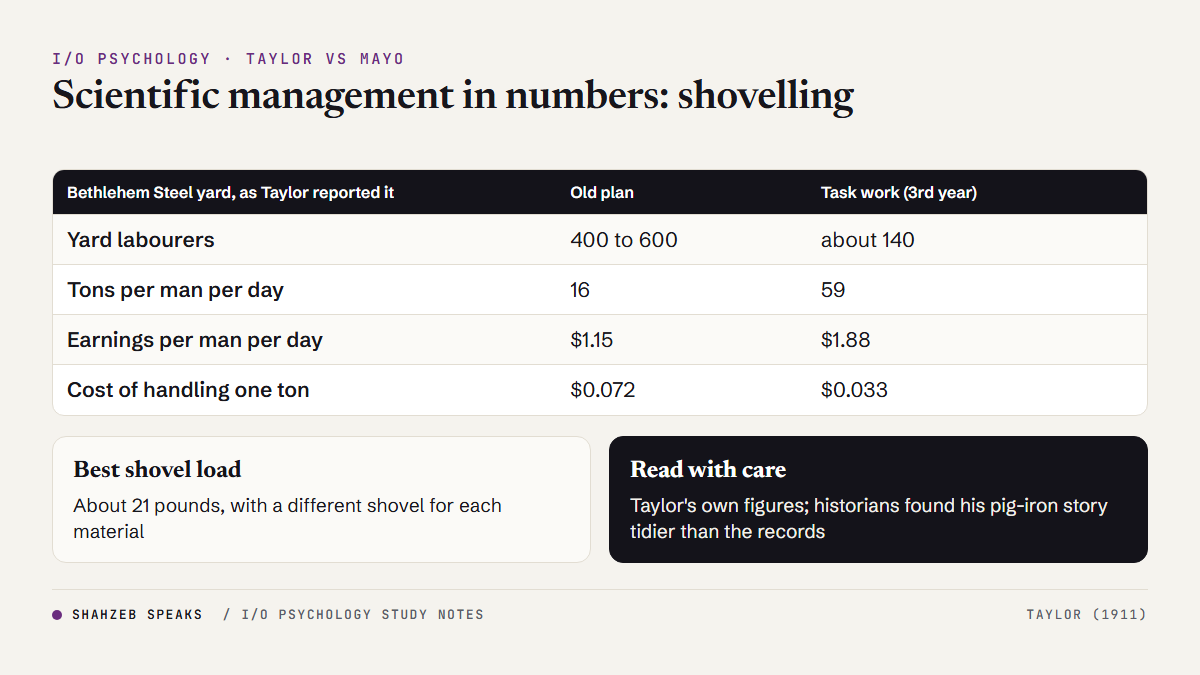
His shovelling study is less famous but more detailed. He found that a first-class shoveller did the most work with a load of about 21 pounds per shovel, and the company supplied different shovels for different materials. For the third year under the new plan, Taylor reported that the yard labourers fell from between 400 and 600 to about 140, average tons handled per man per day rose from 16 to 59, average earnings rose from $1.15 to $1.88 a day, and the cost of handling a ton fell from $0.072 to $0.033.
Keep in mind that these are Taylor’s own figures, written to persuade. Historians Charles Wrege and Amedeo Perroni (1974) went back to the records and argued that the published pig-iron story was more fiction than fact; they also identified “Schmidt” as a worker named Henry Noll. So in an exam, write “Taylor reported” rather than “Taylor proved”.
What is the human relations approach?
The human relations movement grew out of the Hawthorne studies at Western Electric (1924 to 1932) and the interpretations of Elton Mayo (1880 to 1949), an Australian-born professor at Harvard Business School, and his colleague Fritz Roethlisberger. Mayo set out his view in The Human Problems of an Industrial Civilization (1933); Roethlisberger and Dickson gave the full report in Management and the Worker (1939).
The studies began with an engineering question very much in Taylor’s spirit: does better lighting raise output? Output rose in test and control groups alike, so lighting could not be the cause. In the Relay Assembly Test Room, total weekly output reached a new high even when rest pauses were taken away. Interviews with 21,126 employees showed how much feelings about supervisors and co-workers mattered. In the Bank Wiring Observation Room, a group of 14 men held output to their own idea of a fair day’s work. The details are on the Hawthorne studies page.
From this the human relations approach drew its main ideas:
- Workers are social beings; belonging, recognition and being listened to motivate them, not only pay.
- The work group, not the isolated individual, is the unit that sets output norms.
- Every organization has an informal organization of friendships, cliques and unwritten rules beside the formal chart.
- Supervision style matters: a supervisor who listens and consults gets more than one who only controls.
- Communication and counselling help: the Hawthorne interviews led to supervisor training and an employee counselling programme.
Scientific management vs human relations: the differences in a table
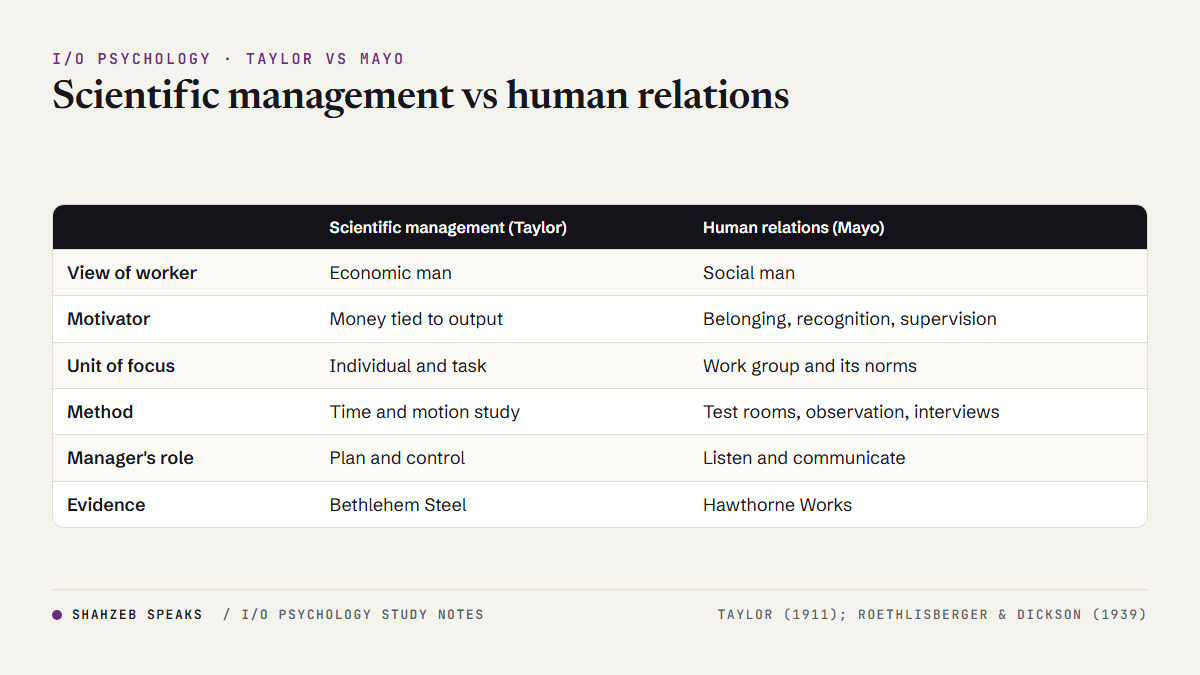
| Basis | Scientific management | Human relations |
|---|---|---|
| Key figures and works | F. W. Taylor, The Principles of Scientific Management (1911); also the Gilbreths | Elton Mayo (1933); Roethlisberger & Dickson (1939) |
| Period | 1880s to 1910s | 1920s to 1950s |
| View of the worker | “Economic man”: a person who responds to pay and clear instructions | “Social man”: a person with social needs who belongs to a group |
| Main motivator | Money tied to output (piece rate, bonus for meeting the task) | Belonging, recognition, attention, good supervision |
| Unit of focus | The individual worker and the single task | The work group and its norms |
| Method | Time and motion study with a stopwatch; standard methods and tools | Test rooms, observation and non-directive interviews |
| Role of the manager | Plan the work; separate planning from doing; control | Listen, communicate, build morale and team spirit |
| Informal organization | Seen as a cause of soldiering to be broken up | Seen as a fact of working life to understand and work with |
| Famous evidence | Bethlehem Steel pig iron and shovelling | Western Electric’s Hawthorne Works |
| Main criticism | Treats people like parts of a machine; numbers were Taylor’s own and partly embellished | Weak evidence; data also fit money and discipline; can be used to calm workers without changing pay or conditions |
| Legacy today | Work study, standard times, industrial engineering, call-handling targets | Supervisor training, employee surveys, counselling, organizational behaviour |
The point most notes miss: both saw group pressure
Taylor wrote that if a worker tried to do his largest possible day’s work, “he would be abused by his fellow-workers”. Twenty years later the Bank Wiring Observation Room recorded the same thing: a man who produced too much was called a “rate-buster” and punched on the arm.
The two schools read this pressure in opposite ways. Taylor saw it as a problem to remove: set the task scientifically, pay each man individually for meeting it, and the group’s hold weakens. The Hawthorne researchers saw it as a social fact: the group gives its members security and identity, so managers have to understand it and work through it. If you can make this point in an exam, you show you understand both schools rather than having memorised two lists.
Criticisms of both approaches
Criticisms of scientific management
- It treats people as parts of a machine. Taylor’s own description of the ideal pig-iron handler compared him to an ox. Planning was taken away from workers, which made jobs narrow and repetitive.
- Workers and unions resisted it. Even Hugo Münsterberg, who admired much of Taylor’s work, noted in 1913 that some trade unions opposed it, mainly because it reduced the number of workers needed, and that some of Taylor’s followers had made “almost a religion” of his ideas.
- The evidence is partly a story. Wrege and Perroni (1974) and Wrege and Hodgetts (2000) showed that the pig-iron account was much tidier than the records.
- It ignores individual differences beyond physical strength, which is where psychologists such as Münsterberg came in. See Hugo Münsterberg’s contribution.
Criticisms of the human relations approach
- The evidence is weak. Carey (1967) argued that the Hawthorne data fit money, firm leadership and discipline at least as well. Franke and Kaul (1978), in the first statistical analysis, explained most of the output change by managerial discipline, the depression and raw-material quality.
- It was criticised early, mainly by sociologists. Muldoon (2017) shows that most critics from 1936 to 1958 were sociologists, and their objections were about theory, method and research ethics.
- A happy worker is not always a productive worker. A large meta-analysis by Judge, Thoresen, Bono and Patton (2001) put the average correlation between job satisfaction and performance at about .30: real, but far from one-to-one. “Keep them happy” is not a full management theory.
- A point to discuss: help or manipulation? If a manager listens and gives attention but never changes pay or conditions, does that help workers or only calm them? A strong exam answer raises this question and gives a view.
Which one is right? How modern I/O psychology uses both
Neither school won. Modern I/O psychology keeps the careful measurement and job analysis of Taylor’s era and the attention to attitudes, groups and leadership that came from Hawthorne. Job design research, such as the job characteristics model, is a good example: it studies the task (Taylor’s level) but measures how the task feels to the person (the human relations level).
You can see both in a Pakistani or Philippine workplace today. A Karachi garment factory that sets standard minutes for stitching a collar and pays a piece rate is using scientific management. The same factory, if it trains line supervisors to listen to operators and form stable teams, is using human relations. A call centre in Manila that tracks average handling time down to the second is Taylorist; the team huddle at the start of the shift is human relations. Most good workplaces use both.
For the bigger picture of how these two schools fit into the growth of the field, see the history of I/O psychology timeline. For motivation theories that came after both, see work motivation theories compared.
10-mark answer structure
- Introduction: two early schools of management thought that shaped I/O psychology; scientific management (Taylor, 1911) and human relations (Mayo, Hawthorne studies, 1924 to 1932).
- Scientific management: soldiering; Taylor’s four duties of management; time and motion study; differential pay.
- Evidence: Bethlehem Steel pig iron (12.5 to 47 tons reported) and shovelling (16 to 59 tons per man per day reported).
- Human relations: Hawthorne phases in two lines; social man, group norms, informal organization, supervision, communication.
- Comparison: 5 or 6 rows from the table (view of worker, motivator, unit of focus, method, manager’s role, informal organization).
- Common ground: both observed group restriction of output but drew opposite lessons.
- Criticisms: Taylor’s mechanistic view and embellished evidence (Wrege & Perroni, 1974); weak Hawthorne evidence (Carey, 1967; Franke & Kaul, 1978).
- Local example: piece rates and standard minutes in a garment factory vs supervisor training and team huddles.
- Conclusion: modern I/O psychology combines Taylor’s measurement with human relations’ attention to people and groups.
Model opening line: “Scientific management and the human relations approach both tried to raise output, but Taylor looked for the answer in the task and the pay packet, while Mayo looked for it in the work group and the supervisor.”
Practice MCQs: Taylor vs Mayo
Practice questions written to the published syllabus, not past-paper questions.
-
What did Taylor mean by “soldiering”?
- Military-style discipline at work
- Deliberately working slowly to avoid a full day’s work
- Working in teams
- Training new workers
Show answer
B. Taylor used “soldiering” for deliberate slow working, which he said was almost universal. It has nothing to do with military discipline or teams.
-
Which of these is NOT one of Taylor’s four duties of management?
- Develop a science for each element of work
- Scientifically select and train workers
- Let each work group set its own output norm
- Divide work and responsibility between management and workers
Show answer
C. Taylor wanted management, not the group, to set the task scientifically. Letting the group set its own norm is close to what the Hawthorne researchers observed, and what Taylor fought against.
-
According to Taylor’s own account, how much pig iron per day did the Bethlehem gang load on average before his changes?
- About 4 tons
- About 12.5 tons
- About 47 tons
- About 59 tons
Show answer
B. The gang averaged about 12.5 long tons per man per day; 47 to 48 tons was Taylor’s target. 59 tons is from the separate shovelling study.
-
The human relations approach sees the worker mainly as:
- An economic man who works only for money
- A social being whose output depends on group membership and supervision
- A machine part to be timed
- A customer to be persuaded
Show answer
B. “Social man” is the human relations view. A and C describe the scientific management view; D describes consumer psychology.
-
A manager in a Lahore textile mill sets standard minutes for each operation and pays a bonus for every piece above the standard. Which approach is she using?
- Human relations
- Scientific management
- Transformational leadership
- Job enrichment
Show answer
B. Standard times from work study plus pay tied to output is Taylor’s system. Nothing here concerns groups, inspiration or enriching the job.
-
A new call centre supervisor starts each shift with a team meeting, asks agents for ideas and learns their names. Which approach does this reflect?
- Scientific management
- Human relations
- Bureaucracy
- Time and motion study
Show answer
B. Listening, consulting and building team feeling are human relations practices. Time and motion study belongs to scientific management.
-
What did both Taylor and the Bank Wiring Observation Room researchers observe?
- Brighter light raised output
- Workers who produced too much were pressured by their co-workers
- Piece rates always raised output
- Workers preferred longer hours
Show answer
B. Taylor wrote that a fast worker “would be abused by his fellow-workers”; the bank wiring men called him a “rate-buster”. A was disproved in the illumination tests; C and D are not findings of either.
-
Who argued in 1974 that Taylor’s published pig-iron story was more fiction than fact?
- Franke and Kaul
- Wrege and Perroni
- Roethlisberger and Dickson
- Levitt and List
Show answer
B. Wrege and Perroni re-examined the pig-iron records. Franke and Kaul and Levitt and List re-analysed Hawthorne data; Roethlisberger and Dickson wrote the Hawthorne report.
-
Which is a fair criticism of the human relations approach?
- It ignored the work group
- Its key evidence, the Hawthorne data, also fits explanations based on money and discipline
- It relied only on stopwatch studies
- It was created by engineers at Bethlehem Steel
Show answer
B. Carey (1967) and Franke and Kaul (1978) made this point. The approach centred on the group (so A is wrong), used interviews and observation (not C), and came from Western Electric and Harvard (not D).
-
Which statement best describes how modern I/O psychology treats the two schools?
- It rejects both completely
- It follows only scientific management
- It combines careful measurement of work with attention to attitudes, groups and leadership
- It follows only human relations
Show answer
C. Job analysis and measurement come from one tradition and the study of attitudes, groups and leadership from the other. The field keeps both, so A, B and D are too narrow.
Practise on your phone
The free I/O Psychology Prep app has 410 explained
questions, flashcards and an exam countdown, and works offline. Get it on Google Play
· About the app
More questions on this period: history of I/O psychology MCQs.
Questions students ask
What is the main difference between scientific management and human relations?
Scientific management looks for higher output in the task: the one best method, the right worker and pay tied to output. Human relations looks for it in people: group norms, supervision, recognition and communication.
What are Taylor’s principles of scientific management?
Taylor listed four duties of management: develop a science for each element of work; scientifically select, train and develop workers; co-operate with workers so the work follows the science; and divide work and responsibility between management and workers.
Who is the father of the human relations movement?
Elton Mayo is usually named, because of his role in interpreting the Hawthorne studies and his 1933 book. Fritz Roethlisberger and William Dickson wrote the full report in 1939.
How did the Hawthorne studies challenge scientific management?
They started with a Taylor-style question about lighting and found that physical conditions did not explain output. Group norms and supervision did, which scientific management had treated as obstacles rather than causes.
Is scientific management still used today?
Yes. Standard times in factories, delivery-route optimisation and call-handling targets all use Taylor’s logic of measuring and standardising tasks, usually combined with more attention to people than Taylor gave.
What is the “economic man” vs “social man” idea?
“Economic man” is the scientific management view that people work mainly for money and respond to incentives. “Social man” is the human relations view that people work for belonging and recognition too, and are shaped by their group.
Practise on your phone
The free I/O Psychology Prep app has 410 explained
questions, flashcards and an exam countdown, and works offline. Get it on Google Play
· About the app
References
- Carey, A. (1967). The Hawthorne studies: A radical criticism. American Sociological Review, 32(3), 403–416. https://doi.org/10.2307/2091087
- Franke, R. H., & Kaul, J. D. (1978). The Hawthorne experiments: First statistical interpretation. American Sociological Review, 43(5), 623–643. https://doi.org/10.2307/2094540
- Judge, T. A., Thoresen, C. J., Bono, J. E., & Patton, G. K. (2001). The job satisfaction–job performance relationship: A qualitative and quantitative review. Psychological Bulletin, 127(3), 376–407. https://doi.org/10.1037/0033-2909.127.3.376
- Mayo, E. (1933). The human problems of an industrial civilization. Macmillan.
- Muldoon, J. (2017). The Hawthorne studies: An analysis of critical perspectives, 1936–1958. Journal of Management History, 23(1), 74–94. https://doi.org/10.1108/JMH-09-2016-0052
- Münsterberg, H. (1913). Psychology and industrial efficiency. Houghton Mifflin.
- Roethlisberger, F. J., & Dickson, W. J. (1939). Management and the worker. Harvard University Press.
- Taylor, F. W. (1911). The principles of scientific management. Harper & Brothers. Full text: https://archive.org/details/principlesofscie00taylrich
- Wrege, C. D., & Hodgetts, R. M. (2000). Frederick W. Taylor’s 1899 pig iron observations: Examining fact, fiction, and lessons for the new millennium. Academy of Management Journal, 43(6), 1283–1291. https://doi.org/10.2307/1556350
- Wrege, C. D., & Perroni, A. G. (1974). Taylor’s pig-tale: A historical analysis of Frederick W. Taylor’s pig-iron experiments. Academy of Management Journal, 17(1), 6–27. https://doi.org/10.2307/254767
This post is part of the I/O psychology study guide. Read next: the Hawthorne studies in detail, Hugo Münsterberg and the I/O psychology theorists.