
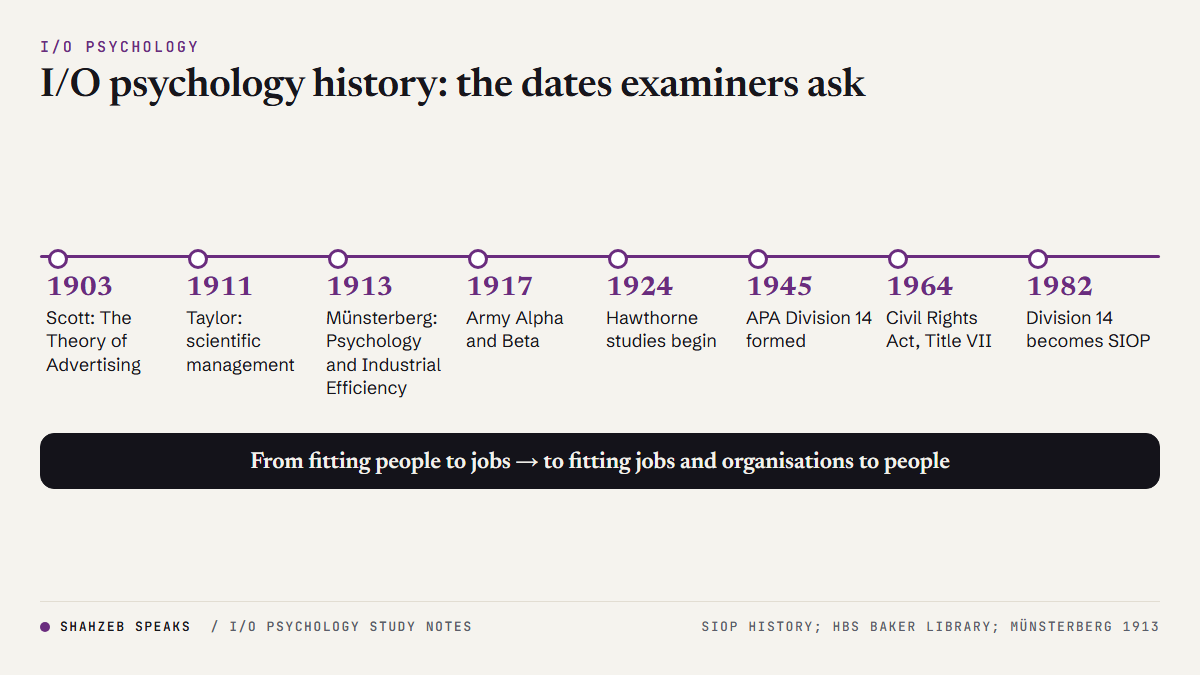
History of I/O psychology MCQs centre on a few names and dates: Walter Dill Scott (advertising, 1903), Frederick Taylor (scientific management, 1911), Hugo Münsterberg (Psychology and Industrial Efficiency, 1913), the Army Alpha and Beta tests (1917), the Hawthorne studies (1924 to the early 1930s) and APA Division 14, founded in 1945 and incorporated as SIOP in 1982.
This set is for students revising the first chapter of almost every I/O psychology course: the definition and history of the field. It is also the part of a board review or lecturer test where pure recall (who, when, which book) is most common. You get a one-page timeline, a table of the key figures, 25 practice questions with explanations, and a plan for the long question. The questions are practice questions written to the published syllabus, not past-paper or board items.
History questions reward exact names and years, so I have checked each date against a primary or institutional source and listed them in the references. Where sources disagree, the explanation says so.
The history of I/O psychology in one page
Roots in experimental psychology. Wilhelm Wundt’s laboratory at Leipzig trained many early psychologists. One of them, Hugo Münsterberg, earned his doctorate under Wundt and was recruited by William James to Harvard in 1892. His Psychology and Industrial Efficiency (1913) applied laboratory methods to selecting workers, including streetcar motormen, and is why he is often called the father of industrial psychology. Walter Dill Scott applied psychology to advertising in The Theory of Advertising (1903) and later to selecting salespeople.
Scientific management. Frederick W. Taylor, an engineer, published The Principles of Scientific Management in 1911: study each job to find the “one best way”, select and train workers for it, and tie pay to output. Frank and Lillian Gilbreth developed motion study and named the small elements of work “therbligs” (roughly Gilbreth spelled backwards). Lillian Gilbreth earned a PhD in psychology from Brown University in 1915.
World War I and the 1910s. In 1917 a committee led by Robert Yerkes built the Army Alpha (a written group test) and Army Beta (a non-verbal version for recruits who could not read or did not speak English). The Journal of Applied Psychology began in 1917, and Walter Bingham set up the Division of Applied Psychology at the Carnegie Institute of Technology in 1915 to 1916. In 1921 James McKeen Cattell founded the Psychological Corporation to bring applied psychology to business.
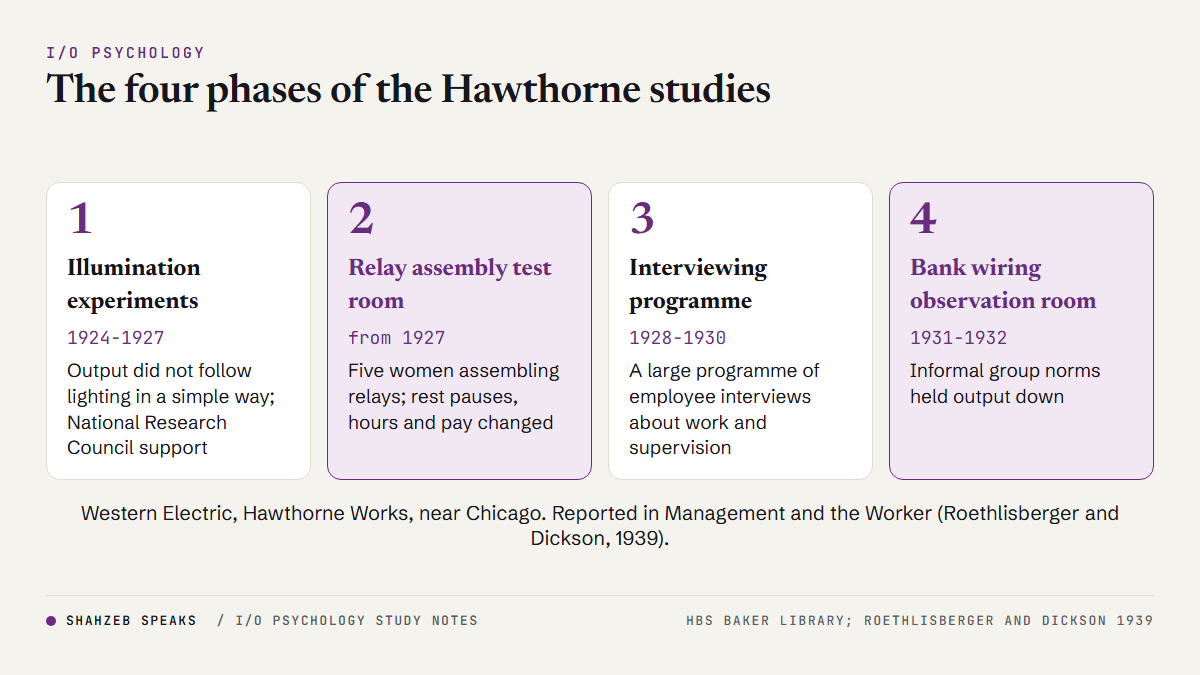
The Hawthorne studies and human relations. At Western Electric’s Hawthorne Works near Chicago, illumination experiments (1924 to 1927, with support from the National Research Council) found that output did not follow lighting in a simple way. The relay assembly test room followed from 1927, Elton Mayo of Harvard became involved from 1928, a large interviewing programme ran from 1928 to 1930, and the bank wiring observation room (1931 to 1932) showed informal group norms holding output down. Roethlisberger and Dickson reported the work in Management and the Worker (1939). The studies started the human relations movement, though later critics such as Carey (1967) argued the data did not support all of the conclusions.
From 1945 to today. APA Division 14 was formed in 1945 as “Industrial and Business Psychology”; “Business” was dropped in 1962, “Organizational” was added in 1973, and in 1982 the division incorporated as the Society for Industrial and Organizational Psychology (SIOP). After World War II, assessment centres spread from military use to industry through AT&T’s Management Progress Study (begun 1956), and the US Civil Rights Act of 1964 pushed employers to prove that selection tests were valid and fair. For the long version, read the history of I/O psychology timeline.
Summary table: who did what, and when
| Person or event | Year | Contribution | Read more |
|---|---|---|---|
| Walter Dill Scott | 1903 | The Theory of Advertising; later salesman selection | I/O theorists |
| Frederick W. Taylor | 1911 | The Principles of Scientific Management | Taylor vs Mayo |
| Hugo Münsterberg | 1913 | Psychology and Industrial Efficiency; motorman selection | Münsterberg |
| Lillian Gilbreth | 1915 | PhD in psychology, Brown University; motion study with Frank Gilbreth | I/O theorists |
| Army Alpha and Beta | 1917 | Group tests for placing recruits; Beta non-verbal | History timeline |
| Psychological Corporation | 1921 | Founded by James McKeen Cattell | History timeline |
| Hawthorne studies | 1924 to early 1930s | Social factors and informal groups affect output | Hawthorne studies |
| APA Division 14 | 1945 | “Industrial and Business Psychology”; renamed 1962 and 1973 | Industrial vs organizational |
| Civil Rights Act, Title VII | 1964 | Bans employment discrimination in the US; selection must be fair and job-related | Selection MCQs |
| SIOP | 1982 | Division 14 incorporates as the Society for Industrial and Organizational Psychology | Study guide |
Practice MCQs: history of I/O psychology
-
Who recruited Hugo Münsterberg to run Harvard’s psychology laboratory in 1892?
- G. Stanley Hall
- Wilhelm Wundt
- William James
- Frederick Taylor
Show answer
C. William James brought Münsterberg to Harvard to lead its experimental laboratory. Wundt had supervised his doctorate in Leipzig, Hall was at Clark University, and Taylor was an engineer.
-
Kurt Lewin’s idea of “action research” (1946) is best described as:
- Testing army recruits
- Laboratory experiments with animals
- Research done in repeated cycles of planning, action and fact-finding about the results, with the people involved
- Time-and-motion study
Show answer
C. Lewin wanted research that helps solve real social and organisational problems, which later shaped organisation development. Animal experiments, army testing and motion study belong to other traditions.
-
A street railway company wants fewer accidents and asks a psychologist to find out which applicants will make safe drivers. This is the kind of problem Münsterberg studied with:
- Pig-iron handlers at Bethlehem Steel
- Army officers in World War II
- Relay assemblers at Hawthorne
- Electric streetcar motormen
Show answer
D. In Psychology and Industrial Efficiency he described tests for selecting motormen for electric railways, because accidents were costly and worried the public. World War II officers, the Hawthorne relay room and Bethlehem Steel belong to other parts of the story.
-
At the Carnegie Institute of Technology, Walter Dill Scott led which unit, which developed methods for selecting salespeople?
- The Bureau of Salesmanship Research
- The Psychological Corporation
- The Hawthorne Works
- The Office of Strategic Services
Show answer
A. Scott directed the Bureau of Salesmanship Research, working with companies on hiring salespeople, alongside Bingham’s Division of Applied Psychology. Cattell founded the Psychological Corporation, Hawthorne was a Western Electric plant, and the OSS was a wartime agency.
-
Taylor’s best-known demonstration of scientific management, described in his 1911 book, involved:
- Loading pig iron at Bethlehem Steel
- Assembling telephone relays at Western Electric
- Testing streetcar motormen in Boston
- Selecting army officers in World War I
Show answer
A. Taylor described how a worker loading pig iron at Bethlehem Steel raised his daily output after the method, rest and pay were redesigned. Relays were at Hawthorne, motormen were Münsterberg’s study, and officer selection belongs to the army testing story. More: Taylor vs Mayo.
-
The word “therblig”, used for the basic elements of a manual task such as “search”, “grasp” and “hold”, comes from:
- A German word for motion
- Taylor’s initials
- A Hawthorne research code
- The name Gilbreth, roughly spelled backwards
Show answer
D. Frank and Lillian Gilbreth broke work into small motions, often filmed, and named the units after themselves in reverse. The other options are invented. The exact number of therbligs differs between sources, so exams usually ask about the name rather than the count.
-
Lillian Gilbreth earned a PhD in psychology in 1915 from which university?
- Harvard University
- University of Leipzig
- Brown University
- Carnegie Institute of Technology
Show answer
C. Her Brown dissertation applied ideas about eliminating waste to teaching. An earlier Berkeley dissertation became the book The Psychology of Management (1914), but that degree was not awarded. Harvard, Leipzig and Carnegie are linked to Münsterberg, Wundt and Bingham.
-
Why were the Army Alpha and Beta tests of 1917 important for the later growth of I/O psychology?
- They showed that group tests could classify very large numbers of people quickly, which raised business interest in testing after the war
- They proved that intelligence is fixed at birth
- They replaced interviews in every company
- They were the first personality tests
Show answer
A. The scale of wartime testing showed employers what group testing could do, and many psychologists moved into industry afterwards. The tests did not prove anything about intelligence being fixed (they were later heavily criticised), did not replace interviews everywhere, and measured ability rather than personality.
-
Who led the committee of psychologists that developed the Army Alpha and Beta tests during World War I?
- Robert Yerkes
- Elton Mayo
- Hugo Münsterberg
- Kurt Lewin
Show answer
A. Yerkes, then president of the American Psychological Association, chaired the group that wrote the tests in 1917. Mayo is linked to Hawthorne, Münsterberg died in 1916, and Lewin’s work came later.
-
Walter Bingham is linked with which early milestone in applied psychology?
- The first Hawthorne illumination test
- Founding SIOP in 1982
- Writing The Theory of Advertising
- Setting up the Division of Applied Psychology at the Carnegie Institute of Technology
Show answer
D. Bingham left Dartmouth in 1915 to organise the division at Carnegie (the university dates it to 1916). It was an early academic home for selection and training research. The Hawthorne tests were run by Western Electric, SIOP came decades later, and Scott wrote the advertising book.
-
The Journal of Applied Psychology published its first issue in:
- 1903
- 1917
- 1939
- 1945
Show answer
B. The first issue appeared in March 1917. Textbooks usually credit G. Stanley Hall, but Thomas (2009) shows that Ludwig Geissler and John Wallace Baird, his Clark University colleagues, were co-founders and that Geissler did much of the editing. 1903 is Scott’s advertising book, 1939 is Management and the Worker, and 1945 is Division 14.
-
In 1921, which psychologist founded the Psychological Corporation to make applied psychology available to business?
- Walter Dill Scott
- Frederick Taylor
- James McKeen Cattell
- Robert Yerkes
Show answer
C. Cattell founded the Psychological Corporation in 1921; it later became a major publisher of psychological tests. Scott, Taylor and Yerkes are known for advertising and selection, scientific management and army testing.
-
Which statement about the Hawthorne illumination experiments (1924 to 1927) is correct?
- Output rose and fell in direct step with lighting levels
- They were designed by Elton Mayo from the start
- They were run at a steel mill in Pittsburgh
- Western Electric ran them with support from the National Research Council, and output did not follow lighting in a simple way
Show answer
D. The lighting tests were run at the Hawthorne Works near Chicago with National Research Council support, and their puzzling results led to the later phases. Mayo’s involvement began around 1928, after the illumination work. More in the Hawthorne studies.
-
In the relay assembly test room, which began in 1927, researchers:
- Moved a small group of women assembling telephone relays to a separate room and changed rest pauses, hours and pay over time
- Interviewed every worker in the plant
- Observed a group of men wiring switchboard banks
- Tested only the effect of lighting
Show answer
A. Five women assembled relays in a test room while conditions were varied over several years. Plant-wide interviews were the later interviewing programme, the men wiring banks were in the bank wiring room, and lighting belonged to the first phase.
-
A Western Electric superintendent sought advice in 1928 from which Harvard figure, who then became closely linked with the Hawthorne studies?
- Hugo Münsterberg
- Elton Mayo
- William James
- B. F. Skinner
Show answer
B. George Pennock of Western Electric turned to Elton Mayo at Harvard Business School, and Mayo, Roethlisberger and colleagues shaped how the studies were interpreted. Münsterberg died in 1916, James in 1910, and Skinner was not involved.
-
The main lesson of the bank wiring observation room (1931 to 1932) was that:
- Better lighting raises output
- Individual piece rates always raise output
- Informal group norms can hold output below what management expects, even under incentive pay
- Rest pauses reduce output
Show answer
C. The men in the bank wiring room kept to an output level the group saw as fair, and pressure from the group mattered more than the pay scheme. That is why incentives did not “always” work. Lighting and rest pauses were tested in earlier phases.
-
The full report of the Hawthorne research, Management and the Worker (1939), was written by:
- Fritz Roethlisberger and William Dickson
- Elton Mayo alone
- Frederick Taylor and Henry Gantt
- Kurt Lewin and Ronald Lippitt
Show answer
A. Roethlisberger of Harvard and Dickson of Western Electric wrote the 1939 report. Mayo wrote his own books on the work, Taylor and Gantt belong to scientific management, and Lewin and Lippitt studied leadership climates.
-
A team in a call centre works harder for a few weeks simply because researchers are visibly observing them. This is called:
- The halo effect
- Social loafing
- Scientific management
- The Hawthorne effect
Show answer
D. The Hawthorne effect is a change in behaviour caused by being observed or given attention. Halo is a rating error, social loafing is less effort in groups, and scientific management is Taylor’s system.
-
Carey’s (1967) “radical criticism” of the Hawthorne studies argued that:
- The studies proved that money never matters
- The evidence did not support many of the human relations conclusions drawn from them
- The studies were never actually carried out
- Lighting was the true cause of all output changes
Show answer
B. Carey re-examined the reports and argued that factors such as pay, discipline and changes of personnel could explain the output gains, so the conclusions about social factors went beyond the data. He did not deny the studies happened or claim lighting explained everything.
-
Which statement best contrasts scientific management with the human relations movement?
- Both treat pay as the only motivator
- Scientific management stressed job design, standard methods and pay for output; human relations stressed social needs, supervision and informal groups
- Human relations came first, scientific management later
- Scientific management was developed by psychologists, human relations by engineers
Show answer
B. Taylor (1911) came first and was an engineer; human relations grew from the Hawthorne research in the late 1920s and 1930s. Neither treats pay as the only factor in the same way. See scientific management vs human relations.
-
When APA Division 14 was formed in 1945, what was its name?
- Industrial and Business Psychology
- Industrial and Organizational Psychology
- Society for Industrial and Organizational Psychology
- Personnel Psychology
Show answer
A. The division grew out of the AAAP’s industrial and business section. “Business” was dropped in 1962, “Organizational” was added in 1973, and the SIOP name came with incorporation in 1982.
-
What was APA Division 14 called between 1962 and 1973?
- Industrial and Business Psychology
- Industrial Psychology
- Industrial and Organizational Psychology
- Society for Industrial and Organizational Psychology
Show answer
B. In 1962 “Business” was dropped, leaving “Industrial Psychology”. The original 1945 name was “Industrial and Business Psychology”, “Organizational” was added in 1973, and the SIOP name came with incorporation in 1982. More in industrial vs organizational psychology.
-
During World War II, the US Office of Strategic Services used multi-day programmes of situational exercises and observers to select:
- Factory supervisors for Western Electric
- Agents for intelligence and secret operations overseas
- University students for scholarships
- Salespeople for insurance firms
Show answer
B. The OSS assessed candidates for intelligence work, an early form of the assessment centre. After the war, AT&T’s Management Progress Study (begun 1956) brought the method into business. See assessment centres.
-
Which US law, passed in 1964, made fairness and job-relatedness of selection tests a central concern for I/O psychologists?
- The Fair Labor Standards Act
- Title VII of the Civil Rights Act
- The Americans with Disabilities Act
- The Equal Pay Act
Show answer
B. Title VII banned employment discrimination based on race, colour, religion, sex or national origin, which pushed employers to show their tests were valid. The Fair Labor Standards Act (1938) covers wages and hours, the ADA came in 1990, and the Equal Pay Act (1963) covers equal pay for equal work.
-
Put these in the correct order, earliest first: (1) Army Alpha and Beta, (2) Taylor’s Principles of Scientific Management, (3) Hawthorne illumination experiments begin, (4) Münsterberg’s Psychology and Industrial Efficiency.
- 4, 2, 1, 3
- 2, 1, 4, 3
- 2, 4, 1, 3
- 1, 2, 3, 4
Show answer
C. Taylor 1911, Münsterberg 1913, Army Alpha and Beta 1917, Hawthorne 1924. Students often place Münsterberg before Taylor because he is the “father” of the field, but Taylor’s book came two years earlier.
Practise on your phone
The free I/O Psychology Prep app has 410 explained
questions, flashcards and an exam countdown, and works offline. Get it on Google Play
· About the app
The Hawthorne studies phase by phase
The Hawthorne research is the single most examined event in I/O history, and exam questions usually ask you to name a phase and its finding. Learn the four phases in order with one line each.
How to write a history answer in your exam
The long question is usually “Trace the history of industrial and organizational psychology” or “Discuss the contribution of the Hawthorne studies”. A list of names will not score well; examiners want periods, causes and effects.
10-mark answer structure
- Definition: I/O psychology as the scientific study of people at work, with an industrial (personnel) side and an organizational side.
- Early roots, 1900 to 1916: Scott (1903) on advertising, Taylor (1911) on scientific management, Münsterberg (1913) on selection and efficiency.
- World War I: Army Alpha and Beta (1917, Yerkes) show group testing can work at scale; the Journal of Applied Psychology begins.
- Between the wars: the Psychological Corporation (1921) and the Hawthorne studies (1924 onwards), leading to the human relations movement; mention Carey’s (1967) criticism.
- World War II and after: wartime selection, assessment centres moving into industry (AT&T, 1956), and Division 14 (1945).
- From the 1960s: the Civil Rights Act (1964) and the focus on valid, fair selection; “Organizational” added in 1973; SIOP in 1982.
- Conclusion: the field moved from fitting people to jobs, to fitting jobs and organisations to people, and now does both.
Model opening line: “Industrial and organizational psychology grew out of early twentieth-century efforts to apply experimental psychology to advertising, selection and efficiency, and widened after the Hawthorne studies to include motivation, groups and the organisation as a whole.”
Questions students ask
Who is the father of I/O psychology?
Hugo Münsterberg is most often given the title, for Psychology and Industrial Efficiency (1913). Some writers also credit Walter Dill Scott for his earlier applied work in advertising and selection. Name both in a long answer.
When did I/O psychology start?
Most textbooks date the start to the early 1900s, with Scott’s advertising work (1903) and Münsterberg’s 1913 book. The field became organised after World War I and gained its professional body, APA Division 14, in 1945.
What are the four phases of the Hawthorne studies?
The illumination experiments (1924 to 1927), the relay assembly test room (from 1927), the interviewing programme (1928 to 1930) and the bank wiring observation room (1931 to 1932).
What did the Hawthorne studies conclude?
That social factors, attention from supervisors and informal group norms affect output, not just physical conditions or pay. Later critics argued the data were weaker than the conclusions, so mention both sides.
Why is it called industrial and organizational psychology?
The early field was “industrial” psychology: selection, testing and training. After the Hawthorne studies and later work on motivation and leadership, the “organizational” side grew, and APA Division 14 added the word in 1973.
Is I/O psychology history the same in Pakistan or India?
The history taught in most courses is mainly American and European, because that is where the field was organised first. Local courses then add national workplaces and laws. My page on industrial psychology in Pakistan covers the local side.
Practise on your phone
The free I/O Psychology Prep app has 410 explained
questions, flashcards and an exam countdown, and works offline. Get it on Google Play
· About the app
References
- Bray, D. W., Campbell, R. J., & Grant, D. L. (1974). Formative years in business: A long-term AT&T study of managerial lives. Wiley.
- Carey, A. (1967). The Hawthorne studies: A radical criticism. American Sociological Review, 32(3), 403-416. https://doi.org/10.2307/2091087
- Harvard Business School, Baker Library. (n.d.). The human relations movement: Harvard Business School and the Hawthorne experiments, 1924-1933. https://www.library.hbs.edu/hc/hawthorne/
- Koppes, L. L. (n.d.). A brief history of the Society for Industrial and Organizational Psychology. SIOP. https://www.siop.org/About-SIOP/SIOP-Museum/Koppes-History
- Landy, F. J. (1992). Hugo Münsterberg: Victim or visionary? Journal of Applied Psychology, 77(6), 787-802. https://doi.org/10.1037/0021-9010.77.6.787
- Lewin, K. (1946). Action research and minority problems. Journal of Social Issues, 2(4), 34-46. https://doi.org/10.1111/j.1540-4560.1946.tb02295.x
- Münsterberg, H. (1913). Psychology and industrial efficiency. Houghton Mifflin. https://www.gutenberg.org/files/15154/15154-h/15154-h.htm
- Roethlisberger, F. J., & Dickson, W. J. (1939). Management and the worker. Harvard University Press.
- Scott, W. D. (1903). The theory of advertising. Small, Maynard.
- Taylor, F. W. (1911). The principles of scientific management. Harper & Brothers.
- Thomas, R. K. (2009). Ludwig Reinhold Geissler and the founding of the Journal of Applied Psychology. American Journal of Psychology, 122(3), 395-403. https://www.psychology.uga.edu/sites/default/files/inline-files/ThomasAJP2009_0.pdf
- Yerkes, R. M. (Ed.). (1921). Psychological examining in the United States Army. Memoirs of the National Academy of Sciences, 15. Government Printing Office.
Next: return to the I/O psychology MCQs hub, read what I/O psychology is, or test yourself on work motivation and leadership. For the people behind the theories, see I/O psychology theorists.