
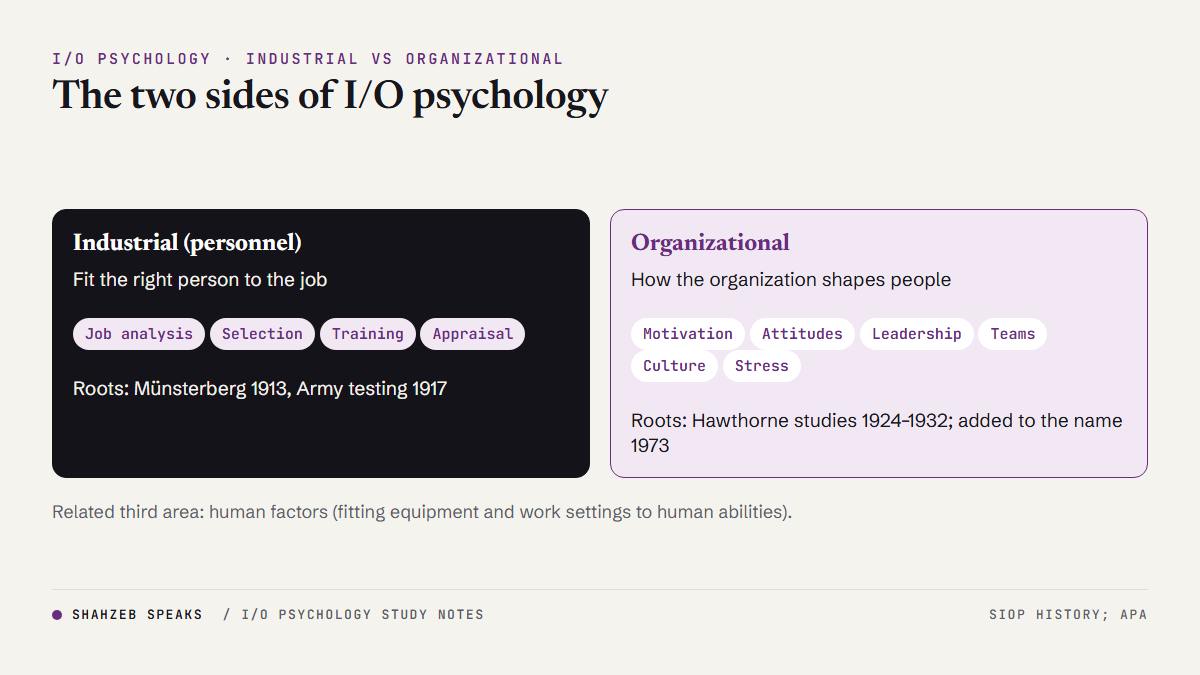
Industrial psychology (also called personnel psychology) fits people to jobs: job analysis, selection, training and performance appraisal. Organizational psychology studies how the organization affects people: motivation, attitudes, leadership, teams, culture and stress. The industrial side came first, from early 1900s testing; the organizational side grew from the Hawthorne studies and joined the field’s name in 1973.
Students meet “industrial and organizational psychology” in their first lecture and soon ask whether these are two subjects or one. They are two sides of one field, and exam papers (especially in the Philippines, Pakistan and India) often ask you to explain the difference. This page gives you the definitions, a comparison table, a worked example that shows why both sides are needed, a 10-mark answer plan and practice MCQs.
What is industrial psychology?
Industrial psychology is the side of I/O psychology that deals with matching people and jobs. It asks: what does this job require, who can do it well, how do we find them, how do we train them, and how do we judge their performance fairly? Because these are the questions of the personnel or HR function, this side is also called personnel psychology.
Its main topics are:
- Job analysis: describing the tasks of a job and the knowledge, skills and abilities it needs. See job analysis methods.
- Selection: tests, interviews and assessment centres, and checking that they are reliable and valid. See validity in employee selection.
- Training and development: working out who needs what training and whether it worked.
- Performance appraisal: measuring how well people do the job and reducing rating errors.
It is the older side. Hugo Münsterberg’s Psychology and Industrial Efficiency (1913) was mainly about choosing “the best possible man” for a job, and the group testing of US Army recruits in 1917 showed testing could work at scale. Its typical tools are measurement tools: tests, rating scales, statistics.
What is organizational psychology?
Organizational psychology is the side that studies how the organization, its structure, leaders, groups and culture, shapes the people in it, and how to make the organization a better place to work. Its main topics are:
- Work motivation: why people put effort into work. See work motivation theories.
- Job attitudes: job satisfaction, organizational commitment, engagement.
- Leadership: what effective leaders do and when. See leadership theories.
- Groups and teams, organizational culture and climate, organizational change and development, and occupational stress and well-being.
This side grew from the Hawthorne studies (1924 to 1932), which showed that group norms, supervision and attitudes affected output, and from the human relations movement that followed. Research on motivation, leadership and attitudes expanded through the 1950s and 1960s. In 1973 the APA division for the field changed its name from Industrial Psychology to Industrial and Organizational Psychology, making the “O” official (Koppes, SIOP history). Its typical tools are surveys, interviews and planned interventions in whole teams or organizations.
Industrial vs organizational psychology: the differences in a table
| Basis | Industrial (personnel) psychology | Organizational psychology |
|---|---|---|
| Core question | How do we fit the right person to the job? | How does the organization affect people, and how do we improve it? |
| Main topics | Job analysis, selection, training, performance appraisal | Motivation, attitudes, leadership, teams, culture, change, stress |
| Level of focus | Mainly the individual and the job | Individuals, groups and the whole organization |
| Origins | Münsterberg (1913), World War I testing (1917) | Hawthorne studies (1924 to 1932), human relations movement |
| Typical tools | Tests, interviews, rating scales, validation statistics | Attitude surveys, focus groups, team and leadership interventions |
| Typical outcome measured | Job performance, training results, test validity | Satisfaction, commitment, engagement, turnover, well-being |
| Older name | Personnel psychology | Sometimes called organizational behaviour when taught in business schools |
| Typical jobs today | Assessment and selection consultant, test developer, people analytics | Organization development consultant, engagement and culture specialist, leadership developer |
A simple way to remember it: the industrial side leans towards a management view (making the workforce more effective by picking and developing the right people), while the organizational side takes more of a people view (understanding and improving the experience of working). Both aim at an organization that works well for the business and for the people in it.
Is personnel psychology the same as industrial psychology?
For exam purposes, yes. “Personnel psychology” is the name for the industrial side: the study of individual differences at work and their use in hiring, training and appraisal. The phrase is still common in journal and course titles. When a question asks for “personnel psychology vs organizational psychology”, it is asking the same question as this page.
Some textbooks also list a third area, human factors or engineering psychology, which designs machines, tools and work settings to fit human abilities (for example, a control panel that is easy to read under stress). Münsterberg’s chapter on adjusting technical conditions to the mind was an early example. In most syllabi it is treated as a related field rather than part of the “I” or the “O”.
One problem, two lenses: why the two sides belong together
Here is the example I find makes the difference click for students. Imagine a bank in Karachi (a made-up but typical case) where many new branch customer service officers leave in their first year.
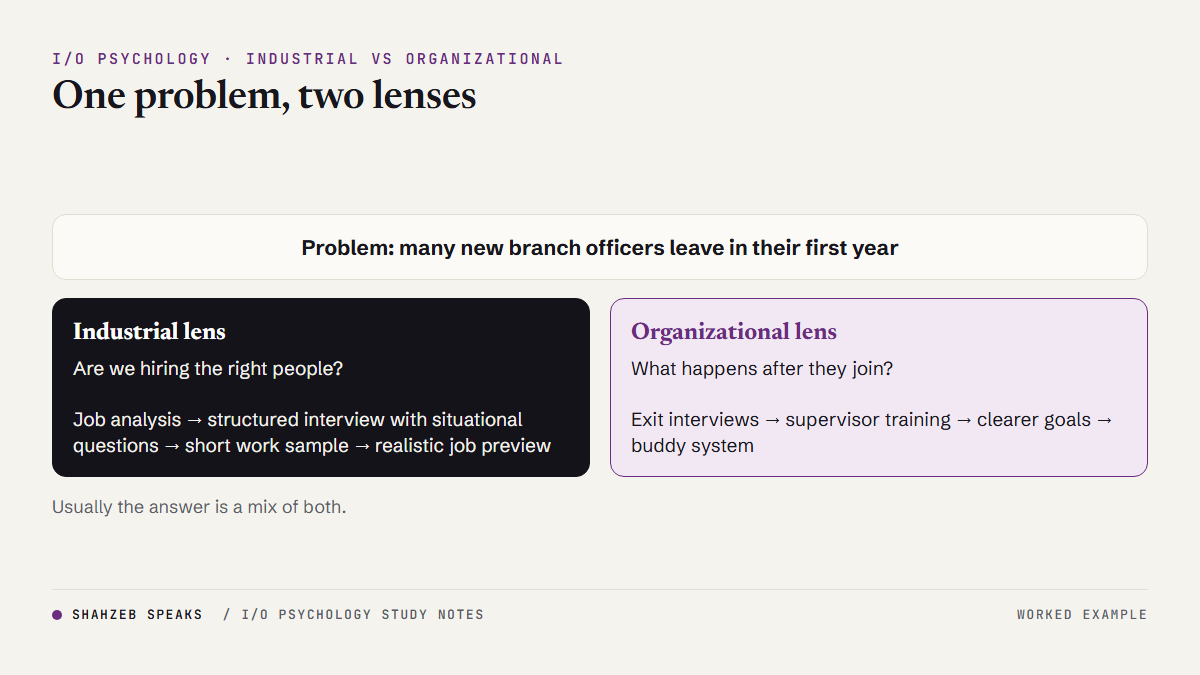
- The industrial lens asks whether the bank is hiring the right people. A job analysis may show the role needs patience with difficult customers and accuracy under time pressure, while the interview only checks English and grades. Better selection (a structured interview with situational questions, a short work sample) and a realistic job preview would help.
- The organizational lens asks what happens to people after they join. Exit interviews may show that branch managers rarely give feedback, targets are changed without warning and new officers feel alone. Better supervisor training, clearer goals and a buddy system would help.
Usually the answer is a mix of both, which is why the two sides were put into one field. A selection test that picks good people cannot fix a branch that pushes them out, and a friendly culture cannot fix a hiring process that picks the wrong people. The same logic sits behind tools on this site such as the employee turnover cost calculator.
Which side should you specialise in?
Most master’s programmes teach both, and most I/O psychologists work on both at some point. If you enjoy statistics, measurement and building tests, the industrial side will suit you; thesis topics there include scale validation, selection validity and rater accuracy. If you are drawn to leadership, culture and well-being, the organizational side will suit you; thesis topics there include engagement, commitment, burnout and leadership styles. For ideas, see I/O psychology thesis topics, and for careers and pay see how to become an I/O psychologist.
The American Psychological Association recognised industrial-organizational psychology as a specialty in 1996. Its description puts both sides together: the scientific study of behaviour in organizations and the workplace, building principles of individual, group and organizational behaviour and using them to solve problems at work.
10-mark answer structure
- Introduction: I/O psychology is the scientific study of people at work; it has an industrial side and an organizational side, joined in the field’s name in 1973.
- Industrial (personnel) psychology: definition; fits people to jobs; job analysis, selection, training, appraisal.
- Origins of the industrial side: Münsterberg (1913), World War I Army Alpha and Beta (1917).
- Organizational psychology: definition; how organizations affect people; motivation, attitudes, leadership, teams, culture, stress.
- Origins of the organizational side: Hawthorne studies (1924 to 1932), human relations movement.
- Differences: 4 or 5 rows from the table (core question, topics, level, tools, outcomes).
- Example: high turnover in a bank branch, with an industrial fix (selection) and an organizational fix (supervision, culture).
- Overlap: both use the scientific method; many problems need both; human factors as a related third area.
- Conclusion: different emphasis, one field; the best solutions combine both.
Model opening line: “Industrial psychology asks how to fit the right person to the job, while organizational psychology asks how the organization shapes the people in it; together they form one field because most workplace problems have both sides.”
Practice MCQs: industrial vs organizational psychology
Practice questions written to the published syllabus, not past-paper questions.
-
Which topic belongs mainly to the industrial side of I/O psychology?
- Organizational culture
- Employee selection
- Transformational leadership
- Team development
Show answer
B. Selection is the core of industrial (personnel) psychology. Culture, leadership and teams are organizational topics.
-
Another name for industrial psychology is:
- Personnel psychology
- Organizational behaviour
- Clinical psychology
- Social psychology
Show answer
A. The industrial side is also called personnel psychology. Organizational behaviour is the business-school field; clinical and social psychology are separate areas.
-
The organizational side of the field is most closely linked to which historical event?
- Army Alpha testing in 1917
- The Hawthorne studies
- Münsterberg’s telephone operator study
- Taylor’s shovelling study
Show answer
B. Hawthorne turned attention to group norms, supervision and attitudes. The other three are about testing people or tasks, which is industrial-side work.
-
In which year did “organizational” become part of the APA division’s name?
- 1945
- 1962
- 1973
- 1996
Show answer
C. 1973. 1945 is when Division 14 was formed, 1962 is when “Business” was dropped, and 1996 is when the APA recognised I/O as a specialty.
-
A psychologist runs an engagement survey across a hospital and then works with ward managers to improve communication. Which side of I/O is this?
- Industrial
- Organizational
- Human factors
- Psychometrics only
Show answer
B. Surveys of attitudes and work with managers on communication are organizational. Industrial work would be selecting or training nurses; human factors would redesign equipment.
-
A call centre in Cebu builds a call-handling simulation and checks whether high scorers later get better quality ratings. Which side of I/O is this?
- Industrial
- Organizational
- Neither
- Organizational development
Show answer
A. Building a selection test and checking its validity against performance is classic industrial (personnel) work. Organizational development works on the organization, not on selection tests.
-
Which of these is NOT usually an organizational psychology topic?
- Job satisfaction
- Leadership
- Test-retest reliability of an aptitude test
- Occupational stress
Show answer
C. The reliability of a selection test is a measurement question for the industrial side. Satisfaction, leadership and stress are organizational topics.
-
Designing a cockpit display that pilots can read quickly under stress belongs mainly to:
- Industrial psychology
- Organizational psychology
- Human factors (engineering psychology)
- Counselling psychology
Show answer
C. Fitting equipment to human abilities is human factors, often listed as a related third area. It is not selection (industrial) or culture and motivation (organizational).
-
A bank finds high first-year turnover among new officers. Which statement fits the I/O view best?
- Only better selection can fix it
- Only a better culture can fix it
- It may need both better selection and better supervision, so both sides of I/O apply
- It is not an I/O problem
Show answer
C. Turnover can come from hiring the wrong people and from how people are treated after hiring. Options A and B each ignore one side; turnover is a core I/O topic, so D is wrong.
Practise on your phone
The free I/O Psychology Prep app has 410 explained
questions, flashcards and an exam countdown, and works offline. Get it on Google Play
· About the app
Test yourself across both sides on the I/O psychology MCQ hub.
Questions students ask
What is the difference between industrial and organizational psychology?
Industrial psychology fits people to jobs through job analysis, selection, training and appraisal. Organizational psychology studies how the organization affects people through motivation, attitudes, leadership, teams, culture and stress. They are two sides of one field.
Is industrial psychology the same as I/O psychology?
Not exactly. Industrial psychology is the older, personnel side. I/O psychology is the whole field, which since 1973 has formally included the organizational side too. Many people still say “industrial psychology” for the whole field.
What is personnel psychology vs organizational psychology?
Personnel psychology is another name for the industrial side: individual differences used in hiring, training and appraisal. Organizational psychology covers motivation, attitudes, leadership, teams and culture.
Which came first, industrial or organizational psychology?
Industrial. It began in the early 1900s with Scott and Münsterberg and grew with World War I testing. The organizational side developed from the Hawthorne studies (1924 to 1932) onwards.
Is organizational psychology the same as organizational behaviour?
They overlap heavily. Organizational psychology is a branch of psychology; organizational behaviour is usually taught in business schools and draws on sociology and management too. See organizational behavior vs I/O psychology.
Which side has more jobs?
There is no reliable count split by side. In practice most roles mix both: a consultant may design a selection process one month and an engagement survey the next.
Practise on your phone
The free I/O Psychology Prep app has 410 explained
questions, flashcards and an exam countdown, and works offline. Get it on Google Play
· About the app
References
- American Psychological Association. (n.d.). Industrial and organizational psychology [Recognized specialty description]. https://www.apa.org/ed/graduate/specialize/industrial
- American Psychological Association. (n.d.). Recognized specialties and subspecialties in professional psychology. https://www.apa.org/ed/graduate/specialize/recognized
- Katzell, R. A., & Austin, J. T. (1992). From then to now: The development of industrial-organizational psychology in the United States. Journal of Applied Psychology, 77(6), 803–835. https://doi.org/10.1037/0021-9010.77.6.803
- Koppes, L. L. (n.d.). A brief history of the Society for Industrial and Organizational Psychology, Inc. SIOP Museum. https://www.siop.org/About-SIOP/SIOP-Museum/Koppes-History
- Münsterberg, H. (1913). Psychology and industrial efficiency. Houghton Mifflin.
- Roethlisberger, F. J., & Dickson, W. J. (1939). Management and the worker. Harvard University Press.
- Vinchur, A. J., & Koppes, L. L. (2011). A historical survey of research and practice in industrial and organizational psychology. In S. Zedeck (Ed.), APA handbook of industrial and organizational psychology (Vol. 1, pp. 3–36). American Psychological Association. https://doi.org/10.1037/12169-001
This post is part of the I/O psychology study guide. Read next: organizational behavior vs I/O psychology, I/O psychology vs HRM and the history of I/O psychology.