
Organizational behavior (OB) is a business-school field that studies individuals and groups within organizations, drawing on psychology, sociology and management. I/O psychology is a branch of psychology that studies people at work, with a stronger focus on measurement, selection and testing. They share many topics, such as motivation, leadership and job attitudes, but differ in home discipline, methods and careers.
If you are choosing between a psychology degree with an I/O focus and an MBA or BBA with OB courses, or your exam asks you to “distinguish organizational behaviour from industrial-organizational psychology”, this page is for you. It gives clear definitions, a comparison table, a diagram of where the two overlap, a 10-mark answer plan and practice MCQs.
A note on spelling: in the US and in most journals the field is “organizational behavior”; in British-style English, used in Pakistan, India and the UK, it is “organisational behaviour”. They are the same subject.
What is organizational behavior?
The Academy of Management’s Organizational Behavior Division, the main professional body for OB scholars, defines its domain as understanding individuals and groups within an organizational context. It studies attributes, processes, behaviours and outcomes at four levels: individual, interpersonal, group and organizational (Academy of Management, n.d.).
OB is usually taught in business and management schools, in BBA, MBA and MS Management programmes. Its textbooks describe it as interdisciplinary: it takes ideas from psychology (individual behaviour, motivation, personality), social psychology (groups, attitudes), sociology (structure, power, culture), anthropology (organizational culture) and management. Scholars often split it into:
- Micro OB: individuals and small groups: motivation, attitudes, personality, perception, decision making, leadership, teams. This part overlaps heavily with I/O psychology.
- Macro OB (close to organization theory): structure, design, power and politics, organizational change, the organization and its environment. This part is closer to sociology than to psychology.
What is I/O psychology?
Industrial and organizational (I/O) psychology is a branch of psychology. The American Psychological Association recognised it as a specialty in 1996 and describes it as the scientific study of behaviour in organizations and the workplace, building principles of individual, group and organizational behaviour and using them to solve problems at work (APA, n.d.). Its professional body in the US is the Society for Industrial and Organizational Psychology (SIOP), incorporated in 1982 from APA Division 14 (Koppes, SIOP history).
I/O has two sides. The industrial (personnel) side covers job analysis, selection, training and performance appraisal. The organizational side covers motivation, attitudes, leadership, teams, culture and stress. The full difference is on industrial vs organizational psychology. The organizational side is where I/O and OB meet.
Organizational behavior vs I/O psychology: differences in a table
| Basis | Organizational behavior (OB) | I/O psychology |
|---|---|---|
| Home discipline | Management / business studies | Psychology |
| Where it is taught | Business schools: BBA, MBA, MS Management, HRM programmes | Psychology departments: BS/MSc/MS Psychology with an I/O track |
| Contributing fields | Psychology, social psychology, sociology, anthropology, management | Mainly psychology: differential, social, cognitive, psychometrics, statistics |
| Levels of analysis | Individual, interpersonal, group, organization (micro and macro) | Mainly individual and group, some organizational |
| Topics mostly unique to it | Organization structure and design, power and politics, organizational strategy and environment | Selection and test validation, job analysis, psychometrics, performance measurement, training evaluation |
| Shared topics | Motivation, job attitudes, leadership, teams, culture and climate, stress and well-being, organizational justice, change | |
| Typical methods | Surveys, case studies, field studies, qualitative research | Surveys, experiments, validation studies, psychometric analysis |
| Professional body (US) | Academy of Management, OB Division | SIOP (and APA Division 14) |
| Example journals | Journal of Organizational Behavior, Academy of Management Journal | Journal of Applied Psychology, Personnel Psychology |
| Title and licensing | No psychologist title; graduates work as managers, HR or OB academics | “Psychologist” may be a protected title in some countries; rules vary |
| Typical careers | Management, HR business partner, consulting, business-school teaching | Assessment and selection, people analytics, organization development, psychology teaching and research |
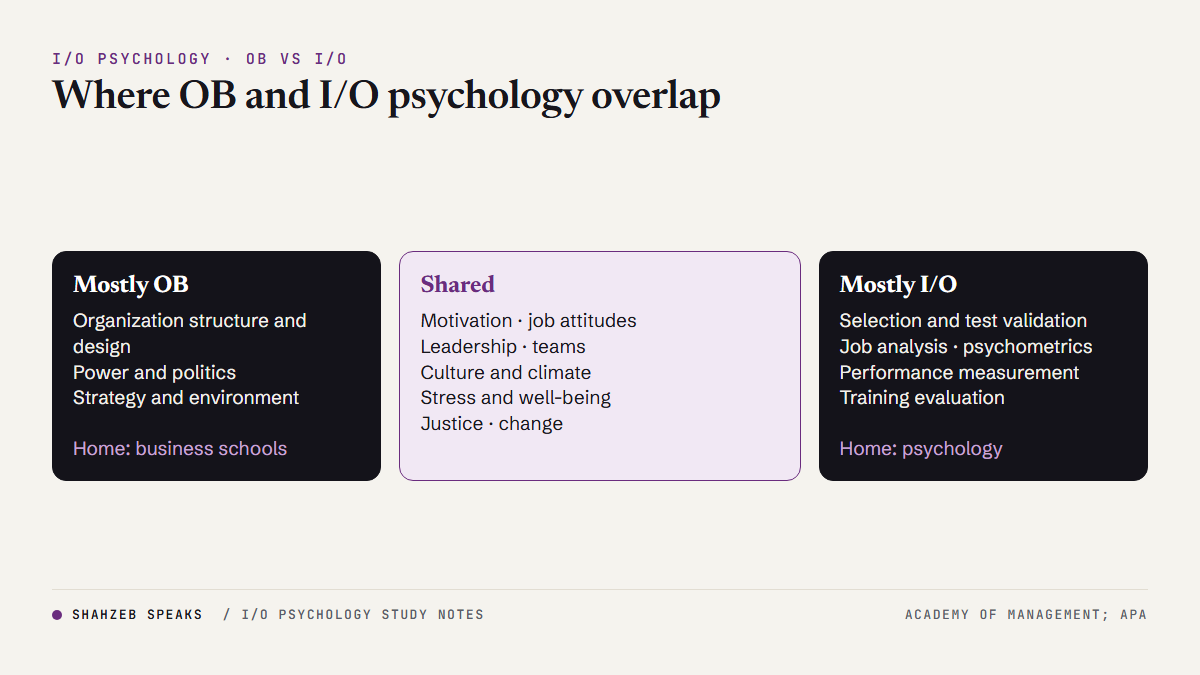
Where OB and I/O psychology overlap
The overlap is large. The same theories are taught in both: Maslow and Herzberg, expectancy theory, goal-setting, the job characteristics model, transformational leadership, Tuckman’s stages, Schein’s levels of culture. Both fields cite the Hawthorne studies as a starting point. Researchers move between them: many I/O psychologists teach in business schools, and OB scholars publish in psychology journals.
Even the journals show the overlap. The Journal of Organizational Behavior began in 1980 as the Journal of Occupational Behaviour and took its current name in 1988 (JSTOR title history). It publishes work that would sit comfortably in an I/O course.
The real difference is emphasis. An OB course in an MBA asks, “How should a manager motivate and lead people?” An I/O course asks, “How do we measure motivation, and what does the evidence say, and how sure can we be?” I/O students spend much more time on statistics, reliability and validity; OB students spend more time on cases, structure and strategy.
OB vs industrial psychology vs organizational psychology
Exam questions sometimes use “industrial psychology” or “organizational psychology” instead of “I/O psychology”. The comparison changes a little:
- OB vs industrial psychology: the difference is large. Industrial (personnel) psychology is about selection, testing and appraisal, which OB courses mention only briefly.
- OB vs organizational psychology: the difference is small. Both study motivation, attitudes, leadership and groups. Organizational psychology stays within psychology; OB adds sociology, structure and strategy.
Which should you study: OB or I/O psychology?
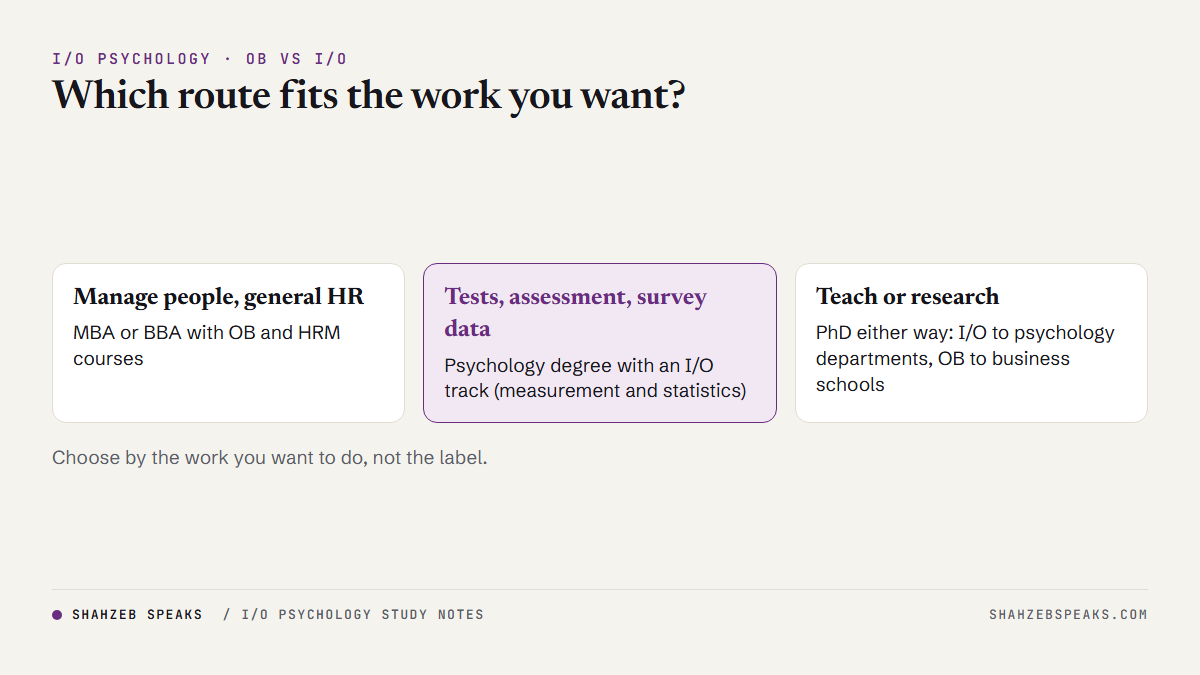
Choose by the work you want to do, not the label.
- If you want to manage people or work in general HR, an MBA or BBA with OB and HRM courses fits. See I/O psychology vs HRM for how HR and I/O differ.
- If you want to design tests, run assessment centres, analyse survey data or do workplace research, an I/O psychology degree fits better, because it trains you in measurement and statistics.
- If you want to teach or research, both paths lead to a PhD; I/O usually leads to a psychology department, OB to a business school.
For Pakistani students, the practical picture is set out on the scope of industrial psychology in Pakistan page, and the steps by country are in how to become an I/O psychologist. If you are weighing up the degree itself, read is I/O psychology worth it.
10-mark answer structure
- Introduction: both study behaviour at work; OB comes from management, I/O from psychology.
- Define OB: understanding individuals and groups within an organizational context (Academy of Management); interdisciplinary; micro and macro OB.
- Define I/O psychology: branch of psychology, APA specialty (1996); industrial and organizational sides; SIOP.
- Differences: home discipline, where taught, contributing fields, levels of analysis, unique topics, methods, professional bodies.
- Similarities: shared topics (motivation, attitudes, leadership, teams, culture, stress); shared roots in the Hawthorne studies.
- Example: a bank’s engagement problem: OB looks at structure and management practice; I/O also builds and validates the survey that measures engagement.
- Industrial vs organizational nuance: OB is close to organizational psychology, far from industrial psychology.
- Conclusion: overlapping fields with different emphasis; I/O stresses measurement and evidence, OB stresses management application and organizational context.
Model opening line: “Organizational behaviour and industrial-organizational psychology study the same workplaces from two homes: OB from management, where it serves the manager, and I/O from psychology, where measurement and evidence come first.”
Practice MCQs: OB vs I/O psychology
Practice questions written to the published syllabus, not past-paper questions.
-
Organizational behavior is most often taught in:
- Medical colleges
- Business and management schools
- Engineering faculties
- Law schools
Show answer
B. OB is a core course in BBA and MBA programmes. I/O psychology is taught mainly in psychology departments; the other options are unrelated.
-
Which topic is studied in I/O psychology but only touched on in most OB courses?
- Motivation
- Leadership
- Validation of selection tests
- Team dynamics
Show answer
C. Test validation is industrial-side, psychometric work. Motivation, leadership and teams are shared by both fields.
-
Which topic belongs more to macro OB than to I/O psychology?
- Organization structure and design
- Job analysis
- Performance appraisal errors
- Test reliability
Show answer
A. Structure and design come from organization theory and sociology. The other three are personnel psychology topics.
-
Which is the main US professional body for I/O psychologists?
- Society for Industrial and Organizational Psychology (SIOP)
- Academy of Management OB Division
- American Marketing Association
- Project Management Institute
Show answer
A. SIOP is the I/O body, and is also APA Division 14. The Academy of Management’s OB Division is the home for OB scholars; the other two are unrelated.
-
Which of these is NOT a shared topic of OB and I/O psychology?
- Job satisfaction
- Transformational leadership
- Organizational culture
- Item analysis of a selection test
Show answer
D. Item analysis is a psychometric technique taught in I/O and testing courses. Satisfaction, leadership and culture are shared.
-
OB is described as interdisciplinary because it draws on:
- Psychology only
- Psychology, sociology, anthropology and management
- Economics only
- Engineering and medicine
Show answer
B. OB takes ideas from several social sciences and management. I/O psychology stays mainly within psychology.
-
A student wants to build and validate an assessment centre for a telecom company in Lahore. Which degree route prepares her best?
- An MBA with OB courses
- A psychology degree with an I/O track
- A law degree
- A degree in marketing
Show answer
B. Designing and validating assessments needs psychometrics and statistics, which I/O programmes teach in depth. An MBA covers OB but rarely test validation.
-
Which statement about OB and organizational psychology is most accurate?
- They have nothing in common
- They overlap heavily; OB adds sociology, structure and strategy
- Organizational psychology is a branch of OB
- OB is a branch of clinical psychology
Show answer
B. Both study motivation, attitudes, leadership and groups. Organizational psychology belongs to psychology, not OB, and OB is not clinical psychology.
-
The Journal of Organizational Behavior was originally called:
- Journal of Applied Psychology
- Journal of Occupational Behaviour
- Personnel Psychology
- Human Relations
Show answer
B. It began in 1980 as the Journal of Occupational Behaviour and was renamed in 1988. The other journals are separate titles.
Practise on your phone
The free I/O Psychology Prep app has 410 explained
questions, flashcards and an exam countdown, and works offline. Get it on Google Play
· About the app
More practice across the whole syllabus: I/O psychology MCQs.
Questions students ask
What is the difference between organizational behavior and I/O psychology?
OB is a management field that studies individuals and groups in organizations using several social sciences. I/O psychology is a branch of psychology that studies people at work with a stronger focus on measurement, selection and evidence. They share many topics.
Is organizational behavior a part of psychology?
Not formally. It draws heavily on psychology, especially at the micro level, but it is taught and researched mainly in business schools and also uses sociology, anthropology and management.
Is OB the same as organizational psychology?
Close but not the same. Both study motivation, attitudes, leadership and teams. Organizational psychology stays within psychology; OB also covers structure, power and strategy.
Which pays more, OB or I/O psychology?
Pay depends on the job and country more than the label. Managers with MBAs and I/O consultants can both earn well. See the I/O psychology salary by country page for sourced figures.
Can an MBA graduate work as an I/O psychologist?
They can do much of the same practical work, such as engagement surveys or leadership training. But the title “psychologist” usually needs a psychology degree, and in some countries it is legally protected.
Is I/O psychology the same as HRM?
No. HRM runs the people processes of an organization; I/O psychology supplies the research and measurement behind many of them. See I/O psychology vs HRM.
Practise on your phone
The free I/O Psychology Prep app has 410 explained
questions, flashcards and an exam countdown, and works offline. Get it on Google Play
· About the app
References
- Academy of Management. (n.d.). Organizational behavior [Division domain statement]. https://www.aom.org/organizational-behavior/
- Academy of Management, Organizational Behavior Division. (n.d.). About the OB Division. https://ob.aom.org/ob/about-us/about-the-ob-division
- American Psychological Association. (n.d.). Industrial and organizational psychology [Recognized specialty description]. https://www.apa.org/ed/graduate/specialize/industrial
- JSTOR. (n.d.). Journal of Organizational Behavior: Title history. https://www.jstor.org/journal/jorgabeha
- Katzell, R. A., & Austin, J. T. (1992). From then to now: The development of industrial-organizational psychology in the United States. Journal of Applied Psychology, 77(6), 803–835. https://doi.org/10.1037/0021-9010.77.6.803
- Koppes, L. L. (n.d.). A brief history of the Society for Industrial and Organizational Psychology, Inc. SIOP Museum. https://www.siop.org/About-SIOP/SIOP-Museum/Koppes-History
- Roethlisberger, F. J., & Dickson, W. J. (1939). Management and the worker. Harvard University Press.
This post is part of the I/O psychology study guide. Read next: industrial vs organizational psychology, I/O psychology vs HRM and the history of I/O psychology.