
I/O psychology is worth it if you enjoy data, testing and workplace problems, and you accept that most jobs will carry HR or analytics titles. In the US, BLS reports a median of $193,950 for I/O psychologists (May 2025), but only about 4,000 such jobs, with 300 more expected by 2035.
This page is for students deciding whether to take an MSc or PhD in industrial-organizational psychology, and for anyone who has read “is I/O psychology worth it?” threads and wants numbers instead of opinions. I give the pros, the cons, the official job outlook, the master’s vs PhD question and the alternatives, with a source for every figure.
A note on where I stand. I studied I/O psychology and work in it in Karachi, so I have a reason to like the field. That is exactly why I have tried to put the weak points first in some sections. If the cons below describe you, a different path may serve you better, and that is a fine outcome.
Who is I/O psychology worth it for?
| If this describes you | Verdict | Why |
|---|---|---|
| You like statistics, surveys and testing | Good fit | Selection, assessment and survey work are the core of the field |
| You want to do therapy or counselling | Poor fit | That is clinical or counselling psychology, a different training route |
| You want the job title “psychologist” in Pakistan | Expect a mismatch | Employers there advertise I/O work as HR, training and talent roles |
| You want to work in the US, UK or South Africa as a registered practitioner | Worth it, with a long route | Each has a protected title with extra training (see the country guide) |
| You are unsure between HR and psychology | Worth it if you add data skills | I/O adds measurement and research methods that a general HR degree may not |
The pros: what I/O psychology gives you
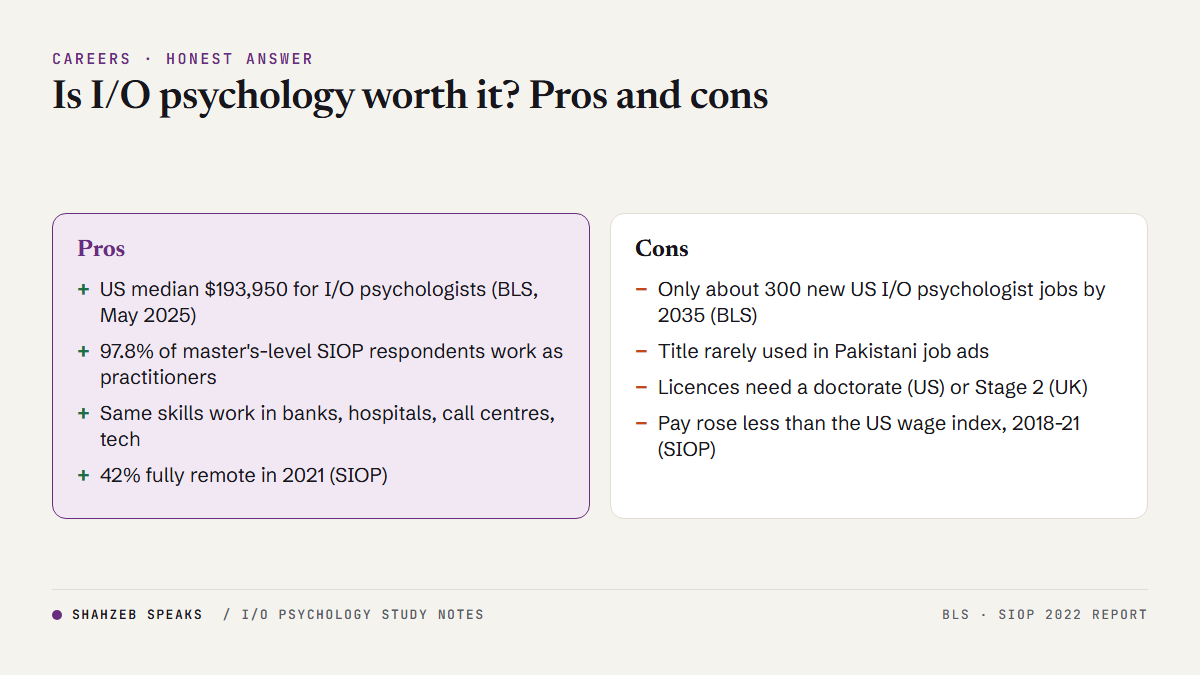
- High pay where the title exists. In the US, BLS gives a May 2025 median of $193,950 for industrial-organizational psychologists, against $100,580 for clinical and counselling psychologists. It is the highest-paid psychologist group BLS lists.
- Applied work. In the Society for Industrial and Organizational Psychology (SIOP) 2021 salary survey, 97.8% of master’s-level respondents worked as practitioners, not academics. You use what you learn.
- Many sectors. The same skills (job analysis, test validation, training evaluation, survey design) work in banks, hospitals, call centres, the armed forces, government and tech firms.
- Remote options. SIOP’s 2021 survey found 42% of I/O respondents worked fully remotely, up from 17% before the pandemic, and remote status did not affect pay.
- Transferable research skills. Knowing how to tell a valid test from a guess is useful far beyond HR.
The cons: what nobody puts in the brochure
- Few jobs carry the title. BLS projects US I/O psychologist employment to grow from about 4,000 in 2025 to 4,300 in 2035. That 6% growth means only 300 new jobs in ten years. Most graduates work under other titles.
- The title is rare in South Asia. In Pakistan, my count of job ads found the work advertised as HR, talent and training roles, almost never as “industrial psychologist” (see the Pakistan scope page).
- Licensing confusion. In the US, many states restrict the word “psychologist” to licensed people, and licences need a doctorate. In the UK you need two to four more years of BPS Stage 2 training after the MSc to use “occupational psychologist”.
- Pay growth has been modest. SIOP’s report says I/O salaries rose less than the US average wage index from 2018 to 2021 (doctorate incomes up 9.6%, master’s up 12.4%, wage index up 11%), and doctorate pay did not keep up with inflation (16.2%).
- It is statistics-heavy. If regression and reliability coefficients make you anxious, expect a hard first year. It is learnable, but it is not optional.
Job outlook: what BLS projects
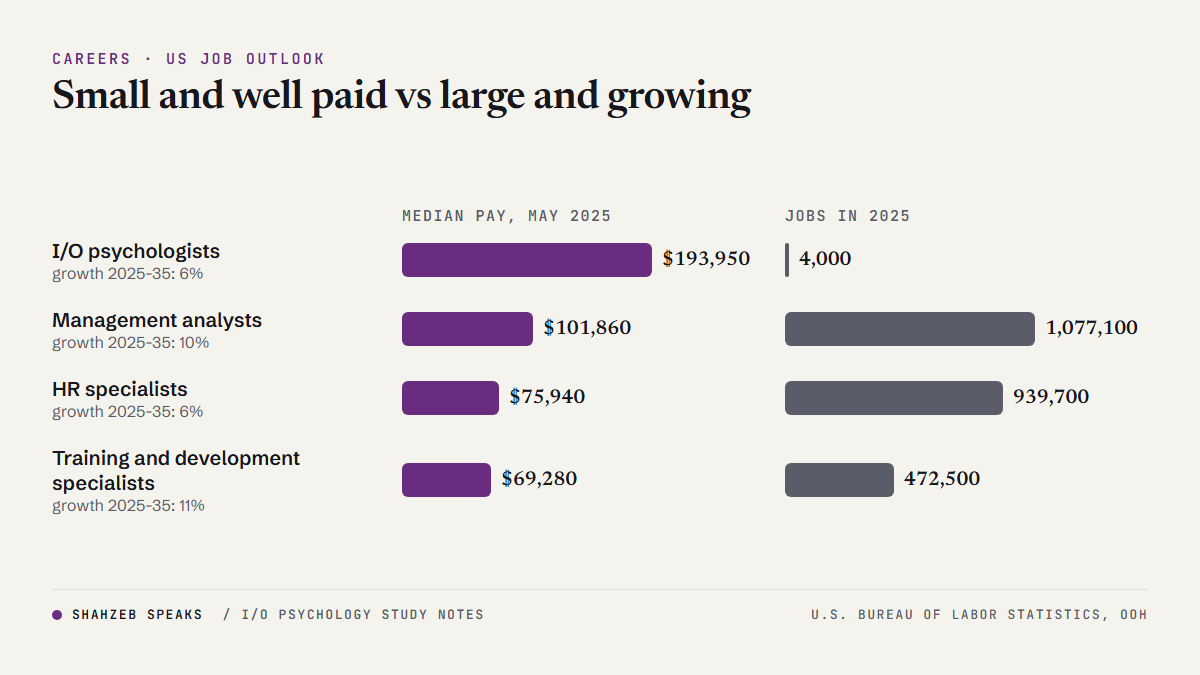
The fairest way to judge the outlook is to look at I/O psychology next to the jobs I/O graduates often take. These are BLS figures for the United States (median pay May 2025, projections 2025 to 2035):
| Occupation | Median pay | Jobs in 2025 | Growth 2025-35 | Typical entry education |
|---|---|---|---|---|
| Industrial-organizational psychologists | $193,950 | About 4,000 | 6% (+300 jobs) | Master’s |
| Management analysts | $101,860 | 1,077,100 | 10% (94,100 openings a year) | Bachelor’s |
| Human resources specialists | $75,940 | 939,700 | 6% (73,700 openings a year) | Bachelor’s |
| Training and development specialists | $69,280 | 472,500 | 11% (46,000 openings a year) | Bachelor’s |
Read it this way: the I/O psychologist title pays the most but has the fewest jobs. The neighbouring occupations have hundreds of times more jobs and many openings every year. An I/O degree is most “worth it” when you use it to compete for those larger occupations with stronger measurement and research skills than other applicants.
Master’s or PhD: which is worth it?
SIOP’s 2021 Income and Employment survey gives the clearest picture of how I/O graduates actually work:
- 62% of doctorate-level respondents were practitioners and 38% worked in academia. Almost all master’s-level respondents (97.8%) were practitioners.
- Practitioners’ median income was 19.5% higher than academics’.
- Among master’s-level practitioners, those in the technology industry had the highest median salary ($121,729).
- Among doctorate-level practitioners, independent consultants had the highest median ($350,000). This is a small, experienced group, not a typical starting salary.
So a master’s is the practical degree for company work. A PhD is worth it if you want to teach at a university, lead research, consult independently later in your career, or hold a US licence. Remember that these SIOP figures describe mainly US-based members; they do not tell you what a PhD pays in Lahore or Manila. For those countries, see I/O psychology salary by country.
Is I/O psychology hard?
The theory is not the hard part. Most students find motivation, leadership and job attitudes easy to follow. The difficult parts are measurement and research: reliability, validity, regression, and writing a thesis with a proper sample. If you want a preview, read the research methods for an I/O thesis guide and try one of the free I/O calculators. If you enjoy working through a reliability or utility example, you will probably enjoy the degree.
Alternatives if you are not sure
- HR analytics or people analytics: a business or statistics route with HR data. You can add I/O theory later through short courses.
- A general HRM degree: faster entry into HR jobs; weaker on testing and research. My I/O psychology vs HRM page compares them.
- Training and development: BLS gives this the fastest growth of the four occupations above (11%).
- Clinical or counselling psychology: if what you really want is one-to-one helping work.
Changing direction later is normal. The career change psychology article covers how people handle that switch.
A 5-part paragraph on “why I/O psychology is worth it for me”
- The problem you care about, in one workplace example (for instance, unfair hiring in a textile mill).
- The I/O skill that solves it (structured interviews, valid tests, job analysis).
- One honest risk you have checked (few jobs carry the title) and your plan for it.
- The job titles you will target and the country you will work in.
- What this programme adds that a general HR degree would not.
Model opening line: “I chose I/O psychology because I want to measure what predicts good work, not guess it, and I know most of the jobs that use this skill are called talent or HR roles, so I plan to build strong data skills alongside the theory.”
Practice MCQs: is I/O psychology worth it?
Practice questions written for this page, based on the figures above.
-
BLS projects how many new US I/O psychologist jobs between 2025 and 2035?
- About 300
- About 3,000
- About 46,000
- About 94,100
Show answer
A. Employment rises from about 4,000 to 4,300. The 46,000 and 94,100 figures are yearly openings for training specialists and management analysts.
-
In SIOP’s 2021 survey, what share of master’s-level respondents worked as practitioners?
- 38%
- 62%
- 97.8%
- 19.5%
Show answer
C. 97.8%. The 62% and 38% describe doctorate-level respondents, and 19.5% is the practitioner pay advantage over academics.
-
Which statement about I/O pay growth from 2018 to 2021 (SIOP) is correct?
- Doctorate pay rose faster than inflation
- Master’s pay rose more than doctorate pay
- All I/O pay fell
- I/O pay rose faster than the average wage index for both groups
Show answer
B. Master’s incomes rose 12.4% and doctorate incomes 9.6%. Doctorate pay did not beat inflation (16.2%), and SIOP says I/O salaries rose less than the wage index overall.
-
Bilal wants to do one-to-one therapy with anxious clients. What is the best advice?
- Take I/O psychology, it covers therapy
- Consider clinical or counselling psychology instead
- Take HR analytics
- Take training and development
Show answer
B. Therapy is clinical or counselling work with its own training route. I/O, HR analytics and training focus on organisations, not individual treatment.
-
Which of these is NOT a real drawback of I/O psychology mentioned on this page?
- Few jobs carry the I/O title
- Heavy use of statistics
- I/O psychologists earn less than clinical psychologists in the US
- Licensing rules can restrict the word “psychologist”
Show answer
C. BLS shows the opposite: $193,950 for I/O against $100,580 for clinical and counselling psychologists in May 2025.
-
Which BLS occupation on this page has the fastest projected growth for 2025-35?
- I/O psychologists
- HR specialists
- Management analysts
- Training and development specialists
Show answer
D. Training and development specialists, at 11%. Management analysts are at 10%, and both HR specialists and I/O psychologists at 6%.
-
Among doctorate-level practitioners in SIOP’s survey, who had the highest median salary?
- Technology employees
- Independent consultants
- Psychology department academics
- Government employees
Show answer
B. Independent consultants ($350,000). The $121,729 technology figure is for master’s-level practitioners, and psychology department academics had a median of $92,000.
-
A student in Karachi says, “I/O is worthless because no ads say industrial psychologist.” What is the best reply?
- She is right; nobody hires I/O graduates
- The work is advertised under HR, talent and training titles, so search for those
- She should only apply abroad
- She must first get a Pakistani licence
Show answer
B. The skills are hired under other titles. No Pakistani licence is in force, and moving abroad is a choice, not a requirement.
-
In SIOP’s 2021 survey, what share of I/O respondents worked fully remotely?
- 17%
- 42%
- 62%
- 88.5%
Show answer
B. 42%. The 17% was the pre-pandemic share, 62% is the doctorate practitioner share, and 88.5% is the share who reported no change in employment or income due to COVID-19 in 2021.
Practise on your phone
The free I/O Psychology Prep app has 410 explained
questions, flashcards and an exam countdown, and works offline. Get it on Google Play
· About the app
Questions students ask
Is I/O psychology in demand?
The skills are in demand; the title less so. BLS projects 6% growth for US I/O psychologists to 2035 but only about 300 new jobs. Larger occupations that use I/O skills, such as training and development (11%) and management analysis (10%), are growing faster and have many more openings.
Can I get a job with a master’s in I/O psychology?
Yes. BLS says a master’s is the typical entry level for I/O psychologists, and SIOP’s survey shows nearly all master’s-level members work as practitioners. Expect titles such as assessment specialist, talent analyst, learning and development, organisational development or HR business partner.
Is I/O psychology better than HRM?
Neither is better in general. I/O gives you stronger testing, measurement and research skills; HRM gives you broader HR operations and employment law. If you like data and evidence, I/O usually suits you more. The full comparison lists the differences module by module.
Is I/O psychology worth it in Pakistan?
It is worth it if you target HR, talent and training roles and build analysis skills, because that is where the work is advertised. It is not worth it if you expect a job titled “industrial psychologist” or a government licence, since neither is common yet.
Is I/O psychology hard?
The theories are manageable for most students. The hard parts are statistics, psychometrics and the thesis. If you are willing to practise regression, reliability and validity, the degree is very doable.
Do I need a PhD in I/O psychology?
Only for university teaching, senior research, a US licence or some consulting paths. Most organisational jobs ask for a master’s. SIOP’s figures show doctorate holders split between practice (62%) and academia (38%).
Practise on your phone
The free I/O Psychology Prep app has 410 explained
questions, flashcards and an exam countdown, and works offline. Get it on Google Play
· About the app
References
- U.S. Bureau of Labor Statistics. (2026). Psychologists. Occupational Outlook Handbook. https://www.bls.gov/ooh/life-physical-and-social-science/psychologists.htm
- U.S. Bureau of Labor Statistics. (2026). Human resources specialists. Occupational Outlook Handbook. https://www.bls.gov/ooh/business-and-financial/human-resources-specialists.htm
- U.S. Bureau of Labor Statistics. (2026). Training and development specialists. Occupational Outlook Handbook. https://www.bls.gov/ooh/business-and-financial/training-and-development-specialists.htm
- U.S. Bureau of Labor Statistics. (2026). Management analysts. Occupational Outlook Handbook. https://www.bls.gov/ooh/business-and-financial/management-analysts.htm
- Society for Industrial and Organizational Psychology. (2022). Income and employment report: Executive summary (2021 SIOP Salary Survey). https://www.siop.org/resource/2022-siop-income-and-employment-report-executive-summary/
- Society for Industrial and Organizational Psychology. (n.d.). Licensure for I-O psychologists. https://www.siop.org/Membership/Licensure-for-I-O-Psychologists
Part of the I/O Psychology Study Guide. Read next: How to become an I/O psychologist, I/O psychology salary by country and Industrial vs organizational psychology. For the local picture, see my homepage on industrial psychology in Pakistan.