
If you have a psychology degree in Pakistan and an interest in the workplace, you will eventually be told to do an MBA in HR instead of an MS in I/O psychology. “HR has jobs. Psychology doesn’t.” It is the most common piece of career advice I hear, and it is half right. The jobs are in HR. But the decisions that go wrong inside HR go wrong in exactly the area an I/O psychologist is trained for — and that is not an opinion, it has been measured in five countries.
This guide compares the two properly: what each field actually is, what you study, what the research says about the gap between HR practice and evidence, how admissions differ in Pakistan, which certifications matter, and what the jobs pay. At the end there is a plain decision guide — including the hybrid routes most people never hear about.
I am an Industrial and Organizational Psychologist based in Karachi. I am obviously not neutral about my own field, so every claim below comes with its source, and where the evidence favours HR, I say so.
“HR is the function you will work in. I/O psychology is the science of the decisions made inside it. The question is not which one has jobs — it is whether you want to run the process or be the person who can tell whether the process works.”
— Workplace Psychology Analysis, ShahzebSpeaks
⚡ Chapter 1: The short answer
Choose an MBA or MS in HR if you want to manage people processes across a business — hiring, pay, employee relations, labour law, policy — and you want the widest range of job titles open to you. HR is a large, well-defined business function, and an HR degree speaks its language from day one.
Choose an MS in I/O psychology if you are drawn to measurement — designing selection tests, structured interviews, engagement surveys, performance systems, training evaluation — and you are willing to work in HR-titled roles while bringing a skill most of your colleagues lack. In Pakistan you will rarely be hired as an “I/O psychologist”; I covered why in the scope of industrial psychology in Pakistan.
The rest of this article is the evidence behind that answer.
🧭 Chapter 2: What each field actually is
The professional bodies define the two fields in revealingly different ways.
I/O psychology is a science. The Society for Industrial and Organizational Psychology (SIOP) describes the field as “defined by scientifically studying human well-being and performance in organizational and work settings.” Its training guidelines go further and say they are not meant for related fields — and name “Human Resources” as one of them. SIOP itself treats HR as a neighbour, not a synonym.
HR is a profession and a function. SHRM, the largest HR body, frames HR expertise as “the principles, practices and functions of effective HR management”, organised into three domains — People, Organization and Workplace — and fourteen functional areas, from talent acquisition and total rewards to employee relations and employment law. The UK’s CIPD puts the purpose more broadly: “to champion better work and working lives.”
Read those side by side and the difference is clear. HR is defined by what it is responsible for. I/O psychology is defined by how it knows things. One owns the processes; the other studies whether they work.
📚 Chapter 3: What you actually study
SIOP’s education guidelines list 26 areas of competence for I/O training, and — tellingly — use one set for both master’s and doctoral levels. They start with research methods and statistics, and the selection competency explicitly includes “test theory, development, and use; job analysis; criterion development and measurement”. That is psychometrics, and it is the core of the degree.
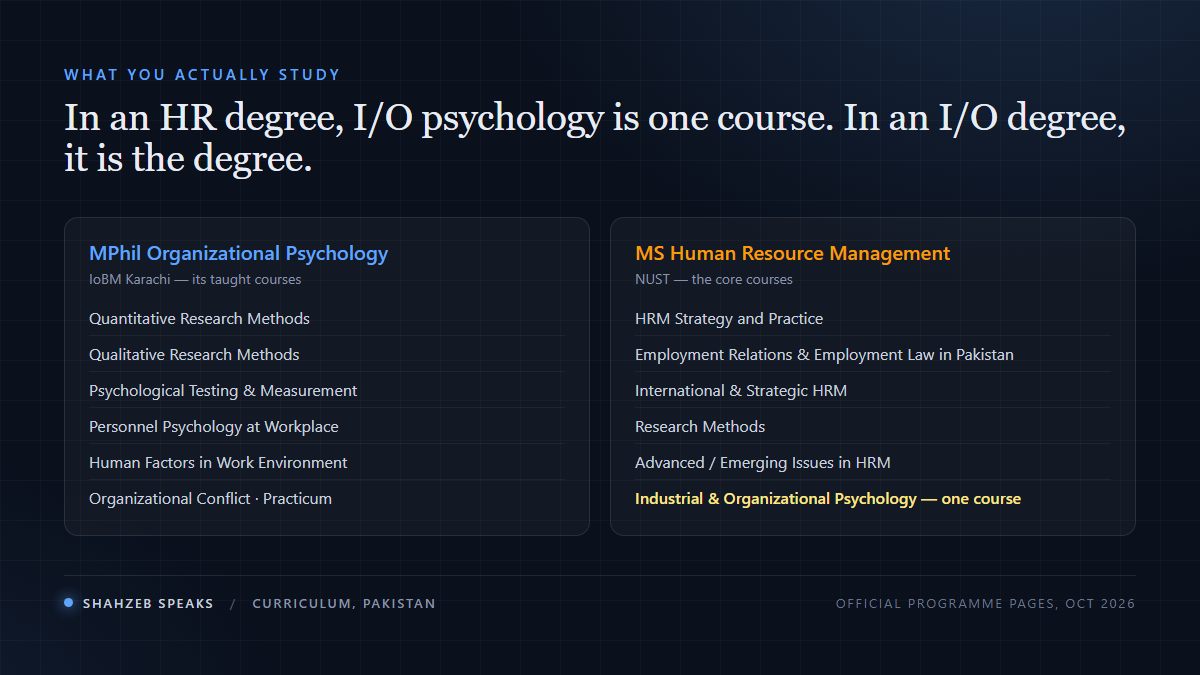
Compare two real Pakistani programmes:
| IoBM — MPhil Organizational Psychology | NUST — MS Human Resource Management (core) |
|---|---|
| Quantitative Research Methods in Psychology | HRM Strategy and Practice |
| Qualitative Research Methods in Psychology | Employment Relations and Employment Law in Pakistan |
| Psychological Testing and Measurement | International & Strategic HRM |
| Personnel Psychology at Workplace | Research Methods |
| Human Factors in Work Environment | Advanced/Emerging Issues in HRM |
| Organizational Conflict Management · Practicum | Industrial & Organizational Psychology (one 3-credit course) |
That last cell is the whole comparison in one line. In NUST’s MS HRM, industrial and organizational psychology is a single course. In an I/O degree, it is the degree. NUST’s electives then add the HR-side depth — reward management, recruitment and selection, performance management systems, HR analytics, organisation design — while an I/O programme spends that time on measurement, testing and research.
Neither is better in the abstract. They train for different jobs: the HR graduate to run the system, the I/O graduate to build and test the instruments inside it.
🔬 Chapter 4: The evidence gap — where HR goes wrong most often
This is the chapter that should decide the question for anyone who cares about doing the work well.
In 2002, Sara Rynes, Amy Colbert and Kenneth Brown surveyed HR professionals in the United States and compared their beliefs with what research had established. Of 5,000 surveyed, 959 responded. They found “large discrepancies between research findings and practitioners’ beliefs in some content areas, especially selection” — practitioners placed “far less faith in intelligence and personality tests as predictors of employee performance than HR research would recommend.”
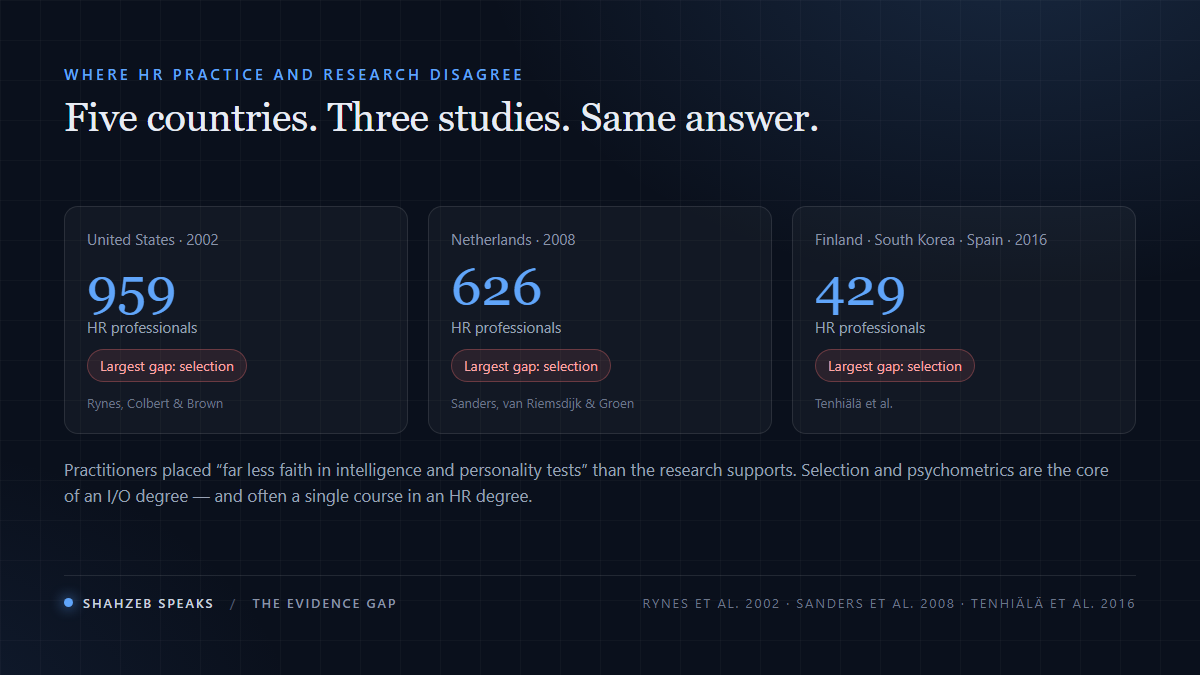
It was not an American quirk. A Dutch replication of 626 HR professionals in 2008 found “remarkable similarities”, with the largest gaps again in recruitment and selection. A 2016 cross-cultural study in Finland, South Korea and Spain found “large discrepancies … particularly in the area of staffing.”
Two details from the original study matter for your decision:
- The gap is widest in selection — exactly where I/O training is deepest. Test theory, validity, structured interviewing and job analysis are the centre of an I/O degree; in the HR programmes I checked, selection is one course among many, and at NUST it is an elective.
- The practitioners who agreed most with research were those at higher organisational levels, those holding the SPHR certification, and those who read the academic literature. In other words, the gap is not between HR and psychology as tribes. It is between people who engage with evidence and people who don’t — and an I/O degree forces that habit.
The HR bodies agree this matters. SHRM’s own competency framework now asks HR professionals to advocate “for the implementation of evidence-based HR solutions”, and CIPD describes the people profession as evidence-based. This is the bridge between the two fields, and it is where an I/O graduate inside an HR team earns their place. For what that looks like in practice, see how the research reshapes performance reviews and psychometric testing for jobs in Pakistan.
🎓 Chapter 5: Getting in — the admission rules in Pakistan
The Higher Education Commission’s 2023 graduate policy sets the shared baseline for any MS or MPhil: sixteen years of education and an admission test passed at 50% or above (a university’s own test, or GAT/HAT/GRE-type tests). Beyond that, the two paths split on who they let in.
| Programme | Who can apply (official page, Oct 2026) |
|---|---|
| IoBM — MPhil Organizational Psychology | Psychology degree required (CGPA 3.0 or first division), plus GAT |
| UMT — MS Industrial & Organizational Psychology | MSc or BS (Hons) in Psychology, plus GAT or UMT test and interview |
| GC University Lahore — MS I/O Psychology | 16 years in Psychology or Business Management, plus GAT |
| NUST — MS Human Resource Management | Business, management, public administration, commerce, economics, mass communication, engineering or IT — psychology is not on the list |
| IBA Karachi — MBA (HR electives) | Any 16-year degree, but at least 3 years’ work experience, plus IBA test or GMAT/GRE |
Three things follow:
- If you have a psychology bachelor’s, the I/O route is the natural one — and some respected HR programmes do not list your degree at all.
- If you have a business bachelor’s and want I/O, GC University Lahore is the open door. Bahria’s MS in HRM and Organizational Psychology is the other hybrid worth a look.
- If you are a fresh graduate eyeing a top MBA, check the experience requirement before anything else; IBA’s asks for three years.
I am not printing fees, deliberately: no official page I checked gives a dated fee for the current session, and an undated figure is worse than none.
🏅 Chapter 6: Certifications and titles
This is where HR has a clear practical advantage.
- SHRM-CP needs no degree and no prior HR experience. SHRM-SCP needs at least three years of strategic-level HR work. Your degree subject is irrelevant either way — a psychology graduate can sit them on the same terms as anyone.
- CIPD membership can be reached through its qualifications or through an experience-assessment route.
- There is no I/O certification. SIOP does not offer one; a 2023 article in its own journal proposed creating one. In the US, licensing is run by state psychology boards and varies by state, and APA does not accredit I/O programmes at all. In the UK, by contrast, “occupational psychologist” is a legally protected title.
- In Pakistan, no law protects the title “psychologist”, and the Allied Health Professionals Council Act, 2022 leaves open whether corporate I/O work falls within it.
A useful data point: in SIOP’s 2022 income report, 23% of master’s-level I/O respondents already held some certification or credential — many of them HR credentials. The report found pay differences linked to certification were generally not statistically significant, so treat a certificate as a door-opener, not a pay rise. The practical upshot for a Pakistani I/O graduate: the strongest combination on paper is an I/O master’s plus SHRM-CP — evidence-trained, and fluent in the HR vocabulary employers screen for.
💼 Chapter 7: Jobs and pay — what the data can and can’t tell you
There is no reliable Pakistani salary data separating I/O psychologists from HR professionals; I explained why in the scope article. The cleanest comparison available is from the US Bureau of Labor Statistics, and it is instructive precisely because it shows the trade-off:
| US occupation (BLS, May 2025 pay) | Median pay | Jobs |
|---|---|---|
| Industrial-organizational psychologists | $193,950 | 4,000 |
| Human resources managers | $149,280 | 224,900 |
| Human resources specialists | $75,940 | 939,700 |
Read it carefully. Per head, the I/O title pays the most. But there are about 4,000 such jobs in the entire United States, against more than 1.1 million HR manager and specialist jobs combined. All three are projected to grow at the same 6% to 2035. And BLS notes that an HR manager’s degree “may be in human resources or another field, such as business, communications, or psychology” — the HR door is open to psychology graduates.
That is the global shape of this choice, and Pakistan is a sharper version of it: a small number of roles that pay for measurement expertise, and a very large number of HR roles where that expertise is rare and valuable but not in the job title.
🧩 Chapter 8: The decision guide
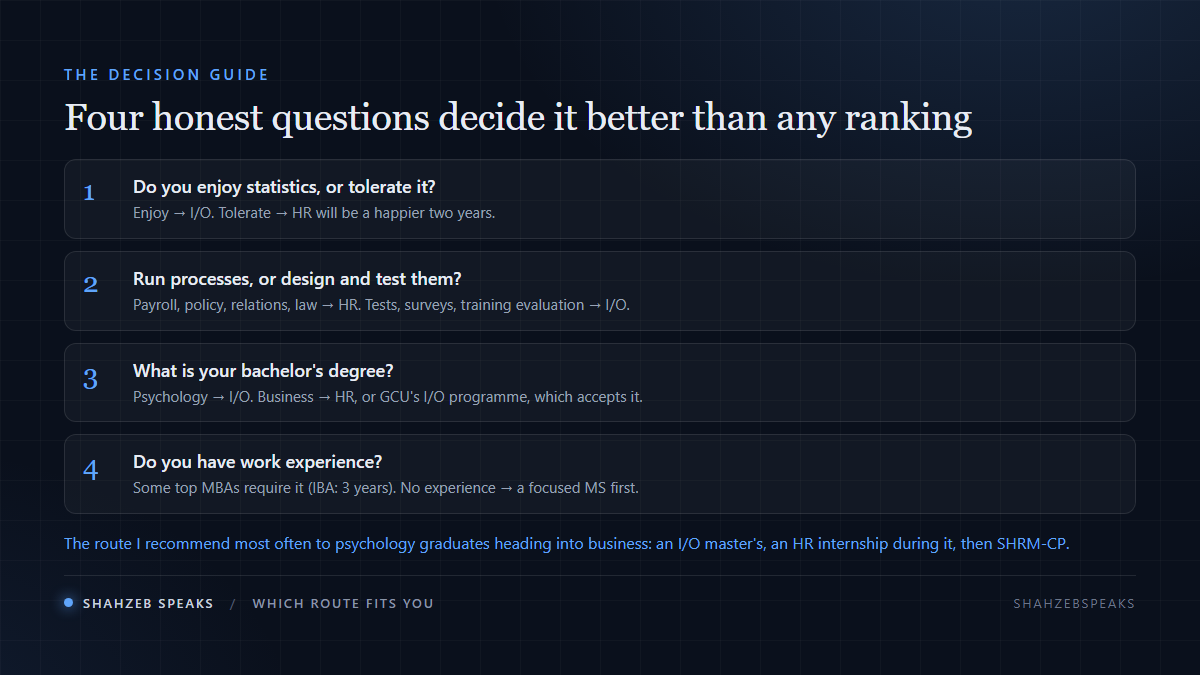
Answer these four questions honestly:
- Do you enjoy statistics, or tolerate it? An I/O degree is built on research methods and psychometrics. If numbers drain you, the HR route will be a happier two years.
- Do you want to run processes or design and test them? Running payroll, policy, employee relations and compliance is HR’s core. Building a selection test or proving a training programme worked is I/O’s.
- What is your bachelor’s degree? Psychology points to I/O (and some HR programmes won’t list you). Business points to HR — or GCU’s I/O programme if measurement is what you want.
- Do you have work experience? Several top MBAs require it. If you don’t, a focused MS now and an MBA later is a common, sensible sequence.
The route I recommend most often to psychology graduates who want corporate careers: an MS or MPhil in I/O or organisational psychology, an internship in an HR team during it, then SHRM-CP. You come out with the measurement skills HR teams lack and the vocabulary they hire for. And if you choose HR instead, take every elective in recruitment and selection, performance management and HR analytics you can — those are the courses closest to where the evidence gap lives.
❓ Questions I am asked most often
Is I/O psychology the same as HR?
No. HR is a business function responsible for people processes — hiring, pay, relations, policy and law. I/O psychology is a scientific discipline that studies behaviour and performance at work and how to measure it. Most I/O graduates work inside HR functions, but the training is different: I/O degrees centre on research methods, statistics and psychometrics.
Which is better, an MS in I/O psychology or an MBA in HR?
Neither is better in general. An MBA or MS in HR opens more job titles and suits people who want to manage HR operations. An MS in I/O suits people who want to design and test selection, assessment, training and survey work. The research gap in HR practice is largest in selection, which is I/O’s core strength.
Can a psychology graduate do an MS in HRM in Pakistan?
It depends on the university. Some programmes list accepted bachelor’s subjects and do not include psychology — NUST’s MS HRM is one example. MBA programmes such as IBA’s accept any 16-year degree but may require work experience. Always check the official eligibility page for the current session.
Can a business graduate study I/O psychology?
Sometimes. Most I/O programmes in Pakistan require a psychology degree, but GC University Lahore’s MS in I/O psychology also accepts a 16-year degree in business management. Bahria University’s MS in HRM and Organizational Psychology is another hybrid route.
Do I need SHRM-CP if I study I/O psychology?
You do not need it, but it helps. SHRM-CP requires no degree and no prior HR experience, so an I/O graduate can sit it immediately. It signals HR fluency to employers who screen for HR credentials; it should not be expected to raise pay on its own.
Is there a licence for I/O psychologists in Pakistan?
Not in a way that settles the question. Pakistan’s Allied Health Professionals Council Act, 2022 lists “Psychology and counseling” as one discipline but is written around health care, and no law protects the title “psychologist”. In the UK, by contrast, “occupational psychologist” is a protected title.
Still deciding between I/O and HR?
If you are weighing the two, or trying to turn a psychology degree into a role a Pakistani employer will recognise, I am happy to talk it through.
More on my field, and why it matters in Pakistani workplaces: industrial psychology in Pakistan.
Sources
- Society for Industrial and Organizational Psychology. “About SIOP” (definition of the field). siop.org
- Society for Industrial and Organizational Psychology (2016). Guidelines for Education and Training in Industrial-Organizational Psychology. Approved by APA, 2017.
- SHRM (2026). SHRM Body of Applied Skills and Knowledge (BASK); SHRM certification eligibility criteria and 2025 Certification Handbook.
- CIPD. “Professional values and purpose” (Profession Map); CIPD membership levels.
- Rynes, S. L., Colbert, A. E., & Brown, K. G. (2002). HR professionals’ beliefs about effective human resource practices: Correspondence between research and practice. Human Resource Management, 41(2), 149–174. doi:10.1002/hrm.10029
- Sanders, K., van Riemsdijk, M., & Groen, B. (2008). The gap between research and practice: A replication study on the HR professionals’ beliefs about effective human resource practices. International Journal of Human Resource Management, 19(10), 1976–1988.
- Tenhiälä, A., Giluk, T. L., Kepes, S., Simón, C., Oh, I.-S., & Kim, S. (2016). The research-practice gap in human resource management: A cross-cultural study. Human Resource Management, 55(2), 179–200.
- Rousseau, D. M. (2006). Is there such a thing as “evidence-based management”? Academy of Management Review, 31(2), 256–269.
- US Bureau of Labor Statistics, Occupational Outlook Handbook: Psychologists; Human Resources Managers; Human Resources Specialists (last modified 27 August 2026; May 2025 pay; 2025–35 projections).
- SIOP (2022). Income and Employment Report (2021 survey, analysed by HumRRO).
- Higher Education Commission (2023). Graduate Education Policy, section 2.1.
- Programme pages, October 2026: IoBM MPhil Organizational Psychology; UMT MS Industrial and Organizational Psychology; GC University Lahore MS/MPhil programmes; NUST MS Human Resource Management and eligibility criteria; IBA Karachi MBA.
- Health and Care Professions Council (UK). “The professions we regulate.”