
Industrial and organizational (I/O) psychology is the scientific study of people at work. Its industrial side fits people to jobs (job analysis, selection, training, appraisal); its organizational side studies how organizations affect people (motivation, attitudes, leadership, teams, culture, stress). It began with Scott and Münsterberg in the early 1900s and became an APA-recognised specialty in 1996.
This is the starting page for anyone studying I/O psychology: a BS or MSc psychology student in Karachi or Lahore, a BBA or MBA student taking organizational behaviour, a Philippine psychometrician candidate, an Indian student preparing for an IGNOU or UGC NET paper, or anyone deciding whether to study the field at all. It explains what the field is, its nature and scope, its subfields and key theories, the careers it leads to and how to study it, and it links to a detailed page for every topic.
I hold an MSc in Industrial and Organizational Psychology, and I have laid this guide out as a map first and details after. Use the table of contents to jump to what you need.
What is I/O psychology?
The American Psychological Association (APA), which recognised industrial-organizational psychology as a specialty in 1996, describes it as the scientific study of behaviour in organizations and the workplace: the field builds principles of individual, group and organizational behaviour and uses them to solve problems at work. In the United States its professional body is the Society for Industrial and Organizational Psychology (SIOP), which began as APA Division 14 in 1945 and was incorporated in 1982 (Koppes, SIOP history).
Put simply, I/O psychologists ask questions like these, and answer them with data:
- Which applicants will do this job well, and how can we tell fairly?
- Why do some employees put in extra effort while others do the minimum?
- What makes a supervisor effective in one team and ineffective in another?
- Why are nurses on one hospital ward burning out while another ward is fine?
- Did the training programme actually change anything?
Many people in Pakistan and India still say “industrial psychology” for the whole field. That is fine in conversation, but in an exam it helps to know that “industrial” is strictly one of two sides, as the next section shows.
Nature and scope of I/O psychology
Nature
“Nature and scope” is one of the most common first questions in Pakistani and Indian papers. For the nature of the field, five points are enough:
- It is a science. It uses the scientific method: hypotheses, measurement, data and statistics. Claims about people at work are tested, not assumed.
- It is applied. Its purpose is to solve real problems in real organizations, so research and practice feed each other. This is called the scientist-practitioner model.
- It has two sides. The industrial (personnel) side fits people to jobs; the organizational side studies how organizations shape people. See industrial vs organizational psychology.
- It works at several levels. The individual (abilities, personality, attitudes), the group (teams, norms, leadership) and the organization (culture, structure, change).
- It serves two goals at once. Organizational effectiveness and employee well-being. Good I/O work improves both, and the field’s ethics require attention to fairness.
Scope
The scope of I/O psychology is everything that happens to people at work, from the job advert to retirement. The table below maps the main areas, what each studies, and the page on this site that covers it in detail.
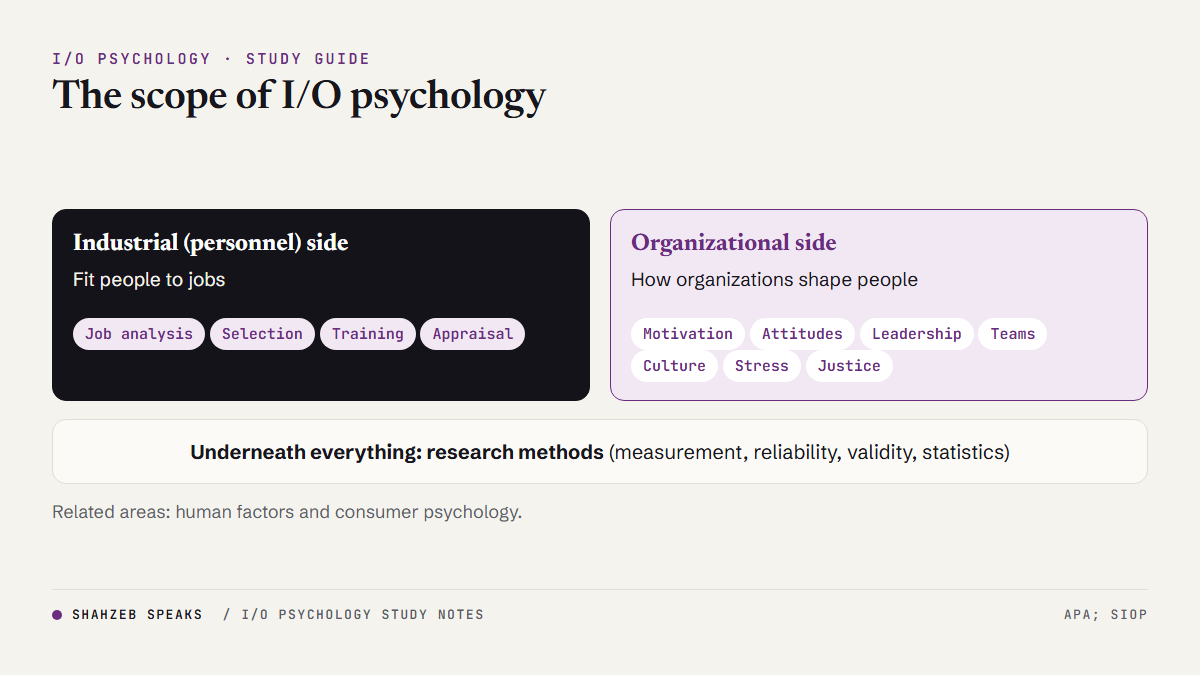
| Area | What it studies | Side | Start here |
|---|---|---|---|
| Job analysis | What a job involves and what it requires (tasks, knowledge, skills, abilities) | Industrial | Job analysis methods |
| Recruitment and selection | Tests, interviews and assessment centres; reliability and validity | Industrial | Personnel psychology notes |
| Training and development | Needs analysis, training design and evaluation | Industrial | Training needs analysis |
| Performance appraisal | Rating methods, rater errors, feedback | Industrial | Performance appraisal errors |
| Work motivation | Why people put effort into work; need, process and job design theories | Organizational | Work motivation theories |
| Job attitudes | Job satisfaction, commitment, engagement, citizenship and counterproductive behaviour | Organizational | Job satisfaction |
| Leadership | Trait, behavioural, contingency and transformational approaches | Organizational | Leadership theories |
| Groups and teams | Group development, norms, team effectiveness | Organizational | Tuckman’s stages |
| Culture, climate and change | Shared assumptions and values; organization development | Organizational | Schein’s culture model |
| Stress and well-being | Demands, control, burnout, engagement | Organizational | Occupational stress models |
| Fairness and justice | Distributive, procedural and interactional justice | Organizational | Organisational justice |
| Research methods | Designs, measurement, statistics used in all the areas above | Both | I/O research methods |
Two related areas often appear at the edges of syllabi: human factors (designing equipment and work settings to fit human abilities) and consumer psychology, which Münsterberg included in 1913 but which now sits mainly in marketing.
A short history of the field
The field is about 120 years old. Walter Dill Scott applied psychology to advertising in 1903, and Hugo Münsterberg’s Psychology and Industrial Efficiency (1913) laid out a plan for choosing workers, improving work and influencing buyers. World War I made group testing large-scale with the Army Alpha and Beta tests in 1917. The Hawthorne studies at Western Electric (1924 to 1932) showed that group norms and supervision affect output, which opened the organizational side. APA Division 14 was founded in 1945, added “Organizational” to its name in 1973 and became SIOP in 1982.
Each part of that story has its own page:
- History of I/O psychology: timeline from 1900 to today
- Hugo Münsterberg: his contribution to I/O psychology
- Taylor vs Mayo: scientific management vs human relations
- The Hawthorne studies: the 4 phases and what they found
- The I/O psychology theorists you need to know
I/O psychology vs related fields
Students often confuse I/O psychology with three neighbours. In short:
| Field | Home discipline | How it differs from I/O psychology | Read more |
|---|---|---|---|
| Human resource management (HRM) | Management | Runs the people processes of an organization (hiring, pay, policy, compliance). I/O supplies much of the research and measurement behind them. | I/O psychology vs HRM |
| Organizational behaviour (OB) | Management | Studies individuals and groups in organizations, drawing on several social sciences; less focus on testing and measurement. | OB vs I/O psychology |
| Clinical and counselling psychology | Psychology | Assesses and treats mental health problems in individuals. I/O works with healthy people in work settings, though both meet in employee well-being. | Workplace burnout |
Key theories in I/O psychology: a map
Most exam questions are about a small set of theories. Here they are by area, with the year you should write. Learn the year, the author and the core idea, then go to the topic page for the detail and criticism.
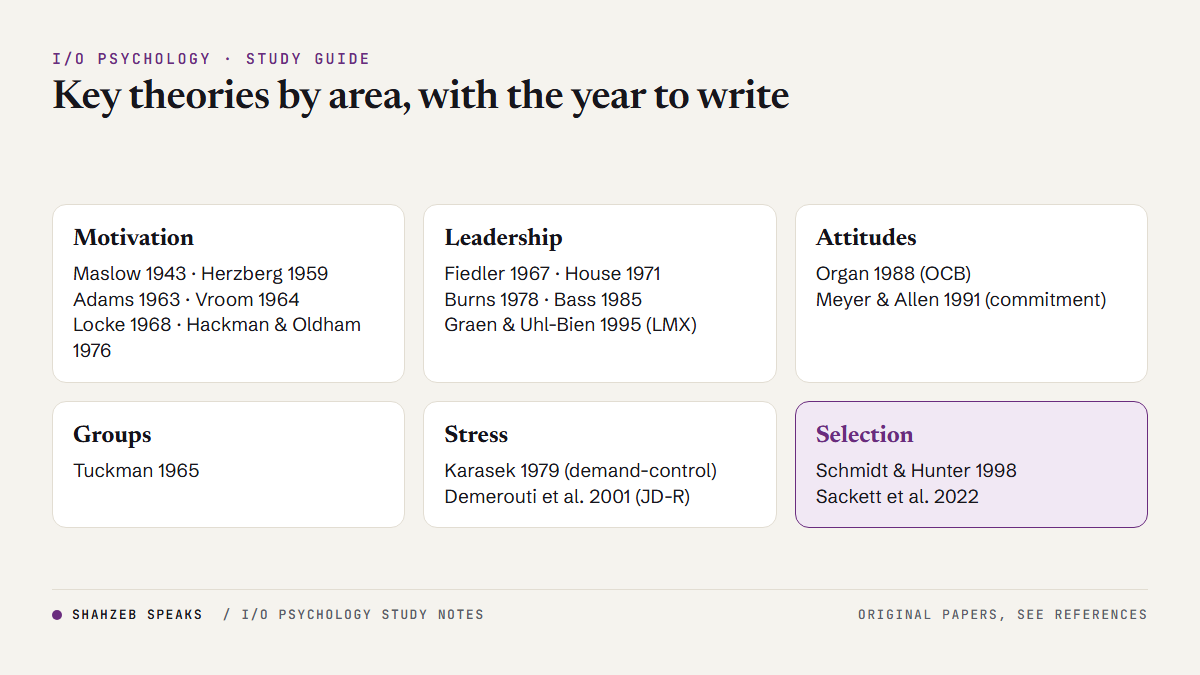
| Area | Theory (author, year) | Core idea in one line |
|---|---|---|
| Motivation | Hierarchy of needs (Maslow, 1943) | Needs form a ladder from physiological to self-actualisation |
| Two-factor theory (Herzberg, Mausner & Snyderman, 1959) | Hygiene factors prevent dissatisfaction; motivators create satisfaction | |
| Equity theory (Adams, 1963) | People compare their outcome-to-input ratio with others’ | |
| Expectancy theory (Vroom, 1964) | Effort depends on expectancy, instrumentality and valence | |
| Goal-setting theory (Locke, 1968) | Specific, difficult goals beat “do your best” | |
| Job characteristics model (Hackman & Oldham, 1976) | Five core job features drive motivation through three psychological states | |
| Leadership | Contingency model (Fiedler, 1967) | Effectiveness depends on fit between style and situational control |
| Path-goal theory (House, 1971) | Leaders clear the path to goals that followers value | |
| Transformational leadership (Burns, 1978; Bass, 1985) | Leaders raise followers’ aims beyond simple exchange | |
| Leader-member exchange (Graen & Uhl-Bien, 1995 review) | Leaders form different-quality relationships with each follower | |
| Attitudes | Three-component model of commitment (Meyer & Allen, 1991) | Affective, continuance and normative commitment |
| Organizational citizenship behaviour (Organ, 1988) | Helpful behaviour beyond formal job duties | |
| Groups | Stages of group development (Tuckman, 1965) | Forming, storming, norming, performing (adjourning added later) |
| Stress | Demand-control model (Karasek, 1979) | High demands with low control produce strain |
| Job demands-resources model (Demerouti et al., 2001) | Demands drain energy; resources build engagement | |
| Selection | Validity of selection methods (Schmidt & Hunter, 1998; Sackett et al., 2022) | Some predictors forecast performance far better than others |
The pillar pages go deeper: all work motivation theories compared, leadership theories compared and personnel psychology notes on selection, appraisal and training.
What do I/O psychologists do? Careers and settings
I/O psychologists work in four broad settings:
- Consulting firms: designing assessment centres and selection tests, running engagement surveys, leadership development, organizational change projects.
- Inside organizations: talent management, learning and development, people analytics, organization development, often within the HR function, for example in a bank, a telecom company, a multinational or a large hospital.
- Government and the military: public service selection, military selection and training, workplace safety research.
- Universities: teaching psychology or management and doing research.
Day-to-day tasks include writing job descriptions from a job analysis, building and checking tests, analysing survey data, designing training and evaluating it, coaching managers and advising on fair, legal selection. Many of the calculations involved are available as free tools on this site, for example the motivating potential score calculator, the content validity ratio calculator and the Taylor-Russell calculator. The full list is on the free tools page.
For the practical questions, each has its own page:
- What does the job pay? I/O psychology salary by country (US, UK, India, Philippines, Pakistan, South Africa)
- What are the steps? How to become an I/O psychologist, by country
- Should I do it? Is I/O psychology worth it? An honest answer
- What about Pakistan specifically? Scope of industrial psychology in Pakistan
Is I/O psychology hard? How to study it
I/O psychology is not hard in the way physics is hard, but students struggle with two things: the number of theories with similar names, and the statistics. Both are manageable with a plan. Here is an eight-week plan that follows the order of most university outlines, including Punjab University’s Industrial Psychology course, which moves from definition and history through research methods, job analysis, selection, training, appraisal, motivation, stress, culture, leadership and teams.
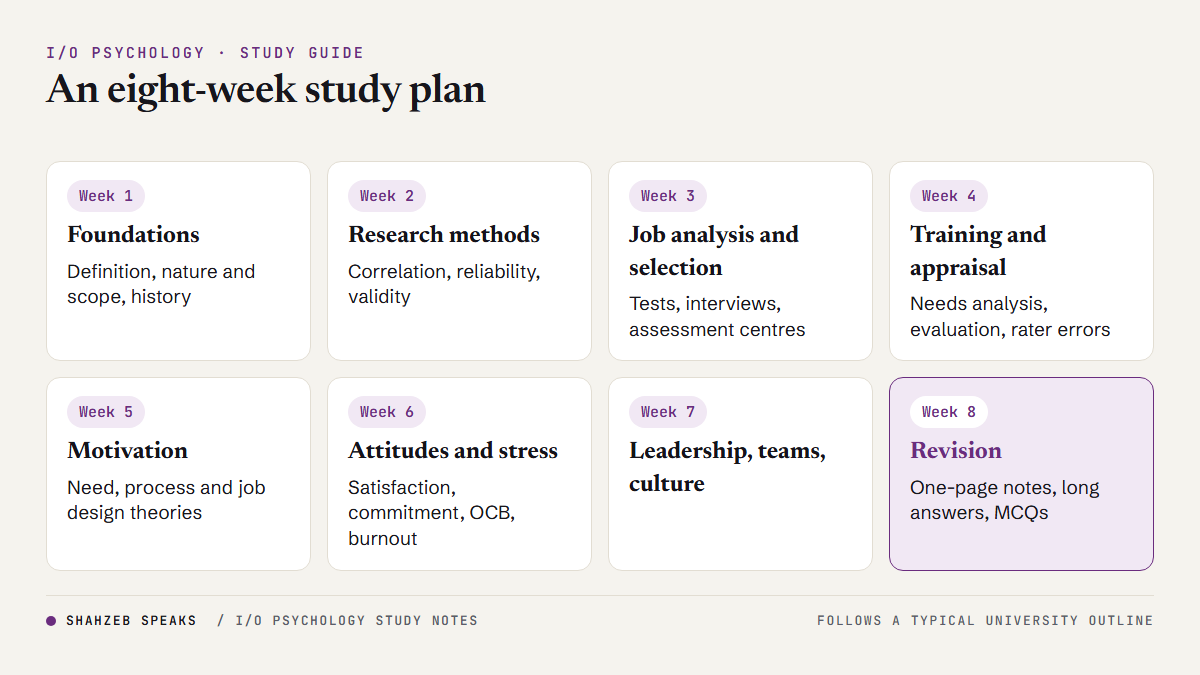
- Week 1, foundations: definition, nature and scope (this page), history, the two sides.
- Week 2, research methods: correlation, reliability and validity, basic statistics. Do not skip this; every later topic uses it.
- Week 3, job analysis and selection: job analysis methods, tests, interviews, assessment centres, validity.
- Week 4, training and appraisal: training needs analysis, training evaluation, appraisal methods and errors.
- Week 5, motivation: need theories, process theories, job design.
- Week 6, attitudes and stress: satisfaction, commitment, OCB and CWB, stress models, burnout.
- Week 7, leadership, teams and culture.
- Week 8, revision: one-page notes for each topic, timed long answers, MCQs.
Study tips that work:
- Learn each theory as four facts: author, year, core idea, one criticism. That is the skeleton of every long answer.
- Use comparison tables. Most long questions are “compare X and Y”. Make your own table for each pair.
- Attach a local example to every theory: a bank branch, a call centre, a hospital ward, a textile mill, a university department. Examiners reward it.
- Practise MCQs with explanations, not just answers, so you learn why the wrong options are wrong. Start with the I/O psychology MCQ hub.
- Revise from short notes: the one-page industrial psychology notes are made for the last two weeks.
- Use the textbooks your course names. Landy and Conte and Aamodt are the usual choices; see best books for I/O psychology for how they compare.
If you are writing a thesis, start with 150 I/O psychology thesis topics with scales, which also points to the free reliability and validity calculators.
10-mark answer structure: “Define industrial/organizational psychology and discuss its nature and scope”
- Definition: the scientific study of people at work; APA specialty (1996); two sides, industrial and organizational.
- Brief history: Scott (1903), Münsterberg (1913), Army testing (1917), Hawthorne (1924 to 1932), “Organizational” added in 1973.
- Nature (5 points): scientific, applied (scientist-practitioner), two sides, several levels, effectiveness plus well-being.
- Scope, industrial side: job analysis, selection, training, appraisal.
- Scope, organizational side: motivation, attitudes, leadership, teams, culture, stress, justice.
- Related areas: human factors, consumer psychology; difference from HRM and OB in one line each.
- Example: a bank or hospital where selection, training and leadership problems each call on a different part of the field.
- Scope in practice: consulting firms, HR and talent teams inside organizations, government and the military, and universities.
- Conclusion: a broad applied science whose aim is workplaces that are both effective and fair.
Model opening line: “Industrial and organizational psychology is the scientific study of people at work; its industrial side fits people to jobs and its organizational side studies how organizations shape people, so its scope covers every stage of working life from hiring to retirement.”
Practice MCQs: I/O psychology basics
Practice questions written to the published syllabus, not past-paper questions. They cover the whole field; each topic page has its own set.
-
Which of these is an industrial-side topic?
- Organizational culture
- Job analysis
- Transformational leadership
- Burnout
Show answer
B. Job analysis is the base of the industrial (personnel) side. Culture, leadership and burnout are organizational topics.
-
The scientist-practitioner model means that I/O psychologists:
- Only do laboratory research
- Only consult for companies
- Base practice on research and use practice to raise research questions
- Must hold a medical licence
Show answer
C. Research and practice feed each other. A and B describe only half of the model; D is unrelated.
-
In which year did the APA recognise industrial-organizational psychology as a specialty?
- 1913
- 1945
- 1973
- 1996
Show answer
D. 1996. 1913 is Münsterberg’s book, 1945 the founding of Division 14, and 1973 the year “Organizational” was added to the division’s name.
-
A hospital wants to know why nurses on one ward report much more exhaustion than on others. Which area of I/O psychology fits best?
- Job analysis
- Occupational stress and well-being
- Consumer psychology
- Test construction
Show answer
B. Exhaustion across a ward is a stress and burnout question, for example through the demand-control or JD-R models. The other areas do not address it directly.
-
Who wrote Psychology and Industrial Efficiency (1913)?
- Walter Dill Scott
- Elton Mayo
- Hugo Münsterberg
- Frederick Taylor
Show answer
C. Münsterberg. Scott wrote on advertising (1903), Taylor on scientific management (1911) and Mayo on the human problems of industry (1933).
-
Which theory says specific, difficult goals lead to higher performance than “do your best” goals?
- Equity theory
- Goal-setting theory
- Two-factor theory
- Path-goal theory
Show answer
B. Goal-setting theory (Locke, 1968). Equity theory is about fairness comparisons, two-factor theory about hygiene and motivators, and path-goal theory about leadership.
-
Which of these is NOT part of the nature of I/O psychology?
- It uses the scientific method
- It is applied to real workplace problems
- It is mainly concerned with diagnosing mental disorders
- It works at individual, group and organizational levels
Show answer
C. Diagnosing mental disorders is clinical psychology. The other three describe the nature of I/O psychology.
-
How does HRM differ from I/O psychology?
- They are the same field
- HRM runs people processes; I/O supplies research and measurement behind many of them
- HRM is a branch of psychology
- I/O psychology deals only with pay
Show answer
B. HRM is a management function; I/O is a psychological science that informs it. HRM is not a branch of psychology, and I/O covers far more than pay.
-
The job characteristics model was proposed by:
- Herzberg
- Hackman and Oldham
- Maslow
- Vroom
Show answer
B. Hackman and Oldham (1976). Herzberg proposed the two-factor theory, Maslow the hierarchy of needs and Vroom expectancy theory.
-
A student says I/O psychology is “just common sense”. What is the best reply?
- Agree; no research is needed
- Research often finds results that common sense gets wrong, such as feedback sometimes making performance worse
- I/O psychology avoids data
- Only managers can study it
Show answer
B. Kluger and DeNisi’s (1996) meta-analysis, for example, found that in about a third of cases feedback reduced performance. That is why the field tests ideas with data.
Practise on your phone
The free I/O Psychology Prep app has 410 explained
questions, flashcards and an exam countdown, and works offline. Get it on Google Play
· About the app
Questions students ask
What is industrial psychology in simple words?
It is the use of psychology to make work better: choosing the right people for jobs, training them, judging their performance fairly, and understanding what motivates them and how leaders and teams work. Its full name today is industrial and organizational psychology.
What is the scope of industrial psychology?
It covers job analysis, selection, training, performance appraisal, motivation, job attitudes, leadership, teams, culture, stress and fairness at work. I/O psychologists work in consulting, inside organizations, in government and the military, and in universities.
Who is the father of industrial psychology?
Hugo Münsterberg is most often named, for Psychology and Industrial Efficiency (1913). Walter Dill Scott is also counted as a founder.
Is I/O psychology a good career in Pakistan?
It can be, through roles in HR, assessment, training and consulting, and through university teaching. The detailed picture, with its limits, is on the scope of industrial psychology in Pakistan page.
Do I need maths for I/O psychology?
You need basic statistics: averages, correlation, reliability and validity, and later regression for a thesis. You do not need advanced mathematics. The free calculators on this site help you practise with real numbers.
What are the main subfields of I/O psychology?
Personnel psychology (job analysis, selection, training, appraisal) and organizational psychology (motivation, attitudes, leadership, teams, culture, stress), with human factors as a related area. Research methods run through all of them.
Which books should I use?
Use the textbook your course names. Landy and Conte and Aamodt are the most common in Pakistan, India and the Philippines. See the best books for I/O psychology page for a comparison.
Practise on your phone
The free I/O Psychology Prep app has 410 explained
questions, flashcards and an exam countdown, and works offline. Get it on Google Play
· About the app
References
- Adams, J. S. (1963). Towards an understanding of inequity. Journal of Abnormal and Social Psychology, 67(5), 422–436. https://doi.org/10.1037/h0040968
- American Psychological Association. (n.d.). Industrial and organizational psychology [Recognized specialty description]. https://www.apa.org/ed/graduate/specialize/industrial
- Bass, B. M. (1985). Leadership and performance beyond expectations. Free Press.
- Burns, J. M. (1978). Leadership. Harper & Row.
- Demerouti, E., Bakker, A. B., Nachreiner, F., & Schaufeli, W. B. (2001). The job demands-resources model of burnout. Journal of Applied Psychology, 86(3), 499–512. https://doi.org/10.1037/0021-9010.86.3.499
- Fiedler, F. E. (1967). A theory of leadership effectiveness. McGraw-Hill.
- Graen, G. B., & Uhl-Bien, M. (1995). Relationship-based approach to leadership: Development of leader-member exchange (LMX) theory of leadership over 25 years. The Leadership Quarterly, 6(2), 219–247. https://doi.org/10.1016/1048-9843(95)90036-5
- Hackman, J. R., & Oldham, G. R. (1976). Motivation through the design of work: Test of a theory. Organizational Behavior and Human Performance, 16(2), 250–279. https://doi.org/10.1016/0030-5073(76)90016-7
- Herzberg, F., Mausner, B., & Snyderman, B. B. (1959). The motivation to work. Wiley.
- House, R. J. (1971). A path goal theory of leader effectiveness. Administrative Science Quarterly, 16(3), 321–339. https://doi.org/10.2307/2391905
- Karasek, R. A. (1979). Job demands, job decision latitude, and mental strain: Implications for job redesign. Administrative Science Quarterly, 24(2), 285–308. https://doi.org/10.2307/2392498
- Kluger, A. N., & DeNisi, A. (1996). The effects of feedback interventions on performance: A historical review, a meta-analysis, and a preliminary feedback intervention theory. Psychological Bulletin, 119(2), 254–284. https://doi.org/10.1037/0033-2909.119.2.254
- Koppes, L. L. (n.d.). A brief history of the Society for Industrial and Organizational Psychology, Inc. SIOP Museum. https://www.siop.org/About-SIOP/SIOP-Museum/Koppes-History
- Locke, E. A. (1968). Toward a theory of task motivation and incentives. Organizational Behavior and Human Performance, 3(2), 157–189. https://doi.org/10.1016/0030-5073(68)90004-4
- Maslow, A. H. (1943). A theory of human motivation. Psychological Review, 50(4), 370–396. https://doi.org/10.1037/h0054346
- Meyer, J. P., & Allen, N. J. (1991). A three-component conceptualization of organizational commitment. Human Resource Management Review, 1(1), 61–89. https://doi.org/10.1016/1053-4822(91)90011-Z
- Münsterberg, H. (1913). Psychology and industrial efficiency. Houghton Mifflin.
- Organ, D. W. (1988). Organizational citizenship behavior: The good soldier syndrome. Lexington Books.
- Sackett, P. R., Zhang, C., Berry, C. M., & Lievens, F. (2022). Revisiting meta-analytic estimates of validity in personnel selection: Addressing systematic overcorrection for restriction of range. Journal of Applied Psychology, 107(11), 2040–2068. https://doi.org/10.1037/apl0000994
- Schmidt, F. L., & Hunter, J. E. (1998). The validity and utility of selection methods in personnel psychology: Practical and theoretical implications of 85 years of research findings. Psychological Bulletin, 124(2), 262–274. https://doi.org/10.1037/0033-2909.124.2.262
- Tuckman, B. W. (1965). Developmental sequence in small groups. Psychological Bulletin, 63(6), 384–399. https://doi.org/10.1037/h0022100
- Vroom, V. H. (1964). Work and motivation. Wiley.
Every page in this study guide: one-page notes · history timeline · Hawthorne studies · Taylor vs Mayo · Hugo Münsterberg · industrial vs organizational · OB vs I/O · salary by country · how to become an I/O psychologist · is it worth it?. The other hubs: motivation, personnel psychology, leadership, thesis topics and MCQs. For the profession at home, see industrial psychology in Pakistan.