
Tuckman’s stages of group development are forming, storming, norming, performing and adjourning. Bruce Tuckman proposed the first four in 1965 after reviewing 50 articles on how groups change over time. In 1977 Tuckman and Mary Ann Jensen added adjourning, the stage when a group finishes its task and breaks up.
This page is for students who need Tuckman’s model for an exam, a group-work reflection or the literature review of a thesis on teams. You get each stage with a workplace example, a table of what happens to relationships and to the task at each stage, a stage diagram, what later research found (including the strongest criticism), a 10-mark exam structure and 10 practice MCQs with explained answers.
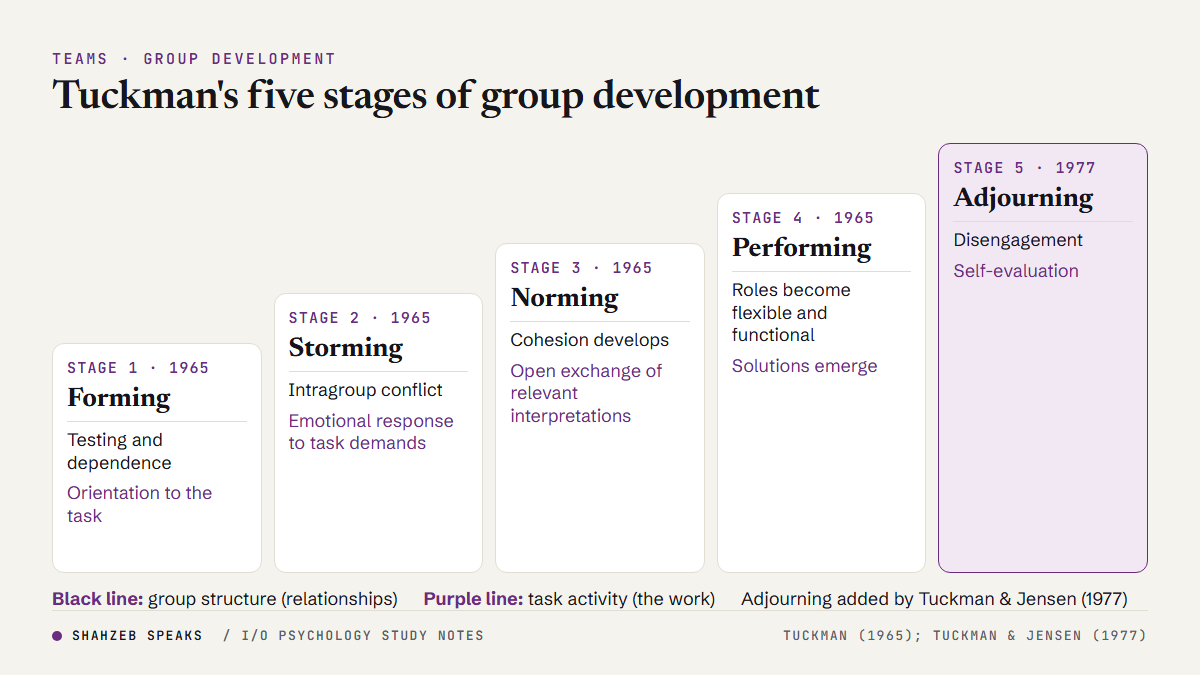
One thing most summaries leave out: Tuckman described two things happening at once in every stage. One is the group structure, meaning how members relate to each other. The other is the task activity, meaning how they deal with the work itself. If you write about both in an exam, your answer already stands above the usual “forming, storming, norming, performing” list.
What are Tuckman’s stages of group development?
In the early 1960s Bruce W. Tuckman worked at the Naval Medical Research Institute in the United States, where a small team of social psychologists studied small groups for the US Navy. His supervisor, Irwin Altman, had collected every article he could find on group development and passed the collection to him. Tuckman later explained that the collection contained 50 articles, many of them psychoanalytic studies of therapy groups and T-groups (training groups used in human relations courses) (Tuckman, 1984).
Tuckman sorted the studies by setting: therapy groups, T-groups, and natural and laboratory groups. He then looked for one sequence that fitted most of them. He found four stages, moving from orientation, testing and dependence, to conflict, to group cohesion, to functional role-relatedness. He gave them the short rhyming names that made the paper famous: forming, storming, norming and performing (Tuckman, 1965). The paper appeared in Psychological Bulletin in 1965.
Twelve years later, Tuckman and Mary Ann Jensen reviewed 22 studies published since 1965. These studies broadly supported the four stages but pointed to a fifth one at the end of a group’s life. Because no perfect rhyme could be found, they called it adjourning (Tuckman & Jensen, 1977; Tuckman, 1984).
The five stages explained, with workplace examples
Picture a new team of six customer service agents in a Karachi or Manila call centre, put together to launch a new client account. Here is how Tuckman’s stages would look for them.
1. Forming: testing and dependence
Group structure: members test which behaviour is acceptable and depend on the leader for direction. Task activity: members try to understand the task, its rules and what is expected. In the call centre, agents are polite, ask the team leader many questions and wait to be told how calls should be handled. Very little real disagreement is visible yet.
2. Storming: intragroup conflict
Group structure: members resist the group’s influence and argue with each other or with the leader. Task activity: there is an emotional response to the demands of the task. In the call centre, two experienced agents question the scripts, someone complains that shift allocation is unfair, and small groups form. Many teams feel this is a failure. In Tuckman’s model it is a normal stage.
3. Norming: cohesion and new standards
Group structure: in-group feeling and cohesiveness develop, new standards evolve and members accept roles. Task activity: members exchange ideas and interpretations openly. In the call centre, the team agrees on rules such as “handover notes before every break” and members start to cover for each other. A norm is an unwritten rule the group expects its members to follow.
4. Performing: functional roles
Group structure: roles become flexible and functional, so relationships now support the work. Task activity: group energy goes into the task and solutions emerge. In the call centre, the team solves problems without waiting for the leader, and members switch roles when someone is absent.
5. Adjourning: disengagement
Added in 1977, adjourning is the end of the group’s life. Members may feel anxiety about separation, some sadness, and they look back on what the group achieved. When the client contract ends and the agents move to different accounts, the team is adjourning. University students know this stage well: the week after a group project is submitted, the WhatsApp group goes quiet.
Tuckman’s stages in a table
Use this table for revision. The “group structure” and “task activity” columns follow Tuckman’s two realms; the example column is my own illustration.
| Stage | Group structure (relationships) | Task activity (the work) | Workplace example |
|---|---|---|---|
| Forming | Testing and dependence on the leader | Orientation to the task | New hospital ward team learns routines and asks the charge nurse everything |
| Storming | Intragroup conflict, resistance to group influence | Emotional response to task demands | Arguments about night shifts and who reports to whom |
| Norming | Cohesion develops, new standards and roles accepted | Open exchange of relevant interpretations | Team agrees a handover checklist and starts sharing ideas |
| Performing | Roles become flexible and functional | Solutions emerge; energy goes into the task | Team handles a busy weekend without the manager stepping in |
| Adjourning (1977) | Disengagement; anxiety about separation | Self-evaluation as the task ends | Project team writes a lessons-learned note and disbands |
Where did the adjourning stage come from?
The 1965 model had no ending. Many real groups, however, are temporary: project teams, committees, student groups, training cohorts. In the 1977 update, published in Group & Organization Studies, Tuckman and Jensen located 22 newer studies through the Social Sciences Citation Index. Those studies tended to support the four original stages and also suggested a final stage of termination, which the authors named adjourning (Tuckman, 1984).
In exams, write “Tuckman and Jensen (1977)” when you mention adjourning, and “Tuckman (1965)” for the original four. Mixing up the two dates is a common way to lose a mark.
What has research found since Tuckman?
Tuckman’s model is the best known account of team development, and a historical review by Bonebright (2010) notes that it became popular with training and HR practitioners first and only later in academic writing. But students should know its limits.
1. The evidence base was narrow. Most of the 50 source articles described therapy groups and T-groups, not work teams. Tuckman himself told the story that the editor of Psychological Bulletin, Lloyd Humphreys, first rejected the paper because the reviewed studies were not good enough. Tuckman replied that he was drawing inferences from the studies, not defending them, and the paper was accepted (Tuckman, 1984).
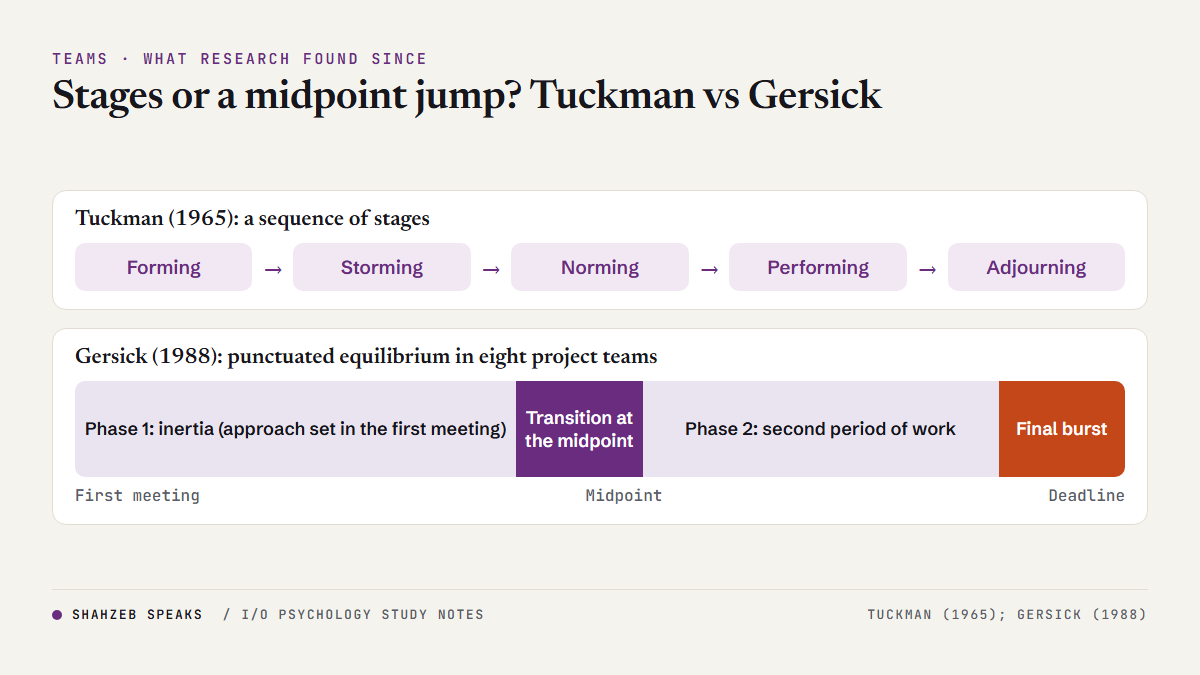
2. Work teams with deadlines may not follow stages. Connie Gersick (1988) followed eight real project teams from six organisations, with lives from seven days to six months. Each team settled on its approach in its very first meeting and kept it through a long period of inertia. Then, at about the midpoint between the first meeting and the deadline, every team went through a sharp transition, dropped old habits and made a jump in progress, followed by a second phase and a final burst of work. Gersick called this punctuated equilibrium. The trigger was awareness of time, not the team “maturing”.
3. Teams do several things at once. Marks, Mathieu and Zaccaro (2001) described teams as working in repeated episodes, moving between planning (transition) and doing (action) phases many times, with several processes running at the same time. Later reviews of team research, such as Mathieu et al. (2008), use an input-mediator-outcome framework rather than a single sequence of stages.
4. Practical reading. Many textbooks add that a team can slip back to storming when a new member joins or the task changes. That is a sensible reading of the model, but it is not something Tuckman tested, so present it as an application, not a finding.
How can a team leader use Tuckman’s model?
Tuckman described stages; he did not write a manual for leaders. The suggestions below are a practical reading that links the stages to leadership theories you will study in the same unit.
- Forming: give clear goals, roles and ground rules. Members depend on the leader here, which fits the directive behaviour in House’s path-goal theory (see path-goal theory).
- Storming: treat conflict about the work as normal, keep it about the task, and make it safe to disagree. Our guide to psychological safety at work explains why this matters for learning in teams.
- Norming: write down the norms the team has agreed and watch for in-groups and out-groups forming around the leader (see LMX theory).
- Performing: step back, delegate and remove obstacles.
- Adjourning: recognise what the team achieved and record lessons before people scatter.
When a new joiner arrives in a performing team, the team often has to re-form around that person. The first weeks of a new hire are covered in our piece on employee onboarding in the first 90 days.
10-mark answer structure
- Definition (who, year): Tuckman (1965) proposed that small groups develop through forming, storming, norming and performing; Tuckman and Jensen (1977) added adjourning.
- Basis of the model: a review of 50 articles on therapy groups, T-groups, and natural and laboratory groups; two realms, group structure and task activity.
- The five stages: one short paragraph each, naming both the relationship side and the task side.
- Workplace example: follow one team (bank branch, hospital ward, call centre or student project) through all five stages.
- Evaluation: narrow evidence base (few work teams); Gersick (1988) punctuated equilibrium; stages may overlap or repeat.
- Practical use: what a leader should do at each stage.
- Conclusion: a useful language for team development, best used as a guide rather than a fixed timetable.
Model opening line: “Tuckman (1965), reviewing 50 studies of small groups, proposed that groups pass through forming, storming, norming and performing, both in how members relate to one another and in how they handle the task; Tuckman and Jensen (1977) later added a fifth stage, adjourning.”
Practice MCQs: Tuckman’s stages of group development
Practice questions written to the published syllabus. Try each one before opening the answer.
-
Which is the correct order of Tuckman’s stages, including the stage added in 1977?
- Forming, norming, storming, performing, adjourning
- Forming, storming, norming, performing, adjourning
- Storming, forming, norming, adjourning, performing
- Forming, storming, performing, norming, adjourning
Show answer
B. Conflict (storming) comes before cohesion (norming), and adjourning is the final stage. A swaps storming and norming; C starts with conflict; D puts performing before norming.
-
Who added the adjourning stage, and when?
- Tuckman alone, in 1965
- Gersick, in 1988
- Tuckman and Jensen, in 1977
- Marks, Mathieu and Zaccaro, in 2001
Show answer
C. Tuckman and Jensen (1977) added adjourning after reviewing 22 later studies. The 1965 paper had only four stages; Gersick and Marks et al. proposed different models.
-
A new ward team at a hospital argues about night-shift allocation, and two senior nurses openly challenge the charge nurse’s rota. Which stage is this?
- Forming
- Norming
- Storming
- Adjourning
Show answer
C. Intragroup conflict and resistance to the leader mark storming. Forming is polite testing; norming has agreed standards; adjourning is the end of the group.
-
Tuckman’s 1965 review was based mostly on which kinds of groups?
- Military combat units
- Therapy groups and T-groups
- Manufacturing work teams
- Sports teams
Show answer
B. Many of the 50 articles were studies of therapy groups and T-groups, with some natural and laboratory groups. This is why critics question how well the model fits work teams. The other options were not the main sources.
-
Tuckman described each stage in two realms. Which pair is correct?
- Group structure and task activity
- Leadership style and follower maturity
- Inputs and outputs
- Culture and climate
Show answer
A. Tuckman tracked the interpersonal (group structure) realm and the task activity realm. B is from situational leadership approaches, C from input-process-output models and D from organisational culture research.
-
In Gersick’s (1988) study of eight project teams, when did the major change in each team’s approach happen?
- In the first meeting only
- Gradually, stage by stage
- At about the midpoint between the first meeting and the deadline
- Only after a new leader was appointed
Show answer
C. Gersick found a sharp transition at roughly the halfway point of the team’s calendar time, triggered by awareness of the deadline. The approach was set in the first meeting (A) but then changed; the change was sudden, not gradual (B); leadership change was not the trigger (D).
-
A university project group agrees that everyone will reply on the group chat within a day, and members start to trust each other. Which stage is this?
- Norming
- Storming
- Performing
- Forming
Show answer
A. New standards and growing cohesion are the signs of norming. Performing comes when roles are flexible and energy goes fully into the task; storming is conflict; forming is orientation.
-
In Tuckman’s model, the task activity that matches storming is:
- Orientation to the task
- Emotional response to task demands
- Emergence of solutions
- Self-evaluation
Show answer
B. During storming, members react emotionally to what the task asks of them. Orientation is forming, emergence of solutions is performing, and self-evaluation belongs to adjourning.
-
Which of these is NOT a fair criticism of Tuckman’s model?
- Few of the source studies were work teams
- Deadline-driven teams may change at the midpoint instead of moving through stages
- Tuckman built the model without looking at any studies
- Teams may run several processes at the same time
Show answer
C. The model came from a review of 50 published articles, so C is false. A, B (Gersick, 1988) and D (Marks et al., 2001) are recognised criticisms.
-
A team’s roles have become flexible, members cover for each other without being asked, and the leader mainly removes obstacles. Which stage is this?
- Adjourning
- Norming
- Forming
- Performing
Show answer
D. Flexible, functional roles that support the task describe performing. Norming is the earlier stage where standards are still being set; forming and adjourning are the start and end of the group.
Practise on your phone
The free I/O Psychology Prep app has 410 explained
questions, flashcards and an exam countdown, and works offline. Get it on Google Play
· About the app
Want more team and leadership questions? Try the leadership theories MCQs or the full I/O psychology MCQ hub.
Questions students ask
What are the 5 stages of Tuckman’s model?
Forming, storming, norming, performing and adjourning. The first four come from Tuckman (1965). Adjourning was added by Tuckman and Jensen (1977) to describe the end of a group’s life, when the task is finished and members separate.
Who added the adjourning stage?
Bruce Tuckman and Mary Ann Jensen, in a 1977 article in Group & Organization Studies called “Stages of small-group development revisited”. They reviewed 22 studies published after 1965 and found evidence for a termination stage.
Is Tuckman’s model supported by research?
Partly. The 22 later studies reviewed in 1977 tended to support the four stages. But the original evidence came mostly from therapy and training groups, and Gersick (1988) found that real project teams with deadlines changed sharply at their midpoint rather than moving through stages. Treat the model as a useful description, not a law.
Can a team go back to an earlier stage?
Many textbooks and trainers say yes: a new member, a new leader or a changed task can send a team back to forming or storming. This is a practical reading of the model. Tuckman did not test it, so in an exam present it as an application, not as his finding.
How long does each stage last?
Tuckman did not give durations. A group can storm for a day or for months. Gersick’s study suggests that, for teams with a fixed deadline, the calendar matters: the big shift tends to come at about the halfway point of the time available.
What is the difference between Tuckman and Gersick?
Tuckman (1965) describes a sequence of stages that a group moves through in order. Gersick (1988) describes punctuated equilibrium: a long period of inertia, a sudden transition at the midpoint of the team’s time, then a second period of work and a final burst before the deadline.
References
- Bonebright, D. A. (2010). 40 years of storming: A historical review of Tuckman’s model of small group development. Human Resource Development International, 13(1), 111–120. https://doi.org/10.1080/13678861003589099
- Gersick, C. J. G. (1988). Time and transition in work teams: Toward a new model of group development. Academy of Management Journal, 31(1), 9–41. https://doi.org/10.5465/256496
- Marks, M. A., Mathieu, J. E., & Zaccaro, S. J. (2001). A temporally based framework and taxonomy of team processes. Academy of Management Review, 26(3), 356–376. https://doi.org/10.5465/amr.2001.4845785
- Mathieu, J., Maynard, M. T., Rapp, T., & Gilson, L. (2008). Team effectiveness 1997–2007: A review of recent advancements and a glimpse into the future. Journal of Management, 34(3), 410–476. https://doi.org/10.1177/0149206308316061
- Tuckman, B. W. (1965). Developmental sequence in small groups. Psychological Bulletin, 63(6), 384–399. https://doi.org/10.1037/h0022100
- Tuckman, B. W. (1984). This week’s citation classic: Developmental sequence in small groups. Current Contents. https://garfield.library.upenn.edu/classics1984/A1984TD25600001.pdf
- Tuckman, B. W., & Jensen, M. A. C. (1977). Stages of small-group development revisited. Group & Organization Studies, 2(4), 419–427. https://doi.org/10.1177/105960117700200404
Practise on your phone
The free I/O Psychology Prep app has 410 explained
questions, flashcards and an exam countdown, and works offline. Get it on Google Play
· About the app
This post is part of our guide to leadership theories in I/O psychology, which covers leadership, teams and the organisation. Next, read Schein’s model of organizational culture, transformational vs transactional leadership and the job demands-resources model. For the wider field, start with the I/O psychology study guide or read about industrial psychology in Pakistan.