
Path-goal theory of leadership was developed by Robert House (1971), building on Martin Evans (1970), and set out with Terence Mitchell in 1974. It says leaders motivate followers by clarifying the path to work goals, removing obstacles and linking rewards to performance, choosing between directive, supportive, participative and achievement-oriented behaviour to suit the follower and the task.
This page is for students who need path-goal theory for an exam or assignment, and for anyone asked to compare it with Hersey and Blanchard’s situational approach or Fiedler’s model. It covers who developed the theory, its link to expectancy theory (with a small worked example), the four leader behaviours in a table, the contingency factors, examples from real workplaces, what the research found, a comparison table, a 10-mark answer plan and 10 practice MCQs with explanations.
What is path-goal theory, and who developed it?
Path-goal theory is a contingency theory of leadership: it says the best leader behaviour depends on the situation. Its starting point is motivation. House and Mitchell (1974) explain the name directly: the theory is called path-goal because its main concern is how the leader influences followers’ perceptions of their work goals, their personal goals and the paths to reaching them.
The theory has three main contributors:
- Martin Evans (1970) argued that leaders are effective by making rewards available and making them depend on reaching specific goals. Clarifying which behaviour leads to valued rewards is what House and Mitchell later called path clarification. Evans also saw the leader’s supportiveness as itself a reward.
- Robert House (1971) turned these ideas into a fuller theory of leader effectiveness in Administrative Science Quarterly.
- House and Mitchell (1974) set out the version taught today, with four leader behaviours and two groups of contingency factors.
House and Mitchell (1974) state the theory in two propositions. Learn them; they make an excellent exam paragraph:
- Leader behaviour is acceptable and satisfying to followers to the extent that they see it as an immediate source of satisfaction or as a means to future satisfaction.
- Leader behaviour is motivating (it increases effort) to the extent that it makes satisfying followers’ needs depend on effective performance, and it complements the followers’ environment by providing the coaching, guidance, support and rewards needed for effective performance.
The key word is complements. A leader should add what is missing, not repeat what is already there. If the task is already crystal clear, more instructions only feel like close control.
How does path-goal theory use expectancy theory?
House and Mitchell (1974) say path-goal theory has its roots in expectancy theory of motivation (Vroom, 1964). In expectancy theory, effort depends on three beliefs: expectancy (if I try, will I perform well?), instrumentality (if I perform well, will I get the reward?) and valence (do I want that reward?). Vroom’s model multiplies them: motivational force = expectancy × instrumentality × valence. Path-goal theory asks: what can the leader do to raise each one?
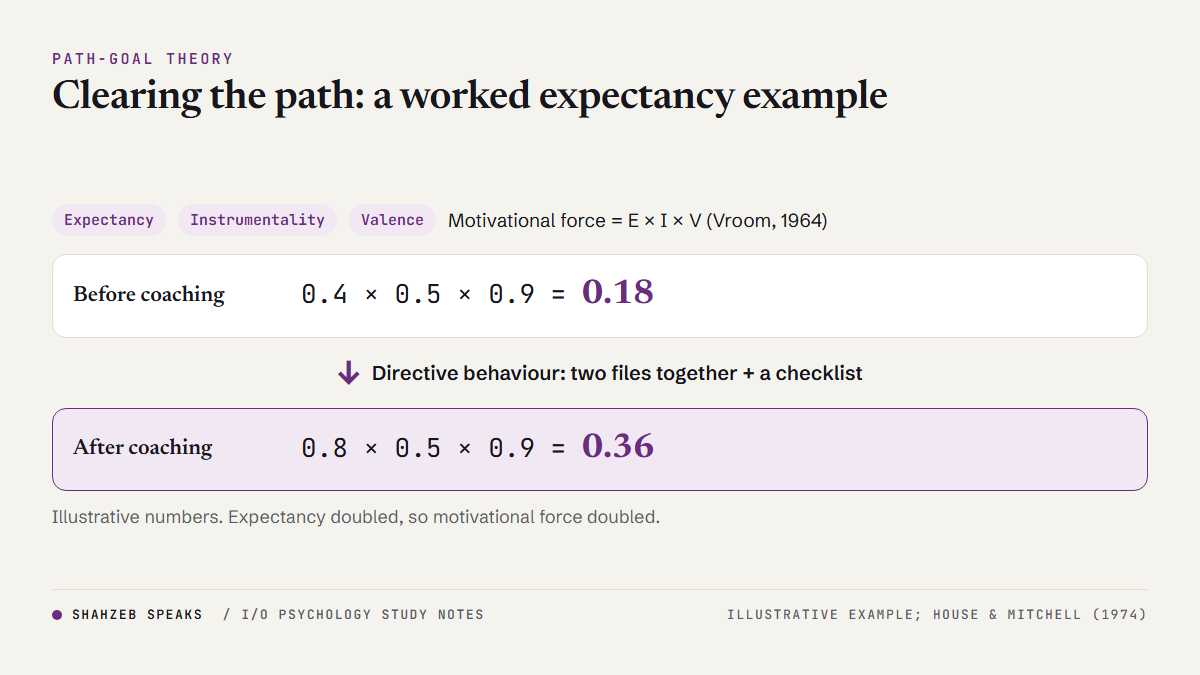
A worked example (illustrative numbers). Ayesha is a new credit analyst at a bank in Lahore. She is not sure she can prepare a loan file correctly (expectancy 0.4). She believes good files are noticed at appraisal time (instrumentality 0.5) and she very much wants a good rating (valence 0.9). Motivational force = 0.4 × 0.5 × 0.9 = 0.18. Her manager sits with her for two files and gives her a checklist: directive behaviour that clarifies the path. Her expectancy rises to 0.8, and motivational force becomes 0.8 × 0.5 × 0.9 = 0.36, double the starting value. If the manager also makes the link to rewards clearer, instrumentality rises too. You can try your own numbers in the free expectancy theory calculator, and see the motivation side in work motivation theories.
House and Mitchell (1974) list the leader’s strategic functions in the same spirit: recognising and arousing followers’ needs for outcomes the leader controls, increasing the pay-offs for reaching work goals, making the path to those pay-offs easier through coaching and direction, helping followers clarify their expectations, reducing frustrating barriers, and increasing the chances of personal satisfaction along the way.
The four leader behaviours in path-goal theory
House and Mitchell (1974) describe four kinds of leader behaviour. Unlike Fiedler, they assume one leader can use all four, at different times and with different people.
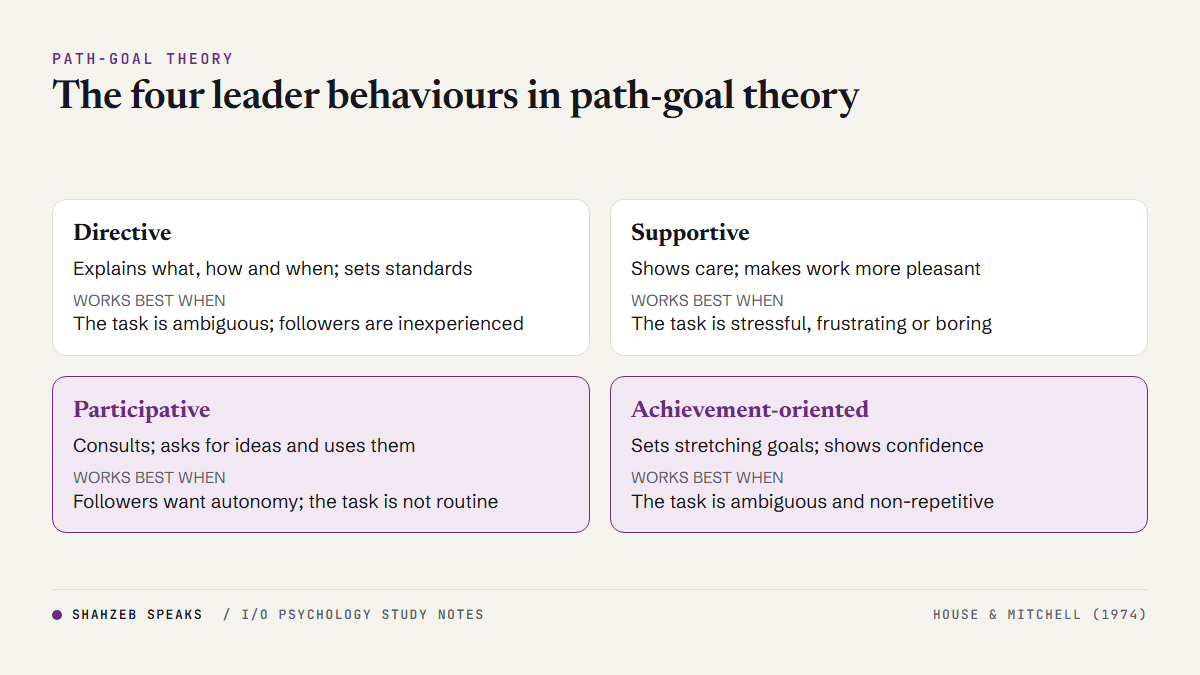
- Directive leadership: lets followers know what is expected, gives specific guidance on what to do and how, schedules work, keeps clear performance standards and asks people to follow rules and procedures.
- Supportive leadership: is friendly and approachable, shows concern for followers’ status, wellbeing and needs, makes the work more pleasant and treats members as equals.
- Participative leadership: consults followers, asks for their suggestions and takes them seriously before making a decision.
- Achievement-oriented leadership: sets challenging goals, expects the highest level of performance, keeps looking for improvement and shows confidence that followers will take responsibility and meet the challenge.
| Behaviour | What the leader does | Works best when | Workplace example |
|---|---|---|---|
| Directive | Explains what, how and when; sets standards | The task is ambiguous; followers are inexperienced or prefer clear structure | A supervisor trains new hospital ward clerks on a new patient record system |
| Supportive | Shows care, makes work more pleasant, treats people as equals | The task is stressful, frustrating or boring | A call-centre team lead on a complaints line checks in after abusive calls and rotates breaks |
| Participative | Consults, asks for ideas, uses them | Followers want autonomy and control; the task is not routine | A university head of department plans the new timetable with the faculty |
| Achievement-oriented | Sets stretching goals, shows confidence | The task is ambiguous and non-repetitive; followers are capable | A software team lead in Karachi challenges developers to cut app load time in half |
Contingency factors: followers and the work environment
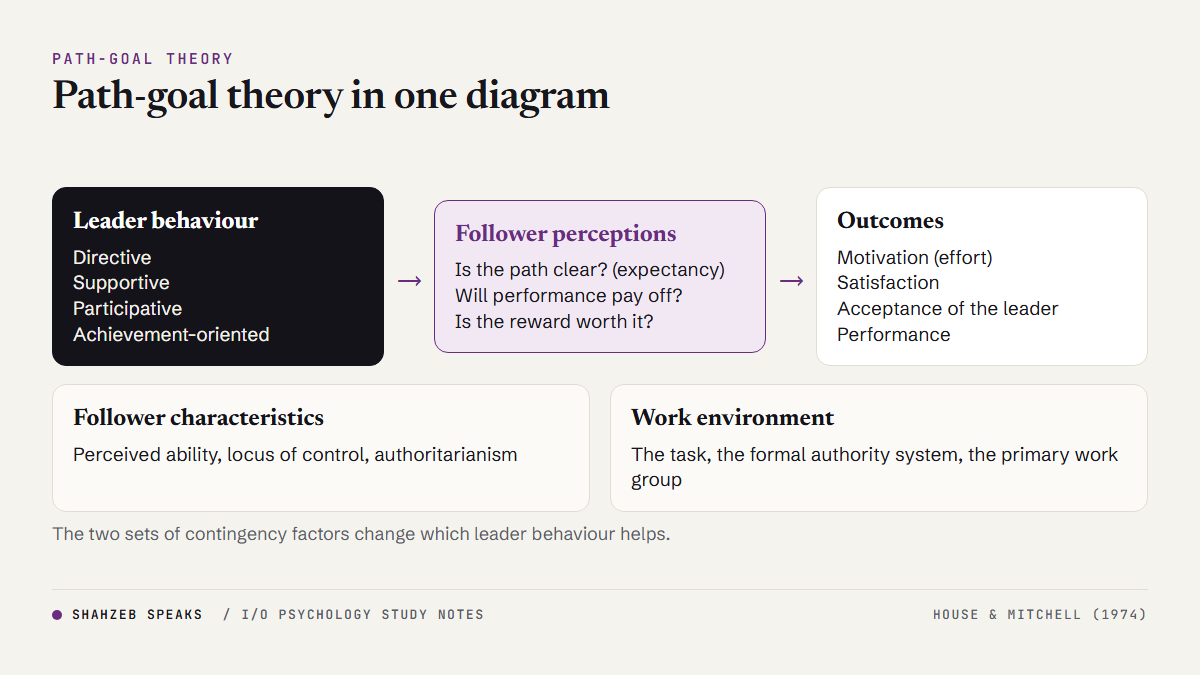
Which behaviour helps depends on two classes of contingency factors (House & Mitchell, 1974). A contingency factor moderates the link between leader behaviour and outcomes; for example, task structure changes whether directive behaviour makes people more or less satisfied.
1. Follower (subordinate) characteristics
- Perceived ability: the more able followers think they are, the less they accept directive behaviour and close coaching; for them it can feel like excessive control.
- Locus of control: people who believe outcomes depend on their own behaviour (“internals”) tend to be more satisfied with participative leadership; those who believe outcomes depend on luck or chance (“externals”) tend to be more satisfied with directive leadership (House & Mitchell, 1974, citing Runyon and Mitchell).
- Authoritarianism and need for autonomy: Dessler found that on routine, clear tasks, authoritarian, closed-minded followers preferred directive leadership while open-minded followers did not; on ambiguous tasks both groups preferred direction (House & Mitchell, 1974). Followers who prefer autonomy respond better to participative leadership.
2. The work environment
House and Mitchell (1974) name three environmental factors outside the follower’s control: the followers’ tasks, the formal authority system of the organisation, and the primary work group. If the environment already provides something, such as clear procedures from a strict authority system or support from a close-knit team, the leader does not need to supply it again. This idea later grew into Kerr and Jermier’s (1978) substitutes for leadership: features of the task, the organisation or the followers that can replace or neutralise what a leader does.
What does the research say about path-goal theory?
In their 1974 review, House and Mitchell reported early support. Directive leadership was linked with higher satisfaction and expectancies for people doing ambiguous tasks, and with lower satisfaction for people doing clear tasks. The supportive leadership hypothesis (most useful on stressful, frustrating or dissatisfying tasks) had been tested in ten samples and was disconfirmed in only one. For achievement-oriented leadership, a study of white-collar service employees found that, on ambiguous, non-repetitive tasks, more achievement orientation went with greater confidence that effort would lead to good performance; on more repetitive tasks there was no such link.
Later reviews were more cautious. Wofford and Liska (1993) meta-analysed 120 studies and concluded that much of the research testing path-goal theory had been flawed; of 16 moderator tests they could run, 7 met their criteria and one went in the opposite direction to the prediction. Schriesheim, Castro, Zhou and DeChurch (2006) noted that over 120 scholarly articles had examined the theory, while several authors argued it had still not been adequately tested. Overall, support is mixed, and participative and achievement-oriented behaviour have received much less research attention than directive and supportive behaviour (Seyranian, 2009).
House (1996) responded with a reformulated theory that has eight classes of leader behaviour and links path-goal ideas to “value-based” (charismatic and transformational) leadership. Most textbooks and exam papers, however, still use the 1974 version with four behaviours.
Strengths
- It explains why a leader’s behaviour works: through followers’ motivation and expectancies.
- It gives a practical rule: add what the follower and the situation are missing.
- It allows one leader to use different behaviours, which fits everyday management.
- It influenced later theories, including substitutes for leadership.
Criticisms
- Complex: many behaviours, follower traits and environmental factors interact, so it is hard to test all at once.
- Mixed evidence: many tests had design problems (Wofford & Liska, 1993).
- Leader-centred and one-way: it focuses on what the leader does to followers, not on the relationship both build (compare LMX theory).
- Individual focus: it says little about leading a whole team or organisation.
Path-goal theory vs situational leadership and Fiedler
“Path-goal vs situational” is a common search and a common exam question. All three are contingency theories, but they differ in what they read and what they let the leader change.
| Point | Path-goal (House, 1971; House & Mitchell, 1974) | Hersey and Blanchard’s situational approach (1969) | Fiedler’s contingency model (1967) |
|---|---|---|---|
| Main idea | Clarify the path to goals and boost motivation | Match direction and support to follower readiness | Match a fixed style to situational favourableness |
| Theory roots | Expectancy theory | Ohio State task and relationship dimensions | LPC research on leader motivation |
| Leader options | Directive, supportive, participative, achievement-oriented | Telling, selling, participating, delegating | Task-motivated or relationship-motivated (cannot switch) |
| Situation read | Follower characteristics + task, authority system, work group | Follower ability and willingness | Leader-member relations, task structure, position power |
| Can the leader change? | Yes | Yes | No: change the situation or the leader |
10-mark answer structure: “Discuss the path-goal theory of leadership”
- Definition: contingency theory by House (1971), building on Evans (1970), developed with Mitchell (1974); why it is called “path-goal”.
- Roots: expectancy theory (expectancy, instrumentality, valence); the leader clarifies paths and raises pay-offs.
- The two propositions: acceptable when it satisfies; motivating when it links needs to performance and complements the environment.
- The four behaviours with one example each: directive, supportive, participative, achievement-oriented.
- Contingency factors: follower characteristics (perceived ability, locus of control, authoritarianism) and environment (task, formal authority system, primary work group).
- Diagram: leader behaviour, contingency factors, follower perceptions, outcomes.
- Evaluation: early support (House & Mitchell, 1974), Wofford and Liska (1993) meta-analysis, House (1996) reformulation; strengths and criticisms.
- Conclusion: a flexible, motivation-based view; compare briefly with Fiedler or Hersey and Blanchard.
Model opening line: “Path-goal theory (House, 1971; House & Mitchell, 1974) holds that an effective leader increases followers’ motivation by clarifying the path to work goals and supplying whatever the follower and the task are missing.”
Practice MCQs: path-goal theory
Practice questions written to the published syllabus of typical I/O psychology courses, not past-paper questions. More on the leadership MCQs page.
-
Path-goal theory is mainly rooted in which motivation theory?
- Maslow’s hierarchy of needs
- Expectancy theory
- Equity theory
- Herzberg’s two-factor theory
Show answer
B. House and Mitchell (1974) say the theory has its roots in expectancy theory. The other three are motivation theories but are not the basis of path-goal theory.
-
Which researcher’s 1970 work is usually named as the starting point that House developed?
- Martin Evans
- Fred Fiedler
- Victor Vroom
- Bernard Bass
Show answer
A. Evans (1970) linked supervisory behaviour to path-goal perceptions. Fiedler built the contingency model, Vroom the expectancy model (1964), and Bass transformational leadership.
-
A team lead consults the team, asks for suggestions and uses them before deciding the new shift pattern. This is:
- Directive
- Supportive
- Participative
- Achievement-oriented
Show answer
C. Consulting and using suggestions defines participative leadership. Directive gives instructions, supportive shows care, achievement-oriented sets challenging goals.
-
According to path-goal theory, supportive leadership is most helpful when the task is:
- Interesting and enjoyable
- Stressful, frustrating or dissatisfying
- Highly ambiguous and creative
- Fully automated
Show answer
B. Support complements a stressful or dull task. An enjoyable task already provides satisfaction, and ambiguous tasks call more for directive or achievement-oriented behaviour.
-
An experienced engineer who knows the job well is given step-by-step instructions by a new manager. Path-goal theory predicts the engineer will most likely:
- Become more motivated
- See it as excessive close control
- Develop a high-quality LMX
- Move to octant I
Show answer
B. High perceived ability makes directive behaviour less acceptable. LMX and octants belong to other theories.
-
Which is NOT one of the three environmental contingency factors named by House and Mitchell (1974)?
- The followers’ tasks
- The formal authority system
- The primary work group
- The leader’s LPC score
Show answer
D. LPC is Fiedler’s measure of leader style. The three environmental factors are the task, the formal authority system and the primary work group.
-
A follower with an internal locus of control is expected to be most satisfied with which behaviour?
- Directive
- Participative
- Laissez-faire
- Management by exception
Show answer
B. Internals believe outcomes follow from their own actions, so they prefer to be involved. Externals tend to prefer directive leadership; laissez-faire and management by exception belong to the full range model.
-
Using Vroom’s formula, if expectancy = 0.5, instrumentality = 0.8 and valence = 0.5, motivational force is:
- 1.8
- 0.2
- 0.4
- 0.25
Show answer
B. 0.5 × 0.8 × 0.5 = 0.2. Adding the values (1.8) is the most common mistake; 0.4 and 0.25 multiply only two of the three terms.
-
What did Wofford and Liska’s (1993) meta-analysis of 120 studies conclude?
- The theory was fully confirmed
- Much of the research testing the theory was flawed
- Directive leadership never works
- Leaders cannot change behaviour
Show answer
B. They found much of the testing research flawed and support for moderators mixed. They did not claim full confirmation, and the theory itself assumes leaders can change behaviour.
-
The main difference between path-goal theory and Fiedler’s model is that path-goal theory:
- Ignores the situation
- Assumes the leader can use different behaviours
- Uses the LPC scale
- Focuses only on traits
Show answer
B. Path-goal leaders can switch between four behaviours; Fiedler saw style as fixed and used LPC. Both theories focus on the situation, and neither is a trait theory.
Practise on your phone
The free I/O Psychology Prep app has 410 explained
questions, flashcards and an exam countdown, and works offline. Get it on Google Play
· About the app
Questions students ask
Who developed path-goal theory?
Robert J. House developed it in 1971, building on Martin Evans’s 1970 work, and House and Terence Mitchell set out the four-behaviour version in 1974. House published a reformulated theory in 1996.
What are the four leadership styles in path-goal theory?
Directive (clear instructions and standards), supportive (care and a pleasant climate), participative (consulting and using followers’ ideas) and achievement-oriented (challenging goals and confidence in followers).
What is an example of path-goal theory?
A bank manager coaches a new analyst through loan files (directive) because the task is new and unclear, but simply sets a stretch target for an experienced analyst (achievement-oriented). Same leader, different behaviour, chosen to clear each person’s path to the goal.
What is the difference between path-goal theory and situational leadership?
Path-goal theory is built on expectancy theory and reads several factors: follower ability, locus of control and the work environment. Hersey and Blanchard’s situational approach reads one factor, follower readiness, and moves from telling to delegating as readiness grows.
Why is it called path-goal theory?
Because its main concern is how the leader shapes followers’ views of their work goals, personal goals and the paths to reaching them (House & Mitchell, 1974). The leader’s job is to make the path clearer and the goal worth reaching.
Is path-goal theory still relevant?
Yes, as a teaching and management tool, and its ideas live on in substitutes for leadership and in House’s 1996 version. Research support is mixed, so present it as useful but not fully proven.
Revise leadership offline
The free I/O Psychology Prep app has 410 explained
questions, flashcards and an exam countdown, and works offline. Get it on Google Play
· About the app
References
- Evans, M. G. (1970). The effects of supervisory behavior on the path-goal relationship. Organizational Behavior and Human Performance, 5(3), 277-298. https://doi.org/10.1016/0030-5073(70)90021-8
- Fiedler, F. E. (1967). A theory of leadership effectiveness. McGraw-Hill.
- Hersey, P., & Blanchard, K. H. (1969). Life cycle theory of leadership. Training and Development Journal, 23(5), 26-34.
- House, R. J. (1971). A path goal theory of leader effectiveness. Administrative Science Quarterly, 16(3), 321-339. https://doi.org/10.2307/2391905
- House, R. J. (1996). Path-goal theory of leadership: Lessons, legacy, and a reformulated theory. The Leadership Quarterly, 7(3), 323-352. https://doi.org/10.1016/S1048-9843(96)90024-7
- House, R. J., & Mitchell, T. R. (1974). Path-goal theory of leadership. Journal of Contemporary Business, 3(4), 81-97. (Also issued as Technical Report 75-67, University of Washington, 1975.)
- Kerr, S., & Jermier, J. M. (1978). Substitutes for leadership: Their meaning and measurement. Organizational Behavior and Human Performance, 22(3), 375-403. https://doi.org/10.1016/0030-5073(78)90023-5
- Schriesheim, C. A., Castro, S. L., Zhou, X., & DeChurch, L. A. (2006). An investigation of path-goal and transformational leadership theory predictions at the individual level of analysis. The Leadership Quarterly, 17(1), 21-38. https://doi.org/10.1016/j.leaqua.2005.10.008
- Seyranian, V. (2009). Contingency theories of leadership. In J. M. Levine & M. A. Hogg (Eds.), Encyclopedia of group processes and intergroup relations (pp. 152-156). SAGE.
- Vroom, V. H. (1964). Work and motivation. Wiley.
- Wofford, J. C., & Liska, L. Z. (1993). Path-goal theories of leadership: A meta-analysis. Journal of Management, 19(4), 857-876. https://doi.org/10.1177/014920639301900407
Path-goal theory is one of the contingency theories on the leadership theories in I/O psychology hub. Compare it with Fiedler’s contingency model, transformational vs transactional leadership and LMX theory.