
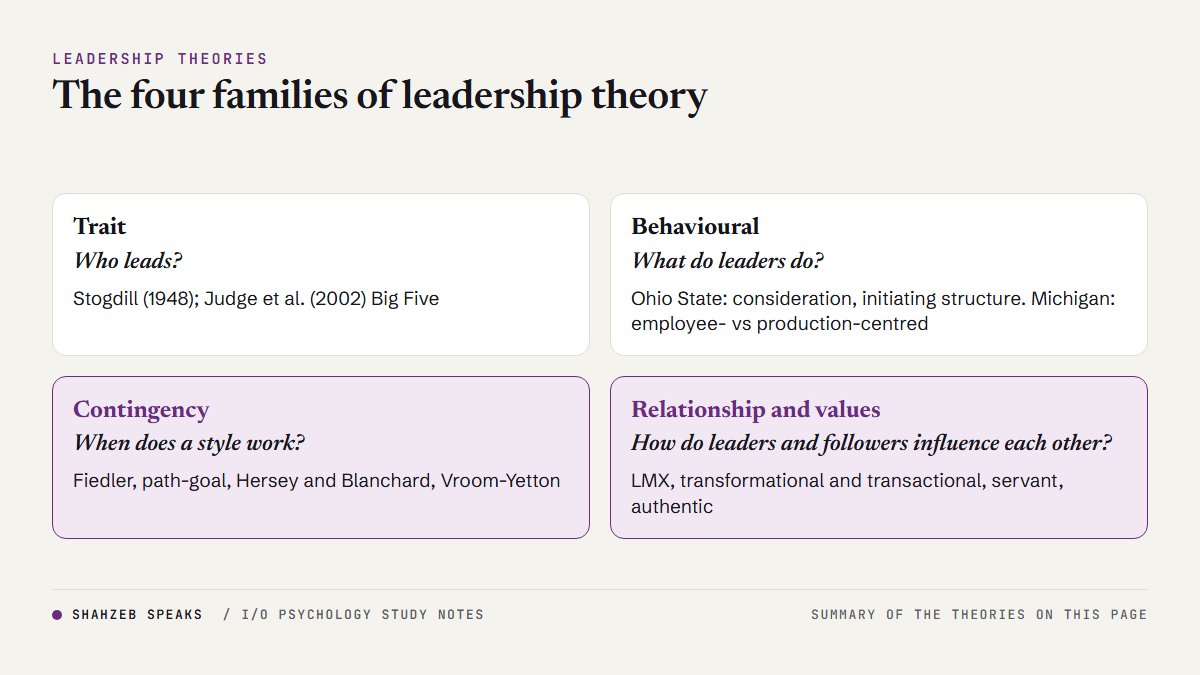
Leadership theories in I/O psychology fall into four families. Trait theories (Stogdill, 1948; Judge et al., 2002) ask who leads. Behavioural theories (Ohio State, Michigan) ask what leaders do. Contingency theories (Fiedler, 1967; House, 1971) ask when a style works. Relationship and values theories (LMX, transformational, servant, authentic) ask how leaders and followers influence each other.
This page is for students who have “leadership theories” on the syllabus: BS and MSc psychology, MBA and HRM courses, nursing management, CSS and university papers in Pakistan, IGNOU and UGC NET in India, and the industrial psychology part of the psychometrician board exam in the Philippines. It covers every theory that usually appears in an I/O psychology course, in the order they were developed, with the original authors and years, what the research later found, one comparison table of all of them, a 10-mark exam answer plan and 10 practice MCQs with explanations.
Each theory has its own detailed page on this site. Use this page to see the whole map first, then follow the links for the theory your exam or assignment asks about.
What is leadership in I/O psychology?
In I/O psychology, leadership is the process by which one person influences a group of people towards a shared goal. The leader does not have to be the boss. A senior nurse on a hospital ward, a team lead in a call centre or the most trusted operator on a textile mill floor can all lead, even when the formal manager sits somewhere else.
Psychologists have studied leadership for more than a century, and the questions they asked changed over time. That is why there are so many theories. A simple way to remember them is to ask what each family was trying to explain:
- Trait theories: Who becomes a leader? Are some people simply built for it?
- Behavioural theories: What do effective leaders actually do, day to day?
- Contingency (situational) theories: Does the best style depend on the situation?
- Relationship and values theories: How do the leader and each follower build a relationship, and how do leaders change what followers value and aim for?
Graen and Uhl-Bien (1995) offered another useful lens. They said leadership has three domains: the leader, the follower and the relationship between them. Trait and behavioural theories look mainly at the leader. Contingency theories add the situation and the follower. LMX theory looks at the relationship itself. Keep these three domains in mind while you read, because examiners like students who can say what each theory leaves out.
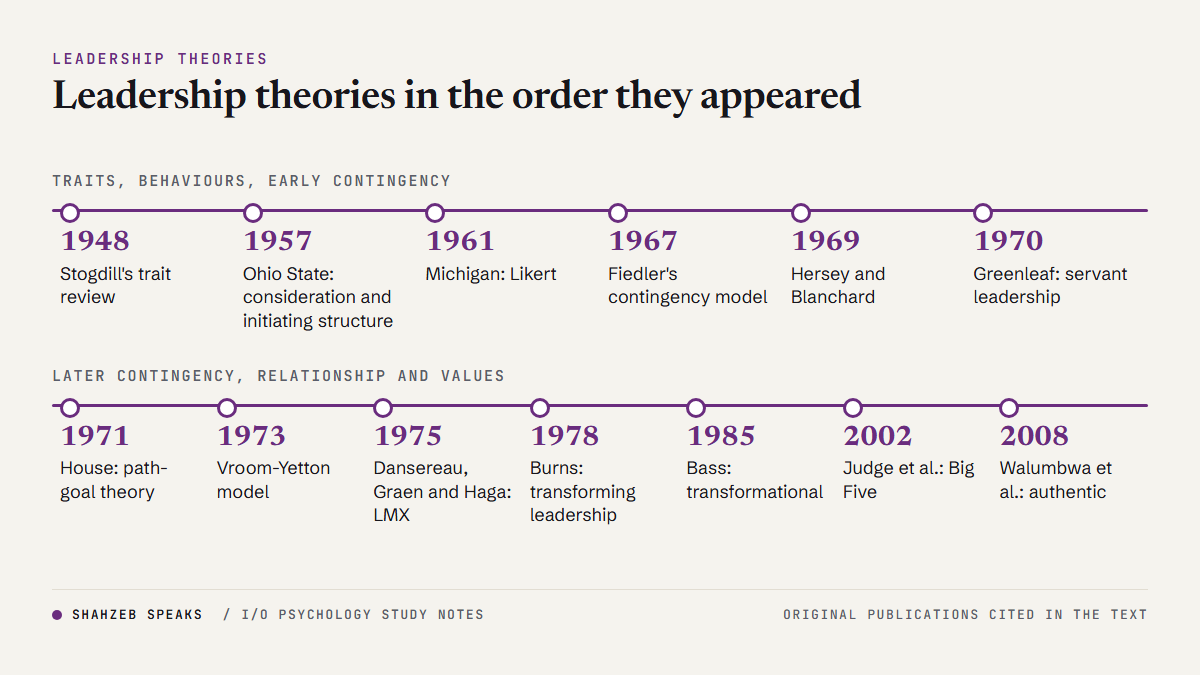
Trait theories: from Stogdill to the Big Five
The oldest idea is that leaders are born with special qualities. Early twentieth-century writers called this the “great man” view. Psychologists tried to test it by comparing leaders with non-leaders on intelligence, confidence, height, energy and many other traits.
Stogdill’s 1948 review
Ralph Stogdill (1948) reviewed 124 trait studies published between 1904 and 1947. Leaders did tend to score a little higher on traits such as intelligence, alertness, responsibility, initiative, persistence, self-confidence and sociability. But no trait was enough on its own, and the traits that mattered changed from one situation to another. His conclusion is the line most textbooks quote in their own words: a person does not become a leader just by having a set of traits; the traits must fit the followers, the task and the situation. Mann (1959) reached a similar conclusion. For about two decades, many researchers moved away from traits.
Stogdill later reviewed 163 more studies (Stogdill, 1974) and gave traits a fairer place: traits matter, but in combination with the situation. This is why trait theory did not disappear.
The Big Five meta-analysis (Judge et al., 2002)
Trait theory came back when researchers had two new tools: the Big Five model of personality and meta-analysis (a statistical method that combines many studies). Lord, De Vader and Alliger (1986) re-analysed Mann’s data and found that intelligence, masculinity and dominance were linked to whether people are seen as leaders. Then Judge, Bono, Ilies and Gerhardt (2002) combined 222 correlations from 73 samples and grouped the traits under the Big Five.
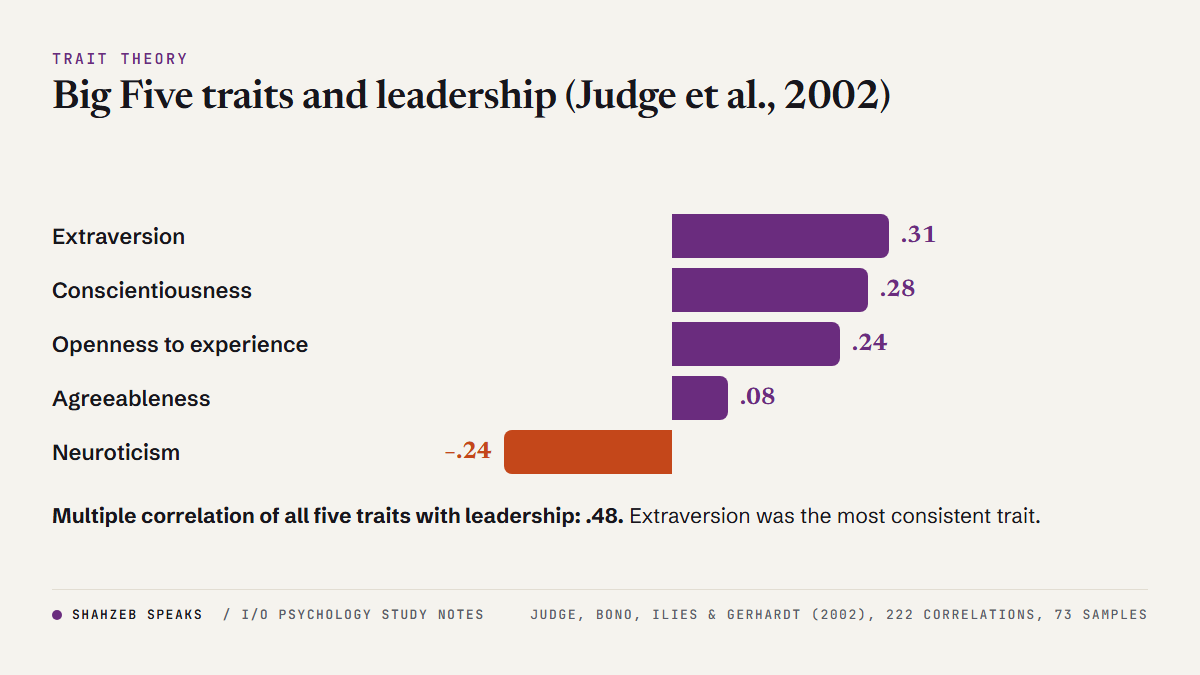
Their estimated correlations with leadership were: extraversion .31, conscientiousness .28, openness to experience .24, agreeableness .08 and neuroticism −.24. Together, the five traits had a multiple correlation of .48 with leadership. Extraversion was the most consistent trait across settings and across the ways leadership was measured. The study looked at both leader emergence (who gets chosen or seen as the leader) and leader effectiveness (how well the group performs under that person).
What this means for students: trait theory is “partly right”. Personality does predict who emerges and, to a lesser degree, who is effective. But a correlation of .31 still leaves most of the difference between leaders unexplained, and traits cannot tell a manager what to do differently on Monday morning. That gap led to the behavioural approach. If personality testing in hiring interests you, read personality tests at work and emotional intelligence at work.
Behavioural theories: the Ohio State and Michigan studies
If traits could not explain leadership, perhaps behaviour could. Behaviour has one big advantage: it can be learned and trained. Two research programmes in the United States started in the late 1940s and ran through the 1950s.
The Ohio State studies
Researchers at Ohio State University asked employees to describe their supervisors using long questionnaires. The best known is the Leader Behavior Description Questionnaire (LBDQ), described in Stogdill and Coons (1957). When the answers were analysed, two broad groups of behaviour kept appearing:
- Consideration: concern for people. Building trust and rapport, listening, showing respect for staff ideas and feelings.
- Initiating structure: organising the work. Assigning roles, planning, setting deadlines and standards.
The two are separate dimensions, not two ends of one line. A leader can be high on both, low on both or high on one only.
The Michigan studies
At about the same time, the University of Michigan’s Survey Research Center interviewed supervisors and workers and compared their behaviour with group productivity (Likert, 1961). They described employee-centred supervisors, who focus on people and relationships, and production-centred (job-centred) supervisors, who focus on tasks and output. These are close to the Ohio State dimensions, under different names. Blake and Mouton (1964) later turned the two dimensions into a grid and argued that the best leaders score high on both.
What did the research find?
For years, results looked inconsistent, so many textbooks said the behavioural approach had “failed”. Judge, Piccolo and Ilies (2004) re-tested it with meta-analysis and called consideration and initiating structure “the forgotten ones”. Across 163 correlations for consideration and 159 for initiating structure, consideration had an overall estimated correlation of .48 with leadership outcomes and initiating structure .29. Consideration was more strongly linked to follower satisfaction, motivation and rated leader effectiveness. Initiating structure was slightly more strongly linked to the leader’s job performance and to group or organisation performance.
So both behaviours matter, but they help different outcomes. Picture a bank branch manager in Karachi before the month-end targets. Initiating structure (clear daily targets, who calls which customers) helps the numbers. Consideration (noticing that a cashier is overloaded, thanking staff in front of the team) helps people stay and stay motivated. Managers who only push structure, with no consideration, are the ones staff describe in our posts on micromanagement and toxic workplaces.
The main weakness: behavioural theories still assumed one best style for every situation. Contingency theories challenged exactly that.
Contingency theories: Fiedler, path-goal, Hersey and Blanchard, Vroom-Yetton
“Contingency” means “it depends”. These theories say a style that works in one situation can fail in another. They differ in what they think the situation is, and in whether the leader can change style.
Fiedler’s contingency model (1967)
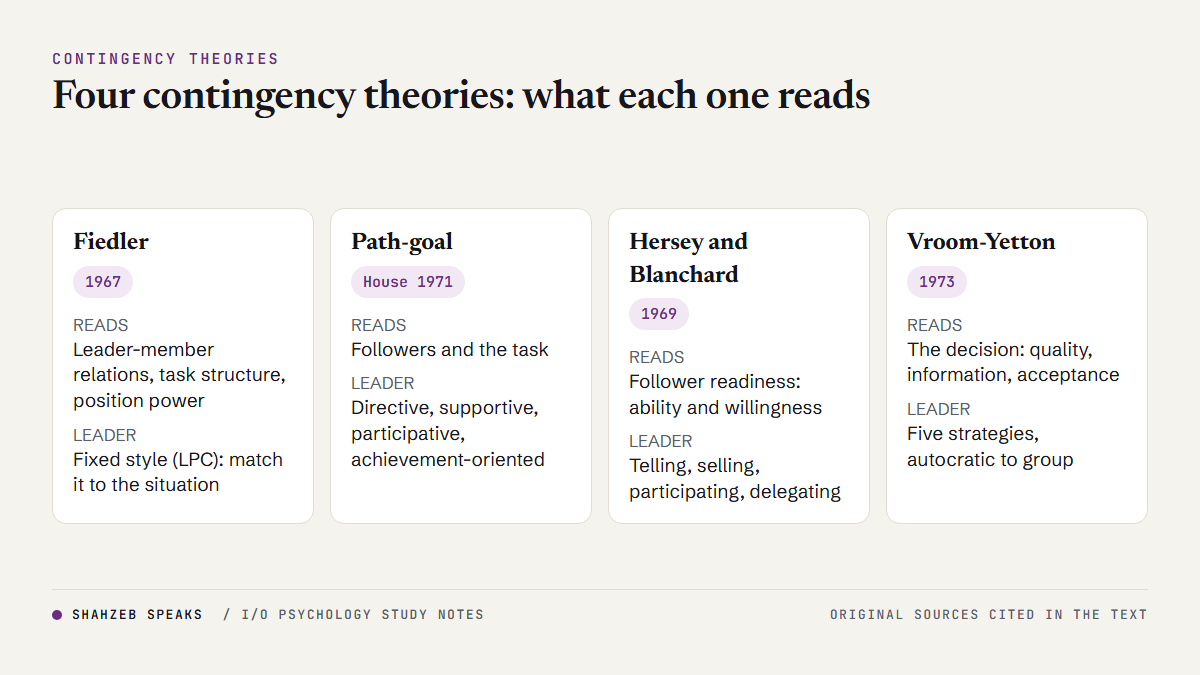
Fred Fiedler (1967) proposed the first full contingency theory. He measured the leader’s style with the Least Preferred Co-worker (LPC) scale: the leader thinks of the person they have worked with least well and rates that person on a set of 8-point bipolar adjective pairs. A leader who still describes that person fairly positively gets a high LPC score and is seen as relationship-motivated. A leader who describes them harshly gets a low score and is seen as task-motivated.
The situation is judged by its favourableness (how much control the leader has), built from three factors in order of importance: leader-member relations (good or poor), task structure (high or low) and position power (strong or weak). These combine into eight situations, called octants. Low-LPC leaders are predicted to do best when the situation is very favourable or very unfavourable; high-LPC leaders do best in the middle. Fiedler treated style as a stable trait, so the advice is to match the leader to the situation, or change the situation, rather than train the leader to change. Three meta-analyses (Strube & Garcia, 1981; Peters, Hartke & Pohlmann, 1985; Schriesheim, Tepper & Tetrault, 1994) more or less support the model, but not every octant, and what the LPC score really measures is still debated (Seyranian, 2009). The full octant diagram and the LPC debate are on the Fiedler’s contingency model page.
Path-goal theory (House, 1971)
Path-goal theory grew from Evans (1970) and was developed by Robert House (1971), with House and Mitchell (1974) adding the four leader behaviours students learn today: directive, supportive, participative and achievement-oriented. It is built on expectancy theory: the leader’s job is to make the path to the goal clear, remove obstacles and make the reward worth the effort. Which behaviour helps depends on the followers (their ability, experience, need for control) and on the task (clear or ambiguous, boring or interesting). An ambiguous task calls for directive leadership; a dull, stressful task calls for supportive leadership. Unlike Fiedler, House assumed leaders can switch between behaviours. Wofford and Liska’s (1993) meta-analysis of 120 studies found that much of the research testing the theory was flawed, so support is mixed. House (1996) later reformulated the theory with eight classes of leader behaviour. See path-goal theory for worked examples, and try the expectancy theory calculator to see the motivation logic underneath it.
Hersey and Blanchard’s situational approach (1969)
Paul Hersey and Ken Blanchard first published their idea as the “life cycle theory of leadership” (Hersey & Blanchard, 1969). The situation here is the follower’s maturity or readiness: their ability and their willingness to do the task. The leader mixes directive (task) and supportive (relationship) behaviour into four styles: telling (high directive, low support), selling (high directive, high support), participating (low directive, high support) and delegating (low directive, low support). A new trainee in a call centre needs telling; an experienced, willing agent can be given delegating. The approach is popular in training because it is easy to use, but it has less research behind it than its popularity suggests. Studies support the idea that low-maturity followers benefit from directive behaviour, while the other predictions have weaker evidence, and critics note that it reads only one situational variable (Seyranian, 2009; Vecchio, 1987).
Vroom-Yetton normative decision model (1973)
Victor Vroom and Philip Yetton (1973) asked a narrower question: how much should the leader involve the team in a particular decision? Their model offers five decision strategies on a line from autocratic to participative: two autocratic (the leader decides alone, often coded AI and AII), two consultative (the leader asks others but still decides, CI and CII) and one group strategy (the group decides together, GII). The leader answers a series of yes/no questions on a decision tree, such as how important decision quality is, whether the leader has enough information and whether followers will accept a decision made without them. Vroom and Jago (1988) later revised the model and reported that decisions that followed the model’s advice were much more likely to succeed. A common criticism is that leaders may not be able to answer the tree’s questions accurately, for example to predict whether staff will accept a decision.
Relationship and values theories: LMX, transformational, servant, authentic
From the 1970s, researchers looked beyond the leader’s style and asked how leaders build relationships and change what followers believe and want. These theories dominate journal research today.
Leader-member exchange (LMX) theory
Earlier theories assumed a leader treats the whole team the same way. Dansereau, Graen and Haga (1975) found that this “average leadership style” did not match what employees reported. Different staff described the same manager very differently. Some had high-quality exchanges, at first called the in-group: high mutual trust, respect and obligation, and they acted like trusted assistants who went beyond their job description. Others had low-quality exchanges, the out-group: they did what the contract required and little more (Graen & Uhl-Bien, 1995). The early version was called vertical dyad linkage (VDL).
Graen and Uhl-Bien (1995) traced the theory through four stages and described “leadership making”: relationships move from a stranger phase through an acquaintance phase to a mature partnership, and the leader is encouraged to offer a high-quality relationship to every member. Meta-analyses link high LMX with better job performance, satisfaction with the supervisor, commitment, role clarity and lower turnover intentions (Gerstner & Day, 1997). A larger meta-analysis of 247 studies found that leader behaviour and perceptions explained the most variance in LMX quality (Dulebohn et al., 2012). In a Pakistani office, the in-group is often visible: the two officers who are always “in the loop” while the rest hear news last. The fairness problems this creates link LMX to organisational justice. Full notes: LMX theory.
Transformational and transactional leadership
James MacGregor Burns (1978), a political historian, contrasted transactional leaders, who exchange one thing for another (pay for work, votes for jobs), with transforming leaders, who raise followers’ motivation and values. Bernard Bass (1985) brought the idea into organisational psychology and argued the two are separate dimensions that a good leader uses together.
Transformational leadership has four components, the “four I’s”: idealised influence (acting as a role model people trust), inspirational motivation (a clear, hopeful vision), intellectual stimulation (inviting people to question old ways) and individualised consideration (coaching each person). Transactional leadership includes contingent reward and management by exception (active or passive); laissez-faire is the absence of leadership. Together these make up the full range leadership model, usually measured with the Multifactor Leadership Questionnaire (MLQ) by Bass and Avolio, a licensed instrument sold by Mind Garden.
Judge and Piccolo (2004) combined 626 correlations from 87 sources. Transformational leadership had an overall validity of .44, but it correlated .80 with contingent reward, and contingent reward predicted some outcomes better than transformational leadership did. Wang, Oh, Courtright and Colbert (2011) found that transformational leadership added to contingent reward for contextual performance (helping, extra effort) and team performance, but not for individual task performance. Van Knippenberg and Sitkin (2013) went further and argued the concept has no clear definition and is measured in a way that mixes the leader’s behaviour with its effects. The full comparison is on transformational vs transactional leadership.
Servant leadership
Robert Greenleaf introduced servant leadership in his 1970 essay “The Servant as Leader” (collected in Greenleaf, 1977). The servant leader’s first aim is to serve: to put followers’ growth and wellbeing before the leader’s own interests, and to look beyond the organisation to the wider community. For years it was more a philosophy than a tested theory. Eva, Robin, Sendjaya, van Dierendonck and Liden (2019) reviewed the research and proposed a clearer definition: an approach that is other-oriented, shows itself in one-to-one attention to each follower’s needs, and turns concern from the self towards others in the organisation and community. Hoch, Bommer, Dulebohn and Wu (2018) found that servant leadership explained outcomes beyond transformational leadership better than authentic or ethical leadership did, which makes it one of the more promising newer theories.
Authentic leadership
Authentic leadership describes leaders who know themselves and act in line with their values (Avolio & Gardner, 2005). Walumbwa, Avolio, Gardner, Wernsing and Peterson (2008) developed the Authentic Leadership Questionnaire around four components: self-awareness, relational transparency (being open and honest with others), balanced processing (weighing information fairly before deciding) and an internalised moral perspective (acting on inner moral standards, not group pressure). The main criticism is overlap: Hoch et al. (2018) found authentic leadership correlated so highly with transformational leadership that it added little extra explanation for most outcomes.
Leaders also shape teams and climate, which is where leadership meets the rest of Hub D: how groups develop (Tuckman’s stages), how culture forms (Schein’s culture model), what employees feel they were promised (the psychological contract), whether people feel safe to speak up (psychological safety at work), and how demands and support drive strain (the JD-R model, occupational stress models and workplace burnout).
Leadership theories compared in one table
This table is the one to revise from. It lists each theory with its original authors, its core idea, the domain it focuses on, how it is usually measured and its main criticism.
| Theory | Key authors (year) | Core idea | Focus | Usual measure | Main criticism |
|---|---|---|---|---|---|
| Trait | Stogdill (1948); Judge et al. (2002) | Some personal traits predict who leads | Leader | Big Five inventories | Traits explain only part; no advice on what to do |
| Ohio State | Stogdill & Coons (1957) | Consideration and initiating structure | Leader behaviour | LBDQ | Assumes one best style |
| Michigan | Likert (1961) | Employee-centred vs production-centred | Leader behaviour | Interviews, surveys | Ignores the situation |
| Fiedler’s contingency model | Fiedler (1967) | Match fixed style (LPC) to situational favourableness | Leader + situation | LPC scale | Unclear what LPC measures; style assumed fixed |
| Hersey and Blanchard’s situational approach | Hersey & Blanchard (1969) | Adjust telling, selling, participating, delegating to follower readiness | Leader + follower | Training instruments | Little research support; one situational variable |
| Path-goal | House (1971); House & Mitchell (1974) | Clarify the path to goals with four behaviours | Leader + follower + task | Behaviour questionnaires | Complex; tests often flawed |
| Vroom-Yetton | Vroom & Yetton (1973) | Choose how much participation a decision needs | Decision situation | Decision tree | Leaders may not answer the questions accurately |
| LMX | Dansereau, Graen & Haga (1975); Graen & Uhl-Bien (1995) | Each leader-member relationship differs in quality | Relationship | LMX-7 | Fairness of in-groups; how to build high LMX |
| Transformational / transactional | Burns (1978); Bass (1985) | Four I’s inspire; exchange and correction maintain | Leader + follower | MLQ | Definition unclear; overlaps with contingent reward |
| Servant | Greenleaf (1970) | Serve followers’ growth first | Follower and community | Several scales | Long seen as philosophy rather than theory |
| Authentic | Avolio & Gardner (2005); Walumbwa et al. (2008) | Self-aware, transparent, value-led leadership | Leader | Authentic Leadership Questionnaire | Overlaps heavily with transformational |
Which theory explains what? A workplace example
Imagine a new nurse manager on a busy medical ward in a Lahore teaching hospital. Trait theory would say her conscientiousness and extraversion will help her be accepted. The Ohio State lens says she needs both a clear duty roster (initiating structure) and visible care for tired staff (consideration). Fiedler would ask whether her relations with the nurses are good, whether the tasks are structured and how much formal power she has. Path-goal would tell her to be directive with a confused new graduate and supportive on night shifts. LMX would warn her not to let two favourite nurses become the only ones she trusts. Transformational leadership would ask her to give the ward a shared purpose beyond the roster. No single theory covers all of this, which is why an exam answer should compare them.
10-mark answer structure: “Discuss the major theories of leadership”
- Definition: leadership as influence towards a shared goal; mention the leader, follower and relationship domains (Graen & Uhl-Bien, 1995).
- Trait theories: Stogdill (1948) review of 124 studies, then Judge et al. (2002): extraversion .31, multiple R .48. One line of criticism.
- Behavioural theories: Ohio State consideration and initiating structure; Michigan employee-centred vs production-centred; Judge, Piccolo and Ilies (2004) .48 and .29.
- Contingency theories: Fiedler (LPC, three situational factors, eight octants), path-goal (four behaviours), Hersey and Blanchard (four styles by follower readiness), Vroom-Yetton (participation in decisions).
- Relationship and values theories: LMX in-group/out-group; transformational four I’s vs transactional; servant and authentic in one line each.
- Comparison: a short table or a paragraph on what each family adds and leaves out.
- Example: one workplace from your own country (bank branch, ward, call centre).
- Conclusion: modern view combines person, behaviour, situation and relationship; no single best theory.
Model opening line: “Leadership is the process of influencing a group towards a shared goal, and I/O psychology has explained it in four waves: traits, behaviours, situations and relationships, each correcting the gaps of the one before.”
Practice MCQs: leadership theories
Practice questions written to the published syllabus of typical I/O psychology courses. They are not past-paper questions. For a longer set, see the leadership theories MCQs page and the full I/O psychology MCQ hub.
-
In Judge, Bono, Ilies and Gerhardt’s (2002) meta-analysis, which Big Five trait was the most consistent correlate of leadership?
- Agreeableness
- Extraversion
- Openness to experience
- Neuroticism
Show answer
B. Extraversion (.31) was the strongest and most consistent trait. Agreeableness was the weakest (.08), openness was .24, and neuroticism was negative (−.24).
-
A supervisor at a textile mill sets clear daily targets, assigns each operator a machine and checks quality standards. In Ohio State terms, this is:
- Consideration
- Initiating structure
- Individualised consideration
- Contingent reward
Show answer
B. Organising roles, targets and standards is initiating structure. Consideration is concern for people; individualised consideration and contingent reward belong to the later transformational/transactional model, not the Ohio State studies.
-
Which statement about Stogdill’s (1948) review is correct?
- It proved leaders are born, not made
- It found traits matter only in relation to the situation and followers
- It introduced the LPC scale
- It was based on the Big Five model
Show answer
B. Stogdill concluded that traits alone do not make a leader; they must fit the situation. The LPC scale is Fiedler’s, and the Big Five meta-analysis is Judge et al. (2002).
-
Which theory assumes the leader’s style is fairly fixed, so the situation should be changed or the leader moved?
- Path-goal theory
- Hersey and Blanchard’s situational approach
- Fiedler’s contingency model
- Vroom-Yetton model
Show answer
C. Fiedler treated LPC-based style as stable. Path-goal, Hersey and Blanchard and Vroom-Yetton all expect the leader to change behaviour to fit the situation.
-
Which of these is NOT one of Fiedler’s three situational factors?
- Leader-member relations
- Task structure
- Follower maturity
- Position power
Show answer
C. Follower maturity (readiness) is the situational variable in Hersey and Blanchard’s approach. Fiedler used leader-member relations, task structure and position power.
-
A call-centre team lead tells a confused new agent exactly how to handle a refund call, step by step. Under path-goal theory this is:
- Supportive leadership
- Participative leadership
- Achievement-oriented leadership
- Directive leadership
Show answer
D. Giving clear instructions for an ambiguous task to an inexperienced follower is directive behaviour. Supportive is about care and comfort, participative about asking for input, achievement-oriented about challenging goals.
-
LMX theory differs from earlier theories mainly because it:
- Measures the leader’s personality
- Says leaders form relationships of different quality with each follower
- Uses a decision tree
- Focuses on the leader’s vision
Show answer
B. LMX rejected the “average leadership style” and studied each leader-member dyad. Personality is trait theory, the decision tree is Vroom-Yetton, and vision is transformational leadership.
-
Which is NOT one of the “four I’s” of transformational leadership?
- Intellectual stimulation
- Inspirational motivation
- Instrumental reward
- Individualised consideration
Show answer
C. The four I’s are idealised influence, inspirational motivation, intellectual stimulation and individualised consideration. Rewards for performance belong to transactional leadership (contingent reward).
-
According to Judge and Piccolo (2004), why is it hard to separate transformational leadership from contingent reward?
- They correlated .80 with each other
- Contingent reward was never measured
- Transformational leadership predicted nothing
- Both are forms of laissez-faire leadership
Show answer
A. The two correlated .80 in their meta-analysis. Contingent reward was measured and sometimes predicted outcomes better; transformational leadership had an overall validity of .44; neither is laissez-faire.
-
Hoch et al. (2018) found that one newer theory added the most beyond transformational leadership. Which one?
- Authentic leadership
- Ethical leadership
- Servant leadership
- Trait leadership
Show answer
C. Servant leadership showed more promise as a stand-alone approach. Authentic and ethical leadership correlated highly with transformational leadership and added little; trait theory was not part of that comparison.
Practise on your phone
The free I/O Psychology Prep app has 410 explained
questions, flashcards and an exam countdown, and works offline. Get it on Google Play
· About the app
Questions students ask
What are the main leadership theories in I/O psychology?
Four families: trait theories (Stogdill, 1948; Judge et al., 2002), behavioural theories (Ohio State and Michigan studies), contingency theories (Fiedler, path-goal, Hersey and Blanchard, Vroom-Yetton) and relationship and values theories (LMX, transformational and transactional, servant and authentic leadership).
What is the difference between leadership theories and leadership styles?
A theory explains why leadership works or fails and can be tested with data. A style is a pattern of behaviour, such as directive, participative or delegating. Many theories describe styles, but a style list on its own, such as “autocratic, democratic, laissez-faire”, is not a full theory.
What is the difference between trait, behavioural and contingency theories?
Trait theories focus on who the leader is, behavioural theories on what the leader does, and contingency theories on when a certain style works. Trait and behavioural theories look for one best answer; contingency theories say the answer depends on the followers, the task and the leader’s power.
Which leadership theory is the best?
None is best for every purpose. Transformational leadership and LMX have the most research behind them today, consideration and initiating structure have strong meta-analytic support, and contingency theories are useful for practical decisions. Good exam answers say what each theory explains and what it leaves out.
Is situational leadership the same as contingency theory?
Hersey and Blanchard’s situational approach is one kind of contingency theory. All contingency theories say effectiveness depends on the situation; Hersey and Blanchard’s version reads one variable, follower readiness, while Fiedler and path-goal theory read several.
Who gave the trait theory of leadership?
No single person. The “great man” idea is older, but Ralph Stogdill’s 1948 review is the classic test of it, and Judge, Bono, Ilies and Gerhardt (2002) gave the modern Big Five version. Name both in an exam.
For the history behind these names, see I/O psychology theorists, and for the place of leadership in the wider subject, the I/O psychology study guide. Students in Karachi and across the country often start from industrial psychology in Pakistan.
Revise leadership offline
The free I/O Psychology Prep app has 410 explained
questions, flashcards and an exam countdown, and works offline. Get it on Google Play
· About the app
References
- Avolio, B. J., & Gardner, W. L. (2005). Authentic leadership development: Getting to the root of positive forms of leadership. The Leadership Quarterly, 16(3), 315-338. https://doi.org/10.1016/j.leaqua.2005.03.001
- Bass, B. M. (1985). Leadership and performance beyond expectations. Free Press.
- Blake, R. R., & Mouton, J. S. (1964). The managerial grid. Gulf Publishing.
- Burns, J. M. (1978). Leadership. Harper & Row.
- Dansereau, F., Graen, G., & Haga, W. J. (1975). A vertical dyad linkage approach to leadership within formal organizations. Organizational Behavior and Human Performance, 13(1), 46-78. https://doi.org/10.1016/0030-5073(75)90005-7
- Dulebohn, J. H., Bommer, W. H., Liden, R. C., Brouer, R. L., & Ferris, G. R. (2012). A meta-analysis of antecedents and consequences of leader-member exchange. Journal of Management, 38(6), 1715-1759. https://doi.org/10.1177/0149206311415280
- Eva, N., Robin, M., Sendjaya, S., van Dierendonck, D., & Liden, R. C. (2019). Servant leadership: A systematic review and call for future research. The Leadership Quarterly, 30(1), 111-132. https://doi.org/10.1016/j.leaqua.2018.07.004
- Evans, M. G. (1970). The effects of supervisory behavior on the path-goal relationship. Organizational Behavior and Human Performance, 5(3), 277-298. https://doi.org/10.1016/0030-5073(70)90021-8
- Fiedler, F. E. (1967). A theory of leadership effectiveness. McGraw-Hill.
- Gerstner, C. R., & Day, D. V. (1997). Meta-analytic review of leader-member exchange theory: Correlates and construct issues. Journal of Applied Psychology, 82(6), 827-844. https://doi.org/10.1037/0021-9010.82.6.827
- Graen, G. B., & Uhl-Bien, M. (1995). Relationship-based approach to leadership: Development of leader-member exchange (LMX) theory of leadership over 25 years: Applying a multi-level multi-domain perspective. The Leadership Quarterly, 6(2), 219-247. https://doi.org/10.1016/1048-9843(95)90036-5
- Greenleaf, R. K. (1977). Servant leadership: A journey into the nature of legitimate power and greatness. Paulist Press. (Includes the 1970 essay “The Servant as Leader”.)
- Hersey, P., & Blanchard, K. H. (1969). Life cycle theory of leadership. Training and Development Journal, 23(5), 26-34.
- Hoch, J. E., Bommer, W. H., Dulebohn, J. H., & Wu, D. (2018). Do ethical, authentic, and servant leadership explain variance above and beyond transformational leadership? A meta-analysis. Journal of Management, 44(2), 501-529. https://doi.org/10.1177/0149206316665461
- House, R. J. (1971). A path goal theory of leader effectiveness. Administrative Science Quarterly, 16(3), 321-339. https://doi.org/10.2307/2391905
- House, R. J. (1996). Path-goal theory of leadership: Lessons, legacy, and a reformulated theory. The Leadership Quarterly, 7(3), 323-352. https://doi.org/10.1016/S1048-9843(96)90024-7
- House, R. J., & Mitchell, T. R. (1974). Path-goal theory of leadership. Journal of Contemporary Business, 3, 81-97.
- Judge, T. A., Bono, J. E., Ilies, R., & Gerhardt, M. W. (2002). Personality and leadership: A qualitative and quantitative review. Journal of Applied Psychology, 87(4), 765-780. https://doi.org/10.1037/0021-9010.87.4.765
- Judge, T. A., & Piccolo, R. F. (2004). Transformational and transactional leadership: A meta-analytic test of their relative validity. Journal of Applied Psychology, 89(5), 755-768. https://doi.org/10.1037/0021-9010.89.5.755
- Judge, T. A., Piccolo, R. F., & Ilies, R. (2004). The forgotten ones? The validity of consideration and initiating structure in leadership research. Journal of Applied Psychology, 89(1), 36-51. https://doi.org/10.1037/0021-9010.89.1.36
- Likert, R. (1961). New patterns of management. McGraw-Hill.
- Lord, R. G., De Vader, C. L., & Alliger, G. M. (1986). A meta-analysis of the relation between personality traits and leadership perceptions: An application of validity generalization procedures. Journal of Applied Psychology, 71(3), 402-410. https://doi.org/10.1037/0021-9010.71.3.402
- Mann, R. D. (1959). A review of the relationships between personality and performance in small groups. Psychological Bulletin, 56(4), 241-270. https://doi.org/10.1037/h0044587
- Peters, L. H., Hartke, D. D., & Pohlmann, J. T. (1985). Fiedler’s contingency theory of leadership: An application of the meta-analysis procedures of Schmidt and Hunter. Psychological Bulletin, 97(2), 274-285. https://doi.org/10.1037/0033-2909.97.2.274
- Schriesheim, C. A., Tepper, B. J., & Tetrault, L. A. (1994). Least preferred co-worker score, situational control, and leadership effectiveness: A meta-analysis of contingency model performance predictions. Journal of Applied Psychology, 79(4), 561-573. https://doi.org/10.1037/0021-9010.79.4.561
- Seyranian, V. (2009). Contingency theories of leadership. In J. M. Levine & M. A. Hogg (Eds.), Encyclopedia of group processes and intergroup relations (pp. 152-156). SAGE.
- Stogdill, R. M. (1948). Personal factors associated with leadership: A survey of the literature. The Journal of Psychology, 25(1), 35-71. https://doi.org/10.1080/00223980.1948.9917362
- Stogdill, R. M. (1974). Handbook of leadership: A survey of theory and research. Free Press.
- Stogdill, R. M., & Coons, A. E. (Eds.). (1957). Leader behavior: Its description and measurement. Ohio State University, Bureau of Business Research.
- Strube, M. J., & Garcia, J. E. (1981). A meta-analytic investigation of Fiedler’s contingency model of leadership effectiveness. Psychological Bulletin, 90(2), 307-321. https://doi.org/10.1037/0033-2909.90.2.307
- van Knippenberg, D., & Sitkin, S. B. (2013). A critical assessment of charismatic-transformational leadership research: Back to the drawing board? The Academy of Management Annals, 7(1), 1-60. https://doi.org/10.5465/19416520.2013.759433
- Vecchio, R. P. (1987). Situational leadership theory: An examination of a prescriptive theory. Journal of Applied Psychology, 72(3), 444-451. https://doi.org/10.1037/0021-9010.72.3.444
- Vroom, V. H., & Jago, A. G. (1988). The new leadership: Managing participation in organizations. Prentice Hall.
- Vroom, V. H., & Yetton, P. W. (1973). Leadership and decision-making. University of Pittsburgh Press.
- Walumbwa, F. O., Avolio, B. J., Gardner, W. L., Wernsing, T. S., & Peterson, S. J. (2008). Authentic leadership: Development and validation of a theory-based measure. Journal of Management, 34(1), 89-126. https://doi.org/10.1177/0149206307308913
- Wang, G., Oh, I.-S., Courtright, S. H., & Colbert, A. E. (2011). Transformational leadership and performance across criteria and levels: A meta-analytic review of 25 years of research. Group & Organization Management, 36(2), 223-270. https://doi.org/10.1177/1059601111401017
- Wofford, J. C., & Liska, L. Z. (1993). Path-goal theories of leadership: A meta-analysis. Journal of Management, 19(4), 857-876. https://doi.org/10.1177/014920639301900407
This is the hub page for leadership, teams and the organisation. Go deeper with transformational vs transactional leadership, path-goal theory, LMX theory and Fiedler’s contingency model, or move to motivation with work motivation theories.