
A manager interviews two candidates for a customer-facing role. One is calm, warm and articulate about other people’s feelings. The other is quieter, less polished in the room, but has a record of steady work under pressure and honest feedback from former colleagues. Which one has more emotional intelligence? Most hiring panels would pick the first candidate without hesitation — and that confident answer is exactly where emotional intelligence at work goes wrong. The popular version of EI is a personality impression. The scientific version is a set of measurable abilities, and the two do not always point the same way.
This guide separates the two. It explains what emotional intelligence means in the research literature, what meta-analyses actually find about its link to job performance, what a very large 2026 study adds about gender differences, where vendor marketing overstates the case, and how to use EI fairly in hiring and leadership without turning it into a vague character test.
I am an Industrial and Organizational Psychologist based in Karachi. I work with the same tension every time EI comes up in a workplace: managers want a simple quality they can select for, and the evidence offers something more useful but less tidy — a bundle of skills that matter most in some jobs, measured best by some tests, and easily confused with charm, confidence, or being agreeable in an interview.
“Emotional intelligence is real, and it is smaller, narrower and more useful than the posters claim. The moment you treat it as a single score for a whole person, you have stopped measuring it.”
— Workplace Psychology Analysis, ShahzebSpeaks
⚡ Chapter 1: The short answer
Emotional intelligence at work is best understood as the ability to perceive, use, understand and manage emotions — your own and other people’s — in order to think and act more effectively. That is the ability model of Mayer and Salovey (1997). On that definition, EI is related to job performance, but modestly: meta-analyses put the raw correlation between ability EI and task performance at around 0.16 to 0.21, and much of that overlap disappears once personality and cognitive ability are taken into account, falling to about 0.07 in one major analysis. Self-report and mixed measures of EI predict performance more strongly, but they also overlap heavily with personality traits such as conscientiousness and emotional stability, which raises the question of what, exactly, they add.
The practical conclusion is not to ignore EI, and not to worship it. Use it where emotional demands are genuinely high — customer service, care, teaching, negotiation, leadership under pressure — measure it with a method that fits the claim you are making, and never use a single EI score to override a work sample, a structured interview, or a record of past performance. The rest of this guide shows why that cautious position is the one the evidence supports, and where the popular claims come from.
🧩 Chapter 2: Three different things called “emotional intelligence”
Much of the confusion about EI is definitional. At least three different things travel under the same name, and they behave differently in research.
First, ability EI: the Mayer and Salovey model. It treats EI as a mental ability, like verbal or spatial ability, and measures it with performance tests in which answers can be scored as more or less correct — identifying the emotion in a face, choosing the most effective way to calm a tense colleague. The flagship test is the Mayer-Salovey-Caruso Emotional Intelligence Test (MSCEIT).
Second, trait EI: self-perceived emotional abilities and dispositions, measured by questionnaires in which people rate themselves. This is closer to personality. It is useful for understanding how people see themselves and how they typically behave, but a self-rating of “I handle stress well” is not the same evidence as a test of handling stress well. The gap between self-perception and demonstrated ability is a recurring theme in this field — and, as Chapter 5 shows, it differs systematically between groups.
Third, mixed models: broad bundles that combine emotional abilities with motivation, social skills, optimism and other qualities. Daniel Goleman’s popular work, beginning with his 1995 book Emotional Intelligence and his 1998 Harvard Business Review article “What Makes a Leader?”, did more than any other writing to bring EI into management language. Goleman deserves credit for that reach. But a mixed model is, by construction, a mixture: when it predicts performance, it is hard to know whether the emotional part, the personality part, or the motivation part did the work. That matters when an employer buys a test and believes it is buying a pure measure of emotional skill.
Before any workplace decision, ask one question: which EI is this? If the answer is unclear, the score that follows will be unclear too. For a related warning about tests that promise more than they measure, see my guide to personality tests at work, and for how interview impressions can mislead, my guide to structured interviews.
🌿 Chapter 3: The four branches, in plain language
The ability model is worth learning properly, because it is the version of EI with the clearest definition and the most defensible measurement. Mayer and Salovey (1997) proposed four branches, arranged from the most basic to the most complex.
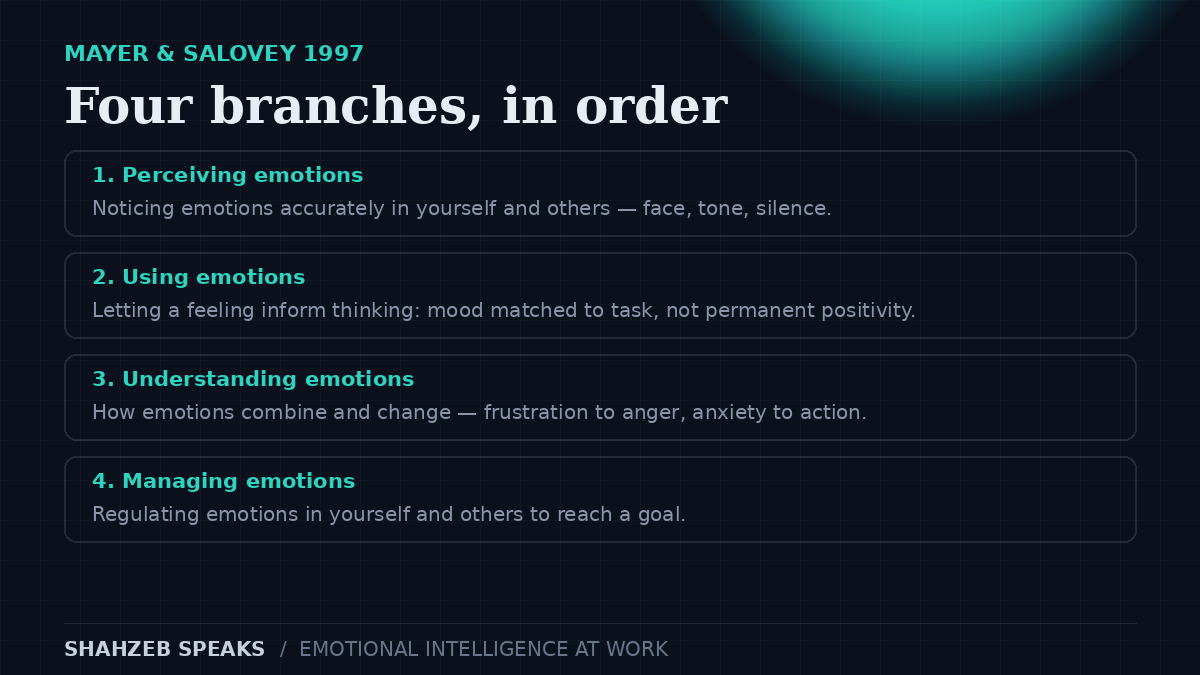
| Branch | What it means at work |
|---|---|
| 1. Perceiving emotions | Noticing emotions accurately in yourself and others — in a face, a tone of voice, a sudden silence in a meeting — including when an expressed emotion does not match the real one. |
| 2. Using emotions to facilitate thought | Letting a feeling inform thinking: a low mood can support careful checking, a positive mood can support brainstorming. The point is fit between mood and task, not permanent positivity. |
| 3. Understanding emotions | Knowing how emotions combine and change — how frustration can become anger, how anxiety about a deadline differs from anxiety about a person — and what situations tend to produce them. |
| 4. Managing emotions | Regulating emotions in yourself and others to reach a goal: calming yourself before a difficult conversation, or helping a team recover after a setback without pretending the setback did not happen. |
Notice what this model does not claim. It does not claim that emotionally intelligent people are always calm, always kind, or always positive. A person can perceive emotions sharply and use that perception unkindly — to manipulate a negotiation, for example. That is why researchers distinguish EI as an ability from how someone chooses to use it. A workplace that selects for EI without also checking values and conduct is selecting for a tool, not for character. The distinction is easy to forget in a leadership programme that treats EI as a synonym for goodness.
📊 Chapter 4: What the meta-analyses actually find
Meta-analyses — studies that combine many earlier studies — are the best available summary of a messy literature. Read together, they tell a consistent story: EI is related to performance, the relationship is modest, and the type of measure changes the answer.
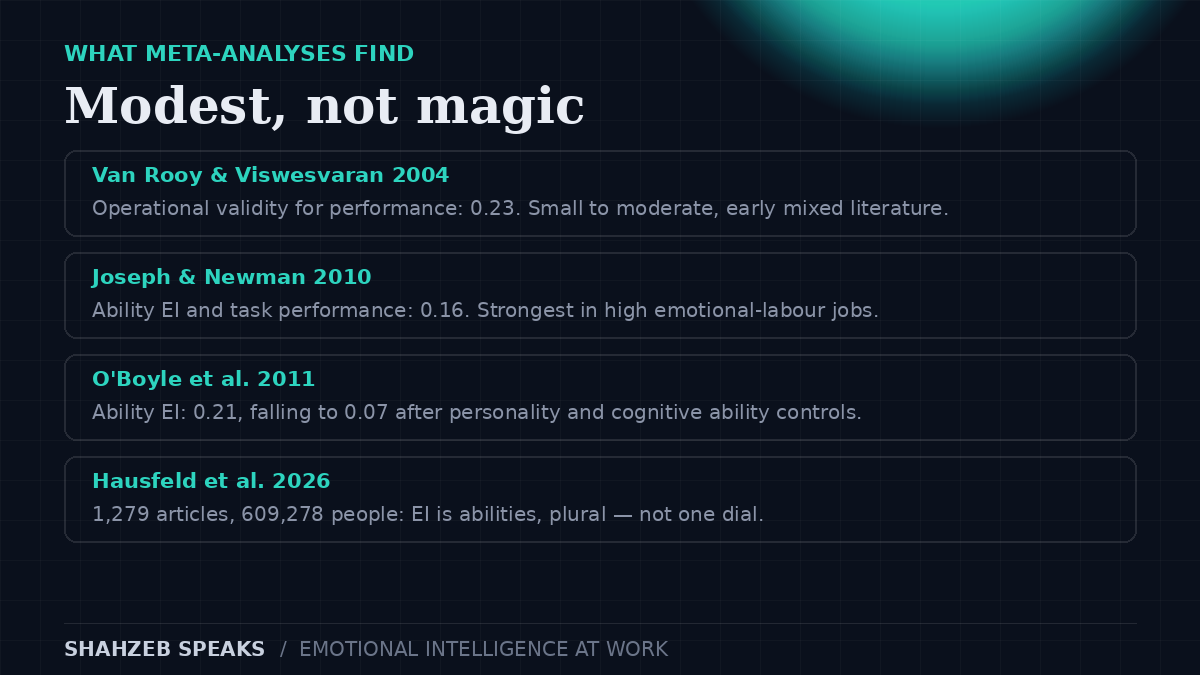
| Meta-analysis | Finding | What it means |
|---|---|---|
| Van Rooy & Viswesvaran (2004) | Operational validity of EI for performance reported as .23 | A real, small-to-moderate link, in early literature mixing EI types. |
| Joseph & Newman (2010) | Ability EI and task performance: correlation 0.16 | Ability EI predicted task performance mainly in high emotional-labour jobs, after controlling for personality and cognitive ability. |
| O’Boyle et al. (2011) | Ability EI and task performance: 0.21, falling to 0.07 with controls | Self-report and mixed EI predicted more strongly and added value beyond personality and ability — but they overlap with personality, so the added value needs careful reading. |
Three lessons follow. First, a correlation of 0.16 or 0.21 is not nothing: across hundreds of employees, small advantages compound. But it is also not a sorting machine. It will not reliably tell you, person by person, who will succeed. Second, context matters. Joseph and Newman found ability EI mattered more where emotional labour was high — jobs that require managing feelings as part of the work itself. In a low emotional-labour job, a high EI score is less informative, and selecting on it wastes a selection slot that could have gone to a work sample or a cognitive test. Third, the strongest-looking EI results often come from the measures that overlap most with personality. That does not make them useless — personality predicts performance too — but it does mean an employer who already measures conscientiousness and emotional stability may gain less from adding a mixed EI questionnaire than the marketing suggests.
None of this is an argument against developing emotional skills. It is an argument against pretending a questionnaire has settled a hiring decision that it has only informed.
🔬 Chapter 5: What the huge 2026 study adds — and what it does not
In September 2026, a meta-analysis by Hausfeld, Hampel, Bach and Menges, published in the journal Emotion, re-examined one of the most repeated claims about EI: that women are more emotionally intelligent than men. The scale is unusual and worth stating plainly: 1,279 articles, 1,428 samples, 609,278 participants across 76 countries, covering published and unpublished work up to 31 December 2023.
The findings are more interesting than either side of the popular argument. Women did score higher on average in general EI, and the advantage was stronger for abilities directed towards other people than towards the self. It was also larger on performance-based assessments — tasks scored for accuracy — than on self-report surveys, where people rate themselves. But the picture split when the researchers looked at regulation specifically: men and boys tended to score higher on regulating their own emotions, while women scored higher on regulating other people’s emotions. And the size and direction of differences varied with context, including leadership position, male-dominated industry, participant age, geographical region, and year of data collection.
The authors’ own warning is the part workplaces should take home. Group averages, even from 609,278 people, do not license judging the colleague beside you. As one of the researchers put it, confidence and competence are not the same thing: on self-reports the gender gap almost disappeared, while on performance tests it was substantial — which suggests men may overestimate, women may underestimate, or both. The practical advice that follows is procedural, not rhetorical: treat EI as a set of skills, use validated performance-based measures where they exist rather than relying on self-reports, develop the abilities in everyone, and do not let emotional work aimed at others become women’s responsibility by default, unrecognised and unrewarded. That last point is an organisational design issue, not a trait issue: if the same people are always asked to soothe clients, defuse tension and comfort colleagues, the organisation is harvesting their skill without paying for it in recognition or promotion.
This study does not settle whether EI can be trained, or how much it matters for a given job. It settles something narrower and more useful: EI is not one dial on which one group sits higher. It is a set of abilities, with different patterns for different abilities, measured differently by different methods, in different contexts. Any workplace claim that ignores that structure is a slogan, not a finding.
⚠️ Chapter 6: The hype — where the big numbers come from
Now the uncomfortable part: the numbers most managers have actually heard are not the meta-analytic ones. The most quoted figures in EI training decks — that EI accounts for 58% of performance across job types, and that 90% of top performers score high in EI while only 20% of the lowest performers do — come from TalentSmart, a company that sells EI tests and training. I label them as vendor claims deliberately. A vendor’s own dataset, analysed by the vendor, is not the same evidence as an independent meta-analysis, and a percentage of variance explained in a vendor sample does not translate into the 0.07 to 0.21 correlations above.
That does not mean the vendor numbers are invented. It means they cannot carry the weight placed on them. When a training provider tells you EI explains most of performance, ask three questions: who was in the sample, what test was used, and what happened when personality and cognitive ability were controlled for? If those answers are not available, the claim is marketing, whatever the slide design. The same test applies to the broader “80% EQ, 20% IQ” style slogans that circulate in secondary articles: I have not verified an origin for them in this guide, and I do not repeat them as findings.
There is a second, subtler form of hype: the AI-era version. As AI tools take over routine cognitive work, it is fashionable to argue that emotional skills are now the only human advantage left. Reports of Mercer Global Talent Trends 2026, as reported second-hand in October 2026, put 53% of employees worried about lacking future-ready skills, with concern about AI-related job loss rising from 28% in 2024 to 40% in 2026. Separately, search interest in “career change” was reported in 2026 as about three times higher than five years earlier. Those figures describe anxiety and attention, not proof that EI training solves either. Anxiety about AI is a reason to think carefully about which human skills matter — it is not evidence that a particular EI course improves them. For the related evidence on how work itself is changing, see my guide to workplace burnout and to psychological safety at work.
✅ Chapter 7: Using EI fairly — a playbook for hiring and leadership
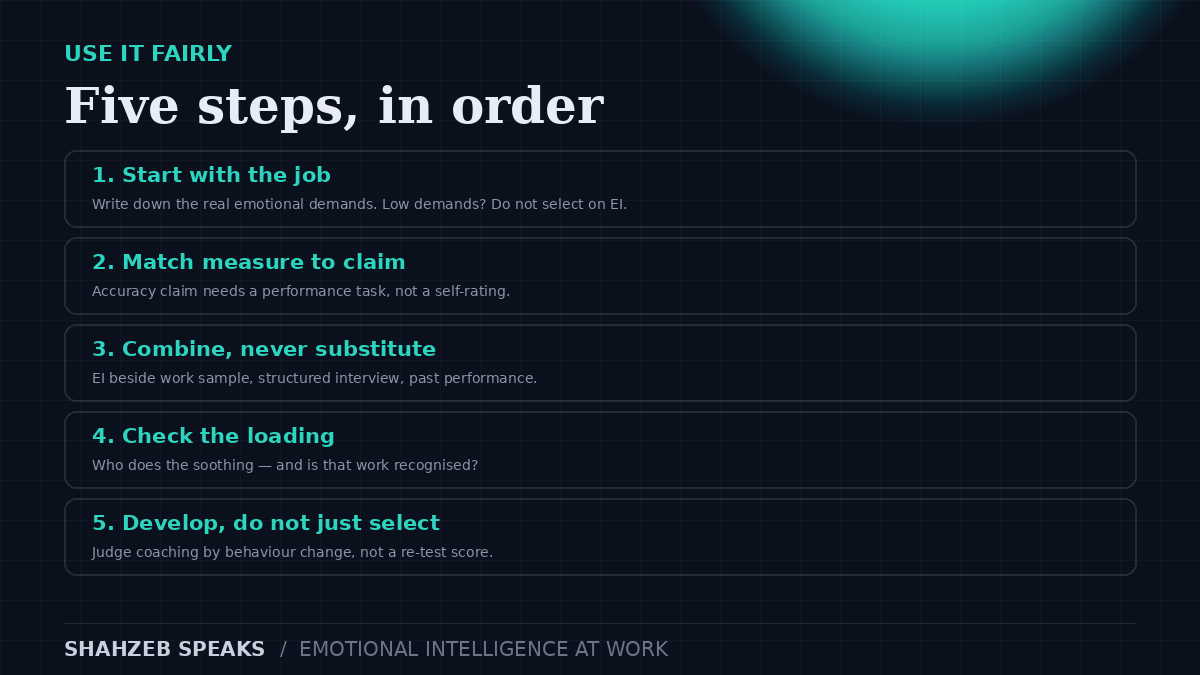
1. Start with the job, not the test. Write down the actual emotional demands: angry customers, grief, conflict between teams, high-stakes negotiation, or none of these. If the demands are low, do not select on EI at all. 2. Match the measure to the claim. If you claim someone can read emotions accurately, use a performance task. If you claim someone typically behaves calmly, use structured references and work samples — and say which one you used. 3. Combine, never substitute. EI evidence should sit beside a work sample, a structured interview and past performance, with weights decided in advance. A single EI score should never override the other three. 4. Check for adverse impact and for emotional-labour loading. Ask who is being asked to do the soothing, whether that work is recognised, and whether your EI measure rewards confidence or charm rather than accuracy. The 2026 study is a warning here: self-reports and performance tests can tell different stories about the same person. 5. Develop, do not just select. The most defensible use of EI in most organisations is development: coaching on perceiving and managing emotions, feedback on specific behaviours, and practice in realistic scenarios — with progress judged by behaviour change, not by a re-test score alone. Training studies are mixed on transfer to job performance, so treat development as a working hypothesis to evaluate, not a guaranteed return.
For leaders specifically, the most useful EI skill is often the least glamorous: regulation of your own emotions before you regulate anyone else’s. A leader who can notice rising frustration, name it silently, and delay a decision by an hour will do more for a team than a leader who can deliver an inspiring speech while still angry. That is a trainable routine — pause, label, delay, decide — and it does not require believing that EI explains most of performance.
🚫 Chapter 8: Where EI thinking goes wrong
First, confusing warmth with ability. A warm interviewee may be high in agreeableness, not in emotion perception. A quiet candidate may read a room well and say little. Second, using EI as a polite proxy for something else — “not a culture fit”, “lacks presence”, “not leadership material” — without naming the behaviour. If you cannot name the behaviour, you cannot defend the decision. Third, treating EI as fixed. Abilities can be developed, and contexts change them: the same person regulates well with sleep and support, and badly under sustained overload. An organisation that measures EI once and files the result has measured a moment, not a person. Fourth, outsourcing judgement to a score. A test vendor’s cut-off is a commercial decision, not a scientific law. If you would not hire or reject on a single personality questionnaire, do not do it on a single EI questionnaire either. Finally, ignoring the system. No amount of individual EI compensates for a workload, a pay structure, or a manager that generates the very emotions employees are then asked to regulate. Sometimes the intervention is not training the employee. It is fixing the job.
❓ Questions I am asked most often
What is emotional intelligence at work, in simple terms?
It is the ability to perceive, use, understand and manage emotions — your own and other people’s — so that thinking and action improve. In the ability model, it is a skill with four branches, not a personality type and not a synonym for being nice.
Does emotional intelligence predict job performance?
Yes, modestly. Meta-analyses put the raw link between ability EI and task performance at about 0.16 to 0.21, falling to about 0.07 once personality and cognitive ability are controlled for. Self-report and mixed measures predict more strongly but overlap with personality. It matters most in high emotional-labour jobs.
Is emotional intelligence more important than IQ?
No honest summary supports that as a general claim. Cognitive ability remains one of the strongest predictors of job performance, and EI adds value mainly in specific contexts and alongside, not instead of, ability and personality measures. Vendor claims that EI explains most of performance should be treated as marketing until independently replicated.
Can emotional intelligence be trained?
People can practise perceiving, understanding and managing emotions, and coaching can change specific behaviours. Whether training reliably transfers to measured job performance is less settled, so judge development by observed behaviour change at work, not by a re-test score alone.
Are women more emotionally intelligent than men?
On average, in a 2026 meta-analysis of 1,279 articles and 609,278 people, women scored higher in general EI, especially for other-focused abilities and on performance-based tests. Men tended to score higher on regulating their own emotions. Group averages do not describe any individual, and the gap almost disappeared on self-reports.
Should employers test emotional intelligence when hiring?
Only where the job genuinely demands emotional work, only with a measure matched to the claim, and only as one piece of evidence beside work samples, structured interviews and past performance. Never use a single EI score to hire or reject on its own, and check that the measure rewards accuracy rather than charm or confidence.
📬 Want help using emotional intelligence fairly in your organisation?
If your hiring or leadership programme uses EI, I can review which version of EI it actually measures, what the evidence says it predicts for your roles, and where a work sample or structured interview would serve you better.
For context on the field behind this work, my writing on industrial psychology in Pakistan explains what an I/O psychologist actually does — and for how a different psychological idea is used, and sometimes misused, in customer experience, see my guide to the peak-end rule.
Sources
- Goleman, D. (1995). Emotional Intelligence. Bantam Books.
- Goleman, D. (1998). What makes a leader? Harvard Business Review, 76(6), 93–102.
- Hausfeld, M. M., Hampel, V., Bach, L. J., & Menges, J. I. (2026). Putting assumptions to the test: A meta-analytic review of gender differences in emotional intelligence and specific emotion abilities. Emotion (advance online publication). https://doi.org/10.1037/emo0001733
- Joseph, D. L., & Newman, D. A. (2010). Emotional intelligence: An integrative meta-analysis and cascading model. Journal of Applied Psychology, 95(1), 54–78.
- Mayer, J. D., & Salovey, P. (1997). What is emotional intelligence? In P. Salovey & D. J. Sluyter (Eds.), Emotional Development and Emotional Intelligence.
- Mayer, J. D., Salovey, P., & Caruso, D. R. (2008). Emotional intelligence: New ability or eclectic traits? American Psychologist, 63(6), 503–517.
- O’Boyle, E. H., Jr., Humphrey, R. H., Pollack, J. M., Hawver, T. H., & Story, P. A. (2011). The relation between emotional intelligence and job performance: A meta-analysis. Journal of Organizational Behavior, 32(5), 788–818.
- Salovey, P., & Mayer, J. D. (1990). Emotional intelligence. Imagination, Cognition and Personality, 9(3), 185–211.
- Van Rooy, D. L., & Viswesvaran, C. (2004). Emotional intelligence: A meta-analytic investigation of predictive validity and nomological net. Journal of Vocational Behavior, 65(1), 71–95.