
A guest has a perfectly pleasant three-night hotel stay: clean room, good breakfast, friendly staff. On the last morning the checkout queue is twenty minutes long, nobody explains the bill, and she leaves annoyed. Ask her a month later about the hotel and she will tell you about the queue. Customers do not remember experiences the way they lived them. They remember the most intense moment and the ending — and they judge the whole thing by those two snapshots.
This guide explains the peak-end rule: the experiments that proved it, what it means for customer experience, where it breaks down, and a practical playbook for designing peaks and endings without tricking anyone. I am careful about the difference between what the laboratory showed and what businesses claim it shows, because the rule is powerful enough without exaggeration.
I am an Industrial and Organizational Psychologist based in Karachi. The peak-end rule sits at the meeting point of my two worlds: it is a finding about human memory, and it is one of the most misused ideas in customer experience. Used honestly, it helps you spend effort where memory is actually formed. Used dishonestly, it becomes an excuse for a bad middle dressed up with a nice goodbye.
“Nobody reviews the average of their holiday. They review the moment that made them gasp and the moment they walked out of the door — and everything in between is just the price of getting there.”
— Consumer Psychology Analysis, ShahzebSpeaks
⚡ Chapter 1: The short answer
The peak-end rule, from the work of Daniel Kahneman and his colleagues, says that when people look back on an experience, they judge it mainly by two things: how they felt at its most intense moment (the peak, good or bad) and how they felt at the end. The duration of the experience, and the sum of all its moments, matter far less than common sense suggests. This neglect of duration is called duration neglect.
That has a direct consequence for anyone designing a service. Improving the average quality of every minute is expensive and often invisible in memory. Fixing the worst moment and designing a deliberate, generous ending is cheaper — and it is what customers actually carry away with them. But the rule cuts both ways: one bad peak, such as a rude checkout or a painful billing surprise, can outweigh hours of good service, and a rushed, cold ending can spoil an otherwise excellent experience.
The rest of this guide shows the evidence, the limits, and how to use the rule fairly.
🔬 Chapter 2: Two selves, one memory
Kahneman’s framing is the key to the whole rule. He distinguishes the experiencing self, which lives through each moment as it happens, from the remembering self, which keeps the story of what happened and makes the decisions: whether to return, whether to recommend, whether to repeat. The remembering self does not keep a full recording. It keeps snapshots, and it weights the peak and the end far above the rest.
This is why satisfaction surveys can mislead. A survey taken during an experience measures the experiencing self. A review written a week later measures the remembering self. Both are real, but only the second one decides whether the customer comes back. A business that only measures moment-by-moment satisfaction, and never asks what customers remember, is measuring the wrong self.
The rule also only applies to experiences with a definite beginning and end: a hotel stay, a meal, a phone call, a course, a medical procedure. For an ongoing relationship with no clear ending, such as a subscription you use daily, the picture is messier — which is one reason the rule should guide design, not replace judgement. For related evidence on how wording and framing change decisions, see my guide to the framing effect, and for how familiarity shapes liking over time, the mere exposure effect.
📊 Chapter 3: The experiments that proved it
The rule was not invented by consultants. It came out of a series of careful, uncomfortable experiments in the 1990s.
| Experiment | What happened | What it showed |
|---|---|---|
| Cold water, 1993 (Kahneman, Fredrickson, Schreiber & Redelmeier) | One hand in 14°C water for 60 seconds; the other hand in 14°C water for 60 seconds, then 30 more seconds at a slightly warmer 15°C | Most participants chose to repeat the longer, more painful trial — because it ended less badly |
| Film clips, 1993 (Fredrickson & Kahneman) | Pleasant and unpleasant clips of different lengths, judged afterwards | Length was largely ignored; judgements followed affective snapshots |
| Colonoscopy and lithotripsy, 1996 (Redelmeier & Kahneman) | Real-time pain ratings for 154 colonoscopy and 133 lithotripsy patients, compared with retrospective ratings | Retrospective pain tracked the peak and the last 3 minutes (both P<0.005), not duration |
| Colonoscopy trial, 2003 (Redelmeier, Katz & Kahneman) | Randomised trial, 682 patients; half had the scope left still for a short, mildly uncomfortable period at the end | The longer procedure with the gentler ending was rated less unpleasant, and patients were more likely to return for follow-up |
The cold-water result is the one to sit with, because it breaks common sense. The longer trial contained strictly more pain: the same 60 seconds, plus 30 more seconds of cold water. Yet most participants preferred to repeat it. The only difference was the ending. A slightly warmer final 30 seconds changed the memory of the whole episode — and the memory, not the pain itself, decided the choice. Kahneman and colleagues concluded that subjects chose the longer trial because they liked the memory of it better, or disliked it less.
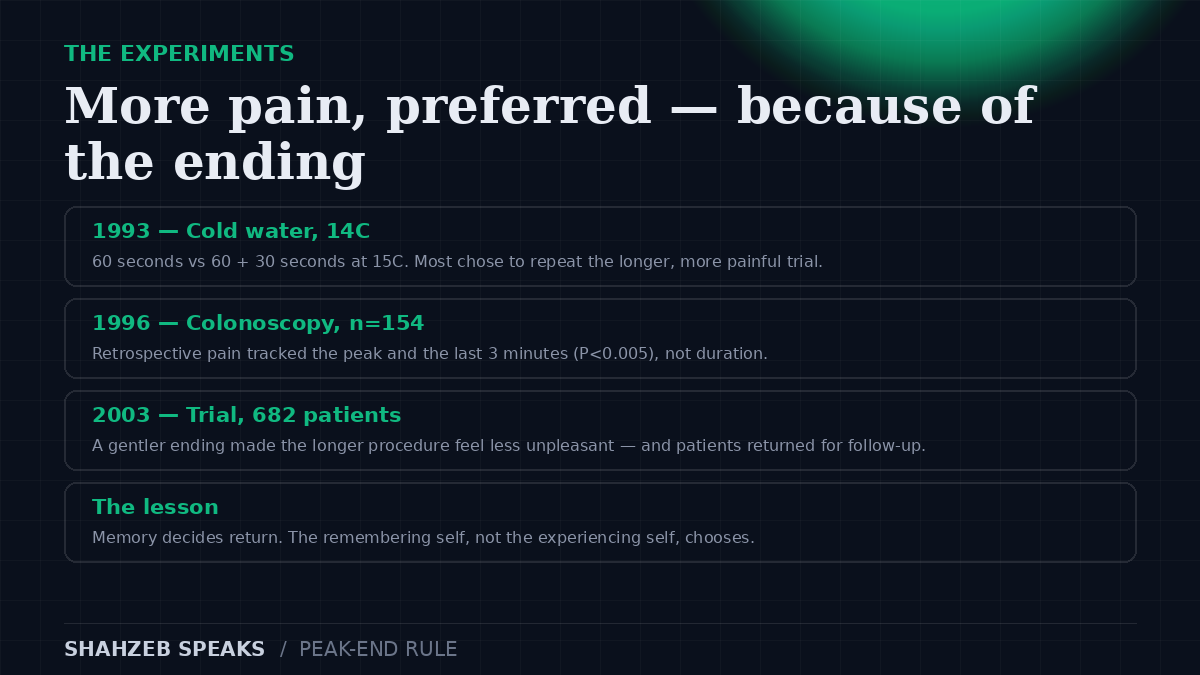
The clinical trial matters most for anyone who doubts that laboratory effects survive contact with reality. In 2003, Redelmeier, Katz and Kahneman ran a randomised controlled trial with 682 colonoscopy patients. Half received the standard procedure; for the other half, the scope was left stationary for a short additional period at the end, causing slight discomfort that was less intense than the procedure’s peak. The extended group experienced more total discomfort — yet rated the procedure as significantly less unpleasant and were more likely to attend a follow-up when one was clinically recommended. Duration, which ranged from under ten minutes to over an hour, was not significantly associated with retrospective discomfort ratings. A better ending did not just change a memory. It changed a health decision.
🧠 Chapter 4: Why the brain does this
Memory is not a video recorder. It is a compression system. An experience that lasted hours cannot be stored moment by moment, so the brain keeps a summary built from the most emotionally intense point and the most recent point. Psychologists call this a heuristic: a mental shortcut that is usually good enough and sometimes badly wrong.
Duration neglect follows naturally. If you only keep two snapshots, you have thrown away the information about how long the experience lasted. A two-hour delay and a twenty-minute delay can leave similar memories if they peaked and ended the same way — which is why customers will forgive a long wait that ends well and will never forgive a short wait that ends in rudeness.
There is a second mechanism worth knowing: the peak dominates because intense emotion is what gets encoded most strongly. A single moment of delight or humiliation is neurologically louder than an hour of adequacy. Adequacy is forgettable by design. That is the uncomfortable truth behind the rule: being consistently fine is not the same as being memorable, and memory is what drives return visits.
🏨 Chapter 5: What this means for customer experience
Apply the rule to a customer journey and three design priorities emerge. First, find the peaks. Map the journey and ask, honestly, where emotion runs highest: the moment of arrival, the moment of payment, the moment something goes wrong, the moment of delivery. Those are the moments customers will describe to friends. Everything else is context.
Second, design the ending as deliberately as the beginning. Most businesses over-invest in first impressions and under-invest in last ones. The welcome is rehearsed; the goodbye is an afterthought. Checkout, delivery, discharge, unboxing, the final email — these are the last snapshots, and they set the story. A clear bill explained before it is presented, a named person to contact afterwards, a small unexpected gesture after the transaction is complete: these cost little and are remembered a lot.
Third, treat service recovery as a peak, not as damage control. When something goes wrong, the recovery itself becomes the most intense moment of the journey. A fast, human, empowered fix — someone who owns the problem, explains the fix and follows through — can become the story the customer tells. A slow, scripted apology that requires three transfers becomes a second, worse peak. Recovery done well is not an exception to the rule. It is the rule, working in your favour.
One small, often-cited illustration: a 2002 study reported that giving restaurant customers a small unexpected gift with the bill raised tips from about 18.95% to about 22.99%. I cite it as a single study, not as a law — the effect size will vary, and a mint does not rescue bad food. But the mechanism is exactly the rule’s: the gift shifted the final snapshot from a transaction (the bill) to a gesture, and the memory improved.
✅ Chapter 6: A peak-end playbook you can run this week
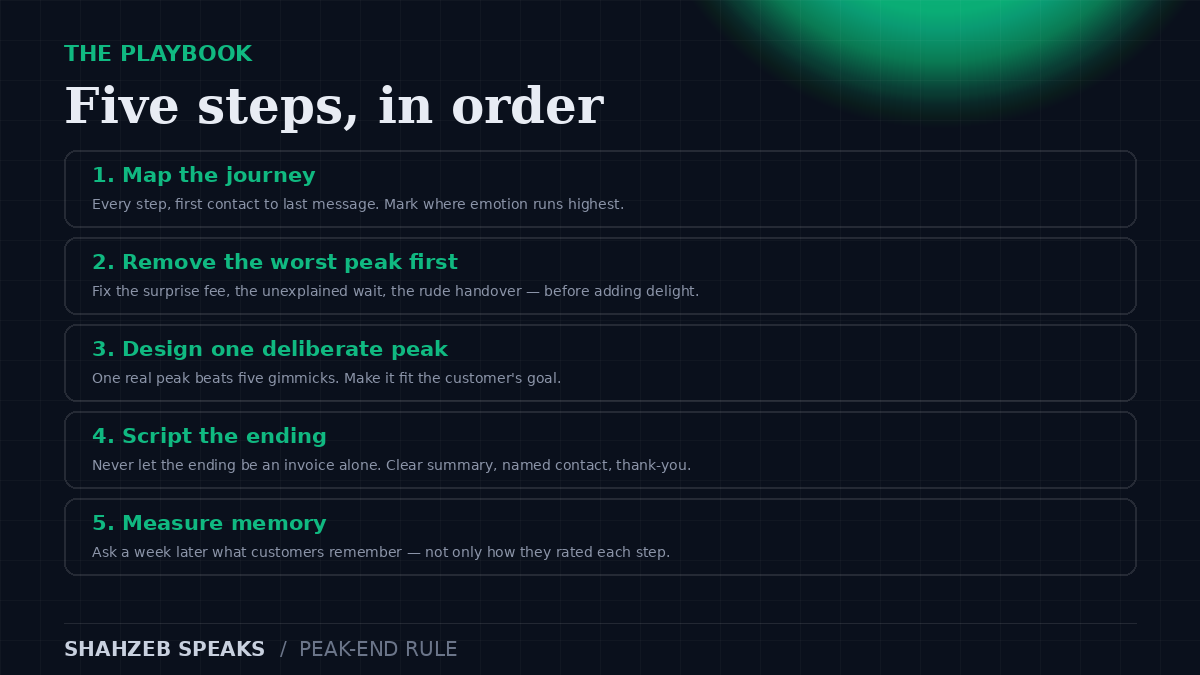
| Step | What to do |
|---|---|
| 1. Map the journey | Write down every step a customer takes, from first contact to the last message after purchase. Mark where emotion is likely highest. |
| 2. Remove the worst peak first | Find the single most painful moment — the surprise fee, the unexplained wait, the rude handover — and fix or soften it before adding anything delightful. |
| 3. Design one deliberate peak | Choose one moment to make genuinely good: a personal welcome, a first-use success, a result delivered with care. One real peak beats five gimmicks. |
| 4. Script the ending | Decide exactly what the last interaction is: who says what, what the customer receives, what happens next. Never let the ending be an invoice alone. |
| 5. Measure memory, not just moments | Ask customers a week later what they remember, not only how they rated each step on the day. The gap between the two answers is where the rule lives. |
A note on honesty, because this playbook can be abused. Designing a good ending is legitimate. Using a good ending to hide a bad product is not. If the middle of your experience is broken — the product fails, the fee is hidden, the support line never answers — a pleasant goodbye is manipulation, and customers will eventually notice that the story does not match the experience. The rule describes how memory works. It does not license you to exploit it.
🚫 Chapter 7: Five mistakes people make with the peak-end rule
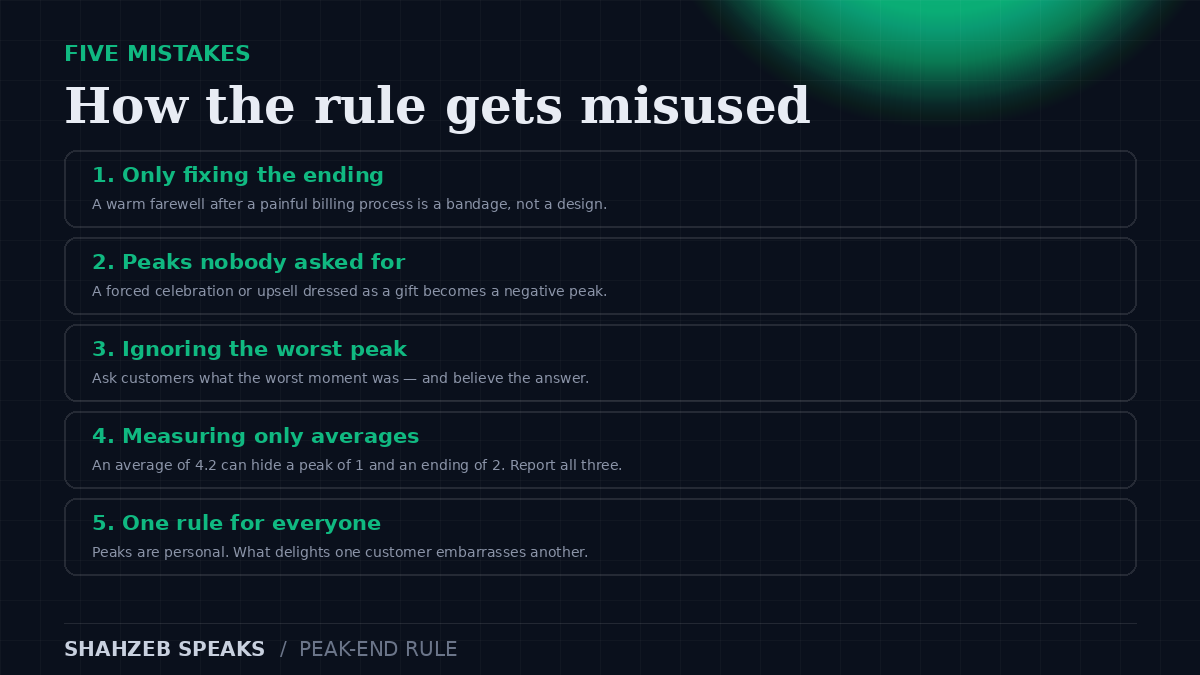
1. Only fixing the ending. A warm farewell after a painful billing process is a bandage, not a design. Fix the worst peak first. 2. Adding peaks nobody asked for. A surprise that interrupts or confuses — a forced celebration, an unwanted upsell dressed as a gift — becomes a negative peak. Peaks must fit the customer’s goal, not the brand’s ego. 3. Ignoring the negative peak. Businesses love designing delight and hate auditing pain. Ask customers what the worst moment was, and believe the answer. 4. Measuring only averages. An average satisfaction score of 4.2 can hide a peak of 1 and an ending of 2. Report the peak, the end and the average separately. 5. Assuming one rule fits every customer. Peaks are personal: what delights one customer embarrasses another. The rule describes memory in general; it does not tell you what any individual values.
⚠️ Chapter 8: Where the rule breaks down
The peak-end rule is strong, but it is not universal, and honest use requires knowing its limits. First, duration does matter sometimes. Later research found that when people are given a frame of reference — a comparison, a familiar standard, a fixed scale — duration can re-enter their judgements. A customer who has stayed at ten hotels knows what a long check-in means in a way a first-time guest does not.
Second, the rule describes retrospective judgement, not experienced wellbeing. The colonoscopy patients who remembered less pain still experienced more of it. Designing only for memory, at the expense of actual comfort, is ethically dubious — in medicine and in business. The 2003 trial is defensible because the gentler ending also helped patients return for needed follow-up. A gentler ending that merely hides real harm would not be.
Third, sequences matter. A peak at the very start of an experience, followed by a long decline, is remembered differently from the same peak near the end. Order, trend and expectation all shape the story. And fourth, the rule was built largely on episodes with clear boundaries. For continuous services, habits and relationships, other effects — such as the mere exposure effect, or the endowment effect covered in my guide to why you overvalue what you own — often matter more.
The practical conclusion is modest and useful: design for peaks and endings, but do not design only for peaks and endings. Fix the middle too. The remembering self decides whether customers return, but the experiencing self is the person you actually served.
❓ Questions I am asked most often
What is the peak-end rule in simple terms?
People judge a past experience mainly by its most intense moment and by how it ended, not by adding up every moment or by how long it lasted. A great peak and a good ending can make a whole experience feel better than its average — and a bad peak or ending can spoil it.
Who discovered the peak-end rule?
Daniel Kahneman and colleagues, including Barbara Fredrickson, Charles Schreiber and Donald Redelmeier, in studies published in 1993 and 1996, with a key randomised trial by Redelmeier, Katz and Kahneman in 2003. Kahneman later discussed it in Thinking, Fast and Slow (2011) through the experiencing self and the remembering self.
Does the peak-end rule mean duration does not matter?
Mostly, in retrospective judgement — but not always. Duration is largely neglected when people judge from memory, yet later research shows it can matter again when people have a clear frame of reference, such as a comparison or a familiar standard. Do not use the rule as an excuse for long, avoidable waits.
How can a small business use the peak-end rule?
Map the customer journey, fix the single worst moment first, design one genuinely good peak, and script the ending so it is never just an invoice. Then ask customers a week later what they remember. Small, honest gestures at the end — a clear summary, a named contact, a thank-you — cost little and are remembered.
Is using the peak-end rule manipulative?
It can be, if a good ending is used to hide a bad product or a hidden fee. It is not manipulative when it means removing real pain points and ending an experience with clarity and care. The test is simple: would the design still be fair if the customer knew exactly why you designed it that way?
Does the peak-end rule work for negative experiences too?
Yes — that is the warning in the rule. A single intensely bad moment, or a cold and confusing ending, can dominate memory even after a mostly good experience. That is why fixing the worst peak matters more than adding another pleasant one.
📬 Want help designing peaks and endings your customers remember?
If customers rate you well in the moment but do not return, the gap is usually in memory: a bad peak, or an ending nobody designed. I can map your customer journey against this evidence and show you where the memory is actually formed.
For context on the field behind this work, my writing on industrial psychology in Pakistan explains what an I/O psychologist actually does — and if you want to see how a brand builds memory over decades, my audit of Coca-Cola shows the long version of the same lesson.
Sources
- Fredrickson, B. L., & Kahneman, D. (1993). Duration neglect in retrospective evaluations of affective episodes. Journal of Personality and Social Psychology, 65(1), 45–55.
- Kahneman, D. (2011). Thinking, Fast and Slow. Farrar, Straus and Giroux.
- Kahneman, D., Fredrickson, B. L., Schreiber, C. A., & Redelmeier, D. A. (1993). When more pain is preferred to less: Adding a better end. Psychological Science, 4(6), 401–405.
- Redelmeier, D. A., & Kahneman, D. (1996). Towards a psychophysics of memories of pain: The peak-end rule and duration neglect. Pain (reported findings: n=154 colonoscopy, n=133 lithotripsy).
- Redelmeier, D. A., Katz, J., & Kahneman, D. (2003). Memories of colonoscopy: A randomized trial. Pain, 104(1–2), 187–194.
- Schreiber, C. A., & Kahneman, D. (2000). Determinants of the remembered utility of aversive sounds. Journal of Experimental Psychology: General, 129(1), 27–42.