Coca-Cola Psychology Audit — The Contour Bottle, the Santa Suit and 140 Years of Red
A psychology audit of Coca-Cola: the 1915 contour bottle you can recognise blind, the Santa of 1931, the 79-day New Coke disaster, the secret formula, Share a Coke, and the real legal record — EU commitments, a settled Vitaminwater suit and a dismissed sugary-drinks case.

86 / 100
Overall consumer behavior effectiveness
Brand Overview
- Brand nameCoca-Cola
- Founded1886
- HeadquartersAtlanta, Georgia, USA
- IndustryFood & Beverage
- Websitewww.coca-colacompany.com ↗
Psychology Techniques Identified
- 01Distinctiveness & the Isolation Effect (Contour Bottle)
- 02Haptic Brand Design (Feel-in-the-Dark Brief)
- 03Nostalgia Engineering (The Sundblom Santa)
- 04Ritual & Intergenerational Habit (Christmas Campaigns)
- 05Loss Aversion & the Endowment Effect (New Coke)
- 06Curiosity Gap (The Secret Formula)
- 07Personalisation & Identity (Share a Coke)
- 08Name-Letter Effect (Your Name on the Can)
- 09Mere Exposure at Scale (Arm's Reach of Desire)
- 10Association Transfer (A Century of the Olympics)
- 11Scarcity of Knowledge (The Vault Theatre)
- 12Brand Heritage as Trust Signal (140 Years)
Full Psychology Audit Report
In this audit
It is a five-cent drink sold from a pharmacy counter in Atlanta, and nine people a day buy it. One hundred and forty years later, the same drink sells for more money than most countries’ budgets — $47.1 billion in a single year — in more than 200 countries, in a bottle you can recognise in the dark. Nobody did this with a better product. Coca-Cola is the most successful application of psychology ever sold in a bottle: distinctiveness you can feel, nostalgia you can drink, a secret nobody knows, and — in 1985 — the most expensive lesson ever taught about what happens when you take away what people love.
The numbers need their labels. The Coca-Cola Company reported $47.1 billion in net revenues for full-year 2024 (its own results release, 11 February 2025). Interbrand’s 2025 ranking puts the brand at #7 in the world with a value of $60.1 billion, down 2% from 2024. The drink was born on 8 May 1886 at Jacobs’ Pharmacy in Atlanta, sold for five cents a glass, and averaged nine drinks a day in its first year — all from the company’s own history. The “more than 200 countries” and “500+ brands” figures are the company’s own claims. Everything below comes with its source and its date.
I am an Industrial and Organizational Psychologist, and this audit treats Coca-Cola as psychology’s longest-running field experiment: the contour bottle as an expectancy-violation and distinctiveness case study, Santa Claus as engineered nostalgia, New Coke as a live-fire demonstration of loss aversion, the secret formula as a century-long curiosity gap, and “Share a Coke” as the personalisation principle at planetary scale. There is also a real legal record — a European antitrust settlement without a finding, a settled Vitaminwater suit, a dismissed sugary-drinks case, and an Indian groundwater dispute that never produced a liability finding — reported here at its exact status.
“Coca-Cola understood before the science existed that memory is comparative and attachment is emotional. It made its bottle a shape you could identify blind, its Christmas a ritual you inherit, its formula a secret you will never learn — and then it measured, to the day, what losing it costs: seventy-nine days of pure, documented panic. No brand on earth has tested more psychology, on more people, for longer.”
— Brand Psychology Analysis, ShahzebSpeaks
📋 Brand Overview: Coca-Cola at a Glance
| Brand | Coca-Cola (The Coca-Cola Company) |
| Founded | 1886 (drink first sold 8 May 1886); The Coca-Cola Company incorporated 1892; sold for $25 million to the Woodruff-led group in 1919 |
| Headquarters | Atlanta, Georgia, USA |
| Scale | $47.1 billion net revenues, full-year 2024 (company release, 11 Feb 2025); “more than 200 countries” and “500+ brands” are company claims |
| Brand rank | #7 globally, brand value $60.1B (Interbrand Best Global Brands 2025) |
| Founder | Dr John Stith Pemberton (pharmacist); named and scripted by Frank M. Robinson; scaled by Asa Candler and Robert Woodruff |
| Signature | Contour bottle (1916), Spencerian script logo, “within an arm’s reach of desire” |
| Model | Concentrate sold to a global bottling network; the product is sugar water, the business is meaning |
📜 Chapter 1: The History — From Nine Drinks a Day to $47.1 Billion
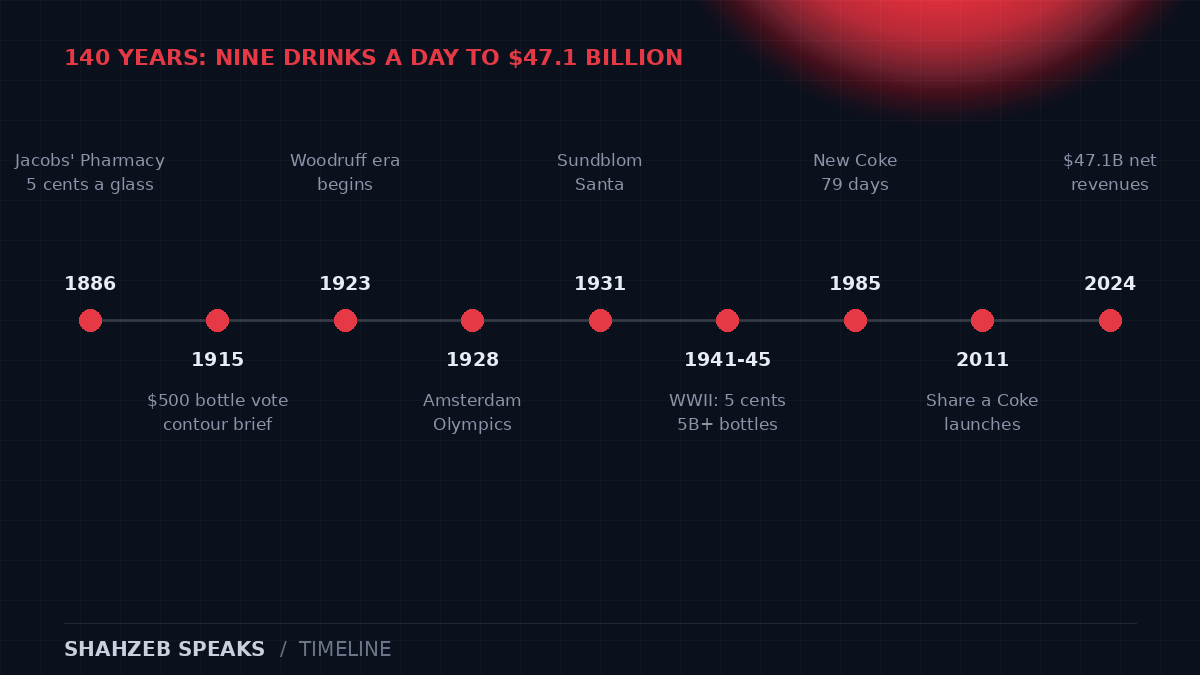
🥤 1886: Nine drinks a day
Coca-Cola “was born in Atlanta, Georgia, on May 8, 1886.” Dr John Stith Pemberton, a local pharmacist, produced the syrup and carried a jug down the street to Jacobs’ Pharmacy, where it was sampled, pronounced “excellent,” and placed on sale for five cents a glass as a soda-fountain drink. Thinking “the two Cs would look well in advertising,” his partner and bookkeeper Frank M. Robinson suggested the name “Coca-Cola” and penned the trademark in his unique script — the same script still on every can. The first newspaper ad appeared in The Atlanta Journal; first-year sales averaged nine drinks per day. (All per the company’s own history.)
🏭 1892–1919: The Candler and Woodruff deals
Pemberton sold his remaining interest to Asa G. Candler shortly before his death in 1888; Candler founded The Coca-Cola Company in 1892 as a Georgia corporation. In 1919, Candler sold the company for $25 million to an investor group led by Ernest Woodruff — 500,000 shares offered publicly at $40 each. Ernest’s son Robert Woodruff, elected president in 1923, led the company “for more than half of the twentieth century” and drove its philosophy of ubiquity: the famous declaration that Coca-Cola should be “within an arm’s reach of desire,” which the company dates to 1941.
🪖 1941–1945: The war that made it global
In 1941, Woodruff ordered “that every man in uniform gets a bottle of Coca-Cola for 5 cents, wherever he is and whatever it costs the Company.” At the outbreak of the war, Coke was bottled in 44 countries; on 29 June 1943, General Dwight Eisenhower cabled Allied headquarters in North Africa requesting equipment for 10 bottling plants plus 3 million filled bottles. 64 bottling plants were shipped abroad during the war, and more than 5 billion bottles were consumed by military personnel. The company’s heritage director cautions that the “nickel” directive is best read as a guiding philosophy rather than a verbatim quote — and the company itself records it that way. Whatever the wording, the effect is beyond dispute: American servicemen introduced Coca-Cola to the world, and the world kept drinking it.
📈 1946–2024: The machine
From the mid-1940s to 1960, the number of countries with bottling operations nearly doubled. The company now reports six operating segments (Europe/Middle East/Africa, Latin America, North America, Asia Pacific, Global Ventures, Bottling Investments), $47.1 billion in 2024 net revenues (up 3%), and — its own claim — more than 200 countries and 500+ brands. Interbrand’s 2025 ranking values the brand at $60.1 billion, #7 in the world. CEO James Quincey calls the strategy “all-weather”: “Our all-weather strategy is working, and we continue to demonstrate our ability to lead through dynamic external environments.”
🍾 Chapter 2: The Bottle You Recognise in the Dark
In 1933, Hedwig von Restorff showed that when several similar items appear together, the one that stands out is remembered far better — the isolation effect. I have written about it in my von Restorff effect piece: memory is comparative, so distinctiveness wins. In 1915, Coca-Cola ran the most literal possible implementation of that insight.
On 26 April 1915, the trustees of the Coca-Cola Bottling Association voted to spend $500 developing a distinctive bottle, inviting at least eight glass companies to compete. The brief was a masterpiece of consumer psychology: a bottle “so distinct that you would recognize it by feel in the dark or lying broken on the ground.” The winner was the Root Glass Company of Terre Haute, Indiana — a team including C.J. and William Root, shop foreman Alexander Samuelson, Earl Dean and Clyde Edwards. Finding an illustration of a cocoa bean with an elongated shape and distinct ribs in a local library, Dean sketched the now-famous curves on heavy linen paper. (The company tells this story; historians debate whether the inspiration was a cocoa bean or a kola nut, and Samuelson’s exact role — the record is genuinely contested.)
The patent was granted on 16 November 1915 under Samuelson’s name — filed without the Coca-Cola script lettering to protect the design’s secrecy and the client’s identity — and in early 1916 a committee of bottlers chose the Root design. The bottles were coloured “German Green” (later “Georgia Green”), each city’s name embossed on the bottom; the glass weighed at least 14.5 ounces for 6.5 ounces of Coke, so every filled bottle weighed more than a pound.
The psychology runs deeper than looks. Peck and Childers (2003) showed that consumers differ in their “need for touch,” and that touching products increases confidence in judgments — people high in need for touch retrieve haptic information from memory faster (Journal of Consumer Research). The 1915 brief was explicitly haptic: recognition by feel. A century before sensory marketing had a name, Coca-Cola designed a bottle for the hand, not just the eye. That is why the contour bottle survives every redesign era: it is the rare package that works blind.
🎅 Chapter 3: The Santa Suit — Engineered Nostalgia
Coca-Cola’s own FAQ says it plainly: “Coca-Cola did not create the legend of Santa Claus. But Coca-Cola advertising did play a big role in shaping the jolly character we know today.” The company even disclaims the popular myth that the red suit comes from Coke — Santa appeared in red before its ads. What the company does claim is the modern Santa’s face, and that claim is documented.
Christmas advertising began in the 1920s; in 1930, artist Fred Mizen painted a department-store Santa drinking Coke for The Saturday Evening Post. In 1931, the company commissioned Michigan-born illustrator Haddon Sundblom, with D’Arcy Advertising executive Archie Lee wanting a wholesome Santa who was “both realistic and symbolic” — Santa himself, not a man dressed as Santa. Sundblom drew on Clement Clark Moore’s 1823 poem “A Visit From St. Nicholas.” His Santa debuted in 1931 and appeared in Coca-Cola advertising from 1931 to 1964, with the final version painted in 1964. The paintings — adapted for magazines, billboards, calendars and store displays — now sit in the company’s archives and at the World of Coca-Cola in Atlanta.
Two mechanisms make this work. First, nostalgia: Muehling and Sprott (2004) found in an experiment (n=159) that ads with nostalgic cues evoked more personal thoughts and produced more favorable attitudes toward the advertised brand than non-nostalgic ads — and that nostalgia is “inherently bittersweet,” which is why the ads feel warm rather than cheap. A 2024 cross-country study (277 British and 255 Indian consumers) found nostalgic advertising increases brand love in both countries. Second, ritual: Vohs, Wang, Gino and Norton (2013) showed across four experiments that ritualistic behaviour before consumption made chocolate taste more flavorful and valuable — ritual works through deeper personal involvement in the experience. The annual Santa campaign is a ritual engine: children who grew up with the Sundblom Santa now buy Coke for their children at Christmas, and the feeling compounds across generations. No ad campaign buys that; only decades of repetition do.
🥤 Chapter 4: The 79-Day Disaster — New Coke and Loss Aversion
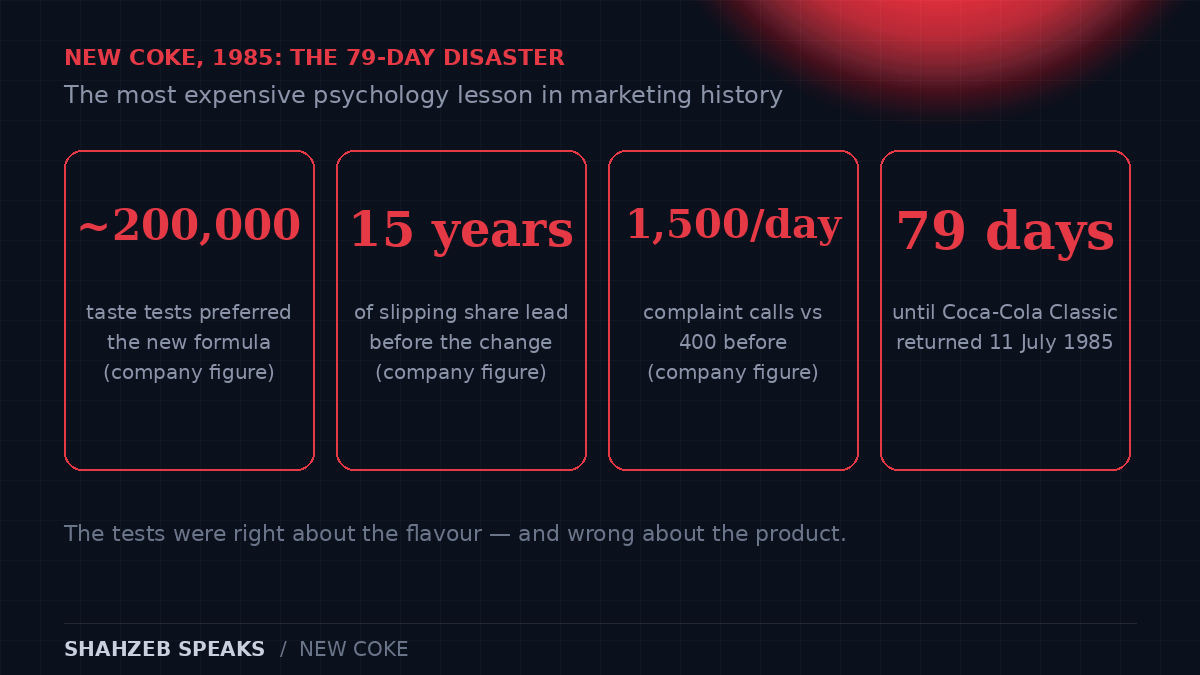
On 23 April 1985, The Coca-Cola Company announced it was changing the formula of its signature soft drink for the first time in 99 years. The logic was impeccable and the data was real: after taste tests of nearly 200,000 consumers preferred the new sweeter formula, and with the company’s share lead over its chief competitor “slowly slipping for 15 consecutive years,” management acted. What the tests did not show, as the company itself later admitted, “was the bond consumers felt with their Coca-Cola.”
Prospect theory — Kahneman and Tversky (1979) — says losses loom larger than gains: taking something away hurts more than adding the equivalent gives. New Coke was a live-fire demonstration. Consumers hoarded the old Coke; protests ran by the thousands; by June 1985 the consumer hotline was getting 1,500 calls a day versus 400 before the change (the company’s own figure; secondary reporting says up to 8,000 a day — the two are not reconciled). CEO Roberto Goizueta received a letter addressed to “Chief Dodo, The Coca-Cola Company.”
On 11 July 1985 — 79 days after launch — the original formula returned, rebranded as Coca-Cola Classic. The taste tests had been right about the flavour and wrong about the product: nobody was buying a flavour, they were buying continuity. Goizueta later said: “We set out to change the dynamics of sugar colas in the United States, and we did exactly that — albeit not in the way we had planned.” President and COO Donald Keough was blunter at the press conference: “The simple truth is that we are not that dumb and we are not that smart… The passion for Original Coke was something that caught us completely by surprise.”
At the ten-year anniversary, Goizueta characterised the episode as a prime example of “taking intelligent risks” — and in a strange way he was right. New Coke taught the company, and every marketer since, what I wrote about in my loss aversion in marketing piece: the endowment effect means customers own the brand emotionally, and threatening what they own provokes a response no focus group can simulate. The panic proved the attachment was real. Coca-Cola has never threatened the original formula again.
🔒 Chapter 5: The Secret Everyone Knows
Ask anyone what is in Coca-Cola and they will tell you: a secret. The company’s official line is narrower than the myth: the formula is “shared only with a small group” — it does not say “only two people.” A spokeswoman put it plainly: “We cannot confirm the number of people who are familiar with the formulation, but it is only a small handful.” The popular claim that only two people know the recipe — and may not travel together — is a myth; fact-checkers have found it false, and the company makes no such claim.
What is real is the theatre. The formula had been held in a SunTrust Bank vault in downtown Atlanta since 1925; on 8 December 2011 the company moved it to a new vault at the World of Coca-Cola museum, where it is on public “display” — visitors can see the vault, never the recipe. Then-CEO Muhtar Kent: “The time has come for our secret formula to come back home.”
The psychology is the curiosity gap: a known unknown that can never be resolved becomes permanent free advertising. Every rumour, every claimed leak, every “I know what’s really in it” conversation is marketing the company does not pay for. The honest version of the lesson: secrecy works when the secret is framed as valuable, not when it is actually unknowable — the vault is on display, the recipe is not, and the distinction is the entire trick.
📝 Chapter 6: Your Name on a Coke — “Share a Coke”
In 2011, Coca-Cola Australia did something the brand had never done: it replaced the Coca-Cola logo on bottles and cans with the country’s 150 most popular names, printed in the Spencerian script — the first major packaging change in the brand’s history. The agency was Ogilvy Sydney. The campaign, “Share a Coke,” ran in over 80 markets and, per trade reporting, reversed an 11-year consumption decline in the United States. It was relaunched in Australia in 2019 with pop-up personalisation kiosks, and again in 2025 in more than 120 countries (per Coca-Cola Australia). Senior marketing director Kate Miller: “Nothing beats the feeling of seeing your name, or your best mates name on a Coca-Cola can or bottle.”
Three research threads explain the effect. First, customisation: Franke, Keinz and Steger (2009, Journal of Marketing) found that customised products deliver significantly higher benefits than standard products in willingness to pay, purchase intention and attitude — gains are largest when customers understand their preferences and are highly involved. Franke and Piller (2004) found a 100% value increment for self-designed watches in experiments with 717 participants. Second, the name-letter effect: Nuttin (1985) showed people prefer letters appearing in their own names, and Brendl and colleagues (2005) showed the positive valence transfers to brand and object choice. Your name on the can is not decoration; it is identity. Third, the IKEA effect: people value what carries their mark — you did not buy a Coke, you found someone’s name and handed it to them. Reciprocity and identity in one gesture.
🏅 Chapter 7: A Century of Borrowed Glory — The Olympics
Coca-Cola “first sponsored the Olympics with the 1928 Amsterdam Games“: a freighter carrying the US Olympic team also carried 1,000 cases of Coca-Cola. The IOC’s own historical note calls it “by far the oldest sponsor of the Olympic Games” and the “longest-running partnership in the Olympic movement.” In 1986 the company became an inaugural member of the IOC’s TOP programme; in 1992 it became the first sponsor of the Olympic torch relay; and in 2019 it agreed a joint TOP partnership with Chinese dairy firm Mengniu running through 2032.
The mechanism is association plus mere exposure on a geological timescale. Every four years, for nearly a century, the red logo has stood next to the five rings — excellence, youth, global unity — until the associations bleed together in memory. No single campaign could buy this; it is the compound interest of presence.
🌍 Chapter 8: The $47.1 Billion Machine
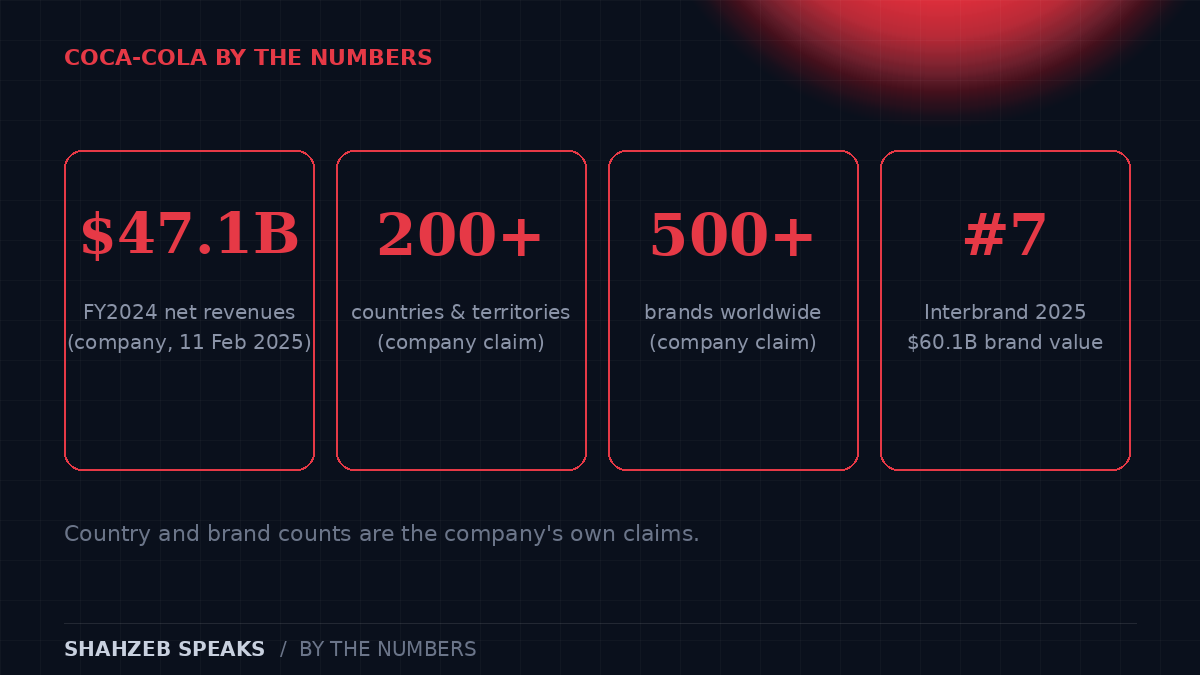
The psychology chapters above would be trivia without the machine underneath. Full-year 2024: $47.1 billion in net revenues (up 3%), with Q4 at $11.5 billion (up 6%). Unit case volume grew 1%; sparkling soft drinks grew 2%; Trademark Coca-Cola grew 2%; Coca-Cola Zero Sugar grew 9%. Operating margin was 21.2% (down from 24.7%, including a $3.1 billion charge on the fairlife contingent consideration), and cash flow from operations was $6.8 billion, down 41% — primarily because of a $6.0 billion deposit to the US IRS related to ongoing tax litigation. (All per the company’s FY2024 release, 11 February 2025.)
The psychological principle is availability as strategy: “within an arm’s reach of desire” is not a slogan, it is a distribution doctrine. Mere exposure (Zajonc, 1968) says repeated exposure breeds liking; Coca-Cola’s version is that unavailability breeds nothing. The 200+ countries claim is the point: the brand’s emotional real estate is a direct function of its physical real estate.
⚠️ Chapter 9: The Dark Side — The Real Legal Record
A 140-year-old company in 200 countries collects lawsuits the way other companies collect awards. Here is the record at its exact legal status, as of 11 October 2026. Read it carefully: several of these are routinely misreported, and the misreporting always upgrades “alleged” to “proven.”
🇪🇺 The European Commission case (2005): commitments, no finding
After dawn raids on Coca-Cola’s anchor bottlers in Austria, the UK, Germany and Denmark on 20–21 July 1999 over suspected infringements of EU competition rules, the European Commission moved toward settlement: it announced its intent to accept commitments in October 2004, market-tested them, and on 22 June 2005 adopted a commitments decision (case COMP/39.116/B-2) addressed to The Coca-Cola Company and three bottlers. The decision made the commitments binding — no exclusive supply arrangements, no growth/target rebates, no leveraging market power between product categories across the EEA, and at least 20% of Coca-Cola-provided cooler space open to rivals — and ended the proceedings without any finding of infringement. The commitments applied until 31 December 2010. This was not a fine and not a guilty verdict; it was a negotiated settlement with no liability finding.
🧃 Vitaminwater (2009–2016): filed, settled without admission
In 2009, the Center for Science in the Public Interest and co-counsel filed a class action against Coca-Cola and its Glaceau subsidiary (Ackerman et al v. Coca-Cola and Energy Brands, 9-cv-00395) over Vitaminwater health claims such as “vitamins + water = all you need,” with CSPI noting a bottle carried roughly 8 teaspoons of sugar. In mid-2010, a US district judge rejected Coca-Cola’s motion to dismiss, holding the labelling could reinforce a mistaken belief that the product was only vitamins and water. In March 2016, the court gave final approval to a settlement: injunctive terms only — Coca-Cola was barred from the challenged claims and must label Vitaminwater conspicuously as “with sweeteners” with “120 calories” on the front — plus $2.7 million in plaintiffs’ attorneys’ fees. No damages to consumers, no admission of liability. (“Although we remain confident in our legal position, it simply made no sense to continue this costly legal battle,” the company said.) Note: no FTC enforcement action on Vitaminwater was located during research — this was private litigation, not a regulator.
🥤 The sugary-drinks “deception” case (2017–2021): filed, then voluntarily dismissed
On 4 January 2017, The Praxis Project — with CSPI and the Public Health Advocacy Institute as counsel — sued Coca-Cola and the American Beverage Association in the US District Court for the Northern District of California, alleging the companies misled the public about the health harms of sugary drinks. Refiled in the District of Columbia in July 2017, the ABA was dismissed in January 2019, CSPI withdrew in November 2019, and on 8 February 2021 the plaintiffs voluntarily dismissed the case. No settlement, no admission, no court finding on the merits. Every health-harm allegation in that suit remains an allegation only.
🇮🇳 Plachimada, India: alleged, never adjudicated
The company began bottling at Plachimada, Kerala, in 2000. In 2003 the local village council refused to renew the plant’s licence, citing excessive groundwater exploitation; the plant shut in 2004 and never reopened. In 2017, company counsel told India’s Supreme Court it had no intention of resuming operations, and the court closed the case. A High Powered Committee assessed community damage of about ₹216 crore; reporting as of 2018 indicated no compensation had been paid. The legal status: groundwater-depletion and contamination claims were alleged by residents and the council and refuted by the company; no final court finding of liability against Coca-Cola was located. The current compensation status is not verifiable past 2018 and is not printed here.
🇪🇺 The 2021 probe: investigation opened, outcome unknown
In May 2021, Coca-Cola confirmed it had received a formal request for information from the European Commission regarding a fresh probe into unfair trading practices, saying it would cooperate. That is an investigation opened; no outcome was located during research. Do not treat it as a finding.
🇵🇰 Chapter 10: What Pakistani Brands Should — and Shouldn’t — Copy
Copy this
- Design for the hand, not the screenshot. The contour bottle’s brief was haptic — recognisable by feel in the dark. Pakistani beverage and food brands obsess over shelf colour and ignore touch, weight and shape. The bottle is the media.
- Build one ritual and repeat it for decades. The Sundblom Santa ran from 1931 to 1964 and still pays out. Most Pakistani brands change campaigns yearly and build nothing. Pick your ritual and defend it for a decade.
- Personalise at scale. “Share a Coke” proved identity beats logo. Names, cities, occasions — Pakistani brands with regional pride (and there is plenty) have an underused advantage here.
- Make availability the strategy. “Within an arm’s reach of desire” is distribution, not advertising. The brand with the widest chillers wins the impulse buy; psychology cannot save a product that is not there.
Do not copy this
- Do not touch the core formula. New Coke’s 79 days are the warning: in a heritage brand, the product is the promise. Reformulate the extensions, never the flagship.
- Do not fake a secret. The formula myth works because the secrecy is real and old. A manufactured mystery around a new product reads as a gimmick and dies with the launch.
- Do not outspend your legal discipline. Coca-Cola survived its legal record because every case was met with process, not denial theatrics. Bold health claims in beverages invite litigation everywhere — Pakistan included.
⚔️ Chapter 11: Competitive Positioning
Coca-Cola’s moat is not the drink — it is 140 years of compounded meaning plus distribution no rival can rent. Pepsi competes on taste-test wins and celebrity; it has never matched the ritual layer. Local brands compete on price; they cannot touch the identity layer. New entrants compete on health; Coca-Cola answers with Zero Sugar (+9% in 2024) and acquisitions, not arguments. The vulnerabilities: sugar is the category’s original sin, and every health allegation — even the voluntarily dismissed ones — sticks to the brand in search results; the nostalgia engine needs constant new material to reach generations that never saw a Sundblom Santa; and “200+ countries” is also 200+ regulatory regimes, as the EU record shows.
📊 Chapter 12: Psychology Scorecard — Detailed Ratings
| Psychology Dimension | Score | Verdict |
| Distinctiveness & Brand Identity | 98/100 | The contour bottle, recognisable blind since 1916; the most distinctive package in consumer goods. |
| Global Scale & Consistency | 92/100 | $47.1B revenue, 200+ countries (company claim), #7 brand in the world (Interbrand 2025). |
| Sensory & Ritual Design | 93/100 | Sundblom Santa 1931–1964; a Christmas ritual inherited across generations. |
| Emotional Attachment & Endowment | 90/100 | New Coke proved the attachment: 79 days, thousands of protests, the formula restored. |
| Personalisation & Identity | 88/100 | “Share a Coke” (2011): 150 names, 80+ markets, reversed an 11-year US decline. |
| Association & Sponsorship | 85/100 | Olympics since 1928; the longest-running partnership in the Olympic movement. |
| Mystery & Curiosity (The Formula) | 80/100 | A century-long curiosity gap; weakened only because the myth now outruns the fact. |
| Regulatory Resilience | 62/100 | EU 2005 ended with no finding; Vitaminwater settled 2016; sugary-drinks case dismissed 2021; Plachimada alleged, unadjudicated. |
Score arithmetic: 98 + 92 + 93 + 90 + 88 + 85 + 80 + 62 = 688; 688 ÷ 8 = 86. Overall Psychology Score: 86/100.
✅ Chapter 13: Balance Sheet & A Psychologist’s Prescription
What Coca-Cola gets right
- It built distinctiveness into the object — a bottle recognisable by feel — a century before “sensory marketing” existed.
- It turned advertising into ritual: the Santa campaign compounded across generations instead of expiring each year.
- It learned from New Coke instead of hiding it: the 79-day disaster is now institutional memory, and the original formula is untouchable.
- It personalises at planetary scale — “Share a Coke” proved identity beats logo.
- It treats availability as psychology: within an arm’s reach of desire, everywhere, always.
Where it is exposed
- Sugar is the category’s original sin: every dismissed or settled case leaves the allegation in the search results, and the health evidence only accumulates.
- The nostalgia engine needs new material — generations that never saw a Sundblom Santa must be given their own rituals.
- The secret-formula myth now outruns the fact; a century of “nobody knows” invites exactly the leaks and debunkings the company cannot control.
- 200+ countries means 200+ regulatory regimes; the 2021 EU information request shows the antitrust file is never truly closed.
The prescription
- Keep the flagship untouchable. New Coke’s lesson is permanent: reformulate the extensions, never the promise. Put it in writing, the way the 1985 reversal is in the company’s memory.
- Give Gen Z its own ritual. The Santa works for the inherited generations; the next ritual must be built, not assumed. Rituals take decades — start now.
- Own the health conversation. Zero Sugar’s 9% growth is the path: lead with the portfolio’s direction of travel instead of litigating the past.
- Retire the two-person myth. The company already says “a small group”; let the fact-checkers’ correction become the company’s own honesty. Mystery survives truth — gimmick does not.
📝 Final Verdict
Coca-Cola is the deepest psychology case I have audited: not the cleverest, the deepest. The contour bottle made distinctiveness physical; Santa made advertising hereditary; New Coke proved, at a cost of 79 days of panic, that customers own the brand emotionally; the secret formula made curiosity permanent; “Share a Coke” made identity scalable; and “within an arm’s reach of desire” made psychology inseparable from distribution. Eight principles, one bottle, 140 years.
Its weaknesses are the price of its strengths. A brand this old collects lawsuits the way other brands collect awards — and while the record shows no liability finding anywhere I could verify, the allegations travel.
For brands everywhere — Pakistan included — the lesson is not “be old.” It is that distinctiveness is a decision, ritual is a strategy, and the cheapest psychology in marketing is the meaning customers carry for you, for free, for decades.
Psychology Score: 86/100 — Coca-Cola earns near-perfect marks for distinctiveness and brand identity (98), sensory and ritual design (93), global scale and consistency (92), emotional attachment (90), personalisation (88) and association (85), with a genuine curiosity asset (80), held back only by regulatory resilience (62). The best-marketed bottle on earth, and the most thoroughly tested psychology in the business.
🧠 Building a Brand People Can’t Ignore?
I’m Muhammad Shahzeb, an MSc Industrial Psychologist and web and app developer. I audit brands through behavioural psychology — what makes people care, share and stay loyal, and where the line is.
More psychology behind the brands you buy: the von Restorff effect, loss aversion in marketing and the psychology of colour in branding. And my field is industrial psychology in Pakistan — the homepage is where that work lives.
📚 References & Sources
- The Coca-Cola Company — official history: the birth of a refreshing idea (8 May 1886, Jacobs’ Pharmacy, five cents, nine drinks a day, Frank M. Robinson naming and script). coca-colacompany.com (accessed 11 Oct 2026).
- The Coca-Cola Company — the chronicle of Coca-Cola: Woodruff’s 1941 directive, WWII bottling (44 countries, Eisenhower’s 29 June 1943 cablegram, 64 plants, 5 billion+ bottles). coca-colacompany.com (accessed 11 Oct 2026).
- The Coca-Cola Company — the history of the contour bottle: 26 April 1915 vote, $500, the “feel in the dark” brief, Root Glass team, 16 November 1915 patent, early-1916 selection. coca-colacompany.com (accessed 11 Oct 2026).
- The Coca-Cola Company — Haddon Sundblom and the Coca-Cola Santas: 1931 commission, Archie Lee, Clement Clark Moore inspiration, 1931–1964 run, red-suit disclaimer. coca-colacompany.com (accessed 11 Oct 2026).
- The Coca-Cola Company — FAQ: “Coca-Cola did not create the legend of Santa Claus.” coca-cola.com (accessed 11 Oct 2026).
- The Coca-Cola Company — New Coke history: 23 April 1985, taste tests of nearly 200,000 consumers, 1,500 vs 400 calls a day, Goizueta “taking intelligent risks.” coca-colacompany.com (accessed 11 Oct 2026).
- The Coca-Cola Company — FY2024 results release: $47.1B net revenues, 11 Feb 2025. investors.coca-colacompany.com.
- Georgia Historical Society marker: birthplace of Coca-Cola (1886; Candler 1892; $25M 1919 sale). georgiahistory.com.
- European Commission — commitments decision COMP/39.116/B-2, 22 June 2005 (no infringement finding; binding to 31 Dec 2010). ec.europa.eu.
- CSPI case pages: Vitaminwater class action (filed 2009; settled March 2016, $2.7M fees, no admission); sugary-drinks case (filed 4 Jan 2017; voluntarily dismissed 8 Feb 2021). cspinet.org.
- FoodNavigator, 25 May 2021: European Commission formal request for information — fresh competition probe (investigation opened; outcome not verified).
- HISTORY.com: New Coke debuts (23 April 1985; 11 July 1985 return; up-to-8,000-calls-a-day secondary figure; Goizueta and Keough quotes).
- IOC historical note (via LA84 Foundation): Coca-Cola “by far the oldest sponsor of the Olympic Games,” first appeared at Amsterdam 1928.
- SportsBusiness Journal, 10 May 2024: 1,000 cases at Amsterdam 1928; TOP programme 1986; torch relay 1992; Mengniu joint partnership through 2032.
- Campaign Brief: “Share a Coke” 2011 Australia via Ogilvy Sydney; 150 names; 80+ markets; reversed 11-year US decline.
- B&T: “Share a Coke” 2025 relaunch in more than 120 countries; Kate Miller quote.
- Interbrand Best Global Brands 2025: Coca-Cola #7, $60.1B, −2%. interbrand.com.
- Africa Check; Fact Crescendo: the “only two people know the formula” claim is false; company says “a small group.”
- USO: Ted Ryan (Coca-Cola heritage communications) — the WWII “nickel” directive as guiding philosophy, not verbatim quote.
- Madhyamam; InformEA; BMJ Global Health blog: Plachimada timeline (2000 plant; 2003 licence refusal; 2004 shutdown; 2017 Supreme Court closure; ₹216 crore assessed; no liability finding located).
- von Restorff, H. (1933). Über die Wirkung von Bereichsbildungen im Spurenfeld. Psychologische Forschung, 18, 299–342.
- Kahneman, D., & Tversky, A. (1979). Prospect theory: An analysis of decision under risk. Econometrica, 47(2), 263–291.
- Peck, J., & Childers, T. L. (2003). Individual differences in haptic information processing: The “Need for Touch” scale. Journal of Consumer Research, 30(3), 430–442.
- Muehling, D. D., & Sprott, D. E. (2004). The power of reflection: An empirical examination of nostalgia advertising effects. Journal of Advertising.
- Vohs, K. D., Wang, Y., Gino, F., & Norton, M. I. (2013). Rituals enhance consumption. Psychological Science, 24, 1714–1721. doi:10.1177/0956797613478949
- Franke, N., Keinz, P., & Steger, C. J. (2009). Testing the value of customization. Journal of Marketing, 73(5), 103–121. doi:10.1509/jmkg.73.5.103
- Franke, N., & Piller, F. T. (2004). Value creation by toolkits for user innovation and design: The case of the watch market. Journal of Product Innovation Management, 21(6), 401–415.
- Nuttin, J. M. (1985). Narcissism beyond Gestalt and awareness: The name-letter effect. European Journal of Social Psychology, 15(3), 353–361.
- Brendl, C. M., Chattopadhyay, A., Pelham, B. W., & Carvallo, M. (2005). Name letter branding: Valence transfers when product specific needs are active. Journal of Consumer Research, 32, 405–415.
- Zajonc, R. B. (1968). Attitudinal effects of mere exposure. Journal of Personality and Social Psychology, 9(2), 177–183.
Key Findings
- $47.1B net revenues for FY2024 (company release, 11 Feb 2025); Interbrand 2025 ranks Coca-Cola #7 with a $60.1B brand value
- New Coke launched 23 April 1985 and was withdrawn after 79 days — the company's own history says the consumer bond 'caught us completely by surprise'
- EU antitrust case ended 22 June 2005 with a commitments decision and NO infringement finding; commitments expired 31 Dec 2010
- Vitaminwater class action filed 2009, SETTLED March 2016 with injunctive terms only and $2.7M in attorneys' fees — no admission of liability
- Sugary-drinks case filed 4 Jan 2017 was VOLUNTARILY DISMISSED 8 Feb 2021 — no settlement, no admission, no merits finding
- Plachimada, India: plant shut 2004, closed by the Supreme Court in 2017; groundwater claims alleged only, no liability finding located
Overall Psychology Score
Coca-Cola scores 86/100 in our comprehensive psychology audit covering consumer behavior strategies, UX design principles, and psychological marketing effectiveness.
The detailed dimension scores are in the audit's Psychology Scorecard chapter.
RevolutionaryMuhammad Shahzeb
MSc Industrial Psychologist, specializing in consumer behavior, UX psychology, and brand strategy analysis. Helping brands understand the psychology behind their success.
About Muhammad Shahzeb →