Tapal Psychology Audit — How a Jodia Bazaar Tea Shop Became the Taste of Pakistan’s Chai
A psychology audit of Tapal, the Karachi family business that became Pakistan's largest-selling tea brand. How chai works as a social instrument in Pakistan, why the visible granule (dana) is a quality signal, how a ladder of brands from Danedar to Chenak keeps customers inside the company, what "Tum, Mein, Aik Aur Cup Chai" is really selling, and the risks of an imported staple in an inflationary economy.

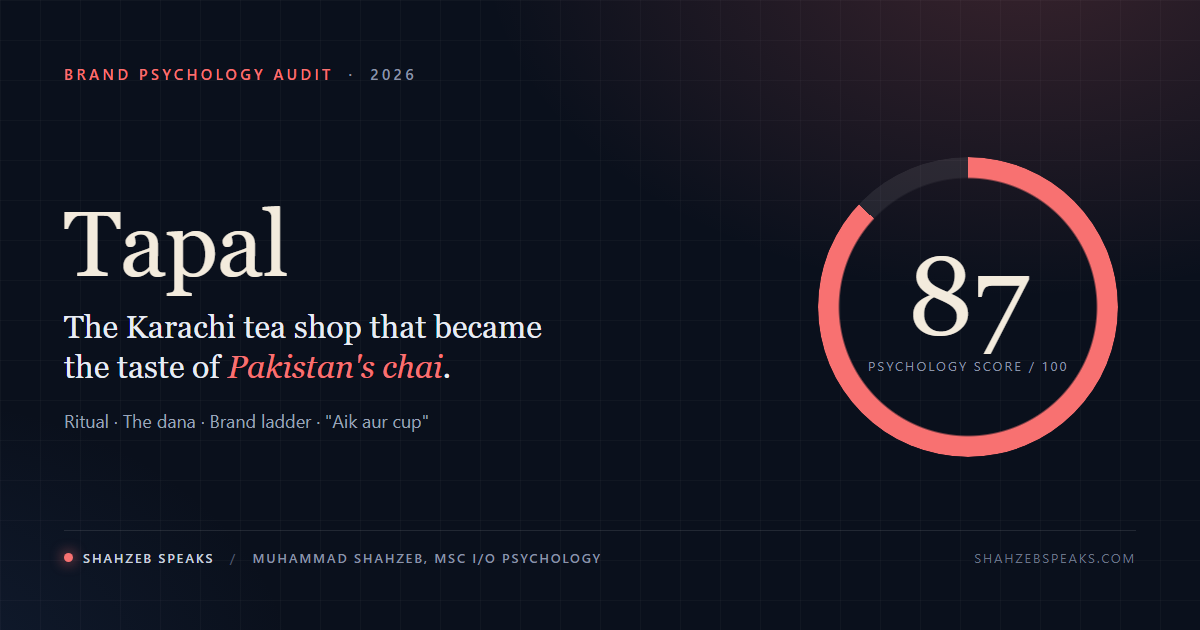
87 / 100
Overall consumer behavior effectiveness
Brand Overview
- Brand nameTapal
- Founded1947
- HeadquartersKarachi, Pakistan
- IndustryFood & Beverage
- Websitetapaltea.com ↗
Psychology Techniques Identified
- 01Chai as Social Ritual
- 02Habit & Context Cues
- 03Underdog & Local Champion Effect
- 04In-Group Trust
- 05Brand Portfolio Ladder
- 06Price Anchoring Across Tiers
- 07Visible Quality Cues (Cue Utilisation)
- 08Emotional Relationship Advertising
- 09Consumption Frequency Framing ("Aik Aur Cup")
- 10Distinctive Brand Assets
- 11Mental & Physical Availability
- 12Default Choice in Low-Involvement Purchases
Full Psychology Audit Report
In this audit
In a Karachi office at four in the afternoon, someone says “chai?” and the whole room stops. In a village in interior Sindh, a guest arrives and before any question is asked, water is on the stove. In a Lahore living room, two people who have not spoken properly in weeks sit down with one cup each, and then, without planning to, a second. Pakistan does not drink tea. Pakistan uses tea to say things it does not say out loud.
That is the market Tapal has owned for most of the last two decades. Pakistan imports almost all of its tea, and on some trade estimates it was the world’s largest tea importer in 2025, bringing in roughly $630 million worth. A large share of what Pakistanis drink is still sold loose, without a brand at all. Of the branded market, Tapal became the largest-selling tea brand in the country around 2008-2009, overtaking the multinational that had dominated it for decades.
Every business student in Pakistan seems to write a Tapal marketing report at some point. Most of them describe the 4Ps. This audit asks a different question: what does Tapal understand about the Pakistani mind that a global company with far more money did not? I am an Industrial and Organizational Psychologist based in Karachi, a few kilometres from where Tapal started, and this is a psychology teardown of Pakistan’s most intimate everyday brand.
“Tapal does not sell tea leaves. It sells the moment between two people that the tea makes possible, and it sells a visible, tangible proof of strength in a market that judges tea with its eyes before its tongue.”
— Brand Psychology Analysis, ShahzebSpeaks
📋 Brand Overview: Tapal at a Glance
| Company Name | Tapal Tea (Pvt.) Ltd. |
| Founded | 1947, as a shop in Jodia Bazaar, Karachi, by Adam Ali Tapal |
| Headquarters | Karachi, Pakistan |
| Ownership | Family-owned and privately held |
| Key Brands | Danedar (flagship granular tea), Family Mixture, Mezban, Tezdum, Chenak, plus green and flavoured teas |
| Market Position | Pakistan’s largest-selling tea brand since around 2008-2009; published estimates of its branded share vary widely by source |
| Main Competitors | Unilever’s Lipton and Supreme, Eastern Tea’s Vital, regional brands, and unbranded loose tea |
| Market Context | Pakistan imports nearly all its tea (about $630 million in 2025 on trade estimates), mostly from Kenya |
| Psychological Code | Strong enough to see, shared enough to matter |
| Psychology Score | 87 / 100 — ⚡ High Impact |
📜 Chapter 1: The History — From a Jodia Bazaar Shop to the Number One Cup (1947–2026)
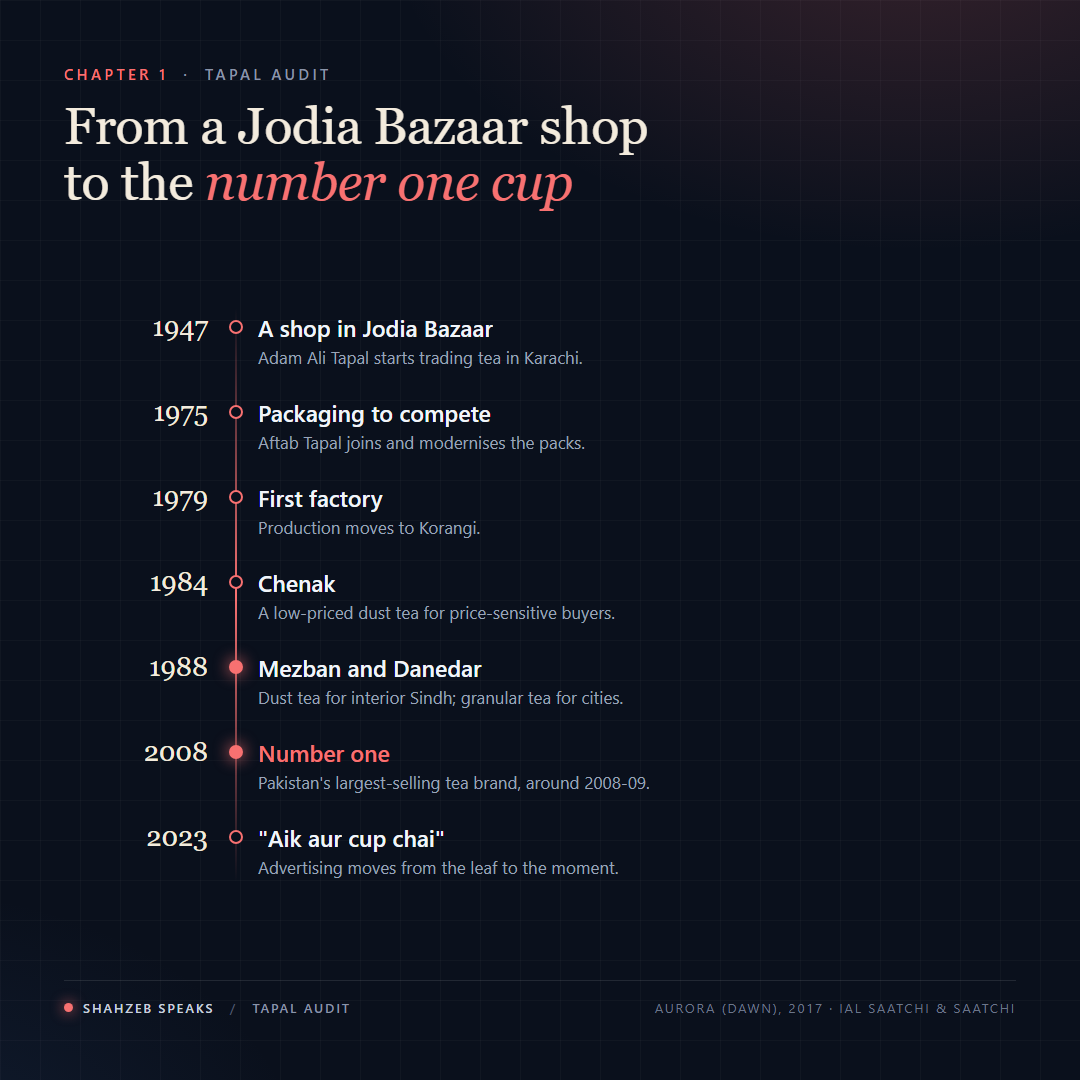
🏪 1947: A shop in Jodia Bazaar
Tapal began in the year Pakistan did, as a small tea shop in Jodia Bazaar, Karachi’s old wholesale market, founded by Adam Ali Tapal. For decades it was a trader and blender, not a national brand. Multinational companies owned the branded market, and a large part of the country drank loose tea bought by weight.
🏭 1975–1979: Packaging and a factory
According to Dawn’s Aurora magazine, Aftab Tapal, of the family’s third generation, joined in 1975 and pushed the company toward better packaging so it could compete with international brands on the shelf. In 1979 the company moved into its first factory in Korangi.
🗺️ 1980s: A brand for every kind of household
The 1980s built the portfolio that still defines Tapal. Aurora reports the launch of Chenak in 1984, a low-priced dust tea aimed at Thar, and of Mezban and Danedar in 1988: Mezban as a dust tea for interior Sindh, Danedar as a granular Kenyan tea for urban households. Family Mixture, a blend of leaf and dust, offered a middle path. Chapter 4 explains why this ladder was the company’s most important strategic decision.
👑 2008–2009: Number one
Aurora reports that Tapal became Pakistan’s largest-selling tea brand around 2008-2009, overtaking the multinational leader. Aftab Tapal credited “an unwavering focus on quality and continued innovation,” and noted that the multinationals “did not pay much attention” to the company in its early years, which worked in its favour.
☕ 2023–2026: Selling the moment, not the leaf
Recent advertising has moved from product to relationship. The Danedar campaign “Tum, Mein, Aik Aur Cup Chai,” created by IAL Saatchi & Saatchi, is built on the idea that with someone you love, it is never just one cup. Chapter 6 explains why that line is psychologically sharper than it first appears.
🫖 Chapter 2: What Chai Means in Pakistan
Before any brand strategy, there is a cultural fact that Tapal understood better than its competitors: in Pakistan, tea is less a drink than a social instrument.
Hospitality. Offering tea to a guest is close to obligatory, and refusing it can feel like refusing the relationship. The act of making tea says “you are welcome here” before anyone speaks.
Pause and permission. “Chai break” is often the only culturally accepted pause in a working day. It is where office gossip, reconciliation and real decisions happen, away from the formal meeting.
Intimacy without words. Offering someone a cup can be an apology, a thank-you or an invitation to talk. In a culture where many feelings are not stated directly, tea carries them.
Ritual and habit. Most households drink tea at fixed moments: morning, after meals, when guests arrive, in the afternoon. Habit research by Wendy Wood and colleagues shows that behaviour tied to stable contexts runs largely on automatic cues. A brand that becomes part of that ritual is not chosen each morning. It is reached for.
This matters because it defines what the product actually is. A multinational can treat tea as a commodity category with a global brand on top. Tapal’s advantage was treating tea as a local ritual that happens to require leaves.
🏠 Chapter 3: The Local Champion Against the Multinational
For decades, the branded tea market in Pakistan was dominated by multinationals, most prominently Unilever with Lipton and, after it acquired the brand in the 1990s, Brooke Bond Supreme. Tapal’s rise to leadership is a classic story of a local company beating a global one on its home ground, and the psychology behind that is instructive.
The underdog becomes the insider
Research on the “underdog effect” in branding, notably by Neeru Paharia and colleagues in the Journal of Consumer Research in 2011, found that consumers often favour brands with an underdog story of external disadvantage combined with passion and determination, especially when they identify with that struggle themselves. A Karachi family business competing with a global corporation has exactly that narrative, and many Pakistani consumers relate to it.
Home-country and in-group trust
People extend more trust to members of their in-group. For a product as intimate as the tea you serve your family and guests, “made by people like us, in our city” is a meaningful signal. Tapal’s Karachi roots and family ownership work as a quiet form of in-group identity that a global brand cannot easily copy.
Understanding taste locally
Local knowledge also shows in the product. Tapal blended for Pakistani tastes and preparation: strong, milky tea boiled in the pan, where colour, strength and aroma matter more than subtle notes. A brand optimised for how Pakistanis actually make chai has an advantage over one designed for a global palate.
The honest caveat, which I return to in Chapter 9, is that “local champion” is a powerful story only while the product keeps its promise. The in-group bonus disappears fast if quality drops or prices feel unfair.
🪜 Chapter 4: The Tier Ladder — A Tea for Every Wallet and Region
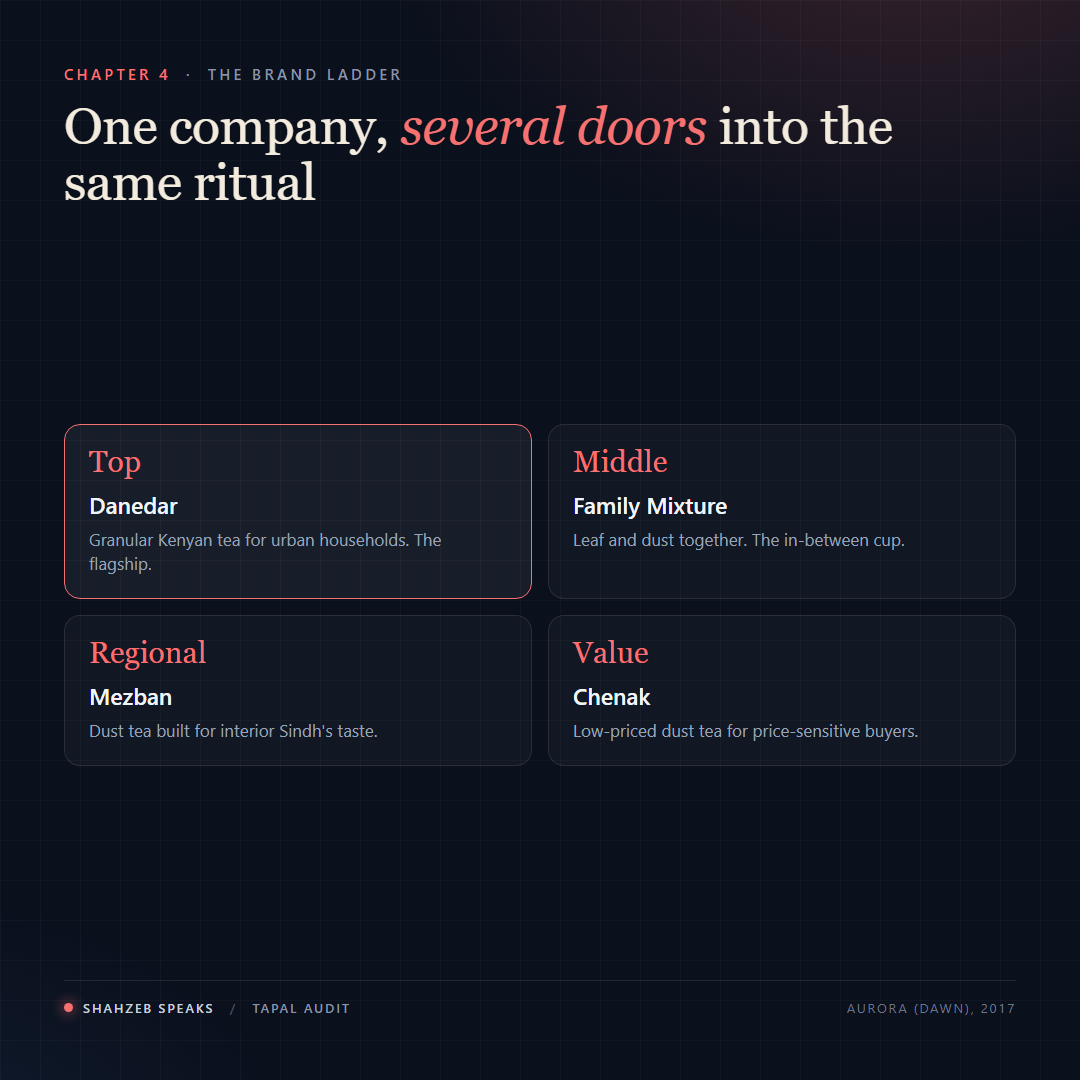
Tapal’s most important strategic decision was not a campaign. It was building a portfolio of brands matched to different households, regions and budgets, rather than one national brand at one price.
- Chenak: a low-priced dust tea, which Aurora describes as launched for Thar and positioned against a competitor’s economy brand.
- Mezban: a premium dust tea for interior Sindh. Aurora reported in 2017 that Mezban held around 90% of the branded dust tea segment, a figure worth treating as a 2017 estimate.
- Family Mixture: a blend of leaf and dust, offering the middle ground.
- Danedar: granular Kenyan tea, the flagship for urban middle-class households.
Psychologically, this ladder does three things at once.
It meets different taste identities. Dust tea and granular tea are not only price tiers; they produce different colour, strength and brewing behaviour, and different regions have strong preferences. A household in rural Sindh is not a “cheaper version” of a Karachi household. It has its own standard of a good cup.
It keeps customers inside the company when income changes. When prices rise or incomes fall, a customer can trade down from Danedar to Family Mixture without leaving Tapal. When incomes rise, they can trade up. The company, not the competitor, captures both movements.
It creates anchors. Premium variants make mid-tier brands look sensible by comparison, and economy brands make the flagship feel like an affordable upgrade. I covered this mechanism in my article on the decoy effect and in the anchoring bias article: the price of one option changes how the others feel.
👁️ Chapter 5: The Dana — Quality You Can See
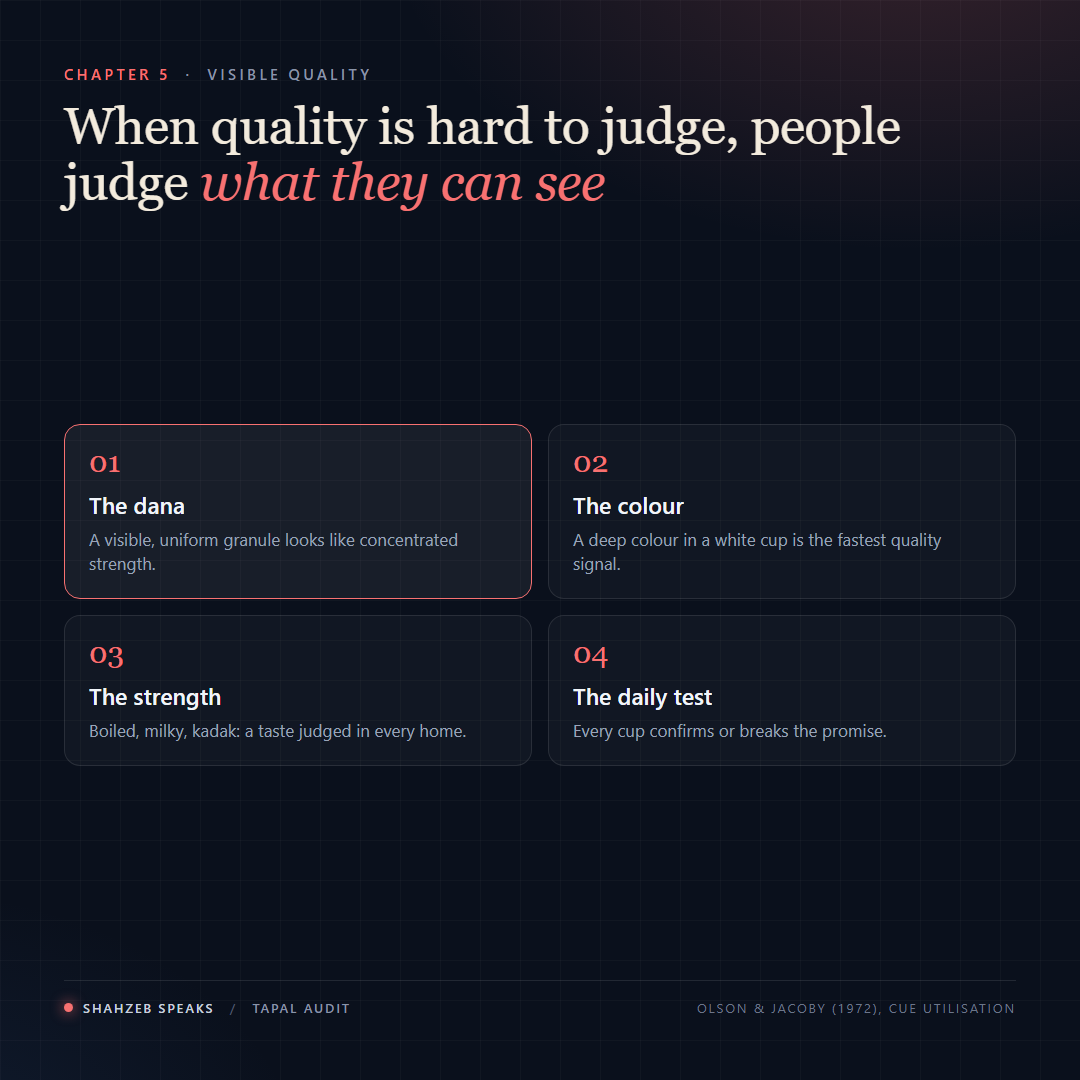
The name “Danedar” means granular, from dana, a grain. It is not only a product description. It is a quality signal.
Most consumers cannot evaluate tea quality directly. They do not know the estate, the grade or the processing. When quality is hard to judge, psychology research on cue utilisation shows that people rely on visible, easy-to-read signals instead. For packaged foods these include colour, texture and anything tangible that seems to indicate strength or freshness.
Tapal made the granule itself the cue. A visible, uniform grain looks like concentrated, strong tea. The customer can see it in the pack and in the spoon, and then confirm it in the cup through colour and strength. The brand name tells people what to look for, and the product delivers what they see. That loop between promise and visible evidence is one of the most effective trust mechanisms in food branding.
This also explains why colour and strength dominate so much tea advertising in Pakistan. A rich, deep colour in a white cup is the fastest quality signal a viewer can process. The consumer’s own experience at home then either confirms or contradicts it every single day, which makes consistency non-negotiable.
❤️ Chapter 6: “Tum, Mein, Aik Aur Cup Chai” — Selling the Second Cup
The Danedar campaign “Tum, Mein, Aik Aur Cup Chai” (“you, me, and one more cup of tea”) is built on a simple observation: with someone you love, one cup is never enough. On the surface it is a warm relationship ad. Underneath, it is precise brand psychology.
It attaches the brand to a relationship, not a product feature. The campaign does not claim the tea is stronger, fresher or better value. It claims a place in the most intimate moments between two people. Emotional brand associations of this kind are far harder for competitors to displace than functional claims, because they do not invite comparison.
It legitimises a second cup. “Aik aur cup” normalises more consumption without ever mentioning quantity or price. The extra cup is framed as extra time with a loved one, not as extra tea. For a consumable product, increasing frequency of use is worth more than winning a new customer, and this line does it gently.
It uses the “us” frame. “Tum, mein” is a pairing, not an individual. It connects the brand to belonging and togetherness, which in a collectivist culture is a stronger motivator than individual indulgence. Compare global coffee advertising, which often sells a personal moment of self-reward; Tapal sells a shared moment.
It aligns with ritual. As Chapter 2 showed, tea is already how Pakistanis create moments of connection. The campaign does not ask people to change behaviour. It names what they already do and places the brand inside it, which is the most efficient kind of advertising there is.
🎨 Chapter 7: Distinctive Brand Assets
Byron Sharp’s work at the Ehrenberg-Bass Institute emphasises distinctive brand assets: colours, shapes, logos and sounds that make a brand instantly recognisable at the point of purchase. In a crowded shelf of similar packs, recognition in a fraction of a second decides a large share of habitual purchases.
Tapal’s portfolio uses consistent packaging colours per sub-brand, which lets shoppers find “their” tea without reading, and makes Danedar, Family Mixture and Mezban recognisable as separate identities within one family. For a product bought weekly or monthly, often by habit and sometimes by a family member sent to the shop, this matters enormously. The easiest brand to buy again is the one you can find without thinking.
The limitation is that many tea brands in Pakistan use similar warm reds, oranges and golds to signal strength and warmth. Distinctiveness within a category that shares a colour language is harder to achieve, and it rests heavily on the logo and sub-brand names.
🛒 Chapter 8: Distribution as Psychology
Aurora reports that Tapal moved from company-owned vans to an independent distributor network managing its many variants across the country. Distribution is usually treated as logistics, but it is also psychology.
Mental and physical availability. The Ehrenberg-Bass view of brand growth argues that brands grow mainly by being easy to think of and easy to buy for as many people as possible. For tea, “easy to buy” means being present in every small kiryana store, not only in supermarkets. A brand that is always there becomes the default.
Defaults win in low-involvement purchases. Tea is bought frequently, at modest prices, often by habit. In such categories people rarely deliberate. If the familiar pack is on the shelf, it is bought. Availability does the persuading.
This is also why loose, unbranded tea remains a major competitor: it is available everywhere, often cheaper, and sold by a trusted local shopkeeper who can vouch for it personally.
⚠️ Chapter 9: The Dark Side and the Risks
💸 Inflation and an imported product
Pakistan imports nearly all its tea, mostly from Kenya, so its cost is tied to global prices and the rupee exchange rate. When the rupee weakens sharply, as it did in 2022 and 2023, tea becomes more expensive regardless of what any brand does. Price rises on a daily ritual are felt personally, and a brand that has built emotional warmth is vulnerable to feeling betrayed when the cup costs more.
🧺 The loose-tea competitor
Unbranded loose tea competes on price and on the personal trust of the local shopkeeper. When budgets tighten, some households switch to loose tea, which undermines the branded market as a whole. Tapal’s economy brands exist partly to hold these customers.
🧪 Quality consistency is the whole promise
Because Tapal’s positioning rests on visible strength and trusted quality, any perceived drop in quality is expensive. Customers judge every cup against memory. The promise is renewed or broken daily, in millions of kitchens.
📱 Relevance with younger consumers
Younger urban Pakistanis increasingly experiment with coffee, café culture and imported beverages. Tea remains dominant, but the brand’s challenge is to stay part of younger people’s identity rather than being seen as their parents’ habit. The shift to relationship-centred advertising helps, but digital presence and youth culture remain areas where a family business is often slower than multinational competitors.
🌍 Ethics of the supply chain
Global tea supply chains have faced long-running concerns about plantation workers’ pay and conditions, particularly in East Africa. Consumers in Pakistan rarely ask these questions today, but brands that source heavily from Kenya are exposed if they become more visible.
⚔️ Chapter 10: Competitive Positioning
| Competitor | Psychological Position | Where Tapal Wins or Loses |
| Lipton and Supreme (Unilever) | Global quality, long heritage, big advertising budgets | Tapal wins on local identity and taste fit; loses on international prestige |
| Vital (Eastern Tea) | Energetic challenger, value and strength | Tapal wins on scale and trust; must defend price-sensitive segments |
| Loose tea (khuli patti) | Cheapest, personal trust in the local shopkeeper | Tapal wins on consistency and hygiene; loses on price during inflation |
| Regional brands | Deep local loyalty in specific areas | Tapal’s regional sub-brands such as Mezban are its answer |
| Coffee and café culture | Modern, aspirational, youthful | The long-term identity threat among young urban consumers |
The pattern is clear. Tapal rarely wins on prestige or price alone. It wins on fit: fit with local taste, fit with regional preferences, fit with the ritual. Its competitors can match its budgets or its prices; matching its understanding of the Pakistani cup has proved much harder.
📊 Chapter 11: Psychology Scorecard — Detailed Ratings
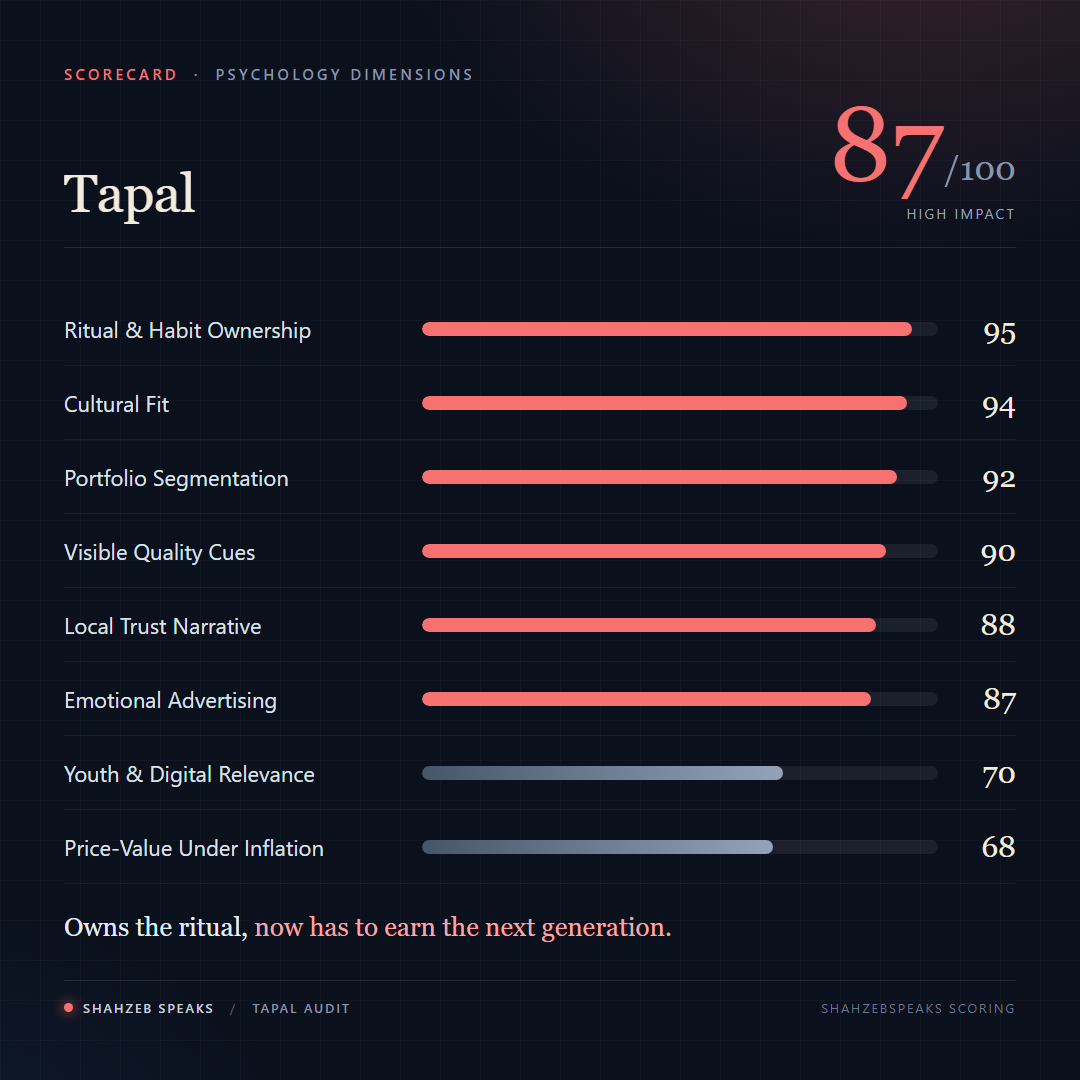
| Psychology Dimension | Score | Verdict |
| Ritual & Habit Ownership | 95/100 | Part of the daily rhythm of millions of households. |
| Cultural Fit | 94/100 | Treats chai as a social instrument, not a commodity. |
| Portfolio Segmentation | 92/100 | A brand for each region and budget keeps customers inside the company. |
| Visible Quality Cues | 90/100 | The dana turns an invisible quality into something you can see. |
| Local Trust Narrative | 88/100 | A Karachi family business that beat a multinational. |
| Emotional Advertising | 87/100 | “Aik aur cup” sells togetherness and a second cup at once. |
| Youth & Digital Relevance | 70/100 | Risks being the parents’ brand as café culture grows. |
| Price-Value Under Inflation | 68/100 | An imported staple exposed to the rupee and loose-tea competition. |
| OVERALL PSYCHOLOGY SCORE | 87/100 | ⚡ High Impact — the brand that understood the Pakistani cup better than the companies that came before it. |
✅ Chapter 12: Balance Sheet & A Psychologist’s Prescription
💪 Psychological Strengths
- Ritual ownership: embedded in daily, habitual moments that rarely involve deliberate choice
- Cultural understanding: sells the moment between people, not the leaf
- A ladder, not a single brand: customers can trade up or down without leaving the company
- A visible quality cue: the granule makes strength something you can see
- Local champion story: in-group trust that a global brand cannot easily buy
- Availability: present in the small shops where most tea is bought
⚠️ Psychological Weaknesses
- Price exposure: an imported product in a currency-sensitive economy
- Loose-tea competition: strongest exactly when budgets are tightest
- Youth relevance: café culture and coffee are claiming the younger urban identity
- Shared colour language: distinctiveness is harder in a category that uses the same warm colours
- Daily quality test: any inconsistency is noticed in millions of cups
🔮 The Prescription
- Be honest about price when it moves. When import costs force increases, explain them plainly, and protect a clearly affordable option. A ritual brand survives price rises better when customers feel respected rather than surprised.
- Take “aik aur cup” into younger rituals. Study break, late-night work, cricket with friends, office chai rounds. Place the brand inside the moments young people already share instead of competing with café culture on its own terms.
- Make the quality cue verifiable. Show where the tea comes from and how it is graded. In a market with adulteration concerns around loose tea, transparent sourcing is a trust advantage branded tea can own.
- Strengthen distinctive assets. Consistent, instantly recognisable pack design and a signature sound or line across all media make the brand easier to find in a shared colour language.
- Tell the Karachi story more. The Jodia Bazaar beginning and the win against multinationals is a genuine, emotionally powerful narrative that younger Pakistanis often do not know.
📝 Final Verdict
Tapal’s story is often told as a marketing case study about packaging and distribution. Those mattered. But the deeper reason it became Pakistan’s leading tea brand is psychological: it understood that chai in Pakistan is a social act, that quality is judged by what people can see, and that one national brand at one price could never serve a country of very different households.
So it built a ladder of brands for different tastes and budgets, made the granule itself the proof of strength, and increasingly sells not the tea but the moment between people that the tea creates. “Tum, mein, aik aur cup chai” is not an advertising slogan so much as a description of how the country already behaves.
Its challenges are real: an imported product exposed to the rupee, loose tea that competes hardest when budgets are tightest, and a younger generation drawn to café culture. But a brand that owns a ritual has a rare advantage. It does not need to be chosen every day. It only needs never to give people a reason to stop.
Psychology Score: 87/100 — Tapal earns elite marks for ritual and habit ownership (95), cultural fit (94), portfolio segmentation (92) and visible quality cues (90), held back by youth and digital relevance (70) and price-value under inflation (68). The brand that understood the Pakistani cup, now working to keep the next generation at the table.
🧠 Want a Psychology Audit for Your Pakistani Brand?
I’m Muhammad Shahzeb, an MSc Industrial Psychologist and web developer in Karachi. I audit how Pakistani brands connect with local rituals, price tiers and trust, and show where your customers’ real reasons for buying differ from the ones in your marketing plan.
📚 References & Sources
- Aurora Magazine (Dawn). “Tapal’s journey to the top.” November-December 2017. (Company history, 1975-2009 milestones, product launches, Aftab Tapal quotes.)
- Tapal Tea. Official website and legacy pages. tapaltea.com
- IAL Saatchi & Saatchi. “Tapal Danedar – Tum mein aik aur cup chai.” Campaign case page.
- World’s Top Exports. “Tea Imports by Country 2025.” (Pakistan tea import value.)
- The Observatory of Economic Complexity. “Tea in Pakistan trade.” (Import sources.)
- Wood, W., & Neal, D. T. (2007). “A new look at habits and the habit-goal interface.” Psychological Review, 114(4), 843-863.
- Paharia, N., Keinan, A., Avery, J., & Schor, J. B. (2011). “The underdog effect: The marketing of disadvantage and determination through brand biography.” Journal of Consumer Research, 37(5), 775-790.
- Sharp, B. (2010). How Brands Grow: What Marketers Don’t Know. Oxford University Press.
- Romaniuk, J. (2018). Building Distinctive Brand Assets. Oxford University Press.
- Olson, J. C., & Jacoby, J. (1972). “Cue utilization in the quality perception process.” Proceedings of the Annual Conference of the Association for Consumer Research, 167-179.
Audit conducted by Muhammad Shahzeb, MSc Industrial & Organizational Psychology | Brand Psychology Specialist | Karachi, Pakistan
Learn more about my approach →
Key Findings
- Tapal grew from a 1947 shop in Jodia Bazaar into Pakistan's largest-selling tea brand around 2008-2009, overtaking a multinational that had led the market for decades
- Its advantage is psychological fit: it treats chai as a social instrument of hospitality and connection rather than as a commodity drink
- A ladder of brands, from Danedar for urban households to Mezban for interior Sindh and Chenak for price-sensitive buyers, lets customers trade up or down without leaving the company
- The name Danedar turns the visible granule into a quality cue, giving customers something to see in a category where quality is otherwise hard to judge
- "Tum, Mein, Aik Aur Cup Chai" sells togetherness and a second cup at the same time, attaching the brand to relationships rather than product claims
- Its main risks are an imported product exposed to the rupee, loose-tea competition when budgets tighten, and relevance with younger urban consumers drawn to café culture
Overall Psychology Score
Tapal scores 87/100 in our comprehensive psychology audit covering consumer behavior strategies, UX design principles, and psychological marketing effectiveness.
The detailed dimension scores are in the audit's Psychology Scorecard chapter.
High impactMuhammad Shahzeb
MSc Industrial Psychologist, specializing in consumer behavior, UX psychology, and brand strategy analysis. Helping brands understand the psychology behind their success.
About Muhammad Shahzeb →