Mondelēz Psychology Audit — The Snack Drawer Empire
Mondelēz turned Oreo, Cadbury and Toblerone into habits of shape and colour, then faced a €337.5m EU fine and a November 2026 trademark allegation. Scored 80/100.

80 / 100
Overall consumer behavior effectiveness
Brand Overview
- Brand nameMondelēz International
- Founded2012
- HeadquartersChicago, Illinois, United States
- IndustryFood & Beverage
- Websitewww.mondelezinternational.com ↗
Psychology Techniques Identified
- 01Von Restorff Effect / Distinctiveness (Toblerone Shape)
- 02Colour Association & Fluency (Cadbury Purple, Pantone 2685C)
- 03Mere Exposure & Familiarity (Zajonc 1968)
- 04Habit Loop: Cue, Routine, Reward (Oreo Twist, Lick, Dunk)
- 05Ritual & Social Bonding (Shared Eating Occasions)
- 06Social Proof & Ubiquity (The Snack Drawer)
- 07Loss Aversion (Kahneman & Tversky 1979; Shrinkflation Reaction)
- 08Anchoring via Small-Pack Pricing
- 09Endowment & Familiarity (Portfolio Breadth)
- 10Scarcity & Limited Editions (Flavour Refreshes)
- 11Authority & Heritage Transfer (1824, 1908, 1912 Brand Dates)
- 12Gifting Framing (Toblerone Travel Retail)
Full Psychology Audit Report
In this audit
Open a kitchen drawer in almost any country and you will find the same small argument in foil and cardboard: a purple bar, a black-and-white biscuit, a triangular box that does not fit neatly beside anything else. You did not choose that drawer in one decision. You built it over years, one familiar shape and colour at a time. Mondelēz International is the company that owns most of that drawer, and its psychology is not about one great advertisement. It is about shape, colour, ritual, and habit, repeated until choice feels like recognition.
I am an Industrial and Organizational Psychologist in Karachi, and I audit brands by testing their psychology against their evidence: what the brand claims, what it actually does, and what the numbers support. Mondelēz is a useful test because it is both ordinary and enormous. Created in 2012 from the split of Kraft Foods, headquartered in Chicago, and reporting net revenue of $36.44 billion in 2024, it sells in more than 150 countries through brands older than the company itself: Oreo from 1912, Cadbury from 1824, Milka from 1901, Toblerone from 1908. This audit works through how those brands earn attention, where the psychology turns sharp, and why a November 2026 trademark allegation over a chocolate shape is, for this company, not a side story but the main story.
“Mondelēz does not ask you to discover a new taste. It asks you to recognise an old shape, in a familiar colour, and to repeat a small ritual you learned as a child.” — Brand Psychology Analysis, ShahzebSpeaks
📋 Brand Overview
| Field | Detail |
|---|---|
| Brand | Mondelēz International, Inc. |
| Founded | 1 October 2012, from the split of Kraft Foods Inc. |
| Headquarters | Chicago, Illinois, United States |
| Website | mondelezinternational.com |
| Flagship brands | Oreo, Cadbury, Milka, Toblerone, Ritz, Chips Ahoy! |
| Scale | Net revenue $36.44 billion in 2024; presence in more than 150 countries |
| Psychology Score | 80/100 |
🏛️ Chapter 1: History — a new company with very old brands
Mondelēz is young as a company and old as a shelf. The name itself, from the French word for world and a blend suggesting delicious snacks, was chosen for the global snacking business when Kraft Foods split in 2012. The North American grocery business kept the Kraft name. Mondelēz kept the brands that travelled: biscuits, chocolate, gum and candy, and powdered drinks, sold through a system built for scale rather than for novelty. That history explains its psychology. Mondelēz rarely needs to introduce a brand from nothing. It needs to keep brands that are already familiar feeling familiar, while quietly changing what sits behind them: recipes, pack sizes, factories, and prices.
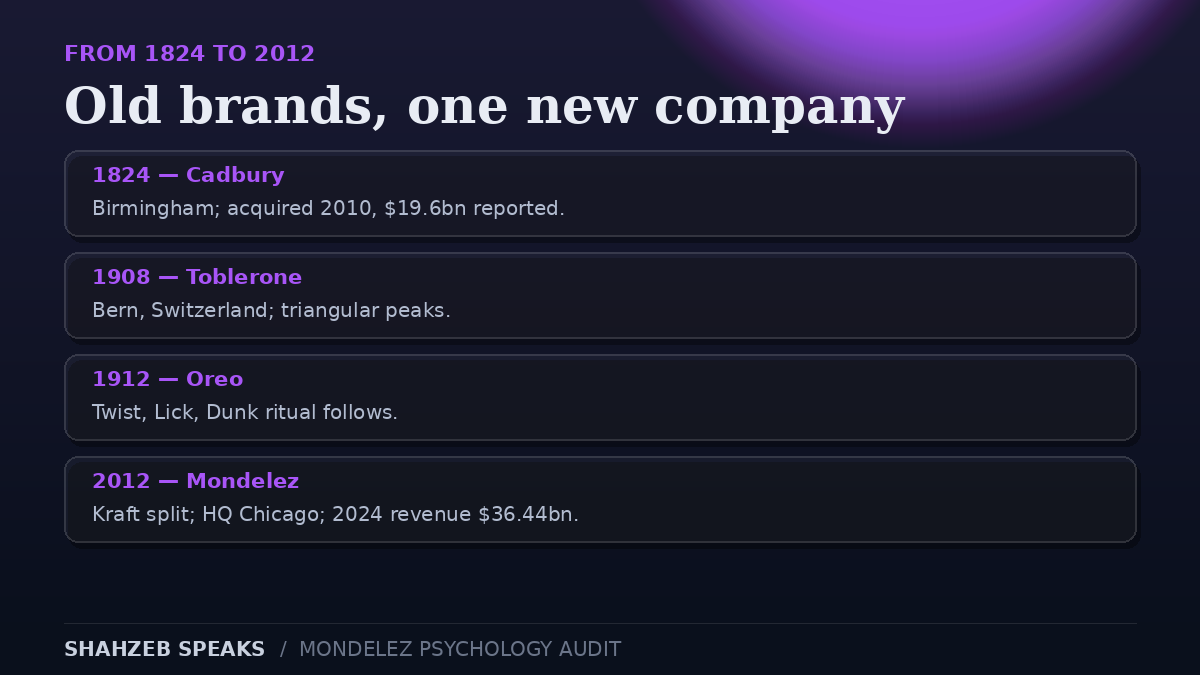
Cadbury dates to 1824 in Birmingham, England, and was acquired by Kraft in 2010, before the split, for a reported $19.6 billion. Toblerone was created in Bern, Switzerland, in 1908. Oreo was launched in 1912. Milka dates to 1901. When Mondelēz was formed, it inherited not only factories and distribution, but also memories: the taste of a childhood biscuit, the colour of a bar bought on a journey, the shape of a gift brought home from an airport. A brand audit that ignores those memories misses the product. For Mondelēz, the product is partly the memory, and the psychology chapters that follow are about how that memory is protected, refreshed, and, at times, spent.
🔺 Chapter 2: Shape as identity — the Toblerone lesson (von Restorff effect)
The von Restorff effect, also called the isolation effect, says that an item that stands out from its neighbours is more likely to be remembered. Toblerone is the textbook case, because the product itself is the distinctive item. A row of triangular peaks, in a triangular box, does not look like other chocolate. It does not need a logo to be recognised on a shelf or in a hand. The shape does the work that, for most brands, packaging must do. That is why shape, for Toblerone, is not decoration. It is the brand asset, and it is why a dispute about shape, discussed in Chapter 8, matters so much to Mondelēz.
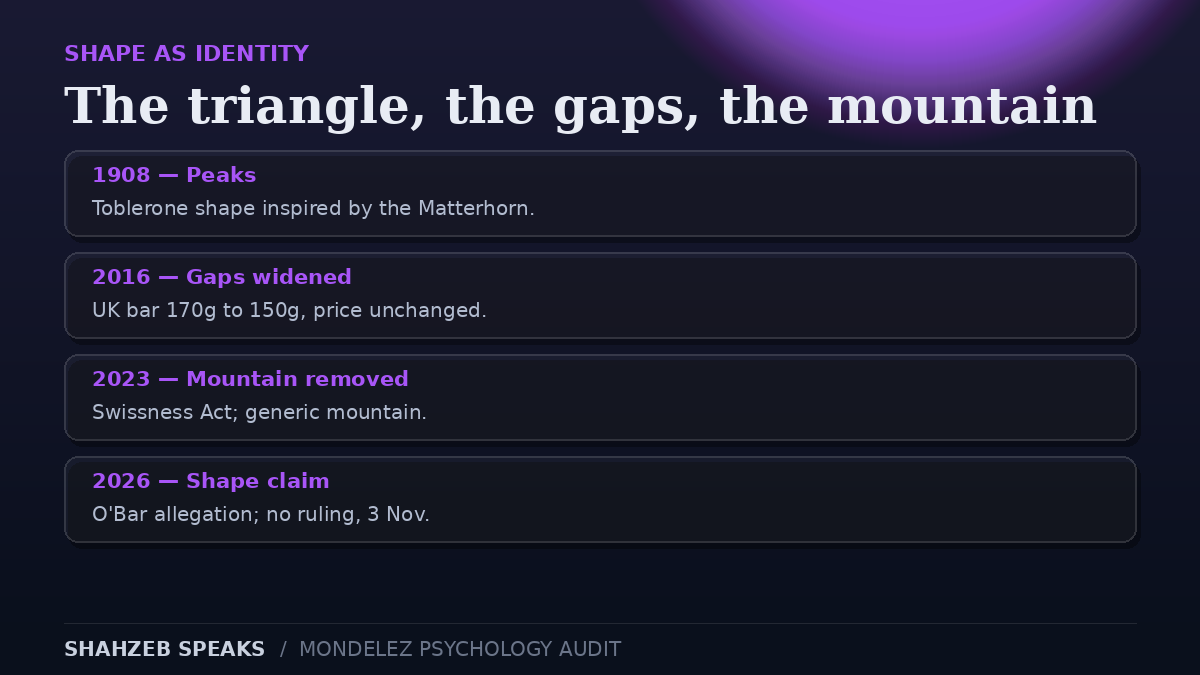
The shape story also shows how distinctiveness can be damaged by quiet changes. In 2016, Mondelēz widened the gaps between the peaks of UK Toblerone bars, cutting the 170g bar to 150g while keeping the price and the box size the same. Customers noticed at once, and the change became a symbol of shrinkflation: shrinking a product instead of raising its price. The original shape was restored in 2018, but the episode left a lesson that Mondelēz, and every maker of a distinctive product, should have kept: people do not only buy the taste. They buy the object they remember, and when the object changes without warning, the feeling is not that the price changed. It is that trust changed. A distinctive shape is a promise, and a promise broken quietly is remembered loudly.
The Matterhorn episode in 2023 made the same point from the other direction. Toblerone had carried the Matterhorn on its packaging since 1970, with a hidden bear, the heraldic animal of Bern, in the mountain’s shadow. When part of production moved to Slovakia, Switzerland’s Swissness Act, in force since 2017, meant the bar could no longer use Swiss symbols in the same way. Mondelēz replaced the Matterhorn with a more generic mountain and changed the wording from “of Switzerland” to “established in Switzerland”. The company said bars would still be produced in Switzerland, and the new design kept the triangular geometry. The episode is a clean illustration of a psychological truth: an image can claim origin so strongly that the law treats it as a claim, not as decoration. Move the factory, and you must move the mountain.
🟣 Chapter 3: Colour as ownership — Cadbury purple and Milka lilac
If Toblerone owns a shape, Cadbury owns a colour. Cadbury’s purple, Pantone 2685C, has been linked with Dairy Milk since 1914, and in 2012 Cadbury won a UK court battle against Nestlé to trademark that purple for milk chocolate in bar and tablet form, drinking chocolate, and preparations for making drinking chocolate. The scope was narrowed: the court did not grant the much broader list Cadbury had sought, and it noted, for example, that the claim for chocolate assortments was not supported in the same way. That narrowing matters, because it shows what colour ownership really is. It is not ownership of purple in general. It is ownership of a specific association, built over a century, in a specific category, where the public has learned to read the colour as the brand.
Psychologically, colour works through fluency and mere exposure, the tendency described by Robert Zajonc in 1968 to prefer things encountered before. A purple wrapper on a shelf does not need to be read. It is recognised, and recognition feels like safety. Milka works the same way with lilac and with its long-standing lilac cow, a gentler, Alpine association that signals milk, mountains, and tenderness rather than luxury. Together, Cadbury purple and Milka lilac show Mondelēz’s colour strategy at its best: choose one colour, use it without variation for decades, and let the colour do the work of a name in a busy shop. The risk, as with shape, is that colour ownership invites disputes, and disputes invite the public to ask whether a colour can really belong to one company. The 2012 case answered that question narrowly, in Cadbury’s favour, for a defined set of products. It did not answer it for all time.
🥛 Chapter 4: Ritual as habit — Twist, Lick, Dunk
Oreo’s psychology is different again. It is not shape or colour, though the black-and-white biscuit is distinctive. It is ritual. “Twist, Lick, Dunk” turns eating a biscuit into a small sequence: twist the biscuit open, lick the cream, dunk the biscuit in milk. The ritual was refreshed in the UK in March 2026 with a campaign inviting consumers to film how they eat an Oreo, and it has been used, in local forms, in many markets for years. A ritual matters because it changes the product from something consumed to something performed. Performance creates memory, and memory creates repetition. A child who learns the ritual from a parent, as many do, is not only learning how to eat a biscuit. They are learning a family moment, and the biscuit becomes the prop for that moment.
The habit loop, cue, routine, and reward, explains why the ritual is so durable. The cue is the biscuit itself, or the milk beside it. The routine is the twist, the lick, the dunk. The reward is sensory, the contrast of crisp biscuit and sweet cream, and social, the shared laughter when the biscuit breaks in the milk. Mondelēz does not need to persuade a new customer with an argument. It needs to keep the ritual available, affordable, and present in the places where families shop and children ask. Limited editions and local flavours refresh the loop without breaking it: a new flavour gives a reason to repeat the ritual, and the ritual gives the new flavour a familiar frame. That is a strong psychology, and it is also a fair one, provided the ritual is not used to hide changes in size, price, or ingredients that a reasonable customer would want to know.
🧠 Chapter 5: Familiarity, fluency, and the snack drawer
Across its brands, Mondelēz benefits from a single, compounding effect: familiarity. A shopper who has seen Oreo, Cadbury, Ritz, and Toblerone for years does not evaluate each purchase from scratch. They recognise, they reach, and they move on. That fluency feels like preference, and in many cases it is preference, built from genuine past enjoyment. But fluency can also hide a lack of comparison. When every option in a drawer is a Mondelēz brand, the choice is not between Mondelēz and a rival. It is between Mondelēz products, and the company wins either way. Portfolio breadth is therefore a psychological strategy as well as a commercial one: own enough familiar brands, and the shelf itself becomes the advertisement.
That breadth also explains why Mondelēz can survive a controversy in one brand better than a single-brand company could. A Toblerone shrinkflation story, or a Cadbury recipe debate, dents one association. It does not empty the drawer. The cost is different: breadth makes the company harder to hold to account for any single decision, because attention moves on to the next familiar product. The audit’s judgement here is balanced. Familiarity earned through consistent quality is a legitimate asset. Familiarity used to carry a quiet price rise, a smaller pack, or a changed recipe past a customer who is not looking is a different matter, and Mondelēz’s own history contains both kinds of familiarity.
💰 Chapter 6: Pricing psychology — small packs, small prices, big habits
Mondelēz sells many of its products in small, low-priced formats, and that format is itself a psychology. A small bar or a single-serve pack lowers the barrier to a first purchase and to a repeat purchase. It also makes a price rise harder to notice when it arrives as a smaller pack rather than a higher shelf price, which is why shrinkflation stories attach themselves to this company so readily. The Toblerone 2016 case is the famous example, but the principle is general: when the pack stays the same size and the contents shrink, the customer is being asked to pay the same for less, without being told in the moment of purchase. A company that values trust should announce such a change plainly, on the pack, before the customer opens it at home.
There is a second pricing psychology at work in gifting and travel retail, where Toblerone in particular is sold as a gift. A triangular box is not an efficient shape for a shelf, but it is an excellent shape for a present. It signals that the chocolate is not only for eating, but for giving, and giving changes the price sensitivity: a gift buyer is less likely to compare grams per pound than a buyer for themselves. Mondelēz has used that gifting frame for decades, and it is a legitimate use of packaging psychology, provided the gift framing does not become a cover for a smaller bar at a premium price. The test, again, is transparency: does the buyer know what they are giving, in weight as well as in shape?
👥 Chapter 7: Community and occasion — who the brands are for
Mondelēz brands are rarely sold as solitary luxuries. They are sold as shared occasions: a biscuit with tea, a bar broken and shared, a box brought home from a trip. That occasion framing is psychologically powerful because it ties the product to a social moment rather than to hunger alone. A Cadbury bar shared between friends, an Oreo ritual performed with a child, a Toblerone bought at an airport for someone waiting at home: each occasion gives the product a role in a relationship, and relationships are harder to break than habits. Social proof reinforces the effect. When a brand is everywhere, in every shop and every drawer, its ubiquity reads as endorsement. Everyone buys it, so it must be safe to buy.
The limit of occasion framing is that it can normalise frequent, low-nutrition snacking by wrapping it in warmth. Mondelēz does not claim its chocolate and biscuits are health foods, and this audit makes no health claim about them either. The psychological point is narrower: when a product is always presented as a shared treat, the customer is less likely to count how often the treat occurs. A responsible version of occasion marketing would pair the warmth with clear portion and frequency cues, and with small formats that make a single occasion genuinely single. Mondelēz’s small-pack formats help here, but only if the customer can see, and choose, the small pack rather than being nudged, by shelf placement and price, towards the large one.
⚠️ Chapter 8: The dark side — a €337.5m fine and a November 2026 allegation
Every audit in this series has a chapter where the psychology meets the law, and for Mondelēz that chapter has two parts, with very different legal statuses, which must not be confused. The first part is a final decision. On 23 May 2024, the European Commission fined Mondelēz €337.5 million for hindering cross-border trade of chocolate, biscuits and coffee products between EU member states, in breach of EU competition rules. The Commission found 22 anticompetitive agreements or concerted practices aimed at restricting cross-border trade, and an abuse of a dominant position in certain national markets for chocolate tablets, including refusing to supply a broker in Germany to prevent resale in higher-priced territories. The fine was reduced by 15% because Mondelēz cooperated and acknowledged liability. The Commission’s point was consumer-facing: retailers could not freely source products from lower-priced member states, so consumers paid more. That is a finding, not an allegation, and it belongs in any honest audit of this company.
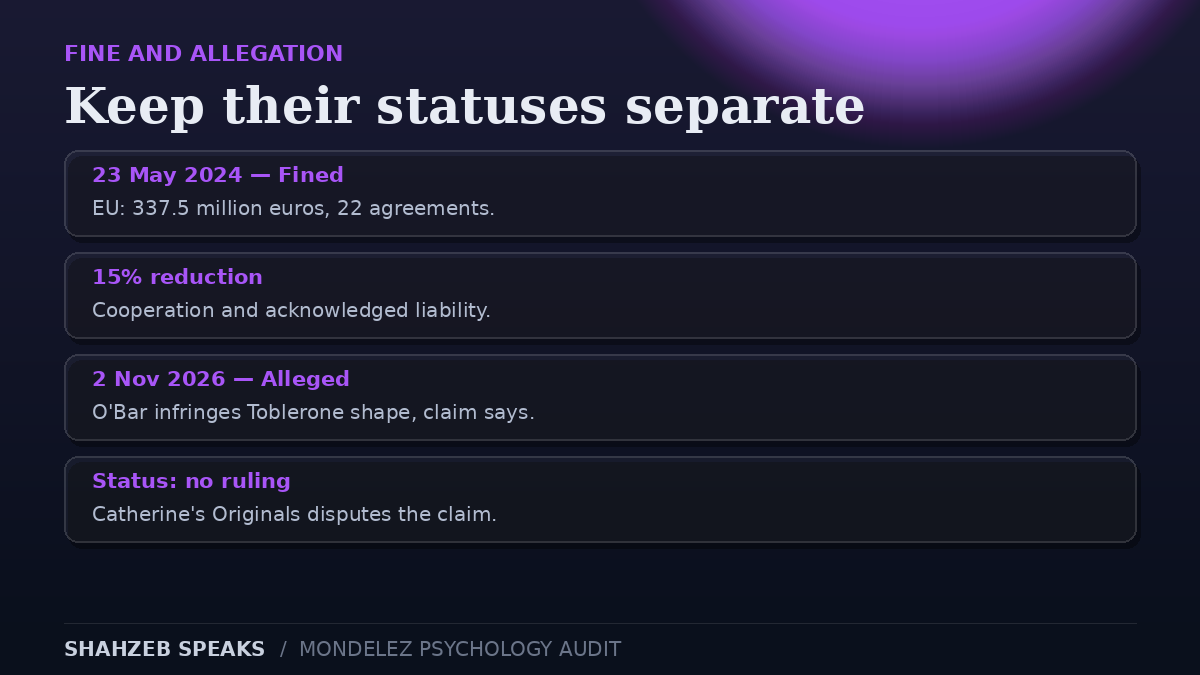
The second part is live and unproven. On 2 November 2026, news reports described legal action at the UK High Court, brought by Kraft Foods Schweiz Holding GmbH, a Mondelēz group entity, against Catherine’s Originals, a small British vegan brand founded by Catherine Dodd in 2021. Mondelēz ALLEGES that Catherine’s O’Bar, with chunky, rounded segments, infringes Toblerone’s trademark shape and takes unfair advantage of its reputation, and could mislead shoppers into believing there is a commercial connection. Mondelēz said it had tried to resolve the matter directly over several months without agreement. Dodd disputes the claim, says her business has no commercial affiliation with Toblerone or Mondelēz, and says she will defend it. As of 3 November 2026, there is NO court ruling on this claim, and this audit does not predict one. The contrast matters: a company fined for restricting trade is now asking a court to restrict a rival’s shape. Both stories can be true, and neither, on its own, settles whether a triangular, or rounded, chocolate bar belongs to one company.
There is a wider psychological question inside that contrast. When a company owns a distinctive shape, defending it can look like protecting customers from confusion, or like using size to intimidate a small rival. Which reading is fair depends on evidence a court has not yet given: how similar the products really are, how shoppers actually perceive them, and whether the smaller brand’s packaging and name make confusion likely. Until that evidence is tested, the honest position is to report the allegation, report the denial, and withhold judgement. What can be judged now is the optics. A company with a €337.5 million cross-border fine on its record, suing a small vegan business over a shape, will be read by many shoppers as a giant defending a mountain, not a brand defending a customer. That reading may be unfair to the legal merits. It is, nonetheless, the psychology Mondelēz must manage.
🇵🇰 Chapter 9: What brands elsewhere should — and should not — copy
Copy this: choose one distinctive cue, shape or colour, and protect it by using it consistently for decades, not by changing it every season. Toblerone’s shape and Cadbury’s purple work because they have not changed casually. Copy the ritual too: a small, repeatable sequence that turns consumption into a shared moment is worth more than a slogan, and it is harder for a rival to copy than a price. Copy the portfolio discipline as well: own a set of familiar brands that cover different occasions, so that a customer can stay within your world without feeling trapped in one product.
Do not copy the quiet shrink. If a pack must get smaller, say so on the pack, in plain words, before purchase. Do not copy the cross-border restriction that led to the €337.5 million fine: partitioning markets to maintain higher prices is not a psychology strategy, it is a competition breach, and it costs more in trust than it gains in margin. And do not copy the habit of defending a distinctive asset only through lawyers. A shape or colour is defended first by keeping the product worthy of recognition, and only second by a court. A small rival that feels bullied becomes a story, and in 2026, a story travels faster than a trademark filing.
📊 Psychology Scorecard
The scorecard below rates Mondelēz on eight dimensions, each from 0 to 100. The overall score is the rounded average of the eight.
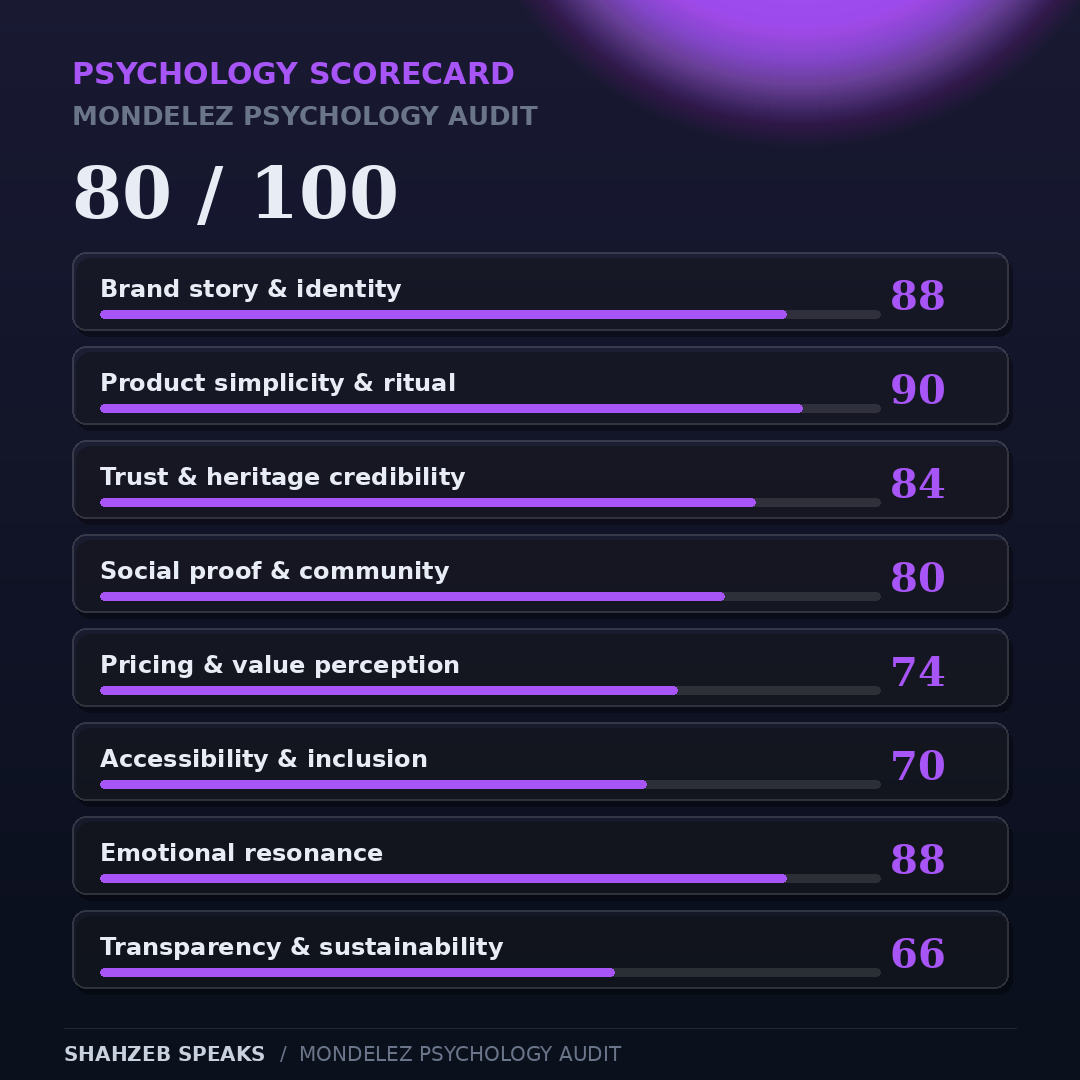
| Dimension | Score | Verdict |
|---|---|---|
| Brand story & identity | 88 | Centuries-old brands, held together by one company story. |
| Product simplicity & ritual | 90 | Twist, Lick, Dunk is the strongest ritual in snacking. |
| Trust & heritage credibility | 84 | Heritage is real, but shrinkflation episodes dent it. |
| Social proof & community | 80 | Ubiquity reads as endorsement in every drawer. |
| Pricing & value perception | 74 | Small packs help, but quiet size cuts hurt value trust. |
| Accessibility & inclusion | 70 | Widely available, yet small-format and price clarity vary. |
| Emotional resonance | 88 | Childhood, travel, and sharing give the brands warmth. |
| Transparency & sustainability | 66 | The EU fine and the live shape claim weigh heavily here. |
Arithmetic: 88 + 90 + 84 + 80 + 74 + 70 + 88 + 66 = 640; 640 / 8 = 80.
✅ Balance sheet & prescription
On the credit side, Mondelēz owns the most durable psychology in food: distinctive shapes and colours, a ritual that children learn from parents, and a portfolio so familiar that choice feels like recognition. On the debit side, it has spent that familiarity at times: a quiet shrink in 2016, a cross-border restriction fined in 2024, and a live trademark allegation in 2026 that, whatever its legal merits, reads to many shoppers as size against a small rival. The prescription is therefore simple, and it is the same for every distinctive brand: announce size and recipe changes on the pack, keep cross-border pricing explainable, and defend shape and colour by keeping the product excellent, not only by filing claims. Trust, for a snack company, is not a slogan. It is the feeling, on opening a familiar box, that what is inside is what you remember. Protect that feeling, and the score rises. Break it quietly, and no amount of purple or triangular packaging will restore it.
📝 Final Verdict
Mondelēz is a master of recognition, and a cautionary tale about what recognition costs when it is spent carelessly. Its brands will survive a lawsuit and a fine, because drawers do not empty overnight. Whether they keep their warmth depends on a narrower question: will the next change to a familiar bar be announced plainly, or discovered quietly at home? Answer that question well, and the snack drawer stays a place of pleasure. Answer it badly, and it becomes a place of suspicion.
“Psychology Score: 80/100 — A drawer full of memories, defended by shape and colour, and tested by how openly it changes.”
📬 Which Mondelēz brand do you recognise first?
Is it the purple, the triangle, or the twist? Contact me and tell me which cue you spotted first, and whether a smaller pack or a changed shape ever broke your trust in a familiar brand.
For the broader field behind this audit, see my homepage on industrial psychology in Pakistan, and for related audits, see the PG Tips audit and the Coca-Cola audit.
📚 References & Sources
- European Commission (2024). Commission fines Mondelēz €337.5 million for cross-border trade restrictions. Press release IP/24/2727, 23 May 2024.
- Just-Food (2026). Mondelez enters trademark battle with UK start-up Catherine’s Originals. 2 November 2026.
- Vegan Food & Living (2026). Mondelēz sues vegan chocolate brand Catherine’s Originals over O’Bar shape. 2 November 2026.
- Associated Press via WAMC (2023). Toblerone is no longer Swiss enough to feature the Matterhorn on its packaging. 6 March 2023.
- Snack Food & Wholesale Bakery (2012). Cadbury trademarks its purple. 3 October 2012.
- Zajonc, R. B. (1968). Attitudinal effects of mere exposure. Journal of Personality and Social Psychology, 9(2), 1-27.
- Kahneman, D., & Tversky, A. (1979). Prospect theory: An analysis of decision under risk. Econometrica.
- von Restorff, H. (1933). Über die Wirkung von Bereichsbildungen im Spurenfeld. Psychologische Forschung, 18, 299-342.
Key Findings
- Mondelēz International was created 1 October 2012 from the Kraft Foods split; headquarters Chicago, Illinois; net revenue $36.44 billion in 2024; presence in more than 150 countries.
- Flagship brands predate the company by decades: Cadbury 1824, Toblerone 1908, Oreo 1912, Milka 1901; Cadbury was acquired in 2010 for a reported $19.6 billion.
- Toblerone's triangular shape is its main distinctive asset: UK gaps were widened in 2016, cutting the bar from 170g to 150g at the same price, before the original shape was restored in 2018; the Matterhorn image was removed from packaging in 2023 under Switzerland's Swissness Act.
- Cadbury purple (Pantone 2685C) was trademarked in the UK in 2012 for milk chocolate in bar and tablet form, in a narrowed scope; Oreo's Twist, Lick, Dunk ritual remains the portfolio's strongest repeatable habit.
- Legal record: the European Commission FINED Mondelēz €337.5 million on 23 May 2024 for hindering cross-border trade (22 agreements; 15% reduction for cooperation). Separately, on 2 November 2026 Mondelēz ALLEGED at the UK High Court that Catherine's Originals' O'Bar infringes Toblerone's trademark shape; Catherine's Originals disputes the claim; NO court ruling as of 3 November 2026.
- Score 80/100: 88+90+84+80+74+70+88+66 = 640; 640/8 = 80.
Overall Psychology Score
Mondelēz International scores 80/100 in our comprehensive psychology audit covering consumer behavior strategies, UX design principles, and psychological marketing effectiveness.
The detailed dimension scores are in the audit's Psychology Scorecard chapter.
High impactMuhammad Shahzeb
MSc Industrial Psychologist, specializing in consumer behavior, UX psychology, and brand strategy analysis. Helping brands understand the psychology behind their success.
About Muhammad Shahzeb →