Liquid Death Psychology Audit — Murder Your Thirst: The Psychology of Water in a Beer Can
A psychology audit of Liquid Death, the canned-water brand valued at $1.4 billion in March 2024. How a $1,500 viral ad, a beer-can design, death-metal albums made from hate comments and engineered sellouts built a cult — plus the two filed, undecided lawsuits, and what Pakistani brands should copy.

83 / 100
Overall consumer behavior effectiveness
Brand Overview
- Brand nameLiquid Death
- Founded2017
- HeadquartersLos Angeles (Marina del Rey), California, USA
- IndustryFood & Beverage
- Websiteliquiddeath.com ↗
Psychology Techniques Identified
- 01Expectancy Violation (Beer-Can Design)
- 02Costly Signalling ($1,500 Viral Ad)
- 03Social Identity & Tribe Building (“Greatest Hates”)
- 04Benign Violation Theory (Shock Stunts)
- 05Scarcity & Drop Mechanics (Sellout Collabs)
- 06Mere Exposure (Entertainment Engine)
- 07Moral Identity (Death to Plastic)
- 08Disfluency Dividend (Scary Outside, Simple Inside)
- 09Von Restorff Effect (Aisle Distinctiveness)
- 10Identity-Based Packaging (Alcohol Codes for Water)
- 11Earned Media Engineering (Stunts as Ads)
- 12Ritual & Collectibility (Limited Drops)
Full Psychology Audit Report
In this audit
It is 11 pm at a house party in Austin, Texas. Someone reaches into the cooler, pulls out a tall black can with a skull on it, cracks it open — and drinks water. Nobody laughs at the joke anymore, because the joke won. The can that looks like it should contain the most irresponsible decision of your evening contains the most responsible one. Liquid Death does not sell water. It sells the feeling of drinking something dangerous while staying completely safe — and that feeling turned out to be worth $1.4 billion.
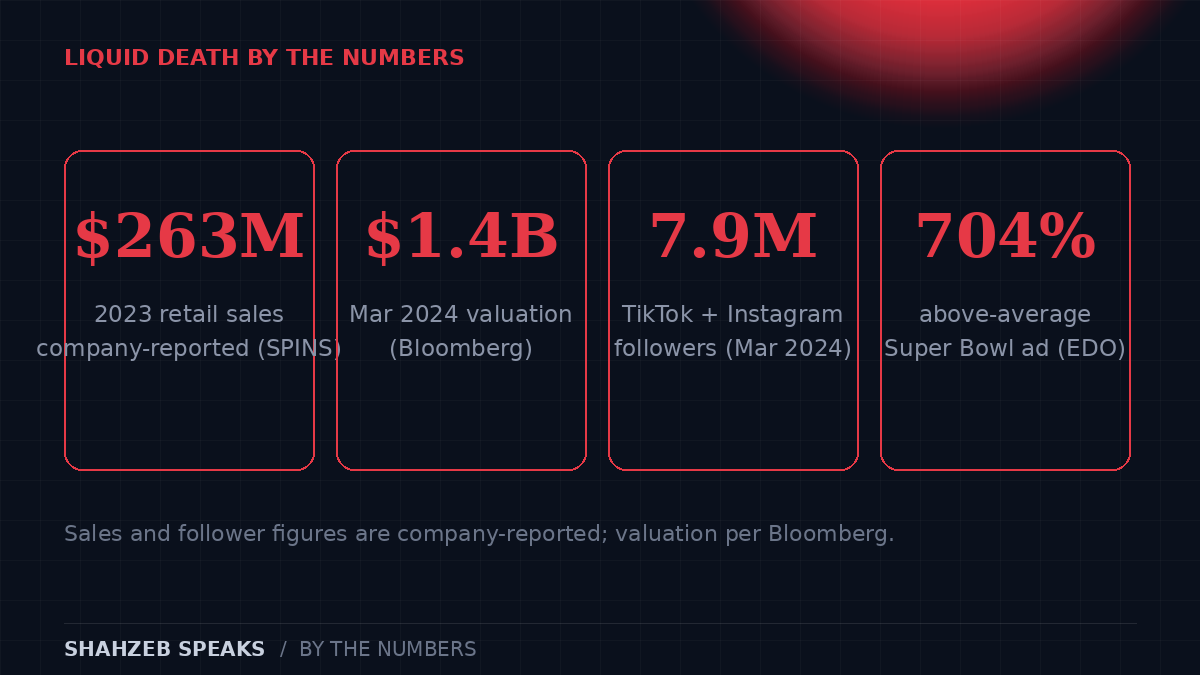
That number needs its label before anything else. In March 2024, Bloomberg reported that Liquid Death raised $67 million at a $1.4 billion valuation, doubling its 2022 valuation. The company, founded in 2017 by former advertising creative Mike Cessario, did not sell its first can until 2019. By 2023 it reported $263 million in retail scanned sales — its own figure, via SPINS data cited by Retail Dive — with triple-digit growth for the third consecutive year. Its slogans are “Murder Your Thirst” and “Death to Plastic.” Its cans are aluminium, marketed as infinitely recyclable. And its marketing team, in Cessario’s words, is run “more like ‘Saturday Night Live'” than a beverage company.
I am an Industrial and Organizational Psychologist, and this audit looks at Liquid Death the way a psychologist would: as a near-perfect demonstration that in a commodity category, the product is not the product — the meaning is. Expectancy violation, costly signalling, benign violations, scarcity, social identity and moral identity are all here, executed with unusual discipline. So are two filed lawsuits, an honest caveat about aluminium cans, and a business model that secondary markets now doubt. Every number below comes with its source and its date.
“Liquid Death understood something the water industry never did: nobody photographs a plastic bottle. The can looks like beer, the name sounds like a threat, and the liquid is water — three violations of expectation stacked inside one object you can hold. It is the most distinctive thing in the beverage aisle, which is exactly what the psychology of attention predicts will win.”
— Brand Psychology Analysis, ShahzebSpeaks
📋 Brand Overview: Liquid Death at a Glance
| Brand | Liquid Death (operating company: Supplying Demand, Inc.) |
| Founded | 2017; first cans sold 2019. Founder: Mike Cessario, co-founder & CEO, former advertising creative |
| Headquarters | Los Angeles (Marina del Rey), California |
| Valuation | $1.4 billion — March 2024 financing round (Bloomberg). Still private as of 10 Oct 2026 |
| Scale | $263 million in 2023 retail scanned sales (company-reported, SPINS via Retail Dive); ~60,000 US stores as of Jan 2023 |
| Product lines | Mountain Water (still & sparkling); flavoured sparkling; soda-flavoured sparkling; iced teas; Sparkling Energy (Dec 2025); Death Dust powders |
| Slogan | “Murder Your Thirst” · “Death to Plastic” |
| Model | Premium canned beverages sold on brand and entertainment, not on water |
📜 Chapter 1: The History — From a $1,500 Ad to a $1.4 Billion Can
🎸 2009: The Warped Tour idea
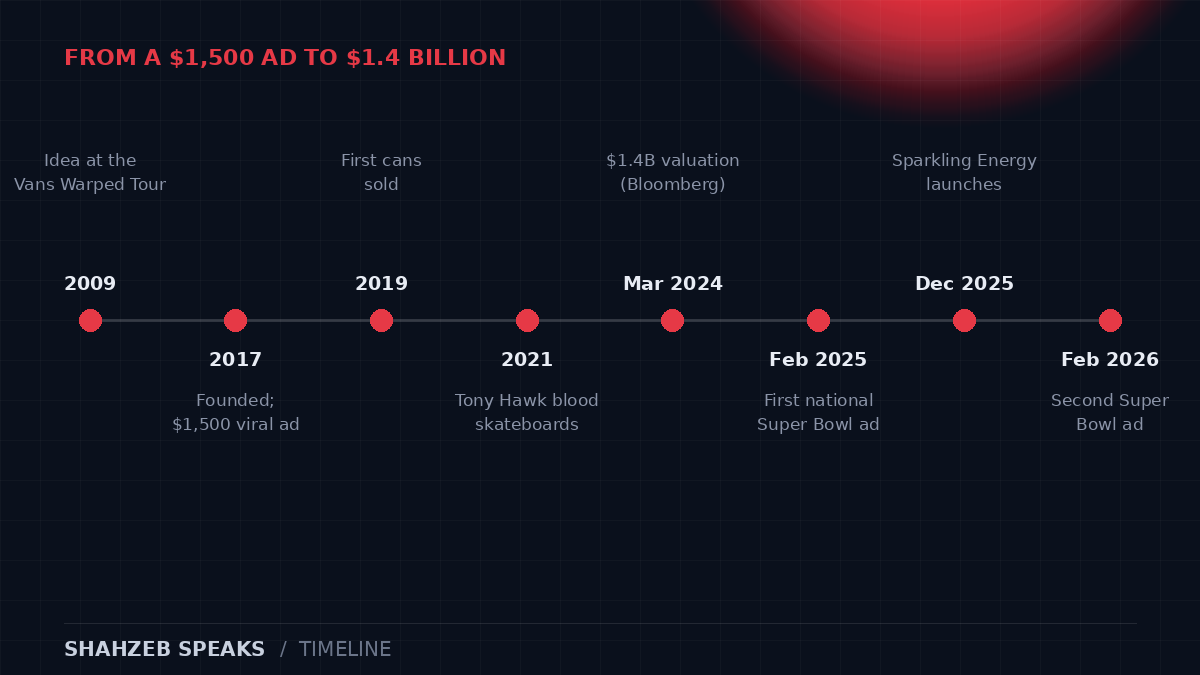
Mike Cessario got the idea in 2009 at the Vans Warped Tour music festival, noticing musicians drinking water from Monster Energy-branded cans. His question, later quoted from a CNBC interview: “Why aren’t there more healthy products that still have funny, cool, irreverent branding? Because most of the funniest, most memorable, irreverent branding marketing is all for junk food.” He spent the next decade as an advertising creative — over ten years at agencies including VaynerMedia and Crispin Porter + Bogusky, working on campaigns for Netflix and Organic Valley — before acting on it.
🎬 2017: A commercial for a product that did not exist
In 2017 Cessario trademarked the name, launched a Facebook page with no product, and shot a launch commercial for $1,500: $1,000 to his wife’s actress friend, $200 for a borrowed camera, a friend’s empty downtown Los Angeles office on a weekend — and a Miller Lite can angled to hide the label standing in for the product. The video went viral with millions of views. Within months, the Facebook page had more followers than Aquafina. Demand was proven before a single can existed.
🥫 2019: The first cans
Liquid Death did not start selling water until 2019, two years after the viral ad. The original water was sourced from the Austrian Alps; in 2023 the company shifted production to the US after ocean-freight costs hurt margins. The can was designed from the start to look like beer — tallboy format, skull logo, gothic type — deliberately, so it would photograph like alcohol on social media.
🩸 2021–2022: Blood, metal and the big game
The stunt era began in earnest. In August 2021, 100 Tony Hawk skateboards painted with the skater’s actual blood sold at $500 each and sold out in 20 minutes. In May 2020 the brand had already released “Greatest Hates,” a death-metal album with lyrics taken verbatim from real hate comments. In February 2022 came a regional Super Bowl spot: children chugging cans to Judas Priest’s “Breaking the Law,” staged to look like a beer advertisement.
💰 2023–2024: Scale and the unicorn round
By January 2023 the brand was in 60,000 US stores. Cessario reported $45 million in 2021 revenue and projected $130 million for 2022 — his own figures. In March 2024, the $67 million round at a $1.4 billion valuation (Bloomberg) made it a unicorn, with investors including Live Nation, actor Josh Brolin and NFL player DeAndre Hopkins. Total raised reached nearly $342 million.
⚡ 2025–2026: Energy drinks and the mainstream
In February 2025 Liquid Death aired its first national Super Bowl ad — a $7M+ buy. In December 2025 it launched Sparkling Energy with 100mg of caffeine, co-formulated with longevity specialist Dr. Darshan Shah. In February 2026 it returned to the Super Bowl a second consecutive year. As of 10 October 2026, the company is still private, has hired Goldman Sachs to explore an IPO (reported 2023, no filing), and faces two filed lawsuits (Chapter 10).
🍺 Chapter 2: The Beer in the Water Aisle — Expectancy Violation
Walk down any water aisle and everything whispers: blue labels, mountain springs, purity. Then one object shouts. A tall black can, a skull, gothic lettering, the words “Murder Your Thirst.” Your brain does a double take — and that double take is the entire business strategy.
In 1933, Hedwig von Restorff showed that when several similar items are presented together, the one that stands out is remembered far better — the isolation effect. I have written about it before in my von Restorff effect piece: weird brands win because memory is comparative. Liquid Death is the purest commercial application I have audited. It did not try to be the best water. It tried to be the only water your eyes land on.
The second mechanism is expectancy violation. Psychologist Judee Burgoon (1978) showed that when communication violates expectations, attention spikes and the violation itself gets scrutinised. A water brand that looks like a beer brand violates two expectations at once: the category’s visual code (blue, calm, pure) and the occasion code (a menacing can at a party should mean alcohol). The 2022 regional Super Bowl ad staged this violation deliberately — children chugging cans to Judas Priest, framed exactly like a beer commercial, until you realise it is water.
This was not an accident of taste. Fast Company reported that the packaging was “aimed at inspiring customers to photograph it and share pictures on social media.” Cessario put it more bluntly: “There’s no reason that only beer is allowed to look cool and do funny things.” The can is a social object first and a container second. Nobody photographs a plastic bottle. Everybody photographs the skull can — which means every customer is a billboard the company does not pay for.
💸 Chapter 3: The $1,500 Bet — Costly Signalling
Before Liquid Death had water, investors, or revenue, it had a $1,500 commercial starring a Miller Lite in disguise. That looks like a joke. Through the lens of signalling theory, it was the most serious thing the company ever did.
Biologist Amotz Zahavi’s handicap principle (1975) argues that signals are believable precisely when they are costly to fake: a peacock’s tail proves fitness because a weak bird could not afford it. In markets, the logic transfers. Cessario could not afford a real product, a real shoot, or real media. What he could afford was public failure — putting a ridiculous ad for non-existent water in front of the internet, where flopping would have marked him as a joke permanently. The millions of views and a Facebook page that within months had more followers than Aquafina were the payoff: proof of demand that no pitch deck could fake.
The signal worked. The seed round came in 2019 (~$2.25–2.65M), then $9M in February 2020 at roughly a $50M valuation, then $23M later that year. Each round priced the brand, not the water — because the water did not exist yet when the brand proved itself. “Anybody can put water in a can,” Cessario later said. “But that’s not why we’re successful.” He is right, and the $1,500 ad is the evidence: the company sold the meaning first and the liquid second.
🤘 Chapter 4: “Greatest Hates” — Turning Hate into Belonging
Every distinctive brand collects haters. Most brands hide them. On 1 May 2020, Liquid Death released a 10-track death-metal album with lyrics taken verbatim from real hate comments about the brand — “Dumbest Name Ever for Water,” “Fire Your Marketing Guy,” “Go Out of Business” — performed by real death-metal musicians, released on Spotify and limited vinyl. Two sequels followed: a punk Vol. 2 and an ’80s-pop Vol. 3.
Henri Tajfel and John Turner’s social identity theory (1979) explains why this is brilliant rather than petty. People derive self-esteem from group membership, and groups define themselves against out-groups. The album draws the boundary in permanent ink: the people who get the joke on one side, the people writing angry comments on the other. Every hater quoted recruits for the in-group; the insult becomes membership fuel.
The same logic runs through the brand’s “sell your soul” gag — fans and ambassadors sign mock soul-selling contracts, and the Tony Hawk blood-board joke was that Hawk had “sold his soul” to Liquid Death. Signing a fake contract is a tiny commitment ritual, and commitment rituals are how groups mark belonging. The haters get an album. The fans get a contract. Both get a side.
😱 Chapter 5: Benign Violations — Why the Jokes Work
A severed-hand candle. A $182 enema kit. Skateboards painted with a celebrity’s blood. Cans containing trace amounts of Ozzy Osbourne’s saliva, sold at $450 each. Any one of these could be merely gross. Together they are a humour system — and humour has a theory.
Peter McGraw and Caleb Warren’s benign violation theory (2010) holds that humour happens when something is simultaneously wrong (a violation) and safe (benign). “Murder Your Thirst” is the formula in four syllables: murder is the violation, thirst is the benign target, and the product — water — guarantees safety. The Martha Stewart “Dismembered Moments” candle (October 2022, $58, a life-size severed hand clutching a can, with Stewart starring in a gory ad) works the same way: dismemberment is the violation, Martha Stewart is the benign frame. Nobody is actually harmed; everybody gets the joke.
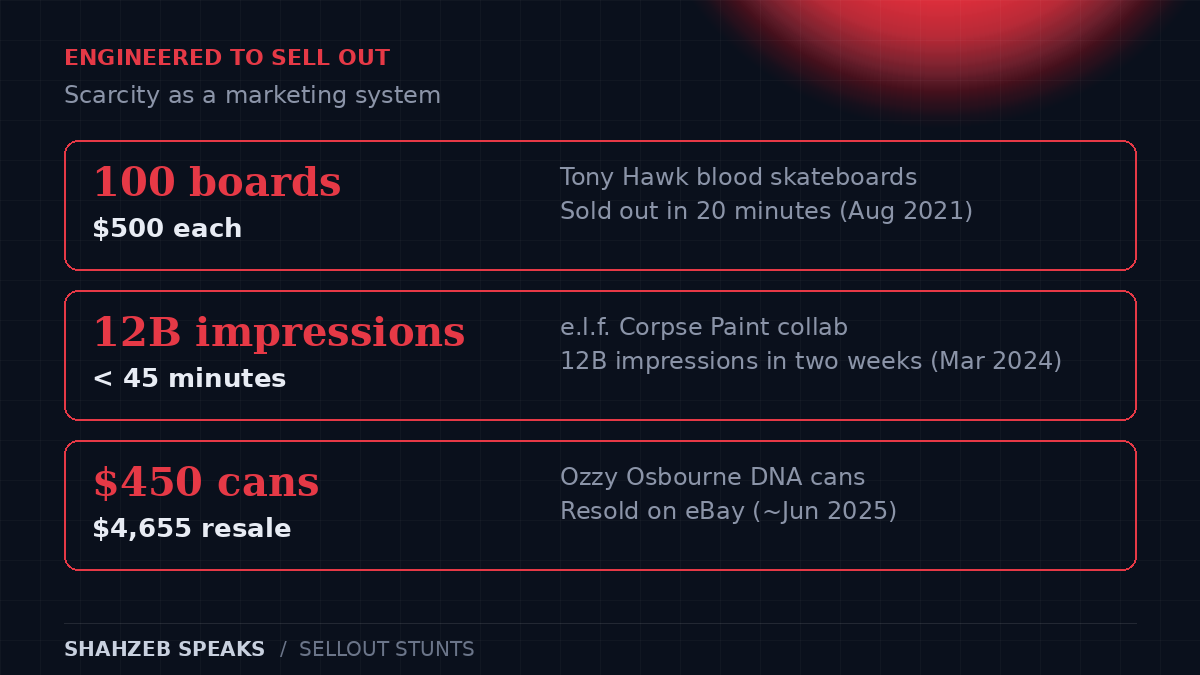
The Travis Barker “Enema of the State” kit (~May 2023, $182, a riff on Blink-182’s album) and the e.l.f. “Corpse Paint” heavy-metal makeup collaboration (March 2024) extend the pattern to partners: borrow someone else’s audience, wrap the product in their transgression, keep it safe enough to share. The e.l.f. ad reportedly generated 12 billion impressions in two weeks (Fast Company), and the limited collab sold out in under 45 minutes. Shock is not the strategy. Shock is the raw material; the strategy is making shock shareable.
The violations stay aesthetic — skulls, blood jokes, metal — never aimed at a vulnerable group. The day a joke punches down instead of sideways, the benign appraisal collapses and the same machinery produces outrage. So far, it has stayed on the safe side of its own theory.
⏳ Chapter 6: The Drop Machine — Scarcity
Robert Cialdini’s scarcity principle (Influence, 2006) is simple: we want what we might not be able to have, and we want it more when rivals want it too. Liquid Death runs scarcity like a streetwear brand. The Tony Hawk blood skateboards — 100 units, $500 each, gone in 20 minutes in August 2021. The e.l.f. Corpse Paint collection — gone in under 45 minutes in March 2024. The Ozzy Osbourne DNA cans — ten iced-tea cans the singer drank from, sold at $450 each around June 2025, one later resold on eBay for $4,655.
Three details make this more than “limited edition” stickers. First, the quantities are genuinely tiny — 100 boards, 10 cans — so the sellout is real, not staged. Second, the resale prices ($4,655 for a $450 can) create public proof that the object was underpriced, which makes the next drop feel like a lottery ticket. Third, scarcity here sells the brand, not just the object: nobody needed a blood-painted skateboard, but everyone who watched it sell out in 20 minutes learned that Liquid Death drops are events. I have covered the mechanics in my scarcity marketing piece — the pattern is identical, from Labubu to booking sites.
Even the company’s media buying follows the logic. In 2024 it auctioned advertising space on its own packaging — the “Biggest Ad Ever” — and Coinbase won, landing on 500,000 cases, which the company claimed gave it more reach than the Super Bowl. When your packaging is media inventory, you have stopped being a water company in every way that matters.
📺 Chapter 7: The SNL of Beverages — Entertainment as Marketing
“We think about our marketing team more like ‘Saturday Night Live,'” Cessario said. The headquarters has a 16-foot skateboard ramp; the office was designed “more like a clubhouse.” This is usually reported as colour. It is actually the operating model: a content studio that happens to sell beverages.
The psychology underneath is the mere exposure effect. Robert Zajonc (1968) showed that repeated exposure to a stimulus increases liking for it, even without any persuasive argument. Liquid Death’s content engine — the stunts, the collabs, the albums, the social accounts — manufactures exposures that people choose to consume, because they are funny. By March 2024 the company reported 7.9 million followers across TikTok and Instagram, and Cessario claimed it was behind only Red Bull among the most-followed beverage companies on both platforms (company figures — treat the ranking as his claim, not an independent measurement).
The two national Super Bowl ads are the exposure strategy at maximum scale. The first, on 9 February 2025 (Fox), cost $7M+ and showed surgeons, pilots, police officers and judges apparently “drinking on the job” — revealed as water and iced tea, with the tagline “Don’t be scared. It’s just water.” EDO measured it as 704% more effective than the average Super Bowl ad (a company-cited figure) and the third most engaging ad of the game. The second, on 8 February 2026 (NBC), was a PSA-style spot for the new Sparkling Energy line starring its co-formulator Dr. Darshan Shah: “Has your head ever exploded from an extreme energy drink?” — papier-mâché heads, and a “guaranteed to not explode your head” promise. Cessario’s defence of the spend: “no cheaper way to reach over 100 million unique people who actually want to pay attention to the commercials.”
Here is the part most coverage misses. The Super Bowl ads are not just reach; they are translation. The skull-can joke was born in metal and skate subcultures. A Super Bowl spot explains it to 100 million people at once without sanding off the edge. That is how a subculture brand becomes a mass brand while keeping its story intact.
♻️ Chapter 8: Death to Plastic — Moral Identity
“Death to Plastic” is the brand’s second slogan, and it does different psychological work from “Murder Your Thirst.” Where the first slogan is a joke, the second is a cause: aluminium cans marketed as infinitely recyclable, with a portion of profits pledged to anti-plastic nonprofits — 5 Gyres and The Skatepark Project were named as recipients of stunt proceeds. The customer is not just buying water in a funny can. They are voting against plastic bottles.
Psychologists Aquino and Reed (2002) described moral identity — the degree to which being a moral person is central to someone’s self-concept — and showed it predicts real behaviour, including purchasing. Liquid Death gives that identity a uniform: the skull can signals rebellion and virtue at once. You look dangerous; you feel responsible. That combination is rare and commercially powerful, because it lets the brand charge a premium that pure virtue (a worthy nonprofit) or pure edge (an energy drink) could not command alone.
Honesty requires the caveat, and I will state it plainly. All aluminium cans have plastic liners — that is an industry fact, reported by plasticstoday.com — which means “Death to Plastic” is a claim about plastic bottles, not about plastic absolutely. A rumoured California class action alleging deception over this point is unverified: I found no court record, case number, or reputable news coverage, so I am not printing it as fact. The fair reading is that the brand’s environmental claim is directionally true (aluminium is genuinely more recyclable than plastic) and literally incomplete. For a brand built on calling out nonsense, that incompleteness is a vulnerability worth watching.
🧠 Chapter 9: Scary Outside, Simple Inside — The Disfluency Dividend
There is one more mechanism at work, and it is the subtlest. “Liquid Death” is a hard name to process the first time you see it on water. It looks wrong. That wrongness is doing work.
Adam Alter and Daniel Oppenheimer’s research on cognitive disfluency (2008) found that when something is harder to process, people think about it more carefully — disfluency triggers deeper, more analytical processing, while fluency lets the brain glide past. A normal water brand is fluent: blue label, spring name, zero thought required, zero thought given. “Liquid Death” is disfluent: the brain stops, inspects, and asks what this thing is. That inspection is attention the brand did not have to buy.
The genius is in the resolution. The 2025 Super Bowl ad’s tagline — “Don’t be scared. It’s just water” — cashes in the disfluency: the scary exterior asks the question, the simple interior answers it, the relief is the reward. Each new product re-runs the arc — Severed Lime, Killer Cola, Dead Billionaire — an alarming name wrapped around something ordinary. (Flavoured sparkling, launched in January 2023, reportedly lifted company revenues by 40% within two months, per Cessario, without cannibalising the original waters; the iced teas launched in 2023 and the company claims they hit #1 in bottled iced tea sales on Amazon.)
The risk is symmetric. Disfluency that never resolves becomes confusion, and a brand that needs its punchline explained has a problem. So far the punchline — it’s just water — has stayed legible.
⚠️ Chapter 10: The Dark Side — Two Filed Lawsuits, Zero Findings
The regulatory record (as of 10 October 2026)
Two lawsuits have been filed against the company. Neither has produced a ruling, a fine, a finding, or a settlement. Keep those words exact — filed is not found.
1. The allulose “0g sugar” proposed class action — filed 24 August 2026, undecided. Williamson v. Supplying Demand Inc. was filed in the US District Court for the Northern District of California. The allegation: the “0g Sugar” / “Zero Sugar” claims on the Sparkling Energy cans (launched December 2025) are false because allulose — a monosaccharide — is the second-listed ingredient. The complaint cites FDA rule 21 CFR 101.60(c)(1) and a July 2026 Seventh Circuit ruling, Franco v. Chobani, holding that allulose counts as sugar under the FDA’s total-sugars rule. The claims run under California’s Unfair Competition Law, False Advertising Law and Consumer Legal Remedies Act, plus breach of warranty and unjust enrichment; the amount in controversy is over $5 million. It is a proposed class action — certification has not happened. No ruling, no settlement, no finding as of 10 October 2026. (Sources disagree on the case number, so I am not printing one.) BevNET’s regulatory roundup notes a second proposed class action on the same allulose issue is also pending; I could not verify its details.
2. Death Wish Coffee v. Liquid Death — filed October 2025, undecided. Death Wish Coffee sued in California federal court seeking to block Liquid Death’s planned expansion into coffee, alleging federal trademark infringement and false designation of origin / unfair competition over the “DEATH”-formative name, and asking the court to declare Liquid Death’s coffee trademarks unregistrable. No ruling as of 10 October 2026.
What I did not find: any fine, any regulatory finding, any settlement — and no public FTC or FDA enforcement action against the company (none found; absence is not proof). The rumoured “Death to Plastic” can-liner class action is unverified and I am not treating it as real (Chapter 8).
The honest business critique
The legal picture is cleaner than the business picture. The company is still private, and the private-market signals are mixed. Secondary-market indicative prices — not valuations — suggest scepticism: a CapLight secondary trade in December 2024 implied roughly $943 million, and Forge’s indicative price around September 2026 sat near $722 million, about 48% below the March 2024 round. Those are secondary-market estimates, not what the company is worth; but they are real data points about how outsiders price the risk. The company also took on debt: a $55 million revolving credit line from Ares in December 2024, and a mid-2025 move to raise up to $20 million via convertible note (an SEC filing confirmed a 4.12% note due 30 June 2028). In Q2 2025, Liquid Death was removed from the Prime Unicorn Index. None of this is fatal. All of it says the easy growth phase is over: the brand now has to prove the joke compounds.
🇵🇰 Chapter 11: What Pakistani Brands Should — and Shouldn’t — Copy
Liquid Death is not officially distributed in Pakistan. Ubuy Pakistan’s listings state the products are “not available locally” and are imported from the US store with express shipping; one grey-market listing (shoppingbag.pk) prices a 12-pack of Mango Chainsaw at Rs. 11,001. There is no official launch, partnership, or Pakistan-specific marketing as of 10 October 2026. That absence is itself the lesson: this is a brand you can study without ever tasting.
For Pakistani founders, marketers and product teams, the transferable lessons are these:
- Design for the camera, not the shelf. The can was engineered to be photographed. In a market where Instagram and TikTok are the shelf, ask of every pack design: would someone post this unprompted?
- Prove demand before you spend. The $1,500 ad validated the brand before the product existed. A weekend shoot and a social page cost less than one failed retail launch.
- Give your haters a stage. “Greatest Hates” converted mockery into membership. Pakistani brands tend to delete criticism; consider what happens if you set it to music instead.
- Scarcity needs a real constraint. 100 skateboards, 10 cans — the sellouts work because the quantities are genuinely tiny. Announcing “limited stock” of 50,000 units trains customers to disbelieve you.
- Don’t import the edginess wholesale. Skulls, blood jokes and “Murder Your Thirst” read as playful rebellion in the US. Pakistan’s cultural and religious lines around death imagery, irreverence and humour are drawn differently. The mechanism (benign violation) travels; the content must be rebuilt locally. Test the joke before you print the can.
- The punchline must survive translation to the product. “Don’t be scared. It’s just water” works because the product really is simple. If your edgy branding wraps a confusing or low-quality product, the disfluency never resolves — and customers remember the confusion, not the joke.
⚔️ Chapter 12: Competitive Positioning
Liquid Death’s moat is not water — it is meaning, and meaning is hard to copy without looking like a copy. Big Water (Aquafina, Dasani) competes on distribution and price; premium water (Fiji, Voss) competes on source mystique. Liquid Death competes on neither. It competes on identity, in the same way energy drinks compete on attitude rather than caffeine content. Its vulnerabilities are the mirror image: water is a commodity, so the premium must be re-earned with every purchase; the humour has a half-life and needs constant new material; the Sparkling Energy line walks into the most litigated claims in beverages (“0g sugar” — see Chapter 10); and the secondary-market markdowns suggest investors want proof the brand compounds rather than peaks.
The strategic question is the one Cessario himself posed to Bloomberg in March 2024: “If you have a valuable brand, it means that people have a reason to care about you beyond the small functional difference.” The functional difference here is zero — it is water. Everything is the reason to care. That is either the strongest moat in beverages or the thinnest, and the next two years will decide which.
📊 Chapter 13: Psychology Scorecard — Detailed Ratings
| Psychology Dimension | Score | Verdict |
| Distinctiveness & Brand Identity | 95/100 | A beer can in the water aisle; nobody can copy the joke without looking like a copy. |
| Earned Media & Shock Marketing | 94/100 | 12 billion impressions in two weeks; a Super Bowl ad 704% above average (EDO, company-cited). |
| Scarcity & Drop Mechanics | 90/100 | 100 skateboards in 20 minutes; every collab engineered to sell out. |
| Social Identity & Tribe Building | 88/100 | “Greatest Hates” turned mockery into membership; 7.9M followers (company figure, Mar 2024). |
| Entertainment-as-Marketing | 87/100 | An SNL-style content engine; two consecutive national Super Bowls. |
| Moral Positioning (Death to Plastic) | 74/100 | Genuine platform with real donations; the can-liner caveat keeps it honest. |
| Regulatory Resilience | 68/100 | Two filed, undecided suits and no findings — but the allulose case targets the newest line’s core claim. |
| Business Model & Unit Economics | 66/100 | $263M in 2023 sales (company claim); secondary-market prices imply scepticism — not valuations. |
✅ Chapter 14: Balance Sheet & A Psychologist’s Prescription
What Liquid Death gets right
- It proved demand with a $1,500 ad before manufacturing a single can — the cheapest market research in beverage history.
- It built distinctiveness into the object itself, not just the advertising; the can works even with the sound off.
- It converts hostility into belonging (“Greatest Hates”) and scarcity into events (the drops).
- It kept the joke benign — aesthetic transgression, never aimed at a vulnerable group.
Where it is exposed
- The “0g sugar” claim on Sparkling Energy is now the subject of a filed proposed class action; the brand’s edgiest claims invite the closest scrutiny.
- “Death to Plastic” is directionally true and literally incomplete — every aluminium can has a plastic liner.
- Humour has a half-life: the content engine must keep producing, because the product underneath is water.
- Secondary-market pricing and new debt suggest the market wants proof the brand compounds rather than peaks.
The prescription
- Resolve the allulose question fast. Whether by relabelling or by winning the argument, a “0g sugar” fight is the wrong fight for a brand whose whole promise is honesty wrapped in a joke.
- Publish the plastic math. Say plainly what “infinitely recyclable” includes and what the liner is. The brand that mocks nonsense cannot afford its own footnote.
- Keep the violations benign. The day a stunt punches down instead of sideways, the humour theory inverts. Guard the line.
- Prove the brand compounds. Repeat purchase data, not stunt impressions, is what turns a $1.4 billion round into a $1.4 billion company. Publish it.
📝 Final Verdict
Liquid Death is the clearest case I have audited of a brand beating a commodity by refusing to compete in it. The water is irrelevant; the meaning is everything. Expectancy violation gets the attention, benign violation makes it funny, costly signalling proved the demand, scarcity makes it urgent, social identity makes it tribal, entertainment makes it unavoidable, moral identity makes it defensible, and disfluency makes the whole thing unforgettable. Eight principles, one can.
Its weaknesses are the price of its strengths. Bold claims get tested — in court, twice, with nothing decided yet. A brand built on jokes must keep being funny, and a brand built on water must show people buy it twice, not just photograph it once.
For brands in Pakistan and everywhere else, the lesson is not “add a skull.” It is that distinctiveness is a decision you make before you spend a rupee — and that the cheapest way to prove a brand is to give the internet something worth reacting to.
Psychology Score: 83/100 — Liquid Death earns elite marks for distinctiveness and brand identity (95), earned media and shock marketing (94), scarcity and drop mechanics (90), social identity and tribe building (88) and entertainment-as-marketing (87), with solid moral positioning (74), held back by regulatory resilience (68) and business-model questions (66). The best-marketed water on earth, still proving it is a business and not just a bit.
🧠 Building a Brand People Can’t Ignore?
I’m Muhammad Shahzeb, an MSc Industrial Psychologist and web and app developer. I audit brands through behavioural psychology — what makes people care, share and stay loyal, and where the line is.
More psychology behind the brands you buy: the von Restorff effect, scarcity marketing and social media addiction.
📚 References & Sources
- Bloomberg, 11 March 2024 (via BusinessWorld mirror): Liquid Death $67M financing at $1.4B valuation; investor list; Cessario on brand value and IPO optionality.
- Retail Dive, 11 March 2024: $263M 2023 retail scanned sales (company-reported, SPINS); triple-digit growth.
- Marketplace, 25 January 2023: Cessario interview — ad background, $1,500 launch ad, SNL-style marketing, 16-foot ramp, 60,000 stores.
- Fast Company, October 2022: revenue $45M (2021), projected $130M (2022); Martha Stewart candle; packaging designed for social sharing.
- Fast Company (brand playbook and collab-strategy pieces): 2017 launch, first cans 2019, e.l.f. Corpse Paint 12B impressions, Ozzy DNA cans.
- Campaign US, 24 August 2021: Tony Hawk blood skateboards — 100 decks, $500, 20-minute sellout, 5 Gyres / Skatepark Project proceeds.
- MediaPost, 5 May 2020: “Greatest Hates” death-metal album from real hate comments.
- Adweek: Travis Barker “Enema of the State” kit (~May 2023); Super Bowl LIX national debut “Safe for Work” ($7M+ buy, 9 Feb 2025); Sparkling Energy tease and Super Bowl LX “Stop Exploding” (8 Feb 2026).
- MediaPost, 11 February 2025: EDO — Super Bowl spot 704% more effective than average, 3rd most engaging ad of the game.
- B&T: 2022 regional Super Bowl spot; 2024 “Biggest Ad Ever” (Coinbase, 500,000 cases).
- DesignRush: Tony Hawk “severed head” soda ad (2025).
- Parade, 12 January 2026: second e.l.f. “Embalm” lip-balm collaboration.
- ppc.land; Top Class Actions: Williamson v. Supplying Demand Inc. — allulose “0g sugar” proposed class action, filed 24 August 2026, N.D. California.
- BevNET regulatory roundup: second allulose proposed class action pending.
- The Fashion Law: Death Wish Coffee v. Liquid Death — trademark suit filed October 2025, California federal court.
- plasticstoday.com: all aluminium cans have plastic liners.
- Ubuy Pakistan; shoppingbag.pk: no official Pakistan distribution; grey-market Rs. 11,001 pricing.
- liquiddeath.com (10 October 2026): “Murder Your Thirst” / “Death to Plastic” slogans; US-only promo terms.
- von Restorff, H. (1933). Über die Wirkung von Bereichsbildungen im Spurenfeld. Psychologische Forschung, 18, 299–342.
- Burgoon, J. K. (1978). A communication model of personal space violations. Human Communication Research, 4(2), 129–142.
- Zahavi, A. (1975). Mate selection — a selection for a handicap. Journal of Theoretical Biology, 53(1), 205–214.
- Tajfel, H., & Turner, J. C. (1979). An integrative theory of intergroup conflict. In W. G. Austin & S. Worchel (Eds.), The social psychology of intergroup relations (pp. 33–47).
- McGraw, A. P., & Warren, C. (2010). Benign violations: Making immoral behavior funny. Psychological Science, 21(8), 1141–1149.
- Cialdini, R. B. (2006). Influence: The psychology of persuasion (rev. ed.). Harper Business.
- Zajonc, R. B. (1968). Attitudinal effects of mere exposure. Journal of Personality and Social Psychology, 9(2), 177–183.
- Aquino, K., & Reed, A., II. (2002). The self-importance of moral identity. Journal of Personality and Social Psychology, 83(6), 1423–1440.
- Alter, A. L., & Oppenheimer, D. M. (2008). Effects of fluency on psychological distance and mental construal. In K. D. Markman et al. (Eds.), The psychology of imagination and the imagination of psychology.
- Kahneman, D., & Tversky, A. (1979). Prospect theory: An analysis of decision under risk. Econometrica, 47(2), 263–291.
Key Findings
- $1.4 billion valuation in the March 2024 financing round (Bloomberg); still private as of 10 Oct 2026
- $263 million in 2023 retail scanned sales, company-reported via SPINS (Retail Dive)
- Allulose “0g sugar” proposed class action FILED 24 Aug 2026 in N.D. California — undecided, no ruling or settlement
- Death Wish Coffee trademark suit FILED October 2025 in California federal court — undecided
- No fines, no regulatory findings, no settlements as of 10 Oct 2026
- Not officially distributed in Pakistan; only grey-market import resellers (Rs. 11,001 for a 12-pack)
Overall Psychology Score
Liquid Death scores 83/100 in our comprehensive psychology audit covering consumer behavior strategies, UX design principles, and psychological marketing effectiveness.
The detailed dimension scores are in the audit's Psychology Scorecard chapter.
High impactMuhammad Shahzeb
MSc Industrial Psychologist, specializing in consumer behavior, UX psychology, and brand strategy analysis. Helping brands understand the psychology behind their success.
About Muhammad Shahzeb →