
The Psychology of Social Media Addiction: Why Your Brain Cannot Stop Scrolling (And What You Can Do About It)
You told yourself it would be five minutes. Just a quick check. Open Instagram, see what is new, close it, get back to work. That was 47 minutes ago. Your thumb is still scrolling, your brain is still consuming, and somewhere in the back of your mind, a faint voice whispers, “I should really stop.” But you do not stop. You cannot stop. And that is not a failure of willpower — it is a triumph of psychological engineering.
The average person checks their phone 96 times per day — once every 10 minutes of waking life. They scroll through approximately 91 meters of social media content daily — roughly the height of the Statue of Liberty. And they spend an average of 2 hours and 31 minutes per day on social media platforms — that is 38 full days per year, or over 5 years of a 75-year lifetime.
These numbers are not accidental. They are the result of the most sophisticated psychological manipulation systems ever designed by humans, built by teams of behavioral psychologists, neuroscientists, and UX designers whose explicit job is to make these apps as addictive as possible.
As an Industrial & Organizational Psychologist, I have spent years studying the intersection of technology and human behavior. This article is my attempt to pull back the curtain on exactly how social media platforms exploit your brain’s reward circuitry — the specific psychological mechanisms they use, the neuroscience behind why they work, and practical, evidence-based strategies to reclaim your attention.
A Note Before We Begin: This article is not anti-technology. Social media has genuine benefits — connection, information, community, business opportunities. But these platforms are designed to maximize engagement (time spent), not well-being. Understanding the psychology gives you the power to use these tools intentionally rather than being used by them.
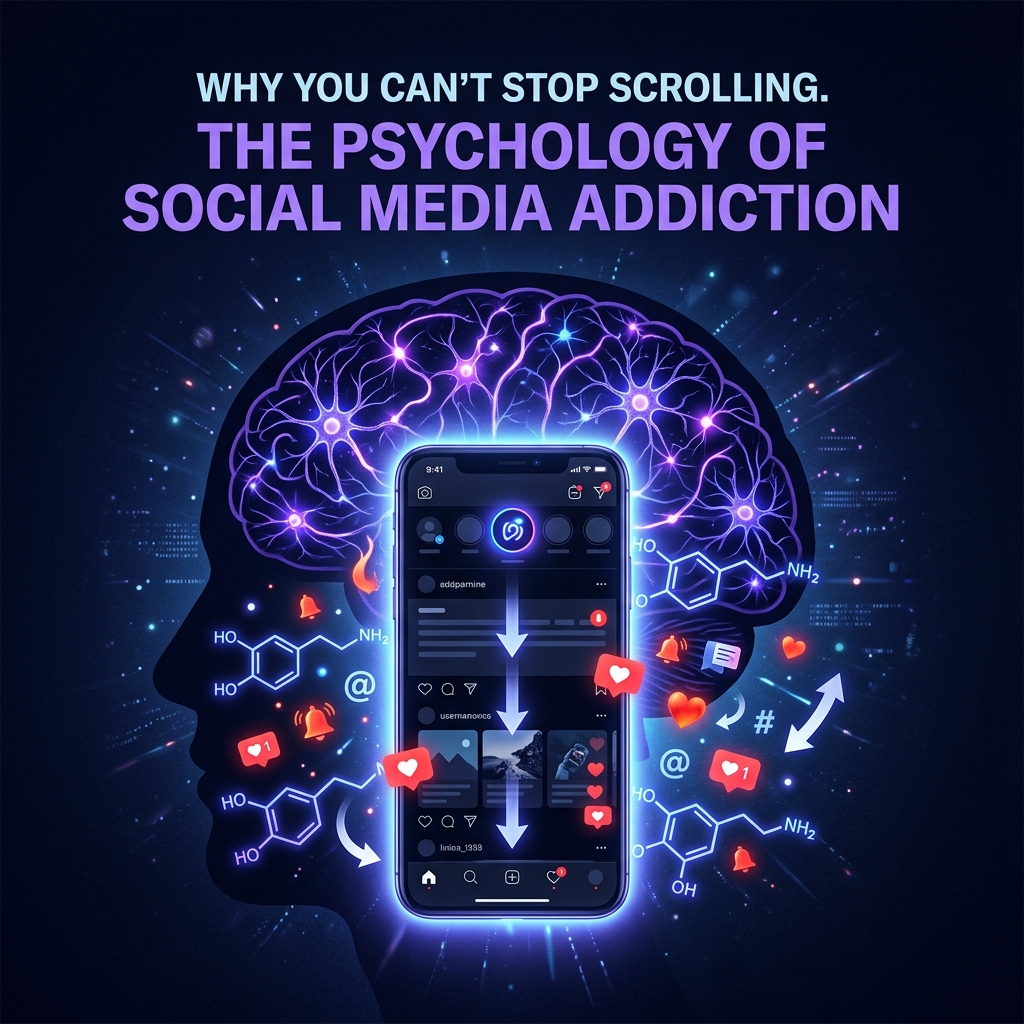
Part 1: The Dopamine Machine — How Your Brain Gets Hijacked
Understanding Dopamine (And Why Social Media Exploits It)
Dopamine is not the “pleasure chemical” — that is a popular but misleading oversimplification. Dopamine is the “wanting” chemical. It is the neurotransmitter of anticipation, not satisfaction. Dopamine spikes when you expect a reward, not when you receive it. And this distinction is what makes social media so devastatingly addictive.
Here is how it works in your brain:
- You post a photo on Instagram
- Your brain anticipates the reward (likes, comments, validation)
- Dopamine surges — creating a craving to check how the post is performing
- You check. You see 47 likes. You feel a brief hit of satisfaction
- The satisfaction fades within seconds. But the dopamine system remembers: “Checking = reward.”
- Minutes later, the craving to check again builds. You comply
- The cycle repeats. Indefinitely.
This is not metaphorical — this is the exact same neurochemical loop that operates in gambling, drug addiction, and compulsive eating. The American Society of Addiction Medicine now includes behavioral addictions (including problematic social media use) in its definition of addiction, citing the same dopaminergic reward pathways.
Variable Ratio Reinforcement: The Slot Machine in Your Pocket
The single most powerful mechanism social media uses is Variable Ratio Reinforcement — a concept from B.F. Skinner’s operant conditioning research that has been understood since the 1950s.
Variable ratio reinforcement means that rewards are delivered at unpredictable intervals. Sometimes you check your phone and have 15 notifications. Sometimes you check and have zero. Sometimes your post gets 200 likes. Sometimes it gets 12. This unpredictability is the key — not knowing when the reward will come makes you check compulsively.
This is the exact same mechanism that makes slot machines the most addictive form of gambling:
- Slot machine: Pull lever → Unknown outcome → Sometimes win → Pull again
- Social media: Pull to refresh → Unknown notifications → Sometimes rewarding → Refresh again
Skinner’s research showed that variable ratio schedules produce the highest response rates and the greatest resistance to extinction — meaning the behavior is hardest to stop. This is not a coincidence. Social media engineers studied this research and implemented it intentionally.

The Intermittent Reinforcement of Likes
Consider the “like” button — arguably the most psychologically engineered feature in the history of technology. Justin Rosenstein, who helped create Facebook’s like button, later compared it to “bright dings of pseudo-pleasure” and took steps to limit his own social media use.
The like system exploits several psychological mechanisms simultaneously:
- Social validation: Each like is a micro-dose of social approval — “People like what I shared. I am accepted”
- Quantified self-worth: Likes convert social acceptance into a NUMBER, making it measurable, comparable, and gamifiable
- Variable reward: You never know how many likes a post will get, creating anticipatory dopamine
- Social comparison: You can see how many likes others get, triggering upward and downward comparison
- Loss aversion: Once you have experienced getting 200 likes, getting 50 on the next post feels like a LOSS — not just fewer likes, but a personal rejection
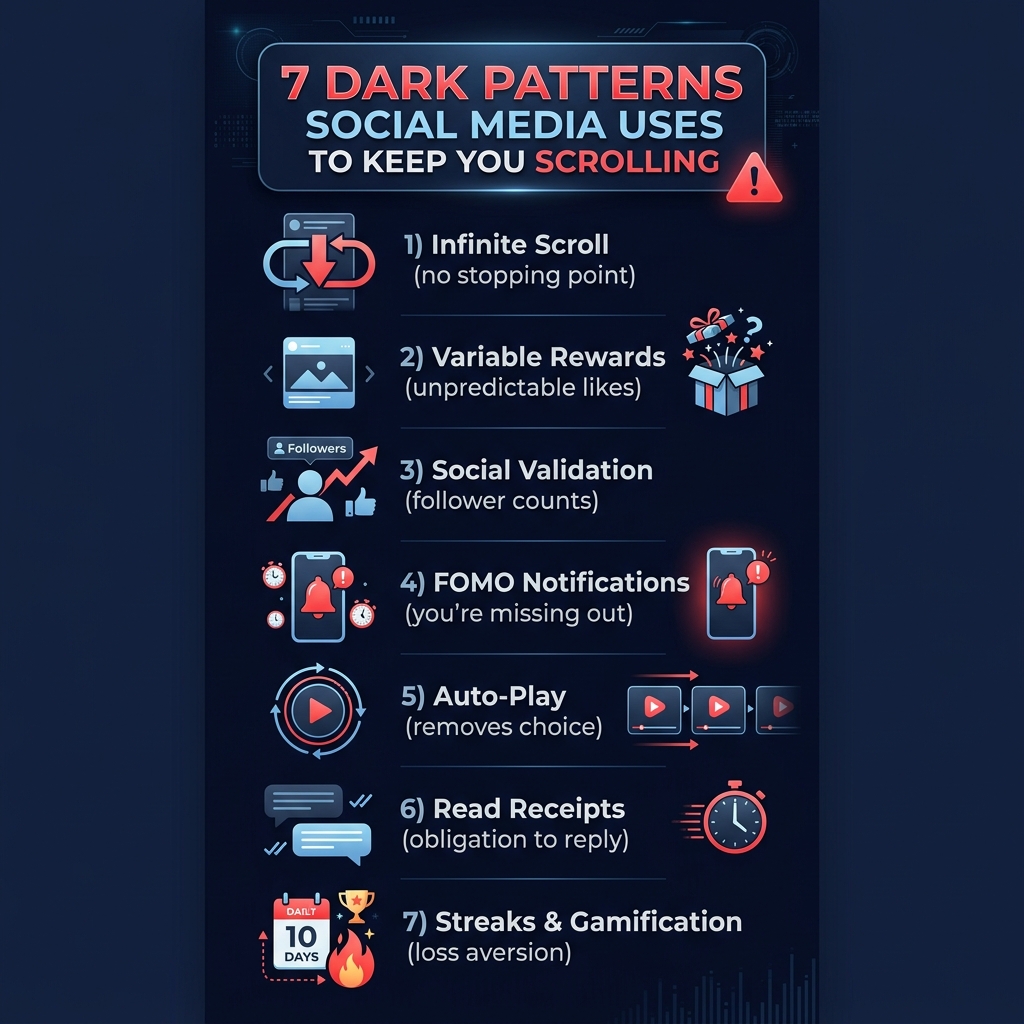
Part 2: The 7 Dark Patterns — How Apps Keep You Scrolling
Beyond the dopamine system, social media platforms employ specific UX design patterns — often called “dark patterns” — that exploit psychological vulnerabilities. As a UX Psychologist, I study these patterns professionally, and I can tell you they are extraordinarily effective:
1. Infinite Scroll — Removing the “Stop Signal”
In the pre-social-media era, content had natural stopping points. A newspaper had a last page. A TV show had an end credits screen. A magazine ran out of articles. These stopping points served as psychological exit ramps — moments where your brain could disengage.
Infinite scroll eliminates all exit ramps. There is no bottom of the page, no “last post,” no natural ending. The content regenerates faster than you can consume it, creating a bottomless bowl effect.
This is directly inspired by Brian Wansink’s famous “bottomless soup bowl” experiment at Cornell: participants who ate from self-refilling soup bowls consumed 73% more soup than those with normal bowls — and did not feel any more full. Without a visual cue that the bowl was emptying (the stopping signal), they simply kept eating. Infinite scroll is a bottomless soup bowl for your attention.
2. Auto-Play — Removing the Decision to Continue
When a YouTube video ends and the next one starts automatically, the platform has removed your decision point. In behavioral psychology, the most effective way to maintain a behavior is to remove the friction of continuing. Auto-play transforms watching from an active choice (“Should I watch another?”) to a passive default (“I would have to actively choose to stop”).
This exploits Status Quo Bias — our strong preference for maintaining the current state of affairs. Continuing to watch is the default; stopping requires effort. And because humans are cognitive misers (we prefer the path of least mental effort), the default wins almost every time.
3. Push Notifications — The Manufactured Trigger
Every notification is a manufactured trigger — an external prompt designed to pull you back into the app. And notifications are psychologically engineered with surgical precision:
- “Sarah liked your photo” — Social validation trigger (someone is paying attention to you)
- “You have 5 unread messages” — Incomplete task trigger (your brain cannot rest with unfinished business — this is the Zeigarnik Effect)
- “John posted for the first time in a while” — Curiosity trigger (information gap creates psychological tension)
- “Your memories from 3 years ago” — Nostalgia trigger (emotional content bypasses rational resistance)
- “You are missing out on trending topics” — FOMO trigger (fear of being left out of the group)
Each notification type targets a different psychological vulnerability. Together, they create a multi-vector assault on your attention that is almost impossible to resist without intentional intervention.
4. Social Reciprocity — The Obligation to Respond
When someone likes your post, comments on your photo, or follows your account, your brain’s Reciprocity Principle activates. Cialdini’s research shows that receiving something creates a powerful sense of obligation to give back. If someone followed you, you feel pressure to follow back. If someone commented, you feel pressure to respond.
Social media platforms weaponize this by showing you exactly who did what. “Ahmed liked your post” is not just information — it is a social obligation trigger. You now “owe” Ahmed attention. This creates a perpetual cycle of engagement driven by social debt rather than genuine desire to interact.
5. Streaks and Gamification — Loss Aversion as a Leash
Snapchat Streaks are the purest example of Loss Aversion applied to social media. A streak tracks consecutive days of messaging with a friend. Miss one day, and the streak resets to zero. Users — especially teenagers — report sending meaningless snaps (“streaks!”) just to maintain their number, not because they have anything to communicate.
The psychology is elegant and ruthless: once you have built a 200-day streak, breaking it feels like losing something valuable. Kahneman and Tversky’s research shows that losses feel 2.5x more painful than equivalent gains. The streak creates a hostage situation — the platform holds your “achievement” hostage, and the ransom is daily engagement.
6. Read Receipts — The Anxiety of Being Seen
Read receipts (“Seen at 2:34 PM”) create social obligation anxiety on both sides. The sender knows you have seen their message and feels entitled to a response. You, the reader, know they know you have seen it — creating pressure to respond immediately or face social consequences (“Why did you leave me on read?”).
This is a double bind — a psychological trap with no comfortable exit. You must either respond (engaging with the app) or endure the anxiety of not responding (which often leads you to check the app more frequently to manage the social tension).
7. The “People You May Know” Algorithm — Exploiting Curiosity
The suggestion algorithms exploit the Information Gap Theory (George Loewenstein, 1994). When you see “People You May Know” or “Accounts You Might Like,” a gap opens between what you know and what you could know. This gap creates psychological discomfort that can only be resolved by clicking — and each click leads to more gaps, more curiosity, more engagement.
Part 3: The Mental Health Impact — What the Research Actually Shows
The psychological impact of social media addiction is not theoretical — it is documented across hundreds of peer-reviewed studies:
Social Comparison and Self-Esteem
Leon Festinger’s Social Comparison Theory (1954) explains that humans evaluate themselves by comparing with others. Social media creates an environment of permanent, curated upward comparison. You are comparing your unedited daily reality with everyone else’s highlight reel — their best photos, biggest achievements, happiest moments. The result is predictable:
- A meta-analysis of 63 studies found a significant negative correlation between social media use and self-esteem
- Instagram was rated as the worst social media platform for mental health by the Royal Society for Public Health (UK)
- Users who passively consume content (scrolling without posting) experience the worst mental health outcomes
- The relationship is dose-dependent: more time = worse outcomes, with a sharp decline after 2+ hours daily
The Anxiety-Notification Loop
Research published in Computers in Human Behavior found that the mere presence of a smartphone — even turned off — reduces cognitive capacity. The brain dedicates processing power to monitoring the device, even unconsciously. This is called “brain drain” — your phone is literally draining your mental resources even when you are not using it.
Push notifications amplify this effect exponentially. Each notification creates a micro-interruption that takes an average of 23 minutes to fully recover from cognitively (according to research from the University of California, Irvine). If you receive just 10 notifications during a work day, you lose approximately 3.8 hours of productive cognitive capacity.
Sleep Disruption
Blue light from screens suppresses melatonin production, but the psychological stimulation matters more than the light. Social media content activates the brain’s alertness systems — social information is processed as high-priority by our evolved brain — making it nearly impossible to transition to sleep while scrolling. Research shows that social media use within 30 minutes of bedtime increases sleep onset latency by an average of 20-40 minutes.
Part 4: Breaking Free — 10 Evidence-Based Strategies That Actually Work
Understanding the psychology is the first step. Here is how to use that understanding to reclaim control:
Strategy 1: The Notification Audit (Do It Right Now)
Go into your phone settings and turn off ALL notifications except phone calls and messages from people you actually want to hear from. Every notification is a manufactured trigger — removing the trigger eliminates the conditioned response. In behavioral psychology terms, this is Stimulus Control — removing environmental cues that trigger unwanted behavior.
This single action will reclaim more attention than any other intervention. Do it now, before you continue reading.
Strategy 2: Create Friction (The 3-Second Rule)
Move social media apps off your home screen and into a folder on your second or third page. This adds approximately 3 seconds of friction between impulse and action. Research shows that even tiny amounts of friction dramatically reduce impulsive behavior. The apps are still accessible — but the automatic, mindless opening is disrupted.
Strategy 3: Grayscale Your Phone
Those vibrant red notification badges? Those colorful app icons? They are designed to attract your attention using color psychology (as I discussed in my article on color psychology in branding). Switch your phone to grayscale mode and watch the magnetic pull weaken significantly. Without color, your phone becomes a tool, not a slot machine.
Strategy 4: Schedule Your Social Media Time
Instead of checking social media whenever the urge strikes (reactive use), designate specific time blocks (proactive use). For example: “I use Instagram from 12:00 to 12:20 and from 7:00 to 7:20.” This transforms social media from an interrupt-driven activity to a scheduled activity, putting you in control of when you engage.
Strategy 5: Replace the Habit Loop
Charles Duhigg’s habit research shows that you cannot eliminate a habit — you can only replace it. The habit loop is: Cue → Routine → Reward. Social media scrolling is often triggered by boredom or anxiety (cue), involves scrolling (routine), and provides dopamine/distraction (reward). Replace the routine while keeping the same cue and reward: when bored, read a Kindle book, listen to a podcast, or do a 2-minute breathing exercise instead of scrolling.
Strategy 6: Use Time Tracking Data as a Mirror
iPhone’s Screen Time and Android’s Digital Wellbeing show you exactly how much time you spend on each app. Most people are shocked when they see the actual numbers. Use this data as a weekly accountability tool — set a time limit for social media apps and review your actual usage each Sunday.
Strategy 7: The Phone-Free First Hour
Do not check your phone for the first hour after waking up. This protects your brain’s most creative, focused state (the prefrontal cortex is most active in the morning) from being hijacked by reactive social media consumption. Morning phone checking primes your brain for reactive mode (responding to others’ agendas) rather than proactive mode (pursuing your own priorities).
Strategy 8: Unfollow Ruthlessly
Apply the “Does this account make me feel better or worse?” test. If an account consistently triggers comparison, anxiety, or inadequacy — unfollow immediately, regardless of social obligation. Curate your feed like you curate your physical environment. You would not keep a poster on your wall that makes you feel bad every time you look at it.
Strategy 9: Turn Off Read Receipts
Disable read receipts on every platform that allows it. This removes the social obligation anxiety — both for you and for the people messaging you. Communication becomes asynchronous (responding when you choose) rather than synchronous (responding because they know you have seen it).
Strategy 10: The “Why Am I Opening This?” Pause
Before opening any social media app, pause for 2 seconds and ask: “Why am I opening this right now?” If the answer is a specific purpose (“I need to reply to Ali’s message” or “I want to check the event details”), proceed. If the answer is vague (“I’m bored” or “I don’t know, just checking”), put the phone down. This 2-second pause engages your prefrontal cortex, giving your rational brain a chance to override the habitual impulse.
The Bigger Picture: Designing Technology for Human Flourishing
As a UX Psychologist, I believe deeply that technology should be designed to enhance human well-being, not exploit human vulnerability. The same psychological principles that are currently weaponized against users can be redesigned to support healthier digital habits:
- Natural stopping points instead of infinite scroll
- Batch notifications (delivered 3x daily) instead of real-time interruptions
- Time-spent awareness integrated into the app experience
- Content quality signals that prioritize depth over engagement
- Default settings that protect attention rather than exploit it
The movement for ethical technology design — led by organizations like the Center for Humane Technology (founded by former Google design ethicist Tristan Harris) — is growing. As consumers, we can support this movement by choosing platforms that respect our attention and by demanding better design from the platforms we use.
The Bottom Line: Your Attention Is the Most Valuable Thing You Own
In the attention economy, your focus is the product being sold. Every minute you spend scrolling is a minute of attention that social media platforms sell to advertisers. Understanding this transaction — and the psychological machinery that drives it — is the first step toward making intentional choices about how you spend the most limited resource you have: your time and attention.
Social media addiction is not a moral failure. It is a designed outcome. The smartest psychologists, neuroscientists, and engineers in the world designed these systems to be maximally engaging. You were never meant to resist them through willpower alone — you need understanding, strategies, and intentional design of your own digital environment.
The 10 strategies in this article are not about quitting social media — they are about shifting from being controlled by it to controlling it. Use these tools intentionally and you will reclaim hours of your day, points of your self-esteem, and depths of your focus that you did not even know you had lost.
Your brain is not broken. It is being exploited. And now that you understand how, you have the power to take it back.
Want to understand more about how psychology drives digital behavior? Explore my in-depth articles on UX Psychology, or read my Brand Psychology Audits to see how companies use behavioral science in their branding. If your business needs a website designed to engage users ethically and effectively, let us talk.
Muhammad Shahzeb is an Industrial & Organizational Psychologist (MSc) and Professional Web Developer who studies the intersection of technology, behavior, and design. His work focuses on applying behavioral psychology to improve user experience, brand trust, and digital well-being. Read more at ShahzebSpeaks.com | UX Psychology | Brand Psychology Audits | Psychology Counseling