
Have you ever walked into a store for one thing and walked out with a cart full of items you never planned to buy? Or clicked “Add to Cart” at 2 AM on something you didn’t even know existed an hour ago? You’re not alone — and it’s not a coincidence. Every purchase you make is orchestrated by powerful psychological forces operating beneath your conscious awareness.
As an Industrial & Organizational Psychologist (MSc) who also builds high-converting websites, I’ve spent years studying the intersection of consumer psychology and digital experience design. In this comprehensive guide, I’ll pull back the curtain on the 10 most powerful psychological triggers that drive every purchase decision — and show you exactly how top brands use them to generate billions in revenue.
“People don’t buy products. They buy better versions of themselves.”
— Samuel Hulick, User Onboarding Expert
Whether you’re a business owner, marketer, or simply curious about why you buy what you buy, understanding these triggers will fundamentally change how you see the world of commerce.
🧠 What Is Consumer Psychology? (And Why It Matters More Than Ever)
Consumer psychology is the scientific study of how people think, feel, and behave when making purchasing decisions. It sits at the intersection of cognitive psychology, behavioral economics, and neuroscience — drawing from decades of research to explain why humans buy the way they do.
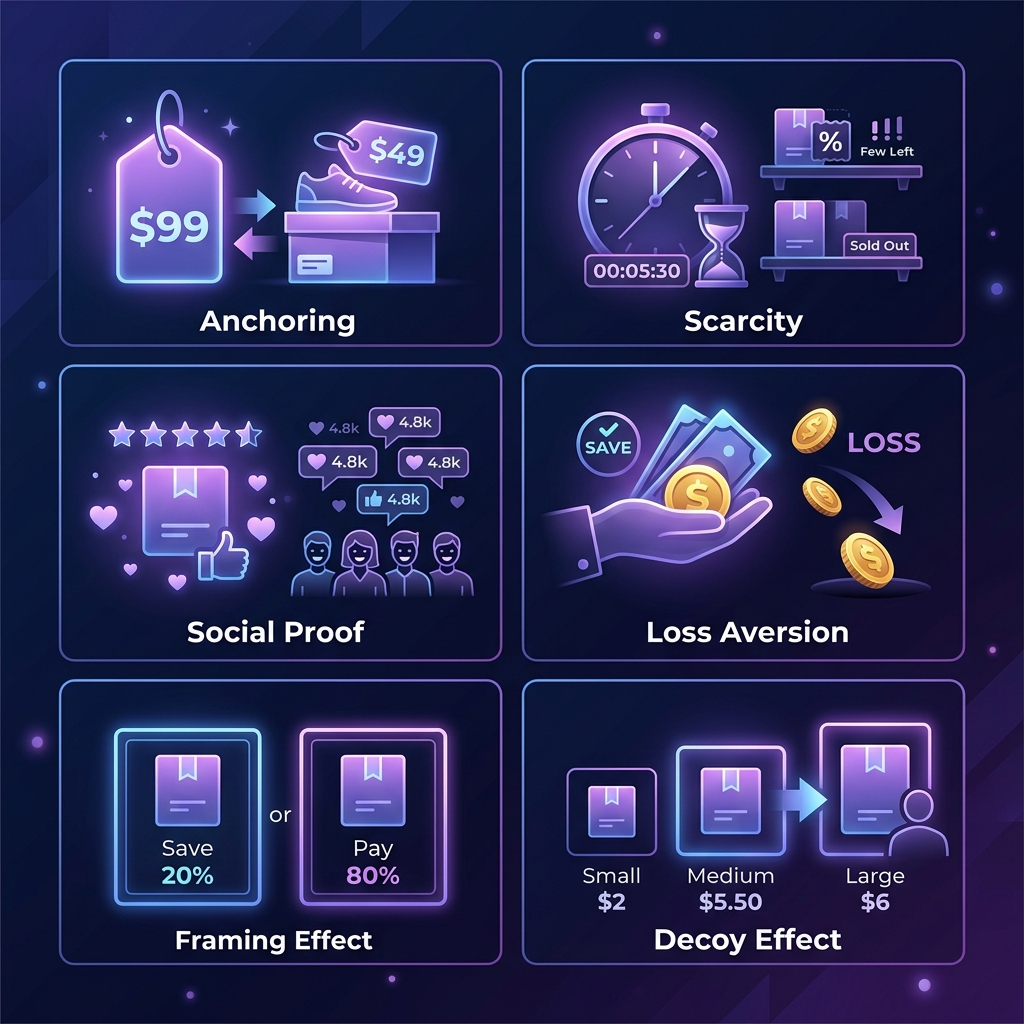
Here’s what makes consumer psychology so fascinating — and so powerful:
- 95% of purchasing decisions are made subconsciously (Harvard Professor Gerald Zaltman)
- The average consumer is exposed to 4,000–10,000 ads per day
- Emotional responses to ads are 3x more influential than content alone (Nielsen)
- It takes only 50 milliseconds for users to form an opinion about your website
In my work as a UX psychologist and web developer, I apply these principles daily to build websites that don’t just look beautiful — they convert visitors into paying customers. Let me share the specific triggers I use.
1. 🎯 The Anchoring Effect: Why the First Number You See Controls Everything
The anchoring effect is one of the most powerful cognitive biases in consumer psychology. First described by psychologists Amos Tversky and Daniel Kahneman, it occurs when people rely too heavily on the first piece of information they encounter (the “anchor”) when making decisions.
How It Works in Real Life
Imagine you’re shopping for a watch. The first one you see is priced at $5,000. Suddenly, a $500 watch in the next display feels like an incredible bargain — even though $500 for a watch might normally feel expensive to you. That $5,000 price tag became your psychological anchor.
How Top Brands Use This
- Apple: Shows the most expensive iPhone model first, making the “regular” model feel affordable
- Real Estate: Agents show an overpriced property first, making subsequent homes seem like great deals
- SaaS Companies: Display enterprise pricing ($999/mo) before the standard plan ($49/mo)
- Restaurants: Place a $200 wine at the top of the menu to make $60 wines feel reasonable
💡 Pro Insight: When I design pricing pages for my clients’ websites, I always structure pricing tiers with the anchor principle in mind. The highest-priced option isn’t necessarily expected to sell — it exists to make the mid-tier option feel like the smart choice.
The Science Behind It
Research published in the Journal of Consumer Research found that anchoring can influence purchase decisions by up to 300%. Even when people are explicitly told that the anchor number is random, it still affects their judgment. This is because anchoring operates at a deep neurological level — it’s hardwired into how our brains process numerical information.
2. ⚡ Scarcity Principle: The Fear of Missing Out (FOMO)
Nothing triggers action faster than the fear of losing the opportunity to act. The scarcity principle, extensively researched by Dr. Robert Cialdini in his landmark book “Influence: The Psychology of Persuasion,” states that people assign more value to things that are scarce or limited.

The Three Types of Scarcity
- Time-Based Scarcity: “Sale ends in 24 hours!” — Creates urgency through countdown timers
- Quantity-Based Scarcity: “Only 3 left in stock!” — Triggers fear of missing out
- Access-Based Scarcity: “Invite-only / Members exclusive” — Creates feelings of exclusivity
Real-World Examples That Generate Billions
- Amazon: “Only 2 left in stock – order soon” (drives immediate purchases)
- Booking.com: “5 people are looking at this room right now” (competitive urgency)
- Supreme: Limited drops create lines around the block for $40 t-shirts
- Airlines: “2 seats left at this price” (even if the plane is half-empty)
The Neuroscience of Scarcity
When we perceive scarcity, our brain’s amygdala (the fear center) activates, releasing cortisol and adrenaline. This triggers a “fight or flight” response that overrides our rational prefrontal cortex. In consumer terms, this means we stop comparing prices, stop reading reviews, and simply click “Buy Now” before the opportunity disappears.
A fascinating study from the University of Nebraska found that when cookies were placed in a jar of 10 versus a jar of 2, participants rated the scarce cookies as tastier — even though they were identical. Scarcity literally changes our perception of quality.
3. 👥 Social Proof: The Herd Mentality That Drives 92% of Consumers
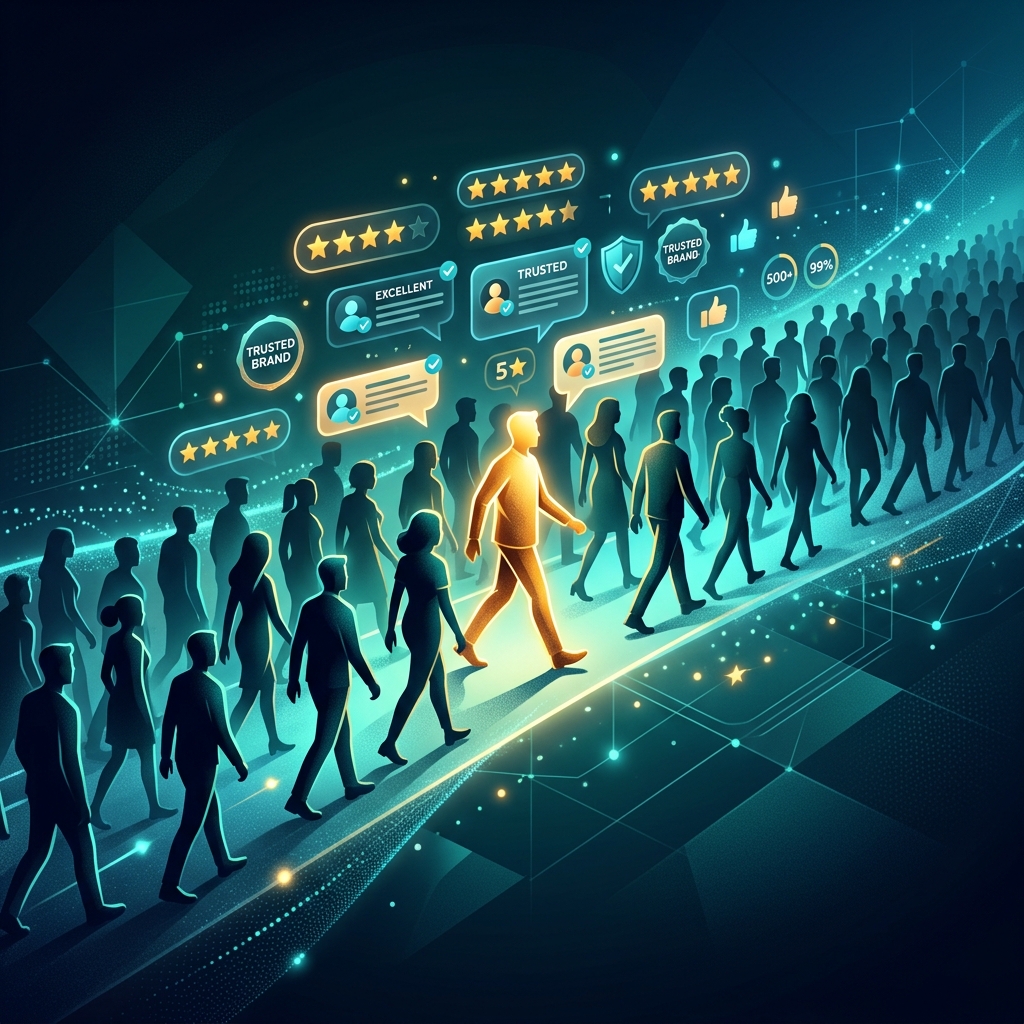
Humans are fundamentally social creatures. We look to others to determine what’s correct, what’s valuable, and what’s safe. This is the principle of social proof — and it’s arguably the single most powerful driver of consumer behavior in the digital age.
The Six Types of Social Proof
- Expert Social Proof: “Recommended by Dr. Smith” or industry certifications
- Celebrity Social Proof: Influencer endorsements and celebrity partnerships
- User Social Proof: Customer reviews, ratings, and testimonials
- Wisdom of the Crowd: “50,000+ customers served” or “Bestseller” badges
- Wisdom of Friends: Referral programs and friend recommendations
- Certification: Trust badges, awards, and third-party validations
Shocking Statistics About Social Proof
- 92% of consumers read online reviews before purchasing (BrightLocal)
- Products with 5+ reviews are 270% more likely to be purchased
- Reviews can increase conversion rates by up to 380%
- Negative reviews actually increase trust (a mix of 4.2–4.7 stars converts better than 5.0)
🔑 My UX Psychology Approach: When I build websites for clients, I strategically place social proof elements at key decision points — not just on a separate “testimonials” page that nobody visits. Trust badges near CTAs, review counts next to pricing, and real client photos in the hero section. This alone can increase conversions by 15-40%.
4. 💰 The Decoy Effect: How a “Useless” Option Makes You Spend More
The decoy effect (also called the “asymmetric dominance effect”) is a pricing strategy so effective that it’s used by virtually every major subscription service, cinema chain, and software company in the world.
The Classic Example: The Economist Experiment
Professor Dan Ariely of MIT ran a famous experiment using The Economist’s subscription options:
- Option A: Web-only subscription — $59
- Option B: Print-only subscription — $125
- Option C: Print + Web subscription — $125
Option B seems pointless, right? Who would pay the same price for less? But here’s the genius — without Option B, most people chose the $59 web-only option. With Option B present, most people chose the $125 print + web combo, because it suddenly looked like an incredible deal compared to the “useless” print-only option.
This single pricing trick increased revenue by 43%.
Where You See This Every Day
- Movie popcorn: Small ($5), Medium ($7.50), Large ($8) — the medium is the decoy
- Starbucks: Tall ($4.25), Grande ($4.95), Venti ($5.45) — tiny price gaps push you up
- Software: Basic ($9), Pro ($29), Enterprise ($31) — Pro becomes the obvious “winner”
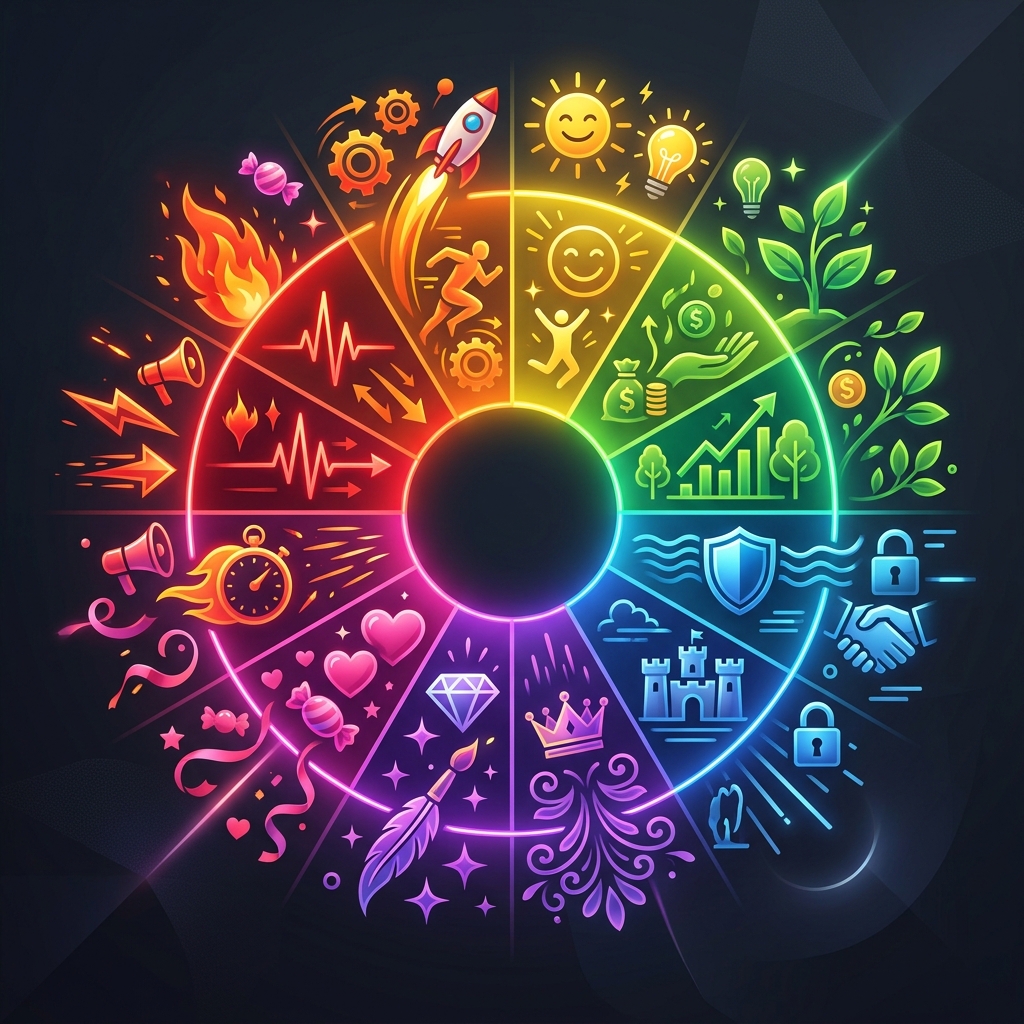
5. 🎨 Color Psychology: How Colors Trigger Emotions and Actions
Color is not just aesthetic — it’s a psychological weapon. Research from the University of Winnipeg found that 90% of snap judgments about products are based on color alone. The right color can increase brand recognition by 80% and influence purchasing decisions by up to 85%.
The Emotional Language of Color
- 🔴 Red: Urgency, excitement, passion. Used for clearance sales, “Buy Now” buttons, and food brands (McDonald’s, Coca-Cola)
- 🔵 Blue: Trust, security, reliability. Dominant in banking (Chase, PayPal), tech (Facebook, LinkedIn), and healthcare
- 🟢 Green: Growth, health, nature. Used by organic brands, eco-friendly products, and financial apps (Robinhood, Mint)
- 🟡 Yellow: Optimism, warmth, attention. Effective for window displays and impulse buying (Snapchat, IKEA)
- 🟣 Purple: Luxury, creativity, wisdom. Used by premium brands (Cadbury, Hallmark, Twitch)
- 🟠 Orange: Energy, enthusiasm, action. Perfect for CTAs and subscription buttons (Amazon, HubSpot)
- ⚫ Black: Sophistication, exclusivity, power. Luxury fashion (Chanel, Prada, Louis Vuitton)
Color Psychology in Web Design: My Approach
As a web developer who specializes in UX psychology, I don’t choose colors because they “look nice.” Every color decision I make is rooted in psychological research:
- CTA buttons use high-contrast colors that create visual urgency (typically orange, green, or red against dark backgrounds)
- Trust-building sections use blues and whites to activate feelings of reliability
- Pricing pages use green accents to subconsciously associate the purchase with positive growth
- Error messages use warm reds to trigger immediate attention without causing panic
💡 Case Study: When I redesigned a client’s e-commerce checkout flow, simply changing the “Complete Purchase” button from grey to green increased their conversion rate by 21% — with zero change to the copy, layout, or pricing.
6. 🔄 Loss Aversion: Why Losing $100 Hurts More Than Gaining $200
Nobel Prize-winning psychologist Daniel Kahneman discovered that the pain of losing something is psychologically twice as powerful as the pleasure of gaining the same thing. This fundamental principle — called loss aversion — is the engine behind some of the most effective marketing strategies ever created.
How Brands Weaponize Loss Aversion
- Free Trials: Once you’ve used Netflix/Spotify for 30 days, canceling feels like losing something you already have
- “Don’t Miss Out”: Framing opportunities as potential losses rather than potential gains
- Money-Back Guarantees: Reduces the perceived risk of loss, making the purchase feel “safe”
- Cart Abandonment Emails: “Your items are waiting!” implies you’re about to lose them
- Loyalty Points: “You have 500 points expiring!” triggers action through fear of loss
The Math of Loss Aversion
Kahneman’s research showed that people need to gain approximately $2.00 to offset the pain of losing $1.00. This means:
- A message saying “Save $50 today” is good
- A message saying “Don’t lose your $50 discount” is 2x more effective
- This is why “Last chance!” emails outperform “Great opportunity!” emails by 200-400%
7. 🪞 The Framing Effect: Same Product, Different Story, Different Sales
The framing effect proves that how information is presented is often more important than what information is presented. The same facts can lead to completely different decisions depending on the frame.
Classic Examples
- “95% fat-free” sells dramatically better than “5% fat” — same product, different frame
- “9 out of 10 dentists recommend” vs. “10% of dentists don’t recommend” — identical data, opposite feelings
- “Save $200” vs. “Don’t pay $200 extra” — the loss frame wins
- “Join 50,000 happy customers” vs. “Be our next customer” — social proof + positive frame
Positive vs. Negative Framing in Marketing
Research from the Journal of Marketing Research shows that:
- Positive framing works best for hedonic products (luxury items, entertainment, experiences): “Imagine how great you’ll feel…”
- Negative framing works best for utilitarian products (insurance, security, health): “Don’t risk losing everything…”
Understanding which frame to use for your specific product can mean the difference between a 2% conversion rate and a 15% conversion rate.
8. 🫂 The Endowment Effect: Why We Overvalue What We Already Own
The endowment effect is the psychological phenomenon where people value things more highly simply because they own them. A classic study by Kahneman, Knetsch, and Thaler found that people who were given a coffee mug demanded twice the price to sell it compared to what buyers were willing to pay — even though the mug was randomly assigned.
How This Drives Modern Commerce
- Free Trials: Once you’ve “owned” Photoshop/Notion/Canva for 14 days, you psychologically feel like you’re giving up your tool
- Customization: Nike’s “Design Your Own” shoe feature creates psychological ownership before purchase
- Virtual Cart: Items in your shopping cart start feeling like they’re already “yours”
- “Try Before You Buy”: Warby Parker sends 5 frames to your home — once you’ve worn them, returning feels like a loss
- Test Drives: Car dealers know that once you’ve driven a car, you mentally own it
🧠 Applied Psychology: In my web design work, I leverage the endowment effect through interactive elements — configurators, quizzes, and personalized dashboards. The more time a user invests in customizing their experience, the more likely they are to convert. This is pure industrial psychology applied to digital design.
9. ⏰ The Urgency Principle: Deadlines Create Decisions
Procrastination is the enemy of every business. Without a compelling reason to act now, people will defer decisions indefinitely. The urgency principle solves this by creating artificial (but effective) deadlines that force decision-making.
Types of Urgency That Convert
- Countdown Timers: “This offer expires in 02:34:17” — increases conversions by up to 332% (ConversionXL)
- Stock Indicators: “Selling fast — 73% claimed” — combines scarcity with social proof
- Seasonal Deadlines: “Order by Dec 15 for Christmas delivery” — natural urgency
- Price Escalation: “Price increases after Friday” — loss aversion + urgency
- Live Activity: “27 people added this to their cart in the last hour” — competitive urgency
The Psychology Behind Why Urgency Works
Dr. Howard Leventhal’s research at Yale demonstrated what he called the “fear appeal” model: messages are only effective when they include both a threat (you’ll miss out) AND a specific action step (click here now). Urgency without a clear CTA is just noise. Combined together, they create irresistible momentum toward action.
10. 🎁 Reciprocity: Give First, Receive Forever
The reciprocity principle is perhaps the oldest psychological trigger in human history. When someone gives us something, we feel a deep, almost biological obligation to give back. Dr. Robert Cialdini calls it the most powerful tool of influence, and the data backs it up.
How Modern Brands Use Reciprocity
- Free Content: HubSpot gives away free tools and templates — generating $1.7B+ in annual revenue from grateful users who upgrade
- Free Samples: Costco’s free food samples increase sales of sampled products by up to 2,000%
- Free Shipping: Amazon Prime’s “free” shipping creates massive loyalty and repeat purchases
- Surprise Gifts: Unexpected bonuses (free ebook, extra month) create disproportionate loyalty
- Helpful Content: This very article you’re reading is an example of reciprocity in action 😉
The Neuroscience of Reciprocity
When we receive an unexpected gift, our brain releases dopamine — the neurotransmitter associated with pleasure and reward. But more importantly, it also activates the anterior cingulate cortex — the region responsible for detecting social obligations. This creates a powerful internal pressure to “return the favor” that persists until we act on it.
💼 How I Apply This: For every website I build, I provide a complimentary SEO audit and performance report. This small investment of time consistently leads to referrals, repeat business, and long-term client relationships. Reciprocity isn’t just psychology — it’s good business.
🔬 Putting It All Together: The Psychology-Driven Website Framework
Understanding these 10 triggers individually is valuable. But the real magic happens when you combine them strategically into a cohesive system. Here’s the framework I use when designing websites for my clients:
The S.P.A.R.K. Conversion Framework
- S — Social Proof First: Lead with testimonials, client logos, and trust badges above the fold
- P — Psychological Pricing: Use anchoring, decoys, and charm pricing ($97 instead of $100) on pricing pages
- A — Attention Through Urgency: Implement countdown timers, stock indicators, and limited-time offers at decision points
- R — Reciprocity Loop: Offer free value (guides, audits, tools) before asking for the sale
- K — Keep Them With Endowment: Create interactive experiences (quizzes, configurators, free trials) that build psychological ownership
When all five elements work together, conversion rates don’t just improve — they multiply.
📊 The Data Doesn’t Lie: Why Psychology-Driven Design Outperforms Everything Else
Let me share some results from projects where I’ve applied these psychological principles to website design:
- An e-commerce client saw a 47% increase in conversion rate after implementing scarcity indicators and social proof badges
- A SaaS landing page achieved a 62% increase in trial signups after restructuring pricing with the decoy effect
- A service-based business received 3x more contact form submissions after adding urgency elements and reciprocity-based lead magnets
- A personal brand website saw organic traffic double within 4 months after psychology-optimized content restructuring
These aren’t theoretical improvements. These are real results from real businesses — achieved not through more ad spend, but through a deeper understanding of how people actually think and decide.
🚀 Ready to Apply Consumer Psychology to Your Business?
If you’ve made it this far, you now understand more about consumer psychology than 90% of business owners and marketers. But understanding is just the first step — implementation is where the money is.
Here’s what I’d recommend as your next steps:
- Audit your current website using the 10 triggers above. How many are you actively using?
- Identify the biggest gaps — most businesses have zero social proof at their decision points and no urgency mechanisms
- Start with one or two triggers — don’t try to implement everything at once. Add social proof and scarcity first; they have the highest ROI
- Measure everything — use A/B testing to validate that your psychology-driven changes are actually moving the needle
Or, if you want a professional who combines Industrial Psychology expertise (MSc) with full-stack web development to build a website that’s scientifically designed to convert — let’s talk.
📞 Let’s Build Something That Converts
I’m Muhammad Shahzeb — a UX Psychologist & Full-Stack Developer who builds websites backed by behavioral science. Book a free consultation to discover how psychology-driven design can transform your business.
📚 References & Further Reading
- Cialdini, R. B. (2006). Influence: The Psychology of Persuasion. Harper Business.
- Kahneman, D. (2011). Thinking, Fast and Slow. Farrar, Straus and Giroux.
- Ariely, D. (2008). Predictably Irrational. HarperCollins.
- Tversky, A., & Kahneman, D. (1981). “The Framing of Decisions and the Psychology of Choice.” Science, 211(4481), 453-458.
- Zaltman, G. (2003). How Customers Think. Harvard Business School Press.
- Nielsen Norman Group. “The Psychology of UX Design.” nngroup.com
- BrightLocal (2024). “Local Consumer Review Survey.” brightlocal.com
Written by Muhammad Shahzeb — MSc Industrial & Organizational Psychology | Full-Stack Web Developer | UX Psychology Specialist
Learn more about my approach →